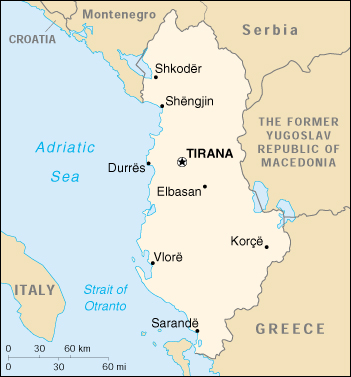
Albania declared its independence from the Ottoman Empire in 1912, but was conquered by Italy in 1939. Communist partisans took over the country in 1944. Albania allied itself first with the USSR (until 1960), and then with China (to 1978). In the early 1990s, Albania ended 46 years of xenophobic Communist rule and established a multiparty democracy. The transition has proven challenging as successive governments have tried to deal with high unemployment, widespread corruption, a dilapidated physical infrastructure, powerful organized crime networks, and combative political opponents. Albania has made progress in its democratic development since first holding multiparty elections in 1991, but deficiencies remain. International observers judged elections to be largely free and fair since the restoration of political stability following the collapse of pyramid schemes in 1997; however, there have been claims of electoral fraud in every one of Albania’s post-communist elections. The 2009 general elections resulted in no single party gaining a majority of the 140 seats in Parliament, and the Movement for Socialist Integration (LSI) and the Democratic Party (DP) combined to form a coalition government, the first such in Albania’s history. The Socialist Party (SP) has, in effect, boycotted Parliament since it convened in September 2009 and has called for investigations into alleged electoral fraud in the June 2009 elections. Albania joined NATO in April 2009 and is a potential candidate for EU accession. Although Albania’s economy continues to grow, the country is still one of the poorest in Europe, hampered by a large informal economy and an inadequate energy and transportation infrastructure.
Geography of Albania
Location: Southeastern Europe, bordering the Adriatic Sea and Ionian Sea, between Greece and the Federal Republic of Yugoslavia.
Capital: Tirana
Geographic coordinates: 41 00 N, 20 00 E
Area:
total: 28,748 sq. km
land: 27,398 sq. km
water: 1,350 sq. km
Coastline: 362 km
Maritime claims:
continental shelf: 200-m depth or to the depth of exploitation
territorial sea: 12 NM
Climate: mild temperate; cool, cloudy, wet winters; hot, clear, dry summers; interior is cooler and wetter
Terrain: mostly mountains and hills; small plains along coast
Elevation extremes:
lowest point: Adriatic Sea 0 m
highest point: Maja e Korabit (Golem Korab) 2,753 m
Natural resources: petroleum, natural gas, coal, chromium, copper, timber, nickel, hydropower
Natural hazards: destructive earthquakes; tsunamis occur along southwestern coast; drought
Geography – note: strategic location along Strait of Otranto (links Adriatic Sea to Ionian Sea and Mediterranean Sea)
National Boundaries
Albania, with a total area of 28,750 square kilometers, is slightly larger than the state of Maryland. It shares a 287- kilometer border with the Yugoslav republics of Montenegro and Serbia to the north, a 151-kilometer border with the Former Yugoslav Republic of Macedonia to the north and east, and a 282- kilometer border with Greece to the south and southeast. Its coastline is 362 kilometers long. The lowlands of the west face the Adriatic Sea and the strategically important Strait of Otranto, which puts less than 100 kilometers of water between Albania and the heel of the Italian “boot.”
The distinct ethnic character of the Albanian people and their isolation within a generally definable area underscored their demands for independence in the early twentieth century. In some places, however, the mingling of different ethnic groups complicated the determination of national borders. Kosovo, across the northeastern Albanian border, was a Serbian-governed province, although ethnic Albanians made up over 90 percent of its population. Many Albanians still regarded Kosovo’s status as an issue. Greeks and Albanians lived in the mountains on both sides of the southeastern Albanian boundary. Neither Greece nor Albania was satisfied with the division of nations effected by their common border.
With the exception of the coastline, all Albanian borders are artificial. They were established in principle at the 1912-13 conference of ambassadors in London. The country was occupied by Italian, Serbian, Greek, and French forces during World War I, but the 1913 boundaries were essentially reaffirmed by the victorious states in 1921. The original principle was to define the borders in accordance with the best interests of the Albanian people and the nationalities in adjacent areas. The northern and eastern borders were intended, insofar as possible, to separate the Albanians from the Serbs and Montenegrins; the southeast border was to separate Albanians and Greeks; the valuable western Macedonia lake district was to be divided among the three states- -Albania, Greece, and Yugoslavia–whose populations shared the area. When there was no compromise involving other factors, borderlines were chosen to make the best possible separation of national groups, connecting the best marked physical features available.
Allowance was made for local economic situations, for example, to prevent separation of a village from its animals’ grazing areas or the markets for its produce. Political pressures also were a factor in the negotiations, but the outcome was subject to approval by powers having relatively abstract interests, most of which involved the balance of power rather than specific economic ambitions.
Division of the lake district among three states required that each of them have a share of the lowlands in the vicinity. Such an artificial distribution, once made, necessarily affected the borderlines to the north and south. The border that runs generally north from the lakes, although it follows the ridges of the eastern highlands, stays sixteen to thirty-two kilometers west of the watershed divide. Because negotiators at the London conference declined to use the watershed divide as the northeast boundary of the new state of Albania, a large Albanian population in Kosovo was incorporated into Serbia.
In Albania’s far north and the northeast mountainous sections, the border connects high points and follows mountain ridges through the largely inaccessible North Albanian Alps, known locally as Bjeshkët e Namuna. For the most part, there is no natural boundary from the highlands to the Adriatic, although Lake Scutari and a portion of the Bunë River south of it were used to mark Albania’s northwest border. From the lake district south and southwest to the Ionian Sea, the country’s southeast border goes against the grain of the land, crossing a number of ridges instead of following them.
Topography
The 70 percent of the country that is mountainous is rugged and often inaccessible. The remainder, an alluvial plain, receives precipitation seasonally, is poorly drained, and is alternately arid or flooded. Much of the plain’s soil is of poor quality. Far from offering a relief from the difficult interior terrain, the alluvial plain is often as inhospitable as the mountains. Good soil and dependable precipitation, however, are found in intermontane river basins, in the lake district along the eastern frontier, and in a narrow band of slightly elevated land between the coastal plains and the interior mountains.
In the far north, the mountains are an extension of the Dinaric Alps and, more specifically, the Montenegrin limestone plateau. Albania’s northern mountains are more folded and rugged, however, than most of the plateau. The rivers have deep valleys with steep sides and arable valley floors. Generally unnavigable, the rivers obstruct rather than encourage movement within the alpine region. Roads are few and poor. Lacking internal communications and external contacts, a tribal society flourished in this area for centuries. Only after World War II were serious efforts made to incorporate the people of the region into Albanian national life. A low coastal belt extends from the northern boundary southward to the vicinity of Vlorë. On average, it extends less than sixteen kilometers inland, but widens to about fifty kilometers in the Elbasan area in central Albania. In its natural state, the coastal belt is characterized by low scrub vegetation, varying from barren to dense. There are large areas of marshlands and other areas of bare, eroded badlands. Where elevations rise slightly and precipitation is regular–in the foothills of the central uplands, for example–the land is highly arable. Marginal land is reclaimed wherever irrigation is possible.
Just east of the lowlands, the central uplands, called Çermenikë by Albanians, are an area of generally moderate elevations, between 305 and 915 meters, with a few points reaching above 1,520 meters. Shifting along the faultline that roughly defines the western edge of the central uplands causes frequent, and occasionally severe, earthquakes.
Although rugged terrain and points of high elevation mark the central uplands, the first major mountain range inland from the Adriatic is an area of predominantly serpentine rock (which derives its name from its dull green color and often spotted appearance), extending nearly the length of the country, from the North Albanian Alps to the Greek border south of Korçë. Within this zone, there are many areas in which sharp limestone and sandstone outcroppings predominate, although the ranges as a whole are characterized by rounded mountains.
The mountains east of the serpentine zone are the highest in Albania, exceeding 2,740 meters in the Mal Korab range. Together with the North Albanian Alps and the serpentine zone, the eastern highlands are the most rugged and inaccessible of any terrain on the Balkan Peninsula.
The three lakes of easternmost Albania, Lake Ohrid, Lake Prespa, and Prespa e Vogël, are remote and picturesque. Much of the terrain in their vicinity is not overly steep, and it supports a larger population than any other inland portion of the country. Albania’s eastern border passes through Lake Ohrid; all but a small tip of Prespa e Vogël is in Greece; and the point at which the boundaries of three states meet is in Lake Prespa. Each of the two larger lakes has a total surface areas of about 260 square kilometers, and Prespa e Vogël is about one-fifth as large. The surface elevation is about 695 meters for Lake Ohrid and 855 meters for the other two lakes.
The southern mountain ranges are more accessible than the serpentine zone, the eastern highlands, or the North Albanian Alps. The transition to the lowlands is less abrupt, and the arable valley floors are wider. Limestone, the predominant mineral, is responsible for the cliffs and clear water of the coastline southeast of Vlorë. Erosion of a blend of softer rocks has provided the sediment that has caused wider valleys to form in the southern mountain area than those characteristic of the remainder of the country. This terrain encouraged the development of larger landholding, thus influencing the social structure of southern Albania.
Drainage
Nearly all of the precipitation that falls on Albania drains into the rivers and reaches the coast without even leaving the country. In the north, only one small stream escapes Albania. In the south, an even smaller rivulet drains into Greece. Because the topographical divide is east of the Albanian border with its neighbors, a considerable amount of water from other countries drains through Albania. An extensive portion of the basin of the Drini i Bardhë River, called Beli Drim by Serbs, basin is in the Kosovo area, across Albania’s northeastern border. The three eastern lakes that Albania shares with its neighboring countries, as well as the streams that flow into them, drain into the Drini i Zi. The watershed divide in the south also dips nearly seventyfive kilometers into Greece at one point. Several tributaries of the Vjosë River rise in that area.
With the exception of the Drini i Zi, which flows northward and drains nearly the entire eastern border region before it turns westward to the sea, most of the rivers in northern and central Albania flow fairly directly westward to the sea. In the process, they cut through the ridges rather than flow around them. This apparent geological impossibility occurs because the highlands originally were lifted without much folding. The streams came into existence at that time. The compression and folding of the plateau into ridges occurred later. The folding process was rapid enough in many instances to dam the rivers temporarily. The resulting lakes existed until their downstream channels became wide enough to drain them. This sequence created the many interior basins that are typically a part of the Albanian landform. During the lifetime of the temporary lakes, enough sediment was deposited in them to form the basis for fertile soils. Folding was rarely rapid enough to force the streams into radically different channels.
The precipitous fall from higher elevations and the highly irregular seasonal flow patterns that are characteristic of nearly all streams in the country reduce the economic value of the streams. They erode the mountains and deposit the sediment that created the lowlands and continues to augment them, but the rivers flood when there is local rainfall. When the lands are parched and need irrigation, the rivers usually are dry. Their violence when they are full makes them difficult to control, and they are unnavigable. The Bunë River is an exception. It is dredged between Shkodër and the Adriatic Sea and can be negotiated by small ships. In contrast to their history of holding fast to their courses in the mountains, the rivers constantly change channels on the lower plains, making waste of much of the land they create.
The Drin River is the largest and most constant stream. Fed by melting snows from the northern and eastern mountains and by the more evenly distributed seasonal precipitation of that area, its flow does not have the extreme variations characteristic of nearly all other rivers in the country. Its normal flow varies seasonally by only about one-third. Along its length of about 282 kilometers, it drains nearly 5,957 square kilometers within Albania. As it also collects from the Adriatic portion of the Kosovo watershed and the three border lakes (Lake Prespa drains to Lake Ohrid via an underground stream), its total basin encompasses about 15,540 square kilometers.
The Seman and Vjosë are the only other rivers that are more than 160 kilometers long and have basins larger than 2,600 square kilometers. These rivers drain the southern regions and, reflecting the seasonal distribution of rainfall, are torrents in winter and nearly dry in the summer, in spite of their length. This variable nature also characterizes the many shorter streams. In the summer, most of them carry less than a tenth of their winter averages, if they are not altogether dry.
Although the sediment carried by the mountain torrents continues to be deposited, new deposits delay exploitation. Stream channels rise as silt is deposited in them and eventually become higher than the surrounding terrain. Shifting channels frustrate development in many areas. Old channels become barriers to proper drainage and create swamps or marshlands. It is difficult to build roads or railroads across the lowlands or otherwise use the land.
Irrigation has been accomplished on a small scale by Albanian peasants for many years. Large irrigation projects were not completed, however, until after World War II, including the Vjosë-Levan-Fier irrigation canal, with an irrigation capacity of 15,000 hectares, and the reservoir at Thanë reservoir, in Lushnjë District, with an irrigation capacity of 35,100 hectares. In 1986 nearly 400,000 hectares of land, or 56 percent of the total cultivated area, were under irrigation, compared with 29,000 hectares, or 10 percent of the total cultivated area, in 1938.
Climate
With its coastline facing the Adriatic and Ionian seas, its highlands backed upon the elevated Balkan landmass, and the entire country lying at a latitude subject to a variety of weather patterns during the winter and summer seasons, Albania has a high number of climatic regions for so small an area. The coastal lowlands have typically Mediterranean weather; the highlands have a Mediterranean continental climate. In both the lowlands and the interior, the weather varies markedly from north to south.
The lowlands have mild winters, averaging about 7° C. Summer temperatures average 24° C, humidity is high, and the weather tends to be oppressively uncomfortable. In the southern lowlands, temperatures average about five degrees higher throughout the year. The difference is greater than five degrees during the summer and somewhat less during the winter.
Inland temperatures are affected more by differences in elevation than by latitude or any other factor. Low winter temperatures in the mountains are caused by the continental air mass that dominates the weather in Eastern Europe and the Balkans. Northerly and northeasterly winds blow much of the time. Average summer temperatures are lower than in the coastal areas and much lower at higher elevations, but daily fluctuations are greater. Daytime maximum temperatures in the interior basins and river valleys are very high, but the nights are almost always cool.
Average precipitation is heavy, a result of the convergence of the prevailing airflow from the Mediterranean Sea and the continental air mass. Because they usually meet at the point where the terrain rises, the heaviest rain falls in the central uplands. Vertical currents initiated when the Mediterranean air is uplifted also cause frequent thunderstorms. Many of these storms are accompanied by high local winds and torrential downpours.
When the continental air mass is weak, Mediterranean winds drop their moisture farther inland. When there is a dominant continental air mass, cold air spills onto the lowland areas, which occurs most frequently in the winter. Because the season’s lower temperatures damage olive trees and citrus fruits, groves and orchards are restricted to sheltered places with southern and western exposures, even in areas with high average winter temperatures.
Lowland rainfall averages from 1,000 millimeters to more than 1,500 millimeters annually, with the higher levels in the north. Nearly 95 percent of the rain falls in the winter.
Rainfall in the upland mountain ranges is heavier. Adequate records are not available, and estimates vary widely, but annual averages are probably about 1,800 millimeters and are as high as 2,550 millimeters in some northern areas. The seasonal variation is not quite as great in the coastal area.
The higher inland mountains receive less precipitation then the intermediate uplands. Terrain differences cause wide local variations, but the seasonal distribution is the most consistent of any area.
People of Albania
Population: 2,986,952 (July 2010 est.)
Age structure:
0-14 years: 23.1% (male 440,528/female 400,816)
15-64 years: 67.1% (male 1,251,001/female 1,190,841)
65 years and over: 9.8% (male 165,557/female 190,710)
Population growth rate: 0.249%
Life expectancy at birth:
total population: 77.22 years
country comparison to the world: 59
male: 74.65 years
female: 80.11 years
Ethnic groups: Albanian 95%, Greek 3%, other 2% (Vlach, Roma (Gypsy), Serb, Macedonian, Bulgarian) (1989 est.)
note: in 1989, other estimates of the Greek population ranged from 1% (official Albanian statistics) to 12% (from a Greek organization)
Religions: Muslim 70%, Albanian Orthodox 20%, Roman Catholic 10%
note: percentages are estimates; there are no available current statistics on religious affiliation; all mosques and churches were closed in 1967 and religious observances prohibited; in November 1990, Albania began allowing private religious practice
History of Albania
ALBANIA, PROCLAIMED A “PEOPLE’S REPUBLIC” in 1946, was for more than forty years one of the most obscure and reclusive countries in the world. A totalitarian communist regime, led by party founder and first secretary Enver Hoxha from 1944 until his death in 1985, maintained strict control over every facet of the country’s internal affairs, while implementing a staunchly idiosyncratic foreign policy. After World War II, Hoxha and his proteges imposed a Stalinist economic system, and turned alternately to Yugoslavia, the Soviet Union, and China for assistance, before denouncing each of these communist countries as “bourgeois” or “revisionist” and embarking on a course of economic self-reliance. Notwithstanding some notable accomplishments in education, health care, and other areas, Hoxha’s policies of centralization, isolation, and repression stifled and demoralized the population, hindered economic development, and relegated Albania to a position of technological backwardness unparalleled in Europe.
Ramiz Alia, Hoxha’s handpicked successor, introduced a modicum of pragmatism to policy making, but his ambiguous stance toward reform did little to ameliorate a growing social and economic crisis. Like President Mikhail S. Gorbachev’s policy of perestroika in the Soviet Union, Alia’s efforts at reform were prompted, and tempered, by a commitment to preserving the system that had facilitated his accession to power. In both countries, however, the departure from traditional hard-line policies sufficed merely to unshackle the forces that would accelerate the collapse of the old system.
In December 1990, swayed by large-scale student demonstrations, strikes, and the exodus of thousands of Albanians to Italy and Greece, and fearing the prospect of a violent overthrow, Alia yielded to the popular demand for political pluralism and a multiparty system. The newly created Albanian Democratic Party (ADP), the country’s first opposition party since World War II, quickly became a major political force, capturing nearly one-third of the seats in the People’s Assembly in the spring 1991 multiparty election. And several months later, as the economy continued to deteriorate, the ADP participated in a “government of national salvation” with the communist Albanian Party of Labor (APL), subsequently renamed the Socialist Party of Albania (SPA). The fragile coalition government led by Prime Minister Ylli Bufi fell apart when the ADP decided to pull out in December. An interim government of nonparty members and specialists headed by Vilson Ahmeti struggled on until the ADP scored a decisive election victory on March 22, 1992, amidst economic free-fall and social chaos, receiving about 62 percent of the vote to the SPA’s 26 percent. Alia resigned as president shortly afterward, paving the way for the ADP to take over the government. On April 9, Sali Berisha, a cardiologist by training and a dynamic ADP leader who had figured prominently in the struggle for political pluralism, became Albania’s first democratically elected president in seventy years. The first noncommunist government, headed by ADP founding member Aleksander Meksi, was appointed four days later. This “cabinet of hope,” as it was popularly dubbed, consisted mainly of young ADP activists, intellectuals without prior government experience. Unlike their communist predecessors, most of whom were of southern Albanian origin, the ministers hailed from various parts of the country. The new government made remarkable progress in restoring law and order, reforming the economy, and raising the population’s standard of living. It privatized small businesses, closed down unprofitable industrial facilities, distributed about 90 percent of the land previously held by collective farms to private farmers, began to privatize housing, improved the supply of food and basic consumer goods, reduced the rate of inflation, stabilized the lek (Albania’s currency unit), cut the budget deficit, and increased the volume of exports. However, more than one year after the Democrats came to power, Albania’s economic plight was far from over. Its 400,000 newly registered private farmers had yet to assume full ownership rights over their land, there was insufficient investment in private agriculture, and shortages of tractors and other farming equipment continued to impede agricultural production. Approximately forty percent of the nonagricultural labor force was unemployed, corruption pervaded the state bureaucracy, and the country remained dependent on foreign food aid. In addition, partly because of the general political instability in the Balkans, particularly in the former Yugoslavia, direct investment from abroad was not forthcoming. Although President Berisha’s “shock therapy” received the imprimatur of the International Monetary Fund, it drew sharp criticism from the SPA, which had been resuscitated by significant gains in the July 1992 local elections. The SPA argued that the reforms should have been implemented gradually, that many more jobs had been eliminated than created, and that at least some of the old state-run factories should have been kept open.
In March 1993, SPA chairman Fatos Nano called on the entire cabinet to resign, accusing it of incompetence. On April 6, President Berisha, citing a need to “correct weaknesses and shortcomings” in the government’s reform efforts, replaced the ministers of agriculture, internal affairs, education, and tourism (although ADP chairman Eduard Selami denied that these changes had been made in response to the opposition’s demands). The new appointees included individuals with greater professional expertise and two political independents. The outgoing ministers of agriculture and internal affairs assumed other government posts. Despite the Socialist challenge, opposition from right- wing extremists, and some manifestations of discord within the ADP, there appeared to be no imminent domestic threat to the Democratic government remained in a strong position in late 1993.
In foreign policy, the unresolved question of the status of Kosovo, a formerly autonomous province of Serbia, predominated. Although in September 1991 Kosovo’s underground parliament proclaimed this enclave with its large majority of ethnic Albanians a “sovereign and independent state,” Albania was the only country that had officially recognized Kosovo’s independence from Serbia. The Serbian government carried out a policy of systematic segregation and repression in Kosovo that some Western observers have compared with South Africa’s apartheid system. Concerned that Serbia’s ethnic cleansing campaigns would spread from Bosnia and Hercegovina to Kosovo and that Albania could be dragged into the ensuing confrontation (potentially a general Balkan war), President Berisha forged closer relations with other Islamic countries, particularly Turkey. In December 1992, Albania joined the Organization of the Islamic Conference (OIC), a move denounced by the SPA as a detriment to the country’s reintegration with Europe. But Berisha also sought ties to the North Atlantic Treaty Organization (NATO) and urged repeatedly that NATO forces be deployed in Kosovo. In March 1993, NATO secretary general Manfred Wörner visited Tiranë, and later that month Albanian defense minister Safet Zhulali participated in a meeting of the North Atlantic Cooperation Council in Brussels. Wörner offered various forms of technical assistance to the Albanian armed forces, though membership in NATO itself was withheld.
In April 1993, Albania granted recognition to the former Yugoslav Republic of Macedonia. Important factors in relations between the two countries were the human rights of the Albanian minority in Macedonia, estimated to amount to between a fifth and a third of the population, and possible Albanian irredentism. Relations benefited from the inclusion of ethnic Albanians in the Macedonian government. Good relations were maintained with Slovenia, Croatia, Italy, Bulgaria, and Romania as well, and steps were taken to improve relations with the neighboring Republic of Montenegro, also home to a large minority Albanian community. In September, Montenegro’s president, Momir Bulatovic, met with President Berisha in Tiranë for the highest level talks between the two countries in a half-century. Attempts to expand cooperation and exchanges with Montenegro, however, were hampered by a UN embargo against the rump Yugoslavia.
Relations with Greece, Albania’s ancient southern neighbor (which, for religious and historical reasons, was expected to side with Serbia in the event of war in Kosovo), deteriorated rapidly in the early 1990s. The tension stemmed primarily from two issues: the influx of hundreds of thousands of illegal aliens, mostly economic immigrants, from Albania to Greece, and the treatment of ethnic Greeks in Albania. Greco-Albanian relations worsened markedly when the Albanian parliament voted in February 1992 to prevent OMONIA (Unity), the political party representing Greek Albanians, from fielding candidates in the March 1992 election. A compromise was reached, permitting OMONIA’s members to register under the name of the Union for Human Rights and to have their representatives included among the candidates, but mutual recriminations persisted.
Another major setback occurred in June 1993 when Albania expelled a Greek Orthodox priest for allegedly fomenting unrest among ethnic Greeks in southern Albania, and Greece retaliated by deporting 25,000 Albanian illegal immigrants. Several weeks later Greece’s prime minister, Constantinos Mitsotakis, demanded “the same rights for the Greek community living in Albania as those that the Albanian government demands for the Albanian communities in the former Yugoslavia.” A potential problem was posed also by the status of “Northern Epirus,” the Greek-populated region in southern Albania on which Greece had made territorial claims in the past. The regional instability created by such ethnic tensions, combined with continued economic deprivation, threatened Albania’s transition to democracy.
Albania Economy
Albania’s economy has improved substantially over recent years and has outperformed many other countries in the region. However, it is still considered one of the poorest countries in Europe. According to the Bank of Albania, per capita income was $4,070 in 2009, and was expected to reach $4,200 in 2010. According to preliminary data by the World Bank’s Poverty Assessment Program, 12.4% of the population lived below the poverty line in 2008, marking a considerable improvement from 25.4% in 2002; this decline in poverty levels was due mainly to higher per capita GDP. The official unemployment rate is 13.75%, with almost 60% of the workforce employed in the agricultural sector, although the construction and service industries have been expanding recently. Tourism has been boosted significantly by ethnic Albanian tourists from throughout the Balkans. GDP is comprised of services, including trade, hotels, and restaurants (21%), transport (5.5%), and communication (4.5%); agriculture (19%); construction (14%); industry (10%); and remittances (9%).
The Albanian economy has been partially sheltered from the global financial crisis and the economic downturn. Albania’s economy grew 2.8% in 2009, according to International Monetary Fund (IMF) data. However, a reduction in remittances from Albanian workers abroad and in demand for its exports has constrained economic activity.
During the global financial crisis, bank deposits shrank considerably and lower liquidity pushed commercial banks to tighten lending. While current bank deposits have reportedly surpassed pre-crisis levels and bank liquidity has improved, the demand for credit is still low. In December 2009, the growth rate of loans dropped to 10% from 35% in 2008. In general, the banking sector remains viable, well capitalized, and able to further finance the economy, as the ratio of loans to deposits, approximately 65%, is still low compared to Western standards.
Albania is trying to attract foreign direct investment (FDI) and promote domestic investment. Increasing FDI is a top priority for the Albanian Government, especially in light of the steady decrease of remittances. The Government of Albania has embarked on an ambitious program to improve the business climate by undertaking fiscal and legislative reforms and by improving infrastructure.
The recent investment in energy generation through new transmission lines and the privatization of the electrical distribution arm will address the lack of reliable energy supply, which was a major concern for businesses following power shortages during 2005-2007.
Heavy investments in the country’s main road corridors have contributed to improved transportation conditions. Completion of the 106 miles (170 km) of highway linking Durres with Kosovo will provide a major transportation corridor connecting markets in the central Balkans through Kosovo to the port of Durres. Similar large-scale infrastructure investments are needed to further improve Albania’s road transportation corridors and limited railway system and to expand the capacity of its sea ports and airports.
Map of Albania