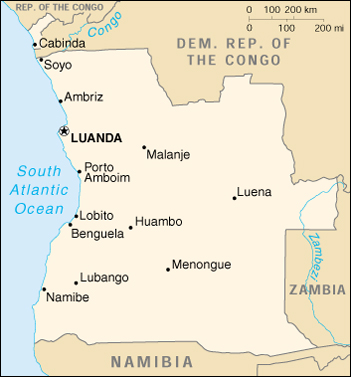
Background: Civil war has been the norm in Angola since independence from Portugal in 1975. A 1994 peace accord between the government and the National Union for the Total Independence of Angola (UNITA) provided for the integration of former UNITA insurgents into the government and armed forces. A national unity government was installed in April of 1997, but serious fighting resumed in late 1998, rendering hundreds of thousands of people homeless. Up to 1.5 million lives may have been lost in fighting over the past quarter century.
Government type: Angola has a transitional government, nominally a multiparty democracy with a strong presidential system.
Capital: Luanda
Currency: 1 kwanza (NKz) = 100 lwei
Geography of Angola
Location: Southern Africa, bordering the South Atlantic Ocean, between Namibia and Democratic Republic of the Congo
Geographic coordinates: 12 30 S, 18 30 E
Area:
total: 1,246,700 sq. km
land: 1,246,700 sq. km
water: 0 sq. km
Land boundaries:
total: 5,198 km
border countries: Democratic Republic of the Congo 2,511 km (of which 220 km is the boundary of discontiguous Cabinda Province), Republic of the Congo 201 km, Namibia 1,376 km, Zambia 1,110 km
Coastline: 1,600 km
Maritime claims:
exclusive economic zone: 200 nm
territorial sea: 12 nm
Climate: semiarid in south and along coast to Luanda; north has cool, dry season (May to October) and hot, rainy season (November to April)
Terrain: narrow coastal plain rises abruptly to vast interior plateau
Elevation extremes:
lowest point: Atlantic Ocean 0 m
highest point: Morro de Moco 2,620 m
Natural resources: petroleum, diamonds, iron ore, phosphates, copper, feldspar, gold, bauxite, uranium
Land use:
arable land: 2%
permanent crops: 0%
permanent pastures: 23%
forests and woodland: 43%
other: 32% (1993 est.)
Irrigated land: 750 sq. km (1993 est.)
Natural hazards: locally heavy rainfall causes periodic flooding on the plateau
Environment – current issues: overuse of pastures and subsequent soil erosion attributable to population pressures; desertification; deforestation of tropical rain forest, in response to both international demand for tropical timber and to domestic use as fuel, resulting in loss of biodiversity; soil erosion contributing to water pollution and siltation of rivers and dams; inadequate supplies of potable water.
Environment – international agreements:
party to: Biodiversity, Desertification, Law of the Sea
signed, but not ratified: Climate Change
Geography – note: Cabinda is separated from rest of country by the Democratic Republic of the Congo.
Terrain
Angola has three principal natural regions: the coastal lowland, characterized by low plains and terraces; hills and mountains, rising inland from the coast into a great escarpment; and an area of high plains, called the high plateau (planalto), which extends eastward from the escarpment.
The coastal lowland rises from the sea in a series of low terraces. This region varies in width from about 25 kilometers near Benguela to more than 150 kilometers in the Cuanza River Valley just south of Angola’s capital, Luanda, and is markedly different from Angola’s highland mass. The Atlantic Ocean’s cold, northwardflowing Benguela Current substantially reduces precipitation along the coast, making the region relatively arid or nearly so south of Benguela (where it forms the northern extension of the Namib Desert), and quite dry even in its northern reaches. Even where, as around Luanda, the average annual rainfall may be as much as fifty centimeters, it is not uncommon for the rains to fail. Given this pattern of precipitation, the far south is marked by sand dunes, which give way to dry scrub along the middle coast. Portions of the northern coastal plain are covered by thick brush.
The belt of hills and mountains parallels the coast at distances ranging from 20 kilometers to 100 kilometers inland. The Cuanza River divides the zone into two parts. The northern part rises gradually from the coastal zone to an average elevation of 500 meters, with crests as high as 1,000 meters to 1,800 meters. South of the Cuanza River, the hills rise sharply from the coastal lowlands and form a high escarpment, extending from a point east of Luanda and running south through Namibia. The escarpment reaches 2,400 meters at its highest point, southeast of the town of Sumbe, and is steepest in the far south in the Serra da Chela mountain range.
The high plateau lies to the east of the hills and mountains and dominates Angola’s terrain. The surface of the plateau is typically flat or rolling, but parts of the Benguela Plateau and the Humpata Highland area of the Huíla Plateau in the south reach heights of 2,500 meters and more. The Malanje Plateau to the north rarely exceeds 1,000 meters in height. The Benguela Plateau and the coastal area in the immediate environs of Benguela and Lobito, the Bié Plateau, the Malanje Plateau, and a small section of the Huíla Plateau near the town of Lubango have long been among the most densely settled areas in Angola.
Drainage
Most of the country’s many rivers originate in central Angola, but their patterns of flow are diverse and their ultimate outlets varied. A number of rivers flow in a more or less westerly course to the Atlantic Ocean, providing water for irrigation in the dry coastal strip and the potential for hydroelectric power, only some of which had been realized by 1988. Two of Angola’s most important rivers, the Cuanza and the Cunene, take a more indirect route to the Atlantic, the Cuanza flowing north and the Cunene flowing south before turning west. The Cuanza is the only river wholly within Angola that is navigable–for nearly 200 kilometers from its mouth- -by boats of commercially or militarily significant size. The Congo River, whose mouth and western end form a small portion of Angola’s northern border with Zaire, is also navigable. North of the Lunda Divide a number of important tributaries of the Congo River flow north to join it, draining Angola’s northeast quadrant. South of the divide some rivers flow into the Zambezi River and thence to the Indian Ocean, others to the Okavango River (as the Cubango River is called along the border with Namibia and in Botswana) and thence to the Okavango Swamp in Botswana. The tributaries of the Cubango River and several of the southern rivers flowing to the Atlantic are seasonal, completely dry much of the year.
Climate
Like the rest of tropical Africa, Angola experiences distinct, alternating rainy and dry seasons. In the north, the rainy season may last for as long as seven months–usually from September to April, with perhaps a brief slackening in January or February. In the south, the rainy season begins later, in November, and lasts until about February. The dry season (cacimbo) is often characterized by a heavy morning mist. In general, precipitation is higher in the north, but at any latitude it is greater in the interior than along the coast and increases with altitude.
Temperatures fall with distance from the equator and with altitude and tend to rise closer to the Atlantic Ocean. Thus at Soyo, at the mouth of the Congo River, the average annual temperature is about 26°C, but it is under 16°C at Huambo on the temperate central plateau. The coolest months are July and August (in the middle of the dry season), when frost may sometimes form at higher altitudes.
People of Angola
Angola has three main ethnic groups, each speaking a Bantu language: Ovimbundu 37%, Kimbundu 25%, and Bakongo, 13%. Other groups include Chokwe (or Lunda), Ganguela, Nhaneca-Humbe, Ambo, Herero, and Xindunga. In addition, mixed racial (European and Africa) people amount to about 2%, with a small (1%) population of whites, mainly ethnically Portuguese. Portuguese make up the largest non-Angolan population, with at least 30,000 (though many native-born Angolans can claim Portuguese nationality under Portuguese law). Portuguese is both the official and predominant language.
Population: 11,190,786 (July 2005 est.)
Age structure:
0-14 years: 43.31%
15-64 years: 53.98%
65 years and over: 2.71%
Population growth rate: 2.15%
Birth rate: 46.54 births/1,000 population
Death rate: 24.68 deaths/1,000 population
Net migration rate: -0.34 migrant(s)/1,000 population
Infant mortality rate: 193.72 deaths/1,000 live births
Life expectancy at birth:
total population: 38.59 years
male: 37.36 years
female: 39.87 years
Total fertility rate: 6.48 children born/woman
Nationality:
noun: Angolan(s)
adjective: Angolan
Ethnic groups: Ovimbundu 37%, Kimbundu 25%, Bakongo 13%, mestico (mixed European and Native African) 2%, European 1%, other 22%
Religions: indigenous beliefs 47%, Roman Catholic 38%, Protestant 15% (1998 est.)
Languages: Portuguese (official), Bantu and other African languages
Literacy:
definition: age 15 and over can read and write
total population: 42%
male: 56%
female: 28% (1998 est.)
History of Angola
AN IMPORTANT SYMBOLIC EPISODE in the course of Angolan history took place on June 22, 1989, in the remote Zairian town of Gbadolite. On that date, Angolan president José Eduardo dos Santos shook the hand of Jonas Savimbi, leader of the antigovernment movement, the National Union for the Total Independence of Angola (União Nacional para a Independência Total de Angola — UNITA). This friendly gesture occurred at the end of a meeting attended by representatives from seventeen African nations and held under the auspices of Zairian president Mobutu Sese Seko. Accompanying the handshake was a communiqué calling for a cease-fire between government forces and UNITA rebels, national reconciliation, and direct negotiations; specific provisions were to be arranged later. But like many other incidents in Angolan history, this promising event soon became a disappointment as the parties failed to make progress along the path to peace. And so, scarcely two months after the so-called Gbadolite Declaration, UNITA announced the end to the cease-fire. As the internal turmoil resumed, Angolans once again became victims in a civil war that by 1989 had lasted for fourteen years.
Clearly, turmoil, victimization, and disappointment are themes that have pervaded Angola’s history, especially since the arrival of Europeans in the fifteenth century. Although the Portuguese crown initially sent to Angola teachers to educate and priests to proselytize, Portugal eventually came to view the area mainly as a source for slaves, especially for Brazil, its colony across the Atlantic Ocean. In the several centuries during which the slave trade flourished, scholars estimate that 4 million Africans from the Angola region were taken into slavery. Of this number, perhaps half died before reaching the New World.
During its five centuries of colonization, Portugal treated Angola mostly with indifference or hostility. Although Angolans were often responsible for enslaving other Africans, Portuguese traders provided the impetus and the market for slaving. By raising small armies, Portuguese fought their way into Angola’s interior, disrupting as they went kingdoms having sophisticated civilizations. Less alluring to Portuguese settlers than Brazil, Angola generally attracted poorer immigrants, a great many of whom were degredados, or exiled convicts. Portugal’s exploitation of Angola did not cease even after slavery had been legally abolished in Angola in 1858. Lisbon spent the last part of the nineteenth century engaged in wars against the African kingdoms that it had not yet conquered and in consolidating its hold on territories awarded to it at the Berlin Conference of 1884 during the so-called scramble for Africa.
In the twentieth century, and particularly after 1926 and António Salazar’s rise to power in Portugal, Lisbon exploited Angola’s agricultural and mineral wealth. Salazar facilitated this exploitation by inducing greater numbers of Portuguese to settle in Angola to manage plantations and mines and by enacting labor laws that forced Angolans to work for Portuguese. He also ensured that Africans could not easily participate in or benefit from the colonial administration.
In the 1950s and 1960s, as most other African colonies were winning their independence, many Angolans, especially educated mestiços and assimilados, came to resent the continued oppressiveness of the Salazar regime, which steadfastly refused to consider granting independence to its African holdings. As a consequence, in the early months of 1961 a rebellion erupted in the northern part of the colony. This event sounded the opening shots of Angola’s war of liberation, a conflict that dragged on until 1974. In that year, a military coup d’état in Lisbon toppled the government of Marcello Caetano (who had replaced Salazar in 1968). The generals who assumed power had fought the anticolonialists in Africa and were weary of that battle. And so, soon after the coup they announced plans for the independence of all of Portugal’s African possessions.
Unlike other Portuguese African colonies, the transition to independence in Angola did not proceed smoothly. During the 1960s and 1970s, the three most important liberation movements were the Popular Movement for the Liberation of Angola (Movimento Popular de Libertação de Angola — MPLA), the National Front for the Liberation of Angola (Frente Nacional de Libertação de Angola — FNLA), and UNITA. When these groups could not resolve peacefully their differences about the leadership and structure of a unified government, they turned their guns on each other; the FNLA and UNITA eventually formed a loose coalition to oppose the MPLA, the movement that finally prevailed. The subsequent chaos, however, induced most Portuguese to repatriate, leaving Angola critically deficient in skilled professionals such as managers, teachers, and technicians.
The resultant civil war had domestic, regional, and international dimensions. Domestically, the movements tended to be divided along ethnic lines: the MPLA came to be identified with the Mbundu, the FNLA with the Bakongo, and UNITA with the Ovimbundu. In the late 1980s, ethnicity was still a sensitive issue. Regionally, Zaire came to the aid of the FNLA by supplying bases and some combat troops. South Africa, concerned about communist expansion in southern Africa, invaded Angola from neighboring Namibia. Internationally, the Soviet Union backed the MPLA with matériel and advisers, while Cuba supplied thousands of combat troops. The United States sided with the FNLA by providing financial assistance and by helping to hire mercenaries.
By mid-1976 most of the fighting had died down. The South Africans had withdrawn, and, for the most part, the FNLA and UNITA had been routed, thanks primarily to the effectiveness of Cuban forces. Consequently, the MPLA was able to legitimize its claim of control over the government. Nonetheless, despite its legitimization and the recognition of its claim by most African states and many other countries and international organizations, the MPLA still was confronted with an insurgency. Leading this insurgency from the southeast part of the country was Savimbi’s UNITA, which had regrouped with the assistance of South Africa, and, after 1985, with aid from the United States. By 1989 this conflict, which many believed was merely an extension of the civil war, had claimed an estimated 60,000 to 90,000 lives, had exacted hundreds of thousands of casualties, and had forced about 700,000 people from their homes.
During the 1980s, the strains of the conflict were everywhere apparent. A significant portion of Angola’s young populace (median age 17.5 years in 1988), estimated at 8.2 million in 1988, was moving westward away from the principal battlegrounds. Between 1975 and 1987, cities such as Luanda, Huambo, and Benguela witnessed an almost unchecked population explosion. But as the cities filled, the countryside emptied. The consequences of this rural-to-urban migration were devastating to the nation’s welfare. The cities were unable to absorb such masses so quickly; the government could not provide adequate services, such as medical care and education; and jobs and housing were in short supply. Most important, with agricultural workers leaving their farms, the cities could not obtain enough food for their residents. By the late 1980s, Angola, once a food exporter, was importing more than half of its grain requirements. Moreover, thousands of those who could not reach cities settled in displaced persons camps, many of which were funded and operated by international relief organizations. Unrecorded as of 1989 were the psychological effects on the populace of leaving the relatively stable, traditional environment of the country for the uncertain, modern society of the city.
Exacerbating these demographic strains was the economy’s poor performance in the 1980s in relation to its vast potential. The production of coffee, sisal, sugar, iron ore, and diamonds either declined or stagnated. Furthermore, the closure by UNITA insurgents of the Benguela Railway, which linked the rich mining regions of Zaire and Zambia with Atlantic ports, denied transit fees to the government. As a result, the economy became almost exclusively dependent on petroleum. Production of oil had begun in 1956, and by the late 1980s, with the financial and technical assistance of Western companies, oil sales accounted for nearly 90 percent of export earnings. Most Angolans, however, failed to benefit from these earnings. To finance the war against UNITA, the government in 1986 allocated more than 40 percent of its budget to defense expenditures, leaving relatively little for pressing social needs.
Several other factors contributed to economic weaknesses. First, because of the lack of foreign exchange, imported consumer goods were scarce, especially in state-run stores. This scarcity generated a widespread parallel market in which goods were frequently bartered rather than sold because Angola’s unit of currency, the kwanza, was virtually worthless. And because of commodity shortages, graft and pilfering (particularly at points of entry) became government concerns. National production also suffered because industrial workers and agricultural laborers were reluctant to work for kwanzas; as a result of the shortage of goods, the government often could not even barter for the services of workers or the output of farmers.
The UNITA insurgency and its associated disruptions notwithstanding, the government itself was responsible for some economic ills. Critics of the government claimed that mismanagement in centralized planning, state-run companies, and state-owned farms contributed significantly to the nation’s economic decline. The government, in fact, seemed to agree in 1987, at which time President dos Santos announced plans to restructure the economy, calling for greater commercial liberalization and privatization of enterprise.
But while the government was willing to concede the economic shortcomings of Marxism-Leninism, it was resolutely opposed to accepting the notion of sweeping changes in political ideology. Since the First Party Congress in December 1977, when the MPLA became a “workers’ party” and added “PT” (for Partido de Trabalho) to its acronym, Angola’s leadership had followed a course that some observers have described as “Moscow oriented.”Despite this characterization and the fact that Angola’s enmeshed party- government structure resembled that of the Soviet Union, the dos Santos regime was notably more moderate than the regime of his predecessor, Agostinho Neto. In the late 1980s, however, political power remained in the hands of dos Santos and his small inner circle.
For the most part, Angola’s goal of installing a functioning socialist state had not been attained. Although millions of Angolans had been mobilized into mass organizations or defense forces, political debate was narrowly constrained. The party, with a membership of only about 45,000, dominated the government. As of 1989, the People’s Assembly–nominally the highest state organ–was largely an appointed body, unrepresentative of the constituents it was designed to serve. Likewise, the MPLA-PT was controlled primarily by the eleven-member Political Bureau (led by its chairman, dos Santos) and secondarily by the Central Committee; the party congress, the MPLA-PT’s theoretical supreme body, in practice was subordinate to the other organs. In addition, reflecting the nation’s precarious security situation, many serving in party and government positions were military officers.
Angola’s foreign relations wavered in the 1980s. Within black Africa, Luanda’s relations with other states generally were good. Those with Zaire, however, fluctuated from normal to poor because of Kinshasa’s sponsorship during the 1970s of the FNLA and because of Angola’s support during the same period of an anti-Mobutu armed movement. In addition, although Zaire denied aiding UNITA, most observers agreed that during the 1980s Kinshasa allowed Zairian territory to be used to support Savimbi’s movement, creating another bone of contention between the two neighbors. Angola’s principal antagonist in the region, however, was not Zaire but South Africa. Since its invasion of Angola in 1975 and 1976 during the war of independence, Pretoria has frequently violated Luanda’s sovereignty, either in pursuit of members of the South West Africa People’s Organization (SWAPO–a group fighting for Namibian independence) or in support of UNITA forces.
In the late 1980s, Angola’s ties to the superpowers were in a state of flux. Although Luanda was closely aligned with the Soviet Union and its allies, this relationship generally was considered an outgrowth of Angola’s security predicament. In economic concerns, the MPLA-PT often turned to the West, particularly in matters relating to the oil sector but also for trade and commerce and in other areas. Reportedly, the Soviet Union prodded the Angolan government into participating in the December 1988 regional accords, but in late 1989 it was uncertain how the reforms being carried out in the Soviet Union under Mikhail S. Gorbachev would affect the policies and practices of the MPLA-PT government. The other superpower, the United States, also played an important role in the accords. After their signing, however, United States president George P. Bush affirmed American support for the UNITA rebels and vowed to continue backing Savimbi’s movement until the MPLA-PT and UNITA reached an accommodation.
The MPLA’s independence struggle and subsequent conflict with UNITA and South Africa compelled the government to develop the People’s Armed Forces for the Liberation of Angola (Forças Armadas Populares de Libertação de Angola — FAPLA). Comprised of a ground force, air and air defense force, and navy, FAPLA was one of the largest and most heavily armed militaries in Africa. In 1988 experts estimated its strength at 100,000 active-duty personnel, 50,000 reservists, and many hundreds of thousands more in a variety of militias and internal security units. Bolstering this force in the late 1980s were about 50,000 Cuban troops, who provided logistical and combat support.
FAPLA was armed and trained by the Soviet Union and its allies. Its major equipment included MiG-21 and MiG-23 aircraft, T-62 and T-72 main battle tanks, and an assortment of air defense, field artillery, and naval assets. Although this arsenal and the assistance of Cuban troops and Soviet and East European advisers had prevented a UNITA victory, by 1988 Luanda had incurred an external debt estimated at almost US$4 billion, most of which was owed to Moscow for military matériel and assistance.
In late 1989, Angola’s economic and political prospects appeared less bleak than they had only a year or two earlier. The economic restructuring program, together with other austerity measures, convinced the International Monetary Fund to admit Angola as a member in June 1989 (over the objection of the United States). This event opened the door for greater financial assistance. Furthermore, the December 1988 regional accords, which provided for the staged withdrawal of Cuban troops, the cessation of South African support for UNITA, and the independence of Namibia, augured well for Angola’s future. Observers reasoned that as the Cuban troops departed (and by mid- 1989 more than 10,000 had left), Luanda’s payments to Havana for military aid would drop; with South Africa’s cutoff of support to UNITA, that organization’s ability to disrupt the economy would decline and perhaps push it closer to accepting a peace plan; and with independence for Namibia, the threat of South African aggression would diminish substantially. Carrying this logic one step further, reporters argued that if the peace process begun at Gbadolite in June 1989 could be revitalized and an agreement between the MPLA-PT and UNITA achieved, Angolans stood a chance of reversing the pattern of turmoil, victimization, and disappointment that had plagued the country for the previous 500 years.
October 18, 1989
A few significant events occurred in Angola after the completion of the research and writing of this manuscript. By mid- 1990 it became clear that Angola, Cuba, and South Africa, the signatories of the December 1988 regional accords, were intent on faithfully executing the provisions of the agreement. Since the signing, more than 37,000 Cuban troops had departed Angola, and the remaining 13,000 Cubans, most of whom were stationed near Luanda, were to be brought home by mid-1991. As promised, South African forces withdrew from Angolan territory, and Pretoria ceased aid to UNITA. Finally, Namibia held elections and, as planned, celebrated its independence on March 21, 1990.
These positive developments notwithstanding, most Angolans enjoyed little improvement in their quality of life, and, for many, conditions deteriorated. The primary reason for this decline was that the MPLA-PT and UNITA had failed to make much progress on the path to peace. Each side of the dispute held a different interpretation of the Gbadolite Declaration. Analysts suggested that Mobutu, the mediator of the Gbadolite talks, may have presented varying versions of the agreement to each side. In any case, warfare persisted from mid-1989 to mid-1990 as FAPLA and UNITA troops battled each other for control of the southeastern town of Mavinga. Government forces captured the town in early February 1990, but intense fighting continued in the region for several months. Following a heavy engagement, FAPLA retreated from Mavinga in early May, and UNITA reoccupied it.
In addition to the combat that raged in Angola’s southeast, UNITA reportedly made inroads in the country’s northwest. This success allegedly was accomplished through Zairian operational support and United States assistance. According to some sources, the Zairian government was resupplying UNITA forces there via cargo flights from Kinshasa. The United States, using this Zairian air bridge, reportedly provided UNITA with matériel and other assistance worth an estimated US$45 million to US$60 million annually. By mid-1990 UNITA forces sabotaged water facilities and electric power lines to Luanda and generally disrupted the economic life of the nation.
Despite the on-going military situation, there appeared to be some softening of political positions. In April 1990, government and UNITA representatives met in Portugal for negotiations. As a result, UNITA recognized the Angolan state with President dos Santos as its head. UNITA, however, also called for the replacement of the single-party state with a multiparty government chosen in free elections. Observers saw a coincidence of interests here because the MPLA-PT had pledged to hold elections in which nonparty candidates–including members of UNITA–could run for seats in the People’s Assembly. The single-party versus multiparty issue was to be debated at the Third Party Congress, scheduled for December 1990.
Regardless of the outcome of this congress, however, observers believed that UNITA’s battlefield successes might encourage Savimbi to hold out for a total military solution. With the continued United States commitment to UNITA, at the same time that Cuban troops were withdrawing and the Soviet Union’s interest in supporting the MPLA-PT government was weakening, some analysts reasoned that a UNITA victory in Angola, whether on the battlefield or at the polls, was merely a question of time.
Angola Economy
Economy – overview: Angola is an economy in disarray because of a quarter century of nearly continuous warfare. Despite its abundant natural resources, output per capita is among the world’s lowest. Subsistence agriculture provides the main livelihood for 85% of the population. Oil production and the supporting activities are vital to the economy, contributing about 45% to GDP and 90% of exports. Violence continues, millions of land mines remain, and many farmers are reluctant to return to their fields. As a result, much of the country’s food must still be imported. To fully take advantage of its rich resources – gold, diamonds, extensive forests, Atlantic fisheries, and large oil deposits – Angola will need to end its conflict and continue reforming government policies. Despite the increase in the pace of civil warfare in late 1998, the economy grew by an estimated 5% in 2000. The government introduced new currency denominations in 1999, including 1 and 5 kwanza notes. Internal strife discourages investment outside of the petroleum sector, which is producing roughly 800,000 barrels of oil per day. Angola has entered into a Staff Monitored Program (SMP) with the IMF. Continued growth depends on sharp cuts in inflation, further economic reform, and a lessening of fighting.
GDP: purchasing power parity – $10.1 billion (2000 est.)
GDP – real growth rate: 4.9% (2000 est.)
GDP – per capita: purchasing power parity – $1,000 (2000 est.)
GDP – composition by sector:
agriculture: 7%
industry: 60%
services: 33% (1999 est.)
Population below poverty line: NA%
Household income or consumption by percentage share:
lowest 10%: NA%
highest 10%: NA%
Inflation rate (consumer prices): 325% (2000 est.)
Labor force: 5 million (1997 est.)
Labor force – by occupation: agriculture 85%, industry and services 15% (1997 est.)
Unemployment rate: extensive unemployment and underemployment affecting more than half the population (2000 est.)
Budget:
revenues: $928 million
expenditures: $2.5 billion, including capital expenditures of $963 million (1992 est.)
Industries: petroleum; diamonds, iron ore, phosphates, feldspar, bauxite, uranium, and gold; cement; basic metal products; fish processing; food processing; brewing; tobacco products; sugar; textiles.
Industrial production growth rate: NA%
Electricity – production: 1.475 billion kWh (1999)
Electricity – production by source:
fossil fuel: 32.2%
hydro: 67.8%
nuclear: 0%
other: 0% (1999)
Electricity – consumption: 1.372 billion kWh (1999)
Electricity – exports: 0 kWh (1999)
Electricity – imports: 0 kWh (1999)
Agriculture – products: bananas, sugarcane, coffee, sisal, corn, cotton, manioc (tapioca), tobacco, vegetables, plantains; livestock; forest products; fish
Exports: $7.8 billion (f.o.b., 2000 est.)
Exports – commodities: crude oil 90%, diamonds, refined petroleum products, gas, coffee, sisal, fish and fish products, timber, cotton
Exports – partners: US 54%, South Korea 14%, Benelux 11%, China 7%, Taiwan 6% (1999)
Imports: $2.5 billion (f.o.b., 2000 est.)
Imports – commodities: machinery and electrical equipment, vehicles and spare parts; medicines, food, textiles, military goods
Imports – partners: South Korea 16%, Portugal 15%, US 13%, South Africa 10%, France 8% (1999)
Debt – external: $10.8 billion (2000 est.)
Economic aid – recipient: $493.1 million (1995)
Currency: 1 kwanza (NKz) = 100 lwei
Map of Angola