Background: Following independence from Spain in 1816, Argentina experienced periods of internal political conflict between conservatives and liberals and between civilian and military factions. After World War II, a long period of Peronist dictatorship was followed by a military junta that took power in 1976. Democracy returned in 1983, and four free elections since then have underscored Argentina’s progress in democratic consolidation.
Government type: republic
Capital: Buenos Aires
Currency: 1 peso = 100 centavos
Geography of Argentina
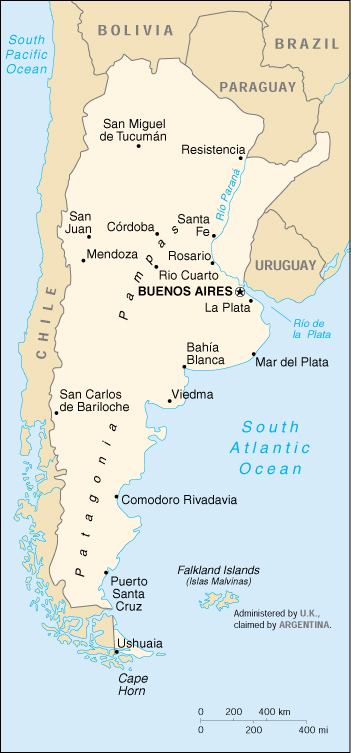
Location: Southern South America, bordering the South Atlantic Ocean, between Chile and Uruguay
Geographic coordinates: 34 00 S, 64 00 W
Area:
total: 2,766,890 sq. km
land: 2,736,690 sq. km
water: 30,200 sq. km
Land boundaries:
total: 9,665 km
border countries: Bolivia 832 km, Brazil 1,224 km, Chile 5,150 km, Paraguay 1,880 km, Uruguay 579 km
Coastline: 4,989 km
Maritime claims:
contiguous zone: 24 nm
continental shelf: 200 nm or to the edge of the continental margin
exclusive economic zone: 200 nm
territorial sea: 12 nm
Climate: mostly temperate; arid in southeast; sub-antarctic in southwest
Terrain: rich plains of the Pampas in northern half, flat to rolling plateau of Patagonia in south, rugged Andes along western border
Elevation extremes:
lowest point: Salinas Chicas -40 m (located on Peninsula Valdes)
highest point: Cerro Aconcagua 6,960 m
Natural resources: fertile plains of the pampas, lead, zinc, tin, copper, iron ore, manganese, petroleum, uranium
Land use:
arable land: 9%
permanent crops: 1%
permanent pastures: 52%
forests and woodland: 19%
other: 19% (1993 est.)
Irrigated land: 17,000 sq. km (1993 est.)
Natural hazards: San Miguel de Tucuman and Mendoza areas in the Andes subject to earthquakes; pamperos are violent windstorms that can strike the Pampas and northeast; heavy flooding.
Environment – current issues: environmental problems (urban and rural) typical of an industrializing economy such as soil degradation, desertification, air pollution, and water pollution
note: Argentina is a world leader in setting voluntary greenhouse gas targets
Environment – international agreements:
party to: Antarctic-Environmental Protocol, Antarctic-Marine Living Resources, Antarctic Seals, Antarctic Treaty, Biodiversity, Climate Change, Desertification, Endangered Species, Environmental Modification, Hazardous Wastes, Law of the Sea, Marine Dumping, Nuclear Test Ban, Ozone Layer Protection, Ship Pollution, Wetlands, Whaling
signed, but not ratified: Climate Change-Kyoto Protocol, Marine Life Conservation
Geography – note: second-largest country in South America (after Brazil); strategic location relative to sea lanes between South Atlantic and South Pacific Oceans (Strait of Magellan, Beagle Channel, Drake Passage)
People of Argentina
Argentines are a fusion of diverse national and ethnic groups, with descendants of Italian and Spanish immigrants predominant. Waves of immigrants from many European countries arrived in the late 19th and early 20th centuries. Syrian, Lebanese, and other Middle Eastern immigrants number about 500,000, mainly in urban areas. Argentina has the largest Jewish population in Latin America, about 250,000 strong. In recent years, there has been a substantial influx of immigrants from neighboring Latin American countries. The indigenous population, estimated at 700,000, is concentrated in the provinces of the north, northwest, and south. The Argentine population has one of Latin America’s lowest growth rates. Eighty percent of the population resides in cities or towns of more than 2,000, and over one-third lives in the greater Buenos Aires area. With 13 million inhabitants, this sprawling metropolis serves as the focus for national life. Argentines enjoy comparatively high standards of living; half the population considers itself middle class.
Population: 39,537,943 (July 2005 est.)
Age structure:
0-14 years: 26.54%
15-64 years: 63.04%
65 years and over: 10.42%
Population growth rate: 1.15%
Birth rate: 18.41 births/1,000 population
Death rate: 7.58 deaths/1,000 population
Net migration rate: 0.64 migrant(s)/1,000 population
Infant mortality rate: 17.75 deaths/1,000 live births
Life expectancy at birth:
total population: 75.26 years
male: 71.88 years
female: 78.82 years
Total fertility rate: 2.44 children born/woman
Nationality:
noun: Argentine(s)
adjective: Argentine
Ethnic groups: white (mostly Spanish and Italian) 97%, mestizo, Amerindian, or other nonwhite groups 3%
Religions: nominally Roman Catholic 92% (less than 20% practicing), Protestant 2%, Jewish 2%, other 4%
Languages: Spanish (official), English, Italian, German, French
Literacy:
definition: age 15 and over can read and write
total population: 96.2%
male: 96.2%
female: 96.2% (1995 est.)
History of Argentina
Europeans arrived in the region with the 1502 voyage of Amerigo Vespucci. Spanish navigator Juan Diaz de Solias visited what is now Argentina in 1516. Spain established a permanent colony on the site of Buenos Aires in 1580, although initial settlement was primarily overland from Peru. The Spanish further integrated Argentina into their empire by establishing the Vice Royalty of Rio de la Plata in 1776, and Buenos Aires became a flourishing port.
Buenos Aires formally declared independence from Spain on July 9, 1816. Argentines revere Gen. Jose de San Martin, who campaigned in Argentina, Chile, and Peru as the hero of their national independence. Following the defeat of the Spanish, centralist and federalist groups waged a lengthy conflict between themselves to determine the future of the nation. National unity was established, and the constitution promulgated in 1853. Two forces combined to create the modern Argentine nation in the late 19th century: the introduction of modern agricultural techniques and integration of Argentina into the world economy. Foreign investment and immigration from Europe aided this economic revolution. Investment, primarily British, came in such fields as railroads and ports. The migrants who worked to develop Argentina’s resources–especially the western pampas–came from throughout Europe, just as in the United States.
Conservative forces dominated Argentine politics until 1916, when their traditional rivals, the Radicals, won control of the government. The Radicals, with their emphasis on fair elections and democratic institutions, opened their doors to Argentina’s expanding middle class as well as to elites previously excluded from power. The Argentine military forced aged Radical President Hipolito Yrigoyen from power in 1930 and ushered in another decade of Conservative rule. Using fraud and force when necessary, the governments of the 1930s attempted to contain the currents of economic and political change that eventually led to the ascendance of Juan Domingo Peron (b. 1897). New social and political forces were seeking political power, including a modern military and labor movements that emerged from the growing urban working class.
The military ousted Argentina’s constitutional government in 1943. Peron, then an army colonel, was one of the coup’s leaders, and he soon became the government’s dominant figure as Minister of Labor. Elections carried him to the presidency in 1946. He aggressively pursued policies aimed at giving an economic and political voice to the working class and greatly expanded the number of unionized workers. In 1947, Peron announced the first 5-year plan based on the growth of nationalized industries. He helped establish the powerful General Confederation of Labor (CGT). Peron’s dynamic wife, Eva Duarte de Peron, known as Evita (1919-52), helped her husband develop strength with labor and women’s groups; women obtained the right to vote in 1947. Peron won reelection in 1952, but the military deposed him in 1955. He went into exile, eventually settling in Spain. In the 1950-60s, military and civilian administrations traded power, trying, with limited success, to deal with diminished economic growth and continued social and labor demands. When military governments failed to revive the economy and suppress escalating terrorism in the late 1960s and early 1970s, the way was open for Peron’s return.
On March 11, 1973, Argentina held general elections for the first time in 10 years. Peron was prevented from running, but voters elected his stand-in, Dr. Hector Campora, as President. Peron’s followers also commanded strong majorities in both houses of Congress. Campora resigned in July 1973, paving the way for new elections. Peron won a decisive victory and returned as President in October 1973 with his third wife, Maria Estela Isabel Martinez de Peron, as Vice President. During this period, extremists on the left and right carried out terrorist acts with a frequency that threatened public order. The government resorted to a number of emergency decrees, including the implementation of special executive authority to deal with violence. This allowed the government to imprison persons indefinitely without charge.
Peron died on July 1, 1974. His wife succeeded him in office, but her administration was undermined by economic problems, Peronist intraparty struggles, and growing terrorism. A military coup removed her from office on March 24, 1976, and the armed forces formally exercised power through a junta composed of the three service commanders until December 10, 1983. The armed forces applied harsh measures against terrorists and many suspected of being their sympathizers. They restored basic order, but the costs of what became known as the “Dirty War” were high in terms of lives lost and basic human rights violated. Conservative counts list over 10,000 persons as “disappeared” during the 1976-83 period.
Serious economic problems, mounting charges of corruption, public revulsion in the face of human rights abuses and, finally, the country’s 1982 defeat by the U.K. in an unsuccessful attempt to seize the Falklands/Malvinas Islands all combined to discredit the Argentine military regime. Under strong public pressure, the junta lifted bans on political parties and gradually restored basic political liberties. On October 30, 1983, Argentines went to the polls to choose a president; vice president; and national, provincial, and local officials in elections found by international observers to be fair and honest. The country returned to constitutional rule after Raul Alfonsin, candidate of the Radial Civic Union, received 52% of the popular vote for president. He began a 6-year term of office on December 10, 1983.
In 1985 and 1987, large turnouts for mid-term elections demonstrated continued public support for a strong and vigorous democratic system. The UCR-led government took steps to resolve some of the nation’s most pressing problems, including accounting for those who disappeared during military rule, establishing civilian control of the armed forces, and consolidating democratic institutions. However, constant friction with the military, failure to resolve endemic economic problems, and an inability to maintain public confidence undermined the effectiveness of the Alfonsin government, which left office 6 months early after Peronist candidate Carlos Saul Menem won the 1989 presidential elections.
As President, Menem launched a major overhaul of Argentine domestic policy. Large-scale structural reforms dramatically reversed the role of the state in Argentine economic life. A decisive leader pressing a controversial agenda, Menem was not reluctant to use the presidency’s extensive powers to issue decrees when the Congress was unable to reach consensus on his proposed reforms. Those powers were curtailed somewhat when the constitution was reformed in 1994 as a result of the so-called Olivos Pact with the opposition Radical Party. That arrangement opened the way for Menem to seek and win reelection with 50% of the vote in the three-way 1995 presidential race.
The 1995 election saw the emergence of the moderate-left FREPASO political alliance. This alternative to the two traditional political parties in Argentina is particularly strong in Buenos Aires but as yet lacks the national infrastructure of the Peronists and Radicals. In an important development in Argentina’s political life, all three major parties in the 1999 race espoused free market economic policies. In October 1999, the UCR-FREPASO Alliance’s presidential candidate, Fernando de la Rua, defeated Peronist candidate Eduardo Duhalde. Taking office in December 1999, De la Rua has not only continued the previous administration’s free market economic policies but has followed an IMF-sponsored program of government spending cuts, revenue increases, and provincial revenue-sharing reforms to get the federal deficit under control. De la Rua also has pursued labor law reform and business-promotion measures aimed at stimulating the economy and increasing employment. Despite these measures, Argentine economic growth remained nearly flat in 2000.
Argentina Economy
Economy – overview: Argentina benefits from rich natural resources, a highly literate population, an export-oriented agricultural sector, and a diversified industrial base. However, when President Carlos MENEM took office in 1989, the country had piled up huge external debts, inflation had reached 200% per month, and output was plummeting. To combat the economic crisis, the government embarked on a path of trade liberalization, deregulation, and privatization. In 1991, it implemented radical monetary reforms which pegged the peso to the US dollar and limited the growth in the monetary base by law to the growth in reserves. Inflation fell sharply in subsequent years. In 1995, the Mexican peso crisis produced capital flight, the loss of banking system deposits, and a severe, but short-lived, recession; a series of reforms to bolster the domestic banking system followed. Real GDP growth recovered strongly, reaching 8% in 1997. In 1998, international financial turmoil caused by Russia’s problems and increasing investor anxiety over Brazil produced the highest domestic interest rates in more than three years, halving the growth rate of the economy. Conditions worsened in 1999 with GDP falling by 3%. President Fernando DE LA RUA, who took office in December 1999, sponsored tax increases and spending cuts to reduce the deficit, which had ballooned to 2.5% of GDP in 1999. Growth in 2000 was a disappointing 0.8%, as both domestic and foreign investors remained skeptical of the government’s ability to pay debts and maintain its fixed exchange rate with the US dollar. One bright spot at the start of 2001 was the IMF’s offer of $13.7 billion in support.
GDP: purchasing power parity – $476 billion (2000 est.)
GDP – real growth rate: 0.8% (2000 est.)
GDP – per capita: purchasing power parity – $12,900 (2000 est.)
GDP – composition by sector:
agriculture: 6%
industry: 32%
services: 62% (2000 est.)
Population below poverty line: 37% (1999 est.)
Inflation rate (consumer prices): -0.9% (2000 est.)
Labor force: 15 million (1999)
Unemployment rate: 15% (December 2000)
Budget:
revenues: $44 billion
expenditures: $48 billion
Industries: food processing, motor vehicles, consumer durables, textiles, chemicals and petrochemicals, printing, metallurgy, steel
Industrial production growth rate: 1% (2000 est.)
Electricity – production: 77.087 billion kWh (1999)
Electricity – production by source:
fossil fuel: 60.3%
hydro: 30.7%
nuclear: 8.75%
other: 0.25% (1999)
Electricity – consumption: 77.111 billion kWh (1999)
Electricity – exports: 1.08 billion kWh (1999)
Electricity – imports: 6.5 billion kWh (1999)
Agriculture – products: sunflower seeds, lemons, soybeans, grapes, corn, tobacco, peanuts, tea, wheat; livestock
Exports: $26.5 billion (f.o.b., 2000 est.)
Exports – commodities: edible oils, fuels and energy, cereals, feed, motor vehicles
Exports – partners: Brazil 24%, EU 21%, US 11% (1999 est.)
Imports: $25.2 billion (f.o.b., 2000 est.)
Imports – commodities: machinery and equipment, motor vehicles, chemicals, metal manufactures, plastics
Imports – partners: EU 28%, US 22%, Brazil 21% (1999 est.)
Debt – external: $154 billion (2000 est.)
Economic aid – recipient: IMF offer of $13.7 billion (January 2001)
Currency: 1 peso = 100 centavos
Exchange rates: Argentine pesos per US dollar – 1.000 (fixed rate pegged to the US dollar)
Map of Argentina