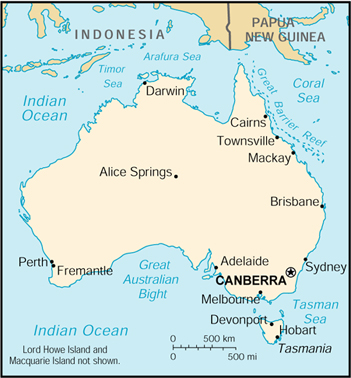
Background: Australia became a commonwealth of the British Empire in 1901. It was able to take advantage of its natural resources to rapidly develop its agricultural and manufacturing industries and to make a major contribution to the British effort in World Wars I and II. Long-term concerns include pollution, particularly depletion of the ozone layer, and management and conservation of coastal areas, especially the Great Barrier Reef. A referendum to change Australia’s status, from a commonwealth headed by the British monarch to an independent republic, was defeated in 1999.
Government type: democratic, federal-state system recognizing the British monarch as sovereign
Capital: Canberra
Currency: 1 Australian dollar ($A) = 100 cents
Geography of Australia
Location: Oceania, continent between the Indian Ocean and the South Pacific Ocean
Geographic coordinates: 27 00 S, 133 00 E
Area:
total: 7,686,850 sq. km
land: 7,617,930 sq. km
water: 68,920 sq. km
note: includes Lord Howe Island and Macquarie Island
Land boundaries: 0 km
Coastline: 25,760 km
Maritime claims:
contiguous zone: 24 nm
continental shelf: 200 nm or to the edge of the continental margin
exclusive economic zone: 200 nm
territorial sea: 12 nm
Climate: generally arid to semiarid; temperate in south and east; tropical in north.
Terrain: mostly low plateau with deserts; fertile plain in southeast.
Elevation extremes:
lowest point: Lake Eyre -15 m
highest point: Mount Kosciuszko 2,229 m
Natural resources: bauxite, coal, iron ore, copper, tin, silver, uranium, nickel, tungsten, mineral sands, lead, zinc, diamonds, natural gas, petroleum.
Land use:
arable land: 6%
permanent crops: 0%
permanent pastures: 54%
forests and woodland: 19%
other: 21% (1993 est.)
Irrigated land: 21,070 sq. km (1993 est.)
Natural hazards: cyclones along the coast; severe droughts
Environment – current issues: soil erosion from overgrazing, industrial development, urbanization, and poor farming practices; soil salinity rising due to the use of poor quality water; desertification; clearing for agricultural purposes threatens the natural habitat of many unique animal and plant species; the Great Barrier Reef off the northeast coast, the largest coral reef in the world, is threatened by increased shipping and its popularity as a tourist site; limited natural fresh water resources.
Environment – international agreements:
party to: Antarctic-Environmental Protocol, Antarctic Treaty, Biodiversity, Climate Change, Endangered Species, Environmental Modification, Hazardous Wastes, Law of the Sea, Marine Dumping, Marine Life Conservation, Nuclear Test Ban, Ozone Layer Protection, Ship Pollution, Tropical Timber 83, Tropical Timber 94, Wetlands, Whaling
signed, but not ratified: Climate Change-Kyoto Protocol, Desertification.
Geography – note: world’s smallest continent but sixth-largest country; population concentrated along the eastern and southeastern coasts; regular, tropical, invigorating, sea breeze known as “the Doctor” occurs along the west coast in the summer.
People of Australia
Australia’s aboriginal inhabitants, a hunting-gathering people generally referred to as Aborigines, arrived about 40,000 years ago. Although their technical culture remained static–depending on wood, bone, and stone tools and weapons–their spiritual and social life was highly complex. Most spoke several languages, and confederacies sometimes linked widely scattered tribal groups. Aboriginal population density ranged from 1 person per square mile along the coasts to 1 person per 35 square miles in the arid interior. Food procurement was usually a matter for the nuclear family and was very demanding, since there was little large game, and they had no agriculture.
Australia may have been sighted by Portuguese sailors in 1601, and Capt. James Cook claimed it for Great Britain in 1770. At that time, the native population may have numbered 300,000 in as many as 500 tribes speaking many different languages. The aboriginal population currently numbers more than 300,000, representing about 1.7% of the population. Since the end of World War II, efforts have been made both by the government and by the public to be more responsive to aboriginal rights and needs.
Today, tribal aborigines lead a settled traditional life in remote areas of northern, central, and western Australia. In the south, where most aborigines are of mixed descent, movement to the cities is increasing.
Immigration has been essential to Australia’s development since the beginning of European settlement in 1788. For generations, most settlers came from the British Isles, and the people of Australia are still predominantly of British or Irish origin, with a culture and outlook similar to those of Americans. However, since the end of World War II, the population has more than doubled; non-European immigration, mostly from the Middle East, Asia, and Latin America, has increased significantly since 1960 through an extensive, planned immigration program. From 1945 through 1996, nearly 5.5 million immigrants settled in Australia, and about 80% have remained; nearly one of every four Australians is foreign-born. Britain and Ireland have been the largest sources of post-war immigrants, followed by Italy, Greece, New Zealand, and the former Yugoslavia.
The 1970s saw progressive reductions in the size of the annual immigration program due to economic and employment conditions; in 1969-70, 185,000 persons were permitted to settle, but by 1975-76 the number had dropped to 52,700. Immigration has slowly risen since. In 1999-2000, Australia accepted 92,270 new immigrants, a 9.7% increase over the previous year.
Australia’s refugee admissions of about 12,000 per year are in addition to the normal immigration program. In recent years, the government has given priority to refugees from the Former Yugoslavia, the Middle East, and Africa. In recent years, refugees from Indochina and the former Yugoslavia have comprised the largest single element in Australia’s refugee program.
Although Australia has scarcely more than two persons per square kilometer, it is one of the world’s most urbanized countries. Less than 15% of the population live in rural areas.
Population: 20,090,437 (July 2005 est.)
Age structure:
0-14 years: 20.64%
15-64 years: 66.86%
65 years and over: 12.5%
Population growth rate: 0.99%
Birth rate: 12.86 births/1,000 population
Death rate: 7.18 deaths/1,000 population
Net migration rate: 4.19 migrant(s)/1,000 population
Infant mortality rate: 4.97 deaths/1,000 live births
Life expectancy at birth:
total population: 79.87 years
male: 77.02 years
female: 82.87 years
Total fertility rate: 1.77 children born/woman
Nationality:
noun: Australian(s)
adjective: Australian
Ethnic groups: Caucasian 92%, Asian 7%, aboriginal and other 1%
Religions: Anglican 26.1%, Roman Catholic 26%, other Christian 24.3%, non-Christian 11%
Languages: English, native languages
Literacy:
definition: age 15 and over can read and write
total population: 100%
male: 100%
female: 100% (1980 est.)
History of Australia
Australia was uninhabited before stone-culture peoples arrived, perhaps by boat across the waters separating the island from the Indonesia archipelago about 40,000 years ago. Portuguese, Spanish, Dutch, and English explorers observed the island before 1770, when Captain Cook explored the east coast and claimed it for Great Britain (three American colonists were crew members aboard Cook’s ship, the Endeavour).
On January 26, 1788 (now celebrated as Australia Day), the First Fleet under Capt. Arthur Phillip landed at Sydney, and formal proclamation of the establishment of the Colony of New South Wales followed on February 7. Many but by no means all of the first settlers were convicts, condemned for offenses that today would often be thought trivial. The mid-19th century saw the beginning of government policies to emancipate convicts and assist the immigration of free persons. The discovery of gold in 1851 led to increased population, wealth, and trade.
The six colonies that now constitute the states of the Australian Commonwealth were established in the following order: New South Wales, 1788; Tasmania, 1825; Western Australia, 1830; South Australia, 1836; Victoria, 1851; and Queensland, 1859.
Settlement had preceded these dates in most cases. Discussions between Australian and British representatives led to adoption by the British Government of an act to constitute the Commonwealth of Australia in 1900.
The first federal Parliament was opened at Melbourne in May 1901 by the Duke of York (later King George V). In May 1927, the seat of government was transferred to Canberra, a planned city designed by an American, Walter Burley Griffin. The first session of Parliament in that city was opened by another Duke of York (later King George VI). Australia passed the Statute of Westminster Adoption Act on October 9, 1942, which officially established Australia’s complete autonomy in both internal and external affairs. Its passage formalized a situation that had existed for years. The Australia Act (1986) eliminated the last vestiges of British legal authority.
Australia Economy
Economy – overview: Australia has a prosperous Western-style capitalist economy, with a per capita GDP at the level of the four dominant West European economies. Rich in natural resources, Australia is a major exporter of agricultural products, minerals, metals, and fossil fuels. Commodities account for 57% of the value of total exports, so that a downturn in world commodity prices can have a big impact on the economy. The government is pushing for increased exports of manufactured goods, but competition in international markets continues to be severe. While Australia has suffered from the low growth and high unemployment characterizing the OECD countries in the early 1990s and during the recent financial problems in East Asia, the economy has expanded at a solid 4% annual growth pace in the last five years. Canberra’s emphasis on reforms is a key factor behind the economy’s resilience to the regional crisis and its stronger than expected growth rate. Growth in 2000 will depend on key international commodity prices, the extent of recovery in nearby Asian economies, and the strength of US and European markets.
GDP: purchasing power parity – $445.8 billion (2000 est.)
GDP – real growth rate: 4.7% (2000 est.)
GDP – per capita: purchasing power parity – $23,200 (2000 est.)
GDP – composition by sector:
agriculture: 3%
industry: 26%
services: 71% (1999 est.)
Household income or consumption by percentage share:
lowest 10%: 2%
highest 10%: 25.4% (1994)
Inflation rate (consumer prices): 1.4% (2000 est.)
Labor force: 9.5 million (December 1999)
Labor force – by occupation: services 73%, industry 22%, agriculture 5% (1997 est.)
Unemployment rate: 6.4% (2000)
Budget:
revenues: $94 billion
expenditures: $103 billion (1999 est.)
Industries: mining, industrial and transportation equipment, food processing, chemicals, steel
Industrial production growth rate: 1.5% (1999 est.)
Electricity – production: 191.727 billion kWh (1999)
Electricity – production by source:
fossil fuel: 89.93%
hydro: 8.36%
nuclear: 0%
other: 1.71% (1999)
Electricity – consumption: 178.306 billion kWh (1999)
Electricity – exports: 0 kWh (1999)
Electricity – imports: 0 kWh (1999)
Agriculture – products: wheat, barley, sugarcane, fruits; cattle, sheep, poultry
Exports: $69 billion (f.o.b., 2000 est.)
Exports – commodities: coal, gold, meat, wool, alumina, iron ore, wheat, machinery and transport equipment
Exports – partners: Japan 19%, EU 14%, ASEAN 12%, US 9%, South Korea, NZ, Taiwan, Hong Kong, China (1999)
Imports: $77 billion (f.o.b., 2000 est.)
Imports – commodities: machinery and transport equipment, computers and office machines, telecommunication equipment and parts; crude oil and petroleum products
Imports – partners: EU 24%, US 22%, Japan 14%, ASEAN 13% (1999)
Debt – external: $220.6 billion (2000)
Economic aid – donor: ODA, $1.43 billion (FY97/98)
Currency: 1 Australian dollar ($A) = 100 cents
Map of Australia