Background: Belgium became independent from the Netherlands in 1830 and was occupied by Germany during World Wars I and II. It has prospered in the past half century as a modern, technologically advanced European state and member of NATO and the EU. Tensions between the Dutch-speaking Flemings of the north and the French-speaking Walloons of the south have led in recent years to constitutional amendments granting these regions formal recognition and autonomy.
Government type: federal parliamentary democracy under a constitutional monarch
Capital: Brussels
Currency: 1 Belgian franc (BF) = 100 centimes
Geography of Belgium
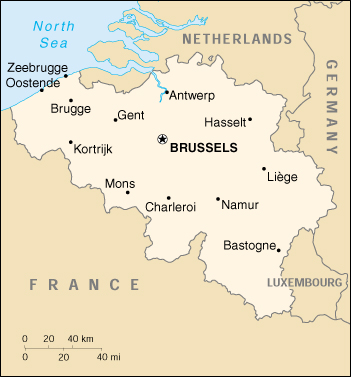
Location: Western Europe, bordering the North Sea, between France and the Netherlands
Geographic coordinates: 50 50 N, 4 00 E
Area:
total: 30,510 sq. km
land: 30,230 sq. km
water: 280 sq. km
Land boundaries:
total: 1,385 km
border countries: France 620 km, Germany 167 km, Luxembourg 148 km, Netherlands 450 km
Coastline: 66 km
Maritime claims:
continental shelf: median line with neighbors
exclusive fishing zone: median line with neighbors (extends about 68 km from coast)
territorial sea: 12 nm
Climate: temperate; mild winters, cool summers; rainy, humid, cloudy
Terrain: flat coastal plains in northwest, central rolling hills, rugged mountains of Ardennes Forest in southeast
Elevation extremes:
lowest point: North Sea 0 m
highest point: Signal de Botrange 694 m
Natural resources: coal, natural gas
Land use:
arable land: 24%
permanent crops: 1%
permanent pastures: 20%
forests and woodland: 21%
other: 34%
Natural hazards: flooding is a threat in areas of reclaimed coastal land, protected from the sea by concrete dikes
Environment – current issues: the environment is exposed to intense pressures from human activities: urbanization, dense transportation network, industry, intense animal breeding and crop cultivation; air and water pollution also have repercussions for neighboring countries; uncertainties regarding federal and regional responsibilities (now resolved) have impeded progress in tackling environmental challenges
Environment – international agreements:
party to: Air Pollution, Air Pollution-Nitrogen Oxides, Air Pollution-Sulphur 94, Air Pollution-Volatile Organic Compounds, Air Pollution-Sulphur 85, Antarctic-Environmental Protocol, Antarctic-Marine Living Resources, Antarctic Seals, Antarctic Treaty, Biodiversity, Climate Change, Desertification, Endangered Species, Environmental Modification, Hazardous Wastes, Law of the Sea, Marine Dumping, Marine Life Conservation, Nuclear Test Ban, Ozone Layer Protection, Ship Pollution, Tropical Timber 83, Tropical Timber 94, Wetlands
signed, but not ratified: Air Pollution-Persistent Organic Pollutants, Climate Change-Kyoto Protocol
Geography – note: crossroads of Western Europe; majority of West European capitals within 1,000 km of Brussels which is the seat of both the EU and NATO
People of Belgium
Geographically and culturally, Belgium is at the crossroads of Europe, and during the past 2,000 years has witnessed a constant ebb and flow of different races and cultures. Consequently, Belgium is one of Europe’s true melting pots with Celtic, Roman, Germanic, French, Dutch, Spanish, and Austrian cultures having made an imprint.
Today, the Belgians are divided ethnically into the Dutch-speaking Flemings and French-speaking Walloons, with a mixed population in Brussels representing the remainder. About 70,000 German speakers reside in the east.
Population: 10,364,388 (July 2005 est.)
Age structure:
0-14 years: 17.48% (male 916,957; female 876,029)
15-64 years: 65.57% (male 3,390,145; female 3,336,908)
65 years and over: 16.95% (male 709,212; female 1,029,511)
Population growth rate: 0.16%
Birth rate: 10.74 births/1,000 population
Death rate: 10.1 deaths/1,000 population
Net migration rate: 0.97 migrant(s)/1,000 population
Infant mortality rate: 4.7 deaths/1,000 live births
Life expectancy at birth:
total population: 77.96 years
male: 74.63 years
female: 81.46 years
Total fertility rate: 1.61 children born/woman
Nationality:
noun: Belgian(s)
adjective: Belgian
Ethnic groups: Fleming 58%, Walloon 31%, mixed or other 11%
Religions: Roman Catholic 75%, Protestant or other 25%
Languages: Dutch 58%, French 32%, German 10%, legally bilingual
Literacy:
definition: age 15 and over can read and write
total population: 98%
History of Belgium
Belgium derives its name from a Celtic tribe, the Belgae, whom Caesar described as the most courageous tribe of Gaul. However, the Belgae were forced to yield to Roman legions during the first century B.C. For some 300 years thereafter, what is now Belgium flourished as a province of Rome. But Rome’s power gradually lessened. In about A.D. 300, Attila the Hun invaded what is now Germany and pushed Germanic tribes into northern Belgium. About 100 years later, the Germanic tribe of the Franks invaded and took possession of Belgium. The northern part of present-day Belgium became an overwhelmingly Germanized and Germanic- Frankish-speaking area, whereas in the southern part people continued to be Roman and spoke derivatives of Latin. After coming under the rule of the Dukes of Burgundy and, through marriage, passing into the possession of the Hapsburgs, Belgium was occupied by the Spanish (1519-1713) and the Austrians (1713-1794).
Under these various rulers, and especially during the 500 years from the 12th to the 17th century, Ghent, Bruges, Brussels, and Antwerp took turns at being major European centers for commerce, industry (especially textiles) and art. Flemish painting–from Van Eyck and Breugel to Rubens and Van Dyck–became the most prized in Europe. Flemish tapestries hung on the walls of castles throughout Europe.
Following the French Revolution, Belgium was invaded and annexed by Napoleonic France in 1795. It was made a part of the Netherlands by the Congress of Vienna in 1815.
In 1830, Belgium wrested its independence from the Dutch as a result of an uprising of the Belgian people. A constitutional monarchy was established in 1831, with a monarch invited in from the House of Saxe-Coburg Gotha in Germany.
Belgium was invaded by the Germans in 1914 and again in 1940. This, plus disillusionment over postwar Soviet behavior, made Belgium one of the foremost advocates of collective security within the framework of European integration and the Atlantic partnership.
Since 1944, when Belgium was liberated by British, Canadian, and American armies, the nation has lived in security and at a level of increased well-being.
A parliamentary democracy, Belgium has been governed by successive coalitions of two or more political parties, with the centrist Flemish Christian Democratic Party providing the Prime Minister most of the time. Two major political controversies have marked the postwar years: a dispute over King Leopold III’s conduct during World War II (which caused him to abdicate in 1951), and the insistence of the nation’s majority linguistic community–the Flemish–upon a reorganization of the state into autonomous regions.
The last 30 years also have been marked by a rapid economic development of Flanders, which had been largely agricultural and, since the industrial revolution, had become the poorer half of Belgium. This Flemish resurgence has been accompanied by a corresponding shift of political power to the Flemings, who now constitute an absolute majority (58%) of the population.
Belgium Economy
Economy – overview: This modern private enterprise economy has capitalized on its central geographic location, highly developed transport network, and diversified industrial and commercial base. Industry is concentrated mainly in the populous Flemish area in the north, although the government is encouraging investment in the southern region of Wallonia. With few natural resources, Belgium must import substantial quantities of raw materials and export a large volume of manufactures, making its economy unusually dependent on the state of world markets. About three-quarters of its trade is with other EU countries. Belgium’s public debt is expected to fall below 100% of GDP in 2002, and the government has succeeded in balancing is budget. Belgium became a charter member of the European Monetary Union (EMU) in January 1999. Economic growth in 2000 was broad based, putting the government in a good position to pursue its energy market liberalization policies and planned tax cuts.
GDP: purchasing power parity – $259.2 billion (2000 est.)
GDP – real growth rate: 4.1% (2000 est.)
GDP – per capita: purchasing power parity – $25,300 (2000 est.)
GDP – composition by sector:
agriculture: 1.4%
industry: 26%
services: 72.6% (2000 est.)
Population below poverty line: 4%
Household income or consumption by percentage share:
lowest 10%: 3.7%
highest 10%: 20.2% (1992)
Inflation rate (consumer prices): 2.2% (2000 est.)
Labor force: 4.341 million (1999)
Labor force – by occupation: services 73%, industry 25%, agriculture 2% (1999 est.)
Unemployment rate: 8.4% (2000 est.)
Budget:
revenues: $114.8 billion
expenditures: $117 billion, including capital expenditures of $7.6 billion (1999)
Industries: engineering and metal products, motor vehicle assembly, processed food and beverages, chemicals, basic metals, textiles, glass, petroleum, coal
Industrial production growth rate: 5.5% (2000 est.)
Electricity – production: 79.829 billion kWh (1999)
Electricity – production by source:
fossil fuel: 40.01%
hydro: 0.42%
nuclear: 58.33%
other: 1.24% (1999)
Electricity – consumption: 75.089 billion kWh (1999)
Electricity – exports: 8.207 billion kWh (1999)
Electricity – imports: 9.055 billion kWh (1999)
Agriculture – products: sugar beets, fresh vegetables, fruits, grain, tobacco; beef, veal, pork, milk
Exports: $181.4 billion (f.o.b., 2000)
Exports – commodities: machinery and equipment, chemicals, diamonds, metals and metal products
Exports – partners: EU 76% (Germany 18%, France 18%, Netherlands 12%, UK 10%) (1999)
Imports: $166 billion (c.i.f., 2000)
Imports – commodities: machinery and equipment, chemicals, metals and metal products
Imports – partners: EU 71% (Germany 18%, Netherlands 17%, France 14%, UK 9%) (1999)
Debt – external: $28.3 billion (1999 est.)
Economic aid – donor: ODA, $764 million (1997)
Currency: 1 Belgian franc (BF) = 100 centimes
Map of Belgium