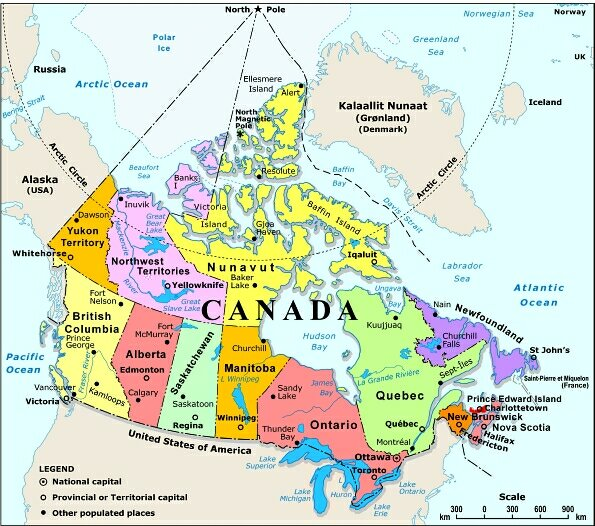
Background: A land of vast distances and rich natural resources, Canada became a self-governing dominion in 1867 while retaining ties to the British crown. Economically and technologically the nation has developed in parallel with the US, its neighbor to the south across an unfortified border. Its paramount political problem continues to be the relationship of the province of Quebec, with its French-speaking residents and unique culture, to the remainder of the country.
Form of Government
Federal parliamentary democracy
Capital Ottawa
Currency: 1 Canadian dollar (Can$) = 100 cents
Geography of Canada
Location: Northern North America, bordering the North Atlantic Ocean and North Pacific Ocean, north of the conterminous US.
Area:
total: 9,976,140 sq. km
land: 9,220,970 sq. km
water: 755,170 sq. km
Land boundaries:
total: 8,893 km
border countries: US 8,893 km (includes 2,477 km with Alaska)
Coastline: 243,791 km
Climate: varies from temperate in south to subarctic and arctic in north
Terrain: mostly plains with mountains in west and lowlands in southeast
Elevation extremes:
lowest point: Atlantic Ocean 0 m
highest point: Mount Logan 5,959 m
Natural resources: iron ore, nickel, zinc, copper, gold, lead, molybdenum, potash, silver, fish, timber, wildlife, coal, petroleum, natural gas, hydropower
Land use:
arable land: 5%
permanent crops: 0%
permanent pastures: 3%
forests and woodland: 54%
other: 38% (1993 est.)
Irrigated land: 7,100 sq. km (1993 est.)
Natural hazards: continuous permafrost in north is a serious obstacle to development; cyclonic storms form east of the Rocky Mountains, a result of the mixing of air masses from the Arctic, Pacific, and North American interior, and produce most of the country’s rain and snow.
Environment – current issues: air pollution and resulting acid rain severely affecting lakes and damaging forests; metal smelting, coal-burning utilities, and vehicle emissions impacting on agricultural and forest productivity; ocean waters becoming contaminated due to agricultural, industrial, mining, and forestry activities.
Environment – international agreements:
party to: Air Pollution, Air Pollution-Nitrogen Oxides, Air Pollution-Persistent Organic Pollutants, Air Pollution-Sulphur 85, Air Pollution-Sulphur 94, Antarctic-Marine Living Resources, Antarctic Seals, Antarctic Treaty, Biodiversity, Climate Change, Desertification, Endangered Species, Environmental Modification, Hazardous Wastes, Marine Dumping, Nuclear Test Ban, Ozone Layer Protection, Ship Pollution, Tropical Timber 83, Tropical Timber 94, Wetlands
signed, but not ratified: Air Pollution-Volatile Organic Compounds, Antarctic-Environmental Protocol, Climate Change-Kyoto Protocol, Law of the Sea, Marine Life Conservation
Geography – note: second-largest country in world (after Russia); strategic location between Russia and US via north polar route; approximately 85% of the population is concentrated within 300 km of the US/Canada border.
People of Canada
Population: 32,805,041 (July 2005 est.)
Age structure:
0-14 years: 18.95%
15-64 years: 68.28%
65 years and over: 12.77%
Population growth rate: 0.99%
Birth rate: 11.21 births/1,000 population
Death rate: 7.47 deaths/1,000 population
Net migration rate: 6.13 migrant(s)/1,000 population
Infant mortality rate: 5.02 deaths/1,000 live births
Life expectancy at birth:
total population: 79.56 years
male: 76.16 years
female: 83.13 years
Total fertility rate: 1.6 children born/woman
Nationality:
noun: Canadian(s)
adjective: Canadian
Ethnic groups: British Isles origin 28%, French origin 23%, other European 15%, Amerindian 2%, other, mostly Asian, African, Arab 6%, mixed background 26%
Religions: Roman Catholic 42%, Protestant 40%, other 18%
Languages: English 59.3% (official), French 23.2% (official), other 17.5%
Literacy:
definition: age 15 and over can read and write
total population: 97% (1986 est.)
Canada Economy
Economy – overview: As an affluent, high-tech industrial society, Canada today closely resembles the United States in its market-oriented economic system, pattern of production, and high living standards. Since World War II, the impressive growth of the manufacturing, mining, and service sectors has transformed the nation from a largely rural economy into one primarily industrial and urban. Real rates of growth have averaged nearly 3.0% since 1993. Unemployment is falling and government budget surpluses are being partially devoted to reducing the large public sector debt. The 1989 US-Canada Free Trade Agreement (FTA) and 1994 North American Free Trade Agreement (NAFTA) (which included Mexico) have touched off a dramatic increase in trade and economic integration with the US. With its great natural resources, skilled labor force, and modern capital plant Canada enjoys solid economic prospects. Two shadows loom, the first being the continuing constitutional impasse between English- and French-speaking areas, which has been raising the possibility of a split in the federation. Another long-term concern is the flow south to the US of professional persons lured by higher pay, lower taxes, and the immense high-tech infrastructure.
GDP: purchasing power parity – $774.7 billion (2000 est.)
GDP – real growth rate: 3.6% (1999 est.), 4.3% (2000 est.)
GDP – per capita: purchasing power parity – $24,800 (2000 est.)
GDP – composition by sector:
agriculture: 3%
industry: 31%
services: 66% (2000 est.)
Household income or consumption by percentage share:
lowest 10%: 2.8%
highest 10%: 23.8% (1994)
Inflation rate (consumer prices): 1.7% (1999), 2.6% (2000)
Labor force: 16.1 million (2000)
Labor force – by occupation: services 74%, manufacturing 15%, construction 5%, agriculture 3%, other 3% (2000)
Unemployment rate: 7.6% (1999), 6.8% (2000 est.)
Budget:
revenues: $126.1 billion
expenditures: $125.3 billion, including capital expenditures of $14.8 billion (2000)
Industries: processed and unprocessed minerals, food products, wood and paper products, transportation equipment, chemicals, fish products, petroleum and natural gas
Industrial production growth rate: 4.3% (1999 est.), 4.5% (2000 est.)
Electricity – production: 567.193 billion kWh (1999)
Electricity – production by source:
fossil fuel: 26.38%
hydro: 60%
nuclear: 12.31%
other: 1.31% (1999)
Electricity – consumption: 497.532 billion kWh (1999)
Electricity – exports: 42.911 billion kWh (1999)
Electricity – imports: 12.953 billion kWh (1999)
Agriculture – products: wheat, barley, oilseed, tobacco, fruits, vegetables; dairy products; forest products; fish
Exports: $272.3 billion (f.o.b., 2000 est.)
Exports – commodities: motor vehicles and parts, newsprint, wood pulp, timber, crude petroleum, machinery, natural gas, aluminum, telecommunications equipment, electricity
Exports – partners: United States 86%, Japan 3%, UK, Germany, South Korea, Netherlands, China (1999)
Imports: $238.2 billion (f.o.b., 2000 est.)
Imports – commodities: machinery and equipment, crude oil, chemicals, motor vehicles and parts, durable consumer goods, electricity
Imports – partners: United States 76%, Japan 3%, UK, Germany, France, Mexico, Taiwan, South Korea (1999)
Debt – external: $1.9 billion (2000)
Economic aid – donor: ODA, $1.3 billion (1999)
Currency: Canadian dollar (CAD)
Map of Canada