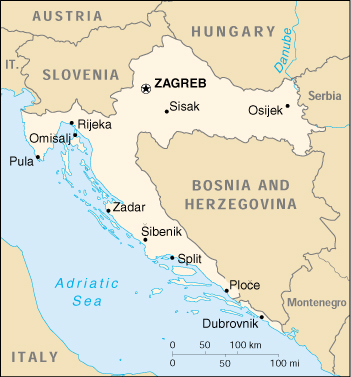
Background: In 1918, the Croats, Serbs, and Slovenes formed a kingdom known after 1929 as Yugoslavia. Following World War II, Yugoslavia became an independent communist state under the strong hand of Marshal TITO. Although Croatia declared its independence from Yugoslavia in 1991, it took four years of sporadic, but often bitter, fighting before occupying Serb armies were mostly cleared from Croatian lands. Under UN supervision the last Serb-held enclave in eastern Slavonia was returned to Croatia in 1998.
Government type: presidential/parliamentary democracy
Capital: Zagreb
Currency: 1 Croatian kuna (HRK) = 100 lipas
Geography of Croatia
Location: Southeastern Europe, bordering the Adriatic Sea, between Bosnia and Herzegovina and Slovenia
Geographic coordinates: 45 10 N, 15 30 E
Area:
total: 56,538 sq. km
land: 56,410 sq. km
water: 128 sq. km
Land boundaries:
total: 2,197 km
border countries: Bosnia and Herzegovina 932 km, Hungary 329 km, Serbia and Montenegro 266 km (241 km with Serbia; 25 km with Montenegro), Slovenia 670 km
Coastline: 5,790 km (mainland 1,778 km, islands 4,012 km)
Maritime claims:
continental shelf: 200-m depth or to the depth of exploitation
territorial sea: 12 nm
Climate: Mediterranean and continental; continental climate predominant with hot summers and cold winters; mild winters, dry summers along coast
Terrain: geographically diverse; flat plains along Hungarian border, low mountains and highlands near Adriatic coastline and islands
Elevation extremes:
lowest point: Adriatic Sea 0 m
highest point: Dinara 1,830 m
Natural resources: oil, some coal, bauxite, low-grade iron ore, calcium, natural asphalt, silica, mica, clays, salt, hydropower
Land use:
arable land: 21%
permanent crops: 2%
permanent pastures: 20%
forests and woodland: 38%
other: 19% (1993 est.)
Irrigated land: 30 sq. km (1993 est.)
Natural hazards: frequent and destructive earthquakes
Environment – current issues: air pollution (from metallurgical plants) and resulting acid rain is damaging the forests; coastal pollution from industrial and domestic waste; landmine removal and reconstruction of infrastructure consequent to 1992-95 civil strife.
Environment – international agreements:
party to: Air Pollution, Air Pollution-Sulphur 94, Biodiversity, Climate Change, Desertification, Endangered Species, Hazardous Wastes, Law of the Sea, Marine Dumping, Nuclear Test Ban, Ozone Layer Protection, Ship Pollution, Wetlands
signed, but not ratified: Air Pollution-Persistent Organic Pollutants, Climate Change-Kyoto Protocol
Geography – note: controls most land routes from Western Europe to Aegean Sea and Turkish Straits.
People of Croatia
Population: 4,495,904 (July 2005 est.)
Age structure:
0-14 years: 18.16%
15-64 years: 66.61%
65 years and over: 15.23%
Population growth rate: 1.48%
Birth rate: 12.82 births/1,000 population
Death rate: 11.41 deaths/1,000 population
Net migration rate: 13.37 migrant(s)/1,000 population
Infant mortality rate: 7.21 deaths/1,000 live births
Life expectancy at birth:
total population: 73.9 years
male: 70.28 years
female: 77.73 years
Total fertility rate: 1.94 children born/woman
Nationality:
noun: Croat(s)
adjective: Croatian
Ethnic groups: Croat 78.1%, Serb 12.2%, Muslim 0.9%, Hungarian 0.5%, Slovenian 0.5%, Czech 0.4%, Albanian 0.3%, Montenegrin 0.3%, Roma 0.2%, others 6.6% (1991)
Religions: Roman Catholic 76.5%, Orthodox 11.1%, Muslim 1.2%, Protestant 0.4%, others and unknown 10.8% (1991)
Languages: Croatian 96%, other 4% (including Italian, Hungarian, Czech, Slovak, and German)
Literacy:
definition: age 15 and over can read and write
total population: 97%
male: 99%
female: 95% (1991 est.)
History of Croatia
The Croats are believed to be a purely Slavic people who migrated from Ukraine and settled in present-day Croatia during the 6th century. After a period of self-rule, Croatians agreed to the Pacta Conventa in 1091, submitting themselves to Hungarian authority. By the mid-1400s, concerns over Ottoman expansion led the Croatian Assembly to invite the Habsburgs, under Archduke Ferdinand, to assume control over Croatia. Habsburg rule proved successful in thwarting the Ottomans, and by the 18th, much of Croatia was free of Turkish control.
In 1868, Croatia gained domestic autonomy while remaining under Hungarian authority. Following World War I and the demise of the Austro-Hungarian Empire, Croatia joined the Kingdom of Serbs, Croats, and Slovenes (The Kingdom of Serbs, Croats, and Slovenes became Yugoslavia in 1929). Yugoslavia changed its name once again after World War II. The new state became the Federal Socialist Republic of Yugoslavia and united Croatia and several other states together under the communistic leadership of Marshall Tito.
After the death of Tito and with the fall of communism throughout eastern Europe, the Yugoslav federation began to crumple. Croatia held its first multi-party elections since World War II in 1990. Long-time Croatian nationalist Franjo Tudjman was elected President, and one year later, Croatians declared independence from Yugoslavia. Conflict between Serbs and Croats in Croatia escalated, and one month after Croatia declared independence, civil war erupted.
The UN mediated a cease-fire in January 1992, but hostilities resumed the next year when Croatia fought to regain a third of the territory lost the previous year. A second cease-fire was enacted in May 1993, followed by a joint declaration the next January between Croatia and Yugoslavia. However, in September 1993, the Croatian Army led an offensive against the Serb-held Republic of Krajina. A third cease-fire was called in March 1994, but it, too, was broken in May and August 1995 after Croatian forces regained large portions of Krajina, prompting an exodus of Serbs from this area. In November 1995, Croatia agreed to peacefully reintegrate Eastern Slavonia, Baranja, and Western Dirmium under terms of the Erdut Agreement. In December 1995, Croatia signed the Dayton peace agreement, committing itself to a permanent cease-fire and the return of all refugees.
The death of President Tudjman in December 1999, followed by the election of a new coalition government and President in early 2000, brought significant changes to Croatia. Croatia’s new government, under the leadership of Prime Minister Racan, has progressed in implementation of the Dayton Peace Accords, regional cooperation, refugee returns, national reconciliation and democratization.
Croatia Economy
The Croats are believed to be a purely Slavic people who migrated from Ukraine and settled in present-day Croatia during the 6th century. After a period of self-rule, Croatians agreed to the Pacta Conventa in 1091, submitting themselves to Hungarian authority. By the mid-1400s, concerns over Ottoman expansion led the Croatian Assembly to invite the Habsburgs, under Archduke Ferdinand, to assume control over Croatia. Habsburg rule proved successful in thwarting the Ottomans, and by the 18th, much of Croatia was free of Turkish control.
In 1868, Croatia gained domestic autonomy while remaining under Hungarian authority. Following World War I and the demise of the Austro-Hungarian Empire, Croatia joined the Kingdom of Serbs, Croats, and Slovenes (The Kingdom of Serbs, Croats, and Slovenes became Yugoslavia in 1929). Yugoslavia changed its name once again after World War II. The new state became the Federal Socialist Republic of Yugoslavia and united Croatia and several other states together under the communistic leadership of Marshall Tito.
After the death of Tito and with the fall of communism throughout eastern Europe, the Yugoslav federation began to crumple. Croatia held its first multi-party elections since World War II in 1990. Long-time Croatian nationalist Franjo Tudjman was elected President, and one year later, Croatians declared independence from Yugoslavia. Conflict between Serbs and Croats in Croatia escalated, and one month after Croatia declared independence, civil war erupted.
The UN mediated a cease-fire in January 1992, but hostilities resumed the next year when Croatia fought to regain a third of the territory lost the previous year. A second cease-fire was enacted in May 1993, followed by a joint declaration the next January between Croatia and Yugoslavia. However, in September 1993, the Croatian Army led an offensive against the Serb-held Republic of Krajina. A third cease-fire was called in March 1994, but it, too, was broken in May and August 1995 after Croatian forces regained large portions of Krajina, prompting an exodus of Serbs from this area. In November 1995, Croatia agreed to peacefully reintegrate Eastern Slavonia, Baranja, and Western Dirmium under terms of the Erdut Agreement. In December 1995, Croatia signed the Dayton peace agreement, committing itself to a permanent cease-fire and the return of all refugees.
The death of President Tudjman in December 1999, followed by the election of a new coalition government and President in early 2000, brought significant changes to Croatia. Croatia’s new government, under the leadership of Prime Minister Racan, has progressed in implementation of the Dayton Peace Accords, regional cooperation, refugee returns, national reconciliation and democratization.
Map of Croatia