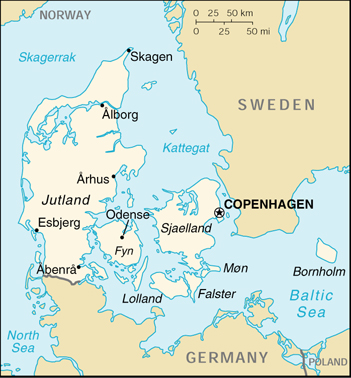
Background: Once the seat of Viking raiders and later a major north European power, Denmark has evolved into a modern, prosperous nation that is participating in the political and economic integration of Europe. So far, however, the country has opted out of some aspects of the European Union’s Maastricht Treaty, including the economic and monetary system (EMU) and issues concerning certain internal affairs.
Government type: constitutional monarchy
Capital: Copenhagen
Currency: 1 Danish krone (DKr) = 100 oere
Geography of Denmark
Location: Northern Europe, bordering the Baltic Sea and the North Sea, on a peninsula north of Germany
Geographic coordinates: 56 00 N, 10 00 E
Map references: Europe
Area:
total: 43,094 sq. km
land: 42,394 sq. km
water: 700 sq. km
note: includes the island of Bornholm in the Baltic Sea and the rest of metropolitan Denmark, but excludes the Faroe Islands and Greenland
Land boundaries:
total: 68 km
border countries: Germany 68 km
Coastline: 7,314 km
Maritime claims:
contiguous zone: 24 nm
continental shelf: 200-m depth or to the depth of exploitation
exclusive economic zone: 200 nm
territorial sea: 12 nm
Climate: temperate; humid and overcast; mild, windy winters and cool summers
Terrain: low and flat to gently rolling plains
Elevation extremes:
lowest point: Lammefjord -7 m
highest point: Ejer Bavnehoj 173 m
Natural resources: petroleum, natural gas, fish, salt, limestone, stone, gravel and sand
Land use:
arable land: 60%
permanent crops: 0%
permanent pastures: 5%
forests and woodland: 10%
other: 25% (1993 est.)
Irrigated land: 4,350 sq. km (1993 est.)
Natural hazards: flooding is a threat in some areas of the country (e.g., parts of Jutland, along the southern coast of the island of Lolland) that are protected from the sea by a system of dikes.
Environment – current issues: air pollution, principally from vehicle and power plant emissions; nitrogen and phosphorus pollution of the North Sea; drinking and surface water becoming polluted from animal wastes and pesticides.
Environment – international agreements:
party to: Air Pollution, Air Pollution-Nitrogen Oxides, Air Pollution-Sulphur 85, Air Pollution-Sulphur 94, Air Pollution-Volatile Organic Compounds, Antarctic Treaty, Biodiversity, Climate Change, Desertification, Endangered Species, Environmental Modification, Hazardous Wastes, Marine Dumping, Marine Life Conservation, Nuclear Test Ban, Ozone Layer Protection, Ship Pollution, Tropical Timber 83, Tropical Timber 94, Wetlands, Whaling
signed, but not ratified: Air Pollution-Persistent Organic Pollutants, Antarctic-Environmental Protocol, Climate Change-Kyoto Protocol, Law of the Sea
Geography – note: controls Danish Straits (Skagerrak and Kattegat) linking Baltic and North Seas; about one-quarter of the population lives in Copenhagen
People of Denmark
The Danes, a homogenous Gothic-Germanic people, have inhabited Denmark since prehistoric times. Danish is the principal language. A small German-speaking minority lives in southern Jutland; a mostly Inuit population inhabits Greenland; and the Faroe Islands have a Nordic population with its own language. Education is compulsory from ages seven to 16 and is free through the university level.
The Evangelical Lutheran Church is state supported and accounts for about 95% of Denmark’s religious affiliation. Denmark has religious freedom, however, and several other Protestant denominations and other religions exist.
Population: 5,432,335 (July 2005 est.)
Age structure:
0-14 years: 18.59%
15-64 years: 66.56%
65 years and over: 14.85%
Population growth rate: 0.3%
Birth rate: 11.96 births/1,000 population
Death rate: 10.9 deaths/1,000 population
Net migration rate: 1.98 migrant(s)/1,000 population
Infant mortality rate: 5.04 deaths/1,000 live births
Life expectancy at birth:
total population: 76.72 years
male: 74.12 years
female: 79.47 years
Total fertility rate: 1.73 children born/woman
Nationality:
noun: Dane(s)
adjective: Danish
Ethnic groups: Scandinavian, Inuit, Faroese, German, Turkish, Iranian, Somali
Religions: Evangelical Lutheran 95%, other Protestant and Roman Catholic 3%, Muslims 2%
Languages: Danish, Faroese, Greenlandic (an Inuit dialect), German (small minority)
note: English is the predominant second language
Literacy:
definition: age 15 and over can read and write
total population: 100%
History of Denmark
During the Viking period (9th-11th centuries), Denmark was a great power based on the Jutland Peninsula, the Island of Zealand, and the southern part of what is now Sweden. In the early 11th century, King Canute united Denmark and England for almost 30 years.
Viking raids brought Denmark into contact with Christianity, and in the 12th century, crown and church influence increased. By the late 13th century, royal power had waned, and the nobility forced the king to grant a charter, considered Denmark’s first constitution. Although the struggle between crown and nobility continued into the 14th century, Queen Margrethe I succeeded in uniting Denmark, Norway, Sweden, Finland, the Faroe Islands, Iceland, and Greenland under the Danish crown. Sweden and Finland left the union in 1520; however, Norway remained until 1814. Iceland, in a “personal union” under the king of Denmark after 1918, became independent in 1944.
The Reformation was introduced in Denmark in 1536. Denmark’s provinces in today’s southwestern Sweden were lost in 1658, and Norway was transferred from the Danish to the Swedish crown in 1814, following the defeat of Napoleon, with whom Denmark was allied.
The Danish liberal movement gained momentum in the 1830s, and in 1849 Denmark became a constitutional monarchy. After the war with Prussia and Austria in 1864, Denmark was forced to cede Schleswig-Holstein to Prussia and adopt a policy of neutrality. Toward the end of the 19th century, Denmark inaugurated important social and labor market reforms, laying the basis for the present welfare state.
Denmark remained neutral during World War I. Despite its declaration of neutrality at the beginning of World War II, it was invaded by the Germans in 1940 and occupied until it was liberated by the Allied forces in May 1945. Denmark became a charter member of the United Nations and was one of the original signers of the North Atlantic Treaty.
Denmark’s rich intellectual heritage contributes to the cultural achievements of the modern world. The astronomical discoveries of Tycho Brahe (1546-1601) and the brilliant contributions to atomic physics of Niels Bohr (1885-1962) indicate the range of Danish scientific achievement. The fairy tales of Hans Christian Andersen (1805-75), the philosophical essays of Soren Kierkegaard (1813-55), and the short stories of Karen Blixen (penname Isak Dinesen, 1885-1962) have earned international recognition, as have the symphonies of Carl Nielsen (1865-1931). Danish applied art and industrial design have won awards for excellence. The name of Georg Jensen (1866-1935) is known worldwide for outstanding modern design in silver, and “Royal Copenhagen” is among the finest porcelains.
Denmark Economy
Economy – overview: This thoroughly modern market economy features high-tech agriculture, up-to-date small-scale and corporate industry, extensive government welfare measures, comfortable living standards, and high dependence on foreign trade. Denmark is a net exporter of food and energy and has a comfortable balance of payments surplus. The center-left coalition government has reduced the formerly high unemployment rate and attained a budget surplus as well as followed the previous government’s policies of maintaining low inflation and a stable currency. The coalition has lowered marginal income tax rates and raised environmental taxes thus maintaining overall tax revenues. Problems of bottlenecks, and longer term demographic changes reducing the labor force, are being addressed through labor market reforms. The government has been successful in meeting, and even exceeding, the economic convergence criteria for participating in the third phase (a common European currency) of the European Monetary Union (EMU), but Denmark, in a September 2000 referendum, reconfirmed its decision not to join the 11 other EU members in the euro. Even so, the Danish currency remains pegged to the euro.
GDP: purchasing power parity – $136.2 billion (2000 est.)
GDP – real growth rate: 1.3% (1999 est.), 2.8% (2000 est.)
GDP – per capita: purchasing power parity – $25,500 (2000 est.)
GDP – composition by sector:
agriculture: 3%
industry: 25%
services: 72% (2000 est.)
Household income or consumption by percentage share:
lowest 10%: 2%
highest 10%: 24% (2000 est.)
Inflation rate (consumer prices): 2.5% (1999 est.), 2.9% (2000 est.)
Labor force: 2.856 million (2000 est.)
Labor force – by occupation: services 79%, industry 17%, agriculture 4% (2000 est.)
Unemployment rate: 5.7% (1999 est.), 5.3% (2000)
Budget:
revenues: $52.9 billion
expenditures: $51.3 billion, including capital expenditures of $500 million (2001 est.)
Industries: food processing, machinery and equipment, textiles and clothing, chemical products, electronics, construction, furniture, and other wood products, shipbuilding, windmills.
Industrial production growth rate: 1.5% (1999 est.), 3% (2000 est.)
Electricity – production: 37.885 billion kWh (1999)
Electricity – production by source:
fossil fuel: 88.4%
hydro: 0.07%
nuclear: 0%
other: 11.53% (1999)
Electricity – consumption: 32.916 billion kWh (1999)
Electricity – exports: 7.28 billion kWh (1999)
Electricity – imports: 4.963 billion kWh (1999)
Agriculture – products: grain, potatoes, rape, sugar beets; pork and beef, dairy products; fish
Exports: $49.5 billion (f.o.b., 1999), $50.8 billion (f.o.b., 2000)
Exports – commodities: machinery and instruments, meat and meat products, dairy products, fish, chemicals, furniture, ships, windmills
Exports – partners: EU 66.5% (Germany 20.1%, Sweden 11.7%, UK 9.6%, France 5.3%, Netherlands 4.7%), Norway 5.8%, US 5.4% (1999)
Imports: $43.9 billion (f.o.b., 1999), $43.6 billion (f.o.b., 2000)
Imports – commodities: machinery and equipment, raw materials and semi-manufactures for industry, chemicals, grain and foodstuffs, consumer goods
Imports – partners: EU 72.1% (Germany 21.6%, Sweden 12.4%, UK 8.0%, Netherlands 8.0%, France 5.8%), Norway 4.2%, US 4.5% (1999)
Debt – external: $44 billion (1996 est.), $21.7 billion (2000)
Economic aid – donor: ODA, $1.63 billion (1999)
Currency: Danish krone (DKK)
Map of Denmark