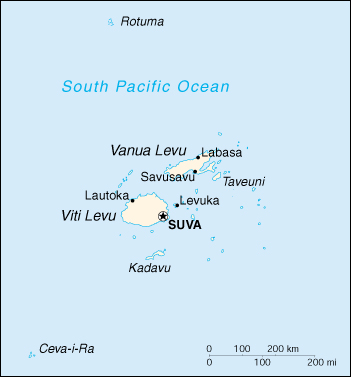
Background: Fiji became independent in 1970, after nearly a century as a British colony. Democratic rule was interrupted by two military coups in 1987, caused by concern over a government perceived as dominated by the Indian community (descendants of contract laborers brought to the islands by the British in the 19th century). A 1990 constitution favored native Melanesian control of Fiji, but led to heavy Indian emigration; the population loss resulted in economic difficulties, but ensured that Melanesians became the majority. Amendments enacted in 1997 made the constitution more equitable. Free and peaceful elections in 1999 resulted in a government led by an Indo-Fijian, but a coup in May of 2000 ushered in a prolonged period of political turmoil. New elections are scheduled for August 2001.
Government type: republic
note: military coup leader Maj. Gen. Sitiveni RABUKA formally declared Fiji a republic on 6 October 1987.
Capital: Suva
Currency: 1 Fijian dollar (F$) = 100 cents
Geography of Fiji
Location: Oceania, island group in the South Pacific Ocean, about two-thirds of the way from Hawaii to New Zealand
Geographic coordinates: 18 00 S, 175 00 E
Area:
total: 18,270 sq. km
land: 18,270 sq. km
water: 0 sq. km
Land boundaries: 0 km
Coastline: 1,129 km
Maritime claims: measured from claimed archipelagic baselines
continental shelf: 200-m depth or to the depth of exploitation; rectilinear shelf claim added
exclusive economic zone: 200 nm
territorial sea: 12 nm
Climate: tropical marine; only slight seasonal temperature variation
Terrain: mostly mountains of volcanic origin
Elevation extremes:
lowest point: Pacific Ocean 0 m
highest point: Tomanivi 1,324 m
Natural resources: timber, fish, gold, copper, offshore oil potential, hydropower
Land use:
arable land: 10%
permanent crops: 4%
permanent pastures: 10%
forests and woodland: 65%
other: 11% (1993 est.)
Irrigated land: 10 sq. km (1993 est.)
Natural hazards: cyclonic storms can occur from November to January
Environment – current issues: deforestation; soil erosion
Environment – international agreements:
party to: Biodiversity, Climate Change, Climate Change-Kyoto Protocol, Desertification, Endangered Species, Law of the Sea, Marine Life Conservation, Nuclear Test Ban, Ozone Layer Protection, Tropical Timber 83, Tropical Timber 94.
Geography – note: includes 332 islands of which approximately 110 are inhabited
People of Fiji
More than half of Fiji’s population lives on the island coasts, either in Suva or in smaller urban centers. The interior is sparsely populated due to its rough terrain.
Indigenous Fijians are a mixture of Polynesian and Melanesian, resulting from the original migrations to the South Pacific many centuries ago. The Indo-Fijian population has grown rapidly from the 60,000 indentured laborers brought from India between 1879 and 1916 to work in the sugarcane fields. Thousands more Indians migrated voluntarily in the 1920s and 1930s and formed the core of Fiji’s business class. The native Fijians live throughout the country, while the Indo-Fijians reside primarily near the urban centers and in the cane-producing areas of the two main islands. Nearly all of the indigenous Fijians are Christian, with more than three-quarters being Methodist. About 80% of the Indo-Fijians are Hindu, 15% are Muslim, and the rest mostly Sikh, with a few Christians.
Population: 893,354 (July 2005 est.)
Age structure:
0-14 years: 32.92%
15-64 years: 63.52%
65 years and over: 3.56%
Population growth rate: 1.41%
Birth rate: 23.33 births/1,000 population
Death rate: 5.75 deaths/1,000 population
Net migration rate: -3.45 migrant(s)/1,000 population
Infant mortality rate: 14.08 deaths/1,000 live births
Life expectancy at birth:
total population: 68.25 years
male: 65.83 years
female: 70.78 years
Total fertility rate: 2.86 children born/woman
Nationality:
noun: Fijian(s)
adjective: Fijian
Ethnic groups: Fijian 51% (predominantly Melanesian with a Polynesian admixture), Indian 44%, European, other Pacific Islanders, overseas Chinese, and other 5% (1998 est.)
Religions: Christian 52% (Methodist 37%, Roman Catholic 9%), Hindu 38%, Muslim 8%, other 2%
note: Fijians are mainly Christian, Indians are Hindu, and there is a Muslim minority
Languages: English (official), Fijian, Hindustani
Literacy:
definition: age 15 and over can read and write
total population: 91.6%
male: 93.8%
female: 89.3% (1995 est.)
History of Fiji
Melanesian and Polynesian peoples settled the Fijian islands some 3,500 years ago. European traders and missionaries arrived in the first half of the 19th century, and the resulting disruption led to increasingly serious wars among the native Fijian confederacies. One ratu (chief), Cakobau, gained limited control over the western islands by the 1850s, but the continuing unrest led a convention of chiefs to cede Fiji unconditionally to the British in 1874.
The pattern of colonialism in Fiji during the following century was similar to that in other British possessions: the pacification of the countryside, the spread of plantation agriculture, and the introduction of Indian indentured labor. Many traditional institutions, including the system of communal land ownership, were maintained.
Fiji soldiers fought alongside the Allies in the Second World War, gaining a fine reputation in the tough Solomon Islands campaign. The United States and other allied countries maintained military installations in Fiji during the war, but Fiji itself never came under attack.
In April 1970, a constitutional conference in London agreed that Fiji should become a fully sovereign and independent nation within the Commonwealth. Fiji became independent on October 10, 1970.
Post-independence politics came to be dominated by the Alliance Party of Ratu Sir Kamisese Mara. The Indian-led opposition won a majority of House seats in 1977, but failed to form a government out of concern that indigenous Fijians would not accept Indo-Fijian leadership. In April 1987, a coalition led by Dr. Timoci Bavadra, an ethnic Fijian supported by the Indo-Fijian community, won the general election and formed Fiji’s first majority Indian government, with Dr. Bavadra serving as Prime Minister. Less than a month later, Dr. Bavadra was forcibly removed from power during a military coup led by Lt. Col. Sitiveni Rabuka on May 14, 1987.
After a period of continued jockeying and negotiation, Rabuka staged a second coup on September 25, 1987. The military government revoked the constitution and declared Fiji a republic on October 10. This action, coupled with protests by the Government of India, led to Fiji’s expulsion from the Commonwealth and official nonrecognition of the Rabuka regime from foreign governments, including Australia and New Zealand. On December 6, Rabuka resigned as head of state and Governor-General Ratu Sir Penaia Ganilau was appointed the first President of the Fijian Republic. Mara was reappointed Prime Minister, and Rabuka became Minister of Home Affairs.
The new government drafted a new constitution that went into force in July 1990. Under its terms, majorities were reserved for ethnic Fijians in both houses of the legislature. Previously, in 1989, the government had released statistical information showing that for the first time since 1946, ethnic Fijians were a majority of the population. More than 12,000 Indo-Fijians and other minorities had left the country in the 2 years following the 1987 coups. After resigning from the military, Rabuka became Prime Minister under the new constitution in 1993.
Ethnic tensions simmered in 1995-96 over the renewal of Indo-Fijian land leases and political maneuvering surrounding the mandated 7-year review of the 1990 constitution. The Constitutional Review Commission produced a draft constitution which expanded the size of the legislature, lowered the proportion of seats reserved by ethnic group, reserved the presidency for ethnic Fijians but opened the position of prime minister to all races. Prime Minister Rabuka and President Mara supported the proposal, while the nationalist indigenous Fijian parties opposed it. The reformed constitution was approved in July 1997. Fiji was readmitted to the Commonwealth in October.
The first legislative elections held under the new constitution took place in May 1999. Rabuka’s coalition was defeated by Indo-Fijian parties led by Mahendra Chaudhry, who became Fiji’s first Indo-Fijian prime minister. One year later, in May 2000, Chaudhry and most other members of parliament were taken hostage in the House of Representatives by gunmen led by ethnic Fijian nationalist George Speight. The standoff dragged on for 8 weeks–during which time Chaudhry was removed from office by the then-president due to his incapacitation–before the Fijian military seized power and brokered a negotiated end to the situation, then arrested Speight when he violated its terms. Former banker Laisenia Qarase was named interim prime minister and head of the interim civilian government by the military and Great Council of Chiefs in July. A constitutional review commission is in the process of drafting a new constitution. The timetable for elections to replace the interim government is still under discussion.
Fiji Economy
Economy – overview: Fiji, endowed with forest, mineral, and fish resources, is one of the most developed of the Pacific island economies, though still with a large subsistence sector. Sugar exports and a growing tourist industry are the major sources of foreign exchange. Sugar processing makes up one-third of industrial activity. Roughly 300,000 tourists visit each year, including thousands of Americans following the start of regularly scheduled non-stop air service from Los Angeles. Fiji’s growth slowed in 1997 because the sugar industry suffered from low world prices and rent disputes between farmers and landowners. Drought in 1998 further damaged the sugar industry, but its recovery in 1999 contributed to robust GDP growth. Long-term problems include low investment and uncertain property rights. The political turmoil in Fiji has had a severe impact with the economy shrinking by 8% in 1999 and over 7,000 people losing their jobs. The interim government’s 2001 budget is an attempt to attract foreign investment and restart economic activity. The government’s ability to manage the budget and fulfill predictions of 4% growth for 2001 will depend on a return to stability, a regaining of investor confidence, and the absence of international sanctions (which could cripple Fiji’s sugar and textile industry).
GDP: purchasing power parity – $5.9 billion (1999 est.)
GDP – real growth rate: 7.8% (1999 est.)
GDP – per capita: purchasing power parity – $7,300 (1999 est.)
GDP – composition by sector:
agriculture: 16%
industry: 30%
services: 54% (1999 est.)
Inflation rate (consumer prices): 0% (1999 est.)
Labor force: 235,000
Labor force – by occupation: subsistence agriculture 67%, wage earners 18%, salary earners 15% (1987)
Unemployment rate: 6% (1997 est.)
Budget:
revenues: $610 million
expenditures: $501 million, including capital expenditures of $NA (1999 est.)
Industries: tourism, sugar, clothing, copra, gold, silver, lumber, small cottage industries
Industrial production growth rate: 2.9% (1995)
Electricity – production: 510 million kWh (1999)
Electricity – production by source:
fossil fuel: 17.65%
hydro: 82.35%
nuclear: 0%
other: 0% (1999)
Agriculture – products: sugarcane, coconuts, cassava (tapioca), rice, sweet potatoes, bananas; cattle, pigs, horses, goats; fish
Exports: $537 million (f.o.b., 1999)
Exports – commodities: sugar, garments, gold, timber, fish
Exports – partners: Australia 33.1%, US 14.8%, UK 13.8%, other Pacific island countries 8.8%, NZ 4.5%, Japan 4.5% (1999)
Imports: $653 million (f.o.b., 1999)
Imports – commodities: manufactured goods, machinery and transport equipment, petroleum products, food, chemicals
Imports – partners: Australia 41.9%, US 14%, NZ 13.3%, Japan 4.8%, Taiwan 1.9% (1999)
Debt – external: $193 million (1998)
Economic aid – recipient: $40.3 million (1995)
Currency: Fijian dollar (FJD)
Map of Fiji