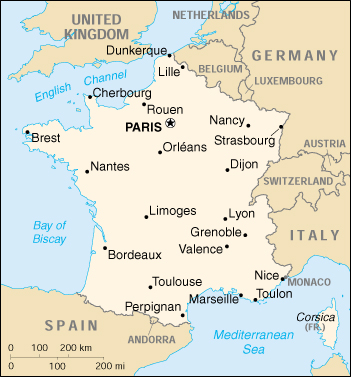
Background: Although ultimately a victor in World Wars I and II, France suffered extensive losses in its empire, wealth, manpower, and rank as a dominant nation-state. Nevertheless, France today is one of the most modern countries in the world and is a leader among European nations. Since 1958, it has constructed a presidential democracy resistant to the instabilities experienced in earlier parliamentary democracies. In recent years, its reconciliation and cooperation with Germany have proved central to the economic integration of Europe, including the advent of the euro in January 1999. Presently, France is at the forefront of European states seeking to exploit the momentum of monetary union to advance the creation of a more unified and capable European defense and security apparatus.
Government type: republic
Capital: Paris
Currency: 1 French franc (F) = 100 centimes; euro (EUR)
Geography of France
Location: Western Europe, bordering the Bay of Biscay and English Channel, between Belgium and Spain, southeast of the UK; bordering the Mediterranean Sea, between Italy and Spain.
Geographic coordinates: 46 00 N, 2 00 E
Area:
total: 547,030 sq. km
land: 545,630 sq. km
water: 1,400 sq. km
note: includes only metropolitan France, but excludes the overseas administrative divisions
Land boundaries:
total: 2,889 km
border countries: Andorra 56.6 km, Belgium 620 km, Germany 451 km, Italy 488 km, Luxembourg 73 km, Monaco 4.4 km, Spain 623 km, Switzerland 573 km
Coastline: 3,427 km
Maritime claims:
contiguous zone: 24 nm
continental shelf: 200-m depth or to the depth of exploitation
exclusive economic zone: 200 nm (does not apply to the Mediterranean)
territorial sea: 12 nm
Climate: generally cool winters and mild summers, but mild winters and hot summers along the Mediterranean
Terrain: mostly flat plains or gently rolling hills in north and west; remainder is mountainous, especially Pyrenees in south, Alps in east
Elevation extremes:
lowest point: Rhone River delta -2 m
highest point: Mont Blanc 4,807 m
Natural resources: coal, iron ore, bauxite, fish, timber, zinc, potash
Land use:
arable land: 33%
permanent crops: 2%
permanent pastures: 20%
forests and woodland: 27%
other: 18% (1993 est.)
Irrigated land: 16,300 sq km (1995 est.)
Natural hazards: flooding; avalanches
Environment – current issues: some forest damage from acid rain (major forest damage occurred as a result of severe December 1999 windstorm); air pollution from industrial and vehicle emissions; water pollution from urban wastes, agricultural runoff.
Environment – international agreements:
party to: Air Pollution, Air Pollution-Nitrogen Oxides, Air Pollution-Sulphur 85, Air Pollution-Sulphur 94, Air Pollution-Volatile Organic Compounds, Antarctic-Environmental Protocol, Antarctic-Marine Living Resources, Antarctic Seals, Antarctic Treaty, Biodiversity, Climate Change, Desertification, Endangered Species, Hazardous Wastes, Law of the Sea, Marine Dumping, Marine Life Conservation, Ozone Layer Protection, Ship Pollution, Tropical Timber 83, Tropical Timber 94, Wetlands, Whaling
signed, but not ratified: Air Pollution-Persistent Organic Pollutants, Climate Change-Kyoto Protocol
Geography – note: largest West European nation
People of France
Since prehistoric times, France has been a crossroads of trade, travel, and invasion. Three basic European ethnic stocks–Celtic, Latin, and Teutonic (Frankish)–have blended over the centuries to make up its present population. France’s birth rate was among the highest in Europe from 1945 until the late 1960s. Since then, its birth rate has fallen but remains higher than that of most other west European countries. Traditionally, France has had a high level of immigration. About 90% of the people are Roman Catholic, less than 2% are Protestant, and about 1% are Jewish. More than 1 million Muslims immigrated in the 1960s and early 1970s from North Africa, especially Algeria. At the end of 1994, there were about 5 million persons of Muslim descent living in France.
Education is free, beginning at age 2, and mandatory between ages 6 and 16. The public education system is highly centralized. Private education is primarily Roman Catholic. Higher education in France began with the founding of the University of Paris in 1150. It now consists of 69 universities and special schools, such as the Grandes Ecoles, technical colleges, and vocational training institutions.
The French language derives from the vernacular Latin spoken by the Romans in Gaul, although it includes many Celtic and Germanic words. French has been an international language for centuries and is a common second language throughout the world. It is one of five official languages at the United Nations. In Africa, Asia, the Pacific, and the West Indies, French has been a unifying factor, particularly in those countries where it serves as the only common language among a variety of indigenous languages and dialects.
Population: 60,656,178 (July 2005 est.)
Age structure:
0-14 years: 18.68%
15-64 years: 65.19%
65 years and over: 16.13%
Population growth rate: 0.37%
Birth rate: 12.1 births/1,000 population
Death rate: 9.09 deaths/1,000 population
Net migration rate: 0.64 migrant(s)/1,000 population
Infant mortality rate: 4.46 deaths/1,000 live births
Life expectancy at birth:
total population: 78.9 years
male: 75.01 years
female: 83.01 years
Total fertility rate: 1.75 children born/woman
Nationality:
noun: Frenchman(men), Frenchwoman(women)
adjective: French
Ethnic groups: Celtic and Latin with Teutonic, Slavic, North African, Indochinese, Basque minorities
Religions: Roman Catholic 90%, Protestant 2%, Jewish 1%, Muslim (North African workers) 3%, unaffiliated 4%
Languages: French 100%, rapidly declining regional dialects and languages (Provencal, Breton, Alsatian, Corsican, Catalan, Basque, Flemish)
Literacy:
definition: age 15 and over can read and write
total population: 99%
male: 99%
female: 99% (1980 est.)
History of France
France was one of the earliest countries to progress from feudalism into the era of the nation-state. Its monarchs surrounded themselves with capable ministers, and French armies were among the most innovative, disciplined, and professional of their day.
During the reign of Louis XIV (1643-1715), France was the dominant power in Europe. But overly ambitious projects and military campaigns of Louis and his successors led to chronic financial problems in the 18th century. Deteriorating economic conditions and popular resentment against the complicated system of privileges granted the nobility and clerics were among the principal causes of the French Revolution (1789-94).
Although the revolutionaries advocated republican and egalitarian principles of government, France reverted to forms of absolute rule or constitutional monarchy four times–the Empire of Napoleon, the Restoration of Louis XVIII, the reign of Louis-Philippe, and the Second Empire of Napoleon III. After the Franco-Prussian War (1870), the Third Republic was established and lasted until the military defeat of 1940.
World War I (1914-18) brought great losses of troops and materiel. In the 1920s, France established an elaborate system of border defenses (the Maginot Line) and alliances to offset resurgent German strength. France was defeated early in World War II, however, and occupied in June 1940. The German victory left the French groping for a new policy and new leadership suited to the circumstances. On July 10, 1940, the Vichy government was established. Its senior leaders acquiesced in the plunder of French resources, as well as the sending of French forced labor to Germany; in doing so, they claimed they hoped to preserve at least some small amount of French sovereignty.
The German occupation proved quite costly, however, as a full one-half of France’s public sector revenue was appropriated by Germany. After 4 years of occupation and strife, Allied forces liberated France in 1944. A bitter legacy carries over to the present day.
France emerged from World War II to face a series of new problems. After a short period of provisional government initially led by Gen. Charles de Gaulle, the Fourth Republic was set up by a new constitution and established as a parliamentary form of government controlled by a series of coalitions. The mixed nature of the coalitions and a consequent lack of agreement on measures for dealing with Indochina and Algeria caused successive cabinet crises and changes of government.
Finally, on May 13, 1958, the government structure collapsed as a result of the tremendous opposing pressures generated in the divisive Algerian issue. A threatened coup led the Parliament to call on General de Gaulle to head the government and prevent civil war. He became prime minister in June 1958 (at the beginning of the Fifth Republic) and was elected president in December of that year.
Seven years later, in an occasion marking the first time in the 20th century that the people of France went to the polls to elect a president by direct ballot, de Gaulle won re-election with a 55% share of the vote, defeating Francois Mitterrand. In April 1969, President de Gaulle’s government conducted a national referendum on the creation of 21 regions with limited political powers. The government’s proposals were defeated, and de Gaulle subsequently resigned. Succeeding him as president of France have been Gaullist Georges Pompidou (1969-74), Independent Republican Valery Giscard d’Estaing (1974-81), Socialist Francois Mitterrand (1981-95), and neo-Gaullist Jacques Chirac (elected in spring 1995).
While France continues to revere its rich history and independence, French leaders are increasingly tying the future of France to the continued development of the European Union. During President Mitterrand’s tenure, he stressed the importance of European integration and advocated the ratification of the Maastricht Treaty on European economic and political union, which France’s electorate narrowly approved in September 1992.
Current President Jacques Chirac assumed office May 17, 1995, after a campaign focused on the need to combat France’s stubbornly high unemployment rate. The center of domestic attention soon shifted, however, to the economic reform and belt-tightening measures required for France to meet the criteria for Economic and Monetary Union (EMU) laid out by the Maastricht Treaty. In late 1995, France experienced its worst labor unrest in at least a decade, as employees protested government cutbacks. On the foreign and security policy front, Chirac took a more assertive approach to protecting French peacekeepers in the former Yugoslavia and helped promote the peace accords negotiated in Dayton and signed in Paris in December 1995. The French have been one of the strongest supporters of NATO and EU policy in Kosovo and the Balkans.
France Economy
Economy – overview: France is in the midst of transition, from an economy that featured extensive government ownership and intervention to one that relies more on market mechanisms. The government remains dominant in some sectors, particularly power, public transport, and defense industries, but it has been relaxing its control since the mid-1980s. The Socialist-led government has sold off part of its holdings in France Telecom, Air France, Thales, Thomson Multimedia, and the European Aerospace and Defense Company (EADS). The telecommunications sector is gradually being opened to competition. France’s leaders remain committed to a capitalism in which they maintain social equity by means of laws, tax policies, and social spending that reduce income disparity and the impact of free markets on public health and welfare. The government has done little to cut generous unemployment and retirement benefits which impose a heavy tax burden and discourage hiring. It has also shied from measures that would dramatically increase the use of stock options and retirement investment plans; such measures would boost the stock market and fast-growing IT firms as well as ease the burden on the pension system, but would disproportionately benefit the rich. In addition to the tax burden, the reduction of the work week to 35-hours has drawn criticism for lowering the competitiveness of French companies.
GDP: purchasing power parity – $1.448 trillion (2000 est.)
GDP – real growth rate: 2.7% (1999 est.), 3.1% (2000 est.)
GDP – per capita: purchasing power parity – $24,400 (2000 est.)
GDP – composition by sector:
agriculture: 3.3%
industry: 26.1%
services: 70.6% (1999)
Household income or consumption by percentage share:
lowest 10%: 2.8%
highest 10%: 25.1% (1995)
Inflation rate (consumer prices): 0.5% (1999 est.), 1.7% (2000 est.)
Labor force: 25 million (2000)
Labor force – by occupation: services 71%, industry 25%, agriculture 4% (1997)
Unemployment rate: 11% (1999 est.), 9.7% (2000 est.)
Budget:
revenues: $210 billion
expenditures: $240 billion (2000 est.)
Industries: steel, machinery, chemicals, automobiles, metallurgy, aircraft, electronics, mining; textiles, food processing; tourism
Industrial production growth rate: 2% (1999 est.), 3.5% (2000 est.)
Electricity – production: 497.26 billion kWh (1999)
Electricity – production by source:
fossil fuel: 9.69%
hydro: 14.39%
nuclear: 75.43%
other: 0.49% (1999)
Electricity – consumption: 398.752 billion kWh (1999)
Electricity – exports: 68.7 billion kWh (1999)
Electricity – imports: 5 billion kWh (1999)
Agriculture – products: wheat, cereals, sugar beets, potatoes, wine grapes; beef, dairy products; fish
Exports: $325 billion (f.o.b., 2000 est.)
Exports – commodities: machinery and transportation equipment, chemicals, iron and steel products; agricultural products, textiles and clothing
Exports – partners: EU 63% (Germany 16%, UK 10%, Spain 9%, Italy 9%, Belgium-Luxembourg 8%), US 8% (1999)
Imports: $320 billion (f.o.b., 2000 est.)
Imports – commodities: crude oil, machinery and equipment, chemicals; agricultural products
Imports – partners: EU 62% (Germany 16%, Belgium-Luxembourg 11%, Italy 9%, UK 8%), US 7% (2000 est.)
Debt – external: $106 billion (1998)
Economic aid – donor: ODA, $6.3 billion (1997)
Currency: French franc (FRF); euro (EUR)
note: on 1 January 1999, the EU introduced the euro as a common currency that is now being used by financial institutions in France at a fixed rate of 6.55957 French francs per euro and will replace the local currency for all transactions in 2002.
Map of France