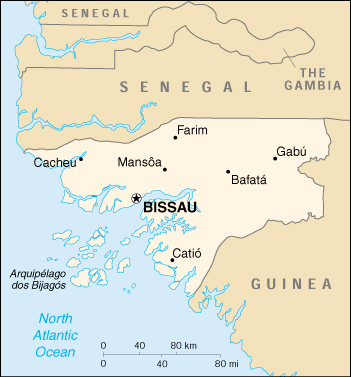
Background: In 1994, 20 years after independence from Portugal, the country’s first multiparty legislative and presidential elections were held. An army uprising that triggered a bloody civil war in 1998, created hundreds of thousands of displaced persons. The president was ousted by a military junta in May 1999. An interim government turned over power in February 2000 when opposition leader Kumba YALA took office following two rounds of transparent presidential elections. Guinea-Bissau’s transition back to democracy will be complicated by a crippled economy devastated by civil war and the military’s predilection for governmental meddling.
Government type: republic, multiparty since mid-1991
Capital: Bissau
Currency: 1 Communaute Financiere Africaine franc (CFAF) = 100 centimes
Geography of Guinea-Bissau
Location: Western Africa, bordering the North Atlantic Ocean, between Guinea and Senegal
Geographic coordinates: 12 00 N, 15 00 W
Area:
total: 36,120 sq. km
land: 28,000 sq. km
water: 8,120 sq. km
Land boundaries:
total: 724 km
border countries: Guinea 386 km, Senegal 338 km
Coastline: 350 km
Maritime claims:
exclusive economic zone: 200 nm
territorial sea: 12 nm
Climate: tropical; generally hot and humid; monsoonal-type rainy season (June to November) with southwesterly winds; dry season (December to May) with northeasterly harmattan winds
Terrain: mostly low coastal plain rising to savanna in east
Elevation extremes:
lowest point: Atlantic Ocean 0 m
highest point: unnamed location in the northeast corner of the country 300 m
Natural resources: fish, timber, phosphates, bauxite, unexploited deposits of petroleum
Land use:
arable land: 11%
permanent crops: 1%
permanent pastures: 38%
forests and woodland: 38%
other: 12% (1993 est.)
Irrigated land: 17 sq. km (1993 est.)
Natural hazards: hot, dry, dusty harmattan haze may reduce visibility during dry season; brush fires
Environment – current issues: deforestation; soil erosion; overgrazing; overfishing
Environment – international agreements:
party to: Biodiversity, Climate Change, Desertification, Endangered Species, Law of the Sea, Wetlands
signed, but not ratified: none of the selected agreements
Geography – note: this small country is swampy along its western coast and low-lying further inland
People of Guinea-Bissau
The population of Guinea-Bissau is ethnically diverse with distinct languages, customs, and social structures. Most people are farmers, with traditional religious beliefs (animism); 45% are Muslim, principally Fula and Mandinka-speaker concentrated in the north and northeast. Other important groups are the Balanta and Papel, living in the southern coastal regions, and the Manjaco and Mancanha, occupying the central and northern coastal areas.
Population: 1,416,027 (July 2005 est.)
Age structure:
0-14 years: 42.09%
15-64 years: 55.05%
65 years and over: 2.86%
Population growth rate: 2.23%
Birth rate: 39.29 births/1,000 population
Death rate: 15.33 deaths/1,000 population
Net migration rate: -1.66 migrant(s)/1,000 population
Infant mortality rate: 110.4 deaths/1,000 live births
Life expectancy at birth:
total population: 49.42 years
male: 47.12 years
female: 51.78 years
Total fertility rate: 5.2 children born/woman
Nationality:
noun: Guinean (s)
adjective: Guinean
Ethnic groups: African 99% (Balanta 30%, Fula 20%, Manjaca 14%, Mandinga 13%, Papel 7%), European and mulatto less than 1%
Religions: indigenous beliefs 50%, Muslim 45%, Christian 5%
Languages: Portuguese (official), Crioulo, African languages
Literacy:
definition: age 15 and over can read and write
total population: 53.9%
male: 67.1%
female: 40.7% (1997 est.)
History of Guinea-Bissau
The rivers of Guinea and the islands of Cape Verde were among the first areas in Africa explored by the Portuguese in the 15th century. Portugal claimed Portuguese Guinea in 1446, but few trading posts were established before 1600. In 1630, a “captaincy-general” of Portuguese Guinea was established to administer the territory. With the cooperation of some local tribes, the Portuguese entered the slave trade and exported large numbers of Africans to the Western Hemisphere via the Cape Verde Islands. Cacheu became one of the major slave centers, and a small fort still stands in the town. The slave trade declined in the 19th century, and Bissau, originally founded as a military and slave-trading center in 1765, grew to become the major commercial center.
Portuguese conquest and consolidation of the interior did not begin until the latter half of the 19th century. Portugal lost part of Guinea to French West Africa, including the center of earlier Portuguese commercial interest, the Casamance River region. A dispute with Great Britain over the island of Bolama was settled in Portugal’s favor with the involvement of U.S. President Ulysses S. Grant.
Before World War I, Portuguese forces, with some assistance from the Muslim population, subdued animist tribes and eventually established the territory’s borders. The interior of Portuguese Guinea was brought under control after more than 30 years of fighting; final subjugation of the Bijagos Islands did not occur until 1936. The administrative capital was moved from Bolama to Bissau in 1941, and in 1952, by constitutional amendment, the colony of Portuguese Guinea became an overseas province of Portugal.
In 1956, the African Party for the Independence of Guinea and Cape Verde (PAIGC) was organized clandestinely by Amilcar Cabral and Raphael Barbosa. The PAIGC moved its headquarters to Conakry, Guinea, in 1960 and started an armed rebellion against the Portuguese in 1961. Despite the presence of Portuguese troops, which grew to more than 35,000, the PAIGC steadily expanded its influence until, by 1968, it controlled most of the country. It established civilian rule in the territory under its control and held elections for a National Assembly. Portuguese forces and civilians increasingly were confined to their garrisons and larger towns. The Portuguese Governor and Commander in Chief from 1968 to 1973, Gen. Antonio de Spinola, returned to Portugal and led the movement which brought democracy to Portugal and independence for its colonies.
Amilcar Cabral was assassinated in Conakry in 1973, and party leadership fell to Aristides Pereira, who later became the first president of the Republic of Cape Verde. The PAIGC National Assembly met at Boe in the southeastern region and declared the independence of Guinea-Bissau on September 24, 1973. Following Portugal’s April 1974 revolution, it granted independence to Guinea-Bissau on September 10, 1974. The United States recognized the new nation that day. Luis Cabral, Amilcar Cabral’s half-brother, became President of Guinea-Bissau. In late 1980, the government was overthrown in a relatively bloodless coup led by Prime Minister and former armed forces commander Joao Bernardo Vieira.
From November 1980 to May 1984, power was held by a provisional government responsible to a Revolutionary Council headed by President Joao Bernardo Vieira. In 1984, the council was dissolved, and the National Popular Assembly (ANP) was reconstituted. The single-party assembly approved a new constitution, elected President Vieira to a new 5-year term, and elected a Council of State, which was the executive agent of the ANP. Under this system, the president presides over the Council of State and serves as head of state and government. The president also was head of the PAIGC and commander in chief of the armed forces.
There were alleged coup plots against the Vieira government in 1983, 1985, and 1993. In 1986, first Vice President Paulo Correia and five others were executed for treason following a lengthy trial. In 1994, the country’s first multi-party legislative and presidential elections were held. An army uprising against the Vieira government in June 1998 triggered a bloody civil war that created hundreds of thousands of displaced persons. The president was ousted by a military junta in May 1999. An interim government turned over power in February 2000 when opposition leader Kumba Yala, founder of the Social Renovation Party (PRS), took office following two rounds of transparent presidential elections.
Guinea-Bissau Economy
Guinea-Bissau is among the world’s least developed nations and depends mainly on agriculture and fishing. Guinea-Bissau exports some fish and seafood, along with small amounts of peanuts, palm kernels, and timber. License fees for fishing provide the government with some revenue. Rice is the major crop and staple food. Because of high costs, the development of petroleum, phosphate, and other mineral resources is not a near-term prospect. However, unexploited offshore oil reserves may possibly provide much-needed revenue in the long run.
The military conflict that took place in Guinea-Bissau from June 1998 to early 1999 caused severe damage to the country’s infrastructure and widely disrupted economic activity. Agricultural production is estimated to have fallen by 17% during the conflict, and the civil war led to a 28% overall drop in GDP in 1998. Cashew nut output, the main export crop, declined in 1998 by an estimated 30%. World cashew prices dropped by more than 50% in 2000, compounding the economic devastation caused by the conflict. Before the war, trade reform and price liberalization were the most successful part of the country’s structural adjustment program under IMF sponsorship. Under the government’s post-conflict economic and financial program, implemented with IMF and World Bank input, real GDP recovered in 1999 by almost 8%. In December 2000 Guinea-Bissau qualified for almost $800 million in debt-service relief under the first phase of the enhanced HIPC initiative and is scheduled to submit its Poverty Reduction Strategy Paper in March 2002. Guinea-Bissau will receive the bulk of its assistance under the enhanced HIPC initiative when it satisfies a number of conditions, including implementation of its Poverty Reduction Strategy Paper.
GDP: purchasing power parity – $1.1 billion (2000 est.)
GDP – real growth rate: 7.6% (2000 est.)
GDP – per capita: purchasing power parity – $850 (2000 est.)
GDP – composition by sector:
agriculture: 54%
industry: 15%
services: 31% (1997 est.)
Household income or consumption by percentage share:
lowest 10%: 0.5%
highest 10%: 42.4% (1991)
Inflation rate (consumer prices): 3% (2000 est.)
Labor force: 480,000
Labor force – by occupation: agriculture 78%
Industries: agricultural products processing, beer, soft drinks
Industrial production growth rate: 2.6% (1997 est.)
Electricity – production: 55 million kWh (1999)
Electricity – production by source:
fossil fuel: 100%
hydro: 0%
nuclear: 0%
other: 0% (1999)
Agriculture – products: rice, corn, beans, cassava (tapioca), cashew nuts, peanuts, palm kernels, cotton; timber; fish
Exports: $80 million (f.o.b., 2000 est.)
Exports – commodities: cashew nuts 70%, shrimp, peanuts, palm kernels, sawn lumber (1996)
Exports – partners: India 59%, Singapore 12%, Italy 10% (1998)
Imports: $55.2 million (f.o.b., 2000 est.)
Imports – commodities: foodstuffs, machinery and transport equipment, petroleum products (1996)
Imports – partners: Portugal 26%, France 8%, Senegal 8%, Netherlands 7% (1998)
Debt – external: $921 million (1997 est.)
Economic aid – recipient: $115.4 million (1995)
Currency: Communaute Financiere Africaine franc (XOF); note – responsible authority is the Central Bank of the West African States; previously the Guinea-Bissau peso (GWP) was used
Map of Guinea-Bissau