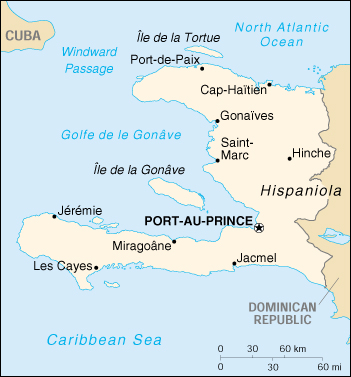
Background: One of the poorest countries in the Western Hemisphere, Haiti has been plagued by political violence for most of its history. Over three decades of dictatorship followed by military rule ended in 1990 when Jean-Bertrand ARISTIDE was elected president. Most of his term was usurped by a military takeover, but he was able to return to office in 1994 and oversee the installation of a close associate to the presidency in 1996. ARISTIDE won a second term as president in 2000, and took office early the following year.
Government type: elected government
Capital: Port-au-Prince
Currency: 1 gourde (G) = 100 centimes
Geography of Haiti
Location: Caribbean, western one-third of the island of Hispaniola, between the Caribbean Sea and the North Atlantic Ocean, west of the Dominican Republic
Geographic coordinates: 19 00 N, 72 25 W
Area:
total: 27,750 sq. km
land: 27,560 sq. km
water: 190 sq. km
Land boundaries:
total: 275 km
border countries: Dominican Republic 275 km
Coastline: 1,771 km
Maritime claims:
contiguous zone: 24 nm
continental shelf: to depth of exploitation
exclusive economic zone: 200 nm
territorial sea: 12 nm
Climate: tropical; semiarid where mountains in east cut off trade winds
Terrain: mostly rough and mountainous
Elevation extremes:
lowest point: Caribbean Sea 0 m
highest point: Chaine de la Selle 2,680 m
Natural resources: bauxite, copper, calcium carbonate, gold, marble, hydropower
Land use:
arable land: 20%
permanent crops: 13%
permanent pastures: 18%
forests and woodland: 5%
other: 44% (1993 est.)
Irrigated land: 750 sq. km (1993 est.)
Natural hazards: lies in the middle of the hurricane belt and subject to severe storms from June to October; occasional flooding and earthquakes; periodic droughts
Environment – current issues: extensive deforestation (much of the remaining forested land is being cleared for agriculture and used as fuel); soil erosion; inadequate supplies of potable water
Environment – international agreements:
party to: Biodiversity, Climate Change, Desertification, Law of the Sea, Marine Dumping, Marine Life Conservation, Ozone Layer Protection
signed, but not ratified: Hazardous Wastes, Nuclear Test Ban
Geography – note: shares island of Hispaniola with Dominican Republic (western one-third is Haiti, eastern two-thirds is the Dominican Republic)
Haiti is a country of only about 28,000 square kilometers, about the size of the state of Maryland. It occupies the western third of the Caribbean island of Hispaniola (La Isla Española); the Dominican Republic takes up the eastern two-thirds. Shaped like a horseshoe on its side, Haiti has two main peninsulas, one in the north and one in the south. Between the peninsulas is the Ile de la Gonâve.
Northwest of the northern peninsula is the Windward Passage, a strip of water that separates Haiti from Cuba, which is about ninety kilometers away. The eastern edge of the country borders the Dominican Republic. A series of treaties and protocols–the most recent of which was the Protocol of Revision of 1936–set the 388-kilometer eastern border, which is formed partly by the Pedernales River in the south and the Massacre River in the north.
The mainland of Haiti has three regions: the northern region, which includes the northern peninsula; the central region; and the southern region, which includes the southern peninsula. In addition, Haiti controls several nearby islands.
The northern region consists of the Massif du Nord (Northern Massif) and the Plaine du Nord (Northern Plain). The Massif du Nord, an extension of the central mountain range in the Dominican Republic, begins at Haiti’s eastern border, north of the Guayamouc River, and extends to the northwest through the northern peninsula. The Massif du Nord ranges in elevation from 600 to 1,100 meters. The Plaine du Nord lies along the northern border with the Dominican Republic, between the Massif du Nord and the North Atlantic Ocean. This lowland area of 2,000 square kilometers is about 150 kilometers long and 30 kilometers wide.
The central region consists of two plains and two sets of mountain ranges. The Plateau Central (Central Plateau) extends along both sides of the Guayamouc River, south of the Massif du Nord. It runs eighty-five kilometers from southeast to northwest and is thirty kilometers wide. To the southwest of the Plateau Central are the Montagnes Noires, with elevations of up to approximately 600 meters. The most northwestern part of this mountain range merges with the Massif du Nord. Southwest of the Montagnes Noires and oriented around the Artibonite River is the Plaine de l’Artibonite, measuring about 800 square kilometers. South of this plain lie the Chaîne des Matheux and the Montagnes du Trou d’Eau, which are an extension of the Sierra de Neiba range of the Dominican Republic.
The southern region consists of the Plaine du Cul-de-Sac and the mountainous southern peninsula. The Plaine du Cul-de-Sac is a natural depression, twelve kilometers wide, that extends thirtytwo kilometers from the border with the Dominican Republic to the coast of the Baie de Port-au-Prince. The mountains of the southern peninsula, an extension of the southern mountain chain of the Dominican Republic (the Sierra de Baoruco), extend from the Massif de la Selle in the east to the Massif de la Hotte in the west. The range’s highest peak, the Morne de la Selle, is the highest point in Haiti, rising to an altitude of 2,715 meters. The Massif de la Hotte varies in elevation from 1,270 to 2,255 meters.
The four islands of notable size in Haitian territory are Ile de la Gonâve, Ile de la Tortue (Tortuga Island), Grande Cayemite, and Ile à Vache. Ile de la Gonâve is sixty kilometers long and fifteen kilometers wide. The hills that cross the island rise to heights of up to 760 meters. Ile de la Tortue is located north of the northern peninsula, separated from the city of Port-de-Paix by a twelve-kilometer channel. Ile à Vache is located south of the southern peninsula; Grande Cayemite lies north of the southern peninsula.
Numerous rivers and streams, which slow to a trickle during the dry season and which carry torrential flows during the wet season, cross Haiti’s plains and mountainous areas. The largest drainage system in the country is that of the Artibonite River. Rising as the Libón River in the foothills of the Massif du Nord, the river crosses the border into the Dominican Republic and then forms part of the border before reentering Haiti as the Artibonite River. At the border, the river expands to form the Lac de Péligre in the southern part of the Plateau Central. The 400-kilometer Artibonite River is only one meter deep during the dry season, and it may even dry up completely in certain spots. During the wet season, it is more than three meters deep and subject to flooding.
The ninety-five-kilometer Guayamouc River is one of the principal tributaries of the Artibonite River. The most important river in the northern region is Les Trois Rivières, or The Three Rivers. It is 150 kilometers long, has an average width of sixty meters, and is three to four meters deep.
The most prominent body of water in the southern region is the salt-water Etang Saumâtre, located at the eastern end of the Plaine du Cul-de-Sac. At an elevation of sixteen meters above sea level, the lake is twenty kilometers long and six to fourteen kilometers wide; it has a circumference of eighty-eight kilometers.
Haiti has a generally hot and humid tropical climate. The north wind brings fog and drizzle, which interrupt Haiti’s dry season from November to January. But during February through May, the weather is very wet. Northeast trade winds bring rains during the wet season.
The average annual rainfall is 140 to 200 centimeters, but it is unevenly distributed. Heavier rainfall occurs in the southern peninsula and in the northern plains and mountains. Rainfall decreases from east to west across the northern peninsula. The eastern central region receives a moderate amount of precipitation, while the western coast from the northern peninsula to Port-au-Prince, the capital, is relatively dry. Temperatures are almost always high in the lowland areas, ranging from 15° C to 25° C in the winter and from 25° C to 35° C during the summer.
People of Haiti
Although Haiti averages about 250 people per square kilometer (650 per sq. mi.). Its population is concentrated most heavily in urban areas, coastal plains, and valleys. About 95% of Haitians are of African descent. The rest of the population is mostly of mixed Caucasian-African ancestry. A few are of European or Levantine heritage. About two-thirds of the population live in rural areas.
French is one of two official languages, but it is spoken by only about 10% of the people. All Haitians speak Creole, the country’s other official language. English is increasingly spoken among the young and in the business sector.
The state religion is Roman Catholicism, which most of the population professes. Some Haitians have converted to Protestantism through the work of missionaries active throughout the country. Much of the population also practices voudou (voodoo) traditions. Haitians tend to see no conflict in these African-rooted beliefs coexisting with Christian faiths.
Although public education is free, private and parochial schools provide around 88% of educational programs offered, and less than 65% of those eligible for primary education are actually enrolled. At the secondary level, the figure drops to 15%. Only 63% of those enrolled will complete primary school. Though Haitians place a high value on education, few can afford to send their children to secondary school. Remittances sent by Haitians living abroad are important in paying educational costs.
Largescale emigration, principally to the U.S.–but also to Canada, the Dominican Republic, The Bahamas and other Caribbean neighbors, and France–has created what Haitians refer to as the Tenth Department or the Diaspora. About one of every seven Haitians live abroad.
Population: 765,283 (July 2005 est.)
Age structure:
0-14 years: 40.31%
15-64 years: 55.52%
65 years and over: 4.17%
Population growth rate: .26%
Birth rate: 31.68 births/1,000 population
Death rate: 15 deaths/1,000 population
Net migration rate: -2.64 migrant(s)/1,000 population
Infant mortality rate: 95.23 deaths/1,000 live births
Life expectancy at birth:
total population: 49.38 years
male: 47.67 years
female: 51.17 years
Total fertility rate: 4.4 children born/woman
Nationality:
noun: Haitian(s)
adjective: Haitian0
Ethnic groups: black 95%, mulatto plus white 5%
Religions: Roman Catholic 80%, Protestant 16% (Baptist 10%, Pentecostal 4%, Adventist 1%, other 1%), none 1%, other 3% (1982)
note: roughly one-half of the population also practices Voodoo
Languages: French (official), Creole (official)
Literacy:
definition: age 15 and over can read and write
total population: 45%
male: 48%
female: 42.2% (1995 est.)
Demographic Profile
The estimated population of Haiti in 1989 was 6.1 million, with an average population density of 182 people per square kilometer. Some 75 percent of the population lived in rural areas, while only 25 percent remained in urban areas; this was one of the lowest urban-to-rural population ratios in Latin America and the Caribbean. The estimated annual population growth rate between 1971 and 1982 was 1.4 percent. The crude mortality rate in 1982 was estimated to be 16.5 percent, with a crude birth rate of 36 percent. A profile of the population reveals that the majority of Haitians are young.
Haiti has conducted only a few censuses throughout its history. A survey taken during 1918 and 1919 indicated that there were about 1.9 million people in the country. The first formal census, taken in 1950, showed that the population had reached 3.1 million. The second census, in 1971, indicated a population of 4.2 million. Critics have argued that these censuses, along with one taken in 1982 (the final results of which were still unavailable as of 1989), were deficient and that they seriously undercounted the population.
Urban areas, particularly Port-au-Prince, grew significantly in the 1970s and the 1980s. The annual population growth rate of metropolitan Port-au-Prince was estimated to be 3.5 percent between 1971 and 1982, substantially above the 1.4 percent national rate for that period. The growth rate for other urban areas was estimated at 2.4 percent. Metropolitan Port-au-Prince, which includes the capital and the suburbs of Delmas and Carrefour, was by far the largest urban area, in 1982, with a population of 763,188, or about 61 percent of the total urban population. The population of the second largest city, CapHaïtien , was estimated to be 64,400 in 1982. The next two largest towns, Gonaïves and Les Cayes, had estimated populations of slightly more than 34,000. Six other towns had populations greater than 10,000.
The rural population, which grew about 1 percent a year between 1971 and 1982, was estimated to be 3.8 million in 1982, 3.4 million in 1971, and 2.7 million in 1950. In 1982 there were about 464 people per square kilometer in rural areas, one of the highest population densities in the Western Hemisphere.
Migration
The population growth rate in Haiti’s rural areas has been lower than the rate for urban areas, even though fertility rates are higher in rural areas. The main reason for this disparity is outmigration. People in rural areas have moved to cities, or they have emigrated to other countries, mostly the United States and the Dominican Republic. An estimated 1 million people left Haiti between 1957 and 1982.
Many of the emigrants in the 1950s and the 1960s were urban middle-class and upper-class opponents of the government of François Duvalier (1957-71). Throughout the 1970s, however, an increasing number of rural and lower-class urban Haitians emigrated, too. In the 1980s, as many as 500,000 Haitians were living in the United States; there were large communities in New York, Miami, Boston, Chicago, and Philadelphia. Thousands of Haitians also illegally emigrated to the United States through nonimmigrant visas, while others entered the United States without any documentation at all.
The first reports of Haitians’ arriving in the United States, by boat and without documentation, occurred in 1972. Between 1972 and 1981, the United States Immigration and Naturalization Service (INS) reported more than 55,000 Haitian “boat people” arrived in Florida. The INS estimated that because as many as half of the arrivals escaped detection, the actual number of boat people may have exceeded 100,000. An unknown number of Haitians are reported to have died during their attempts to reach the United States by sea.
Though poorer than earlier immigrants, the boat people were often literate and skilled, and all had families who could afford the price of a passage to Florida. About 85 percent of these boat people settled in Miami.
In September 1981, the United States entered an agreement with Haiti to interdict Haitian boats and return prospective immigrants to Haiti. Under the agreement, 3,107 Haitians had been returned by 1984. Nevertheless, clandestine departures by boat continued throughout the 1980s. The Bahamas was another destination of Haitian emigrants; an estimated 50,000 arrived there by boat during the 1980s. The Bahamas had welcomed Haitian immigrants during the 1960s, but in the late 1970s, it reversed its position, leading to increased emigration to Florida.
Since the early twentieth century, the Dominican Republic has received both temporary and permanent Haitian migrants. The International Labour Office estimated that between 200,000 and 500,000 Haitians resided in the Dominican Republic in 1983. About 85,000 of them lived on cane plantations. In the early 1980s, about 80 to 90 percent of the cane cutters in the Dominican Republic were reported to be Haitians. Through an accord with the Haitian government, the Dominican Republic imported Haitian workers to cut cane. In 1983 the Dominican Republic hired an estimated 19,000 workers. Evidence presented to the United Nations (UN) Working Group on Slavery revealed that the Dominican Republic paid wages that were miserably low and that working and living conditions failed to meet standards set by the two governments. According to some reports, Haitian cane cutters were unable to leave their workplaces, and they were prevented from learning about the terms of the contracts under which they had been hired.
Emigration helped moderate Haiti’s population growth. Furthermore, annual remittances from abroad, estimated to be as high as US$100 million, supported thousands of poor families and provided an important infusion of capital into the Haitian economy. At the same time, emigration resulted in a heavy loss of professional and skilled personnel from urban and rural areas.
Fertility and Family Planning
A number of studies show that Haiti’s fertility rate declined significantly from the early 1960s to the early 1980s. As was true in other countries, there appeared to be a correlation among declining fertility rates, urban residence, and literacy. The 1977 Haitian Fertility Survey found that between 1962 and 1977, the fertility rate of urban literate women declined by 33 percent. In contrast, the rate for rural illiterate women declined by only 7 percent during the same period. Moreover, the fertility rate of literate rural women declined by 27 percent, while that of illiterate urban women declined by 15 percent.
Haitian women interviewed in the 1977 survey indicated that they desired between three and four children, but at that time, the average woman had more than five children.
Expressed desire for family planning services exceeded available programs, and many women lacked access to modern contraceptives and birth-control information. The survey found that, despite the widespread desire for fewer children, only 7 percent of women of childbearing age were using modern contraceptives. Haitian men traditionally shunned the use of condoms. The fertility survey reported a condom-use rate of only 1 percent. The absence of more recent surveys made it impossible to determine whether or not condom use had risen in response to the high incidence of Acquired Immune Deficiency Syndrome (AIDS) in Haiti.
SOCIAL STRUCTURE
As a result of the extinction of the indigenous population by the beginning of the seventeenth century, the population of preindependence Saint-Domingue (present-day Haiti) was entirely the product of the French colonists’ slaveholding policies and practices. The major planters and government officials who constituted the ruling class carefully controlled every segment of the population, especially the majority of African slaves and their descendants. Society was structured for the rapid production of wealth for the planters and their investors in France.
In the colonial period, the French imposed a three-tiered social structure. At the top of the social and political ladder was the white elite (grands blancs). At the bottom of the social structure were the black slaves (noirs), most of whom had been transported from Africa. Between the white elite and the slaves arose a third group, the freedmen (affranchis), most of whom were descended from unions of slaveowners and slaves. Some mulatto freedmen inherited land, became relatively wealthy, and owned slaves (perhaps as many as one-fourth of all slaves in Saint-Domingue belonged to affranchis). Nevertheless, racial codes kept the affranchis socially and politically inferior to the whites. Also between the white elite and the slaves were the poor whites (petits blancs), who considered themselves socially superior to the mulattoes, even if they sometimes found themselves economically inferior to them. Of a population of 519,000 in 1791, 87 percent were slaves, 8 percent were whites, and 5 percent were freedmen. Because of harsh living and working conditions, many slaves died, and new slaves were imported. Thus, at the time of the slave rebellion of 1791, most slaves had been born in Africa rather than in Saint-Domingue.
The Haitian Revolution changed the country’s social structure. The colonial ruling class, and most of the white population, was eliminated, and the plantation system was largely destroyed. The earliest black and mulatto leaders attempted to restore a plantation system that relied on an essentially free labor force, through strict military control, but the system collapsed during the tenure of Alexandre Pétion (1806-18). The Haitian Revolution broke up plantations and distributed land among the former slaves. Through this process, the new Haitian upper class lost control over agricultural land and labor, which had been the economic basis of colonial control. To maintain their superior economic and social position, the new Haitian upper class turned away from agricultural pursuits in favor of more urban-based activities, particularly government.
The nineteenth-century Haitian ruling class consisted of two groups, the urban elite and the military leadership. The urban elite were primarily a closed group of educated, comparatively wealthy, and French-speaking mulattoes. Birth determined an individual’s social position, and shared values and intermarriage reinforced class solidarity. The military, however, was a means of advancement for disadvantaged black Haitians. In a shifting, and often uneasy, alliance with the military, the urban elite ruled the country and kept the peasantry isolated from national affairs. The urban elite promoted French norms and models as a means of separating themselves from the peasantry. Thus, French language and manners, orthodox Roman Catholicism, and light skin were important criteria of high social position. The elite disdained manual labor, industry, and commerce in favor of the more genteel professions, such as law and medicine.
A small, but politically important, middle class emerged during the twentieth century. Although social mobility increased slightly, the traditional elite retained their economic preeminence, despite countervailing efforts by François Duvalier. For the most part, the peasantry continued to be excluded from national affairs, but by the 1980s, this isolation had decreased significantly. Still, economic hardship in rural areas caused many cultivators to migrate to the cities in search of a higher standard of living, thereby increasing the size of the urban lower class.
The Upper Class
In the 1980s, Haiti’s upper class constituted as little as 2 percent of the total population, but it controlled about 44 percent of the national income. The upper class included not only the traditional elite, which had not controlled the government for more than thirty years, but also individuals who had become wealthy and powerful through their connections with the governments of François Duvalier and his son, Jean-Claude Duvalier. Increased access to education helped carry some individuals into the ranks of the upper class. Others were able to move upward because of wealth they accrued in industry or export-import businesses.
The traditional elite held key positions in trade, industry, real estate, and the professions, and they were identified by membership in “good families,” which claimed several generations of recognized legal status and name. Being a member of the elite also required a thorough knowledge of cultural refinements, particularly the customs of the French. Light skin and straight hair continued to be important characteristics of this group. French surnames were common among the mulatto elite, but increased immigration from Europe and the Middle East in the late nineteenth and the early twentieth centuries had introduced German, English, Danish, and Arabic names to the roster.
The only group described as an ethnic minority in Haiti was the “Arabs,” people descended from Syrian, Lebanese, and Palestinian traders who began to arrive in Haiti and elsewhere in the Caribbean in the late nineteenth century. From their beginnings, as itinerant peddlers of fabrics and other dry goods, the Arabs moved into the export-import sector, engendering the hostility of Haitians and foreign rivals. Nevertheless, the Arabs remained. Many adopted French and Creole as their preferred languages, took Haitian citizenship, and integrated themselves into the upper and the middle classes. Formerly spurned by elite mulatto families and excluded from the best clubs, the Arabs had begun to intermarry with elite Haitians and to take part in all aspects of upper-class life, including entry into the professions and industry.
The Middle Class
The middle class was essentially nonexistent during the nineteenth century. But at about the time of the United States occupation (1915-34), it became more defined. The creation of a professional military and the expansion of government services fostered the development of Haiti’s middle class. Educational reform in the 1920s, an upsurge in black consciousness, and the wave of economic prosperity after World War II also contributed to the strengthening of the class. In the late 1980s, the middle class probably made up less than 5 percent of the total population, but it was growing, and it was becoming more politically powerful.
The mulatto elite dominated governments in the 1930s and the early 1940s and thwarted the political aspirations of the black middle class. President Dumarsais Estimé (1946-50) came to power with the aim of strengthening the middle class. The Duvalier government also claimed the allegiance of the black middle class, at least through the 1970s. During the Duvalier period, many in the middle class owed their economic security to the government. A number of individuals from this class, however, benefited from institutionalized corruption.
Some members of the middle class had acquired political power by the 1980s, but most continued to be culturally ambivalent and insecure. Class solidarity, identity, and traditions were all weak. The criteria for membership in the middle class included a nonmanual occupation, a moderate income, literacy, and a mastery of French. Middle-class Haitians sought upward mobility for themselves and their children, and they perceived education and urban residence as two essential keys to achieving higher status. Although they attempted to emulate the lifestyle of the upper class, middle-class Haitians resented the social preeminence and the color prejudice of the elite. Conflicts between the FrancoHaitian and the Afro-Haitian cultural traditions were most common among the middle class.
Peasants
Haiti’s peasantry constituted approximately 75 percent of the total population. Unlike peasants in much of Latin America, most of Haiti’s peasants had owned land since the early nineteenth century. Land was the most valuable rural commodity, and peasant families went to great lengths to retain it and to increase their holdings.
Peasants in general had control over their landholdings, but many lacked clear title to their plots. Haiti has never conducted a cadastral survey, but it is likely that many families have passed on land over generations without updating land titles. Division of land equally among male and female heirs resulted in farm plots that became too small to warrant the high costs of a surveyor. Heirs occasionally surveyed land before taking possession of it, but more frequently, heirs divided plots among themselves in the presence of community witnesses and often a notary. Some inherited land was not divided, but was used in common, for example, for pasture, or it was worked by heirs in rotation. Families commonly sold land to raise cash for such contingencies as funerals or to pay the expenses of emigration. Purchasers often held land with a notarized paper, rather than a formal deed.
There were strata within the peasantry based on the amount of property owned. Many peasants worked land as sharecroppers or tenants, and some hoped eventually to inherit the plots they worked. Some tenant farmers owned and cultivated plots in addition to the land they worked for others. The number of entirely landless peasants who relied solely on wage labor was probably quite small. Agricultural wages were so low that peasants deprived of land were likely to migrate to urban areas in search of higher incomes. Wealthier peasants maintained their economic positions through the control of capital and influence in local politics.
Peasants maintained a strong, positive identity as Haitians and as cultivators of the land, but they exhibited a weak sense of class consciousness. Rivalries among peasants were more common than unified resentment toward the upper class.
Cooperation among peasants diminished during the twentieth century. Farms run by nuclear families and exchanges among extended families had formed the basis of the agrarian system. Until the middle of the twentieth century, collective labor teams, called kounbit, and larger labor-exchange groups were quite common. These groups were formed to carry out specific tasks on an individual’s land; the owner provided music and a festive meal. After the 1940s, smaller groups, called eskouad,began to replace the kounbit. The eskouad carried out tasks on a strictly reciprocal basis or sold their collective labor to other peasants.
Although Haitian peasant villages generally lacked a sense of community and civic-mindedness, some civic-action groups had emerged over the years. After the 1960s, wealthy peasants led rural community councils, which were supervised by the government. These councils often served more to control the flow of development resources into an area than to represent the local population. In the 1980s, a countervailing movement of small peasant groups (groupman) emerged with support from the Roman Catholic Church, principally in the Plateau Central. The groupman discussed common interests and undertook some cooperative activities. Both the Duvalier governments and the succeeding National Council of Government (Conseil National de Gouvernement–CNG), headed by Lieutenant General Henri Namphy, took steps to curb the activities of these peasant groups.
The first generation of Haitian peasants pursued selfsufficiency , freedom, and peace. The necessity of devoting at least some share of their limited hectarage to the production of cash crops, however, hindered the peasants’ ability to achieve self-sufficiency in the cultivation of domestic staples. Although they acquired a degree of freedom, they also found themselves isolated from the rest of the nation and the world. In the second half of the twentieth century, the Haitian peasantry gradually became much less isolated. Several factors accelerated the peasants’ involvement with the outside world in the 1970s and the 1980s. Road projects improved the transportation system, and foreign religious missions and private development agencies penetrated the rural areas. These organizations brought new resources and provided an institutional link to the outside world. Many people from almost every community had migrated to Port-au-Prince or overseas, and they sent money home to rural areas. Cassette tapes enabled illiterate people who had traveled far from home to communicate with their families. Creole, which became widely used on radio, brought news of Haiti and the world to remote villages. And in 1986, media coverage of the fall of the Duvalier regime put rural Haitians in touch with the political affairs of the nation.
Urban Lower Class
The urban lower class, which made up about 15 percent of the total population in the early 1980s, was concentrated in Port-au- Prince and the major coastal towns. Increased migration from rural areas contributed greatly to the growth of this class. Industrial growth was insufficient, however, to absorb the labor surplus produced by the burgeoning urbanization; unemployment and underemployment were severe in urban areas. The urban lower class was socially heterogeneous, and it had little class consciousness. One outstanding characteristic of this group was its commitment to education. Despite economic hardships, urban lower-class parents made a real effort to keep their children in school throughout the primary curriculum. Through education and political participation, some members of the lower class achieved mobility into the middle class.
The poorest strata of the urban lower class lived under Haiti’s worst sanitary and health conditions. According to the World Bank, one-third of the population of Portau -Prince lived in densities of more than 1,000 people per hectare in 1976. The poorest families consumed as few as seven liters of water per person, per day, for cooking, drinking, and cleaning, and they spent about one-fifth of their income to obtain it. For many of these families, income and living conditions worsened in the 1980s.
GENDER ROLES AND FAMILY LIFE
In rural areas, men and women played complementary roles. Men were primarily responsible for farming and, especially, for heavy work, such as tilling. Women, however, often assisted with tasks such as weeding and harvesting. Women were responsible for selling agricultural produce. In general, Haitian women participated in the labor force to a much greater extent than did women in other Latin American countries. Haiti’s culture valued women’s economic contribution to the farm in that all income generated through agricultural production belonged to both husband and wife. Many women also acquired sufficient capital to become full-time market traders, and they were thus economically independent. The income that they earned from nonfarm business activities was recognized as their own; they were not required to share it with their husbands.
The most common marital relationship among peasants and the urban lower class was known as plasaj. The government did not recognize plasaj as legitimate marriage, but in lowerclass communities, these relationships were considered normal and proper. The husband and wife often made an explicit agreement about their economic relationship at the beginning of a marriage. These agreements usually required the husband to cultivate at least one plot of land for the wife and to provide her with a house. Women performed most household tasks, though men often did heavy chores, such as gathering firewood.
For the most part, lower-class men and women had civil and religious marriages for reasons of prestige rather than to legitimize marital relations. Because weddings were expensive, many couples waited several years before having them. In the 1960s, this pattern began to change among Protestant families who belonged to churches that strongly encouraged legal marriage and provided affordable weddings. It was not unusual for peasants to have more than one marital relationship. Some entered into polygamous marriages, which only a few men could afford.
Legal marriages were neither more stable nor more productive than plasaj relationships. Also, legal marriages were not necessarily monogamous. In fact, legally married men were often more economically stable than men in plasaj relationships, so it was easier for them to separate from their wives or to enter into extramarital relationships.
Men and women both valued children and both contributed to child care, but women generally bore most of the burden. Parents were proud of their children, regardless of whether they were born in a marital relationship or as “outside children.” Parents took pains to ensure that all of their children received equal inheritances.
Family structure in rural Haiti has changed since the nineteenth century. Until the early part of the twentieth century, the lakou, an extended family, usually defined along male lines, was the principal family form. The term lakou referred not only to the family members, but to the cluster of houses in which they lived. Members of a lakou worked cooperatively, and they provided each other with financial and other kinds of support. Land ownership was not cooperative, however, and successive generations of heirs inherited individual plots. Under the pressure of population growth and the increasing fragmentation of landholdings, the lakou system disintegrated. By the mid-twentieth century, the nuclear family had become the norm among peasants. The lakou survived as a typical place of residence, but the cooperative labor and the social security provided by these extended families disappeared. Haitian peasants still relied on their kin for support, but the extended family sometimes became an arena for land disputes as much as a mechanism for cooperation.
Family life among the traditional elite was substantially different from that of the lower class. Civil and religious marriages were the norm, and the “best” families could trace legally married ancestors to the nineteenth century. Because of the importance of intermarriage, mulatto elite families were often interrelated. Marital relationships have changed somewhat since the mid-twentieth century. Divorce, once rare, has become acceptable. Elite wives, once exclusively homemakers surrounded by servants, entered the labor force in increasing numbers in the 1970s and the 1980s. The legal rights of married women, including rights to property, were expanded through legislation in the 1980s. In addition, the elite had a broader choice of partners as economic change and immigration changed the composition of that group.
History of Haiti
The Spaniards used the island of Hispaniola (of which Haiti is the western part and the Dominican Republic the eastern) as a launching point from which to explore the rest of the Western Hemisphere. French buccaneers later used the western third of the island as a point from which to harass English and Spanish ships. In 1697, Spain ceded the western third of Hispaniola to France. As piracy was gradually suppressed, some French adventurers became planters, making Saint Domingue, as the French portion of the island was known, the “pearl of the Antilles”–one of the richest colonies in the 18th century French empire.
During this period, African slaves were brought to work on sugarcane and coffee plantations. In 1791, the slave population revolted–led by Haitian heroes Toussaint L’Ouverture, Jean Jacques Dessalines, and Henri Christophe–and gained control of the northern part of the French colony, waging a war of attrition against the French.
By January 1804, local forces defeated an army sent by Napoleon Bonaparte, established independence from France, and renamed the area Haiti. The impending defeat of the French in Haiti is widely credited with contributing to Napoleon’s decision to sell the Louisiana territory to the United States in 1803. Haiti is the world’s oldest black republic and the second-oldest republic in the Western Hemisphere, after the United States. Although Haiti actively assisted the independence movements of many Latin American countries, the independent nation of former slaves was excluded from the hemisphere’s first regional meeting of independent nations, in Panama in 1826, and did not receive U.S. diplomatic recognition until 1862.
Two separate regimes–north and south–emerged after independence but were unified in 1820. Two years later, Haiti occupied Santo Domingo, the eastern, Spanish-speaking part of Hispaniola. In 1844, however, Santo Domingo broke away from Haiti and became the Dominican Republic. With 22 changes of government from 1843 to 1915, Haiti experienced numerous periods of intense political and economic disorder, prompting the United States military intervention of 1915. Following a 19-year occupation, U.S. military forces were withdrawn in 1934, and Haiti regained sovereign rule.
From February 7, 1986–when the 29-year dictatorship of the Duvalier family ended–until 1991, Haiti was ruled by a series of provisional governments. In 1987, a constitution was ratified that provides for an elected, bicameral parliament; an elected president that serves as head of state; and a prime minister, cabinet, ministers, and supreme court appointed by the president with parliament’s consent. The Haitian Constitution also provides for political decentralization through the election of mayors and administrative bodies responsible for local government.
The 1991 Coup
In December 1990, Jean-Bertrand Aristide, a charismatic Roman Catholic priest, won 67% of the vote in a presidential election that international observers deemed largely free and fair. Aristide took office on February 7, 1991, but was overthrown that September in a violent coup led by dissatisfied elements of the army and supported by many of the country’s economic elite. Following the coup, Aristide began what became a 3-year period of exile. As many as several thousand Haitians may have been killed during the period of de facto military rule. The coup triggered a largescale exodus of Haitians by boat. The U.S. Coast Guard rescued a total of 41,342 Haitians at sea during 1991 and 1992, more than the number of rescued boat people from the previous 10 years combined.
From October 1991 to September 1994 an unconstitutional military de facto regime governed Haiti. Various OAS and UN initiatives to end the political crisis through the peaceful restoration of the constitutionally elected government, including the Governors Island Agreement of July 1993, failed. When the military refused to uphold its end of the agreements, the de facto authorities refused to allow a return to constitutional government, even though the economy was collapsing and the country’s infrastructure deteriorated from neglect.
Transition to Democracy
On July 31, 1994, as repression mounted in Haiti and a UN-OAS civilian human rights monitoring mission (MICIVIH) was expelled from the country, the UN Security Council adopted Resolution 940. UNSC Resolution 940 authorized member states to use all necessary means to facilitate the departure of Haiti’s military leadership and to restore Haiti’s constitutionally elected government to power.
In the weeks that followed, the United States took the lead in forming a multinational force (MFN) to carry out the UN’s mandate by means of a military intervention. In mid-September, with U.S. troops prepared to enter Haiti by force, President Clinton dispatched a negotiating team led by former President Jimmy Carter to persuade the de facto authorities to step aside and allow for the return of constitutional rule. With intervening troops already airborne, Gen. Raoul Cedras and other top leaders agreed to accept the intervention of the MNF. On September 19, 1994, the first contingents of what became a 21,000 international force touched down in Haiti to oversee the end of military rule and the restoration of the constitutional government. By early October, the three de facto leaders–Cedras, Gen. Philippe Biamby, and Police Chief Lt. Col. Michel Francois -and their families had departed Haiti. President Aristide and other elected officials in exile returned on October 15.
Under the watchful eyes of international peacekeepers, restored Haitian authorities organized nationwide local and parliamentary elections in June 1995. A pro-Aristide, multi-party coalition called the Lavalas Political Organization (OPL) swept into power at all levels. With his term ending in February 1996 and barred by the constitution from succeeding himself, President Aristide agreed to step aside and support a presidential election in December 1995. Rene Preval, a prominent Aristide political ally, who had been Aristide’s Prime Minister in 1991, took 88% of the vote, and was sworn in to a 5-year term on February 7, 1996, during what was Haiti’s first-ever transition between two democratically elected presidents.
Political Gridlock
In late 1996, former President Aristide broke from the OPL and created a new political party, the Lavalas Family (FL). The OPL, holding the majority of the Parliament, renamed itself the Struggling People’s Organization, maintaining the OPL acronym. Elections in April 1997 for the renewal of one-third of the Senate and creation of commune-level assemblies and town delegations provided the first opportunity for the former political allies to compete for elected office. Although preliminary results indicated victories for FL candidates in most races, the elections, which drew only about 5% of registered voters, were plagued with allegations of fraud and not certified by most international observers as free and fair. Partisan rancor from the election dispute led to deep divisions within Parliament and between the legislative and executive branches, resulting in almost total governmental gridlock. In June 1997, Prime Minister Rosny Smarth resigned. Two successors proposed by President Preval thereafter were rejected by the legislature. Eventually, in December 1998, Jacques Alexis was confirmed as Prime Minister.
During this gridlock period, the government was unable to organize the local and parliamentary elections due in late 1998. In early January 1999, President Preval dismissed legislators whose terms had expired–the entire Chamber of Deputies and all but nine members of the Senate–and converted local elected officials into state employees. The President and Prime Minister then ruled by decree, establishing a cabinet composed almost entirely of FL partisans. Under pressure from a new political coalition called the Democratic Consultation Group (ESPACE), the government allocated three seats of the nine-member Provisional Electoral Council (CEP) to opposition groups and mandated the CEP to organize the overdue elections for the end of 1999. Following several delays, the first round of elections for local councils–ASEC and CASEK, municipal governments, town delegates, the Chamber of Deputies, and two-thirds of the Senate took place on May 21, 2000. The election drew the participation of a multitude of candidates from a wide array of political parties and a voter turnout of more than 60%.
The Electoral Crisis
Controversy mired the good start, however, when the CEP used a flawed methodology to determine the winners of the Senate races, thus avoiding run-off elections for eight seats and giving the FL a virtual sweep in the first round. The flawed vote count, combined with the lack of CEP follow-up of investigations of alleged irregularities and fraud, undercut the credibility of that body, whose President fled Haiti, and two members eventually resigned rather than accede to government pressure to release the erroneous results. This electoral manipulation and the subsequent intransigence of Haitian authorities toward international efforts led by the OAS to assist them take corrective measures, led to sharp criticism of the Government of Haiti from the international community. On August 28, 2000, Haiti’s new Parliament, including the contested Senators accorded victory under the flawed vote count, was convened.
Concurrently, most opposition parties regrouped in a tactical alliance that eventually became the Democratic Convergence. It was the position of the Convergence that the May elections were so fraudulent that they should be annulled and held again under a new CEP, but only after then-President Preval stood down and had been replaced by a provisional government. In the meantime, the opposition announced it would boycott the November presidential and senatorial elections.
Through a number of diplomatic missions by the OAS, the Caribbean Community (CARICOM), and the United States, the international community had sought to delay Parliament’s seating until the electoral problems could be rectified. When these efforts were rebuffed and Parliament was seated, Haiti’s main bilateral donors announced the end of “business as usual.” They moved to re-channel Haitian assistance away from the government and announced they would not support or send observers to the November elections.
From September through late October 2000, the international community attempted unsuccessfully to bridge the differences between the Fanmi Lavalas government and the Democratic Convergence. In the absence of a solution and in keeping with the timetable established by the Haitian Constitution, elections for President and nine Senators took place on November 26, 2000. All major opposition parties boycotted these elections in which voter participation was very low. Jean-Bertrand Aristide emerged as the easy victor of these controversial elections, and the candidates of his FL party swept all contested Senate seats.
The political stalemate that began with the May 2000 legislative elections has continued through the date of this report. On February 6, 2001, the Democratic Convergence named respected lawyer and human rights activist Gerard Gourgue as provisional president of their “alternative government.” Gourgue called the act “symbolic,” designed to protest flawed elections, yet he also issued a provocative call to re-establish the Haitian Army which then-President Aristide had disbanded upon his return from exile.
On February 7, 2001, Jean-Bertrand Aristide was inaugurated as President. Notwithstanding the previous year’s electoral controversy, the inauguration marked the first time in the country’s history that a full-term president peacefully transferred power to an incoming president.
A period of frequent negotiations on the political stalemate, mediated by the OAS, CARICOM, and local civil society groups, occurred between April and July 2001. FL and the Democratic Convergence discussed the possible makeup of a new electoral council, a timetable for new elections, security for political parties, and other confidence-building measures. Although much progress was made, including substantial concessions from both sides, the negotiations were suspended in mid-July without a final agreement.
On July 28, 2001, unknown gunmen attacked police facilities in Port-au-Prince and the provinces. A subsequent crackdown on opposition party members and former soldiers by the authorities further increased tensions between Lavalas and Convergence. On December 17, 2001, an unknown number of unidentified gunmen attacked the National Palace in Port-au-Prince. According to the government, several police officers and civilians were killed, and eight people were injured. Following the assault, progovernment groups attacked the offices and homes of several opposition leaders. One opposition member was killed. Negotiations between FL and Democratic Convergence, already on hold following the July violence, were suspended indefinitely.
In January 2002, the OAS passed a resolution on Haiti to address the political stalemate, growing violence, and deterioration in respect for human rights. The OAS and the Inter-American Commission on Human Rights visited Haiti in February. The OAS visit culminated in an agreement with the government in which the OAS would investigate the December 17 attacks and establish a mission in Haiti in order to create conditions for a renewal of negotiations between the government and the Democratic Convergence.
International Presence
Since the transition of the 21,000-strong MNF into a peacekeeping force on March 31, 1995, the presence of international military forces that helped restore constitutional government to power was gradually ended. Initially, the U.S.-led UN peacekeeping force numbered 6,000 troops, but that number was scaled back progressively over the next 4 years as a series of UN technical missions succeeded the peacekeeping force. By January 2000, all U.S. troops stationed in Haiti had departed. In March 2000, the UN peacekeeping mission transitioned into a peace-building mission, the International Civilian Support Mission in Haiti (MICAH). MICAH consisted of some 80 nonuniformed UN technical advisers providing advice and material assistance in policing, justice, and human rights to the Haitian Government. MICAH’s mandate ended on February 7, 2001, coinciding with the end of the Preval administration.
Haiti Economy
Since the demise of the Duvalier dictatorship in 1986, international economists have urged Haiti to reform and modernize its economy. Under President Preval (1995-2000), the country’s economic agenda included trade/tariff liberalization, measures to control government expenditure and increase tax revenues, civil service downsizing, financial sector reform, and the modernization of two out of nine state-owned enterprises through their sale to private investors, the provision of private sector management contracts, or joint public-private investment. Structural adjustment agreements with the International Monetary Fund, World Bank, Inter-American Development Bank, and other international financial institutions intended to create necessary conditions for private sector growth, proved only partly successful.
In 1999, Haiti’s economy began to falter after about 4 years of positive, though modest growth. Real GDP growth fell in 2001 by 1.2%. The Privatization program stalled. Macroeconomic stability was adversely affected by political uncertainty, low investment, a significant increase in the budget deficit, and reduced international capital flows. The lack of an agreement with the IMF has prevented the resumption of crucial international assistance. This recent weakening of the economy has serious implication for future economic development as well as efforts to improve the general standard of living.
External aid is essential to the future economic development of Haiti, the least-developed country in the Western Hemisphere and one of the poorest in the world. Comparative social and economic indicators show Haiti falling behind other low-income developing countries (particularly in the hemisphere) since the 1980s. Haiti’s economic stagnation is the result of earlier inappropriate economic policies, political instability, a shortage of good arable land, environmental deterioration, continued use of traditional technologies, under-capitalization and lack of public investment in human resources, migration of large portions of the skilled population, a weak national savings rate, and the lack of a functioning judicial system.
Haiti continues to suffer the consequences of the 1991 coup and the irresponsible economic and financial policies of the de facto authorities which greatly accelerated Haiti’s economic decline. Following the coup, the United States adopted mandatory sanctions, and the OAS instituted voluntary sanctions aimed at restoring constitutional government. International sanctions culminated in the May 1994 UN embargo of all goods entering Haiti except humanitarian supplies, such as food and medicine. The assembly sector, heavily dependent on U.S. markets for its products, employed nearly 80,000 workers in the mid-1980s. During the embargo, employment fell below 17,000. Private domestic and foreign investment has been slow to return to Haiti. Since the return of constitutional rule, assembly sector employment has gradually recovered with about 25,000 now employed, but further growth has been stalled by investor concerns over safety and political instability.
If the political situation stabilizes, high-crime levels reduce, and new investment increases, tourism could take its place next to export-oriented manufacturing (the assembly sector) as a potential source of foreign exchange. Remittances from abroad now constitute a significant source of financial support for many Haitian households.
Workers in Haiti are guaranteed the right of association. Unionization is protected by the labor code. A legal minimum wage of 36 gourds a day (about U.S. $1.80) applies to most workers in the formal sector.
GDP: purchasing power parity – $12.7 billion (2000 est.)
GDP – real growth rate: 1.2% (2000 est.)
GDP – per capita: purchasing power parity – $1,800 (2000 est.)
GDP – composition by sector:
agriculture: 32%
industry: 20%
services: 48% (1999 est.)
Inflation rate (consumer prices): 19% (2000 est.)
Labor force: 3.6 million (1995)
note: shortage of skilled labor, unskilled labor abundant (1998)
Labor force – by occupation: agriculture 66%, services 25%, industry 9%
Unemployment rate: 70%; widespread underemployment; more than two-thirds of the labor force do not have formal jobs (1999)
Budget:
revenues: $317 million
expenditures: $362 million, including capital expenditures of $84 million (FY99/00 est.)
Industries: sugar refining, flour milling, textiles, cement, tourism, light assembly industries based on imported parts
Industrial production growth rate: 0.6% (1997 est.)
Electricity – production: 672 million kWh (1999)
Electricity – production by source:
fossil fuel: 52.83%
hydro: 47.17%
nuclear: 0%
other: 0% (1999)
Agriculture – products: coffee, mangoes, sugarcane, rice, corn, sorghum; wood
Exports: $322 million (f.o.b., 1999)
Exports – commodities: manufactures, coffee, oils, mangoes
Exports – partners: United States 89%, EU 8% (1999)
Imports: $762 million (c.i.f., 1999)
Imports – commodities: food, machinery and transport equipment, fuels
Imports – partners: United States 60%, EU 13% (1999)
Debt – external: $1 billion (1998 est.)
Economic aid – recipient: $730.6 million (1995)
Currency: gourde (HTG)
Map of Haiti