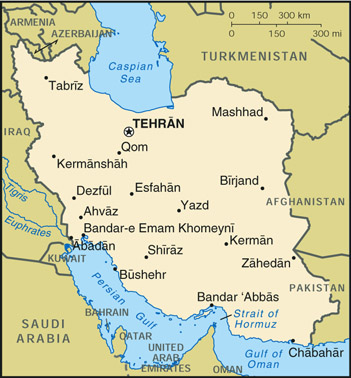
Background: Known as Persia until 1935, Iran became an Islamic republic in 1979 after the ruling monarchy was overthrown and the shah was forced into exile. Conservative clerical forces established a theocratic system of government with ultimate political authority nominally vested in a learned religious scholar. Iranian-US relations have been strained since a group of Iranian students seized the US Embassy in Tehran on 4 November 1979 and held it until 20 January 1981. During 1980-88, Iran fought a bloody, indecisive war with Iraq that eventually expanded into the Persian Gulf and led to clashes between US Navy and Iranian military forces between 1987-1988. Iran has been designated a state sponsor of terrorism for its activities in Lebanon and elsewhere in the world and remains subject to US economic sanctions and export controls because of its continued involvement. Following the elections of a reformist president and Majlis in the late 1990s, attempts to foster political reform in response to popular dissatisfaction have floundered as conservative politicians have prevented reform measures from being enacted, increased repressive measures, and consolidated their control over the government.
Government type: theocratic republic
Capital: Tehran
Currency: 10 Iranian rials (IR) = 1 toman; note – domestic figures are generally referred to in terms of the toman
Geography of Iran
Location: Middle East, bordering the Gulf of Oman, the Persian Gulf, and the Caspian Sea, between Iraq and Pakistan
Geographic coordinates: 32 00 N, 53 00 E
Area:
total: 1.648 million sq. km
land: 1.636 million sq. km
water: 12,000 sq. km
Land boundaries:
total: 5,440 km
border countries: Afghanistan 936 km, Armenia 35 km, Azerbaijan-proper 432 km, Azerbaijan-Naxcivan exclave 179 km, Iraq 1,458 km, Pakistan 909 km, Turkey 499 km, Turkmenistan 992 km
Coastline: 2,440 km
note: Iran also borders the Caspian Sea (740 km)
Maritime claims:
contiguous zone: 24 nm
continental shelf: natural prolongation
exclusive economic zone: bilateral agreements, or median lines in the Persian Gulf
territorial sea: 12 nm
Climate: mostly arid or semiarid, subtropical along Caspian coast
Terrain: rugged, mountainous rim; high, central basin with deserts, mountains; small, discontinuous plains along both coasts
Elevation extremes:
lowest point: Caspian Sea -28 m
highest point: Qolleh-ye Damavand 5,671 m
Natural resources: petroleum, natural gas, coal, chromium, copper, iron ore, lead, manganese, zinc, sulfur
Land use:
arable land: 10%
permanent crops: 1%
permanent pastures: 27%
forests and woodland: 7%
other: 55% (1993 est.)
Irrigated land: 94,000 sq. km (1993 est.)
Natural hazards: periodic droughts, floods; dust storms, sandstorms; earthquakes along western border and in the northeast
Environment – current issues: air pollution, especially in urban areas, from vehicle emissions, refinery operations, and industrial effluents; deforestation; overgrazing; desertification; oil pollution in the Persian Gulf; inadequate supplies of potable water.
Environment – international agreements:
party to: Biodiversity, Climate Change, Desertification, Endangered Species, Hazardous Wastes, Marine Dumping, Nuclear Test Ban, Ozone Layer Protection, Wetlands
signed, but not ratified: Environmental Modification, Law of the Sea, Marine Life Conservation
Geography – note: strategic location on the Persian Gulf and Strait of Hormuz, which are vital maritime pathways for crude oil transport
People of Iran
Almost two-thirds of Iran’s people are of Aryan origin–their ancestors migrated from Central Asia. The major groups in this category include Persians, Kurds, Lurs, and Baluchi. The remainder are primarily Turkic but also include Arabs, Armenians, Jews, and Assyrians.
The 1979 Islamic revolution and the war with Iraq transformed Iran’s class structure politically, socially, and economically. In general, however, Iranian society remains divided into urban, market-town, village, and tribal groups. Clerics, called mullahs, dominate politics and nearly all aspects of Iranian life, both urban and rural. After the fall of the Pahlavi regime in 1979, much of the urban upper class of prominent merchants, industrialists, and professionals, favored by the former Shah, lost standing and influence to the senior clergy and their supporters. Bazaar merchants, who were allied with the clergy against the Pahlavi shahs, have also gained political and economic power since the revolution. The urban working class has enjoyed somewhat enhanced status and economic mobility, spurred in part by opportunities provided by revolutionary organizations and the government bureaucracy.
Unemployment, a major problem even before the revolution, has many causes, including population growth, the war with Iraq, and shortages of raw materials and trained managers. Farmers and peasants received a psychological boost from the attention given them by the Islamic regime but appear to be hardly better off in economic terms. The government has made progress on rural development, including electrification and road building but has not yet made a commitment to land redistribution.
Most Iranians are Muslims; 89% belong to the Shi’a branch of Islam, the official state religion, and about 10% belong to the Sunni branch, which predominates in neighboring Muslim countries. Non-Muslim minorities include Zoroastrians, Jews, Baha’is, and Christians.
Population: 68,017,860 (July 2005 est.)
Age structure:
0-14 years: 32.97%
15-64 years: 62.38%
65 years and over: 4.65%
Population growth rate: 0.86%
Birth rate: 17.1 births/1,000 population
Death rate: 5.41 deaths/1,000 population
Net migration rate: -4.51 migrant(s)/1,000 population
Infant mortality rate: 29.04 deaths/1,000 live births
Life expectancy at birth:
total population: 69.95 years
male: 68.61 years
female: 71.37 years
Total fertility rate: 2.02 children born/woman
Nationality:
noun: Iranian(s)
adjective: Iranian
Ethnic groups: Persian 51%, Azeri 24%, Gilaki and Mazandarani 8%, Kurd 7%, Arab 3%, Lur 2%, Baloch 2%, Turkmen 2%, other 1%
Religions: Shi’a Muslim 89%, Sunni Muslim 10%, Zoroastrian, Jewish, Christian, and Baha’i 1%
Languages: Persian and Persian dialects 58%, Turkic and Turkic dialects 26%, Kurdish 9%, Luri 2%, Balochi 1%, Arabic 1%, Turkish 1%, other 2%
Literacy:
definition: age 15 and over can read and write
total population: 72.1%
male: 78.4%
female: 65.8% (1994 est.)
History of Iran
DURING IRAN’S LONG HISTORY, the country has evolved its own great Persian civilization, in addition to forming a part of a number of world empires. Iran has created sophisticated institutions, many of which still influenced its Islamic regime in the 1980s. Despite the turmoil surrounding the establishment of its revolutionary government, Iran’s development has shown continuity. Major trends affecting Iran throughout much of its history have been a tradition of monarchical government, represented in the twentieth century by Mohammad Reza Shah Pahlavi; the important political role of the Shia Islamic clergy, seen most recently in Ayatollah Sayyid Ruhollah Musavi Khomeini; and, since the late nineteenth century, pressure for Westernization or modernization.
Iran has been distinguished for having regimes that not only conquered neighboring areas but also devised ingenious institutions. The Achaemenids (550-330 B.C.)–who ruled the first Iranian world empire, which stretched from the Aegean coast of Asia Minor to Afghanistan, as well as south to Egypt–created the magnificent structures at Persepolis, the remains of which still exist. The Achaemenids also inaugurated a vast network of roads, a legal code, a coinage system, and a comprehensive administrative system that allowed some local autonomy, and they engaged in wide-ranging commerce. Iran has also influenced its conquerors. Following its conquest of Iran, the Muslim Umayyad Empire (A.D. 661- 750) adopted many Iranian institutions, such as Iran’s administrative system and coinage. Moreover, Tamerlane (1381-1405), the famous Mongol ruler, made use of Iranian administrators in governing his far-flung territories.
Despite their primarily tribal origin, for most of the country’s history the people of Iran have known only monarchical government, often of an absolutist type. For example, the Sassanids who ruled Iran for four centuries, beginning in A.D. 224, revived the Achaemenid term shahanshah (king of kings) for their ruler and considered him the “shadow of God on earth.” This concept was again revived in the late eighteenth century by the Qajar monarchy, which remained in power until Reza Khan, a military commander, had himself crowned as Reza Shah Pahlavi in 1926. Many considered Reza Shah’s son, Mohammad Reza Shah, to be an absolutist ruler in his later days, especially because of his use of the internal security force SAVAK (Sazman-e Ettelaat va Amniyat- e Keshvar) to repress domestic opposition.
After the Muslim conquest, Iran was strongly influenced by Islam and, specifically, the political role exercised by the Shia clergy. Such influence was established under the indigenous dynastic reign of the Safavids (1501- 1722). The Safavids belonged to a Sufi religious order and made Shia Islam the official religion of Iran, undertaking a major conversion campaign of Iranian Muslims. The precedent was revived in 1979 in a much more thoroughgoing theocratic fashion by Ayatollah Khomeini.
In contrast to this traditional element in Iranian history has been the pressure toward Westernization that began in the late nineteenth century. Such pressures initially came from Britain, which sought to increase its commercial relations with Iran by promoting modernization of Iran’s infrastructure and liberalization of its trade. British prodding had little effect, however, until Iranian domestic reaction to the growing corruption of the Qajar monarchy led to a constitutional revolution in 1905-1906. This revolution resulted in an elected parliament, or Majlis, a cabinet approved by the Majlis, and a constitution guaranteeing certain personal freedoms of citizens. Within less than twenty years, the program of Reza Shah stressed measures designed to reduce the powers of both tribal and religious leaders and to bring about economic development and legal and educational reforms along Western lines. Mohammad Reza Shah, like his father, promoted such Westernization and largely ignored the traditional role in Iranian society of conservative Shia religious leaders.
Mohammad Reza Shah also strengthened the military by considerably expanding its role in internal security matters to counteract the domestic opposition that arose after Mohammad Mossadeq’s prime ministership. In addition, the shah stressed defense against external enemies because he felt threatened by the Soviet Union, which had occupied Iranian territory during and after World War II. To counter such a threat, the shah sought United States military assistance in the form of advisory personnel and sophisticated weaponry. He also harshly repressed the communist Tudeh Party and other dissident groups such as the Islamic extremist Mojahedin (Mojahedin-e Khalq, or People’s Struggle) and Fadayan (Cherikha-ye Fadayan-e Khalq, or People’s Guerrillas) organizations.
Meanwhile, the shah promoted Iran’s economic development by implementing a series of seven- and five-year economic development plans, of which the first was launched in 1948. The programs emphasized the creation of the necessary infrastructure and the establishment of capital-intensive industry, initially making use of Iran’s enormous oil revenues but seeking ultimately to diversify the country’s economy by expanding heavy industry. In the 1960s, the shah also paid attention to land reform, but the redistribution of land to peasants was slow, and in many instances the amount of land allocated to individual farmers was inadequate for economically viable agricultural production. Moreover, Iran experienced high inflation as a result of the shah’s huge foreign arms purchases and his unduly rapid attempts at industrial development and modernization. Members of the bazaar, or small merchant class, benefited unevenly from the modernization and gained less proportionately than the shah’s Westernizing elite. This lack of benefit from reforms was also true of the inhabitants of most small villages, who remained without electricity, running water, or paved roads.
Many factors contributed to the fall of the shah. Observers most often cited such factors as concern over growing Western influences and secularization, the ignoring of the religious leaders, the repression of potential dissidents and of the Tudeh Party, and the failure of the bazaar class to achieve significant benefits from the shah’s economic development programs. Following a brief secular provisional government after the shah was overthrown in 1979, clerical forces loyal to Ayatollah Khomeini took control and launched a far- reaching Islamic revolution.
In Khomeini’s revolutionary regime, the Ayatollah himself acted as policy guide and ultimate decision maker in his role as the pious jurist, or faqih, in accordance with the doctrine of velayat-e faqih, under which religious scholars guided the community of believers. Iran, officially renamed the Islamic Republic of Iran, became a theocratic state with the rulers representing God in governing a Muslim people, something not attempted previously even by the twelve Shia Imams.
The Constitution of 1979 designates Khomeini as the faqih for life. The Assembly of Experts in 1985 designated Hojjatoleslam Hosain Ali Montazeri as the deputy to Khomeini and thus in line as successor. In 1988 it was not clear, however, whether the country would accept the choice of the experts when Khomeini died.
Other than appointing Khomeini faqih for life, the revolutionary Constitution provides for political institutions to implement the legislative aspects of the government. An elected legislative assembly, the Majlis, charged with approving legislation devised by the executive, was dominated by Muslim religious leaders. The Constitution also created the Council of Guardians to ensure that laws passed by the Majlis conformed with Islam. In practice, the Council of Guardians has been conservative about economic legislation, blocking Majlis measures on land reform, for example. To overcome this blocking of legislation, in January 1988 Ayatollah Khomeini gave a ruling to President Ali Khamenehi in which he claimed that the Islamic state had the same powers as the Prophet Muhammad, who was God’s vice regent; therefore, the state could set aside the Quran with regard to legislation if it were for the good of the community.
Other than through legislative instititutions, political expression occurred in principle through political parties. However, the dominant political faction, the largely clergy-led Islamic Republican Party established in early 1979, was dissolved in 1987 because it had become unmanageable. Subsequently, only one legally recognized political party, the Iran Freedom Movement (Nehzat-e Azadi-yi Iran), which had been established by former Prime Minister Mehdi Bazargan, operated in Iran. Estimates of the number of persons opposed to the government or in prison varied. Officially, the latter number was given as 9,000, but the antigovernment Mojahedin maintained that 140,000 was a more realistic figure. In 1988 opposition parties existed in exile, primarily in Western Europe, and included ethnic Kurdish movements and the Mojahedin Islamic extremists, as well as Marxists and monarchists. The Mojahedin also had created the Iranian National Army of Liberation, which operated out of northern Iraq against the Khomeini regime.
After the Ayatollah’s government came to power, it initially executed or imprisoned many members of the shah’s regime, including officers of the various armed services. But, following the outbreak of the war with Iraq in 1980, substantial numbers of military men were released from prison to provide essential leadership on the battlefield or in the air war. As early as June 1979, a counterforce to the regular military was created in the form of the Pasdaran (Pasdaran-e Enghelab-e Islami, or Islamic Revolutionary Guard Corps, or Revolutionary Guards), an organization charged with safeguarding the Revolution. The Pasdaran became a significant military force in its own right and was overseen by a cabinet-level minister.
By 1988 the eight-year-old war with Iraq had evolved through various stages of strategy and tactics. Because Iran’s population was approximately three times that of Iraq, Iran’s military manpower pool was vastly superior. Capitalizing on this advantage, in the early stages of the war Iran engaged extensively in “human-wave” assaults against Iraqi positions, frequently using youths in their early teens. This war strategy proved extremely costly to Iran in terms of human casualties; it was estimated that between 300,000 and 400,000 Iranians had been killed by 1987, and estimated losses of matériel were also large. The hostilities included a tanker war in the Persian Gulf and the mining of the Gulf by Iran, events that led to the involvement of the United States and other Western nations, which sought to protect their shipping and safeguard their strategic, economic, and political interests in the area. Furthermore, a “war of cities” was inaugurated in 1985, with each side bombarding the other’s urban centers with missiles. Iran expended considerable effort in developing a domestic arms industry capable of manufacturing or modifying weapons and war matériel obtained from outside sources. Iran’s principal arms supplier was China, from which it acquired Silkworm HY-2 surface-to-surface missiles, among other weapons systems. Iran also obtained missiles from the Soviet Union, which attempted to maintain amicable relations with both sides in the Iran-Iraq War. In addition, in the ground war, which initially had favored Iraq but then turned strongly in Iran’s favor, in April 1988 Iraq succeeded in regaining the Faw Peninsula. Iraq thus recovered a significant part of the territory it had lost earlier to Iran.
The war has severely strained Iran’s economy by depleting its foreign exchange reserves and causing a balance of payments deficit. It has also redirected manpower that would otherwise have been engaged in agriculture and industry. By 1987 Iran’s overall war costs were calculated at approximately US$350 billion. Moreover, wartime damage to urban centers in western Iran, such as Abadan, Ahvaz, Dezful, and Khorramshahr, caused refugees to flood into Tehran and other cities, further aggravating the housing shortage. The destruction of petroleum producing, processing, and shipping installations on the Persian Gulf had reduced Iran’s oil production and its export capability, thereby cutting revenues. Sales of other domestic commodities, such as carpets, agricultural products, and caviar, were unable to compensate for the lost oil revenue, which was further reduced by a world oil glut. Thus, in 1988 the revolutionary regime faced a straitened economic future in which basic structural problems–such as the degree of state involvement in the economy and the successful implementation of agricultural reform–remained to be addressed.
Iran’s economic situation has influenced its foreign policy to some extent. Although ideological considerations based on revolutionary principles dominated in the early days of the Revolution, Iran’s policies became more pragmatic as the war with Iraq continued. For example, because of its need for weapons and other military matériel, the Khomeini regime was willing to purchase arms from Western nations and even from Israel. Initially, the revolutionary government had made a radical foreign policy change from the pro-Western stance of the shah. The United States, because of its support of the shah, was branded as the “Great Satan” and the Soviet Union as the “Lesser Satan.” Both capitalism and socialism were condemned as materialistic systems that sought to dominate the Third World. In practice, however, the United States was the major target, as evidenced most clearly in the seizure of the United States embassy in Tehran and the taking of American diplomats as hostages in November 1979.
Because of the Khomeini regime’s desire to export revolution, regional monarchies with Western associations, such as Saudi Arabia, the Gulf states, and Jordan, were regarded with some hostility, particularly after these countries came to the support of Iraq in the Iran-Iraq War. Iran’s militant foreign policy in the region was reflected in the August 1, 1987, demonstrations during the Mecca pilgrimage. As a result, over 400 pilgrims were killed (the majority of them Iranian). As a protest against Iranian actions in the Gulf, in late April 1988 Saudi Arabia severed diplomatic relations with Iran. Another instance of Iran’s militant policy was its funding and sponsorship of Islamic extremist organizations in Lebanon, particularly Islamic Amal and Hizballah, which contributed to the ongoing civil war in Lebanon.
In 1988 the country with which Iran had the most cordial relationship was Syria. Iran also maintained active economic relations with the Soviet Union, especially with respect to direct trade, arms purchases, and the transshipment of goods via the Soviet Union to Western Europe.
Iran’s future course in the late 1980s hinged upon a number of factors. These included the smoothness with which it would be able to make the transition to Ayatollah Khomeini’s successor; the duration, cost, and settlement terms of the war with Iraq; the direction of Iran’s foreign policy, in relation both to the superpowers and to the remainder of the world, particularly the countries of the region; and the skill of Iranian technocrats in taking the necessary steps to address the country’s economic difficulties.
Iran Economy
Pre-revolutionary Iran’s economic development was rapid. Traditionally an agricultural society, by the 1970s, Iran had achieved significant industrialization and economic modernization. However, the pace of growth had slowed dramatically by 1978, just before the Islamic revolution.
Since the revolution, increased government involvement in the economy has further stunted growth. Iran’s current difficulties can be traced to a combination of factors. Economic activity, severely disrupted by the revolution, was further depressed by the war with Iraq and by the decline of oil prices beginning in late 1985. After the war with Iraq ended, the situation began to improve: Iran’s GDP grew for 2 years running, partly from an oil windfall in 1990, and there was a substantial increase in imports.
A decrease in oil revenues in 1991 and growing external debt, though, dampened optimism. In March 1989, Khomeini had approved Rafsanjani’s 5-year plan for economic development, which allowed Iran to seek foreign loans. But mismanagement and inefficient bureaucracy, as well as political and ideological infighting, have hampered the formulation and execution of coherent economic policies. Today, Iran’s economy is a mixture of central planning, state ownership of oil and other large enterprises, village agriculture, and smallscale private trading and service ventures. President Khatami has continued to follow the market reform plans of former President Rafsanjani and has indicated that he will pursue diversification of Iran’s oil-reliant economy, although he has made little progress toward that goal.
Official unemployment was estimated to be 14% for 1999. Although Islam guarantees the right to private ownership, banks and some industries–including the petroleum, transportation, utilities, and mining sectors–were nationalized after the revolution, although Iran has been pursuing some privatization. (Oil price and debt problems are no longer relevant.) The import-dependent industrial sector is further plagued by low labor productivity, lack of foreign exchange, and shortages of raw materials and spare parts.
Agriculture also has suffered from shortages of capital, raw materials, and equipment, as well as from the war with Iraq; in addition, a major area of dissension within the regime has been how to proceed with land reform.
GDP: purchasing power parity – $413 billion (2000 est.)
GDP – real growth rate: 3% (2000 est.)
GDP – per capita: purchasing power parity – $6,300 (2000 est.)
GDP – composition by sector:
agriculture: 24%
industry: 28%
services: 48% (2000 est.)
Inflation rate (consumer prices): 16% (2000 est.)
Labor force: 17.3 million
note: shortage of skilled labor (1998)
Labor force – by occupation: agriculture 33%, industry 25%, services 42% (1999 est.)
Unemployment rate: 14% (1999 est.)
Budget:
revenues: $27 billion
expenditures: $27 billion (1999)
Industries: petroleum, petrochemicals, textiles, cement and other construction materials, food processing (particularly sugar refining and vegetable oil production), metal fabricating, armaments
Industrial production growth rate: 4.4% (nonoil) (1999)
Electricity – production: 103.054 billion kWh (1999)
Electricity – production by source:
fossil fuel: 93.16%
hydro: 6.84%
nuclear: 0%
other: 0% (1999)
Agriculture – products: wheat, rice, other grains, sugar beets, fruits, nuts, cotton; dairy products, wool; caviar
Exports: $25 billion (f.o.b., 2000 est.)
Exports – commodities: petroleum 85%, carpets, fruits and nuts, iron and steel, chemicals
Exports – partners: Japan, Italy, UAE, South Korea, France, China
Imports: $15 billion (f.o.b., 2000 est.)
Imports – commodities: industrial raw materials and intermediate goods, capital goods, foodstuffs and other consumer goods, technical services, military supplies
Imports – partners: Germany, South Korea, Italy, UAE, France, Japan
Debt – external: $7.5 billion (2000 est.)
Economic aid – recipient: $116.5 million (1995)
Currency: Iranian rial (IRR)
Map of Iran