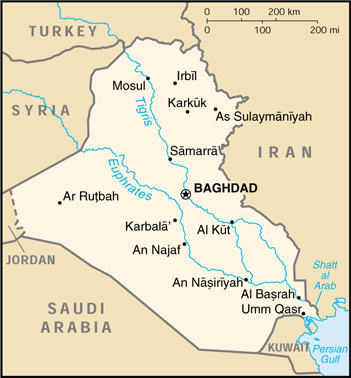
Background: Formerly part of the Ottoman Empire, Iraq was occupied by Britain during the course of World War I; in 1920, it was declared a League of Nations mandate under UK administration. In stages over the next dozen years, Iraq attained its independence as a kingdom in 1932. A “republic” was proclaimed in 1958, but in actuality a series of military strongmen ruled the country, the latest was SADDAM Husayn. Territorial disputes with Iran led to an inconclusive and costly eight-year war (1980-88). In August 1990, Iraq seized Kuwait, but was expelled by US-led, UN coalition forces during the Gulf War of January-February 1991. Following Kuwait’s liberation, the UN Security Council (UNSC) required Iraq to scrap all weapons of mass destruction and long-range missiles and to allow UN verification inspections. Continued Iraqi noncompliance with UNSC resolutions over a period of 12 years resulted in the US-led invasion of Iraq in March 2003 and the ouster of the SADDAM Husayn regime. Coalition forces remain in Iraq, helping to restore degraded infrastructure and facilitating the establishment of a freely elected government, while simultaneously dealing with a robust insurgency. The Coalition Provisional Authority transferred sovereignty to the Iraqi Interim Government (IG) in June 2004. Iraqis voted on 30 January 2005 to elect a 275-member Transitional National Assembly that will draft a permanent constitution and pave the way for new national elections at the end of 2005.
Government type: republic
Capital: Baghdad
Currency: 1 Iraqi dinar (IQD) = 1,000 fils
Geography of Iraq
Location: Middle East, bordering the Persian Gulf, between Iran and Kuwait
Geographic coordinates: 33 00 N, 44 00 E
Area:
total: 437,072 sq. km
land: 432,162 sq. km
water: 4,910 sq. km
Land boundaries:
total: 3,631 km
border countries: Iran 1,458 km, Jordan 181 km, Kuwait 242 km, Saudi Arabia 814 km, Syria 605 km, Turkey 331 km
Coastline: 58 km
Maritime claims:
continental shelf: not specified
territorial sea: 12 nm
Climate: mostly desert; mild to cool winters with dry, hot, cloudless summers; northern mountainous regions along Iranian and Turkish borders experience cold winters with occasionally heavy snows that melt in early spring, sometimes causing extensive flooding in central and southern Iraq
Terrain: mostly broad plains; reedy marshes along Iranian border in south with large flooded areas; mountains along borders with Iran and Turkey
Elevation extremes:
lowest point: Persian Gulf 0 m
highest point: Haji Ibrahim 3,600 m
Natural resources: petroleum, natural gas, phosphates, sulfur
Land use:
arable land: 12%
permanent crops: 0%
permanent pastures: 9%
forests and woodland: 0%
other: 79% (1993 est.)
Irrigated land: 25,500 sq. km (1993 est.)
Natural hazards: dust storms, sandstorms, floods
Environment – current issues: government water control projects have drained most of the inhabited marsh areas east of An Nasiriyah by drying up or diverting the feeder streams and rivers; a once sizable population of Shi’a Muslims, who have inhabited these areas for thousands of years, has been displaced; furthermore, the destruction of the natural habitat poses serious threats to the area’s wildlife populations; inadequate supplies of potable water; development of Tigris-Euphrates Rivers system contingent upon agreements with upstream riparian Turkey; air and water pollution; soil degradation (salination) and erosion; desertification.
Environment – international agreements:
party to: Law of the Sea, Nuclear Test Ban
signed, but not ratified: Environmental Modification
Geography – note: strategic location on Shatt al Arab waterway and at the head of the Persian Gulf
People of Iraq
Almost 75% of Iraq’s population live in the flat, alluvial plain stretching southeast toward Baghdad and Basrah to the Persian Gulf. The Tigris and Euphrates Rivers carry about 70 million cubic meters of silt annually to the delta. Known in ancient times as Mesopotamia, the region is the legendary locale of the Garden of Eden. The ruins of Ur, Babylon, and other ancient cities are here.
Iraq’s two largest ethnic groups are Arabs and Kurds. Other distinct groups are Turkomans, Assyrians, Iranians, Lurs, and Armenians. Arabic is the most commonly spoken language. Kurdish is spoken in the north, and English is the most commonly spoken Western language.
Most Iraqi Muslims are members of the Shi’a sect, but there is a large Sunni population as well, made up of both Arabs and Kurds. Small communities of Christians, Jews, Bahais, Mandaeans, and Yezidis also exist. Most Kurds are Sunni Muslim but differ from their Arab neighbors in language, dress, and customs.
Population: 26,074,906 (July 2005 est.)
Age structure:
0-14 years: 41.64%
15-64 years: 55.28%
65 years and over: 3.08%
Population growth rate: 2.7%
Birth rate: 34.64 births/1,000 population
Death rate: 6.21 deaths/1,000 population
Net migration rate: 0 migrant(s)/1,000 population
Infant mortality rate: 60.05 deaths/1,000 live births
Life expectancy at birth:
total population: 66.95 years
male: 65.92 years
female: 68.03 years
Total fertility rate: 4.75 children born/woman
Nationality:
noun: Iraqi(s)
adjective: Iraqi
Ethnic groups: Arab 75%-80%, Kurdish 15%-20%, Turkoman, Assyrian or other 5%
Religions: Muslim 97% (Shi’a 60%-65%, Sunni 32%-37%), Christian or other 3%
Languages: Arabic, Kurdish (official in Kurdish regions), Assyrian, Armenian
Literacy:
definition: age 15 and over can read and write
total population: 58%
male: 70.7%
female: 45% (1995 est.)
History of Iraq
IRAQ, A REPUBLIC since the 1958 coup d’etat that ended the reign of King Faisal II, became a sovereign, independent state in 1932. Although the modern state, the Republic of Iraq, is quite young, the history of the land and its people dates back more than 5,000 years. Indeed, Iraq contains the world’s richest known archaeological sites. Here, in ancient Mesopotamia (the land between the rivers), the first civilization–that of Sumer– appeared in the Near East. Despite the millennium separating the two epochs, Iraqi history displays a continuity shaped by adaptation to the ebbings and flowings of the Tigris and Euphrates rivers (in Arabic, the Dijlis and Furat, respectively). Allowed to flow unchecked, the rivers wrought destruction in terrible floods that inundated whole towns. When the rivers were controlled by irrigation dikes and other waterworks, the land became extremely fertile.
The dual nature of the Tigris and the Euphrates–their potential to be destructive or productive–has resulted in two distinct legacies found throughout Iraqi history. On the one hand, Mesopotamia’s plentiful water resources and lush river valleys allowed for the production of surplus food that served as the basis for the civilizing trend begun at Sumer and preserved by rulers such as Hammurabi (1792-1750 B.C.), Cyrus (550-530 B.C.), Darius (520-485 B.C.), Alexander (336-323 B.C.), and the Abbasids (750-1258). The ancient cities of Sumer, Babylon, and Assyria all were located in what is now Iraq. Surplus food production and joint irrigation and flood control efforts facilitated the growth of a powerful and expanding state.
Mesopotamia could also be an extremely threatening environment, however, driving its peoples to seek security from the vicissitudes of nature. Throughout Iraqi history, various groups have formed autonomous, self-contained social units. Allegiance to ancient religious deities at Ur and Eridu, membership in the Shiat Ali (or party of Ali, the small group of followers that supported Ali ibn Abu Talib as rightful leader of the Islamic community in the seventh century), residence in the asnaf (guilds) or the mahallat (city quarters) of Baghdad under the Ottoman Turks, membership in one of a multitude of tribes–such efforts to build autonomous security-providing structures have exerted a powerful centrifugal force on Iraqi culture.
Two other factors that have inhibited political centralization are the absence of stone and Iraq’s geographic location as the eastern flank of the Arab world. For much of Iraqi history, the lack of stone has severely hindered the building of roads. As a result, many parts of the country have remained beyond government control. Also, because it borders nonArab Turkey and Iran and because of the great agricultural potential of its river valley, Iraq has attracted waves of ethnically diverse migrations. Although this influx of people has enriched Iraqi culture, it also has disrupted the country’s internal balance and has led to deep-seated schisms.
Throughout Iraqi history, the conflict between political fragmentation and centralization has been reflected in the struggles among tribes and cities for the food-producing flatlands of the river valleys. When a central power neglected to keep the waterworks in repair, land fell into disuse, and tribes attacked settled peoples for precious and scarce agricultural commodities. For nearly 600 years, between the collapse of the Abbasid Empire in the thirteenth century and the waning years of the Ottoman era in the late nineteenth century, government authority was tenuous and tribal Iraq was, in effect, autonomous. At the beginning of the twentieth century, Iraq’s disconnected, and often antagonistic, ethnic, religious, and tribal social groups professed little or no allegiance to the central government. As a result, the all-consuming concern of contemporary Iraqi history has been the forging of a nation-state out of this diverse and conflict-ridden social structure and the concomitant transformation of parochial loyalties, both tribal and ethnic, into a national identity.
Beginning in the middle of the nineteenth century, the tanzimat reforms (an administrative and legal reorganization of the Ottoman Empire), the emergence of private property, and the tying of Iraq to the world capitalist market severely altered Iraq’s social structure. Tribal shaykhs traditionally had provided both spiritual leadership and tribal security. Land reform and increasing links with the West transformed many shaykhs into profit-seeking landlords, whose tribesmen became impoverished sharecroppers. Moreover, as Western economic penetration increased, the products of Iraq’s once-prosperous craftsmen were displaced by machine-made British textiles.
During the twentieth century, as the power of tribal Iraq waned, Baghdad benefited from the rise of a centralized governmental apparatus, a burgeoning bureaucracy, increased educational opportunities, and the growth of the oil industry. The transformation of the urban-tribal balance resulted in a massive rural-to-urban migration. The disruption of existing parochial loyalties and the rise of new class relations based on economics fueled frequent tribal rebellions and urban uprisings during much of the twentieth century.
Iraq’s social fabric was in the throes of a destabilizing transition in the first half of the twentieth century. At the same time, because of its foreign roots, the Iraqi political system suffered from a severe legitimacy crisis. Beginning with its League of Nations Mandate in 1920, the British government had laid out the institutional framework for Iraqi government and politics. Britain imposed a Hashimite (also seen as Hashemite) monarchy, defined the territorial limits of Iraq with little correspondence to natural frontiers or traditional tribal and ethnic settlements, and influenced the writing of a constitution and the structure of parliament. The British also supported narrowly based groups–such as the tribal shaykhs–over the growing, urban-based nationalist movement, and resorted to military force when British interests were threatened, as in the 1941 Rashid Ali coup.
Between 1918 and 1958, British policy in Iraq had farreaching effects. The majority of Iraqis were divorced from the political process, and the process itself failed to develop procedures for resolving internal conflicts other than rule by decree and the frequent use of repressive measures. Also, because the formative experiences of Iraq’s post-1958 political leadership centered around clandestine opposition activity, decision making and government activity in general have been veiled in secrecy. Furthermore, because the country lacks deeply rooted national political institutions, political power frequently has been monopolized by a small elite, the members of which are often bound by close family or tribal ties.
Between the overthrow of the monarchy in 1958 and the emergence of Saddam Husayn in the mid-1970s, Iraqi history was a chronicle of conspiracies, coups, countercoups, and fierce Kurdish uprisings. Beginning in 1975, however, with the signing of the Algiers Agreement–an agreement between Saddam Husayn and the shah of Iran that effectively ended Iranian military support for the Kurds in Iraq–Saddam Husayn was able to bring Iraq an unprecedented period of stability. He effectively used rising oil revenues to fund large-scale development projects, to increase public sector employment, and significantly to improve education and health care. This tied increasing numbers of Iraqis to the ruling Baath (Arab Socialist Resurrection) Party. As a result, for the first time in contemporary Iraqi history, an Iraqi leader successfully forged a national identity out of Iraq’s diverse social structure. Saddam Husayn’s achievements and Iraq’s general prosperity, however, did not survive long. In September 1980, Iraqi troops crossed the border into Iran, embroiling the country in a costly war.
The Iran-Iraq war (1980-88) devastated the economy of Iraq. Iraq declared victory in 1988 but actually achieved a weary return to the status quo antebellum. The war left Iraq with the largest military establishment in the Gulf region but with huge debts and an ongoing rebellion by Kurdish elements in the northern mountains. The government suppressed the rebellion by using weapons of mass destruction on civilian targets, including a mass chemical weapons attack on the city of Halabja that killed several thousand civilians.
Iraq invaded Kuwait in August 1990, but a U.S.-led coalition acting under United Nations (UN) resolutions expelled Iraq from Kuwait in February1991. After the war, UN-mandated sanctions based on Security Council resolutions called for the regime to surrender its weapons of mass destruction and submit to UN inspections. The regime has refused to fully cooperate with the UN inspections and since 1998 has not allowed inspectors into Iraq. Iraq is allowed under the UN Oil-for-Food program to export unlimited quantities of oil with which to purchase food, medicine, and other humanitarian relief equipment and infrastructure support necessary to sustain the civilian population. The UN coalition enforces no-fly zones in southern and northern Iraq to protect Iraqi citizens from attack by the regime and a no-drive zone in southern Iraq to prevent the regime from massing forces to threaten or again invade Kuwait.
Iraq Economy
Iraq’s economy is characterized by a heavy dependence on oil exports and an emphasis on development through central planning. Prior to the outbreak of the war with Iran in September 1980, Iraq’s economic prospects were bright. Oil production had reached a level of 3.5 million barrels per day, and oil revenues were $21 billion in 1979 and $27 billion in 1980. At the outbreak of the war, Iraq had amassed an estimated $35 billion in foreign exchange reserves.
The Iran-Iraq War depleted Iraq’s foreign exchange reserves, devastated its economy, and left the country saddled with a foreign debt of more than $40 billion. After hostilities ceased, oil exports gradually increased with the construction of new pipelines and the restoration of damaged facilities.
Iraq’s invasion of Kuwait in August 1990, subsequent international sanctions, and damage from military action by an international coalition beginning in January 1991 drastically reduced economic activity. Government policies of diverting income to key supporters of the regime while sustaining a large military and internal security force further impaired finances, leaving the average Iraqi citizen facing desperate hardships. Implementation of a UN oil-for-food program in December 1996 has improved conditions for the average Iraqi citizen. Since 1999, Iraq was authorized to export unlimited quantities of oil to finance humanitarian needs including food, medicine, and infrastructure repair parts. Oil exports fluctuate as the regime alternately starts and stops exports, but, in general, oil exports have now reached three-quarters of their pre-Gulf War levels. Per capita output and living standards remain well below pre-Gulf War levels.
Agriculture
Despite its abundant land and water resources, Iraq is a net food importer. Under the UN oil-for-food program, Iraq imports large quantities of grains, meat, poultry, and dairy products. The government abolished its farm collectivization program in 1981, allowing a greater role for private enterprise in agriculture. The Agricultural Cooperative Bank, capitalized at nearly $1 billion by 1984, targets its low-interest, low-collateral loans to private farmers for mechanization, poultry projects, and orchard development. Large modern cattle, dairy, and poultry farms are under construction. Obstacles to agricultural development include labor shortages, inadequate management and maintenance, salinization, urban migration, and dislocations resulting from previous land reform and collectivization programs.
Importation of foreign workers and increased entry of women into traditionally male labor roles have helped compensate for agricultural and industrial labor shortages exacerbated by the way. A disastrous attempt to drain the southern marshes and introduce irrigated farming to this region merely destroyed a natural food producing area, while concentration of salts and minerals in the soil due to the draining left the land unsuitable for agriculture.
Trade
The United Nations imposed economic sanctions on Iraq after it invaded Kuwait in 1990. The Government of Iraq’s refusal to allow weapons inspectors into the country to dismantle Iraq’s weapons of mass destruction program has resulted in those sanctions remaining in place. Under the oil-for-food program, Iraq is allowed to export unlimited quantities of oil in exchange for humanitarian relief supplies, including food, medicine, and infrastructure spare parts. A robust illicit trade in oil with neighboring states and through the Persian Gulf earned almost $2 billion in illegal income for the regime in 2000.
GDP: purchasing power parity – $57 billion (2000 est.)
GDP – real growth rate: 15% (2000 est.)
GDP – per capita: purchasing power parity – $2,500 (2000 est.)
GDP – composition by sector:
agriculture: 6%
industry: 13%
services: 81% (1993 est.)
Inflation rate (consumer prices): 100% (2000 est.)
Labor force: 4.4 million (1989)
Industries: petroleum, chemicals, textiles, construction materials, food processing
Electricity – production: 29.42 billion kWh (1999)
Electricity – production by source:
fossil fuel: 97.96%
hydro: 2.04%
nuclear: 0%
other: 0% (1999)
Agriculture – products: wheat, barley, rice, vegetables, dates, cotton; cattle, sheep
Exports: $21.8 billion (2000 est.)
Exports – commodities: crude oil
Exports – partners: Russia, France, Switzerland, China (2000)
Imports: $13.8 billion (2000 est.)
Imports – commodities: food, medicine, manufactures
Imports – partners: Egypt, Russia, France, Vietnam (2000)
Debt – external: $139 billion (2000 est.)
Economic aid – recipient: $327.5 million (1995)
Currency: Iraqi dinar (IQD)
Map of Iraq