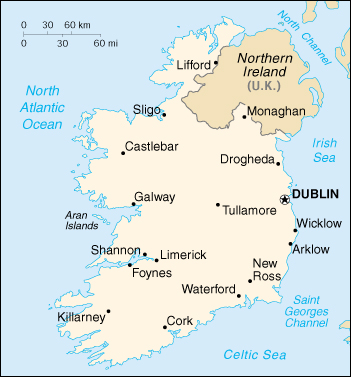
Background: A failed 1916 Easter Monday Rebellion touched off several years of guerrilla warfare that in 1921 resulted in independence from the UK for the 26 southern counties; the six northern counties (Ulster) remained part of Great Britain. In 1948 Ireland withdrew from the British Commonwealth; it joined the European Community in 1973. Irish governments have sought the peaceful unification of Ireland and have cooperated with Britain against terrorist groups. A peace settlement for Northern Ireland, approved in 1998, was implemented the following year.
Government type: republic
Capital: Dublin
Currency: euro (EUR)
Geography of Ireland
Location: Western Europe, occupying five-sixths of the island of Ireland in the North Atlantic Ocean, west of Great Britain
Geographic coordinates: 53 00 N, 8 00 W
Area:
total: 70,280 sq. km
land: 68,890 sq. km
water: 1,390 sq. km
Land boundaries:
total: 360 km
border countries: UK 360 km
Coastline: 1,448 km
Maritime claims:
continental shelf: not specified
exclusive fishing zone: 200 nm
territorial sea: 12 nm
Climate: temperate maritime; modified by North Atlantic Current; mild winters, cool summers; consistently humid; overcast about half the time
Terrain: mostly level to rolling interior plain surrounded by rugged hills and low mountains; sea cliffs on west coast
Elevation extremes:
lowest point: Atlantic Ocean 0 m
highest point: Carrauntoohil 1,041 m
Natural resources: zinc, lead, natural gas, barite, copper, gypsum, limestone, dolomite, peat, silver
Land use:
arable land: 13%
permanent crops: 0%
permanent pastures: 68%
forests and woodland: 5%
other: 14% (1993 est.)
Environment – current issues: water pollution, especially of lakes, from agricultural runoff
Environment – international agreements:
party to: Air Pollution, Air Pollution-Nitrogen Oxides, Air Pollution-Sulphur 94, Biodiversity, Climate Change, Desertification, Environmental Modification, Hazardous Wastes, Law of the Sea, Marine Dumping, Nuclear Test Ban, Ozone Layer Protection, Ship Pollution, Tropical Timber 83, Tropical Timber 94, Wetlands, Whaling
signed, but not ratified: Air Pollution-Persistent Organic Pollutants, Climate Change-Kyoto Protocol, Endangered Species, Marine Life Conservation
Geography – note: strategic location on major air and sea routes between North America and northern Europe; over 40% of the population resides within 97 km of Dublin
People of Ireland
The Irish people are mainly of Celtic origin, with the country’s only significant sized minority having descended from the Anglo-Normans. English is the common language, but Irish (Gaelic) also is an official language and is taught in the schools.
Population: 4,015,676 (July 2005 est.)
Age structure:
0-14 years: 21.57%
15-64 years: 67.08%
65 years and over: 11.35%
Population growth rate: 1.12%
Birth rate: 14.57 births/1,000 population
Death rate: 8.07 deaths/1,000 population
Net migration rate: 4.69 migrant(s)/1,000 population
Infant mortality rate: 5.53 deaths/1,000 live births
Life expectancy at birth:
total population: 76.99 years
male: 74.23 years
female: 79.93 years
Total fertility rate: 1.9 children born/woman
Nationality:
noun: Irishman(men), Irishwoman(women), Irish (collective plural)
adjective: Irish
Ethnic groups: Celtic, English
Religions: Roman Catholic 91.6%, Church of Ireland 2.5%, other 5.9% (1998)
Languages: English is the language generally used, Irish (Gaelic) spoken mainly in areas located along the western seaboard
Literacy:
definition: age 15 and over can read and write
total population: 98% (1981 est.)
History of Ireland
What little is known of pre-Christian Ireland comes from a few references in Roman writings, Irish poetry and myth, and archaeology. The earliest inhabitants–people of a mid-Stone Age culture–arrived about 6000 BC, when the climate had become hospitable following the retreat of the polar icecaps. About 4,000 years later, tribes from southern Europe arrived and established a high Neolithic culture, leaving behind gold ornaments and huge stone monuments for archaeologists. This culture apparently prospered, and the island became more densely populated. The Bronze Age people, who arrived during the next 1,000 years, produced elaborate gold and bronze ornaments and weapons.
The Iron Age arrived abruptly in the fourth century BC with the invasion of the Celts, a tall, energetic people who had spread across Europe and Great Britain in the preceding centuries. The Celts, or Gaels, and their more numerous predecessors divided into five kingdoms in which, despite constant strife, a rich culture flourished. This pagan society was dominated by druids–priests who served as educators, physicians, poets, diviners, and keepers of the laws and histories.
But the coming of Christianity from across the Irish Sea brought major changes and civilizing influences. Tradition maintains that in 432 AD, St. Patrick arrived on the island and, in the years that followed, worked to convert the Irish to Christianity. Probably a Celt himself, St. Patrick preserved the tribal and social patterns of the Irish, codifying their laws and changing only those that conflicted with Christian practices. He also introduced the Roman alphabet, which enabled Irish monks to preserve parts of the extensive Celtic oral literature.
The pagan druid tradition collapsed in the face of the spread of the new faith, and Irish scholars excelled in the study of Latin learning and Christian theology in the monasteries that shortly flourished. Missionaries from Ireland to England and the continent spread news of the flowering of learning, and scholars from other nations came to Irish monasteries. The excellence and isolation of these monasteries helped preserve Latin learning during the Dark Ages. The arts of manuscript illumination, metalworking, and sculpture flourished and produced such treasures as the Book of Kells, ornate jewelry, and the many carved stone crosses that dot the island.
This golden age of culture was interrupted by 200 years of intermittent warfare with waves of Viking raiders who plundered monasteries and towns. The Vikings established Dublin and other seacoast towns but were eventually defeated. Although the Irish were subsequently free from foreign invasion for 150 years, internecine clan warfare continued to drain their energies and resources.
In the 12th century, Pope Adrian IV granted overlordship of the island to Henry II of England, who began an epic struggle between the Irish and the English which not only burned intermittently for 800 years but which continues to affect Irish politics and bilateral relations to this day. The Reformation exacerbated the oppression of the Roman Catholic Irish, and, in the early 17th century, Scottish and English Protestants were sent as colonists to the north of Ireland and the Pale around Dublin.
From 1800 to 1921, Ireland was an integral part of the United Kingdom. Religious freedom was restored in 1829. But this victory for the Irish Catholic majority was overshadowed by severe economic depression and mass famine from 1846-48 when the potato crop failed. The famine spawned the first mass wave of Irish emigration to the United States. A decade later, in 1858, the Irish Republican Brotherhood (IRB–also known as the Fenians) was founded as a secret society dedicated to armed rebellion against the British. An above-ground political counterpart, the Home Rule Movement, was created in 1874, advocating constitutional change for independence. Galvanized by the leadership of Charles Stewart Parnell, the party was able to force British governments after 1885 to introduce several home rule bills. The turn of the century witnessed a surge of interest in Irish nationalism, including the founding of Sinn Fein (“Ourselves Alone”) as an open political movement.
Nationalism was and is a potent populist force in Irish politics. The outbreak of war in Europe in 1914 put home rule efforts on hold, and, in reaction, Padraic Pearse and James Connolly led the unsuccessful Easter Rising of 1916. The decision by the British-imposed court structure to execute the leaders of the rebellion, coupled with the British Government’s threat of conscription, alienated public opinion and produced massive support for Sinn Fein in the 1918 general election. Under the leadership of Eamon de Valera, the elected Sinn Fein deputies constituted themselves as the first Dail. Tensions only increased: British attempts to smash Sinn Fein ignited the Anglo-Irish War of 1919-1921.
The end of the war brought the Anglo-Irish treaty of 1921, which established the Irish Free State of 26 counties within the British Commonwealth and recognized the partition of the island into Ireland and Northern Ireland, though supposedly as a temporary measure. The six predominantly Protestant counties of northeast Ulster–Northern Ireland–remained a part of the United Kingdom with limited self-government. A significant Irish minority repudiated the treaty settlement because of the continuance of subordinate ties to the British monarch and the partition of the island. This opposition led to further hostilities–a civil war (1922-23), which was won by the pro-treaty forces.
In 1932, Eamon de Valera, the political leader of the forces initially opposed to the treaty, became prime minister, and a new Irish constitution was enacted in 1937. The last British military bases were soon withdrawn, and the ports were returned to Irish control. Ireland was neutral in World War II. The government formally declared Ireland a republic in 1948; however, it does not normally use the term “Republic of Ireland,” which tacitly acknowledges the partition but refers to the country simply as “Ireland.”
Ireland Economy
Economy – overview: Ireland is a small, modern, trade-dependent economy with growth averaging a robust 9% in 1995-2000. Agriculture, once the most important sector, is now dwarfed by industry, which accounts for 38% of GDP and about 80% of exports and employs 28% of the labor force. Although exports remain the primary engine for Ireland’s robust growth, the economy is also benefiting from a rise in consumer spending and recovery in both construction and business investment. Over the past decade, the Irish government has implemented a series of national economic programs designed to curb inflation, reduce government spending, increase labor force skills, and promote foreign investment. Ireland joined in launching the euro currency system in January 1999 along with 10 other EU nations. The Irish economy is in danger of overheating, with the tight labor market driving up wage demands and inflation.
GDP: purchasing power parity – $81.9 billion (2000 est.)
GDP – real growth rate: 8.4% (1999 est.), 9.9% (2000 est.)
GDP – per capita: purchasing power parity – $21,600 (2000 est.)
GDP – composition by sector:
agriculture: 4%
industry: 38%
services: 58% (1999)
Population below poverty line: 10% (1997 est.)
Household income or consumption by percentage share:
lowest 10%: 2%
highest 10%: 27.3% (1997)
Inflation rate (consumer prices): 2.2% (1999), 5.6% (2000)
Labor force: 1.82 million (2000 est.)
Labor force – by occupation: services 64%, industry 28%, agriculture 8% (2000 est.)
Unemployment rate: 5.5% (1999), 4.1% (2000)
Budget:
revenues: $25.7 billion
expenditures: $19.2 billion, including capital expenditures of $2 billion (2000)
Industries: food products, brewing, textiles, clothing; chemicals, pharmaceuticals, machinery, transportation equipment, glass and crystal; software
Industrial production growth rate: 10% (1999 est.), 14% (2000 est.)
Electricity – production: 19.542 billion kWh (1999)
Electricity – production by source:
fossil fuel: 94.42%
hydro: 4.23%
nuclear: 0%
other: 1.35% (1999)
Electricity – consumption: 18.414 billion kWh (1999)
Electricity – exports: 50 million kWh (1999)
Electricity – imports: 290 million kWh (1999)
Agriculture – products: turnips, barley, potatoes, sugar beets, wheat; beef, dairy products
Exports: $66 billion (f.o.b., 1999 est.), $73.5 billion (f.o.b., 2000)
Exports – commodities: machinery and equipment, computers, chemicals, pharmaceuticals; live animals, animal products
Exports – partners: EU 59% (UK 19%, Germany 9%, France 7%), US 20% (2000)
Imports: $44 billion (c.i.f., 1999 est.), $45.7 billion (f.o.b., 2000 est.)
Imports – commodities: data processing equipment, other machinery and equipment, chemicals; petroleum and petroleum products, textiles, clothing
Imports – partners: EU 54% (UK 29%, Germany 6%, France 5%), US 18%, Japan 5%, Singapore 4% (2000)
Debt – external: $11 billion (1998)
Economic aid – donor: ODA, $245 million (2000)
Currency: Irish pound (IEP); euro (EUR)
note: on 1 January 1999, the EU introduced the euro as a common currency that is now being used by financial institutions in Ireland at a fixed rate of 0.787564 Irish pounds per euro and will replace the local currency for all transactions in 2002.
Map of Ireland