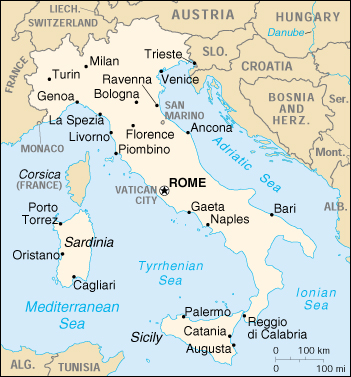
Background: Italy became a nation-state belatedly – in 1861 when the city-states of the peninsula, along with Sardinia and Sicily, were united under King Victor EMMANUEL. An era of parliamentary government came to a close in the early 1920s when Benito MUSSOLINI established a Fascist dictatorship. His disastrous alliance with Nazi Germany led to Italy’s defeat in World War II. A democratic republic replaced the monarchy in 1946 and economic revival followed. Italy was a charter member of NATO and the European Economic Community (EEC). It has been at the forefront of European economic and political unification, joining the European Monetary Union in 1999. Persistent problems include illegal immigration, the ravages of organized crime, corruption, high unemployment, and the low incomes and technical standards of southern Italy compared with the more prosperous north.
Government type: republic
Capital: Rome
Currency: Italian lira (ITL); euro (EUR)
Geography of Italy
Location: Southern Europe, a peninsula extending into the central Mediterranean Sea, northeast of Tunisia
Geographic coordinates: 42 50 N, 12 50 E
Area:
total: 301,230 sq. km
land: 294,020 sq. km
water: 7,210 sq. km
note: includes Sardinia and Sicily
Land boundaries:
total: 1,932.2 km
border countries: Austria 430 km, France 488 km, Holy See (Vatican City) 3.2 km, San Marino 39 km, Slovenia 232 km, Switzerland 740 km
Coastline: 7,600 km
Maritime claims:
continental shelf: 200-m depth or to the depth of exploitation
territorial sea: 12 nm
Climate: predominantly Mediterranean; Alpine in far north; hot, dry in south
Terrain: mostly rugged and mountainous; some plains, coastal lowlands
Elevation extremes:
lowest point: Mediterranean Sea 0 m
highest point: Mont Blanc (Monte Bianco) 4,807 m
Natural resources: mercury, potash, marble, sulfur, dwindling natural gas and crude oil reserves, fish, coal, arable land
Land use:
arable land: 31%
permanent crops: 10%
permanent pastures: 15%
forests and woodland: 23%
other: 21% (1993 est.)
Irrigated land: 27,100 sq. km (1993 est.)
Natural hazards: regional risks include landslides, mudflows, avalanches, earthquakes, volcanic eruptions, flooding; land subsidence in Venice
Environment – current issues: air pollution from industrial emissions such as sulfur dioxide; coastal and inland rivers polluted from industrial and agricultural effluents; acid rain damaging lakes; inadequate industrial waste treatment and disposal facilities.
Environment – international agreements:
party to: Air Pollution, Air Pollution-Nitrogen Oxides, Air Pollution-Sulphur 85, Air Pollution-Sulphur 94, Air Pollution-Volatile Organic Compounds, Antarctic-Environmental Protocol, Antarctic-Marine Living Resources, Antarctic Seals, Antarctic Treaty, Biodiversity, Climate Change, Desertification, Endangered Species, Environmental Modification, Hazardous Wastes, Law of the Sea, Marine Dumping, Nuclear Test Ban, Ozone Layer Protection, Ship Pollution, Tropical Timber 83, Tropical Timber 94, Wetlands, Whaling
signed, but not ratified: Air Pollution-Persistent Organic Pollutants, Climate Change-Kyoto Protocol
Geography – note: strategic location dominating central Mediterranean as well as southern sea and air approaches to Western Europe
People of Italy
Italy is largely homogeneous linguistically and religiously but is diverse culturally, economically, and politically. Italy has the fifth-highest population density in Europe–about 200 persons per square kilometer (490 per sq. mi.). Minority groups are small, the largest being the German-speaking people of Bolzano Province and the Slovenes around Trieste. Other groups comprise small communities of Albanian, Greek, Ladino, and French origin. Immigration has increased in recent years, however, while the Italian population is declining overall due to low birth rates. Although Roman Catholicism is the majority religion–85% of native-born citizens are nominally Catholic–all religious faiths are provided equal freedom before the law by the constitution.
Population: 58,103,033 (July 2005 est.)
Age structure:
0-14 years: 14.17%
15-64 years: 67.48%
65 years and over: 18.35%
Population growth rate: 0.07%
Birth rate: 9.05 births/1,000 population
Death rate: 10.07 deaths/1,000 population
Net migration rate: 1.73 migrant(s)/1,000 population
Infant mortality rate: 5.84 deaths/1,000 live births
Life expectancy at birth:
total population: 79.14 years
male: 75.97 years
female: 82.52 years
Total fertility rate: 1.18 children born/woman
Nationality:
noun: Italian(s)
adjective: Italian
Ethnic groups: Italian (includes small clusters of German-, French-, and Slovene-Italians in the north and Albanian-Italians and Greek-Italians in the south)
Religions: predominately Roman Catholic with mature Protestant and Jewish communities and a growing Muslim immigrant community
Languages: Italian (official), German (parts of Trentino-Alto Adige region are predominantly German speaking), French (small French-speaking minority in Valle d’Aosta region), Slovene (Slovene-speaking minority in the Trieste-Gorizia area).
Literacy:
definition: age 15 and over can read and write
total population: 98% (1998)
History of Italy
Greeks settled in the southern tip of the Italian peninsula in the eighth and seventh centuries B.C.; Etruscans, Romans, and others inhabited the central and northern mainland. The peninsula subsequently was unified under the Roman Republic. The neighboring islands also came under Roman control by the third century B.C.; by the first century A.D., the Roman Empire effectively dominated the Mediterranean world. After the collapse of the Roman Empire in the West in the fifth century A.D., the peninsula and islands were subjected to a series of invasions, and political unity was lost. Italy became an oft-changing succession of small states, principalities, and kingdoms, which fought among themselves and were subject to ambitions of foreign powers. Popes of Rome ruled central Italy; rivalries between the popes and the Holy Roman Emperors, who claimed Italy as their domain, often made the peninsula a battleground.
The commercial prosperity of northern and central Italian cities, beginning in the 11th century, and the influence of the Renaissance mitigated somewhat the effects of these medieval political rivalries. Although Italy declined after the 16th century, the Renaissance had strengthened the idea of a single Italian nationality. By the early 19th century, a nationalist movement developed and led to the reunification of Italy–except for Rome–in the 1860s. In 1861, Victor Emmanuel II of the House of Savoy was proclaimed King of Italy. Rome was incorporated in 1870. From 1870 until 1922, Italy was a constitutional monarchy with a parliament elected under limited suffrage.
20th-Century History
During World War I, Italy renounced its standing alliance with Germany and Austria-Hungary and, in 1915, entered the war on the side of the Allies. Under the postwar settlement, Italy received some former Austrian territory along the northeast frontier. In 1922, Benito Mussolini came to power and, over the next few years, eliminated political parties, curtailed personal liberties, and installed a fascist dictatorship termed the Corporate State. The king, with little or no effective power, remained titular head of state.
Italy allied with Germany and declared war on the United Kingdom and France in 1940. In 1941, Italy–with the other Axis powers, Germany and Japan–declared war on the United States and the Soviet Union. Following the Allied invasion of Sicily in 1943, the King dismissed Mussolini and appointed Marshal Pietro Badoglio as Premier. The Badoglio government declared war on Germany, which quickly occupied most of the country and freed Mussolini, who led a brief-lived regime in the north. An anti-fascist popular resistance movement grew during the last 2 years of the war, harassing German forces before they were driven out in April 1945. A 1946 plebiscite ended the monarchy, and a constituent assembly was elected to draw up plans for the republic.
Under the 1947 peace treaty, minor adjustments were made in Italy’s frontier with France, the eastern border area was transferred to Yugoslavia, and the area around the city of Trieste was designated a free territory. In 1954, the free territory, which had remained under the administration of U.S.-U.K. forces (Zone A, including the city of Trieste) and Yugoslav forces (Zone B), was divided between Italy and Yugoslavia, principally along the zonal boundary. This arrangement was made permanent by the Italian-Yugoslav Treaty of Osimo, ratified in 1977 (currently being discussed by Italy, Slovenia, and Croatia). Under the 1947 peace treaty, Italy also relinquished its overseas territories and certain Mediterranean islands.
The Roman Catholic Church’s status in Italy has been determined, since its temporal powers ended in 1870, by a series of accords with the Italian Government. Under the Lateran Pacts of 1929, which were confirmed by the present constitution, the state of Vatican City is recognized by Italy as an independent, sovereign entity. While preserving that recognition, in 1984, Italy and the Vatican updated several provisions of the 1929 accords. Included was the end of Roman Catholicism as Italy’s formal state religion.
Italy’s Cultural Contributions
Europe’s Renaissance period began in Italy during the 14th and 15th centuries. Literary achievements–such as the poetry of Petrarch, Tasso, and Ariosto and the prose of Boccaccio, Machiavelli, and Castiglione–exerted a tremendous and lasting influence on the subsequent development of Western civilization, as did the painting, sculpture, and architecture contributed by giants such as da Vinci, Raphael, Botticelli, Fra Angelico, and Michelangelo.
The musical influence of Italian composers Monteverdi, Palestrina, and Vivaldi proved epochal; in the 19th century, Italian romantic opera flourished under composers Gioacchino Rossini, Giuseppe Verdi, and Giacomo Puccini. Contemporary Italian artists, writers, filmmakers, architects, composers, and designers contribute significantly to Western culture.
Italy Economy
The Italian economy has changed dramatically since the end of World War II. From an agriculturally based economy, it has developed into an industrial state ranked as the world’s fifth-largest industrial economy. Italy belongs to the Group of Eight (G-8) industrialized nations; it is a member of the European Union and the OECD.
Italy has few natural resources. With much of the land unsuited for farming, it is a net food importer. There are no substantial deposits of iron, coal, or oil. Proven natural gas reserves, mainly in the Po Valley and offshore Adriatic, have grown in recent years and constitute the country’s most important mineral resource. Most raw materials needed for manufacturing and more than 80% of the country’s energy sources are imported. Italy’s economic strength is in the processing and the manufacturing of goods, primarily in small and medium-sized family-owned firms. Its major industries are precision machinery, motor vehicles, chemicals, pharmaceuticals, electric goods, and fashion and clothing.
Italy is in the midst of a slow economic recovery and is gradually catching up to its west European neighbors. In the aftermath of September 11 and the global economy’s tailspin, Italy–like the rest of the EU–saw its economy stumble. Fourth quarter 2001 results showed zero or negative GDP growth. As a result, Italy’s economy decelerated from 2.9% in 2000 to 1.8% in 2001. Average Euro-zone growth in 2001 was 1.4%.
In the post-September 11 period, imports decelerated faster than exports, producing an $8.5 billion surplus in 2001, up from the modest 1.8 billion surplus in 2000. With respect to inflation, Italy is now firmly within norms specified for Economic and Monetary Union (EMU), a major achievement for this historically inflation-prone country. Consumer inflation accelerated from 2.5% in 2000 to 2.8% in 2001. The 1992 agreement on wage adjustments, which has helped keep wage pressures on inflation low, remains in effect. Tight monetary policy by the Bank of Italy also has helped bring inflation expectations down.
Since 1992, economic policy in Italy has focused primarily on reducing government budget deficits and reining in the national debt. Successive Italian governments have adopted annual austerity budgets with cutbacks in spending, as well as new revenue raising measures. Italy has enjoyed a primary budget surplus, net of interest payments, for the last 7 years. The deficit in public administration declined to 1.4% of GDP in 2001, down from 1.7% in 2000. Italy joined the European Monetary Union in May 1998. The national debt, which stood at roughly 124% of GDP in 1995, declined from 110.6% in 2000 to 109.4% in 2001, as it steadily falls toward the EU-imposed debt/GDP ratio of 60% of GDP.
Italy’s closest trade ties are with the other countries of the European Union, with whom it conducts about 55% of its total trade (2001 data). Italy’s largest EU trade partners, in order of market share, are Germany (16.1%), France (11.7%), and the United Kingdom (5.9%).
Labor
Unemployment is a regional issue in Italy–low in the north, high in the south. The “national” rate is at its lowest level since 1992. Chronic problems of inadequate infrastructure, corruption, and organized crime act as disincentives to investment and job creation in the south. A significant underground economy absorbs substantial numbers of people, but they work for low wages and without standard social benefits and protections. Women and youth have significantly higher rates of unemployment than do men.
Unions claim to represent 40% of the work force. Most Italian unions are grouped in four major confederations: the General Italian Confederation of Labor (CGIL), the Italian Confederation of Workers’ Unions (CISL), the Italian Union of Labor (UIL), and the General Union of Labor (UGL), which together claim 35% of the work force. These confederations formerly were associated with important political parties or currents, but they have evolved info fully autonomous, professional bodies. The CGIL, CISL, and UIL are affiliated with the International Confederation of Free Trade Unions (ICFTU) and customarily coordinate their positions before confronting management or lobbying the government. The confederations have had an important consultative role on national social and economic issues. Among their major agreements are a 4-year wage moderation agreement signed in 1993, a reform of the pension system in 1995, and an employment pact, introducing steps for labor market flexibility in economically depressed areas, in 1996. Most recently, in April 2002, unions held a general strike to protest against labor reforms proposed by Prime Minister Berlusconi.
Agriculture
Italy’s agriculture is typical of the division between the agricultures of the northern and southern countries of the European Union. The northern part of Italy produces primarily grains, sugarbeets, soybeans, meat, and dairy products, while the south specializes in producing fruits, vegetables, olive oil, wine, and durum wheat.
Even though much of its mountainous terrain is unsuitable for farming, Italy has a large work force (1.4 million) employed in farming. Most farms are small, with the average farm only seven hectares.GDP: purchasing power parity – $1.273 trillion (2000 est.)
GDP – real growth rate: 1.3% (1999 est.), 2.7% (2000 est.)
GDP – per capita: purchasing power parity – $22,100 (2000 est.)
GDP – composition by sector:
agriculture: 2.5%
industry: 30.4%
services: 67.1% (2000 est.)
Household income or consumption by percentage share:
lowest 10%: 3.5%
highest 10%: 21.8% (1995)
Inflation rate (consumer prices): 1.7% (1999 est.), 2.5% (2000)
Labor force: 23.4 million (2000)
Labor force – by occupation: services 61.9%, industry 32.6%, agriculture 5.5% (1999)
Unemployment rate: 11.5% (1999 est.), 10.4% (2000 est.)
Budget:
revenues: $488 billion
expenditures: $501 billion (2000 est.)
Industries: tourism, machinery, iron and steel, chemicals, food processing, textiles, motor vehicles, clothing, footwear, ceramics
Industrial production growth rate: 1.9% (1998 est.), 1.9% (2000)
Electricity – production: 247.679 billion kWh (1999)
Electricity – production by source:
fossil fuel: 79.09%
hydro: 18.08%
nuclear: 0%
other: 2.83% (1999)
Electricity – consumption: 272.35 billion kWh (1999)
Electricity – exports: 530 million kWh (1999)
Electricity – imports: 42.539 billion kWh (1999)
Agriculture – products: fruits, vegetables, grapes, potatoes, sugar beets, soybeans, grain, olives; beef, dairy products; fish
Exports: $241.1 billion (f.o.b., 2000)
Exports – commodities: engineering products, textiles and clothing, production machinery, motor vehicles, transport equipment, chemicals; food, beverages and tobacco; minerals and nonferrous metals
Exports – partners: EU 56.8% (Germany 16.4%, France 12.9%, Netherlands 7.1%, Spain 6.3%, Netherlands 2.9%), US 9.5% (1999)
Imports: $231.4 billion (f.o.b., 2000)
Imports – commodities: engineering products, chemicals, transport equipment, energy products, minerals and nonferrous metals, textiles and clothing; food, beverages and tobacco
Imports – partners: EU 61% (Germany 19.3%, France 12.6%, Netherlands 6.3%, Spain 4.4%), US 5.0% (1999)
Economic aid – donor: ODA, $1.3 billion (1997)
Currency: Italian lira (ITL); euro (EUR)
note: on 1 January 1999, the EU introduced the euro as a common currency that is now being used by financial institutions in Italy at a fixed rate of 1,936.27 Italian lire per euro and will replace the local currency for all transactions in 2002.
Map of Italy