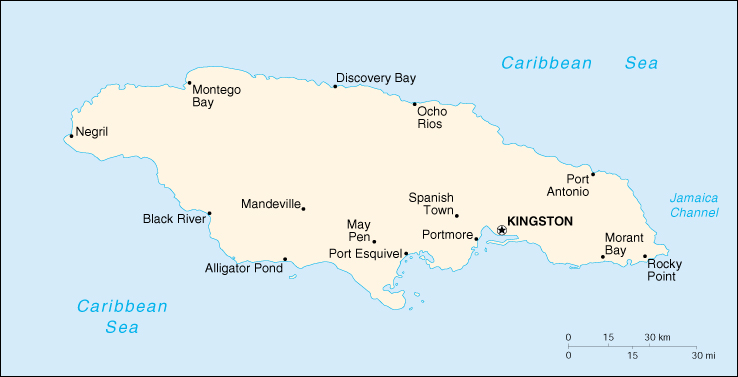
Background: Jamaica gained full independence within the British Commonwealth in 1962. Deteriorating economic conditions during the 1970s led to recurrent violence and a drop-off in tourism. Elections in 1980 saw the democratic socialists voted out of office. Subsequent governments have been open market oriented. Political violence marred elections during the 1990s.
Government type: constitutional parliamentary democracy
Capital: Kingston
Currency: 1 Jamaican dollar (J$) = 100 cents
Geography of Jamaica
Location: Caribbean, island in the Caribbean Sea, south of Cuba
Geographic coordinates: 18 15 N, 77 30 W
Area:
total: 10,990 sq. km
land: 10,830 sq. km
water: 160 sq. km
Land boundaries: 0 km
Coastline: 1,022 km
Maritime claims: measured from claimed archipelagic baselines
continental shelf: 200-m depth or to the depth of exploitation
exclusive economic zone: 200 nm
territorial sea: 12 nm
Climate: tropical; hot, humid; temperate interior
Terrain: mostly mountains, with narrow, discontinuous coastal plain
Elevation extremes:
lowest point: Caribbean Sea 0 m
highest point: Blue Mountain Peak 2,256 m
Natural resources: bauxite, gypsum, limestone
Land use:
arable land: 14%
permanent crops: 6%
permanent pastures: 24%
forests and woodland: 17%
other: 39% (1993 est.)
Irrigated land: 350 sq. km (1993 est.)
Natural hazards: hurricanes (especially July to November)
Environment – current issues: heavy rates of deforestation; coastal waters polluted by industrial waste, sewage, and oil spills; damage to coral reefs; air pollution in Kingston results from vehicle emissions.
Environment – international agreements:
party to: Biodiversity, Climate Change, Climate Change-Kyoto Protocol, Desertification, Endangered Species, Law of the Sea, Marine Dumping, Marine Life Conservation, Nuclear Test Ban, Ozone Layer Protection, Ship Pollution, Wetlands
signed, but not ratified: none of the selected agreements
Geography – note: strategic location between Cayman Trench and Jamaica Channel, the main sea lanes for Panama Canal.
People of Jamaica
Population: 2,731,832 (July 2005 est.)
Age structure:
0-14 years: 29.7%
15-64 years: 63.52%
65 years and over: 6.78%
Population growth rate: 0.51%
Birth rate: 18.12 births/1,000 population
Death rate: 5.48 deaths/1,000 population
Net migration rate: -7.52 migrant(s)/1,000 population
Infant mortality rate: 14.16 deaths/1,000 live births
Life expectancy at birth:
total population: 75.42 years
male: 73.45 years
female: 77.49 years
Total fertility rate: 2.08 children born/woman
Nationality:
noun: Jamaican(s)
adjective: Jamaican
Ethnic groups: black 90.9%, East Indian 1.3%, white 0.2%, Chinese 0.2%, mixed 7.3%, other 0.1%
Religions: Protestant 61.3% (Church of God 21.2%, Baptist 8.8%, Anglican 5.5%, Seventh-Day Adventist 9%, Pentecostal 7.6%, Methodist 2.7%, United Church 2.7%, Brethren 1.1%, Jehovah’s Witness 1.6%, Moravian 1.1%), Roman Catholic 4%, other, including some spiritual cults 34.7%
Languages: English, Creole
Literacy:
definition: age 15 and over has ever attended school
total population: 85%
male: 80.8%
female: 89.1% (1995 est.)
History of Jamaica
Arawaks from South America had settled in Jamaica prior to Christopher Columbus’ first arrival to the island in 1494. During Spain’s occupation of the island, starting in 1510, the Arawaks were exterminated by disease, slavery, and war. Spain brought the first African slaves to Jamaica in 1517. In 1655, British forces seized the island, and in 1670, Great Britain gained formal possession.
Sugar made Jamaica one of the most valuable possessions in the world for more than 150 years. The British Parliament abolished slavery as of August 1, 1834. After a long period of direct British colonial rule, Jamaica gained a degree of local political control in the late 1930s, and held its first election under full universal adult suffrage in 1944. Jamaica joined nine other U.K. territories in the West Indies Federation in 1958 but withdrew after Jamaican voters rejected membership in 1961. Jamaica gained independence in 1962, remaining a member of the Commonwealth.
Historically, Jamaican emigration has been heavy. Since the United Kingdom restricted emigration in 1967, the major flow has been to the United States and Canada. About 20,000 Jamaicans emigrate to the United States each year; another 200,000 visit annually. New York, Miami, Chicago, and Hartford are among the U.S. cities with a significant Jamaican population. Remittances from the expatriate communities in the United States, United Kingdom, and Canada, estimated at up to $800 million per year, make increasingly significant contributions to Jamaica’s economy.
Jamaica Economy
Economy – overview: Key sectors in this island economy are bauxite (alumina and bauxite account for more than half of exports) and tourism. Since assuming office in 1992, Prime Minister PATTERSON has eliminated most price controls, streamlined tax schedules, and privatized government enterprises. Continued tight monetary and fiscal policies have helped slow inflation – although inflationary pressures are mounting – and stabilize the exchange rate, but have resulted in the slowdown of economic growth (moving from 1.5% in 1992 to 0.5% in 1995). In 1996, GDP showed negative growth (-1.4%) and remained negative through 1999. Serious problems include: high interest rates; increased foreign competition; the weak financial condition of business in general resulting in receiverships or closures and downsizings of companies; the shift in investment portfolios to non-productive, short-term high yield instruments; a pressured, sometimes sliding, exchange rate; a widening merchandise trade deficit; and a growing internal debt for government bailouts to various ailing sectors of the economy, particularly the financial sector. Depressed economic conditions in 1999-2000 led to increased civil unrest, including a mounting crime rate. Jamaica’s medium-term prospects will depend upon encouraging investment in the productive sectors, maintaining a competitive exchange rate, stabilizing the labor environment, selling off reacquired firms, and implementing proper fiscal and monetary policies.
GDP: purchasing power parity – $9.7 billion (2000 est.)
GDP – real growth rate: -0.5% (1999 est.), 0.2% (2000 est.)
GDP – per capita: purchasing power parity – $3,700 (2000 est.)
GDP – composition by sector:
agriculture: 7.4%
industry: 35.2%
services: 57.4% (1999 est.)
Population below poverty line: 34.2% (1992 est.)
Household income or consumption by percentage share:
lowest 10%: 2.9%
highest 10%: 28.9% (1996)
Inflation rate (consumer prices): 9.4% (1999 est.), 8.8% (2000 est.)
Labor force: 1.13 million (1998)
Labor force – by occupation: services 60%, agriculture 21%, industry 19% (1998)
Unemployment rate: 15.5% (1998), 16% (2000 est.)
Budget:
revenues: $2.23 billion
expenditures: $2.56 billion, including capital expenditures of $232.5 million (FY99/00 est.)
Industries: tourism, bauxite, textiles, food processing, light manufactures, rum, cement, metal, paper, chemical products
Industrial production growth rate: -2% (2000 est.)
Electricity – production: 6.53 billion kWh (1999)
Electricity – production by source:
fossil fuel: 92.28%
hydro: 1.36%
nuclear: 0%
other: 6.36% (1999)
Electricity – consumption: 6.073 billion kWh (1999)
Electricity – exports: 0 kWh (1999)
Electricity – imports: 0 kWh (1999)
Agriculture – products: sugarcane, bananas, coffee, citrus, potatoes, vegetables; poultry, goats, milk
Exports: $1.4 billion (f.o.b., 1999 est.), $1.7 billion (f.o.b., 2000 est.)
Exports – commodities: alumina, bauxite; sugar, bananas, rum
Exports – partners: US 35.7%, EU (excluding UK) 15.8%, UK 13%, Canada 10.5% (1999)
Imports: $2.7 billion (f.o.b., 1999 est.), $3 billion (f.o.b., 2000 est.)
Imports – commodities: machinery and transport equipment, construction materials, fuel, food, chemicals, fertilizers
Imports – partners: US 47.8%, Caricom countries 12.4%, Latin America 7.2%, EU (excluding UK) 4.7% (1999)
Debt – external: $3.8 billion (1998 est.), $4.7 billion (2000 est.)
Economic aid – recipient: $102.7 million (1995)
Currency: Jamaican dollar (JMD)
Map of Jamaica