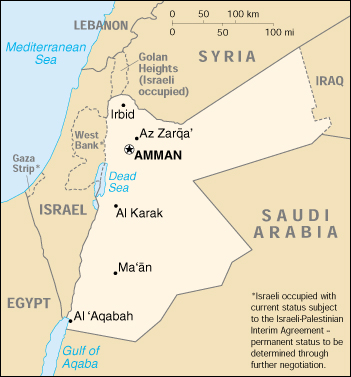
Background: For most of its history since independence from British administration in 1946, Jordan was ruled by King HUSSEIN (1953-1999). A pragmatic ruler, he successfully navigated competing pressures from the major powers (US, USSR, and UK), various Arab states, Israel, and a large internal Palestinian population, through several wars and coup attempts. In 1989 he resumed parliamentary elections and gradually permitted political liberalization; in 1994 a formal peace treaty was signed with Israel. King ABDALLAH II – the eldest son of King HUSSEIN and Princess MUNA – assumed the throne following his father’s death in February 1999. Since then, he has consolidated his power and established his domestic priorities.
Government type: constitutional monarchy
Capital: Amman
Currency: 1 Jordanian dinar (JD) = 1,000 fils
Geography of Jordan
Location: Middle East, northwest of Saudi Arabia
Geographic coordinates: 31 00 N, 36 00 E
Area:
total: 89,213 sq. km
land: 88,884 sq. km
water: 329 sq. km
Land boundaries:
total: 1,619 km
border countries: Iraq 181 km, Israel 238 km, Saudi Arabia 728 km, Syria 375 km, West Bank 97 km
Coastline: 26 km
Maritime claims:
territorial sea: 3 nm
Climate: mostly arid desert; rainy season in west (November to April)
Terrain: mostly desert plateau in east, highland area in west; Great Rift Valley separates East and West Banks of the Jordan River
Elevation extremes:
lowest point: Dead Sea -408 m
highest point: Jabal Ram 1,734 m
Natural resources: phosphates, potash, shale oil
Land use:
arable land: 4%
permanent crops: 1%
permanent pastures: 9%
forests and woodland: 1%
other: 85% (1993 est.)
Irrigated land: 630 sq. km (1993 est.)
Natural hazards: droughts
Environment – current issues: limited natural fresh water resources; deforestation; overgrazing; soil erosion; desertification
Environment – international agreements:
party to: Biodiversity, Climate Change, Desertification, Endangered Species, Hazardous Wastes, Law of the Sea, Marine Dumping, Nuclear Test Ban, Ozone Layer Protection, Wetlands
signed, but not ratified: none of the selected agreements
Geography – note: strategic location at the head of the Gulf of Aqaba and as the Arab country that shares the longest border with Israel and the occupied West Bank.
People of Jordan
Jordanians are Arabs, except for a few small communities of Circassians, Armenians, and Kurds which have adapted to Arab culture. The official language is Arabic, but English is used widely in commerce and government. About 70% of Jordan’s population are urban; less than 6% of the rural population is nomadic or seminomadic. Most people live where the rainfall supports agriculture. About 1.5 million Palestinian Arabs registered as refugees and displaced persons reside in Jordan, most as citizens.
Population: 5,759,732 (July 2005 est.)
Age structure:
0-14 years: 37.23%
15-64 years: 59.44%
65 years and over: 3.33%
Population growth rate: 2.8%
Birth rate: 25.44 births/1,000 population
Death rate: 2.62 deaths/1,000 population
Net migration rate: 7.18 migrant(s)/1,000 population
Infant mortality rate: 20.36 deaths/1,000 live births
Life expectancy at birth:
total population: 77.53 years
male: 75.1 years
female: 80.12 years
Total fertility rate: 3.29 children born/woman
Nationality:
noun: Jordanian(s)
adjective: Jordanian
Ethnic groups: Arab 98%, Circassian 1%, Armenian 1%
Religions: Sunni Muslim 92%, Christian 6% (majority Greek Orthodox, but some Greek Catholics, Roman Catholics, Syrian Orthodox, Coptic Orthodox, Armenian Orthodox, and Protestant denominations), other 2% (several small Shi’a Muslim and Druze populations) (2000 est.)
Languages: Arabic (official), English widely understood among upper and middle classes
Literacy:
definition: age 15 and over can read and write
total population: 86.6%
male: 93.4%
female: 79.4% (1995 est.)
History of Jordan
THE PRESENT KINGDOM of Jordan has had a separate existence for almost seventy years, from the time of the creation in 1921 of the Amirate of Transjordan under Abdullah of the Hashimite (also seen as Hashemite) family, the grandfather of King Hussein. To form Transjordan, the Palestine Mandate was subdivided along the Jordan River-Gulf of Aqaba line. At its creation, Jordan was an artificial entity because inhabitants of northern Jordan have traditionally associated with Syria, those of southern Jordan have associated with the Arabian Peninsula, and those of western Jordan have identified with Palestinians in the West Bank. Moreover, the area that constituted Jordan in 1990 has served historically as a buffer zone between tribes living to the west of the Jordan River as far as the Mediterranean Sea and those roaming the desert to the east of the Jordan River. Over the centuries, the area has formed part of various empires; among these are the Assyrian, Achaemenid, Macedonian, Nabataean, Ptolemaic, Roman, Ghassanid, Muslim, Crusader, and Ottoman empires.
Transjordan’s creation reflected in large measure a compromise settlement by the Allied Powers after World War I that attempted to reconcile Zionist and Arab aspirations in the area. The United Kingdom assumed a mandate over Palestine and Iraq, while France became the mandatory power for Syria and Lebanon. In a British government memorandum of 1922, approved by the League of Nations Council, Jewish settlement in Transjordan was specifically excluded.
As Transjordan moved toward nationhood, the United Kingdom gradually relinquished control, limiting its oversight to financial and foreign policy matters. In March 1946, under the Treaty of London, Transjordan became a kingdom and a new constitution replaced the 1928 Organic Law. The United Kingdom continued to subsidize the Arab Legion, a military force established in 1923. In the Arab-Israeli War of 1948, the Arab Legion gained control for Transjordan of the West Bank, including East Jerusalem. The war added about 450,000 Palestinian Arab refugees as well as approximately 450,000 West Bank Arabs to the roughly 340,000 East Bank Arabs in Jordan. In December 1948, Abdullah took the title King of Jordan, and he officially changed the country’s name to the Hashemite Kingdom of Jordan in April 1949. The following year he annexed the West Bank.
Abdullah was assassinated in Jerusalem in July 1951. Abdullah’s son, Talal, who was in ill health, briefly succeeded to the throne before being obliged to abdicate in favor of his son, Hussein, in 1952. Hussein, who had been studying in Britain, could not legally be crowned until he was eighteen; in the interim he attended the British Royal Military Academy at Sandhurst and returned to Jordan in 1953 to become king.
Jordan signed a mutual defense pact in May 1967 with Egypt, and it participated in the June 1967 war between Israel and the Arab states of Syria, Egypt, and Iraq. During the war, Israel gained control of the West Bank and all of Jerusalem. In 1988, Jordan renounced all claims to the West Bank but retained an administrative role pending a final settlement, and its 1994 treaty with Israel allowed for a continuing Jordanian role in Muslim holy places in Jerusalem. The U.S. Government considers the West Bank to be territory occupied by Israel and believes that its final status should be determined through direct negotiations among the parties concerned on the basis of UN Security Council Resolutions 242 and 338.
The 1967 war led to a dramatic increase in the number of Palestinians living in Jordan. Its Palestinian refugee population–700,000 in 1966–grew by another 300,000 from the West Bank. The period following the 1967 war saw an upsurge in the power and importance of Palestinian resistance elements (fedayeen) in Jordan. The heavily armed fedayeen constituted a growing threat to the sovereignty and security of the Hashemite state, and open fighting erupted in June 1970.
No fighting occurred along the 1967 Jordan River cease-fire line during the October 1973 Arab-Israeli war, but Jordan sent a brigade to Syria to fight Israeli units on Syrian territory. Jordan did not participate in the Gulf war of 1990-91. In 1991, Jordan agreed, along with Syria, Lebanon, and Palestinian representatives, to participate in direct peace negotiations with Israel sponsored by the U.S. and Russia. It negotiated an end to hostilities with Israel and signed a peace treaty in 1994. Jordan has since sought to remain at peace with all of its neighbors.
King Hussein ruled Jordan from 1953 to 1999, surviving a number of challenges to his rule, drawing on the loyalty of his military, and serving as a symbol of unity and stability for both the East Bank and Palestinian communities in Jordan. In 1989 and 1993, Jordan held free and fair parliamentary elections. Controversial changes in the election law led Islamist parties to boycott the 1997 elections. King Hussein ended martial law in 1991 and legalized political parties in 1992.
King Abdullah II succeeded his father Hussein following the latter’s death in February 1999. Abdullah moved quickly to reaffirm Jordan’s peace treaty with Israel and its relations with the U.S. Abdullah, during the first year in power, refocused the government’s agenda on economic reform.
Jordan’s continuing structural economic difficulties, burgeoning population, and more open political environment led to the emergence of a variety of political parties. Moving toward greater independence, Jordan’s Parliament has investigated corruption charges against several regime figures and has become the major forum in which differing political views, including those of political Islamists, are expressed. In June 2001, the King dissolved Parliament. Parliamentary elections are expected to be held next in summer/autumn 2002.
Jordan Economy
Jordan is a small country with limited natural resources. As only 4% of the land is arable, agricultural production is subject to the vagaries of a limited water supply, currently compounded by a 3-year drought. A water protocol with Israel has eased the situation to a certain extent, and the country is currently exploring other ways to expand its supply. Jordan depends on Iraq for most of its energy needs, although a pipeline that will bring natural gas from Egypt is nearing completion. While Jordan’s economy has traditionally been centered on phosphates, potash, fertilizer derivatives, overseas remittances, tourism, and foreign aid, the government hopes to reinvigorate economic growth by focusing on information technology (IT), tariff-free export areas such as the Qualified Industrial Zones (QIZ) and the Aqaba Special Economic Zone (ASEZ), as well as expanding tourism.
In 2001, Jordan became the fourth nation to enter into a Free Trade Agreement (FTA) with the United States. The FTA will phase out duties on nearly all goods and services over a 10-year period. The agreement also provides for more open markets in communications, construction, finance, health, transportation, and services, as well as strict application of international standards for the protection of intellectual property rights. Jordan also has signed trade-liberalizing agreements with the European Union and some of its neighbors in the region. In 2000, it acceded to the World Trade Organization.
As elsewhere in the region, tourism was impacted by the combination of renewed violence on the West Bank/Gaza and the September 11, 2001, terrorist attacks in the U.S. A heavy debt burden and a large public sector continue to be challenges to economic growth in the Kingdom. Despite some progress, red tape and a still developing legal system remain obstacles to foreign investment.
Real GDP, which grew 3.2% in 2000, is expected to increase by 4.1% in 2001. Jordan’s high population growth rate has fallen to 2.8%. The official unemployment is at 16% but may well increase as the impact of the tourist slump ripples through the economy. Inflation continues to be low, and monetary stability remains a priority of the Central Bank of Jordan.
While pursuing economic reform and increased trade, Jordan’s economy will continue to be vulnerable to external shocks and regional unrest. Without calm in the region, economic growth seems destined to stay below its potential.
GDP: purchasing power parity – $17.3 billion (2000 est.)
GDP – real growth rate: 3.2% (2000 est.)
GDP – per capita: purchasing power parity – $3,500 (2000 est.)
GDP – composition by sector:
agriculture: 3%
industry: 25%
services: 72% (1998 est.)
Household income or consumption by percentage share:
lowest 10%: 2.4%
highest 10%: 34.7% (1991)
Inflation rate (consumer prices): 0.7% (2000 est.)
Labor force: 1.15 million
note: in addition, at least 300,000 workers are employed abroad (1997 est.)
Labor force – by occupation: industry 11.4%, commerce, restaurants, and hotels 10.5%, construction 10%, transport and communications 8.7%, agriculture 7.4%, other services 52% (1992)
Unemployment rate: 16% official rate; actual rate is 25%-30% (2000 est.)
Budget:
revenues: $2.8 billion
expenditures: $3.1 billion (2000 est.)
Industries: phosphate mining, petroleum refining, cement, potash, light manufacturing, tourism
Industrial production growth rate: 3.8% (2000 est.)
Electricity – production: 6.657 billion kWh (1999)
Electricity – production by source:
fossil fuel: 99.79%
hydro: 0.21%
nuclear: 0%
other: 0% (1999)
Agriculture – products: wheat, barley, citrus, tomatoes, melons, olives; sheep, goats, poultry
Exports: $2 billion (f.o.b., 2000 est.)
Exports – commodities: phosphates, fertilizers, potash, agricultural products, manufactures
Exports – partners: India, Iraq, Saudi Arabia, EU, Indonesia, UAE, Lebanon, Kuwait, Syria, Ethiopia
Imports: $4 billion (f.o.b., 2000 est.)
Imports – commodities: crude oil, machinery, transport equipment, food, live animals, manufactured goods
Imports – partners: Iraq, Germany, US, Japan, UK, Italy, Turkey, Malaysia, Syria, China
Debt – external: $8 billion (2000 est.)
Economic aid – recipient: ODA, $850 million (1996 est.)
Currency: Jordanian dinar (JOD)
Map of Jordan