Background: Lebanon has made progress toward rebuilding its political institutions and regaining its national sovereignty since 1991 and the end of the devastating 16-year civil war. Under the Ta’if Accord – the blueprint for national reconciliation – the Lebanese have established a more equitable political system, particularly by giving Muslims a greater say in the political process while institutionalizing sectarian divisions in the government. Since the end of the war, the Lebanese have conducted several successful elections, most of the militias have been weakened or disbanded, and the Lebanese Armed Forces (LAF) have extended central government authority over about two-thirds of the country. Hizballah, the radical Shi’a party, retains its weapons. Syria maintains about 25,000 troops in Lebanon based mainly in Beirut, North Lebanon, and the Bekaa Valley. Syria’s troop deployment was legitimized by the Arab League during Lebanon’s civil war and in the Ta’if Accord. Damascus justifies its continued military presence in Lebanon by citing the continued weakness of the LAF, Beirut’s requests, and the failure of the Lebanese Government to implement all of the constitutional reforms in the Ta’if Accord. Israel’s withdrawal from its security zone in southern Lebanon in May of 2000, however, has emboldened some Lebanese Christians and Druze to demand that Syria withdraw its forces as well.
Government type: republic
Capital: Beirut
Currency: 1 Lebanese pound = 100 piasters
Geography of Lebanon
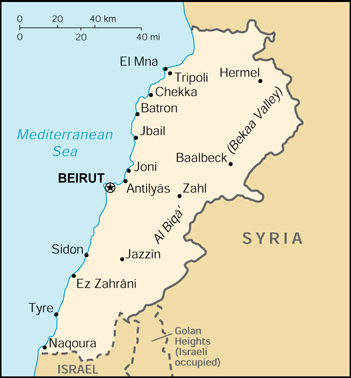
Location: Middle East, bordering the Mediterranean Sea, between Israel and Syria
Geographic coordinates: 33 50 N, 35 50 E
Area:
total: 10,400 sq km
land: 10,230 sq km
water: 170 sq km
Land boundaries:
total: 454 km
border countries: Israel 79 km, Syria 375 km
Coastline: 225 km
Maritime claims:
territorial sea: 12 nm
Climate: Mediterranean; mild to cool, wet winters with hot, dry summers; Lebanon mountains experience heavy winter snows
Terrain: narrow coastal plain; Al Biqa’ (Bekaa Valley) separates Lebanon and Anti-Lebanon Mountains
Elevation extremes:
lowest point: Mediterranean Sea 0 m
highest point: Qurnat as Sawda’ 3,088 m
Natural resources: limestone, iron ore, salt, water-surplus state in a water-deficit region, arable land
Land use:
arable land: 21%
permanent crops: 9%
permanent pastures: 1%
forests and woodland: 8%
other: 61% (1993 est.)
Irrigated land: 860 sq km (1993 est.)
Natural hazards: dust storms, sandstorms
Environment – current issues: deforestation; soil erosion; desertification; air pollution in Beirut from vehicular traffic and the burning of industrial wastes; pollution of coastal waters from raw sewage and oil spills.
Environment – international agreements:
party to: Biodiversity, Climate Change, Desertification, Hazardous Wastes, Law of the Sea, Nuclear Test Ban, Ozone Layer Protection, Ship Pollution, Wetlands
signed, but not ratified: Environmental Modification, Marine Dumping, Marine Life Conservation
Geography – note: Nahr al Litani only major river in Near East not crossing an international boundary; rugged terrain historically helped isolate, protect, and develop numerous factional groups based on religion, clan, and ethnicity.
People of Lebanon
The population of Lebanon comprises Christians and Muslims. No official census has been taken since 1932, reflecting the political sensitivity in Lebanon over confessional (religious) balance. The U.S. Government estimate is that more than half of the resident population is Muslim (Shi’a, Sunni), or Druze, and the rest is Christian (predominantly Maronite, Greek Orthodox, Greek Catholic, and Armenian). Shi’a Muslims make up the single largest sect. Claims since the early 1970s by Muslims that they are in the majority contributed to tensions preceding the 1975-89 civil war and have been the basis of demands for a more powerful Muslim voice in the government.
While 360,000 Palestinian refugees have registered in Lebanon with the United Nations Relief and Works Agency (UNRWA) since 1948, estimates of those remaining range between 160,000-225,000. They are not accorded the legal rights enjoyed by the rest of the population.
With no official figures available, it is estimated that 600,000-900,000 persons fled the country during the initial years of civil war (1975-76). Although some returned, continuing instability until 1992 sparked further waves of emigration, casting even more doubt on population figures. Approximately 17,000-20,000 people are still “missing” or unaccounted for from the civil war period.
Many Lebanese still derive their living from agriculture. The urban population, concentrated mainly in Beirut and Mount Lebanon, is noted for its commercial enterprise. A century and a half of migration and return have produced Lebanese commercial networks around the globe–from North and South America to Europe, the Gulf, and Africa. Lebanon has a high proportion of skilled labor compared with many other Arab countries.
Population: 3,826,018 (July 2005 est.)
Age structure:
0-14 years: 27.57%
15-64 years: 65.72%
65 years and over: 6.71%
Population growth rate: 1.38%
Birth rate: 20.16 births/1,000 population
Death rate: 6.39 deaths/1,000 population
Net migration rate: 0 migrant(s)/1,000 population
Infant mortality rate: 28.35 deaths/1,000 live births
Life expectancy at birth:
total population: 71.52 years
male: 69.13 years
female: 74.03 years
Total fertility rate: 2.05 children born/woman
Nationality:
noun: Lebanese (singular and plural)
adjective: Lebanese
Ethnic groups: Arab 95%, Armenian 4%, other 1%
Religions: Muslim 70% (including Shi’a, Sunni, Druze, Isma’ilite, Alawite or Nusayri), Christian 30% (including Orthodox Christian, Catholic, Protestant), Jewish NEGL%
Languages: Arabic (official), French, English, Armenian widely understood
Literacy:
definition: age 15 and over can read and write
total population: 86.4%
male: 90.8%
female: 82.2% (1997 est.)
History of Lebanon
Lebanon is the historic home of the Phoenicians, Semitic traders whose maritime culture flourished there for more than 2,000 years (c.2700-450 B.C.). In later centuries, Lebanon’s mountains were a refuge for Christians, and Crusaders established several strongholds there. Following the collapse of the Ottoman Empire after World War I, the League of Nations mandated the five provinces that had comprised present-day Lebanon to France. Modern Lebanon’s constitution, drawn up in 1926, specified a balance of political power between the various religious groups. The country gained independence in 1943, and French troops withdrew in 1946.
Lebanon’s history from independence has been marked by periods of political turmoil interspersed with prosperity built on Beirut’s position as a regional center for finance and trade. In 1958, during the last months of President Camille Chamoun’s term, an insurrection broke out, and U.S. forces were briefly dispatched to Lebanon in response to an appeal by the government. During the 1960s, Lebanon enjoyed a period of relative calm and Beirut-focused tourism and banking sector-driven prosperity. Other areas of the country, however, notably the South, North, and Biqa’ Valley, experienced increasing impoverishment.
In the early 1970s, difficulties arose over the presence of Palestinian refugees, many of whom arrived after the 1967 Arab-Israeli war and “Black September” 1970 hostilities in Jordan. Among the latter were Yasser Arafat and the Palestinian Liberation Organization (PLO). Coupled with the Palestinian problem, Muslim and Christian differences grew more intense.
Beginning of the Civil War–1975-81
Fullscale civil war broke out in April 1975. After shots were fired at a church, gunmen in Christian East Beirut ambushed a busload of Palestinians. Palestinian forces joined predominantly leftist-Muslim factions as the fighting persisted, eventually spreading to most parts of the country and precipitating the President’s call for support from Syrian troops in June 1976. In fall of 1976, Arab summits in Riyadh and Cairo set out a plan to end the war. The resulting Arab Deterrent Force, which included Syrian troops already present, moved in to help separate combatants. As an uneasy quiet settled over Beirut, security conditions in the south began to deteriorate.
After a PLO attack on a bus in northern Israel and the Israeli retaliation caused heavy casualties, Israel invaded Lebanon in March 1978, occupying most of the area south of the Litani River. In response, the UN Security Council passed Resolution 425 calling for the immediate withdrawal of Israeli forces and creating the UN Interim Force in Lebanon (UNIFIL), charged with maintaining peace. Israeli forces withdrew later in 1978, turning over positions inside Lebanon along the border to a Lebanese ally, the South Lebanon Army (SLA) under the leadership of Maj. Saad Haddad, thus informally setting up a 12-mile wide “security zone” to protect Israeli territory from crossborder attack.
U.S. Intervention–1982-84
An interim cease-fire brokered by the U.S. in 1981 between Syria, the PLO, and Israel was respected for almost a year. Several incidents, including PLO rocket attacks on northern Israel, led to the June 6, 1982, Israeli ground attack into Lebanon to remove PLO forces. Operation “Peace for Galilee” aimed at establishing a deeper security zone and pushing Syrian troops out of Lebanon, with a view toward paving the way for an Israeli-Lebanese peace agreement. With these aims in mind, Israeli forces drove 25 miles into Lebanon, moving into East Beirut with the support of Maronite Christian leaders and militia.
In August 1982, U.S. mediation resulted in the evacuation of Syrian troops and PLO fighters from Beirut. The agreement also provided for the deployment of a multinational force comprised of U.S. Marines along with French and Italian units. A new President, Bashir Gemayel, was elected with acknowledged Israeli backing. On September 14, however, he was assassinated. The next day, Israeli troops crossed into West Beirut to secure Muslim militia strongholds and stood back as Lebanese Christian militias massacred almost 800 Palestinian civilians in the Sabra and Shatila refugee camps. Then Israeli Minister of Defense Ariel Sharon was held indirectly responsible for the massacre by the Kahane Commission and later resigned. With U.S. backing, Amin Gemayel, chosen by the Lebanese parliament to succeed his brother as president, focused anew on securing the withdrawal of Israeli and Syrian forces. The multinational force returned.
On May 17, 1983, Lebanon, Israel, and the United States signed an agreement on Israeli withdrawal that was conditioned on the departure of Syrian troops. Syria opposed the agreement and declined to discuss the withdrawal of its troops, effectively stalemating further progress. In August 1983, Israel withdrew from the Shuf (southeast of Beirut), thus removing the buffer between the Druze and the Christian militias and triggering another round of brutal fighting. By September, the Druze had gained control over most of the Shuf, and Israeli forces had pulled out from all but the southern security zone, where they remained until May 2000. The virtual collapse of the Lebanese Army in February 1984, following the defection of many Muslim and Druze units to militias, was a major blow to the government. With the U.S. Marines looking ready to withdraw, Syria and Muslim groups stepped up pressure on Gemayal. On March 5 the Lebanese Government canceled the May 17 agreement; the Marines departed a few weeks later.
This period of chaos witnessed the beginning of terrorist attacks launched against U.S. and Western interests. They included the April 18, 1983 suicide attack at the U.S. Embassy in West Beirut (63 dead), the bombing of the headquarters of U.S. and French forces on October 23, 1983 (298 dead), the assassination of American University of Beirut, President Malcolm Kerr on January 18, 1984, and the bombing of the U.S. Embassy annex in East Beirut on September 20, 1984 (9 dead).
It also saw the rise of radicalism among a small number of Lebanese Muslim factions who believed that the successive Israeli and U.S. interventions in Lebanon were serving primarily Christian interests. It was from these factions that Hizballah emerged in 1982 from a loose coalition of Shi’a groups. Hizballah employed terrorist tactics and was supported by Syria and Iran.
Worsening Conflict and Political Crisis–1985-89
Between 1985 and 1989, factional conflict worsened as various efforts at national reconciliation failed. Heavy fighting took place in the “War of the Camps” in 1985 and 1986 as the Shi’a Muslim Amal militia sought to rout the Palestinians from Lebanese strongholds. The Amal movement had been organized in mid-1975, at the beginning of the civil war, to confront what were seen as Israeli plans to displace the Lebanese population with Palestinians. (Its charismatic founder Imam Musa Sadr disappeared in Libya 3 years later. Its current leader, Nabih Berri, is the speaker of the National Assembly.) The combat returned to Beirut in 1987, with Palestinians, leftists, and Druze fighters allied against Amal, eventually drawing further Syrian intervention. Violent confrontation flared up again in Beirut in 1988 between Amal and Hizballah.
Meanwhile, on the political front, Prime Minister Rashid Karami, head of a government of national unit set up after the failed peace efforts of 1984, was assassinated on June 1, 1987. President Gemayel’s term of office expired in September 1988. Before stepping down, he appointed another Maronite Christian, Lebanese Armed Forces Commanding General Michel ‘Awn, as acting Prime Minister, contravening Lebanon’s unwritten “National Pact,” which required the Prime Minister to be Sunni Muslim. Muslim groups rejected the move and pledged support to Salim al-Hoss, a Sunni who had succeeded Karami. Lebanon was thus divided between a Christian government in East Beirut and a Muslim government in West Beirut, with no President.
In February 1989 ‘Awn attacked the rival Lebanese Forces militia. By March he turned his attention to other militias, launching what he termed a “War of Liberation” against the Syrians and their Lebanese militia allies. In the months that followed, ‘Awn rejected both the agreement that ultimately ended the civil war and the election of another Christian leader as president. A Lebanese-Syrian military operation in October 1990 forced him to take cover in the French Embassy in Beirut and later into exile in Paris, where he remains.
End of the Civil War–1989-91
The Ta’if Agreement of 1989 marked the beginning of the end of the war. In January of that year, a committee appointed by the Arab League, chaired by Kuwait and including Saudi Arabia, Algeria, and Morocco, had begun to formulate solutions to the conflict, leading to a meeting of Lebanese parliamentarians in Ta’if, Saudi Arabia, where they agreed to the national reconciliation accord in October. Returning to Lebanon, they ratified the agreement on November 4 and elected Rene Mouawad as President the following day. Assassinated in a car bombing in Beirut on November 22 as his motorcade returned from Lebanese independence day ceremonies, Mouawad was succeeded by Elias Hrawi, who remained in office until 1998.
In August 1990, parliament and the new president agreed on constitutional amendments embodying some of the political reforms envisioned at Ta’if. The National Assembly expanded to 108 seats and was divided equally between Christians and Muslims. In March 1991, parliament passed an amnesty law that pardoned all political crimes prior to its enactment. The amnesty was not extended to crimes perpetrated against foreign diplomats or certain crimes referred by the cabinet to the Higher Judicial Council. In May 1991, the militias (with the important exception of Hizballah) were dissolved, and the Lebanese Armed Forces began to slowly rebuild itself as Lebanon’s only major nonsectarian institution.
In all, it is estimated that more than 100,000 were killed, and another 100,000 handicapped by injuries, during Lebanon’s 16 year civil war. Up to one-fifth of the pre-war resident population, or about 900,000 people, were displaced from their homes, of whom perhaps a quarter of a million emigrated permanently. The last of the Western hostages taken during the mid-1980s were released in May 1992.
Postwar Reconstruction–1992 to Present
Postwar social and political instability, fueled by economic uncertainty and the collapse of the Lebanese currency, led to the resignation of Prime Minister Omar Karami, also in May 1992, after less than 2 years in office. He was replaced by former Prime Minister Rashid al Sulh, who was widely viewed as a caretaker to oversee Lebanon’s first parliamentary elections in 20 years.
By early November 1992, a new parliament had been elected, and Prime Minister Rafiq Hariri had formed a cabinet, retaining for himself the finance portfolio. The formation of a government headed by a successful billionaire businessman was widely seen as a sign that Lebanon would make a priority of rebuilding the country and reviving the economy. Solidere, a private real estate company set up to rebuild downtown Beirut, was a symbol of Hariri’s strategy to link economic recovery to private sector investment. After the election of then-commander of the Lebanese Armed Forces Emile Lahoud in 1998 following Hrawi’s extended term as President, Salim al-Hoss again served as Prime Minister. Hariri returned to office as Prime Minister in November 2000. Although problems with basic infrastructure and government services persist, and Lebanon is now highly indebted, much of the civil war damage has been repaired throughout the country, and many foreign investors and tourists have returned.
If Lebanon has in part recovered over the past decade from the catastrophic damage to infrastructure of its long civil war, the social and political divisions that gave rise to and sustained that conflict remain largely unresolved. Parliamentary and more recently municipal elections have been held with fewer irregularities and more popular participation than in the immediate aftermath of the conflict, and Lebanese civil society generally enjoys significantly more freedoms than elsewhere in the Arab world. However, there are continuing sectarian tensions and unease about Syrian and other external influences. Lebanese Forces (LF) leader Samir Ja’ja, convicted in 1994 for civil war-related offenses, remains imprisoned, and the LF is still banned.
In the late 1990s, the government took action against Sunni Muslim extremists in the north who had attacked its soldiers, and it continues to move against groups such as Asbat al-Ansar, which has been linked to Usama bin Laden’s al-Qaida network. On January 24, 2002, Elie Hobeika, another former Lebanese Forces figure associated with the Sabra and Shatilla massacres who later served in three cabinets and the parliament, was assassinated in a car bombing in Beirut. An estimated 25,000 Syrian troops remain in position in many areas of Lebanon, notwithstanding Ta’if stipulations that called for agreement between the Syrian and Lebanese Governments on their redeployment by September 1992. They did not leave greater Beirut until mid-2001, a year after Israel withdrew from the south, where armed elements of Hizballah are still present.
Lebanon Economy
Lebanon has a competitive and free-market regime and a strong laissez-faire commercial tradition. The Lebanese economy is service-oriented; main growth sectors include banking and tourism. There are no restrictions on foreign exchange or capital movement, and bank secrecy is strictly enforced. Lebanon has recently adopted a law to combat money laundering. There are practically no restrictions on foreign investment. There are no country-specific U.S. trade sanctions against Lebanon.
Lebanon was unable to attract significant foreign aid to help it rebuild from both the long civil war (1975-89) and the Israeli occupation of the south (1978-2000). In addition, the delicate social balance and the near- dissolution of central government institutions during the civil war handicapped the state as it sought to capture revenues to fund the recovery effort. Thus it accumulated significant debt, which by 2001 had reached $28 billion, or nearly 150% of GDP. Unfortunately, economic performance was sluggish in 2000 and 2001 (zero growth in 2000, and estimates between 1.0-1.4% in 2001, largely attributed to slight increases in tourism, banking, industry, and construction). Unemployment is estimated at 14% for 2000 and 29% among the 15-24 year age group, with preliminary estimates of further increases in 2001.
Lebanon’s current program of reforms focuses on three main pillars:
- Economic revival and sustainable growth, with the private sector as the engine of growth;
- Fiscal consolidation and structural improvement in public sector finances; and
- Monetary, financial, and price stability.
The government also has maintained a firm commitment to the Lebanese pound, which has been pegged to the dollar since September 1999. In late 2000, the government substantially reduced customs duties, adopted export promotion schemes for agriculture, decreased social security fees and restrictions on investment in real estate by foreigners, and adopted an open-skies policy, with positive effects on trade in 2001. Nonetheless, the relative appreciation of the Lebanese currency has undermined competitiveness, with merchandise exports falling from 23% of GDP in 1989 to 4% in 2000.
In 2001, the government turned its focus to fiscal measures, increasing gasoline taxes, reducing expenditures, and approving a value-added-tax that became effective in February 2002. Slow money growth and dollarization of deposits have hampered the ability of commercial banks to finance the government, leaving more of the burden to the Central Bank. This monetization of the fiscal deficit has put enormous pressure on Central Bank reserves, mitigated only slightly with the issuance of new Eurobonds over the past 2 years. The Central Bank has maintained a stable currency by intervening directly in the market, as well as low inflation, and succeeded in maintaining investors’ confidence in debt. It has done so at a cost, however, as international reserves declined by $2.4 billion in 2000 and by $1.6 billion in the first half of 2001.
For 2002, the government has put primary emphasis on privatization, initially in the telecom sector and electricity, with continued planning for sales of the state airline, Beirut port, and water utilities. The government has pledged to apply the proceeds of sales to reducing the public debt and the budget deficit. In addition, it projects that privatization will bring new savings as government payrolls are pared, interest rates decline, and private sector growth and foreign investment are stimulated. The government also is tackling the daunting task of administrative reform, aiming to bring in qualified technocrats to address ambitious economic programs, and reviewing further savings that can be realized through reforms of the income tax system. The Lebanese Government faces major challenges in order to meet the requirements of a fiscal adjustment program focusing on tax reforms and modernization, expenditure rationalization, privatization, and improved debt management.
GDP: purchasing power parity – $18.2 billion (2000 est.)
GDP – real growth rate: 0% (2000 est.)
GDP – per capita: purchasing power parity – $5,000 (2000 est.)
GDP – composition by sector:
agriculture: 12%
industry: 27%
services: 61% (1999 est.)
Inflation rate (consumer prices): 0% (2000 est.)
Labor force: 1.3 million (1999 est.)
note: in addition, there are as many as 1 million foreign workers (1997 est.)
Labor force – by occupation: services 62%, industry 31%, agriculture 7% (1997 est.)
Unemployment rate: 14% (2000 est.)
Budget:
revenues: $3.31 billion
expenditures: $5.55 billion (2000 est.)
Industries: banking; food processing; jewelry; cement; textiles; mineral and chemical products; wood and furniture products; oil refining; metal fabricating
Electricity – production: 7.748 billion kWh (1999)
Electricity – production by source:
fossil fuel: 91.29%
hydro: 8.71%
nuclear: 0%
other: 0% (1999)
Agriculture – products: citrus, grapes, tomatoes, apples, vegetables, potatoes, olives, tobacco; sheep, goats
Exports: $700 million (f.o.b., 2000 est.)
Exports – commodities: foodstuffs and tobacco, textiles, chemicals, metal and metal products, electrical equipment and products, jewelry, paper and paper products
Exports – partners: UAE 9%, Saudi Arabia 8%, Syria 6%, US 6%, Kuwait 6%, France 5%, Belgium 5%, Jordan 4% (1999)
Imports: $6.2 billion (f.o.b., 2000 est.)
Imports – commodities: foodstuffs, machinery and transport equipment, consumer goods, chemicals, textiles, metals, fuels, agricultural foods
Imports – partners: Italy 13%, France 11%, Germany 8%, US 7%, Switzerland 6%, Japan, UK, Syria (1999)
Debt – external: $9.6 billion (2000 est.)
Economic aid – recipient: $3.5 billion (pledges 1997-2001)
Currency: Lebanese pound (LBP)
Map of Lebanon