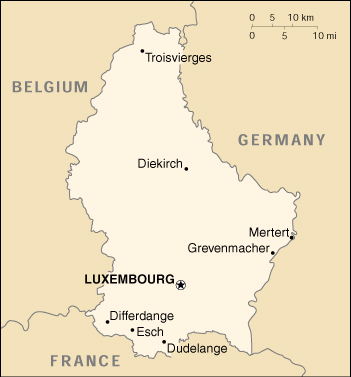
Background: Founded in 963, Luxembourg became a grand duchy in 1815 and an independent state under the Netherlands. It lost more than half of its territory to Belgium in 1839, but gained a larger measure of autonomy. Full independence was attained in 1867. Overrun by Germany in both World Wars, it ended its neutrality in 1948 when it entered into the Benelux Customs Union and when it joined NATO the following year. In 1957, Luxembourg became one of the six founding countries of the European Economic Community (later the European Union) and in 1999 it joined the euro currency area.
Government type: constitutional monarchy
Capital: Luxembourg
Currency: Luxembourg franc (LUF); euro (EUR)
Geography of Luxembourg
Location: Western Europe, between France and Germany
Geographic coordinates: 49 45 N, 6 10 E
Area:
total: 2,586 sq km
land: 2,586 sq km
water: 0 sq km
Land boundaries:
total: 359 km
border countries: Belgium 148 km, France 73 km, Germany 138 km
Coastline: 0 km (landlocked)
Climate: modified continental with mild winters, cool summers
Terrain: mostly gently rolling uplands with broad, shallow valleys; uplands to slightly mountainous in the north; steep slope down to Moselle flood plain in the southeast
Elevation extremes:
lowest point: Moselle River 133 m
highest point: Burgplatz 559 m
Natural resources: iron ore (no longer exploited), arable land
Land use:
arable land: 24%
permanent crops: 1%
permanent pastures: 20%
forests and woodland: 35%
other: 20%
Irrigated land: 10 sq km (including Belgium) (1993 est.)
Environment – current issues: air and water pollution in urban areas, soil pollution of farmland
Environment – international agreements:
party to: Air Pollution, Air Pollution-Nitrogen Oxides, Air Pollution-Persistent Organic Pollutants, Air Pollution-Sulphur 85, Air Pollution-Sulphur 94, Air Pollution-Volatile Organic Compounds, Biodiversity, Climate Change, Desertification, Endangered Species, Hazardous Wastes, Law of the Sea, Marine Dumping, Nuclear Test Ban, Ozone Layer Protection, Ship Pollution, Tropical Timber 83, Tropical Timber 94, Wetlands
signed, but not ratified: Climate Change-Kyoto Protocol, Environmental Modification
Geography – note: landlocked; the only Grand Duchy in the world, it is the smallest of the European Union member states
People of Luxembourg
The language of Luxembourg is Luxembourgish, a blend of old German and Frankish elements. The official language of the civil service, law, and parliament is French, although criminal and legal debates are conducted partly in Luxembourgish and police case files are recorded in German. German is the primary language of the press. French and German are taught in the schools, with German spoken mainly at the primary level and French at the secondary level.
Population: 468,571 (July 2005 est.)
Age structure:
0-14 years: 18.91%
15-64 years: 67.03%
65 years and over: 14.06%
Population growth rate: 1.26%
Birth rate: 12.25 births/1,000 population
Death rate: 8.88 deaths/1,000 population
Net migration rate: 9.26 migrant(s)/1,000 population
Infant mortality rate: 4.77 deaths/1,000 live births
Life expectancy at birth:
total population: 77.3 years
male: 74.02 years
female: 80.8 years
Total fertility rate: 1.7 children born/woman
Nationality:
noun: Luxembourger(s)
adjective: Luxembourg
Ethnic groups: Celtic base (with French and German blend), Portuguese, Italian, Slavs (from Montenegro, Albania, and Kososvo) and European (guest and resident workers)
Religions: the greatest preponderance of the population is Roman Catholic with a very few Protestants, Jews, and Muslims
note: 1979 legislation forbids the collection of religious statistics
Languages: Luxembourgish (national language), German (administrative language), French (administrative language)
Literacy:
definition: age 15 and over can read and write
total population: 100%
male: 100%
female: 100% (2000 est.)
Luxembourg Economy
Economy – overview: The stable, high-income economy features solid growth, low inflation, and low unemployment. The industrial sector, initially dominated by steel, has become increasingly diversified to include chemicals, rubber, and other products. Growth in the financial sector has more than compensated for the decline in steel. Services, especially banking, account for a substantial proportion of the economy. Agriculture is based on small family-owned farms. The economy depends on foreign and trans-border workers for 30% of its labor force. Luxembourg has a custom union with Belgium and the Netherlands, and, as a member of the EU, enjoys the advantages of the open European market. It joined with 10 other EU members to launch the euro on 1 January 1999.
GDP: purchasing power parity – $15.9 billion (2000 est.)
GDP – real growth rate: 5.7% (2000 est.)
GDP – per capita: purchasing power parity – $36,400 (2000 est.)
GDP – composition by sector:
agriculture: 1%
industry: 30%
services: 69% (2000 est.)
Inflation rate (consumer prices): 17.8% (2000 est.)
Labor force: 248,000 (of whom 70,200 are foreign cross-border workers primarily from France, Belgium, and Germany) (2000)
Labor force – by occupation: services 83.2%, industry 14.3%, agriculture 2.5% (1998 est.)
Unemployment rate: 2.7% (2000 est.)
Budget:
revenues: $5.6 billion
expenditures: $5.6 billion (2000 est.)
Industries: banking, iron and steel, food processing, chemicals, metal products, engineering, tires, glass, aluminum
Industrial production growth rate: 7.8% (2000 est.)
Electricity – production: 648 million kWh (1999)
Electricity – production by source:
fossil fuel: 36.88%
hydro: 53.09%
nuclear: 0%
other: 10.03% (1999)
Electricity – consumption: 6.149 billion kWh (1999)
Agriculture – products: barley, oats, potatoes, wheat, fruits, wine grapes; livestock products
Exports: $7.6 billion (f.o.b., 2000)
Exports – commodities: machinery and equipment, steel products, chemicals, rubber products, glass
Exports – partners: EU 75% (Germany 25%, France 21%, Belgium 13%, UK 8%, Italy 6%, Netherlands 5%), US 4% (1999)
Imports: $10 billion (c.i.f., 2000)
Imports – commodities: minerals, metals, foodstuffs, quality consumer goods
Imports – partners: EU 81% (Belgium 35%, Germany 26%, France 12%, Netherlands 4%), US 9% (1999)
Economic aid – donor: ODA, $160 million (1999)
Currency: Luxembourg franc (LUF); euro (EUR)
note: on 1 January 1999, the EU introduced the euro as a common currency that is now being used by financial institutions in Luxembourg at a fixed rate of 40.3399 Luxembourg francs per euro and will replace the local currency for all transactions in 2002.
Map of Luxembourg