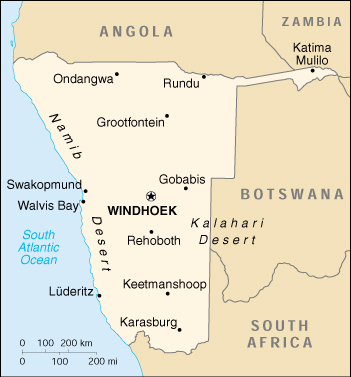
Facts About Namibia
Background: South Africa occupied the German colony of Sud-West Afrika during World War I and administered it as a mandate until after World War II when it annexed the territory. In 1966 the Marxist South-West Africa People’s Organization (SWAPO) guerrilla group launched a war of independence for the area that was soon named Namibia, but it was not until 1988 that South Africa agreed to end its administration in accordance with a UN peace plan for the entire region. Independence came in 1990.
Government type: republic
Capital: Windhoek
Currency: 1 Namibian dollar (N$) = 100 cents
Geography of Namibia
Location: Southern Africa, bordering the South Atlantic Ocean, between Angola and South Africa
Geographic coordinates: 22 00 S, 17 00 E
Area:
total: 825,418 sq km
land: 825,418 sq km
water: 0 sq km
Land boundaries:
total: 3,824 km
border countries: Angola 1,376 km, Botswana 1,360 km, South Africa 855 km, Zambia 233 km
Coastline: 1,572 km
Maritime claims:
contiguous zone: 24 nm
exclusive economic zone: 200 nm
territorial sea: 12 nm
Climate: desert; hot, dry; rainfall sparse and erratic
Terrain: mostly high plateau; Namib Desert along coast; Kalahari Desert in east
Elevation extremes:
lowest point: Atlantic Ocean 0 m
highest point: Konigstein 2,606 m
Natural resources: diamonds, copper, uranium, gold, lead, tin, lithium, cadmium, zinc, salt, vanadium, natural gas, hydropower, fish
note: suspected deposits of oil, coal, and iron ore
Land use:
arable land: 1%
permanent crops: 0%
permanent pastures: 46%
forests and woodland: 22%
other: 31% (1993 est.)
Irrigated land: 60 sq km (1993 est.)
Natural hazards: prolonged periods of drought
Environment – current issues: very limited natural fresh water resources; desertification
Environment – international agreements:
party to: Antarctic-Marine Living Resources, Biodiversity, Climate Change, Desertification, Endangered Species, Hazardous Wastes, Law of the Sea, Ozone Layer Protection, Wetlands
signed, but not ratified: none of the selected agreements
Geography – note: first country in the world to incorporate the protection of the environment into its constitution; some 14% of the land is protected, including virtually the entire Namib Desert coastal strip.
People of Namibia
Namibians are of diverse ethnic origins. The principal groups are the Ovambo, Kavango, Herero/Himba, Damara, mixed race (“Colored” and Rehoboth Baster), white (Afrikaner, German, and Portuguese), Nama, Caprivian (Lozi), Bushman, and Tswana.
The Ovambo make up about half of Namibia’s people. The Ovambo, Kavango, and East Caprivian peoples, who occupy the relatively well-watered and wooded northern part of the country, are settled farmers and herders. Historically, they have shown little interest in the central and southern parts of Namibia, where conditions do not suit their traditional way of life.
Until the early 1900s, these tribes had little contact with the Nama, Damara, and Herero, who roamed the central part of the country vying for control of sparse pastureland. German colonial rule destroyed the warmaking ability of the tribes but did not erase their identities or traditional organization. People from the more populous north have settled throughout the country in recent decades as a result of urbanization, industrialization, and the demand for labor.
The modern mining, farming, and industrial sectors of the economy, controlled by the white minority, have affected traditional African society without transforming it. Urban and migratory workers have adopted Western ways, but in rural areas, traditional society remains intact.
Missionary work during the 1800s drew many Namibians to Christianity. While most Namibian Christians are Lutheran, there also are Roman Catholic, Methodist, Anglican, African Methodist Episcopal, and Dutch Reformed Christians represented.
Modern education and medical care have been extended in varying degrees to most rural areas in recent years. The literacy rate of Africans is generally low except in sections where missionary and government education efforts have been concentrated, such as Ovamboland. The Africans speak various indigenous languages.
The minority white population is primarily of South African, British, and German descent. About 60% of the whites speak Afrikaans (a variation of Dutch), 30% speak German, and 10% speak English.
Population: 2,030,692 (July 2005 est.)
Age structure:
0-14 years: 42.74%
15-64 years: 53.54%
65 years and over: 3.72%
Population growth rate: 1.38%
Birth rate: 34.71 births/1,000 population
Death rate: 20.9 deaths/1,000 population
Net migration rate: 0 migrant(s)/1,000 population
Infant mortality rate: 71.66 deaths/1,000 live births
Life expectancy at birth:
total population: 40.62 years
male: 42.48 years
female: 38.71 years
Total fertility rate: 4.83 children born/woman
Nationality:
noun: Namibian(s)
adjective: Namibian
Ethnic groups: black 87.5%, white 6%, mixed 6.5%
note: about 50% of the population belong to the Ovambo tribe and 9% to the Kavangos tribe; other ethnic groups are: Herero 7%, Damara 7%, Nama 5%, Caprivian 4%, Bushmen 3%, Baster 2%, Tswana 0.5%.
Religions: Christian 80% to 90% (Lutheran 50% at least), indigenous beliefs 10% to 20%
Languages: English 7% (official), Afrikaans common language of most of the population and about 60% of the white population, German 32%, indigenous languages: Oshivambo, Herero, Nama.
Literacy:
definition: age 15 and over can read and write
total population: 38%
male: 45%
female: 31% (1960 est.)
Economy Of Namibia
Economy – overview: The economy is heavily dependent on the extraction and processing of minerals for export. Mining accounts for 20% of GDP. Namibia is the fourth-largest exporter of nonfuel minerals in Africa and the world’s fifth-largest producer of uranium. Rich alluvial diamond deposits make Namibia a primary source for gem-quality diamonds. Namibia also produces large quantities of lead, zinc, tin, silver, and tungsten. Half of the population depends on agriculture (largely subsistence agriculture) for its livelihood. Namibia must import some of its food. Although per capita GDP is four times the per capita GDP of Africa’s poorer countries, the majority of Namibia’s people live in pronounced poverty because of large-scale unemployment, the great inequality of income distribution, and the large amount of wealth going to foreigners. The Namibian economy has close links to South Africa. GDP growth in 2000 was led by gains in the diamond and fish sectors. Agreement has been reached on the privatization of several more enterprises in coming years, which should stimulate long-run foreign investment. Growth in 2001 could be 5.5% provided the world economy remains stable.
GDP: purchasing power parity – $7.6 billion (2000 est.)
GDP – real growth rate: 4% (2000 est.)
GDP – per capita: purchasing power parity – $4,300 (2000 est.)
GDP – composition by sector:
agriculture: 12%
industry: 25%
services: 63% (1999 est.)
Inflation rate (consumer prices): 9.1% (2000)
Labor force: 500,000
Labor force – by occupation: agriculture 47%, industry 20%, services 33% (1999 est.)
Unemployment rate: 30% to 40%, including underemployment (1997 est.)
Budget:
revenues: $883 million
expenditures: $950 million (1998)
Industries: meat packing, fish processing, dairy products; mining (diamond, lead, zinc, tin, silver, tungsten, uranium, copper)
Industrial production growth rate: 10% (1994)
Electricity – production: 1.198 billion kWh (1999)
Electricity – production by source:
fossil fuel: 2%
hydro: 98%
nuclear: 0%
other: 0% (1999)
Electricity – consumption: 1.948 billion kWh (1999)
note: imports electricity from South Africa
Agriculture – products: millet, sorghum, peanuts; livestock; fish
Exports: $1.4 billion (f.o.b., 2000 est.)
Exports – commodities: diamonds, copper, gold, zinc, lead, uranium; cattle, processed fish, karakul skins
Exports – partners: UK 43%, South Africa 26%, Spain 14%, France 8%, Japan (1998 est.)
Imports: $1.6 billion (f.o.b., 2000 est.)
Imports – commodities: foodstuffs; petroleum products and fuel, machinery and equipment, chemicals
Imports – partners: South Africa 81%, US 4%, Germany 2% (1997 est.)
Debt – external: $217 million (2000 est.)
Economic aid – recipient: $127 million (1998)
Currency: Namibian dollar (NAD); South African rand (ZAR)
History Of Namibia
Bushmen (or San) are generally assumed to have been the earliest inhabitants of the region. Later inhabitants include the Nama and the Damara or Berg Dama. The Bantu-speaking Ovambo and Herero migrated from the north in about the 14th century A.D.
The inhospitable Namib Desert constituted a formidable barrier to European exploration until the late 18th century, when successions of travelers, traders, hunters, and missionaries explored the area. The 1878, the United Kingdom annexed Walvis Bay on behalf of Cape Colony, and the area was incorporated into the Cape of Good Hope in 1884. In 1883, a German trader, Adolf Luderitz, claimed the rest of the coastal region after negotiations with a local chief. Negotiations between the United Kingdom and Germany resulted in Germany’s annexation of the coastal region, excluding Walvis Bay. The following year, the United Kingdom recognized the hinterland up to 20 degrees east longitude as a German sphere of influence. A region, Caprivi Strip, became a part of South West Africa after an agreement on July 1, 1890, between the United Kingdom and Germany. The British recognized that the strip would fall under German administration to provide access to the Zambezi River and German colonies in East Africa. In exchange, the British received the islands of Zanzibar and Heligoland.
German colonial power was consolidated, and prime grazing land passed to white control as a result of the Herero and Nama wars of 1904-08. German administration ended during World War I following South African occupation in 1915.
On December 17, 1920, South Africa undertook administration of South West Africa under the terms of Article 22 of the Covenant of the League of Nations and a mandate agreement by the League Council. The mandate agreement gave South Africa full power of administration and legislation over the territory. It required that South Africa promote the material and moral well-being and social progress of the people.
When the League of Nations was dissolved in 1946, the newly formed United Nations inherited its supervisory authority for the territory. South Africa refused UN requests to place the territory under a trusteeship agreement. During the 1960s, as the European powers granted independence to their colonies and trust territories in Africa, pressure mounted on South Africa to do so in Namibia, which was then South West Africa. In 1966, the UN General Assembly revoked South Africa’s mandate.
Also in 1966, the South West Africa People’s Organization (SWAPO) began guerrilla attacks on Namibia, infiltrating the territory from bases in Zambia. After Angola became independent in 1975, SWAPO established bases in the southern part of the country. Hostilities intensified over the years, especially in Ovamboland.
In a 1971 advisory opinion, the International Court of Justice upheld UN authority over Namibia, determining that the South African presence in Namibia was illegal and that South Africa therefore was obligated to withdraw its administration from Namibia immediately. The Court also advised UN member states to refrain from implying legal recognition or assistance to the South African presence.
International Pressure for Independence
In 1977, Western members of the UN Security Council, including Canada, France, the Federal Republic of Germany, the United Kingdom, and the United States (known as the Western Contact Group), launched a joint diplomatic effort to bring an internationally acceptable transition to independence for Namibia. Their efforts led to the presentation in April 1978 of Security Council Resolution 435 for settling the Namibian problem. The proposal, known as the UN Plan, was worked out after lengthy consultations with South Africa, the front-line states (Angola, Botswana, Mozambique, Tanzania, Zambia, and Zimbabwe), SWAPO, UN officials, and the Western Contact Group. It called for the holding of elections in Namibia under UN supervision and control, the cessation of all hostile acts by all parties, and restrictions on the activities of South African and Namibian military, paramilitary, and police.
South Africa agreed to cooperate in achieving the implementation of Resolution 435. Nonetheless, in December 1978, in defiance of the UN proposal, it unilaterally held elections in Namibia which were boycotted by SWAPO and a few other political parties. South Africa continued to administer Namibia through its installed multiracial coalitions. Negotiations after 1978 focused on issues such as supervision of elections connected with the implementation of the UN Plan.
Negotiations and Transition
Intense discussions between the concerned parties continued during the 1978-88 period, with the UN Secretary General’s Special Representative, Martti Ahtisaari, playing a key role. The 1982 Constitutional Principles, agreed upon by the front-line states, SWAPO, and the Western Contact Group created the framework for Namibia’s democratic constitution. The U.S. Government’s role as mediator was critical throughout the period, one example being the intense efforts in 1984 to obtain withdrawal of South African defense forces from southern Angola.
In May 1988, a U.S. mediation team, headed by Assistant Secretary of State for African Affairs Chester A. Crocker, brought negotiators from Angola, Cuba, and South Africa, and observers from the Soviet Union together in London. Intense diplomatic maneuvering characterized the next 7 months, as the parties worked out agreements to bring peace to the region and make implementation of UN Security Council Resolution 435 possible. On December 13, Cuba, South Africa, and the People’s Republic of Angola agreed to a total Cuban troop withdrawal from Angola. The protocol also established a Joint Commission, consisting of the parties with the United States and the Soviet Union as observers, to oversee implementation of the accords. A bilateral agreement between Cuba and the People’s Republic of Angola was signed in New York on December 22, 1988. On the same day a tripartite agreement, in which the parties recommended initiation of the UN Plan on April 1 and the Republic of South Africa agreed to withdraw its troops, was signed. Implementation of Resolution 435 officially began on April 1, 1989, when South African-appointed Administrator Gen. Louis Pienaar officially began administrating the territory’s transition to independence. Special Representative Martti Ahtisaari arrived in Windhoek to begin performing his duties as head of the UN Transition Assistance Group (UNTAG).
The transition got off to a shaky start on April 1 because, in contravention to SWAPO President Sam Nujoma’s written assurances to the UN Secretary General to abide by a cease-fire and repatriate only unarmed insurgents, approximately 2,000 armed members of the People’s Liberation Army of Namibia (PLAN), SWAPO’s military wing, crossed the border from Angola in an apparent attempt to establish a military presence in northern Namibia. The special representative authorized a limited contingent of South African troops to aid the South West African police in restoring order. A period of intense fighting followed, during which 375 PLAN fighters were killed. At Mt. Etjo, a game park outside Windhoek, in a special meeting of the Joint Commission on April 9, a plan was put in place to confine the South African forces to base and return PLAN elements to Angola. While the problem was solved, minor disturbances in the north continued throughout the transition period. In October, under order of the UN Security Council, Pretoria demobilized members of the disbanded counterinsurgency unit, Koevoet (Afrikaans for crowbar), who had been incorporated into the South West African police.
The 11-month transition period went relatively smoothly. Political prisoners were granted amnesty, discriminatory legislation was repealed, South Africa withdrew all its forces from Namibia, and some 42,000 refugees returned safely and voluntarily under the auspices of the Office of the UN High Commissioner for Refugees (UNHCR). Almost 98% of registered voters turned out to elect members of the constituent assembly. The elections were held in November 1989 and were certified as free and fair by the special representative, with SWAPO taking 57% of the vote, just short of the two-thirds necessary to have a free hand in drafting the constitution. The Democratic Turnhalle Alliance, the opposition party, received 29% of the vote. The Constituent Assembly held its first meeting on November 21 and its first act unanimously resolved to use the 1982 Constitutional Principles as the framework for Namibia’s new constitution.
By February 9, 1990, the Constituent Assembly had drafted and adopted a constitution. March 21, independence day, was attended by Secretary of State James A. Baker III to represent President Bush. On that same day, he inaugurated the U.S. Embassy in Windhoek in recognition of the establishment of diplomatic relations.
On March 1, 1994, the coastal enclave of Walvis Bay and 12 offshore islands were transferred to Namibia by South Africa. This followed 3 years of bilateral negotiations between the two governments and the establishment of a transitional Joint Administrative Authority (JAA) in November 1992 to administer the 300 square mile territory. The peaceful resolution of this territorial dispute, which dated back to 1878, was praised by the U.S. and the international community, as it fulfilled the provisions of UN Security Council 432 (1978) which declared Walvis Bay to be an integral part of Namibia.
Map Of Namibia