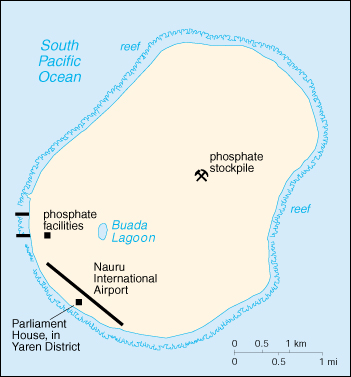
Facts About Nauru
Background: Nauru’s phosphate deposits began to be mined early in the 20th century by a German-British consortium; the island was occupied by Australian forces in World War I. Upon achieving independence in 1968, Nauru became the smallest independent republic in the world; it joined the UN in 1999.
Government type: republic
Capital: no official capital; government offices in Yaren District
Currency: 1 Australian dollar ($A) = 100 cents
Geography of Nauru
Location: Oceania, island in the South Pacific Ocean, south of the Marshall Islands
Geographic coordinates: 0 32 S, 166 55 E
Area:
total: 21 sq km
land: 21 sq km
water: 0 sq km
Land boundaries: 0 km
Coastline: 30 km
Maritime claims:
exclusive fishing zone: 200 nm
territorial sea: 12 nm
Climate: tropical; monsoonal; rainy season (November to February)
Terrain: sandy beach rises to fertile ring around raised coral reefs with phosphate plateau in center
Elevation extremes:
lowest point: Pacific Ocean 0 m
highest point: unnamed location along plateau rim 61 m
Natural resources: phosphates
Land use:
arable land: 0%
permanent crops: 0%
permanent pastures: 0%
forests and woodland: 0%
other: 100% (1993 est.)
Natural hazards: periodic droughts
Environment – current issues: limited natural fresh water resources, roof storage tanks collect rainwater, but mostly dependent on a single, aging desalination plant; intensive phosphate mining during the past 90 years – mainly by a UK, Australia, and NZ consortium – has left the central 90% of Nauru a wasteland and threatens limited remaining land resources.
Environment – international agreements:
party to: Biodiversity, Climate Change, Desertification, Law of the Sea, Marine Dumping
signed, but not ratified: none of the selected agreements
Geography – note: Nauru is one of the three great phosphate rock islands in the Pacific Ocean – the others are Banaba (Ocean Island) in Kiribati and Makatea in French Polynesia; only 53 km south of Equator
People of Nauru
Population: 13,048 (July 2005 est.)
Age structure:
0-14 years: 40.33%
15-64 years: 57.97%
65 years and over: 1.7%
Population growth rate: 2%
Birth rate: 27.22 births/1,000 population
Death rate: 7.2 deaths/1,000 population
Net migration rate: 0 migrant(s)/1,000 population
Infant mortality rate: 10.71 deaths/1,000 live births
Life expectancy at birth:
total population: 61.2 years
male: 57.7 years
female: 64.88 years
Total fertility rate: 3.61 children born/woman
Nationality:
noun: Nauruan(s)
adjective: Nauruan
Ethnic groups: Nauruan 58%, other Pacific Islander 26%, Chinese 8%, European 8%
Religions: Christian (two-thirds Protestant, one-third Roman Catholic)
Languages: Nauruan (official, a distinct Pacific Island language), English widely understood, spoken, and used for most government and commercial purposes.
Economy Of Nauru
Economy – overview: Revenues of this tiny island have come from exports of phosphates, but reserves are expected to be exhausted within five to ten years. Phosphate production has declined since 1989, as demand has fallen in traditional markets and as the marginal cost of extracting the remaining phosphate increases, making it less internationally competitive. While phosphates have given Nauruans one of the highest per capita incomes in the Third World, few other resources exist with most necessities being imported, including fresh water from Australia. The rehabilitation of mined land and the replacement of income from phosphates are serious long-term problems. In anticipation of the exhaustion of Nauru’s phosphate deposits, substantial amounts of phosphate income have been invested in trust funds to help cushion the transition and provide for Nauru’s economic future. The government has been borrowing heavily from the trusts to finance fiscal deficits. To cut costs the government has called for a freezing of wages, a reduction of over-staffed public service departments, privatization of numerous government agencies, and closure of some overseas consulates. In recent years Nauru has encouraged the registration of offshore banks and corporations. Tens of billions of dollars have been channeled through their accounts. Few comprehensive statistics on the Nauru economy exist, with estimates of Nauru’s per capita GDP varying widely.
GDP: purchasing power parity – $59 million (2000 est.)
GDP – per capita: purchasing power parity – $5,000 (2000 est.)
Inflation rate (consumer prices): -3.6% (1993)
Labor force – by occupation: employed in mining phosphates, public administration, education, and transportation
Unemployment rate: 0%
Budget:
revenues: $23.4 million
expenditures: $64.8 million (FY95/96)
Industries: phosphate mining, financial services, coconut products
Electricity – production: 30 million kWh (1999)
Electricity – production by source:
fossil fuel: 100%
hydro: 0%
nuclear: 0%
other: 0% (1999)
Electricity – consumption: 27.9 million kWh (1999)
Agriculture – products: coconuts
Exports: $25.3 million (f.o.b., 1991)
Exports – commodities: phosphates
Exports – partners: Australia, NZ
Imports: $21.1 million (c.i.f., 1991)
Imports – commodities: food, fuel, manufactures, building materials, machinery
Imports – partners: Australia, UK, NZ, Japan
Debt – external: $33.3 million
Economic aid – recipient: $2.25 million from Australia (FY96/97 est.)
Currency: Australian dollar (AUD)
Map Of Nauru