Fact About Nepal
Background: In 1951, the Nepalese monarch ended the century-old system of rule by hereditary premiers and instituted a cabinet system of government. Reforms in 1990 established a multiparty democracy within the framework of a constitutional monarchy. The refugee issue of some 100,000 Bhutanese in Nepal remains unresolved; 90% of these displaced persons are housed in seven United Nations Offices of the High Commissioner for Refugees (UNHCR) camps.
Government type: parliamentary democracy
Capital: Kathmandu
Currency: 1 Nepalese rupee (NR) = 100 paisa
Geography of Nepal
Location: Southern Asia, between China and India
Geographic coordinates: 28 00 N, 84 00 E
Area:
total: 140,800 sq km
land: 136,800 sq km
water: 4,000 sq km
Land boundaries:
total: 2,926 km
border countries: China 1,236 km, India 1,690 km
Coastline: 0 km (landlocked)
Climate: varies from cool summers and severe winters in north to subtropical summers and mild winters in south
Terrain: Terai or flat river plain of the Ganges in south, central hill region, rugged Himalayas in north
Elevation extremes:
lowest point: Kanchan Kalan 70 m
highest point: Mount Everest 8,850 m (1999 est.)
Natural resources: quartz, water, timber, hydropower, scenic beauty, small deposits of lignite, copper, cobalt, iron ore
Land use:
arable land: 17%
permanent crops: 0%
permanent pastures: 15%
forests and woodland: 42%
other: 26% (1993 est.)
Irrigated land: 8,500 sq km (1993 est.)
Natural hazards: severe thunderstorms, flooding, landslides, drought, and famine depending on the timing, intensity, and duration of the summer monsoons
Environment – current issues: deforestation (overuse of wood for fuel and lack of alternatives); contaminated water (with human and animal wastes, agricultural runoff, and industrial effluents); wildlife conservation; vehicular emissions.
Environment – international agreements:
party to: Biodiversity, Climate Change, Desertification, Endangered Species, Hazardous Wastes, Law of the Sea, Nuclear Test Ban, Ozone Layer Protection, Tropical Timber 83, Tropical Timber 94, Wetlands
signed, but not ratified: Marine Dumping, Marine Life Conservation
Geography – note: landlocked; strategic location between China and India; contains eight of world’s 10 highest peaks, including Mount Everest on the border with China, which is the world’s tallest.
People of Nepal
Perched on the southern slopes of the Himalayan Mountains, the Kingdom of Nepal is as ethnically diverse as its terrain of fertile plains, broad valleys, and the highest mountain peaks in the world. The Nepalese are descendants of three major migrations from India, Tibet, and Central Asia.
Among the earliest inhabitants were the Newars of the Kathmandu Valley and aboriginal Tharus in the southern Terai region. The ancestors of the Brahman and Chetri caste groups came from India, while other ethnic groups trace their origins to Central Asia and Tibet, including the Gurungs and Magars in the west, Rais and Limbus in the east, and Sherpas and Bhotias in the north.
In the Terai, a part of the Ganges Basin with 20% of the land, much of the population is physically and culturally similar to the Indo-Aryan people of northern India. People of Indo-Aryan and Mongoloid stock live in the hill region. The mountainous highlands are sparsely populated. Kathmandu Valley, in the middle hill region, constitutes a small fraction of the nation’s area but is the most densely populated, with almost 5% of the population.
Religion is important in Nepal; Kathmandu Valley has more than 2,700 religious shrines alone. Nepal is about 86% Hindu. The constitution describes the country as a “Hindu Kingdom,” although it does not establish Hinduism as the state religion. Buddhists account for about 8% of the population. Buddhist and Hindu shrines and festivals are respected and celebrated by all. Nepal also has small Muslim and Christian minorities. Certain animistic practices of old indigenous religions survive.
Nepali is the official language, although a dozen different languages and about 30 major dialects are spoken throughout the country. Derived from Sanskrit, Nepali is related to the Indian language, Hindi, and is spoken by about 90% of the population. Many Nepalese in government and business also speak English.
Population: 27,676,547 (July 2005 est.)
Age structure:
0-14 years: 40.35%
15-64 years: 56.16%
65 years and over: 3.49%
Population growth rate: 2.32%
Birth rate: 33.4 births/1,000 population
Death rate: 10.22deaths/1,000 population
Net migration rate: 0 migrant(s)/1,000 population
Infant mortality rate: 74.14 deaths/1,000 live births
Life expectancy at birth:
total population: 58.22 years
male: 58.65 years
female: 57.77 years
Total fertility rate: 4.58 children born/woman
Nationality:
noun: Nepalese (singular and plural)
adjective: Nepalese
Ethnic groups: Newars, Indians, Tibetans, Gurungs, Magars, Tamangs, Bhotias, Rais, Limbus, Sherpas
Religions: Hinduism 86.2%, Buddhism 7.8%, Islam 3.8%, other 2.2%
note: only official Hindu state in the world
Languages: Nepali (official; spoken by 90% of the population), about a dozen other languages and about 30 major dialects; note – many in government and business also speak English.
Literacy:
definition: age 15 and over can read and write
total population: 27.5%
male: 40.9%
female: 14% (1995 est.)
History Of Nepal
THE HIMALAYAN KINGDOMS of Nepal and Bhutan share a history of influence by Tibet, China, and India, and an interlude of British colonial guidance. Although the kingdoms are not contiguous, each country is bordered by China to the north and India on its other peripheries. Both kingdoms are ruled by hereditary monarchs and are traditional societies with predominantly agricultural economies; their cultures, however, differ. Nepal’s Hinduism, a legacy of India’s influence, defines its culture and caste-structured society. Bhutan’s Buddhist practices and culture reflect India’s influence by way of Tibet. The two countries’ legal systems also reflect their heritage. Nepal’s judicial system blends Hindu legal and English common law traditions. Bhutan’s legal system is based on Buddhist law and English common law.
Nepal has existed as a kingdom centered in the Kathmandu Valley for more than 1,500 years. The country is known for its majestic Himalayas and has nine of the fourteen peaks in the world over 8,000 meters, including Mount Everest and Annapurna I.
Modern Nepal began its evolution in the sixteenth century with the founding of the House of Gorkha by Dravya Shah in 1559. In the late eighteenth century, Gorkha conquests extended the kingdom through the Himalayas for almost 1,500 kilometers from the western boundary of Garhwal, India, through the territory of Sikkim in the east. In the early nineteenth century, Gorkha power came into conflict with the British East India Company. The resulting Anglo- Nepalese War (1814-16) was devastating for Nepal: the Treaty of Sagauli reduced the kingdom to the boundaries it has since occupied, less than 900 kilometers from east to west. For almost thirty years after the treaty was concluded, infighting among aristocratic factions characterized Nepal.
The next stage of Nepalese politics was the period of hereditary Rana rule–the establishment of a dictatorship of successive Rana prime ministers beginning with Jang Bahadur Kunwar in 1846. During the period of Rana rule, which lasted until the end of 1950, Nepal was governed by a landed aristocracy; parliamentary government was in name only. This period provided stability, but also inhibited political and economic development because the Ranas isolated the country and exercised total control over internal affairs. Although during this period Nepal was a constitutional monarchy with universal suffrage granted at age eighteen, political parties were not formed until the mid-twentieth century and were later banned. The longevity of the Rana dictatorship was also a result of a partnership between the rulers and the army. Patronage ensured loyal soldiers: the military supported the Rana prime ministers and, later, the Shah monarchs, who were figureheads during Rana rule.
In January 1951, the Ranas were forced to concede to the restoration of the monarchy, which then assumed charge of all executive powers: financial management, appointment of government officials, and command of the armed forces. The latter power became an increasingly useful tool for enforcing control. In 1962 King Mahendra Bir Bikram Shah Dev devised the centrally controlled partyless council system of government called panchayat. This system served as the institutional basis of the king’s rule and was envisioned by the palace as a democratic administration although it functioned only at the king’s behest. Incorporated into the 1962 constitution, the panchayat system was established at the village, district, and national levels. Successive changes in government and constitutional revisions did not weaken the powers of the absolute monarchy. In fact, a May 1980 referendum reaffirmed the status quo of the panchayat system and its continuation as a rubber stamp for the king. Elections in 1981 and 1986 were characterized by the lack of political programs.
Government by an absolute monarch behind a democratic façade lasted for some thirty years. Although many party members were exiled to India, opposition to the government and the panchayat system continued to grow, particularly in the late 1980s when the outlawed political parties announced a drive for a multiparty system. A coalition between the Nepali Congress Party and the Communist Party of Nepal was formed in late 1989. The increasing disillusionment with and unpopularity of King Birendra Bir Bikram Shah Dev’s regime and the worsening economic situation caused by the trade and transit dispute with India added to the momentum of the incipient prodemocracy movement.
The dissolution of the Berlin Wall and the Soviet Union, and the successes of the prodemocracy movements in Eastern Europe in the late 1980s and early 1990s, had an impact in Nepal. In part as a result of the participatory experiences of Nepalese in India, movements arose to effect changes in Nepal’s government and society. Nepal’s longstanding history of continuity of rule and relative stability was challenged when the Movement for the Restoration of Democracy, or prodemocracy movement, was formally established on February 18, 1990, almost forty years after the end of Rana control. Demonstrations and rallies–accompanied by violence, arrests, and even deaths–were held throughout the country. Political unrest became widespread. Ethnic groups agitated for official recognition of their cultural heritage and linguistic tradition and demonstrated against the monarchy. The goal of the prodemocracy movement, however, was to establish a more representative democracy and to end the panchayat system.
The demonstrations and protests characterizing the prodemocracy movement gained momentum when the ban on political parties and activities was lifted in April 1990. That same month, the prime minister resigned, the Council of Ministers and the Rashtriya Panchayat (National Panchayat, or Parliament) were dissolved, and talks with the opposition were begun. A multiparty interim government replaced the panchayat system. The king nominated a four-member council, established a Constitution Recommendation Commission, and announced that he would begin an official inquiry into the deaths that had resulted from the prodemocracy demonstrations. In mid-May, a general amnesty was declared for all political prisoners. A draft constitution was announced in the summer of 1990. King Birendra wanted the draft amended to give him more leverage, but subsequent negotiations did not yield as much as he desired. In November 1990, the king finally approved and promulgated a new, more democratic constitution that vested sovereignty in the people.
The panchayat system finally ended in May 1991, when general elections, deemed “generally fair, free, and open” by an international election inspection team, were held. Approximately 65 percent of the populace voted. Although more than forty political parties registered with the election commission, only twenty political parties–mostly small, communist splinter groups–were on the ballot. The Nepali Congress Party won 110 of the 205 seats in the House of Representatives, and the Communist Party of Nepal (United Marxist-Leninist) won 69 seats. Previously operating in exile and behind the scenes, the various communist and other parties and coalitions became a powerful presence in the newly constituted bicameral Parliament. Nepal continued its gradual move toward a multiparty democracy.
Prodemocracy protests continued unabated. Demonstrations were held on February 18, 1992, the second anniversary of the founding of the prodemocracy movement. In early April 1992, rival student groups clashed, and communist and leftist opposition groups called for a general strike as a response to double digit inflation and a more than 60 percent increase in water and electricity tariffs. As a result of skirmishes between the police and demonstrators, a curfew was imposed. In addition, the government banned primary and secondary schoolteachers from political activities and from joining or campaigning for political parties.
Elections to the village development committees and municipalities were held in late May 1992; the elections pitted the various communist factions and other parties against the Nepali Congress Party administration of Prime Minister Girija Prasad (G.P.) Koirala. More than 90,000 civilian and security personnel were assigned to safeguard the elections. In contrast to the May 1991 parliamentary election, the Nepali Congress Party routed the communists in the urban areas and even made some gains in the rural areas. The Nepali Congress Party won 331 positions, or 56 percent of the seats, in the municipalities; the Communist Party of Nepal (United Marxist-Leninist) won 119 seats, or 20 percent of the seats; and other lesser parties won the remainder of the seats. In newly established village development committees, the Nepali Congress Party won 21,461 positions; the Communist Party of Nepal (United Marxist-Leninist) won 11,175 seats.
The Nepalese army has long been intertwined with the monarchy; the 1990 constitution, however, changed the relationship between the military and the king. For the first time, the military no longer was solely an instrument of the king; it was also subordinate to the authority of Parliament. Although under the constitution the king retains his title as the supreme commander of the army, the functional commander in chief is appointed on the recommendation of the prime minister. Although both the king and the government are responsible for implementing national security and military policy, the king’s power to declare a state of national emergency and to conduct foreign affairs has national security implications.
Nepal is noted for its famed Gurkha soldiers. Gurkhas served both at home and abroad in the British, Indian, Singapore, and Brunei armies. Their remittances to Nepal were of primary importance to the economy and served as an important source of foreign exchange. By 1997, however, the number of Gurkhas serving in the British army is expected to be reduced from 8,000 to 2,500 persons, and the Gurkha garrison in Hong Kong is scheduled to be withdrawn gradually in the period up to 1995. As of April 1992, a token number of Gurkhas was serving in a United Nations peacekeeping force in the former Yugoslavia.
The difficulty of replacing Nepal’s long tradition of autocracy with a democracy, coupled with the economic challenges posed by physical geography and location, was daunting. As of 1992, many of the prescribed changes had only just been instituted, or were still to come. Many observers expected that the populist experiment of a multiparty democracy would meet with eventual failure and that the monarchy and the army would return to some type of power-sharing formula.
Nepal’s population, estimated in 1990 as approximately 19.1 million, is very diverse. The country is home to more than a dozen ethnic groups, which originate from three major ethnic divisions: Indo-Nepalese, Tibeto-Nepalese, and indigenous Nepalese. Ethnic identity–distinguished primarily by language and dress–constrains the selection of a spouse, friendships, and career, and is evident in social organization, occupation, and religious observances. Hinduism is the official religion of Nepal, although, in fact, the religion practiced by the majority of Nepalese is a synthesis of Hinduism and Buddhism and the practices have intermingled over time. The socioeconomic ramifications of the country’s diversity have proven problematic for Nepal in the late twentieth century.
Considered a least-developed country, Nepal depends heavily on farming, which accounts for most of the country’s gross domestic product. The work force is largely unskilled and mostly illiterate. Nepal’s industrial base was established in the 1930s, but little process has been made in improving economic performance. In the early 1990s, tourism was one of the largest sources of foreign exchange; visitors from the United States were the most numerous.
Social status in Nepal is measured by economic standing. Landownership is both a measure of status and a source of income. Women occupy a secondary position, particularly in business and the civil service, although the constitution guarantees equality between men and women. Nepalese tribal and communal customs dictate women’s lesser role in society, but their status differs from one ethnic group to another and is usually determined by caste.
As of 1992, education was free and compulsory for five years; however males had literacy rates about three times higher than the rates for females and higher school enrollment levels. There were relatively few other social services in the country. The absence of modern medical care, clean drinking water, and adequate sanitation resulted in the prevalence of gastrointestinal diseases. Malnutrition was also a problem, particularly in rural areas. A period of drought in 1992 was expected to cause further food shortages, especially of grain. The country has consistently had high morbidity and death rates.
Economic assistance from other countries, especially India, has been vital to Nepal. Since the 1980s, however, bilateral aid and multilateral assistance programs from countries other than India have been an increasingly important part of development planning. Nepal has received aid from both the United States and communist countries.
In the late twentieth century, Nepal’s foreign policy continued to be affected by its geostrategic location between China and India and its attempt to maintain a balance between these powerful neighbors. Nepal’s relationship with India is governed by the 1950 Treaty of Peace and Friendship and its accompanying letters, which established an informal military alliance whereby both countries are required to consult and “devise effective countermeasures” in case the security of either is threatened. Since the 1970s, however, Nepal has exhibited greater independence in its foreign policy, establishing bilateral diplomatic relations with other countries and joining various multilateral and regional organizations.
Nepal, for example, belongs to the United Nations and its affiliated agencies such as the Group of 77, as well as the Nonaligned Movement and the Asian Development Bank. It is also a member of the South Asian Association for Regional Cooperation (SAARC), founded in 1983, initially under a slightly different name, as an institutionalized framework for regional cooperation; its permanent secretariat was established in 1987 in Kathmandu. It does not accept compulsory United Nations International Court of Justice jurisdiction.
One of India’s longstanding sources of power over Nepal has been India’s control of access to raw materials and supply routes. The effect of this control was especially evident during the 1989 trade and transit dispute–and its aftermath–when the foreign trade balance was negatively affected and the economy took a downturn.
In early 1992, Nepal’s relations with India were clouded by controversy over the December 1991 agreement for cooperation on a hydroelectric and irrigation project at Tanakpur, near the southwestern Nepalese–Indian border. The Communist Party of Nepal (United Marxist-Leninist) and other leftist parties opposed the project, which they regarded as against Nepal’s national interest because the site, on Nepalese territory, was not covered by a formal treaty. The constitution stipulates that treaties need parliamentary assent if exploitation of the nation’s natural resources is involved. Prime Minister G.P. Koirala said he had signed a memorandum of understanding, not a treaty. The opposition took their case to the Supreme Court.
Military relations between Kathmandu and New Delhi were cordial. In March 1992, the Indian chief of army staff visited Nepal and was made an honorary general of the Royal Nepal Army, an uncommon occurrence.
Nepal’s relations with China were low-key and an exercise in caution. Nonetheless, India interpreted sales of air defense weapons by China to Nepal in 1988 as interfering with its treaty arrangements with Nepal. Nepal and China, however, signed technical and economic cooperation agreements in March 1992.
The refugee problem presented a challenge to India, which needed to balance its interests in maintaining Bhutan’s stability with the necessity of not inflaming nationalist passions among its own ethnic Nepalese population and not upsetting its relations with either Nepal or Bhutan. India would not allow its territory to be used as a staging ground for protests by Bhutanese residents of Nepalese origin. The situation was further complicated by the fact that Indian laborers who entered Nepal in search of work displaced underemployed and unemployed Nepalese workers.
Nepal Economy
Economy – overview: Nepal is among the poorest and least developed countries in the world with nearly half of its population living below the poverty line. Agriculture is the mainstay of the economy, providing a livelihood for over 80% of the population and accounting for 41% of GDP. Industrial activity mainly involves the processing of agricultural produce including jute, sugarcane, tobacco, and grain. Production of textiles and carpets has expanded recently and accounted for about 80% of foreign exchange earnings in the past three years. Agricultural production is growing by about 5% on average as compared with annual population growth of 2.3%. Since May 1991, the government has been moving forward with economic reforms, particularly those that encourage trade and foreign investment, e.g., by reducing business licenses and registration requirements in order to simplify investment procedures. The government has also been cutting expenditures by reducing subsidies, privatizing state industries, and laying off civil servants. More recently, however, political instability – five different governments over the past few years – has hampered Kathmandu’s ability to forge consensus to implement key economic reforms. Nepal has considerable scope for accelerating economic growth by exploiting its potential in hydropower and tourism, areas of recent foreign investment interest. Prospects for foreign trade or investment in other sectors will remain poor, however, because of the small size of the economy, its technological backwardness, its remoteness, its landlocked geographic location, and its susceptibility to natural disaster. The international community’s role of funding more than 60% of Nepal’s development budget and more than 28% of total budgetary expenditures will likely continue as a major ingredient of growth.
GDP: purchasing power parity – $33.7 billion (2000 est.)
GDP – real growth rate: 3.7% (2000 est.)
GDP – per capita: purchasing power parity – $1,360 (2000 est.)
GDP – composition by sector:
agriculture: 41%
industry: 22%
services: 37% (2000 )
Household income or consumption by percentage share:
lowest 10%: 3.2%
highest 10%: 29.8% (1995-96)
Inflation rate (consumer prices): 3.3% (FY99/00 est.)
Labor force: 10 million (1996 est.)
note: severe lack of skilled labor
Labor force – by occupation: agriculture 81%, services 16%, industry 3%
Unemployment rate: substantial underemployment (1999)
Budget:
revenues: $536 million
expenditures: $818 million (FY96/97 est.)
Industries: tourism, carpet, textile; small rice, jute, sugar, and oilseed mills; cigarette; cement and brick production
Electricity – production: 1.255 billion kWh (1999)
Electricity – production by source:
fossil fuel: 9.56%
hydro: 90.44%
nuclear: 0%
other: 0% (1999)
Electricity – consumption: 1.309 billion kWh (1999)
Agriculture – products: rice, corn, wheat, sugarcane, root crops; milk, water buffalo meat
Exports: $485 million (f.o.b., 1998), but does not include unrecorded border trade with India
Exports – commodities: carpets, clothing, leather goods, jute goods, grain
Exports – partners: India 33%, United States 26%, Germany 25% (FY97/98)
Imports: $1.2 billion (f.o.b., 1998)
Imports – commodities: gold, machinery and equipment, petroleum products, fertilizer
Imports – partners: India 31%, China/Hong Kong 16%, Singapore 14% (FY97/98)
Debt – external: $2.4 billion (1997)
Economic aid – recipient: $411 million (FY97/98)
Currency: Nepalese rupee (NPR)
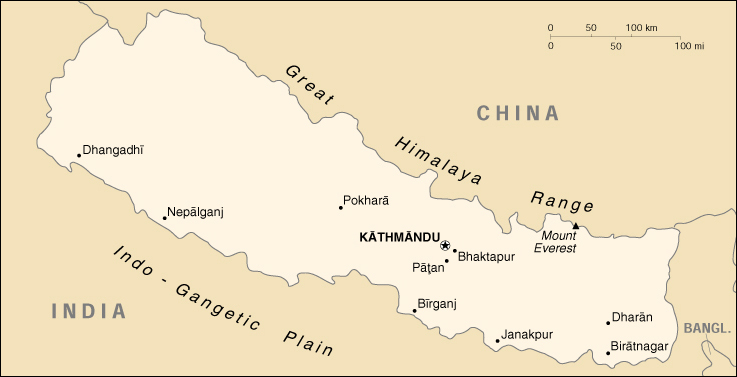
Map Of Nepal