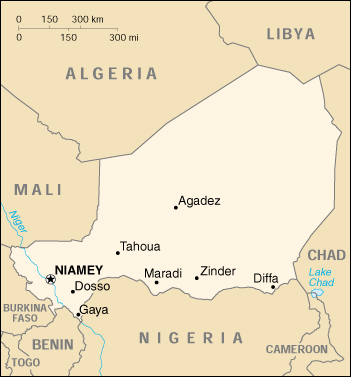
Facts About Niger
Background: Not until 1993, 33 years after independence from France, did Niger hold its first free and open elections. A 1995 peace accord ended a five-year Tuareg insurgency in the north. Coups in 1996 and 1999 were followed by the creation of a National Reconciliation Council that effected a transition to civilian rule in December 1999.
Government type: republic
Capital: Niamey
Currency: 1 Communaute Financiere Africaine franc (CFAF) = 100 centimes
Geography of Niger
Location: Western Africa, southeast of Algeria
Geographic coordinates: 16 00 N, 8 00 E
Area:
total: 1.267 million sq km
land: 1,266,700 sq km
water: 300 sq km
Land boundaries:
total: 5,697 km
border countries: Algeria 956 km, Benin 266 km, Burkina Faso 628 km, Chad 1,175 km, Libya 354 km, Mali 821 km, Nigeria 1,497 km
Coastline: 0 km (landlocked)
Maritime claims: none (landlocked)
Climate: desert; mostly hot, dry, dusty; tropical in extreme south
Terrain: predominately desert plains and sand dunes; flat to rolling plains in south; hills in north
Elevation extremes:
lowest point: Niger River 200 m
highest point: Mont Greboun 1,944 m
Natural resources: uranium, coal, iron ore, tin, phosphates, gold, petroleum
Land use:
arable land: 3%
permanent crops: 0%
permanent pastures: 7%
forests and woodland: 2%
other: 88% (1993 est.)
Irrigated land: 660 sq km (1993 est.)
Natural hazards: recurring droughts
Environment – current issues: overgrazing; soil erosion; deforestation; desertification; wildlife populations (such as elephant, hippopotamus, giraffe, and lion) threatened because of poaching and habitat destruction
Environment – international agreements:
party to: Biodiversity, Climate Change, Desertification, Endangered Species, Environmental Modification, Hazardous Wastes, Nuclear Test Ban, Ozone Layer Protection, Wetlands
signed, but not ratified: Climate Change-Kyoto Protocol, Law of the Sea
Geography – note: landlocked; one of the hottest countries in the world: northern four-fifths is desert, southern one-fifth is savanna, suitable for livestock and limited agriculture.
People of Niger
The largest ethnic groups in Niger are the Hausa, who also constitute the major ethnic group in northern Nigeria, and the Djerma-Songhai, who also are found in parts of Mali. Both groups are sedentary farmers who live in the arable, southern tier. The remainder of the Nigerien people are nomadic or seminomadic livestock-raising peoples–Fulani, Tuareg, Kanouri, and Toubou. With rapidly growing populations and the consequent competition for meager natural resources, lifestyles of these two types of peoples have come increasingly into conflict in Niger in recent years.
Niger’s high infant mortality rate is comparable to levels recorded in neighboring countries. However, the child mortality rate (deaths among children between the ages of 1 and 4) is exceptionally high (274 per 1,000) due to generally poor health conditions and inadequate nutrition for most of the country’s children. Niger’s very high fertility rate (7.4%), nonetheless, means that nearly half (49%) of the Nigerien population is under age 15. School attendance is very low (34%), including 38% of males and only 27% of females. Additional education occurs through Koranic schools.
Population: 11,665,937 (July 2005 est.)
Age structure:
0-14 years: 47.97%
15-64 years: 49.75%
65 years and over: 2.28%
Population growth rate: 2.72%
Birth rate: 50.68 births/1,000 population
Death rate: 22.71 deaths/1,000 population
Net migration rate: -0.73 migrant(s)/1,000 population
Infant mortality rate: 123.57 deaths/1,000 live births
Life expectancy at birth:
total population: 41.59 years
male: 41.74 years
female: 41.44 years
Total fertility rate: 7.4 children born/woman
Nationality:
noun: Nigerien(s)
adjective: Nigerien
Ethnic groups: Hausa 56%, Djerma 22%, Fula 8.5%, Tuareg 8%, Beri Beri (Kanouri) 4.3%, Arab, Toubou, and Gourmantche 1.2%, about 1,200 French expatriates
Religions: Muslim 80%, remainder indigenous beliefs and Christians
Languages: French (official), Hausa, Djerma
Literacy:
definition: age 15 and over can read and write
total population: 13.6%
male: 20.9%
female: 6.6% (1995 est.)
History Of Niger
Considerable evidence indicates that about 600,000 years ago, humans inhabited what has since become the desolate Sahara of northern Niger. Long before the arrival of French influence and control in the area, Niger was an important economic crossroads, and the empires of Songhai, Mali, Gao, Kanem, and Bornu, as well as a number of Hausa states, claimed control over portions of the area.
During recent centuries, the nomadic Tuareg formed large confederations, pushed southward, and, siding with various Hausa states, clashed with the Fulani Empire of Sokoto, which had gained control of much of the Hausa territory in the late 18th century.
In the 19th century, contact with the West began when the first European explorers–notably Mungo Park (British) and Heinrich Barth (German)–explored the area searching for the mouth of the Niger River. Although French efforts at pacification began before 1900, dissident ethnic groups, especially the desert Tuareg, were not subdued until 1922, when Niger became a French colony.
Niger’s colonial history and development parallel that of other French West African territories. France administered her West African colonies through a governor general at Dakar, Senegal, and governors in the individual territories, including Niger. In addition to conferring French citizenship on the inhabitants of the territories, the 1946 French constitution provided for decentralization of power and limited participation in political life for local advisory assemblies.
A further revision in the organization of overseas territories occurred with the passage of the Overseas Reform Act (Loi Cadre) of July 23, 1956, followed by reorganizational measures enacted by the French Parliament early in 1957. In addition to removing voting inequalities, these laws provided for creation of governmental organs, assuring individual territories a large measure of self-government. After the establishment of the Fifth French Republic on December 4, 1958, Niger became an autonomous state within the French Community. Following full independence on August 3, 1960, however, membership was allowed to lapse.
For its first 14 years as an independent state, Niger was run by a single-party civilian regime under the presidency of Hamani Diori. In 1974, a combination of devastating drought and accusations of rampant corruption resulted in a military coup which overthrew the Diori regime. Col. Seyni Kountche and a small group of military ruled the country until Kountche’s death in 1987. He was succeeded by his Chief of Staff, Col. Ali Saibou, who released political prisoners, liberalized some of Niger’s laws and policies, and promulgated a new constitution. However, President Saibou’s efforts to control political reforms failed in the face of union and student demands to institute a multi-party democratic system. The Saibou regime acquiesced to these demands by the end of 1990. New political parties and civic associations sprang up, and a National Conference was convened in July 1991 to prepare the way for the adoption of a new constitution and the holding of free and fair elections. The debate was often contentious and accusatory, but under the leadership of Prof. Andre Salifou, the conference developed consensus on the modalities of a transition government. A transition government was installed in November 1991 to manage the affairs of state until the institutions of the Third Republic were put in place in April 1993. While the economy deteriorated over the course of the transition, certain accomplishments stand out, including the successful conduct of a constitutional referendum; the adoption of key legislation such as the electoral and rural codes; and the holding of several free, fair, and nonviolent nationwide elections. Freedom of the press flourished with the appearance of several new independent newspapers.
Rivalries within a ruling coalition elected in 1994 led to governmental paralysis, which provided Col. Ibrahim Baré Maïnassara a rationale to overthrow the Third Republic in January 1996. While leading a military authority that ran the government (Conseil de Salut National) during a 6-month transition period, Bare enlisted specialists to draft a new constitution for a Fourth Republic announced in May 1996. After dissolving the national electoral committee, Bare organized and won a flawed election in June 1996. When his efforts to justify his coup and subsequent questionable election failed to convince donors to restore multilateral and bilateral economic assistance, a desperate Bare ignored the international embargo on Libya seeking funds for Niger’s economy. In repeated violations of basic civil liberties by the regime, opposition leaders were imprisoned; journalists often arrested, beaten, and deported by an unofficial militia composed of police and military; and independent media offices were looted and burned with impunity.
In the culmination of an initiative started under the 1991 National Conference, however, the government signed peace accords in April 1995 with all Tuareg and Toubou groups that had been in rebellion since 1990 claiming they lacked attention and resources from the central government. The government agreed to absorb some former rebels in the military and, with French assistance, help others return to a productive civilian life.
In April 1999, Bare was overthrown in a coup led by Maj. Daouda Mallam Wanke who established a transitional National Reconciliation Council to oversee the drafting of a constitution for a Fifth Republic with a French style semi-presidential system. In votes that international observers found to be generally free and fair, the Nigerien electorate approved the new constitution in July 1999 and held legislative and presidential elections in October and November 1999. Heading a MNSD/CDS coalition, Mamadou Tandja won the presidency.
Niger Economy
Economy – overview: Niger is a poor, landlocked Sub-Saharan nation, whose economy centers on subsistence agriculture, animal husbandry, reexport trade, and increasingly less on uranium, because of declining world demand. The 50% devaluation of the West African franc in January 1994 boosted exports of livestock, cowpeas, onions, and the products of Niger’s small cotton industry. The government relies on bilateral and multilateral aid – which was suspended following the April 1999 coup d’etat – for operating expenses and public investment. In 2000, the World Bank approved a structural adjustment loan of $35 million to help support fiscal reforms. However, reforms could prove difficult given the government’s bleak financial situation.
GDP: purchasing power parity – $10 billion (2000 est.)
GDP – real growth rate: 3.5% (2000 est.)
GDP – per capita: purchasing power parity – $1,000 (2000 est.)
GDP – composition by sector:
agriculture: 40%
industry: 18%
services: 42% (1998)
Household income or consumption by percentage share:
lowest 10%: 0.8%
highest 10%: 35.4% (1995)
Inflation rate (consumer prices): 2.8% (2000 est.)
Labor force: 70,000 receive regular wages or salaries
Labor force – by occupation: agriculture 90%, industry and commerce 6%, government 4%
Budget:
revenues: $377 million, including $146 million from foreign sources
expenditures: $377 million, including capital expenditures of $105 million (1999 est.)
Industries: uranium mining, cement, brick, textiles, food processing, chemicals, slaughterhouses
Electricity – production: 200 million kWh (1999)
Electricity – production by source:
fossil fuel: 100%
hydro: 0%
nuclear: 0%
other: 0% (1999)
Electricity – consumption: 401 million kWh (1999)
Agriculture – products: cowpeas, cotton, peanuts, millet, sorghum, cassava (tapioca), rice; cattle, sheep, goats, camels, donkeys, horses, poultry
Exports: $385 million (f.o.b., 1999)
Exports – commodities: uranium ore 65%, livestock products, cowpeas, onions (1998 est.)
Exports – partners: France 45%, Nigeria 27%, UK 11% (1999)
Imports: $317 million (f.o.b., 1999)
Imports – commodities: consumer goods, primary materials, machinery, vehicles and parts, petroleum, cereals
Imports – partners: France 22%, Cote d’Ivoire 15%, Nigeria 8%, US 3% (1999)
Debt – external: $1.3 billion (1999 est.)
Economic aid – recipient: $341 million (1997)
note: the IMF approved a $73 million poverty reduction and growth facility for Niger in 2000 and announced $115 million in debt relief under the Heavily Indebted Poor Countries (HIPC) initiative.
Currency: Communaute Financiere Africaine franc (XOF); note – responsible authority is the Central Bank of the West African States.
Map Of Niger