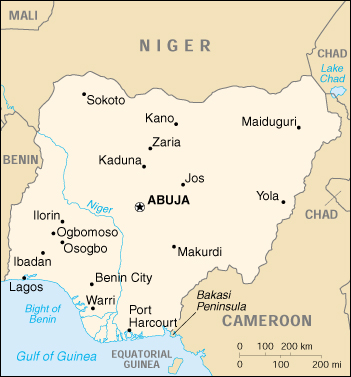
Facts About Nigeria
Background: Following nearly 16 years of military rule, a new constitution was adopted in 1999 and a peaceful transition to civilian government completed. The new president faces the daunting task of rebuilding a petroleum-based economy, whose revenues have been squandered through corruption and mismanagement, and institutionalizing democracy. In addition, the OBASANJO administration must defuse longstanding ethnic and religious tensions, if it is to build a sound foundation for economic growth and political stability.
Government type: republic transitioning from military to civilian rule
Capital: Abuja
note: on 12 December 1991 the capital was officially moved from Lagos to Abuja; many government offices remain in Lagos pending completion of facilities in Abuja,
Currency: 1 naira (N) = 100 kobo
Geography of Nigeria
Location: Western Africa, bordering the Gulf of Guinea, between Benin and Cameroon
Geographic coordinates: 10 00 N, 8 00 E
Area:
total: 923,768 sq km
land: 910,768 sq km
water: 13,000 sq km
Land boundaries:
total: 4,047 km
border countries: Benin 773 km, Cameroon 1,690 km, Chad 87 km, Niger 1,497 km
Coastline: 853 km
Maritime claims:
continental shelf: 200-m depth or to the depth of exploitation
exclusive economic zone: 200 nm
territorial sea: 12 nm
Climate: varies; equatorial in south, tropical in center, arid in north
Terrain: southern lowlands merge into central hills and plateaus; mountains in southeast, plains in north
Elevation extremes:
lowest point: Atlantic Ocean 0 m
highest point: Chappal Waddi 2,419 m
Natural resources: petroleum, tin, columbite, iron ore, coal, limestone, lead, zinc, natural gas, hydropower, arable land
Land use:
arable land: 33%
permanent crops: 3%
permanent pastures: 44%
forests and woodland: 12%
other: 8% (1993 est.)
Irrigated land: 9,570 sq km (1993 est.)
Natural hazards: periodic droughts
Environment – current issues: soil degradation; rapid deforestation; desertification
Environment – international agreements:
party to: Biodiversity, Climate Change, Desertification, Endangered Species, Hazardous Wastes, Law of the Sea, Marine Dumping, Marine Life Conservation, Nuclear Test Ban, Ozone Layer Protection, Wetlands
signed, but not ratified: none of the selected agreements
Geography – note: the Niger enters the country in the northwest and flows southward through tropical rain forests and swamps to its delta in the Gulf of Guinea.
People of Nigeria
The most populous country in Africa, Nigeria accounts for one-quarter of West Africa’s people. Although less than 25% of Nigerians are urban dwellers, at least 24 cities have populations of more than 100,000. The variety of customs, languages, and traditions among Nigeria’s 250 ethnic groups gives the country a rich diversity. The dominant ethnic group in the northern two-thirds of the country is the Hausa-Fulani, most of whom are Muslim. Other major ethnic groups of the north are the Nupe, Tiv, and Kanuri. The Yoruba people are predominant in the southwest. About half of the Yorubas are Christian and half Muslim. The predominantly Catholic Igbo are the largest ethnic group in the southeast, with the Efik, Ibibio, and Ijaw (the country’s fourth-largest ethnic group) comprising a substantial segment of the population in that area as well. Persons of different language backgrounds most commonly communicate in English, although knowledge of two or more Nigerian languages is widespread. Hausa, Yoruba, and Igbo are the most widely used.
Population: 128,771,988 (July 2005 est.)
Age structure:
0-14 years: 43.71%
15-64 years: 53.47%
65 years and over: 2.82%
Population growth rate: 2.61%
Birth rate: 39.69 births/1,000 population
Death rate: 13.91 deaths/1,000 population
Net migration rate: 0.28 migrant(s)/1,000 population
Infant mortality rate: 73.34 deaths/1,000 live births
Life expectancy at birth:
total population: 51.07 years
male: 51.07 years
female: 51.07 years
Total fertility rate: 5.57 children born/woman
Nationality:
noun: Nigerian(s)
adjective: Nigerian
Ethnic groups: Nigeria, which is Africa’s most populous country, is composed of more than 250 ethnic groups; the following are the most populous and politically influential: Hausa and Fulani 29%, Yoruba 21%, Igbo (Ibo) 18%, Ijaw 10%, Kanuri 4%, Ibibio 3.5%, Tiv 2.5%.
Religions: Muslim 50%, Christian 40%, indigenous beliefs 10%
Languages: English (official), Hausa, Yoruba, Igbo (Ibo), Fulani
Literacy:
definition: age 15 and over can read and write
total population: 57.1%
male: 67.3%
female: 47.3% (1995 est.)
History Of Nigeria
THE MOST POPULOUS COUNTRY IN AFRICA and the largest in area of the West African states, Nigeria was an early twentieth century colony that became an independent nation in 1960. A country of great diversity because of the many ethnic, linguistic, and religious groups that live within its borders, Nigeria is also a country with a long past. The history of the peoples that constitute the present state dates back more than 2,000 years. The earliest archaeological finds were of the Nok, who inhabited the central Jos Plateau between the Niger and Benue rivers between 300 B.C. and 200 A.D. A number of states or kingdoms with which contemporary ethnic groups can be identified existed before 1500. Of these, the three dominant regional groups were the Hausa in the northern kingdoms of the savanna, the Yoruba in the west, and the Igbo in the south.
The European slave trade that occurred in Africa as early as the late fifteenth century and that crested between the 1650s and the 1850s had a significant impact on Nigeria. Britain declared the slave trade illegal in 1807 and sent its navy to West African waters to enforce the ban. Britain’s action led ultimately to British intervention in Nigeria, which had become a major area for the slave trade. Meanwhile, whereas European missionaries were bringing Christianity to the peoples of southern Nigeria, Islam had been introduced along the caravan routes of northern Nigeria. The jihad, or holy war, waged within what became the Sokoto Caliphate between 1804 and 1808, was instrumental in spreading the Muslim faith not only in the north but also into adjacent regions, such as the area that came to be known as the middle belt, running from the Niger River valley in the west to the Cameroon Highlands in the east.
Initially, the slave trade had been the area’s primary attraction for the European powers, but other products, including palm oil and cocoa, also played a role. To safeguard trade from the instability resulting from the ongoing Yoruba wars that began in the 1830s, Britain established a colony in Lagos as early as 1861. The Royal Niger Company was chartered for trading purposes in 1886, shortly after the Berlin Conference of 1885 had sought to resolve overlapping European colonial activities on the African continent. Until 1900 British control of the area was limited to the coastal region and Lokoja, at the confluence of the Niger and Benue rivers. In that year, Britain named Frederick Lugard high commissioner of the Protectorate of Northern Nigeria. His tenure, which lasted until 1918, stressed indirect British control using local rulers. When Northern Nigeria and Southern Nigeria were united in 1914, Lugard continued as Britain’s chief representative. Hugh Clifford, who succeeded him as governor from 1919 to 1925, sought to bring Western economic development, to build on educational progress made in the south, and to introduce new governmental structures such as the 1922 constitution and the Legislative Council.
British rule and economic and educational development produced a rising nationalism that was reflected particularly in the organized labor movement and the creation of various political parties during World War II. Following the war, Nigeria developed under two colonial constitutions, those of 1946 and 1951. They expanded the Legislative Council and introduced the federal principle, combining regional autonomy with federal union and stipulating that civil service personnel and personnel in other public spheres should reflect the various parts of the country. In 1952-53 a census indicated that 54 percent of the population resided in the northern part of the country. Because population was the basis for allocating revenues as well as political representation, census findings always aroused considerable controversy as to their accuracy. The 1962 census was voided, and the 1963 census has become the accepted basis for planning purposes. The 1973 census, which claimed that 64 percent of the population lived in the north, was subsequently disallowed. (The November 1991 census was conducted by restricting movement of the population for two days in 250,000 enumeration areas, In mid-March 1992 the government announced that the overall population was only 88.5 million considerably less than anticipated.
Nigeria gained its independence on October 1, 1960, and the First Republic is generally held to have begun then, although the nation actually became a republic on October 1, 1963. The political scene, unfortunately, was clouded by the trial of two leading politicians, who were charged with conspiracy; and widespread political abuses and corruption caused the electorate to become disillusioned. The 1964-65 elections saw very low voter participation, followed by increasing violence that led to the death of as many as 2,000 persons. After an abortive coup attempt in January 1966, the army took over under Major General Johnson Aguiyi Ironsi, an Igbo, and a Federal Military Government was formed. Ironsi’s tenure was short-lived because northern officers staged a countercoup in July, in which Ironsi was killed and Lieutenant Colonel Yakubu Gowon, a Christian from the middle belt area, took control. Tension increased between the infantry, who were mainly of northern origin, and the Igbo soldiers in the south. The conflict led to the bloody civil war of 1967-70 (also known as the Biafran War) that took the lives of about 2 million persons.
Gowon, who intended that his be an interim rule preparing for return to civilian government, concentrated on economic development. In the late 1960s, the discovery of petroleum in commercial quantities caused oil to replace cocoa, peanuts, and palm products as Nigeria’s major foreign exchange earner; and in 1971 Nigeria became a member of the Organization of the Petroleum Exporting Countries (OPEC). The economy suffered, however, from the 1972-74 drought and rising unemployment as farm workers flocked into the cities.
Discontent increased, and in 1975 military forces deposed Gowon in a bloodless coup. They brought in Brigadier General Murtala Muhammad, who began demobilizing the military, cutting the civil service, and creating new states (the number of states eventually came to nineteen) in order to weaken regional ethnic ties. Dissatisfaction within the military over these measures led to Murtala Muhammad’s assassination in 1976. He was succeeded by his next in command, Lieutenant General Olusegun Obasanjo, who concentrated on preparing the country for civilian rule in accordance with the draft of the constitution, which was promulgated in 1979, and the elections held under it.
The resulting Second Republic lasted from 1979 to 1983 under civilian president Shehu Shagari. The weak political coalition government, the end of the oil boom, the strain of recession, and fraud in the 1983 elections caused the army to step in again at the end of December 1983 January 1984 under Major General Muhammadu Buhari, who sought to end widespread corruption. The army removed Buhari in August 1985, substituting Major General Ibrahim Babangida and the calling the new governing military body Armed Forces Ruling Council. Babangida also attempted to prepare Nigeria for civilian government, initially through economic measures. He declared a National Economic Emergency in 1986 and undertook Nigeria’s own version of a rigorous structural adjustment program (SAP), as a result of which it received aid from the World Bank.
Economic measures designed to raise the overall standard of living of Nigerians had to take into account the pluralistic nature of the society. The country contained between 250 and 400 ethnic groups (depending on the way they were defined), speaking about 400 languages. Of these, the Hausa were the dominant group in the northern area, followed by the Kanuri; the Nupe and Tiv predominated in the middle belt; and the southern area was fragmented: the major groups being the Yoruba concentrated in the southwest and the Igbo in the southeast. Whereas 80 percent of Nigeria’s population in 1990 lived in farming villages, the country experienced perhaps the fastest growing urbanization in the world in the 1970s and had the largest total urban population of any state in sub-Saharan Africa. The search for employment drew males to the cities, leaving most rural areas with a population composed largely of women, children, and the elderly.
Religion also has been pluralist. The far northern areas of Nigeria have commonly been considered Muslim, but the middle belt has a mixture of Muslim and Christian adherents. In the south, traditionally considered Christian and featuring Protestant and Africanized churches, such as the Aladura movement among the Yoruba and Roman Catholicism among the Igbo, there was also a sizeable Muslim population in 19900. In addition, traditional religion, characterized by worship of primordial spirits, dead ancestors, and spirits of places, is practiced, especially in rural areas.
Education, too, has followed a varied pattern. By 1992, Nigeria had a nationwide indigenous system in which English had come to be the language of instruction beyond primary school; traditional Quranic schools, both in the rural and urban areas of the north; and private and parochial schools in the cities, which provided a European-style education (such schools were taken over by the government in the mid-1970s but allowed to resume private operation in 1990).
Health facilities were uneven in quality as of 1990. Babangida launched a Primary Health Care plan in 1987 designed to expand immunization and improve inadequate rural health facilities and the geographic maldistribution of medical facilities. Significant health progress had been made nationally, however, since World War II. One of the most challenging health problems of the early 1990s was the prevalence of acquired and human services immune deficiency syndrome (AIDS). In the spring of 1992, the minister of health announced that about 400,000 Nigerians (nearly 0.5 percent of the population) were carriers of the virus that caused AIDS.
The relatively high percentage of secondary school and university graduates in Nigeria represented both an asset and a liability to the economy. Although an educated work force was useful in promoting technology and the professions, in the recession of the late 1980s, Nigeria had an unemployment rate for secondary school graduates of 35 to 40 percent, a potential source of unrest. Efforts to decrease unemployment were hampered by the dependence of the economy on petroleum. In 1988 oil produced 87 percent of the country’s export income and 77 percent of total federal revenues. This situation made the economy very vulnerable to world oil price fluctuations. For example, the fall in oil prices and output in the latter 1980s caused a drastic decline in Nigeria’s gross national product. GNP went from US$830 per capita in 1983 to US$250 per capita in 1989. As a result, in 1989, for the first time, Nigeria was listed by the World Bank as a low-income country. The fall in the price of oil caused Nigeria not only to incur a trade deficit but also to begin foreign borrowing, resulting in 1989 in the largest public debt of any sub-Saharan state.
In addition to petroleum, Nigeria’s major exports in the early 1990s continued to be primary products such as cocoa and, to a lesser degree, peanuts, cotton, and palm oil products. (In 1990 a law was passed banning the export of cocoa beans as of January 1991 in order to promote domestic processing. This law caused concern because despite various projects for establishing processing plants, Nigeria was unable to process all the cocoa beans produced.) The United States replaced Britain in the later 1980s as Nigeria’s best customer, but Britain remained Nigeria’s largest single source of imports.
Babangida’s introduction of the SAP in 1986 represented an effort to increase domestic production and to institute financial and import restrictions that would strengthen the economy. Measures taken under the SAP entailed control of the value of the naira by creating the second-tier foreign exchange market, strict control of the money supply and credits, a budget deficit limited to 4 percent of gross domestic product, privatization of major state-owned companies together with a new industrial policy, easing of trade restrictions, and debt rescheduling. The SAP was still in place in early 1992; the floating of the naira against international currencies in March 1992 was a bold step but was expected to result in further inflation.
Babangida’s SAP was not Nigeria’s first attempt at economic planning. Early government planning efforts, beginning in the late 1940s, had limited results; therefore, in 1990 Nigeria adopted a three-year rolling plan system that could readily be modified when changed circumstances required. The major goals were to reduce inflation, which had averaged 20 percent or more annually between 1973 and 1984; to maintain the infrastructure– Nigeria had one of the best-developed transportation systems in Africa but maintenance had been poor; to achieve agricultural self-sufficiency, and to reduce the SAP burden. As with most other developing countries, the share that agriculture contributed to GDP declined. It went from 65.7 percent in fiscal year 1959 to 39.2 percent in 1988. Moreover, Nigerian’s hope of achieving food self-sufficiency was at least temporarily dashed when in early 1991 drought forced Nigeria to increase substantially its food imports. Manufacturing’s share in GDP gradually rose from 4.4 percent in fiscal year 1959 to 10.0 percent in 1988. The growth in manufacturing resulted in part from the Nigerian Enterprises Promotion decrees of 1972, 1977, and 1981 that facilitated indigenous majority ownership. These decrees were relaxed in 1985, however, to encourage foreign investment and thus stimulate the economy.
The major goals of economic development were integrating agriculture and industry more closely, including privatization or commercialization of a number of parastatals and government-owned enterprises; improving the infrastructure with particular reference to increasing electric power generation, enlarging and modernizing communications systems, and performing needed maintenance on existing transportation systems; reducing dependence on oil; and creating an effective national planning body. By the end of 1991, privatization measures had taken effect in such areas as agriculture, banking, railroads, and telecommunications. Nigeria, however, for the most part lacked the capital necessary for large-scale development and depended upon foreign loans to implement its programs. For example, it received a 1990 European Economic Community grant for rural development and telecommunications of 3.54 billion naira under the (Fourth) Lomé Convention and a 1991 British loan of £23.3 million to expand the electric power system. As a result of such borrowing, at the end of 1991 Nigeria owed an estimated US$34 billion in external debt, 44 percent was owed to members of the Paris Club and 20 percent to foreign commercial banks. Throughout 1990 and 1991, Nigeria engaged in extensive debt rescheduling with Paris Club countries such as Britain, Italy, Japan, and Sweden.
Among other major development projects that Nigeria was pursuing was the large Ajaokuta steelworks, begun with Soviet funding and subsequently funded by the World Bank, due for completion at the end of 1992. On a smaller scale was a European currency unit (ECU) 48 million loan from the European Investment Bank under the Third Lomé Convention for the development of palm oil refining facilities. In addition, despite its efforts to diversify its economy, Nigeria was expanding its oil production. The expansion came, most notably, through the discovery of an offshore field near Akwa Ibom, which was scheduled to increase oil production by one-third by 1994. Expansion also resulted from the renovation of oil refineries at Warri and Kaduna; the development of petrochemical plants; an oil condensate project at Oso on the Niger Delta coast; and the planned construction, beginning in 1992, of facilities to enable the export of liquefied natural gas from Bonny.
Despite this economic progress, the implementation of the SAP led to decreased spending on social programs in the late 1980s. The decrease caused some domestic dissatisfaction, which was reflected in strikes and student demonstrations. Since achieving independence in 1960, Nigeria has faced a number of incidents reflecting domestic discontent; in many instances the incidents were initiated by the army or its leaders. Such dissension, of which the most serious outbreak was the Biafran civil war, has led to twenty-two years of military rule; democratic government under the First Republic and the Second Republic was limited to ten years. Sources of military dissatisfaction have arisen not only from the personal ambitions of various military leaders but also from general dismay at the corruption, bribery, favoritism, and inefficiency prevalent in the government. Many Nigerians initially saw the army as the most effective body to control the country, but with the understanding that military rule was an interim measure and that plans must go forward for the transition to democratic government. In support of this view, a number of organized interest groups, such as professional associations, trade unions, student associations, women’s organizations, and the media have exerted pressures in favor of democratic processes.
The 1989 constitution that Nigeria adopted as the basis for its transition to democratic government was modeled on the United States federal system. It provided for a president; two legislative houses, one based on population and the other on states; and an independent judiciary. A timetable was established for a series of elections at the local government area, state, and national levels. At first, officeholders in any previous government were barred from holding office in an attempt to eliminate corruption and undue political influence; in mid- December 1991 the ban was lifted, making only Babangida ineligible.
In 1989 Babangida also rejected the applications of all political entities to be recognized as political parties and instead in October 1989 created two parties: the Republican National Convention, “a little to the right of center,” and the Social Democratic Party, “a little to the left of center.” This action, which generated considerable controversy, was designed to create parties that would cross ethnic, religious, regional, and socioeconomic lines. Results of the various elections held in 1991 appeared to indicate that previously cohesive blocs were indeed being eroded. On August 27, 1991, the number of states was increased from twenty-one to thirty (see fig. 1). Irregularities in the gubernatorial primaries in October 1991 in nine states caused the election results to be canceled in November and new elections to be rescheduled for early December, with the final state gubernatorial and state assembly elections occurring in mid-December. Although by Nigerian standards the elections went relatively smoothly, there was some criticism of the system of open balloting by which voters stood behind a photograph of their chosen candidate and were counted.
Among the difficulties involved in encouraging the democratic process have been ethnic and religious tensions arising among the multitudinous groups in the country. Outbreaks of violence caused by religious tensions resulting in losses of life have occurred in the past and recurred in the 1980s and 1990s. Most recently, in 1991 and 1992 they took place in Bauchi, Benue, Kaduna, Kano, Taraba, and other states. Desire for ethnic self-assertion and for the power and financial wherewithal resulting from statehood have largely constituted the basis for the creation of new states. Nigeria has moved from three regions at independence to four regions in 1963, twelve states in 1967, nineteen states in 1976, twenty-one states in 1987, and thirty states in August 1991. Government leaders including Babangida have endeavored, however, to diversify ethnic representation in a state so as to prevent the dominance of a single group. The move of the federal capital from Lagos to Abuja in December 1991 resulted not only from the tremendous overcrowding and pressure on transportation and other infrastructure facilities in Lagos but also from the desire to locate the capital in a central area that lacked association with a particular ethnic group. Some issues continued to be controversial, such as the impact the move to Abuja would have on Lagos. Moreover, the relationship of states to the federal government, with particular reference to the division of revenues among them, had as of early 1992 not been resolved to general satisfaction, nor had the highly controversial matter of the establishment of Muslim sharia courts of appeal in southern states.
Despite these domestic difficulties, Nigeria has continued to play a prominent role not only in West Africa but also in the world community. Nigeria was a prime organizer of the Economic Community of West African States (ECOWAS) and of the ECOWAS Cease-fire Monitoring Group (ECOMOG) that stemmed from it. ECOMOG provided a peacekeeping force for Liberia to which Nigeria contributed 900 personnel in August 1990 as well as leadership. To reduce the financial burden on Nigeria of participation in African peacekeeping forces, Babangida, at the 27th annual meeting of the Organization of African Unity (OAU), held in Abuja in June 1991, again raised the matter of a volunteer pan-African defense force, suggesting that such a force be organized on a regional basis.
In 1991-92 Babangida served as president of the OAU, thereby enhancing his mediator role. During this period, he met with the prime ministers of Chad and Niger and the president of Cameroon concerning border problems between Nigeria and these countries. A meeting of the four states in July 1990 had failed to resolve the Lake Chad boundary question, and in the summer of 1991 Cameroon had occupied nine Nigerian border villages or islands. Because it had a higher standard of living than its neighbors, Nigeria was also facing an influx of workers from surrounding countries. In November 1991, in an attempt to deal with the problem, Nigeria announced that it planned to create a frontier force to control illegal immigration. Nigeria’s major role in the African continent was particularly highlighted by the visit of South African president Frederick W. de Klerk to Nigeria in early April 1992. The visit laid a foundation for possible future recognition of a transitional South African government by the OAU and other African states.
Nigeria has sought to play a responsible role in OPEC as well as in various United Nations bodies. Nigeria’s position toward the Arabs-Israeli dispute has been influenced by its domestic religious divisions. Babangida reinstated Nigeria’s diplomatic relations with Israel in August 1991, and shortly thereafter invited Palestine Liberation Organization head Yasser Arafat to visit, greeting him with a twenty-one-gun salute reserved for heads of state. The same month Babangida suspended Nigeria’s membership in the Organization of the Islamic Conference. He had initiated membership in 1986 without any prior consultation, that a move had created a furore among Nigerian Christians. Because of its position as a former British colony, its membership in the British Commonwealth of Nations, and its position as a world oil producer, Nigeria’s national interests have led it to align itself primarily with the West, including the European Economic Community.
Nigeria’s role as an African regional leader, peacekeeper, and mediator has emerged at the same time that the country’s army was being drastically reduced from approximately 250,000 personnel during the civil war to about 80,000 in 1991. Additional cuts were projected in order to bring the forces to approximately 60,000. This process, together with a large-scale restructuring of the armed forces beginning in 1990 and still underway in early 1992, occurred in preparation for civilian government under the transition to the Third Republic.
The size of the armed forces reflected not only Nigeria’s expanse but also the domestic instability the country had experienced since achieving independence in 1960. In the period between 1966 and 1985, Nigeria underwent no less than six coups d’état, in addition to several attempted coups. (A serious recent failed coup was that led by Major Gideon Ockar, a middle belt Christian, in April 1991. He advocated the “excising” from Nigeria of the five northern Muslim states–the coup attempt occurred prior to the creation of Nigeria’s nine additional states–on the grounds that the true Nigeria was the Christian southern part of the country.)
Economic and social conditions worsened in the 1980s, increasing the discontent resulting from ethnic, sectional, and religious cleavages. To these forces for instability were added such factors as the potential for foreign subversion, caused in part by the large number of illegal workers from other African states; the fluctuation of oil prices and particularly the impact of decreasing oil income on the economy; the pressures of the rising foreign debt; and the growing Islamism, or Islamic, activism (sometimes seen as fundamentalism), as well as increasing Christian fundamentalism.
Public disenchantment with the military in the 1980s and 1990s caused increasing demands for democracy, the elimination of military tribunals, and an end to Decree Number 2, passed during the Buhari regime. In 1992 this decree still permitted the jailing of individuals for up to six weeks without charge and set limits on freedom of speech and the press. Pressure groups, such as labor unions, academic, and student groups, and especially the media, agitated for reforms and a greater role in government decision making, particularly in the economic field. Such activity led the government to jail various individuals on a number of occasions. Another public concern was the rising crime rate, especially in urban areas, and the marked increase in drug- related crime and international narcotics trafficking. Numerous jail sentences resulted, leading to overcrowding and causing periodic amnesties to empty penal facilities.
Despite Nigeria’s recent history of military domination of politics, in April 1992 Babangida appeared committed to turning over power to a new civilian government in January 1993. Part of Babangida’s transition process entailed the demilitarization of the government. Demilitarization was accomplished in part in September 1990 by retiring from military service all cabinet ministers except for Babangida and the minister of defense. The officers continued to serve in a civilian capacity. The post of chief of the General Staff was likewise eliminated; the incumbent, Vice Admiral Augustus Aikhomu, who had also been retired from the military, was named vice president. In addition, numerous state military governors were retired and replaced by lower-ranking officers; in each state, a civilian deputy governor served under the military governor in order to become familiar with the duties entailed. In December 1991, the newly elected civilian governors took office.
Serious questions remained, however, as to whether or not Babangida’s goals for the professionalization of the armed forces and the reeducation of the military concerning their subordinate role in a forthcoming civilian government were attainable. Concurrently, Babangida stressed educating the citizenry about their responsibilities for active, knowledgeable participation in government. The question was also raised as to whether or not democracy could be achieved by a military government that established rules for the transition but that simultaneously imposed strict limits on the democratic process and sought to silence critics both of the domestic political scene and of the government’s economic policies, particularly the SAP. The House of Representatives elections and the Senate elections (which will return senators from each state and one from Abuja to the newly structured 61-member Senate) scheduled for November 1992 and the presidential elections scheduled for December 1992 would be the final test in the transition to the Third Republic slated to occur in January 1993.
Nigeria Economy
Economy – overview: The oil-rich Nigerian economy, long hobbled by political instability, corruption, and poor macroeconomic management, is undergoing substantial economic reform under the new civilian administration. Nigeria’s former military rulers failed to diversify the economy away from overdependence on the capital-intensive oil sector, which provides 20% of GDP, 95% of foreign exchange earnings, and about 65% of budgetary revenues. The largely subsistence agricultural sector has failed to keep up with rapid population growth, and Nigeria, once a large net exporter of food, now must import food. Following the signing of an IMF stand-by agreement in August 2000, Nigeria received a debt-restructuring deal from the Paris Club and a $1 billion loan from the IMF, both contingent on economic reforms. Increases in foreign investment and oil production combined with high world oil prices should push growth over 4% in 2001-02.
GDP: purchasing power parity – $117 billion (2000 est.)
GDP – real growth rate: 3.5% (2000 est.)
GDP – per capita: purchasing power parity – $950 (2000 est.)
GDP – composition by sector:
agriculture: 40%
industry: 40%
services: 20% (1999 est.)
Household income or consumption by percentage share:
lowest 10%: 1.6%
highest 10%: 40.8% (1996-97)
Inflation rate (consumer prices): 6.5% (2000 est.)
Labor force: 66 million (1999 est.)
Labor force – by occupation: agriculture 70%, industry 10%, services 20% (1999 est.)
Unemployment rate: 28% (1992 est.)
Budget:
revenues: $3.4 billion
expenditures: $3.6 billion (2000 est.)
Industries: crude oil, coal, tin, columbite, palm oil, peanuts, cotton, rubber, wood, hides and skins, textiles, cement and other construction materials, food products, footwear, chemicals, fertilizer, printing, ceramics, steel
Industrial production growth rate: 1.5% (2000 est.)
Electricity – production: 18.7 billion kWh (1999)
Electricity – production by source:
fossil fuel: 52.94%
hydro: 47.06%
nuclear: 0%
other: 0% (1999)
Electricity – consumption: 17.372 billion kWh (1999)
Agriculture – products: cocoa, peanuts, palm oil, corn, rice, sorghum, millet, cassava (tapioca), yams, rubber; cattle, sheep, goats, pigs; timber; fish
Exports: $22.2 billion (f.o.b., 2000 est.)
Exports – commodities: petroleum and petroleum products 95%, cocoa, rubber
Exports – partners: United States 36%, India 9%, Spain 8%, Brazil 6%, France 6%, (1999)
Imports: $10.7 billion (f.o.b., 2000 est.)
Imports – commodities: machinery, chemicals, transport equipment, manufactured goods, food and live animals
Imports – partners: UK 11%, Germany 10%, United States 9%, France 8%, China 6% (1999)
Debt – external: $32 billion (2000 est.)
Economic aid – recipient: ODA $250 million (1998)
Currency: naira (NGN)
Map Of Nigeria