Facts About Palau
Background: After three decades as part of the UN Trust Territory of the Pacific under US administration, this westernmost cluster of the Caroline Islands opted for independent status in 1978 rather than join the Federated States of Micronesia. A Compact of Free Association with the US was approved in 1986, but not ratified until 1993. It entered into force the following year when the islands gained their independence.
Government type: constitutional government in free association with the US; the Compact of Free Association entered into force 1 October 1994
Capital: Koror
note: a new capital is being built about 20 km northeast of Koror
Currency: 1 United States dollar (US$) = 100 cents
Geography of Palau
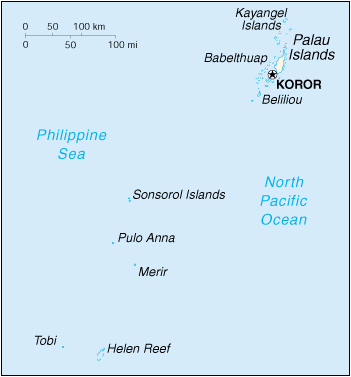
Location: Oceania, group of islands in the North Pacific Ocean, southeast of the Philippines
Geographic coordinates: 7 30 N, 134 30 E
Area:
total: 458 sq km
land: 458 sq km
water: 0 sq km
Land boundaries: 0 km
Coastline: 1,519 km
Maritime claims:
continental shelf: 200-m depth or to the depth of exploitation
exclusive fishing zone: 12 nm
extended fishing zone: 200 nm
territorial sea: 3 nm
Climate: wet season May to November; hot and humid
Terrain: varying geologically from the high, mountainous main island of Babelthuap to low, coral islands usually fringed by large barrier reefs
Elevation extremes:
lowest point: Pacific Ocean 0 m
highest point: Mount Ngerchelchauus 242 m
Natural resources: forests, minerals (especially gold), marine products, deep-seabed minerals
Natural hazards: typhoons (June to December)
Environment – current issues: inadequate facilities for disposal of solid waste; threats to the marine ecosystem from sand and coral dredging, illegal fishing practices, and overfishing
Environment – international agreements:
party to: Biodiversity, Climate Change, Climate Change-Kyoto Protocol, Desertification, Law of the Sea
signed, but not ratified: none of the selected agreements
Geography – note: westernmost archipelago in the Caroline chain, consists of six island groups totaling over 200 islands; includes World War II battleground of Beliliou (Peleliu) and world-famous rock islands.
People of Palau
Population: 20,303 (July 2005 est.)
Age structure:
0-14 years: 26.88%
15-64 years: 68.46%
65 years and over: 4.66%
Population growth rate: 1.69%
Birth rate: 19.64 births/1,000 population
Death rate: 7.23 deaths/1,000 population
Net migration rate: 4.45 migrant(s)/1,000 population
Infant mortality rate: 16.67 deaths/1,000 live births
Life expectancy at birth:
total population: 68.89 years
male: 65.77 years
female: 72.19 years
Total fertility rate: 2.47 children born/woman
Nationality:
noun: Palauan(s)
adjective: Palauan
Ethnic groups: Palauan (Micronesian with Malayan and Melanesian admixtures) 70%, Asian (mainly Filipinos, followed by Chinese, Taiwanese, and Vietnamese) 28%, white 2% (2000 est.)
Religions: Christian (Catholics, Seventh-Day Adventists, Jehovah’s Witnesses, the Assembly of God, the Liebenzell Mission, and Latter-Day Saints), Modekngei religion (one-third of the population observes this religion which is indigenous to Palau)
Languages: English and Palauan official in all states except Sonsoral (Sonsorolese and English are official), Tobi (Tobi and English are official), and Angaur (Angaur, Japanese, and English are official)
Literacy:
definition: age 15 and over can read and write
total population: 92%
male: 93%
female: 90% (1980 est.)
Palau Economy
Economy – overview: The economy consists primarily of subsistence agriculture and fishing. The government is the major employer of the work force, relying heavily on financial assistance from the United States. The population enjoys a per capita income of twice that of the Philippines and much of Micronesia. Long-run prospects for the tourist sector have been greatly bolstered by the expansion of air travel in the Pacific and the rising prosperity of leading East Asian countries.
GDP: purchasing power parity – $129 million (1998 est.)
note: GDP numbers reflect US spending
GDP – real growth rate: -1.4% (1998 est.)
GDP – per capita: purchasing power parity – $7,100 (1998 est.)
Labor force: 8,300 (1999)
Unemployment rate: 2.3% (2000 est.)
Budget:
revenues: $57.7 million
expenditures: $80.8 million, including capital expenditures of $17.1 million (FY98/99 est.)
Industries: tourism, craft items (from shell, wood, pearls), construction, garment making
Electricity – production: 200 million kWh (1996)
Electricity – production by source:
fossil fuel: 85%
hydro: 15%
nuclear: 0%
other: 0% (1996)
Electricity – consumption: 200 million kWh (1996)
Agriculture – products: coconuts, copra, cassava (tapioca), sweet potatoes
Exports: $14.3 million (f.o.b., 1996)
Exports – commodities: trochus (type of shellfish), tuna, copra, handicrafts
Exports – partners: United States, Japan
Imports: $126 million (f.o.b., FY99/00)
Imports – commodities: machinery and equipment, fuels, metals; foodstuffs
Imports – partners: United States
Debt – external: $0 (FY99/00)
Economic aid – recipient: $155.8 million (1995); note – the Compact of Free Association with the US, entered into after the end of the UN trusteeship on 1 October 1994, will provide Palau with up to $700 million in US aid over 15 years in return for furnishing military facilities.
Currency: United States dollar (USD)
Map Of Palau