Facts About Paraguay
Background: In the disastrous War of the Triple Alliance (1865-70), Paraguay lost two-thirds of all adult males and much of its territory. It stagnated economically for the next half century. In the Chaco War of 1932-35, large, economically important areas were won from Bolivia. The 35-year military dictatorship of Alfredo STROESSNER was overthrown in 1989, and, despite a marked increase in political infighting in recent years, relatively free and regular presidential elections have been held since then.
Government type: constitutional republic
Capital: Asuncion
Currency: 1 guarani (G) = 100 centimos
Geography of Paraguay
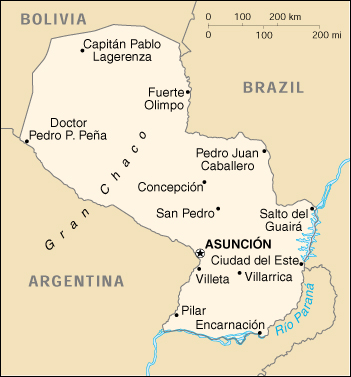
Location: Central South America, northeast of Argentina
Geographic coordinates: 23 00 S, 58 00 W
Area:
total: 406,750 sq km
land: 397,300 sq km
water: 9,450 sq km
Land boundaries:
total: 3,920 km
border countries: Argentina 1,880 km, Bolivia 750 km, Brazil 1,290 km
Coastline: 0 km (landlocked)
Climate: subtropical to temperate; substantial rainfall in the eastern portions, becoming semiarid in the far west
Terrain: grassy plains and wooded hills east of Rio Paraguay; Gran Chaco region west of Rio Paraguay mostly low, marshy plain near the river, and dry forest and thorny scrub elsewhere
Elevation extremes:
lowest point: junction of Rio Paraguay and Rio Parana 46 m
highest point: Cerro San Rafael 850 m
Natural resources: hydropower, timber, iron ore, manganese, limestone
Land use:
arable land: 6%
permanent crops: 0%
permanent pastures: 55%
forests and woodland: 32%
other: 7% (1993 est.)
Irrigated land: 670 sq km (1993 est.)
Natural hazards: local flooding in southeast (early September to June); poorly drained plains may become boggy (early October to June)
Environment – current issues: deforestation (an estimated 2 million hectares of forest land were lost from 1958-85); water pollution; inadequate means for waste disposal present health risks for many urban residents.
Environment – international agreements:
party to: Biodiversity, Climate Change, Climate Change-Kyoto Protocol, Desertification, Endangered Species, Hazardous Wastes, Law of the Sea, Ozone Layer Protection, Wetlands
signed, but not ratified: Nuclear Test Ban
Geography – note: landlocked; lies between Argentina, Bolivia, and Brazil; population concentrated in southern part of country.
People of Paraguay
Paraguay’s population is distributed unevenly throughout the country. The vast majority of the people live in the eastern region, most within 160 kilometers (100 mi.) of Asuncion, the capital and largest city. The Chaco, which accounts for about 60% of the territory, is home to less than 2% of the population. Ethnically, culturally, and socially, Paraguay has one of the most homogeneous populations in South America. About 95% of the people are of mixed Spanish and Guarani Indian descent. Little trace is left of the original Guarani culture except the language, which is understood by 90% of the population. About 75% of all Paraguayans speak Spanish. Guarani and Spanish are official languages. Germans, Japanese, Koreans, ethnic Chinese, Arabs, Brazilians, and Argentines are among those who have settled in Paraguay.
Population: 6,347,884 (July 2005 est.)
Age structure:
0-14 years: 38.9%
15-64 years: 56.39%
65 years and over: 4.71%
Population growth rate: 2.6%
Birth rate: 30.88 births/1,000 population
Death rate: 4.75 deaths/1,000 population
Net migration rate: -0.09 migrant(s)/1,000 population
Infant mortality rate: 29.78 deaths/1,000 live births
Life expectancy at birth:
total population: 73.92 years
male: 71.44 years
female: 76.52 years
Total fertility rate: 4.11 children born/woman
Nationality:
noun: Paraguayan(s)
adjective: Paraguayan
Ethnic groups: mestizo (mixed Spanish and Amerindian) 95%
Religions: Roman Catholic 90%, Mennonite, and other Protestant
Languages: Spanish (official), Guarani (spoken by most of rural population)
Literacy:
definition: age 15 and over can read and write
total population: 92.1%
male: 93.5%
female: 90.6% (1995 est.)
History Of Paraguay
On the night of February 2, 1989, the streets of Asunción became a battleground as forces loyal to First Corps commander Major General Andrés Rodríguez staged a coup d’état against the government of President Alfredo Stroessner Mattiauda. Tank units of the First Cavalry Division left their Ñu Guazú barracks and bombarded the headquarters of the armed forces general staff, the police, and the Presidential Escort Regiment. Elements of the air force’s composite squadron also reportedly joined the rebels and carried out aerial attacks. After several hours of heavy fighting, Stroessner surrendered and offered his “irrevocable resignation from the post of president of the Republic of Paraguay and from the post of commander in chief of its armed forces”–positions that he had held since 1954. Typically for Paraguay, the coup was not a bloodless affair; estimates of the number killed ranged from Rodríguez’s claim of 27 to Western observers’ assertions of up to 300.
During the fighting, the First Cavalry Division seized one of Asunción’s radio stations and broadcast an appeal by Rodríguez to the people of Paraguay. The military had left its barracks, the general asserted, “to defend the dignity and honor of the armed forces, for the total and complete unification of the Colorado Party (Asociación Nacional Republicana-Partido Colorado) in government, for the initiation of democratization in Paraguay, for respect for human rights, and for respect for our Christian, apostolic, Roman Catholic religion.” In fact, the coup was actually a struggle for political control of a post-Stroessner Paraguay.
Relying on a system of coercion and cooptation, Stroessner had brought remarkable political stability to a nation that experienced over twenty coups between 1870 and 1954. Stroessner’s skillful use of the ruling Colorado Party as a dispenser of jobs and patronage was a major factor in achieving this stability. Political stability also resulted from twenty years of sustained economic growth. This was especially true during the 1970s, when construction of the Itaipú hydroelectric plant, completion of the road from Asunción to Puerto Presidente Stroessner and links to Brazilian Atlantic ports, land colonization along the Brazilian border, and increases in agricultural commodity prices combined to produce gross domestic product growth of over 8 percent a year.
By the mid-1980s, however, compelling signs pointed to the twilight of the Stronato, as the Stroessner era was called. Real GDP declined in 1982 and 1983 following the completion of most construction at Itaipú and the drop in commodity prices. Foreign governments increasingly condemned and isolated the Stroessner regime for its repression of the political opposition and its reliance on electoral fraud. In addition, Stroessner turned seventy in 1982 and seemed to lose some of his legendary energy and capacity for hard work as he grew older.
It was not surprising, therefore, that leaders of the Colorado Party began to jockey for position. In the mid-1980s, the party’s thirty-five-member governing board, the National Committee (Junta de Gobierno), split into rival militant (militante) and traditionalist (tradicionalista) camps. The militants were led by four key members of Stroessner’s inner circle: Sabino Augusto Montanaro, minister of interior; Adán Godoy Jiménez, minister of public health and social welfare; José Eugenio Jacquet, minister of justice and labor; and Mario Abdo Benítez, the president’s private secretary. Each of these men had personally profited from the Stronato and felt much more loyalty to Stroessner personally than to the Colorado Party. These militants wanted as little change as possible in any future government. Indeed, many militants promoted air force Lieutenant Colonel Gustavo Stroessner Mora as the ideal successor to his father. Juan Ramón Chaves, the party’s president since the early 1960s, headed the traditionalists. Unlike the militants, traditionalist leaders came from distinguished families who had dominated the Colorado Party prior to Stroessner. Although loyal collaborators throughout the Stronato, traditionalists also believed that continued reliance on repression would spell doom for the Colorado Party.
Although the militant-traditionalist split had been brewing since the mid-1980s, it burst into public prominence with the party’s National Convention in August 1987. Montanaro employed the police to deny traditionalists access to the convention hall, thus ensuring his election as party president and the elections of Abdo Benítez, Godoy, and Jacquet as the three vice presidents. Stroessner, who had largely remained above the fray, soon endorsed the militants’ takeover of the party. The militants continued their purge of the traditionalists over the next year, excluding them from the slate of Colorado Party congressional candidates for the February 1988 election, removing them from key positions within the government, and subjecting them to torrents of abuse in the national media.
Although clearly in control, the militants stumbled badly in late 1988 by becoming embroiled in yet another controversy with the Roman Catholic Church. In the late 1980s, the church had emerged as Stroessner’s most important critic. Its newspaper and radio station broadcast accounts of human rights abuses in Paraguay. The Catholic bishops also issued numerous pastorals condemning government corruption and calling for an end to political violence against regime opponents. The government frequently responded by harassing or deporting priests. In November 1988, however, the militants overstepped the bounds of propriety in the eyes of many Paraguayans by leveling a personal attack against Aníbal Maricevich Fleitas, the bishop of Concepción and a persistent Stroessner critic. Appearing at a Colorado Party rally, National Committee member Ramón Aquino accused Maricevich of being a communist-follower and a drunkard, and dedicated a bottle of liquor in the name of “Maricewhiskey.” Despite widespread outrage within Paraguay, the militant leadership strongly endorsed Aquino’s right to free expression. Aquino soon escalated the conflict by accusing the clergy of being beholden to Cuban leader Fidel Castro Ruz and Nicaraguan president Daniel Ortega Saavedra. In response, Ismael Rolón Silvero, the archbishop of Asunción, issued a decree barring Aquino from taking an active part in any religious ceremony, a measure one step short of excommunication. The Aquino episode apparently convinced many among the Paraguayan elites that the militants were too crude and unsophisticated to be trusted with the reins of government.
In addition to the Aquino affair, traditionalists benefited from the emergence of Luis María Argaña as the de facto leader of the movement. In August 1988, Argaña, an urbane, highly respected politician, stepped down from his post as chief justice of the Supreme Court of Justice after completing a five-year term of office. Although Argaña was a known supporter of traditionalism, many recalled his ambiguous stance at the August 1987 party convention and wondered if he was really prepared to challenge the militants. In speeches in December 1988 and January 1989, however, Argaña dispelled those doubts as he lashed out at the “imposters” who had seized control of the Colorado Party. Accusing the Stroessner government of becoming a police state, Argaña thundered that those who persecute defenseless women or beat priests could not be considered Colorados or even Paraguayans. In response, Aquino accused Argaña of being a traitor with “blue,” i.e. Liberal Party (Partido Liberal), blood. Argaña’s statements gave new vitality to a movement that had been stagnating under the control of the octogenarian Chaves.
Although the militant-traditionalist battle dominated the headlines, the party’s factions tacitly understood that the armed forces remained the ultimate arbiters of Paraguay’s future. The armed forces, especially the senior officer corps, had benefited handsomely during the Stronato from involvement in a variety of legal and illegal businesses. Perhaps because they had so much to protect, however, many in the armed forces’ upper echelon remained wary of the militants. In the late 1980s, observers felt that the army was particularly opposed to the idea of Stroessner’s being succeeded by his son. Selection of an undistinguished air force officer as commander in chief would have challenged the army’s status as the preeminent service and also might have necessitated the retirement of many senior officers.
Both sides in the Colorado Party power struggle also knew that General Rodríguez’s views would be critical in determining the military’s stance. At first glance, Rodríguez seemed an unlikely obstacle in the militants’ path. As a young regimental commander in December 1955, Captain Rodríguez defied his immediate superior and supported Stroessner’s preemptive purge against the latter’s chief rival at the time, Epifanio Méndez Fleitas. In 1961 Stroessner selected his protégé Rodríguez to head the powerful First Cavalry Division. In 1982 Stroessner reorganized the army into three corps and chose Rodríguez to command the First–and most important– Corps. As a result of this promotion, Rodríguez had the best equipped units of the Paraguayan army at his disposal. The long-time professional bonds between Stroessner and Rodríguez were also enhanced by the marriage of Stroessner’s son Alfredo to Rodríguez’s daughter Marta.
But Rodríguez’s long period of service on behalf of the Stronato had apparently whetted his appetite for the presidency. Rodríguez also had close ties with many traditionalist leaders. Finally, Alfredo and Marta’s marital problems and Alfredo’s reported addiction to drugs and alcohol strained the relationship of the two generals.
Stroessner and the militants thus apparently decided that the success of their plan required the neutralization of Rodríguez. On January 12, 1989, two weeks after the promotion of his son to the rank of colonel, Stroessner announced a major reassignment of military commanders. Major General Orlando Machuca Vargas, a key ally of Rodríguez, lost his post as Second Corps commander. The commanders of the Fifth and Seventh Infantry Divisions were sacked and replaced by officers presumed loyal to Stroessner. Stroessner also rotated the commanders of the Third, Fourth, and Sixth Infantry Divisions. The day also saw the swearing in of Stroessner loyalist Brigadier General Alcibiades Ramón Soto Valleau as the new commander of the air force.
Stroessner apparently believed that these reassignments had eliminated Rodríguez’s ability to rally his fellow commanders and to stage a coup. Thus, the moment seemed propitious to strike directly against Rodríguez. Citing a purported run on the national currency, the guaraní, Stroessner issued a resolution on January 27, 1989, closing all currency exchange houses in Paraguay. This action dealt a serious financial blow to Rodríguez, whose Cambios Guaraní was one of Asunción’s largest currency traders. On January 30, 1989, Stroessner ordered the replacement of First Corps colonels Mauricio Bartolomé Díaz Delmas and Regis Aníbal Romero Espinola. Finally, on February 2, 1989, Stroessner summoned Rodríguez and ordered him to give up his direct command of units and either accept the much less significant post of minister of national defense or retire. Rodríguez refused and several hours later called out his forces.
As it turned out, Stroessner’s concerns over Rodríguez’s ambitions were not unwarranted. Two weeks after the coup, Edgar L. Ynsfrán–minister of interior from 1956 to 1966 and leader of the Movement for Colorado Integration (Movimiento del Integración Colorado) faction that was affiliated with the traditionalists– reported that coup preparations had been under way since late December 1988. According to Ynsfrán, Rodríguez ordered Chaves, Argaña, and Ynsfrán to go into hiding immediately prior to the coup. In addition, Ynsfrán claimed that on January 31, 1989, Rodríguez informed key personnel in the First Corps that he would not accept the replacements of Colonels Díaz and Romero. Whether Stroessner was aware of any of this background remains unknown.
In retrospect, Stroessner had overestimated the importance of the earlier command reassignments. The commanders of the Second Corps and Third Corps ignored Rodríguez’s appeal for help. But commanders of two of the three major components of the Second Corps–the Second and Fourth Infantry Divisions–and one of the three major units of the Third Corps–the Sixth Infantry Division– pledged loyalty to Rodríguez. In addition, all of Rodríguez’s First Corps units–the First Cavalry Division, the First Infantry Division, and the Third Infantry Division–rebelled against Stroessner. Within a week after the coup, Rodríguez promoted the commanders of the six rebellious divisions and purged the armed forces hierarchy of Stroessner loyalists.
Hours after Stroessner’s surrender, Rodríguez assumed the presidency. Rodríguez named a nine-member cabinet that had only one Stroessner holdover–the technocratic agriculture and livestock minister Hernando Bertoni Agrón–and included General Machuca as interior minister, Argaña as foreign minister, and Chaves as minister without portfolio. Rodríguez also appointed Chaves and Argaña as president and vice president, respectively, of the Council of State, a body that is primarily advisory in nature but that has the power to issue decrees during the legislature’s recess. The traditionalist resurgence was solidified by the selection of Chaves, Argaña, and Ynsfrán as president, first vice president, and second vice president, respectively, of the Colorado Party, and the removal of all militants from the National Committee. Chaves also dissolved all party local committees (seccionales) and called for new party elections by March 19, 1989.
The new government went to great lengths to insist that its actions were based on the Constitution of 1967. Because the previous president had “resigned,” Rodríguez’s title actually was the constitutionally mandated one of provisional president. Rodríguez’s call for a new presidential election on May 1, 1989, was consistent with Article 179 of the Constitution, which requires such an election within ninety days upon the resignation of a president who has served fewer than two years of his term. (Stroessner had begun serving his eighth term as president in August 1988.) Again consistent with the Constitution, the winner of the May 1989 election would not serve a five-year term but only the unexpired portion of Stroessner’s term. Even Rodríguez’s decision on February 6, 1989, to dissolve the National Congress and to call for new elections in May–an action designed to purge the militants–was given a constitutional twist. Argaña informed the media that Article 182 empowered the president to dissolve the legislature if the latter’s actions distorted the balance of the three branches of government and adversely affected compliance with the Constitution. Argaña also announced that the Council of State would exercise its constitutional prerogative to issue decrees during the legislature’s absence.
In his first three weeks in office, Rodríguez contended that Paraguay had become a much more democratic and open country. Indeed, much that occurred during this period would have been inconceivable under Stroessner’s rule. The government announced that all political parties except the Paraguayan Communist Party (Partido Comunista Paraguayo) could complete in the May 1989 elections. This was an extraordinary turn of events for the parties comprising the National Accord (Acuerdo Nacional)–the Authentic Radical Liberal Party (Partido Liberal Radical Auténtico–PLRA), the Christian Democratic Party (Partido Demócrata Cristiana), the Febrerista Revolutionary Party (Partido Revolucionario Febrerista– PRF), and the Colorado Popular Movement (Movimiento Popular Colorado–Mopoco)–all of whose leaders had been repressed by Stroessner. Actually, Mopoco did not even have to plan for the elections because the traditionalists welcomed the movement back into the Colorado fold after thirty years in exile. The government not only authorized a National Accord rally on February 11 but also permitted it to broadcast live on television. For the first time in their history, Colorados opened their party headquarters to the opposition and warmly received an address by PLRA leader Domingo Laíno. A few days after the coup, Humberto Rubín’s Radio Ñandutí was back on the air and the PRF’s newspaper El Pueblo was publishing once again; the police had forced both to close in 1987. The new minister of education and worship stated that teachers need not join the Colorado Party as a condition of employment. Even a rapprochement with the church was in evidence. Rodríguez and Rolón embraced at a special mass to honor those who had died in the coup. In its first public statement, the new Council of State invited Rolón to reoccupy the seat on the council that was reserved under the Constitution for the archbishop of Asunción. Rolón had boycotted council meetings for many years as a protest against Stroessner’s repression of the church.
Despite these remarkable developments, many observers remained skeptical concerning the flowering of democracy in Paraguay. From 1954 to 1987, traditionalists served as major collaborators of the Stronato. Positioned at all levels of government, traditionalists helped construct and institutionalize authoritarianism in Paraguay. For example, the Supreme Court rarely issued decisions at odds with the executive branch. Traditionalist legislators routinely enacted laws that served Stroessner’s interest. After the coup, traditionalist leaders contended that Stroessner was a great president for thirty-three years but became surrounded by a group of “irresponsible, voracious politicians” in 1987. Such a contention appeared at odds with the structures of authoritarianism that had been in place by the mid-1950s.
Observers also questioned the traditionalist pledge to weed out corruption in government. Following the coup, police arrested over thirty members of Stroessner’s government, including Abdo Benítez, Godoy, Aquino, Central Bank director César Romeo Acosta, and Post Office director Modesto Esquivel. (Montanaro avoided arrest by fleeing to the Honduran embassy in Asunción, and Jacquet had the good fortune of being out of the country at the time of the coup.) Interior Minister Machuca announced that those arrested would be tried for corruption. Smuggling and corruption, however, did not begin in 1987 but were endemic throughout the Stronato, presumably to the benefit of many in the traditionalist camp.
Many observers also contended that President Rodríguez had been a major practitioner of smuggling and corruption over the past thirty years. Critics charged that Rodríguez had become a millionaire by smuggling cigarettes and whiskey into Paraguay. Rodríguez’s residence, a three-story palace reportedly modeled after Versailles, was one of the most sumptuous in Asunción. Rodríguez’s businesses, which were believed to include an air taxi service and a brewery in addition to his currency exchange house, reportedly benefited from the clout that the general exercised.
The most serious allegations against Rodríguez concerned his reported involvement with narcotics trafficking. In the early 1970s, Rodríguez allegedly protected the heroin-smuggling operation of Auguste Ricord, who used Asunción as a transshipment point for narcotics sent from Marseilles to New York. In 1985 police seized forty-three kilograms of cocaine from an airplane allegedly flown by Rodríguez’s personal pilot. The new president denied these allegations and pledged to wage “a firm and intransigent struggle against drug trafficking.”
Less than a month after the coup, its real significance thus remained unclear. Certainly the new government was much more tolerant of opposition activities than was its predecessor. This tolerance created opportunities by allowing the opposition to organize openly for the first time. Rodríguez’s determination to project a democratic image also limited his ability to employ Stroessner’s repressive tactics. But serious questions remained. The Colorado Party’s organizational muscle was such that it was expected to win the May election handily, even without relying on electoral fraud. But if the opposition somehow won, many believed that the Colorados would not surrender power. Observers awaited future developments to determine if the coup was a breakthrough for democracy or the consolidation of authoritarian rule.
Paraguay Economy
Paraguay has a predominantly agricultural economy, with an important commercial sector. There is a large subsistence sector, including sizable urban underemployment, and a large underground re-export sector. The country has vast hydroelectric resources, including the world’s largest hydroelectric generation facility built and operated jointly with Brazil (Itaipú Dam), but it lacks significant mineral or petroleum resources. The government welcomes foreign investment and provides national treatment to foreign investors. The economy is dependent on exports of soybeans, cotton, grains, cattle, timber, and sugar; electricity generation, and to a decreasing degree on re-exporting to Brazil and Argentina products made elsewhere. It is, therefore, vulnerable to the vagaries of weather and to the fortunes of the Argentine and Brazilian economies.
According to Paraguayan Government statistics, Paraguay’s GDP of $7.7 billion in 2000 represented a real decrease of 0.4% from 1999. However, given the importance of the informal sector, accurate economic measures are difficult to obtain. Paraguay generally maintains a small balance-of-payments surplus. In early 2000, official foreign exchange reserves were below $775 million, and foreign official debt remained about $2.2 billion. On a per capita basis, GDP declined by about 3% during 2000, and inflation rose to 8.6%.
Agriculture and Commerce
Agricultural activities, most of which are for export, represent about 24% of GDP. More than 200,000 families depend on subsistence farming activities and maintain marginal ties to the larger productive sector of the economy. The commercial sector is primarily engaged in the import of goods from Asia and the United States for re-export to neighboring countries. The recorded activities of this sector have declined significantly in recent years, placing a strain on government finances, which depend heavily on taxes on this trade. In general, Paraguayans prefer imported goods, and local industry relies on imported capital goods. The underground economy, which is not included in the national accounts, may equal the formal economy in size. The bulk of underground activity centers on the unregistered sale of imported goods–including computers, sound equipment, cameras, liquor, and cigarettes–to Argentina and Brazil.
Post-Stroessner Reforms
Since 1989, the government has deregulated the economy, which had been tightly controlled by President Stroessner’s authoritarian regime. The Rodriguez and Wasmosy administrations eliminated foreign exchange controls and implemented a dirty floating exchange rate system, reformed the tax structure and established tax incentives to attract investment, reduced tariff levels, launched a stock market, and began a process of financial reform. Though the short-lived Cubas administration was hampered by political conflicts, it attempted to reduce the rising government deficit by cutting spending, to fight intellectual property piracy in order to attract foreign investment, and to address a financial sector crisis that had simmered since 1995. The Gonzalez Macchi government has made some progress on state reform and privatization, but the fiscal deficit has grown as has Paraguay’s external debt.
The central government budget in 2000, excluding decentralized agencies and store-owned enterprises, represented 20% of GDP.
GDP: purchasing power parity – $26.2 billion (2000 est.)
GDP – real growth rate: 1% (2000 est.)
GDP – per capita: purchasing power parity – $4,750 (2000 est.)
GDP – composition by sector:
agriculture: 28%
industry: 21%
services: 51% (1999 est.)
Household income or consumption by percentage share:
lowest 10%: 0.7%
highest 10%: 46.6% (1995)
Inflation rate (consumer prices): 8% (2000 est.)
Labor force: 2 million (2000 est.)
Labor force – by occupation: agriculture 45%
Unemployment rate: 16% (2000 est.)
Budget:
revenues: $1.3 billion
expenditures: $2 billion, including capital expenditures of $700 million (1999 est.)
Industries: sugar, cement, textiles, beverages, wood products
Industrial production growth rate: 0% (2000 est.)
Electricity – production: 51.554 billion kWh (1999)
Electricity – production by source:
fossil fuel: 0.07%
hydro: 99.79%
nuclear: 0%
other: 0.15% (1999)
Electricity – consumption: 1.915 billion kWh (1999)
Agriculture – products: cotton, sugarcane, soybeans, corn, wheat, tobacco, cassava (tapioca), fruits, vegetables; beef, pork, eggs, milk; timber
Exports: $3.5 billion (f.o.b., 2000 est.)
Exports – commodities: electricity, soybeans, feed, cotton, meat, edible oils
Exports – partners: Brazil, Argentina, EU
Imports: $3.3 billion (f.o.b., 2000 est.)
Imports – commodities: road vehicles, consumer goods, tobacco, petroleum products, electrical machinery
Imports – partners: Brazil, US, Argentina, Uruguay, EU, Hong Kong
Debt – external: $3 billion (2000 est.)
Currency: guarani (PYG)
Map Of Paraguay