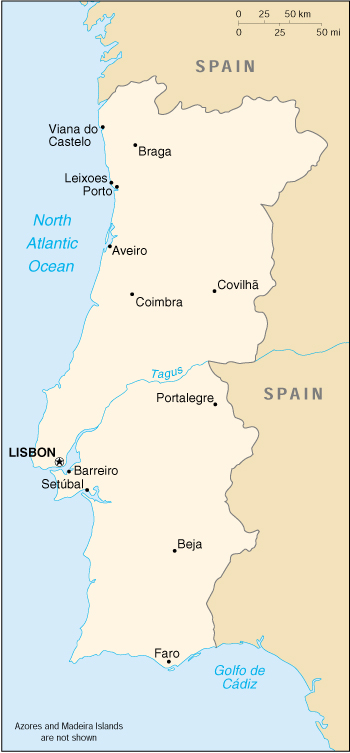
Facts About Portugal
Background: Following its heyday as a world power during the 15th and 16th centuries, Portugal lost much of its wealth and status with the destruction of Lisbon in a 1755 earthquake, occupation during the Napoleonic Wars, and the independence in 1822 of Brazil as a colony. A 1910 revolution deposed the monarchy; for most of the next six decades repressive governments ran the country. In 1974, a left-wing military coup installed broad democratic reforms. The following year Portugal granted independence to all of its African colonies. Portugal entered the EC in 1985.
Government type: parliamentary democracy
Capital: Lisbon
Currency: euro (EUR)
Geography of Portugal
Location: Southwestern Europe, bordering the North Atlantic Ocean, west of Spain
Geographic coordinates: 39 30 N, 8 00 W
Area:
total: 92,391 sq km
land: 91,951 sq km
water: 440 sq km
note: includes Azores and Madeira Islands
Land boundaries:
total: 1,214 km
border countries: Spain 1,214 km
Coastline: 1,793 km
Maritime claims:
continental shelf: 200-m depth or to the depth of exploitation
exclusive economic zone: 200 nm
territorial sea: 12 nm
Climate: maritime temperate; cool and rainy in north, warmer and drier in south
Terrain: mountainous north of the Tagus River, rolling plains in south
Elevation extremes:
lowest point: Atlantic Ocean 0 m
highest point: Ponta do Pico (Pico or Pico Alto) on Ilha do Pico in the Azores 2,351 m
Natural resources: fish, forests (cork), tungsten, iron ore, uranium ore, marble, arable land, hydro power
Land use:
arable land: 26%
permanent crops: 9%
permanent pastures: 9%
forests and woodland: 36%
other: 20% (1993 est.)
Irrigated land: 6,300 sq km (1993 est.)
Natural hazards: Azores subject to severe earthquakes
Environment – current issues: soil erosion; air pollution caused by industrial and vehicle emissions; water pollution, especially in coastal areas.
Environment – international agreements:
party to: Air Pollution, Biodiversity, Climate Change, Desertification, Endangered Species, Hazardous Wastes, Law of the Sea, Marine Dumping, Marine Life Conservation, Ozone Layer Protection, Ship Pollution, Tropical Timber 83, Tropical Timber 94, Wetlands
signed, but not ratified: Air Pollution-Persistent Organic Pollutants, Air Pollution-Volatile Organic Compounds, Climate Change-Kyoto Protocol, Environmental Modification, Nuclear Test Ban.
Geography – note: Azores and Madeira Islands occupy strategic locations along western sea approaches to Strait of Gibraltar
People of Portugal
Population: 10,566,212 (July 2005 est.)
Age structure:
0-14 years: 16.96%
15-64 years: 67.42%
65 years and over: 15.62%
Population growth rate: 0.18%
Birth rate: 11.51 births/1,000 population
Death rate: 10.21 deaths/1,000 population
Net migration rate: 0.5 migrant(s)/1,000 population
Life expectancy at birth:
total population: 75.94 years
male: 72.44 years
female: 79.68 years
Total fertility rate: 1.48 children born/woman
Nationality:
noun: Portuguese (singular and plural)
adjective: Portuguese
Ethnic groups: homogeneous Mediterranean stock; citizens of black African descent who immigrated to mainland during decolonization number less than 100,000
Religions: Roman Catholic 94%, Protestant (1995)
Languages: Portuguese
Literacy:
definition: age 15 and over can read and write
total population: 87.4%
History of Portugal
THE HISTORY OF PORTUGAL can be divided into seven broad periods. The first begins in the Paleolithic period and extends to the formation of Portugal as an independent monarchy. During this period, Lusitania, that portion of the western Iberian Peninsula known today as Portugal, experienced many waves of conquest and settlement by Iberos, Phoenicians, Greeks, Romans, Swabians, Visigoths, and Muslims. Of these successive waves of people, the Romans left the greatest imprint on present Portuguese society.
The second broad period of Portuguese history runs from the founding of the monarchy in 1128 until the disappearance of the House of Burgundy, Portugal’s first dynasty, in 1383. During this period, the monarchy was established and expanded by reconquering territory from the Muslims and populating those lands with Christian settlers. Consolidation and economic development were furthered by policies designed to increase agricultural productivity.
The third period begins with the founding of the House of Avis, Portugal’s second ruling dynasty. During this period, Portugal experienced a dynastic struggle that brought the House of Avis to the throne, a series of wars with Castile that threatened the independence of the new kingdom, a social revolution, a second dynastic struggle, and the assertion of royal supremacy over the nobility.
The fourth period begins in 1415 when the Portuguese seized Ceuta in Morocco, thus beginning Portugal’s maritime expansion. During this period, Portugal explored the west coast of Africa, discovered and colonized Madeira and the Azores, opened the passage to India around Africa, built an empire in Asia, and colonized Brazil.
The fifth period, that of imperial decline, begins with the dynastic crisis of 1580, which saw the demise of the House of Avis. During this period, Portugal was part of the Iberian Union until 1640, when the monarchy was restored and a new dynasty, the House of Bragança, was established. This period includes the advent of absolutism in Portugal and ends with the Napoleonic invasions in the early 1800s.
The sixth, the period of constitutional monarchy, begins with the liberal revolution of 1820, which established in Portugal for the first time a written constitution. This period includes a civil war in which constitutionalists triumphed over absolutists, the winning of independence by Brazil, and the exploration of Portugal’s African possessions. It ends with the collapse of rotativismo in the early twentieth century.
The final period begins in 1910 with the downfall of the monarchy and the establishment of the First Republic. This period includes the corporative republic of António de Oliveira Salazar; the collapse of that regime on April 25, 1974; and the establishment of Portugal’s present democratic regime, the Second Republic.
Portugal Economy
Economy – overview: Portugal is an upcoming capitalist economy with a per capita GDP two-thirds that of the four big West European economies. The country qualified for the European Monetary Union (EMU) in 1998 and joined with 10 other European countries in launching the euro on 1 January 1999. The year 2000 was marked by moderation in growth, inflation, and unemployment. The country continues to run a sizable trade deficit. The government is working to reform the tax system, to modernize capital plant, and to increase the country’s competitiveness in the increasingly integrated world markets. Growth is expected to fall off slightly in 2001. Improvement in the education sector is critical to the long-run catch-up process.
GDP: purchasing power parity – $159 billion (2000 est.)
GDP – real growth rate: 3.2% (1999 est.), 2.7% (2000 est.)
GDP – per capita: purchasing power parity – $15,800 (2000 est.)
GDP – composition by sector:
agriculture: 4%
industry: 36%
services: 60% (1999 est.)
Household income or consumption by percentage share:
lowest 10%: 3.1%
highest 10%: 28.4% (1995 est.)
Inflation rate (consumer prices): 2.4% (1999 est.), 2.8% (2000 est.)
Labor force: 5 million (1999)
Labor force – by occupation: services 60%, industry 30%, agriculture 10% (1999 est.)
Unemployment rate: 4.6% (1999 est.), 4.3% (2000 est.)
Budget:
revenues: $48.6 billion
expenditures: $50.7 billion, including capital expenditures of $7.7 billion (2000 est.)
Industries: textiles and footwear; wood pulp, paper, and cork; metalworking; oil refining; chemicals; fish canning; wine; tourism
Industrial production growth rate: 2.9% (1999 est.)
Electricity – production: 41.696 billion kWh (1999)
Electricity – production by source:
fossil fuel: 79.97%
hydro: 17.25%
nuclear: 0%
other: 2.78% (1999)
Electricity – consumption: 37.915 billion kWh (1999)
Electricity – exports: 4.49 billion kWh (1999)
Electricity – imports: 3.628 billion kWh (1999)
Agriculture – products: grain, potatoes, olives, grapes; sheep, cattle, goats, poultry, beef, dairy products
Exports: $25 billion (f.o.b., 1998), $26.1 billion (f.o.b., 2000 est.)
Exports – commodities: clothing and footwear, machinery, chemicals, cork and paper products, hides
Exports – partners: EU 83% (Germany 20%, Spain 18%, France 14%, UK 12%, Netherlands 5%, Benelux 5%, Italy), US 5% (1999)
Imports: $34.9 billion (f.o.b., 1998), $41 billion (f.o.b., 2000 est.)
Imports – commodities: machinery and transport equipment, chemicals, petroleum, textiles, agricultural
Imports – partners: EU 77% (Spain 24%, Germany 15%, France 11%, Italy 8%, UK 7%, Netherlands 5%), US, Japan (1998)
Debt – external: $13.1 billion (1997 est.)
Economic aid – donor: ODA, $271 million (1995)
Currency: euro (EUR)
Map Of Portugal