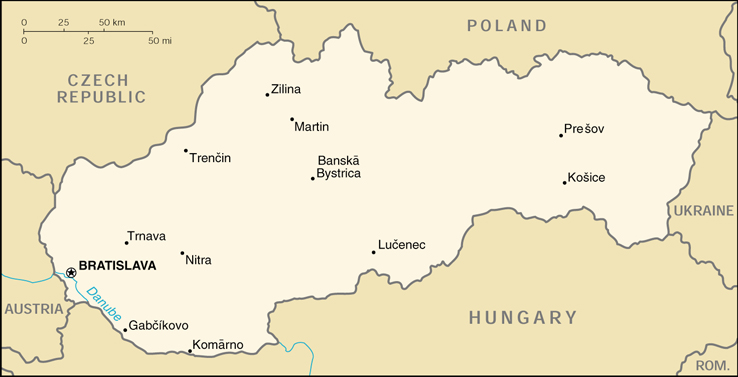
Facts About Slovakia
Background: In 1918 the Slovaks joined the closely related Czechs to form Czechoslovakia. Following the chaos of World War II, Czechoslovakia became a communist nation within Soviet-ruled Eastern Europe. Soviet influence collapsed in 1989 and Czechoslovakia once more became free. The Slovaks and the Czechs agreed to separate peacefully on 1 January 1993. Historic, political, and geographic factors have caused Slovakia to experience more difficulty in developing a modern market economy than some of its Central European neighbors.
Government type: parliamentary democracy
Capital: Bratislava
Currency: 1 Slovak koruna (SKK) = 100 halierov
Geography of Slovakia
Location: Central Europe, south of Poland
Geographic coordinates: 48 40 N, 19 30 E
Area:
total: 48,845 sq km
land: 48,800 sq km
water: 45 sq km
Land boundaries:
total: 1,355 km
border countries: Austria 91 km, Czech Republic 215 km, Hungary 515 km, Poland 444 km, Ukraine 90 km
Coastline: 0 km (landlocked)
Maritime claims: none (landlocked)
Climate: temperate; cool summers; cold, cloudy, humid winters
Terrain: rugged mountains in the central and northern part and lowlands in the south
Elevation extremes:
lowest point: Bodrok River 94 m
highest point: Gerlachovka 2,655 m
Natural resources: brown coal and lignite; small amounts of iron ore, copper and manganese ore; salt; arable land
Land use:
arable land: 31%
permanent crops: 3%
permanent pastures: 17%
forests and woodland: 41%
other: 8% (1993 est.)
Irrigated land: 800 sq km (1993 est.)
Environment – current issues: air pollution from metallurgical plants presents human health risks; acid rain damaging forests
Environment – international agreements:
party to: Air Pollution, Air Pollution-Nitrogen Oxides, Air Pollution-Sulphur 85, Air Pollution-Sulphur 94, Air Pollution-Volatile Organic Compounds, Antarctic Treaty, Biodiversity, Climate Change, Endangered Species, Environmental Modification, Hazardous Wastes, Law of the Sea, Nuclear Test Ban, Ozone Layer Protection, Ship Pollution, Wetlands
signed, but not ratified: Air Pollution-Persistent Organic Pollutants, Antarctic-Environmental Protocol, Climate Change-Kyoto Protocol.
Geography – note: landlocked; most of the country is rugged and mountainous; the Tatra Mountains in the north are interspersed with many scenic lakes and valleys.
People of Slovakia
The majority of the 5.4 million inhabitants of the Slovak Republic are Slovak (86%). Hungarians are the largest ethnic minority (11%) and are concentrated in the southern and eastern regions of Slovakia. Other ethnic groups include Roma, Czechs, Ruthenians, Ukrainians, Germans, and Poles.
The Slovak constitution guarantees freedom of religion. The majority of Slovak citizens (60%) practice Roman Catholicism; the second-largest group are Protestants. About 3,000 Jews remain of the estimated pre-WWII population of 120,000. The official state language is Slovak, and Hungarian is widely spoken in the southern region.
Despite its modern European economy and society, Slovakia has a significant rural element. About 45% of Slovaks live in villages of less than 5,000 people, and 14% in villages of less than 1,000.
Population: 5,431,363 (July 2005 est.)
Age structure:
0-14 years: 18.86%
15-64 years: 69.6%
65 years and over: 11.54%
Population growth rate: 0.13%
Birth rate: 10.05 births/1,000 population
Death rate: 9.25 deaths/1,000 population
Net migration rate: 0.53 migrant(s)/1,000 population
Infant mortality rate: 8.97 deaths/1,000 live births
Life expectancy at birth:
total population: 73.97 years
male: 69.95 years
female: 78.2 years
Total fertility rate: 1.25 children born/woman
Nationality:
noun: Slovak(s)
adjective: Slovak
Ethnic groups: Slovak 85.7%, Hungarian 10.6%, Roma 1.6% (the 1992 census figures underreport the Gypsy/Romany community, which is about 500,000), Czech, Moravian, Silesian 1.1%, Ruthenian and Ukrainian 0.6%, German 0.1%, Polish 0.1%, other 0.2% (1996)
Religions: Roman Catholic 60.3%, atheist 9.7%, Protestant 8.4%, Orthodox 4.1%, other 17.5%
Languages: Slovak (official), Hungarian
History of Slovakia
From the 11th until the early 20th century, present-day Slovakia was under Hungarian rule. The Slovak national revival was begun in the 19 century by intellectuals seeking to revive the Slovak language and culture. The formation of the Czechoslovak Republic in 1918 following World War I satisfied the common aspirations of Czechs and Slovaks for independence from the Habsburg Empire.
Although Czechoslovakia was the only east-central European country to remain a parliamentary democracy from 1918 to 1938, it was plagued with minority problems, the most important of which concerned the country’s large German population. In 1938, the Allies concluded the Munich agreement which forced Czechoslovakia to cede the predominantly German region known as Sudetenland to Germany. Then, in March 1939 Germany invaded what remained of Bohemia and Moravia and established a German protectorate. Slovakia had already declared its independence on March 14, 1939, and had become a Nazi German puppet state led by Jozef Tiso.
On August 29, 1944, 60,000 Slovak troops organized by the underground rose up against the Nazis and the Tiso regime in what became known as the Slovak National Uprising. Although ultimately unsuccessful, this act of resistance became an important historical landmark for the Slovaks. At the close of World War II, Soviet troops overran all of Slovakia, Moravia, and much of Bohemia.
Reunited after the war, the Czechs and Slovaks held elections in 1946. In Slovakia, the Democratic Party won the elections, but the Czechoslovak Communist Party won 38% of the total vote in Czechoslovakia and eventually seized power, in February 1948. The next four decades were characterized by strict communist rule, interrupted only briefly in 1968 when Alexander Dubcek, a Slovak, became party leader. Dubcek proposed political, social, and economic reforms in his effort to make “socialism with a human face” a reality. Concern among other Warsaw Pact governments that Dubcek had gone too far led to the invasion and occupation of Czechoslovakia on August 21, 1968, by Soviet, Hungarian, Bulgarian, East German, and Polish troops. Dubcek was removed as party leader and replaced by another Slovak, Gustav Husak, in April 1969.
The 1970s and 1980s became known as the period of “normalization,” in which the apologists for the 1968 Soviet invasion prevented, as best they could, any opposition to their conservative regime. Political, social, and economic life stagnated. Because the center of the reform movement had been in Prague, normalization was less harshly felt in Slovakia. In fact, the Slovak Republic saw comparatively high economic growth in the 1970s and 1980s relative to the Czech Republic.
The 1970s were also characterized by the development of a dissident movement, especially in the Czech Republic. On January l, 1977, more than 250 human rights activists signed a manifesto called Charter 77, which criticized the government for failing to meet its human rights obligations.
On November 17, 1989, a series of public protests known as the “Velvet Revolution” began and led to the downfall of communist rule in Czechoslovakia. A transition government was formed in December 1989, and the first free elections in Czechoslovakia since 1948 took place in June 1990. In 1992, negotiations on the new federal constitution deadlocked over the issue of Slovak autonomy, and in the latter half of 1992, agreement was reached to peacefully divide Czechoslovakia. On January 1, 1993, the Czech Republic and the Slovak Republic were simultaneously and peacefully founded. Both states attained immediate recognition from the U.S. and their European neighbors.
Slovakia Economy
Economy – overview: Slovakia continues the difficult transition from a centrally planned economy to a modern market economy. The economic slowdown in 1999 stemmed from large budget and current account deficits, fast-growing external debt, and persistent corruption. Even though GDP growth reached only 2.2% in 2000, the year was marked by positive developments such as foreign direct investment of $1.5 billion, strong export performance, restructuring and privatization in the banking sector, entry into the OECD, and initial efforts to stem corruption. Strong challenges face the government in 2001, especially the maintenance of fiscal balance, the further privatization of the economy, and the reduction of unemployment.
GDP: purchasing power parity – $55.3 billion (2000 est.)
GDP – real growth rate: 1.9% (1999 est.), 2.2% (2000 est.)
GDP – per capita: purchasing power parity – $10,200 (2000 est.)
GDP – composition by sector:
agriculture: 4.5%
industry: 29.3%
services: 66.2% (1999 est.)
Household income or consumption by percentage share:
lowest 10%: 5.1%
highest 10%: 18.2% (1992)
Inflation rate (consumer prices): 12.2% (2000 est.)
Labor force: 3 million (1999)
Labor force – by occupation: industry 29.3%, agriculture 8.9%, construction 8%, transport and communication 8.2%, services 45.6% (1994)
Unemployment rate: 17% (2000 est.)
Budget:
revenues: $5.2 billion
expenditures: $5.6 billion (1999)
Industries: metal and metal products; food and beverages; electricity, gas, coke, oil, nuclear fuel; chemicals and manmade fibers; machinery; paper and printing; earthenware and ceramics; transport vehicles; textiles; electrical and optical apparatus; rubber products.
Industrial production growth rate: 9.3% (2000 est.)
Electricity – production: 22.582 billion kWh (1999)
Electricity – production by source:
fossil fuel: 37.56%
hydro: 18.27%
nuclear: 44.17%
other: 0% (1999)
Electricity – consumption: 21.471 billion kWh (1999)
Agriculture – products: grains, potatoes, sugar beets, hops, fruit; pigs, cattle, poultry; forest products
Exports: $12 billion (f.o.b., 2000 est.)
Exports – commodities: machinery and transport equipment 39.4%, intermediate manufactured goods 27.5%, miscellaneous manufactured goods 13%, chemicals 8% (1999).
Exports – partners: EU 59.7% (Germany 27.8%, Austria 8%, Italy 8.9%), Czech Republic 18.1% (1999)
Imports: $12.8 billion (f.o.b., 2000 est.)
Imports – commodities: machinery and transport equipment 37.7%, intermediate manufactured goods 18%, fuels 13%, chemicals 11%, miscellaneous manufactured goods 9.5% (1999)
Imports – partners: EU 51.4% (Germany 26%, Italy 7.1%), Czech Republic 16.6%, Russia 11.9% (1999)
Debt – external: $10.3 billion (2000 est.)
Economic aid – recipient: $421.9 million (1995)
Currency: Slovak koruna (SKK)
Map of Slovakia