Facts About Slovenia
Background: In 1918 the Slovenes joined the Serbs and Croats in forming a new nation, renamed Yugoslavia in 1929. After World War II, Slovenia became a republic of the renewed Yugoslavia, which though communist, distanced itself from Moscow’s rule. Dissatisfied with the exercise of power of the majority Serbs, the Slovenes succeeded in establishing their independence in 1991. Historical ties to Western Europe, a strong economy, and a stable democracy make Slovenia a leading candidate for future membership in the EU and NATO.
Government type: parliamentary democratic republic
Capital: Ljubljana
Currency: 1 tolar (SIT) = 100 stotins
Geography of Slovenia
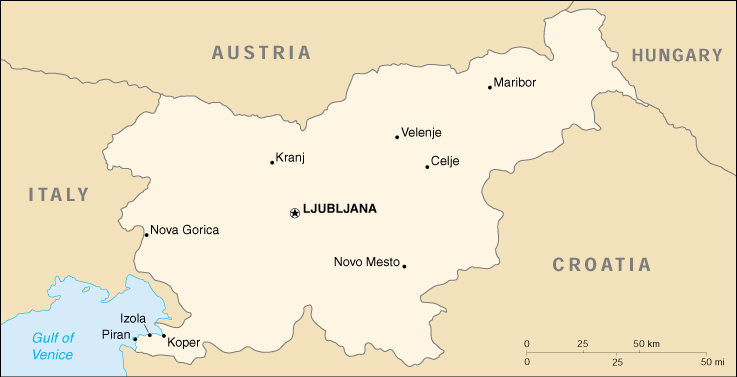
Location: Southeastern Europe, eastern Alps bordering the Adriatic Sea, between Austria and Croatia
Geographic coordinates: 46 00 N, 15 00 E
Area:
total: 20,253 sq km
land: 20,253 sq km
water: 0 sq km
Land boundaries:
total: 1,334 km
border countries: Austria 330 km, Croatia 670 km, Italy 232 km, Hungary 102 km
Coastline: 46.6 km
Climate: Mediterranean climate on the coast, continental climate with mild to hot summers and cold winters in the plateaus and valleys to the east
Terrain: a short coastal strip on the Adriatic, an alpine mountain region adjacent to Italy and Austria, mixed mountain and valleys with numerous rivers to the east.
Elevation extremes:
lowest point: Adriatic Sea 0 m
highest point: Triglav 2,864 m
Natural resources: lignite coal, lead, zinc, mercury, uranium, silver, hydropower
Land use:
arable land: 12%
permanent crops: 3%
permanent pastures: 24%
forests and woodland: 54%
other: 7% (1996 est.)
Irrigated land: 20 sq km (1993 est.)
Natural hazards: flooding and earthquakes
Environment – current issues: Sava River polluted with domestic and industrial waste; pollution of coastal waters with heavy metals and toxic chemicals; forest damage near Koper from air pollution (originating at metallurgical and chemical plants) and resulting acid rain.
Environment – international agreements:
party to: Air Pollution, Air Pollution-Sulphur 94, Biodiversity, Climate Change, Endangered Species, Hazardous Wastes, Law of the Sea, Marine Dumping, Nuclear Test Ban, Ozone Layer Protection, Ship Pollution, Wetlands
signed, but not ratified: Air Pollution-Persistent Organic Pollutants, Climate Change-Kyoto Protocol
People of Slovenia
The majority of Slovenia’s population is Slovene (over 87%). Hungarians and Italians have the status of indigenous minorities under the Slovenian Constitution, which guarantees them seats in the National Assembly. Most other minority groups, particularly those from the former Yugoslavia, immigrated after World War II for economic reasons. Slovenes are predominantly Roman Catholic, though the country also has a small number of Protestants, Orthodox Christians, Muslims, and Jews. Slovene is a Slavic language, written in the Roman script.
Population: 2,011,070 (July 2005 est.)
Age structure:
0-14 years: 16.09%
15-64 years: 69.61%
65 years and over: 14.3%
Population growth rate: 0.14%
Birth rate: 9.32 births/1,000 population
Death rate: 9.98 deaths/1,000 population
Net migration rate: 2.11 migrant(s)/1,000 population
Infant mortality rate: 4.51 deaths/1,000 live births
Life expectancy at birth:
total population: 75.08 years
male: 71.2 years
female: 79.17 years
Total fertility rate: 1.28 children born/woman
Nationality:
noun: Slovene(s)
adjective: Slovenian
Ethnic groups: Slovene 88%, Croat 3%, Serb 2%, Bosniak 1%, Yugoslav 0.6%, Hungarian 0.4%, other 5% (1991)
Religions: Roman Catholic 68.8%, Uniate Catholic 2%, Lutheran 1%, Muslim 1%, atheist 4.3%, other 22.9%
Languages: Slovenian 91%, Serbo-Croatian 6%, other 3%
History of Slovenia
From as early as the 9th century, Slovenia had fallen under foreign rulers, including partial control by Bavarian dukes and the Republic of Venice. With the exception of Napoleon’s 4-year tutelage of parts of Slovenia and Croatia–the “Illyrian Provinces”–Slovenia was part of the Hapsburg empire from the 14th century until 1918. Nevertheless, Slovenia resisted Germanizing influences and retained its unique Slavic language and culture.
In 1918, Slovenia joined with other southern Slav states in forming the Kingdom of Serbs, Croats, and Slovenes as part of the peace plan at the end of World War I. Renamed in 1929 under a Serbian monarch, the Kingdom of Yugoslavia fell to the Axis powers during World War II. Following communist partisan resistance to German, Hungarian, and Italian occupation and elimination of rival resistance groups, socialist Yugoslavia was born under the helm of Josip Broz Tito. During the communist era, Slovenia became Yugoslavia’s most prosperous republic, at the forefront of Yugoslavia’s unique version of communism. Within a few years of Tito’s death in 1980, Belgrade initiated plans to further concentrate political and economic power in its hands. Defying the politicians in Belgrade, Slovenia underwent a flowering of democracy and an opening of its society in cultural, civic, and economic realms to a degree almost unprecedented in the communist world. In September 1989, the General Assembly of the Yugoslav Republic of Slovenia adopted an amendment to its constitution asserting Slovenia’s right to secede from Yugoslavia. On December 23, 1990, 88% of Slovenia’s population voted for independence in a referendum, and on June 25, 1990, the Republic of Slovenia declared its independence. A nearly bloodless 10-day war with Yugoslavia followed; Yugoslav forces withdrew after Slovenia demonstrated stiff resistance to Belgrade.
As a young independent republic, Slovenia pursued economic stabilization and further political openness, while emphasizing its Western outlook and central European heritage. Today, with a growing regional profile, a participant in the SFOR deployment in Bosnia and the KFOR deployment in Kosovo, and a charter WTO member, Slovenia plays a role on the world stage quite out of proportion to its small size.
Slovenia Economy
Economy – overview: Although Slovenia enjoys one of the highest GDPs per capita among the transition economies of Central Europe, it needs to speed up the privatization process and the dismantling of restrictions on foreign investment. About 45% of the economy remains in state hands, and the level of foreign direct investment inflows as a percent of GDP is the lowest in the region. Analysts are predicting between 4.0% and 4.2% growth for 2001. Export growth is expected to slow in 2001 and 2002 as EU markets soften. Inflation rose from 6.1% to 8.9% in 2000 and remains a matter of concern.
GDP: purchasing power parity – $22.9 billion (2000 est.)
GDP – real growth rate: 3.5% (1999 est.), 4.5% (2000 est.)
GDP – per capita: purchasing power parity – $12,000 (2000 est.)
GDP – composition by sector:
agriculture: 4%
industry: 35%
services: 61% (1999 est.)
Household income or consumption by percentage share:
lowest 10%: 3.2%
highest 10%: 20.7% (1995)
Inflation rate (consumer prices): 8.9% (2000 est.)
Labor force: 857,400
Unemployment rate: 7.1% (1997 est.)
Budget:
revenues: $8.11 billion
expenditures: $8.32 billion (1997 est.)
Industries: ferrous metallurgy and rolling mill products, aluminum reduction and rolled products, lead and zinc smelting, electronics (including military electronics), trucks, electric power equipment, wood products, textiles, chemicals, machine tools.
Industrial production growth rate: 6.2% (2000)
Electricity – production: 12.451 billion kWh (1999)
Electricity – production by source:
fossil fuel: 34.44%
hydro: 29.58%
nuclear: 35.98%
other: 0% (1999)
Electricity – consumption: 10.024 billion kWh (1999)
Agriculture – products: potatoes, hops, wheat, sugar beets, corn, grapes; cattle, sheep, poultry
Exports: $8.9 billion (f.o.b., 2000)
Exports – commodities: manufactured goods, machinery and transport equipment, chemicals, food
Exports – partners: Germany 31%, Italy 14%, Croatia 8%, Austria 7%, France 6% (1999)
Imports: $9.9 billion (f.o.b., 2000)
Imports – commodities: machinery and transport equipment, manufactured goods, chemicals, fuels and lubricants, food
Imports – partners: Germany 21%, Italy 17%, France 11%, Austria 8%, Croatia 4%, Hungary, Russia (1999)
Debt – external: $6.2 billion (2000)
Economic aid – recipient: ODA, $5 million (1993)
Currency: tolar (SIT)
Map of Slovenia