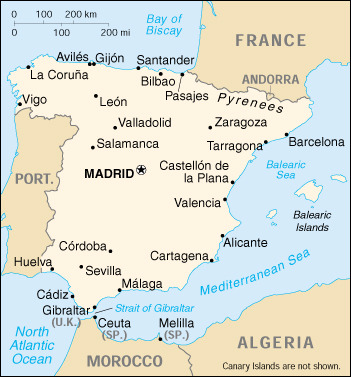
Facts About Spain
Background: Spain’s powerful world empire of the 16th and 17th centuries ultimately yielded command of the seas to England. Subsequent failure to embrace the mercantile and industrial revolutions caused the country to fall behind Britain, France, and Germany in economic and political power. Spain remained neutral in World Wars I and II, but suffered through a devastating Civil War (1936-39). In the second half of the 20th century, it has played a catch-up role in the western international community. Continuing concerns are large-scale unemployment and the Basque separatist movement.
Government type: parliamentary monarchy
Capital:Madrid
Currency: 1 peseta (Pta) = 100 centimos; euro (EUR)
Geography of Spain
Location: Southwestern Europe, bordering the Bay of Biscay, Mediterranean Sea, North Atlantic Ocean, and Pyrenees Mountains, southwest of France
Geographic coordinates: 40 00 N, 4 00 W
Area:
total: 504,782 sq km
land: 499,542 sq km
water: 5,240 sq km
note: includes Balearic Islands, Canary Islands, and five places of sovereignty (plazas de soberania) on and off the coast of Morocco – Ceuta, Melilla, Islas Chafarinas, Penon de Alhucemas, and Penon de Velez de la Gomera
Land boundaries:
total: 1,917.8 km
border countries: Andorra 63.7 km, France 623 km, Gibraltar 1.2 km, Portugal 1,214 km, Morocco (Ceuta) 6.3 km, Morocco (Melilla) 9.6 km
Coastline: 4,964 km
Maritime claims:
contiguous zone: 24 nm
exclusive economic zone: 200 nm (applies only to the Atlantic Ocean)
territorial sea: 12 nm
Climate: temperate; clear, hot summers in interior, more moderate and cloudy along coast; cloudy, cold winters in interior, partly cloudy and cool along coast
Terrain: large, flat to dissected plateau surrounded by rugged hills; Pyrenees in north
Elevation extremes:
lowest point: Atlantic Ocean 0 m
highest point: Pico de Teide (Tenerife) on Canary Islands 3,718 m
Natural resources: coal, lignite, iron ore, uranium, mercury, pyrites, fluorspar, gypsum, zinc, lead, tungsten, copper, kaolin, potash, hydropower, arable land
Land use:
arable land: 30%
permanent crops: 9%
permanent pastures: 21%
forests and woodland: 32%
other: 8% (1993 est.)
Irrigated land: 34,530 sq km (1993 est.)
Natural hazards: periodic droughts
Environment – current issues: pollution of the Mediterranean Sea from raw sewage and effluents from the offshore production of oil and gas; water quality and quantity nationwide; air pollution; deforestation; desertification.
Environment – international agreements:
party to: Air Pollution, Air Pollution-Nitrogen Oxides, Air Pollution-Sulphur 94, Air Pollution-Volatile Organic Compounds, Antarctic-Environmental Protocol, Antarctic-Marine Living Resources, Antarctic Treaty, Biodiversity, Climate Change, Endangered Species, Environmental Modification, Hazardous Wastes, Law of the Sea, Marine Dumping, Marine Life Conservation, Nuclear Test Ban, Ozone Layer Protection, Ship Pollution, Tropical Timber 83, Tropical Timber 94, Wetlands, Whaling
signed, but not ratified: Air Pollution-Persistent Organic Pollutants, Climate Change-Kyoto Protocol, Desertification
Geography – note: strategic location along approaches to Strait of Gibraltar
People of Spain
Spain’s population density, lower than that of most European countries, is roughly equivalent to New England’s. In recent years, following a longstanding pattern in the rest of Europe, rural populations are moving to cities.
Spain has no official religion. The constitution of 1978 disestablished the Roman Catholic Church as the official state religion, while recognizing the role it plays in Spanish society. More than 90% of the population are at least nominally Catholic.
About 70% of Spain’s student population attends public schools or universities. The remainder attend private schools or universities, the great majority of which are operated by the Catholic Church. Compulsory education begins with primary school or general basic education for ages 6-14. It is free in public schools and in many private schools, most of which receive government subsidies.
Population: 40,341,462 (July 2005 est.)
Age structure:
0-14 years: 14.62%
15-64 years: 68.2%
65 years and over: 17.18%
Population growth rate: 0.1%
Birth rate: 9.26 births/1,000 population
Death rate: 9.13 deaths/1,000 population
Net migration rate: 0.87 migrant(s)/1,000 population
Infant mortality rate: 4.92 deaths/1,000 live births
Life expectancy at birth:
total population: 78.93 years
male: 75.47 years
female: 82.62 years
Total fertility rate: 1.15 children born/woman
Nationality:
noun: Spaniard(s)
adjective: Spanish
Ethnic groups: composite of Mediterranean and Nordic types
Religions: Roman Catholic 99%, other 1%
Languages: Castilian Spanish (official) 74%, Catalan 17%, Galician 7%, Basque 2%
Literacy:
definition: age 15 and over can read and write
total population: 97%
History of Spain
Since the late 1950s, Spain has been transformed. A stagnant, inefficient economy, with a large and backward agricultural sector, has become one of the most dynamic in Western Europe, which often produces the continent’s highest growth rates. This transformation brought with it tremendous changes in where Spaniards lived, in how they earned their livelihoods, and in their standard of living. It also came to mean that Spain, long sealed off from the social changes of Western Europe by a reactionary authoritarian regime, gradually opened up and, in the course of a single generation, adopted the living habits and the attitudes of its more advanced neighbors. Most striking of all were two political events. The first, the fashioning of a working democracy that most Spaniards supported, was unique in the country’s history. Perhaps equally pathbreaking was the attainment of varying degrees of autonomy by the country’s regions, in a radical departure from a centuries-old tradition of centralized control from Madrid.
Only since the early 1960s have the doctrines of economic liberalism been widely practiced in Spain. Traditional policy was based on high tariffs, protectionism, and a striving for economic self-sufficiency, practices which resulted in a backward Spanish economy in 1960. At that time, agriculture was still very important because slightly under half of the population earned its living working on farms. The manufacturing sector consisted mainly of small, privately owned firms, using outmoded methods of production, or of large, inefficient, state-run enterprises, specializing in heavy industry. Only the Basque Country (Spanish, Pais Vasco; Basque, Euskadi) and Catalonia (Spanish, Cataluna; Catalan, Catalunya) had experienced an industrial revolution, but both the former’s heavy industry and the latter’s textile production were dependent on the domestic market for sales and on protection from foreign competition.
Spanish industry had profited hugely from World War I, but, once peace returned, it was unable to meet the demands of free trade. The government had resorted to traditional protectionism to keep the country’s businesses running. The Civil War of 1936- 39 so devastated the economy that the living standards of the mid-1930s were not matched again until the early 1950s. The political regime established by the war’s victor, Francisco Franco y Bahamonde, showed its essentially traditional character by embracing the principle of national economic self-sufficiency and by codifying it into the doctrine of autarchy. Stringent import controls and extensive state participation in the industrial sector, through large state-owned and state-operated enterprises, became characteristic features of the economy. Protectionism preserved inefficient businesses, and state controls prevented agricultural innovation or made it pointless. Labor was rigidly controlled, but job security was provided in return.
While Western Europe’s economies experienced a miraculous rebirth in the 1950s, Spain’s economy remained dormant. Lack of growth eventually forced the Franco regime to countenance introduction of liberal economic policies in the late 1950s. The so-called Stabilization Plan of 1959 did away with many import restrictions; imposed temporary wage freezes; devalued the nation’s currency, the peseta; tied Spain’s financial and banking operations more closely to those of the rest of Europe; and encouraged foreign investment. After a painful start, the economy took off in the early 1960s, and, during the next decade, it grew at an astonishing pace. The Spanish gross national product expanded at a rate twice that of the rest of Western Europe. Production per worker doubled, while wages tripled. Exports grew by 12 percent a year, and imports increased by 17 percent annually. Between 1960 and 1975, agriculture’s share of the economically active population fell by almost half, while the manufacturing and service sectors’ shares each rose by nearly a third. Some of this growth was caused by tourism, which brought tens of millions of Europeans to Spain each year, and by the remittances of Spaniards working abroad. Without the liberalization of the economy, however, the overall gains would not have been possible. Liberalization forced the economy to be more market-oriented, and it exposed Spanish businesses to foreign competition.
The first and the second oil crises of the 1970s ended this extraordinary boom. An excessive dependence on foreign oil, insufficient long-term investments, structural defects, and spiraling wage costs made Spain unusually susceptible to the effects of the worldwide economic slump of the late 1970s and the early 1980s. Spain’s economy languished until the second half of the 1980s, and during this time the country was afflicted by an unemployment rate that often exceeded 20 percent, higher than that of any other major West European country.
The sensational victory of the Spanish Socialist Workers’ Party (Partido Socialista Obrero Espanol–PSOE) in the national election of 1982 gave it an absolute majority in Spain’s Parliament, the Cortes, and allowed it to introduce further liberal economic measures that previous weak governments could not consider. The Socialist government, headed by the party leader and prime minister, Felipe Gonzalez Marquez, opted for orthodox monetary and fiscal policies, for wage austerity, and for the scaling down of wasteful state enterprises. The government’s policies began to bear fruit in the second half of the decade, when the economy once again had the fastest growth rates in Western Europe. Many large manufacturing companies and financial institutions had record-breaking profits, and inflation was kept under control.
One reason for the government’s interest in reforming the economy was Spain’s admission to the European Community (EC) in 1986. If the country were to benefit from EC membership, it would have to be able to meet unrestricted foreign competition. At the end of 1992, when a single EC market was to come into being, virtually all restrictions shielding Spain’s economy against competition from other members of the organization would end. This change meant that Spanish firms had to be strong enough to thrive in a more rigorous commercial climate. In mid-1989 the peseta was believed to be sufficiently healthy for the country to join the European Monetary System (EMS), which tied the peseta to the other EC currencies. The country’s financial institutions were undergoing a long strengthening process of reorganization and consolidation. Portions of the agricultural sector had also been modernized, and, given the advantage of Spain’s Mediterranean climate, they were well poised to hold their own with the commercialized farming of other EC countries. In short, in thirty years Spain’s economy had undergone a profound transformation and had joined the European mainstream.
The economic boom of the 1960s and the early 1970s had social effects that transformed Spain in a single generation. First, there was a great movement of population from the countryside to those urban areas that offered employment, mainly Madrid, Barcelona, and centers in the Basque Country. A rapid mechanization of agriculture (the number of tractors in Spain increased sixfold during the boom) made many agricultural workers redundant. The need for work and the desire for the better living standards offered in urban centers, spurred about five million Spaniards to leave the countryside during the 1960s and early the 1970s. More than one million went to other countries of Western Europe. The extent of migration was such that some areas in Extremadura and in the high Castilian plateau appeared nearly depopulated by the mid-1970s.
Urbanization in the 1960s and the 1970s caused cities to grow at an annual rate of 2.4 percent, and as early as 1970 migrants accounted for about 26 percent of the population of Madrid and for 23 percent of that of Barcelona. After the mid-1970s, however, this mass migration slowed down appreciably, and some of the largest urban areas even registered a slight decrease in population in the 1980s.
Another result of the economic transformation was a dramatic rise in living standards. In the 1940s and the 1950s, many Spaniards were extremely poor, so much so that, for example, cigarettes could be bought singly. By the late 1980s, the country’s per capita income amounted to more than US$8,000 annually, somewhat lower than the West European average, but high enough for Spanish consumption patterns to resemble those of other EC countries. In 1960 there were 5 passenger cars per 1,000 inhabitants; in 1985, there were 240. In the same period, the number of television sets showed a similar increase, and the number of telephones per capita increased sixfold. Access to medical care was much better, and the infant mortality rate had decreased so greatly that it was lower than the EC average. In addition, many more Spaniards received higher education.
However, the economic boom was not an unmixed blessing. Housing in many urban regions was often scarce, expensive, and of poor quality. Although many new dwellings were built, the results were frequently unappealing, and there were unhealthy tracts of cramped apartment buildings with few amenities. City transportation systems never caught up with the influx of people, and the road network could not accommodate the explosion in car ownership made possible by increased incomes. An already inadequate social welfare system was also swamped by the waves of rural immigrants, often ill-prepared for life in an urban environment. Widespread unemployment among the young, usually estimated at about 40 percent in the late 1980s, caused hardship. Material need, coupled with a way of life remote from the habits and the restrictions of the rural villages from which most migrants came, often resulted in an upsurge of urban crime. The boom also had not touched all sections of the country. Some areas, for example, had twice the per capita income of others.
The material transformation of Spain was accompanied by a social transformation. The Roman Catholic Church lost, in a single generation, its role of social arbiter and monitor. Traditionally one of the most rigid and doctrinaire churches in Western Europe, the Spanish church had enjoyed a privileged role under the Franco regime. Although significant elements of the church had fought against oppressive aspects of the regime and for democracy, especially after the Second Vatican Council (1962- 65), the church as a whole had been comfortable with the regime. The church supervised the education system, supported the bans on divorce and abortion, and in general counseled submission to political authorities.
This close relationship ended after the death of Franco in 1975. The 1978 Constitution separates church and state, and it deprives Roman Catholicism of the status of official religion. Subsequent legislation brought education under secular control, liberalized press laws, permitted pornography (Porn Studies); and, in the first half of the 1980s, both divorce and abortion became legal. More significant than these formal changes was the secularization of the Spanish people. Church attendance dropped significantly, and by the early 1980s only about 30 percent of Spaniards viewed themselves as practicing Roman Catholics, compared with 80 percent in the mid-1960s. Moreover, about 45 percent of Spaniards declared themselves indifferent, or even hostile, to religion. This attitude was reflected in the precipitous drop in the number of Spaniards choosing religious vocations, and it was evidence of the loss of religion’s central place in many people’s lives.
Another indication of the lessening importance of religion was the absence of any successful nationwide religious political party. Although there were impassioned debates about the legalization of divorce and about the proper role of the Roman Catholic Church in the national education system in the early 1980s, religion was no longer the highly divisive element it had so often been in Spanish politics, and the Roman Catholic Church refrained from endorsing political parties before elections. In contrast to the Second Republic (1931-36), when anticlericalism was a powerful force, many church-going members of leftist parties in the post-Franco era saw no contradiction between their political affiliations and regular church attendance.
Some secular creeds also lost the place they had once filled in public life. The anarchist movement that had been so important for most of the century up to the end of the Civil War was nearly extinct by the end of Franco’s rule. Other left-wing movements that survived the years of Francoist oppression either adapted to the new economic and social circumstances or were marginalized. Old sets of political beliefs faded away in new economic and social conditions.
Social attitudes changed, too. Migration separated many people from old ways of thought. Moreover, the enormous influx of foreign tourists brought in new social and political attitudes, as did the movement of large numbers of Spanish workers back and forth between their country and the rest of Western Europe. Migration broke down the patron-client relationship that had been characteristic of Spaniards’ relationships with the government. Using informal personal networks and petitioning the well-placed to obtain desired government services became, within the space of a few decades, much less common. Persistent, but not wholly effective, reforms of the civil service also aimed at increasing the impartiality of public institutions.
Personal relations changed as well. The position of women improved as the legalization of divorce and birth control gave women more freedom than they had traditionally enjoyed. Although divorce was still not common in Spain in the 1980s, families had become smaller. The extended family continued to be more important in Spain than it was in Northern Europe, but it had lost much of its earlier significance. Legal reforms made women more equal before the law. The expanding economy of the 1960s and the late 1980s employed ever more women, although at a rate considerably below that in Northern Europe.
The social and the economic changes that occurred during the 1960s and the early 1970s convinced segments of the Franco regime that autocratic rule was no longer suitable for Spain and that a growing opposition could no longer be contained by traditional means. The death of Franco made change both imperative and possible. There was no one who could replace him. (His most likely successor had been assassinated in 1973.) Franco’s absence allowed long-submerged forces to engage in open political activity. Over the course of the next three years, a new political order was put in place. A system of parliamentary democracy, rooted in a widely accepted modern constitution, was established. For the first time in Spanish history, a constitution was framed not by segments of society able to impose their will but by representatives of all significant groups, and it was approved in a referendum by the people as a whole.
Given the difficulties this process entailed, Spain was fortunate in several regards. In addition to a population ready for peaceful change, there was political leadership able to bring it about. A skilled Francoist bureaucrat, Adolfo Suarez Gonzalez, guided the governmental apparatus of the Franco regime in disassembling itself and in participating peacefully in its own extinction. Another favorable circumstance was that the king, Juan Carlos de Borbon, chosen and educated by Franco to maintain the regime, worked instead for a constitutional monarchy in a democratic state. The king’s role as commander in chief of the armed forces and his good personal relations with the military served to keep the military on the sidelines during the several years of intense political debate about how Spain was to be governed. Yet another stroke of good fortune was that Spain’s political leadership had learned from the terrible bloodletting of the Civil War that ideological intransigence precluded meaningful political discourse among opposing groups. The poisonous rancors of the Second Republic, Spain’s last attempt at democratic government, were avoided, and the political elite that emerged during the 1970s permitted each significant sector of society a share in the final political solution. Suarez’s legalization in April 1977 of the Communist Party of Spain (Partido Comunista de Espana–PCE), despite much conservative opposition, was the most striking example of this openness.
The first free elections in more than forty years took place in June 1977, and they put Suarez’s party, the Union of the Democratic Center (Union de Centro Democratico–UCD) in power. The UCD also won the next elections in 1979, but it disintegrated almost completely in the elections of 1982. The UCD, a coalition of moderates of varying stripes, had never coalesced into a genuine party. It had, however, been cohesive enough to be the governing party during much of an extraordinary transition from autocratic rule to democracy, and it had withstood serious threats from a violent right and left.
The UCD’s successor as a governing party was Spain’s socialist party, the PSOE, under the leadership of Felipe Gonzalez Marquez, a charismatic young politician. Gonzalez had successfully wrested control of the party away from the aging leadership that had directed it from exile during the dictatorship, and he was able to modernize it, stripping away an encrustation of Marxist doctrine. Gonzalez and his followers had close ties to the West German Social Democrats and they had learned from their example how to form and to direct a dynamic and pragmatic political organization. The PSOE’s victory at the polls in 1982 proved the strength of Spain’s new democracy in that political power passed peacefully to a party that had been in illegal opposition during all of Franco’s rule.
Once in office, Gonzalez and the PSOE surprised many by initiating an economic program that many regarded as free-market and that seemed to benefit the prosperous rather than working people. The government argued that only prosperity–not poverty– could be shared, and it aimed at an expansion of the economy rather than at the creation of government social welfare agencies, however much they were needed. Many of the large and unprofitable state firms were scaled down. The Socialist government also reversed its stand on North Atlantic Treaty Organization (NATO) membership, and it successfully urged that the voters support Spain’s remaining in the alliance in a referendum in early 1986. One reason the PSOE reversed its position was that it came to see that NATO membership could contribute to the democratization of Spain’s armed forces. The government also worked toward this goal by modernizing the military, by reducing its size, by reforming its promotion procedures, and by retiring many of its older officers. Nevertheless, the government retained part of its early position on defense by insisting that the United States close some of its military bases in Spain and by placing some limits on Spain’s participation in the alliance.
The governing PSOE was faithful to its origins, in that it somewhat reformed the education system, and it increased access to schooling for all. There were improvements in the country’s backward social welfare system as well. Critics charged, however, that the Socialist government paid insufficient attention to the more immediate needs of ordinary Spaniards. In the second half of the 1980s, even the PSOE’s own labor union, the General Union of Workers (Union General de Trabajadores–UGT), bitterly contested the government’s economic policies. In December 1988, the UGT and the communist-controlled union, the Workers’ Commissions (Comisiones Obreras–CCOO), mounted a highly successful, nationwide general strike to emphasize their common contention that the government’s economic and social policies hurt wage- earners. Critics within the labor movement were also incensed at the tight control Gonzalez and his followers had over the PSOE, which effectively eliminated any chance of deposing them.
As the 1980s drew to an end, the PSOE, despite a steady erosion of electoral support in national elections, continued to be Spain’s most powerful political party, by far. This continuing preeminence was confirmed by the national elections held on October 29, 1989. Gonzalez had called for the elections before their originally scheduled date of June 1990, because the party leadership believed that the belt-tightening measures needed to dampen inflation and to cool an over-heated economy could only hurt the party’s election chances. They thought it opportune to hold the elections before painful policies were imposed. In addition, the PSOE was encouraged by its success in the elections for the European Parliament in June 1989. The Socialists based their campaign on the premise that Spain needed the continuity of another four years of their rule in order to meet the challenges posed by the country’s projected full participation in the EC’s single market at the end of 1992.
In what was generally regarded as a lackluster contest, the opposition countered by pointing to the poor state of public services and to the poor living conditions of many working people; by suggesting possible reforms of the terms of service for military conscripts; and by decrying the Socialists’ arrogance, abuse of power, and cronyism after seven years in office. An important bone of contention was the government’s alleged manipulation of television news to benefit the PSOE’s cause, a serious issue in a country where newspaper readership was low, compared with the rest of Western Europe, and where most people got their news from television.
The PSOE was expected to suffer some losses, but probably to retain its absolute majority in the Congress of Deputies (the lower-chamber of the Cortes). At first it appeared to have held its majority, but a rerun in late March 1990 in one voting district because of irregularities reduced the number of its members in the Congress of Deputies to 175, constituting exactly half that body, an appreciable drop from the 184 seats the PSOE had controlled after the 1986 national election. The most striking gains were made by the PCE-dominated coalition of leftist parties, the United Left (Izquierda Unida–IU), which, under the leadership of Julio Anguita, increased the number of its seats in the Congress of Deputies from seven to seventeen. The moderately right-wing People’s Party (Partido Popular–PP), which until January 1989 bore the name Popular Alliance (Alianza Popular–AP) gained 2 seats for a total of 107–an excellent showing, considering that the group had a new leader, Jose Maria Aznar, because its long-time head, Manuel Fraga Iribarne, had stepped down just weeks before the election. One reason there was still no effective party on the right, a decade after the promulgation of the Constitution, was that Fraga had never been able to shake off his Francoist past in the eyes of many voters. A new, young, and effective leader of the PP could conceivably change this situation in the 1990s.
Another obstacle to the PP’s political dominance was the existence of several moderately conservative regional parties that received support that the PP otherwise might have claimed. The largest of these parties, Convergence and Union (Convergència i Unio–CiU), was the ruling political force in Catalonia and won 18 seats in the Chamber of Deputies, a result identical to that of 1986. Second in importance was the venerable Basque Nationalist Party (Partido Nacionalists Vasco–PNV), which won five seats, one less than in 1986. As of early 1990, the PP had been unable to come to an accommodation with the conservative nationalist movements these parties represented.
Suarez’s new party, the Democratic and Social Center (Centro Democratico y Social–CDS), stumbled badly, losing a quarter of its seats for a total of fourteen. His party was believed to have been hurt by its collaboration with the PP in the previous June’s European Parliament elections, a move seen by voters as yet another indication that Suarez still had not formed a party with a distinct program.
In addition to the establishment of a democratic system of government, the other historic achievement of post-Franco Spain was a partial devolution of political power to the regional level through the formation of seventeen autonomous communities. This development was nearly as significant as the first, for it broke with the tradition of a highly centralized government in Madrid that had been a constant in Spanish history since the late Middle Ages. Despite the weight of this tradition, centrifugal forces had persisted. Various peoples within Spain remembered their former freedoms, kept their languages and traditions alive, and maintained some historical rights that distinguished them from the Castilian central government. Most notably conscious of their separate pasts were the Basques and the Catalans, both of which groups had also been affected by nationalist movements elsewhere in nineteenth-century Europe. During the Second Republic, both peoples had made some progress toward self-government, but their gains were extinguished after Franco’s victory, and they were persecuted during his rule. Use of their languages in public was prohibited, leading nationalist figures were jailed or were forced into exile, and a watchful campaign to root out any signs of regional nationalism was put in place.
During the period of political transition after Franco’s death, regional nationalism came into the open, most strongly in the Basque Country and in Catalonia, but also in Galicia, Navarre (Spanish, Navarra), Valencia, and other regions. Regional politicians, aware that their support was needed, were able to drive hard bargains with politicians in Madrid and realized some of their aims. The 1978 Constitution extends the right of autonomy to the regions of Spain. Within several years of its adoption, the Basques, the Catalans, the Galicians, the Andalusians, and the Navarrese had attained a degree of regional autonomy. Publications in Catalan, Galician, Basque and other languages became commonplace; these languages were taught in schools at government expense, and they were also used in radio and television broadcasts. Dozens of regional political parties of varied leanings sprang up to participate in elections for seats in the parliaments of the newly established autonomous communities.
Many conservatives regarded this blossoming of regionalism as an insidious attack on the Spanish state. Portions of the military resolved to fight decentralization at all costs, using force if necessary. Elements of the Basque nationalist movement were also dissatisfied with the constitutional provisions for regional autonomy. In contrast to the ultraright, however, they regarded the provisions as too restrictive. They therefore decided to continue the armed struggle for an independent Basque state that they had begun in the last years of the Franco regime. They reasoned that a campaign of systematic attacks on the security forces would cause the military to retaliate against the new democratic order and, perhaps, to destroy it.
The strategy of the Basque terrorist organization, Basque Fatherland and Freedom (Euskadi Ta Askatasuna–ETA), nearly succeeded. During the late 1970s and the 1980s, the ETA assassinated hundreds, many of whom were policemen or military men. These killings were a key factor behind a number of planned military coups, nearly all of which were aborted. A large-scale coup did occur in February 1981, during which the Cortes was briefly occupied by some military men; however, the courageous and expeditious intervention of King Juan Carlos, the commander in chief of Spain’s military forces, on the side of the new democratic order, ended the dangerous incident.
Many observers contend, however, that the February 1981 coup did cause a slowing of the movement toward regional autonomy. In the next two years, the remainder of Spain’s regions became autonomous communities, but with a less extensive degree of independence than that argued for by many regional politicians during constitutional negotiations. The Organic Law on the Harmonization of the Autonomy Process (Ley Organica de Armonizacion del Proceso Autonomico–LOAPA), passed in the summer of 1981, brought the process of devolution under tighter control. In subsequent years, there were gains in political power at the regional level, but the goals of self-government set in the late 1970s were only slowly being realized.
Separatist terrorism was still a problem in Spain at the end of the 1980s, but it was no longer the potentially lethal issue for Spanish democracy that it had been in the late 1970s. The ETA continued to kill, but at a greatly reduced rate. Increased Basque political independence and the establishment of an indigenous police force in the Basque Country undercut much of the popular support the ETA had enjoyed in the last years of the Franco era and in the first years of the democratic transition. Occasional terrorist outrages that claimed the lives of ordinary citizens also eroded local support. Moreover, police successes in capturing or killing many ETA leaders took their toll on the organization, as did belated international support in fighting terrorism, particularly that provided by French authorities. A policy of granting pardons to members of the ETA not linked to acts of violence was also effective.
Violence from the right also declined. Ultrarightist elements in the armed forces were dismissed, or they retired, and the military as a whole had come to accept the new democracy. The Spanish people’s overwhelming support for democracy and for the election successes of the PSOE also undercut any tendency of the military to stage a coup. Military interventions in politics had traditionally been based on the notion that the armed forces were acting on the behalf of, or at the behest of, the Spanish people, and that the military were therefore realizing the true will of Spain. The legitimacy conferred on the new political system by nearly all segments of society made such reasoning impossible.
However reduced violence had become, it was still troubling. In November 1989, two Basques elected to the Chamber of Deputies were shot in a restaurant in Madrid. One of the deputies died; the other was seriously wounded. Police believed that ultrarightist killers had attacked the two men, both of whom had ties to the ETA. The action provoked extensive public demonstrations and some street violence.
Whether or not this dark side of regional politics would continue to be significant through the 1990s was uncertain. It appeared likely, however, that regionalism would play an even greater role in the 1990s than it had since the transition to democracy. Much political energy would be needed to arrange a mutually satisfactory relationship between the Spanish state and its constituent nationalities. The degree to which the autonomous communities should gain full autonomy, or even independence, was likely to be much debated; however, the wrangling, fruitful or futile, could be done peacefully, within the context of Spain’s new democracy.
Economy Of Spain
Economy – overview: Spain’s mixed capitalist economy supports a GDP that on a per capita basis is 80% that of the four leading West European economies. Its center-right government successfully worked to gain admission to the first group of countries launching the European single currency on 1 January 1999. The AZNAR administration has continued to advocate liberalization, privatization, and deregulation of the economy and has introduced some tax reforms to that end. Unemployment has been steadily falling under the AZNAR administration but remains the highest in the EU at 14%. The government intends to make further progress in changing labor laws and reforming pension schemes, which are key to the sustainability of both Spain’s internal economic advances and its competitiveness in a single currency area. Adjusting to the monetary and other economic policies of an integrated Europe – and further reducing unemployment – will pose challenges to Spain in the next few years.
GDP: purchasing power parity – $720.8 billion (2000 est.)
GDP – real growth rate: 3.6% (1999 est.), 4% (2000 est.)
GDP – per capita: purchasing power parity – $18,000 (2000 est.)
GDP – composition by sector:
agriculture: 4%
industry: 31%
services: 65% (1999)
Household income or consumption by percentage share:
lowest 10%: 2.8%
highest 10%: 25.2% (1990)
Inflation rate (consumer prices): 2.3% (1999 est.), 3.4% (2000 est.)
Labor force: 17 million (2000)
Labor force – by occupation: services 64%, manufacturing, mining, and construction 28%, agriculture 8% (1997 est.)
Unemployment rate: 16% (1999 est.), 14% (2000 est.)
Budget:
revenues: $105 billion
expenditures: $109 billion, including capital expenditures of $12.8 billion (2000 est.)
Industries: textiles and apparel (including footwear), food and beverages, metals and metal manufactures, chemicals, shipbuilding, automobiles, machine tools, tourism
Industrial production growth rate: 2.7% (1999 est.), 4.5% (2000 est.)
Electricity – production: 197.694 billion kWh (1999)
Electricity – production by source:
fossil fuel: 57.71%
hydro: 12.1%
nuclear: 28.28%
other: 1.91% (1999)
Electricity – consumption: 189.57 billion kWh (1999)
Electricity – exports: 6.23 billion kWh (1999)
Electricity – imports: 11.945 billion kWh (1999)
Agriculture – products: grain, vegetables, olives, wine grapes, sugar beets, citrus; beef, pork, poultry, dairy products; fish
Exports: $120.5 billion (f.o.b., 2000 est.)
Exports – commodities: machinery, motor vehicles; foodstuffs, other consumer goods
Exports – partners: EU 71% (France 20%, Germany 12%, Italy 9%, Portugal 9%, UK 8%), Latin America 6%, US 5% (2000)
Imports: $153.9 billion (f.o.b., 2000 est.)
Imports – commodities: machinery and equipment, fuels, chemicals, semifinished goods; foodstuffs, consumer goods (1997)
Imports – partners: EU 68% (France 18%, Germany 16%, Italy 9%, UK 7%, Benelux 8%), US 8%, OPEC 5%, Latin America 4%, Japan 3% (1999)
Debt – external: $90 billion (1993 est.)
Economic aid – donor: ODA, $1.3 billion (1995)
Currency: Spanish peseta (ESP); euro (EUR)
note: on 1 January 1999, the EU introduced the euro as a common currency that is now being used by financial institutions in Spain at a fixed rate of 166.386 Spanish pesetas per euro and will replace the local currency for all transactions in 2002.
Map of Spain