Facts About Swaziland
Background: Autonomy for the Swazis of southern Africa was guaranteed by the British in the late 19th century; independence was granted 1968. Student and labor unrest during the 1990s have pressured the monarchy (one of the oldest on the continent) to grudgingly allow political reform and greater democracy.
Government type: monarchy; independent member of Commonwealth
Capital: Mbabane; note – Lobamba is the royal and legislative capital
Currency: 1 lilangeni (SZL) = 100 cents
Geography of Swaziland
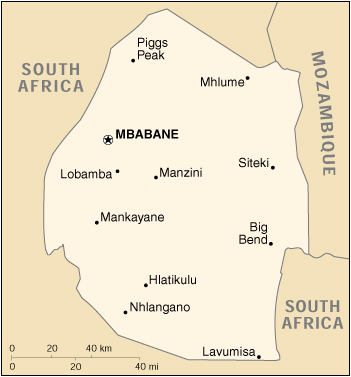
Location: Southern Africa, between Mozambique and South Africa
Geographic coordinates: 26 30 S, 31 30 E
Area:
total: 17,363 sq km
land: 17,203 sq km
water: 160 sq km
Land boundaries:
total: 535 km
border countries: Mozambique 105 km, South Africa 430 km
Coastline: 0 km (landlocked)
Maritime claims: none (landlocked)
Climate: varies from tropical to near temperate
Terrain: mostly mountains and hills; some moderately sloping plains
Elevation extremes:
lowest point: Great Usutu River 21 m
highest point: Emlembe 1,862 m
Natural resources: asbestos, coal, clay, cassiterite, hydropower, forests, small gold and diamond deposits, quarry stone, and talc
Land use:
arable land: 11%
permanent crops: 0%
permanent pastures: 62%
forests and woodland: 7%
other: 20% (1993 est.)
Irrigated land: 670 sq km (1993 est.)
Environment – current issues: limited supplies of potable water; wildlife populations being depleted because of excessive hunting; overgrazing; soil degradation; soil erosion
Environment – international agreements:
party to: Biodiversity, Climate Change, Endangered Species, Nuclear Test Ban, Ozone Layer Protection
signed, but not ratified: Desertification, Law of the Sea
Geography – note: landlocked; almost completely surrounded by South Africa
People of Swaziland
The majority of the population is ethnic Swazi, mixed with a small number of Zulus and non-Africans. Traditionally Swazis have been subsistence farmers and herders, but most now work in the growing urban formal economy and in government. Some Swazis work in the mines in South Africa. Christianity in Swaziland is sometimes mixed with traditional beliefs and practices. Most Swazis ascribe a special spiritual role to the monarch.
The country’s official languages are Siswati (a Nguni language related to Zulu) and English. Government and commercial business is conducted mainly in English.
Population: 1,173,900 (July 2005 est.)
Age structure:
0-14 years: 46% (male 245,626; female 247,825)
15-64 years: 52% (male 270,308; female 291,884)
65 years and over: 2% (male 11,357; female 16,289)
Population growth rate: 2.02%
Birth rate: 40.64 births/1,000 population
Death rate: 20.4 deaths/1,000 population
Net migration rate: 0 migrant(s)/1,000 population
Infant mortality rate: 108.95 deaths/1,000 live births
Life expectancy at birth:
total population: 40.44 years
male: 39.54 years
female: 41.37 years
Total fertility rate: 5.87 children born/woman
Nationality:
noun: Swazi(s)
adjective: Swazi
Ethnic groups: African 97%, European 3%
Religions: Christian 60%, indigenous beliefs 40%
Languages: English (official, government business conducted in English), siSwati (official)
Literacy:
definition: age 15 and over can read and write
total population: 76.7%
male: 78%
female: 75.6% (1995 est.)
History of Swaziland
According to tradition, the people of the present Swazi nation migrated south before the 16th century to what is now Mozambique. Following a series of conflicts with people living in the area of modern Maputo, the Swazis settled in northern Zululand in about 1750. Unable to match the growing Zulu strength, the Swazis moved gradually northward in the 1800s and established themselves in the area of modern or present Swaziland.
They consolidated their hold under several able leaders. The most important was Mswati II, from whom the Swazis derive their name. Under his leadership in the 1840s, the Swazis expanded their territory to the Northwest and stabilized the southern frontier with the Zulus.
Contact with the British came early in Mswati’s reign, when he asked British authorities in South Africa for assistance against Zulu raids into Swaziland. It also was during Mswati’s reign that the first whites settled in the country. Following Mswati’s death, the Swazis reached agreements with British and South African authorities over a range of issues, including independence, claims on resources by Europeans, administrative authority, and security. South Africans administered the Swazi interests from 1894 to 1902. In 1902 the British assumed control.
In 1921 Swaziland established its first legislative body–an advisory council of elected European representatives mandated to advise the British high commissioner on non-Swazi affairs. In 1944, the high commissioner conceded that the council had no official status and recognized the paramount chief, or king, as the native authority for the territory to issue legally enforceable orders to the Swazis.
In 1921, after more than 20 years of rule by Queen Regent Lobatsibeni, Sobhuza II became Ngwenyama (lion) or head of the Swazi nation. In the early years of colonial rule, the British expected that Swaziland would eventually be incorporated into South Africa. After World War II, however, South Africa’s intensification of racial discrimination induced the United Kingdom to prepare Swaziland for independence. Political activity intensified in the early 1960s. Several political parties were formed and jostled for independence and economic development. The largely urban parties had few ties to the rural areas, where the majority of Swazis lived. The traditional Swazi leaders, including King Sobhuza II and his Inner Council, formed the Imbokodvo National Movement (INM), a political group that capitalized on its close identification with the Swazi way of life. Responding to pressure for political change, the colonial government scheduled an election in mid-1964 for the first legislative council in which the Swazis would participate. In the election, the INM and four other parties, most having more radical platforms, competed in the election. The INM won all 24 elective seats.
Having solidified its political base, INM incorporated many demands of the more radical parties, especially that of immediate independence. In 1966, the U.K. Government agreed to discuss a new constitution. A constitutional committee agreed on a constitutional monarchy for Swaziland, with self-government to follow parliamentary elections in 1967. Swaziland became independent on September 6, 1968. Swaziland’s post-independence elections were held in may 1972. The INM received close to 75% of the vote. The Ngwane National Liberatory Congress (NNLC) received slightly more than 20% of the vote which gained the party 3 seats in parliament.
In response to the NNLC ‘s showing, King Sobhuza repealed the 1968 constitution on April 12, 1973 and dissolved parliament. He assumed all powers of government and prohibited all political activities and trade unions from operating. He justified his actions as having removed alien and divisive political practices incompatible with the Swazi way of life. In January 1979, a new parliament was convened, chosen partly through indirect elections and partly through direct appointment by the king.
King Sobhuza II died in august 1982, and Queen Regent Dzeliwe assumed the duties of the head of state. In 1984, an internal dispute led to the replacement of the prime minister and eventual replacement of Dzeliwe by a new Queen Regent Ntombi. Ntombi’s only child, Prince Makhosetive, was named heir to the Swazi throne. Real power at this time was concentrated in the Liqoqo, a supreme traditional advisory body that claimed to give binding advice to the Queen Regent. In October 1985, Queen Regent Ntombi demonstrated her power by dismissing the leading figures of the Liqoqo. Prince Makhosetive returned from school in England to ascend to the throne and help end the continuing internal disputes. He was enthroned as Mswati III on April 25, 1986. Shortly afterwards he abolished the Liqoqo. In November 1987, a new parliament was elected and a new cabinet appointed.
In 1988 and 1989, an underground political party, the Peoples’ United Democratic Movement (PUDEMO) criticized the king and his government, calling for democratic reforms. In response to this political threat and to growing popular calls for greater accountability within government, the king and the prime minister initiated an ongoing national debate on the constitutional and political future of Swaziland. This debate produced a handful of political reforms, approved by the king, including direct and indirect voting, in the 1993 national elections.
Swaziland Economy
Economy – overview: In this small landlocked economy, subsistence agriculture occupies more than 60% of the population. Manufacturing features a number of agroprocessing factories. Mining has declined in importance in recent years: diamond mines have shut down because of the depletion of easily accessible reserves; high-grade iron ore deposits were depleted by 1978; and health concerns have cut world demand for asbestos. Exports of soft drink concentrate, sugar, and wood pulp are the main earners of hard currency. Surrounded by South Africa, except for a short border with Mozambique, Swaziland is heavily dependent on South Africa from which it receives four-fifths of its imports and to which it sends two-thirds of its exports. Remittances from the Southern African Customs Union and Swazi workers in South African mines substantially supplement domestically earned income. The government is trying to improve the atmosphere for foreign investment. Overgrazing, soil depletion, drought, and sometimes floods persist as problems for the future. Prospects for 2001 are strengthened by government millennium projects for a new convention center, additional hotels, an amusement park, a new airport, and stepped-up roadbuilding and factory construction plans.
GDP: purchasing power parity – $4.4 billion (2000 est.)
GDP – real growth rate: 3.1% (1999 est.), 2.4% (2000 est.)
GDP – per capita: purchasing power parity – $4,000 (2000 est.)
GDP – composition by sector:
agriculture: 10%
industry: 48%
services: 42% (1997 est.)
Inflation rate (consumer prices): 6% (1999 est.)
Labor force – by occupation: private sector about 70%, public sector about 30%
Unemployment rate: 22% (1995 est.)
Budget:
revenues: $400 million
expenditures: $450 million, including capital expenditures of $115 million (FY96/97)
Industries: mining (coal and asbestos), wood pulp, sugar, soft drink concentrates
Industrial production growth rate: 3.7% (FY95/96)
Electricity – production: 420 million kWh (1998)
Electricity – production by source:
fossil fuel: 48.81%
hydro: 51.19%
nuclear: 0%
other: 0% (1998)
Electricity – consumption: 1.078 billion kWh (1998)
Electricity – exports: 0 kWh (1998)
Electricity – imports: 687 million kWh
note: imports about 60% of its electricity from South Africa (1998)
Agriculture – products: sugarcane, cotton, corn, tobacco, rice, citrus, pineapples, sorghum, peanuts; cattle, goats, sheep
Exports: $825 million (f.o.b., 1999)
Exports – commodities: soft drink concentrates, sugar, wood pulp, cotton yarn, refrigerators, citrus and canned fruit
Exports – partners: South Africa 74%, EU 12%, Mozambique 5%, US, North Korea (1997)
Imports: $1.05 billion (f.o.b., 1999)
Imports – commodities: motor vehicles, machinery, transport equipment, foodstuffs, petroleum products, chemicals
Imports – partners: South Africa 83%, EU 6%, Japan, UK, Singapore (1997)
Debt – external: $180 million (1999)
Economic aid – recipient: $55 million (1995)
Currency: 1 lilangeni (SZL) = 100 cents
Map of Swaziland