Facts About Taiwan
Background: In 1895, military defeat forced China to cede Taiwan to Japan, however it reverted to Chinese control after World War II. Following the communist victory on the mainland in 1949, 2 million Nationalists fled to Taiwan and established a government using the 1947 constitution drawn up for all of China. Over the next five decades, the ruling authorities gradually democratized and incorporated the native population within its governing structure. Throughout this period, the island has prospered to become one of East Asia’s economic “Tigers.” The dominant political issue continues to be the relationship between Taiwan and China and the question of eventual reunification.
Government type: multiparty democratic regime headed by popularly elected president
Capital: Taipei
Currency: 1 New Taiwan dollar (NT$) = 100 cents
Geography of Taiwan
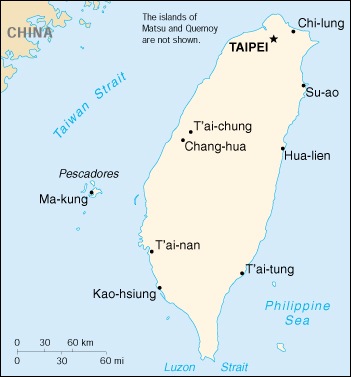
Location: Eastern Asia, islands bordering the East China Sea, Philippine Sea, South China Sea, and Taiwan Strait, north of the Philippines, off the southeastern coast of China
Geographic coordinates: 23 30 N, 121 00 E
Area:
total: 35,980 sq km
land: 32,260 sq km
water: 3,720 sq km
note: includes the Pescadores, Matsu, and Quemoy
Land boundaries: 0 km
Coastline: 1,566.3 km
Maritime claims:
exclusive economic zone: 200 nm
territorial sea: 12 nm
Climate: tropical; marine; rainy season during southwest monsoon (June to August); cloudiness is persistent and extensive all year
Terrain: eastern two-thirds mostly rugged mountains; flat to gently rolling plains in west
Elevation extremes:
lowest point: South China Sea 0 m
highest point: Yu Shan 3,997 m
Natural resources: small deposits of coal, natural gas, limestone, marble, and asbestos
Land use:
arable land: 24%
permanent crops: 1%
permanent pastures: 5%
forests and woodland: 55%
other: 15%
Natural hazards: earthquakes and typhoons
Environment – current issues: air pollution; water pollution from industrial emissions, raw sewage; contamination of drinking water supplies; trade in endangered species; low-level radioactive waste disposal.
People of Taiwan
Taiwan has a population of 22.2 million. More than 18 million, the “native” Taiwanese are descendants of Chinese who migrated from Fujian and Guangdong Provinces on the mainland, primarily in the 18th and 19th centuries. The “mainlanders,” who arrived on Taiwan after 1945, came from all parts of mainland China. About 370,000 aborigines inhabit the mountainous central and eastern parts of the island and are believed to be of Malayo-Polynesian origin.
Education
A 9-year public educational system has been in effect since 1979. Six years of elementary school and 3 years of junior high are compulsory for all children. About 94.7% of junior high graduates continue their studies in either a senior high or vocational school. Reflecting a strong commitment to education, in FY 2001 16% of Taiwan’s budget was allocated for education.
Taiwan has an extensive higher education system with more than 100 institutions of higher learning. Each year over 100,000 students take the joint college entrance exam; about 66.6% of the candidates are admitted to a college or university. Opportunities for graduate education are expanding in Taiwan, but many students travel abroad for advanced education, including 13,000 who study in the United States annually.
Languages
A large majority of people on Taiwan speak Mandarin Chinese, which has been the medium of instruction in the schools for more than four decades. Native Taiwanese and many others also speak one of the Southern Fujianese dialects, Min-nan, also known as Taiwanese. Recently there has been a growing use of Taiwanese in the broadcast media. The Hakka, who are concentrated in several counties throughout Taiwan, have their own distinct dialect. As a result of the half century of Japanese rule, many people over age 60 also can speak Japanese. The method of Chinese romanization most commonly used in Taiwan is the Wade-Giles system.
Religions
According to Taiwan’s Interior Ministry figures, there are about 11.2 million religious believers in Taiwan, with more than 75% identifying themselves as Buddhists or Taoists. At the same time there is a strong belief in Chinese folk religion throughout the island. These are not mutually exclusive, and many people practice a combination of the three. Confucianism also is an honored school of thought and ethical code. Christian churches have been active on Taiwan for many years, and today the island has more than 600,000 Christians, a majority of whom are Protestant.
Culture
Taiwan’s culture is a blend of its distinctive Chinese heritage and Western influences. Fine arts, folk traditions, and popular culture embody traditional and modern, Asian, and Western motifs. One of Taiwan’s greatest attractions is the Palace Museum, which houses over 650,000 pieces of Chinese bronze, jade, calligraphy, painting, and porcelain. This collection was moved from the mainland in 1949 when Chiang Kai-shek’s Nationalist Party (KMT) fled to Taiwan. The collection is so extensive that only 1% is on display at any one time.
Population: 22,894,384 (July 2005 est.)
Age structure:
0-14 years: 21.22%
15-64 years: 69.97%
65 years and over: 8.81%
Population growth rate: 0.8%
Birth rate: 14.31 births/1,000 population
Death rate: 6 deaths/1,000 population
Net migration rate: -0.34 migrant(s)/1,000 population
Infant mortality rate: 6.93 deaths/1,000 live births
Life expectancy at birth:
total population: 76.54 years
male: 73.81 years
female: 79.51 years
Total fertility rate: 1.76 children born/woman
Nationality:
noun: Chinese (singular and plural)
adjective: Chinese
Ethnic groups: Taiwanese (including Hakka) 84%, mainland Chinese 14%, aborigine 2%
Religions: mixture of Buddhist, Confucian, and Taoist 93%, Christian 4.5%, other 2.5%
Languages: Mandarin Chinese (official), Taiwanese (Min), Hakka dialects
Literacy:
definition: age 15 and over can read and write
total population: 86% (1980 est.); note – literacy for the total population has reportedly increased to 94% (1998 est.)
male: 93% (1980 est.)
female: 79% (1980 est.)
History of Taiwan
Taiwan’s aboriginal peoples, who originated in Austronesia and southern China, have lived on Taiwan for 12,000 to 15,000 years. Significant migration to Taiwan from the Chinese mainland began as early as A.D. 500. Dutch traders first claimed the island in 1624 as a base for Dutch commerce with Japan and the China coast. Two years later, the Spanish established a settlement on the northwest coast of Taiwan which they occupied until 1642 when they were driven out by the Dutch. Dutch colonists administered the island and its predominantly aboriginal population until 1661. The first major influx of migrants from the Chinese mainland came during the Dutch period, sparked by the political and economic chaos on the China coast during the Manchu invasion and the end of the Ming Dynasty.
In 1664, a Chinese fleet led by the Ming loyalist Cheng Ch’eng-kung (Zheng Chenggong, known in the West as Koxinga) retreated from the mainland and occupied Taiwan. Cheng expelled the Dutch and established Taiwan as a base in his attempt to restore the Ming Dynasty. He died shortly thereafter, and in 1683 his successors submitted to Manchu (Qing Dynasty) control. From 1680 the Qing Dynasty ruled Taiwan as a prefecture and in 1875 divided the island into two prefectures, north and south. In 1887 the island was made into a separate Chinese province.
During the 18th and 19th centuries, migration from Fujian and Guangdong provinces steadily increased, and Chinese supplanted aborigines as the dominant population group. In 1895, a weakened Imperial China ceded Taiwan to Japan in the Treaty of Shimonoseki following the first Sino-Japanese war.
During its 50 years (1895-1945) of colonial rule, Japan expended considerable effort in developing Taiwan’s economy. At the same time, Japanese rule led to the “Japanization” of the island including compulsory Japanese education and forcing residents of Taiwan to adopt Japanese names.
At the end of World War II in 1945, Taiwan reverted to Chinese rule. During the immediate postwar period, the Nationalist Chinese (KMT) administration on Taiwan was repressive and corrupt, leading to local discontent. Anti-mainlander violence flared on February 28, 1947, prompted by an incident in which a cigarette seller was injured and a passerby was shot to death by Nationalist authorities. The island-wide rioting was brutally put down by Nationalist Chinese troops, who killed thousands of people. As a result of the February 28 Incident, the native Taiwanese felt a deep-seated bitterness to the mainlanders. Until 1995, the KMT authorities suppressed accounts of this episode in Taiwan history. In 1995 a monument was dedicated to the victims of the “2-28 Incident,” and for the first time Taiwan’s leader, President Lee Teng-hui, publicly apologized for the Nationalists’ brutality.
From the 1930s onward a civil war was underway on the mainland between Chiang Kai-shek’s KMT government and the Chinese Communist Party led by Mao Zedong. When the civil war ended in 1949, 2 million refugees, predominately from the nationalist government, military, and business community, fled to Taiwan. In October 1949 the People’s Republic of China (P.R.C.) was founded on the mainland by the victorious communists, several months before Chiang Kai-shek had established in December 1949 a “provisional” KMT capital in Taipei.
During the 1950s, the KMT authorities implemented a far-reaching and highly successful land reform program on Taiwan. They redistributed land among small farmers and compensated large landowners with commodities certificates and stock in state-owned industries. Although this left some large landowners impoverished, others turned their compensation into capital and started commercial and industrial enterprises. These entrepreneurs were to become Taiwan’s first industrial capitalists. Together with refugee businessmen from the mainland, they managed Taiwan’s transition from an agricultural to a commercial, industrial economy.
Taiwan has developed steadily into a major international trading power with more than $218 billion in two-way trade. Tremendous prosperity on the island was accompanied by economic and social stability. Chiang Kai-shek’s successor, his son Chiang Ching-kuo, began to liberalize Taiwan’s political system, a process that has continued when President Lee Teng-hui took office in 1988. The direct election of Lee Teng-hui as president in 1996 was followed by opposition Democratic Progressive Party candidate Chen Shui-bian’s election victory in March 2000.
Taiwan Economy
Economy – overview: Taiwan has a dynamic capitalist economy with gradually decreasing guidance of investment and foreign trade by government authorities. In keeping with this trend, some large government-owned banks and industrial firms are being privatized. Real growth in GDP has averaged about 8% during the past three decades. Exports have grown even faster and have provided the primary impetus for industrialization. Inflation and unemployment are low; the trade surplus is substantial; and foreign reserves are the world’s fourth largest. Agriculture contributes 3% to GDP, down from 35% in 1952. Traditional labor-intensive industries are steadily being moved offshore and replaced with more capital- and technology-intensive industries. Taiwan has become a major investor in China, Thailand, Indonesia, the Philippines, Malaysia, and Vietnam. The tightening of labor markets has led to an influx of foreign workers, both legal and illegal. Because of its conservative financial approach and its entrepreneurial strengths, Taiwan suffered little compared with many of its neighbors from the Asian financial crisis in 1998-99. Growth in 2001 will depend largely on conditions in Taiwan’s export markets and may be about 5%.
GDP: purchasing power parity – $386 billion (2000 est.)
GDP – real growth rate: 5.5% (1999 est.), 6.3% (2000 est.)
GDP – per capita: purchasing power parity – $17,400 (2000 est.)
GDP – composition by sector:
agriculture: 3%
industry: 33%
services: 64% (1999 est.)
Population below poverty line: 1% (1999 est.)
Inflation rate (consumer prices): 0.4% (1999 est.), 1.3% (2000 est.)
Labor force: 9.8 million (2000 est.)
Labor force – by occupation: services 55%, industry 37%, agriculture 8% (1999 est.)
Unemployment rate: 2.9% (1999 est.), 3% (2000 est.)
Budget:
revenues: $42.74 billion
expenditures: $48.8 billion, including capital expenditures of $NA (2001 est.)
Industries: electronics, petroleum refining, chemicals, textiles, iron and steel, machinery, cement, food processing
Industrial production growth rate: 8% (2000 est.)
Electricity – production: 139.676 billion kWh (1999)
Electricity – production by source:
fossil fuel: 67.26%
hydro: 6.32%
nuclear: 26.42%
other: 0% (1999)
Electricity – consumption: 129.899 billion kWh (1999)
Agriculture – products: rice, corn, vegetables, fruit, tea; pigs, poultry, beef, milk; fish
Exports: $121.6 billion (f.o.b., 1999), $148.38 billion (f.o.b., 2000)
Exports – commodities: machinery and electrical equipment 51%, metals, textiles, plastics, chemicals
Exports – partners: US 23.5%, Hong Kong 21.1%, Europe 16%, ASEAN 12.2%, Japan 11.2% (2000)
Imports: $101.7 billion (c.i.f., 1999), $140.01 billion (c.i.f., 2000)
Imports – commodities: machinery and electrical equipment 51%, minerals, precision instruments
Imports – partners: Japan 27.5%, US 17.9%, Europe 13.6% (2000)
Debt – external: $40 billion (2000)
Currency: new Taiwan dollar (TWD)
Map of Taiwan