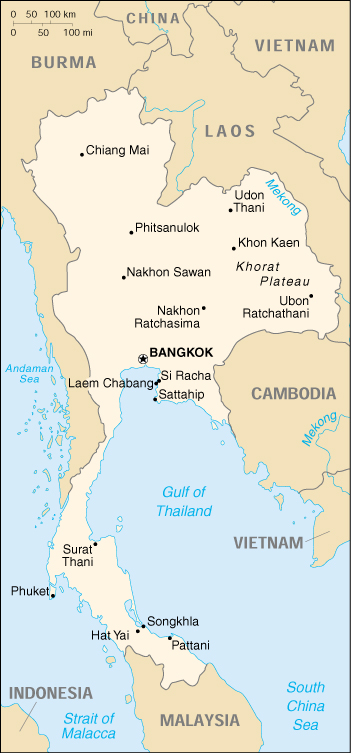
Facts About Thailand
Background: A unified Thai kingdom was established in the mid-14th century; it was known as Siam until 1939. Thailand is the only southeast Asian country never to have been taken over by a European power. A bloodless revolution in 1932 led to a constitutional monarchy. In alliance with Japan during World War II, Thailand became a US ally following the conflict.
Government type: constitutional monarchy
Capital: Bangkok
Currency: 1 baht (B) = 100 satang
Geography of Thailand
Location: Southeastern Asia, bordering the Andaman Sea and the Gulf of Thailand, southeast of Burma
Geographic coordinates: 15 00 N, 100 00 E
Area:
total: 514,000 sq km
land: 511,770 sq km
water: 2,230 sq km
Land boundaries:
total: 4,863 km
border countries: Burma 1,800 km, Cambodia 803 km, Laos 1,754 km, Malaysia 506 km
Coastline: 3,219 km
Maritime claims:
continental shelf: 200-m depth or to the depth of exploitation
exclusive economic zone: 200 nm
territorial sea: 12 nm
Climate: tropical; rainy, warm, cloudy southwest monsoon (mid-May to September); dry, cool northeast monsoon (November to mid-March); southern isthmus always hot and humid
Terrain: central plain; Khorat Plateau in the east; mountains elsewhere
Elevation extremes:
lowest point: Gulf of Thailand 0 m
highest point: Doi Inthanon 2,576 m
Natural resources: tin, rubber, natural gas, tungsten, tantalum, timber, lead, fish, gypsum, lignite, fluorite, arable land
Land use:
arable land: 34%
permanent crops: 6%
permanent pastures: 2%
forests and woodland: 26%
other: 32% (1993 est.)
Irrigated land: 44,000 sq km (1993 est.)
Natural hazards: land subsidence in Bangkok area resulting from the depletion of the water table; droughts
Environment – current issues: air pollution from vehicle emissions; water pollution from organic and factory wastes; deforestation; soil erosion; wildlife populations threatened by illegal hunting.
Environment – international agreements:
party to: Climate Change, Endangered Species, Hazardous Wastes, Marine Life Conservation, Nuclear Test Ban, Ozone Layer Protection, Tropical Timber 83, Tropical Timber 94, Wetlands
signed, but not ratified: Biodiversity, Climate Change-Kyoto Protocol, Law of the Sea
Geography – note: controls only land route from Asia to Malaysia and Singapore
People of Thailand
Thailand’s population is relatively homogeneous. More than 85% speak a dialect of Thai and share a common culture. This core population includes the central Thai (36% of the population), Thai-Lao (32%), northern Thai (8%), and southern Thai (8%).
The language of the central Thai population is the language taught in schools and used in government. Several other small Thai-speaking groups include the Shan, Lue, and Phutai.
The largest minorities are the Chinese–about 12% of the population–and the Malay-speaking Muslims of the south (3%). Other groups include the Khmer; the Mon, who are substantially assimilated with the Thai; and the Vietnamese. Smaller, predominantly mountain-dwelling tribes, such as the Hmong, Karen, and Mein, number about 500,000.
The population is mostly rural, concentrated in the rice-growing areas of the central, northeastern, and northern regions. However, as Thailand continues to industrialize, its urban population–18% of total population, principally in the Bangkok area–is growing.
Thailand’s highly successful government-sponsored family planning program has resulted in a dramatic decline in population growth from 3.1% in 1960 to around 1% today. Life expectancy also has risen, a positive reflection of Thailand’s efforts at public health education. However, the AIDS epidemic has had a major impact on the Thai population. Thai Government officials estimate that Thailand has between 200,000 and 400,000 HIV carriers. Chiang Rai Province in the north may have an infection rate as high as 15%. In recent years, the Thai Government has devoted substantial resources toward AIDS education and awareness.
Universal, free public education is compulsory for a period of 6 years. Education accounts for 25% of total government expenditures.
Theravada Buddhism is the official religion of Thailand and is the religion of more than 90% of its people. The government permits religious diversity, and other major religions are represented. Spirit worship and animism are widely practiced.
Population: 65,444,371 (July 2005 est.)
Age structure:
0-14 years: 23.43%
15-64 years: 69.95%
65 years and over: 6.62%
Population growth rate: 0.91%
Birth rate: 16.63 births/1,000 population
Death rate: 7.54 deaths/1,000 population
Net migration rate: 0 migrant(s)/1,000 population
Infant mortality rate: 30.49 deaths/1,000 live births
Life expectancy at birth:
total population: 68.86 years
male: 65.64 years
female: 72.24 years
Total fertility rate: 1.87 children born/woman
Nationality:
noun: Thai (singular and plural)
adjective: Thai
Ethnic groups: Thai 75%, Chinese 14%, other 11%
Religions: Buddhism 95%, Muslim 3.8%, Christianity 0.5%, Hinduism 0.1%, other 0.6% (1991)
Languages: Thai, English (secondary language of the elite), ethnic and regional dialects
Literacy:
definition: age 15 and over can read and write
total population: 93.8%
male: 96%
female: 91.6% (1995 est.)
History of Thailand
A STABLE AND PROSPERING NATION located in the heart of mainland Southeast Asia, Thailand faced the 1990s with abundant resources, not the least of which was its people. Thai society was characterized by a rich blend of cultural traits, an openness to new ideas, and a high degree of adaptability to new situations. Despite a certain amount of diversity, Thai society, according to many observers, was bound together by three basic tenets: Theravada Buddhism, support for the Thai monarchy, and pride of citizenship in the only nation in Southeast Asia to have maintained its independence throughout its history, including the colonial era.
Centuries of migration of various peoples into the region centered on the valley of the Mae Nam (river) Chao Phraya, followed by decades of conscious nation building by the rulers of the Chakkri Dynasty, had resulted in a relatively homogeneous society based on a wide range of cultural influences. The majority of the populace could trace its lineage over the centuries to the Tai peoples who inhabited southern China in the first millennium A.D. Forced southward by the pressure of an expanding Chinese empire, bands of Tai filtered into Southeast Asia interacting with other ethnic groups that had preceded them. By the late thirteenth century, the Tai states of Sukhothai and Lan Na had been founded in regions previously ruled by the Khmer and the Mon, respectively. Through interaction with these two peoples, the Tai were exposed to the culture, religion, arts, and languages of India. The Hindu- Buddhist traditions of neighboring Mon and Khmer kingdoms strongly influenced the development of the Tai concept of kingship.
Following the fourteenth-century relocation of the Sukhothai capital southward to Ayutthaya on the floodplain of the Chao Phraya, Theravada Buddhism was made the state religion. The Ayutthaya kings gradually extended their suzerainty southward into the Malay Peninsula in the fifteenth century, where their expansion was stopped by the Muslim state of Malacca. To the east, Ayutthaya established intermittent control over the old Khmer Empire. The sixteenth to eighteenth centuries were marked by frequent wars with the Burmese kingdoms to the northwest, culminating in the destruction of the capital of Ayutthaya by the Burmese in 1767. Out of the ashes of Ayutthaya arose a new Tai kingdom centered at Thon Buri on the Chao Phraya Delta. In the following century the rulers of the Chakkri Dynasty, having moved the capital across the river to Bangkok, expanded their control over neighboring Tai principalities centered at Chiang Mai to the north and Vientiane and Luang Prabang to the east. The new kingdom, known as Siam, also established a tributary relationship over the Khmers of Cambodia. Trade with China and India was greatly expanded, and Siamese control was established over many of the trade depots of the Malay Peninsula.
The economy of Siam, as that of its predecessers, Ayutthaya and Sukhothai, was based on wet-rice agriculture. The peasantry, who worked not only their own rice fields but also performed service for a lord or patron under a system known as sakdi na, made up the vast majority of the population. Rice production was greatly increased in the second half of the nineteenth century as new lands were cultivated by an expanding peasantry. By the end of the century, Siam was a major rice-exporting country, with most exports going to India and China. Jobs associated with the rice trade–merchants, millers, and stevedores–were filled by Chinese immigrants, who increasingly flooded into the region from southeastern China after 1850. Many Chinese also entered the lower echelons of the Siamese civil service at that time.
The international side of Siam’s rice trade was largely handled by Western merchants. European traders and missionaries had made their way to the Tai court at Ayutthaya as early as the sixteenth century. Substantial Western impact on Siam, however, began with the reign of King Mongkut (Rama IV, 1851-68). Prior to his accession to the throne, Mongkut had had extensive contact with Western missionaries and had studied European languages, science, and mathematics. Determined that his kingdom should not fall under Western colonial rule, as had neighboring Burma, Mongkut established diplomatic and trade relations with Britain, France, the United States, and other Western powers during his reign. As a result, Siam became a part of the international economic community. Under Mongkut’s son and successor, Chulalongkorn (Rama V, 1868-1910), major reforms and Westernization of the bureaucracy and society were adopted. At the same time, the central government tightened its control over outlying territories in the North and Northeast geographical regions that had previously been rather loosely governed through local princes and chiefs. By the early twentieth century, however, Siam had been forced to give up its suzerainty over Laos and western Cambodia to the French and its control over four Muslim states on the Malay Peninsula to the British. In return for these losses, Siam became a protected buffer state between French Indochina and British Malaya and Burma.
Reform and modernization supported by Mongkut and Chulalongkorn led to the rise of a Westernized military and political elite who increasingly agitated for a liberalizing of the political process. The Chakkri kings of the early twentieth century and their close advisers were somewhat less concerned with modernization of their rule and resisted efforts at establishing a constitutional monarchy. In 1932 a small group of Westernized military leaders and top bureaucrats organized a bloodless coup, forcing a constitutional monarchy on King Prajadhipok (Rama VII, 1925-35). Divisiveness within the coup leadership, however, resulted in several decades of new constitutions and repeated coups, led by various military- bureaucratic factions.
In 1939 the highly nationalistic regime of Prime Minister Luang Plaek Phibunsongkhram changed the name of the country to Muang Thai (Land of the Free), or Thailand. Negotiation and compromise by Phibun (as he was known) and his colleagues in government enabled the Thai to avoid the whole weight of a Japanese occupation force during World War II. Although officially the Thai government had declared war on the Allies, its declaration was never delivered or accepted in the United States, which became a gathering point for Thai resistance efforts. Following the war, the Thai military continued its ascendancy in national life, and a growing communist insurgency in the 1950s prompted a buildup of Thai military strength. The United States government provided aid in the form of weapons and training for the Royal Thai Armed Forces. As United States involvement in Southeast Asia steadily increased during the Second Indochina War (1954-75), Thailand gave permission for the stationing of United States troops at a number of Thai naval and air bases, which were expanded and modernized. Following the end of the war and the detente between Beijing and Washington, Thailand established its own detente with China, which agreed not to support the Communist Party of Thailand. Thereafter, the government applied a combined military-economic approach to defeat the communist insurgents, who had dwindled to a handful by the mid-1980s.
Student-led demonstrations in the 1970s had resulted in the liberalization of government policies and a brief, but unsuccessful, experiment with democratic government. By the late 1970s, the Thai military-bureaucratic elites were again firmly in charge. Although the 1978 Constitution called for an elected House of Representatives in the nation’s bicameral legislature, the National Assembly, the prime minister continued to be selected by a small group of top-ranking military and bureaucratic leaders with the official approval of the king. There was no constitutional requirement that the prime minister be an elected official, and not since 1976 had the position been filled by an elected member of parliament. The members of the Senate, largely drawn from the armed forces and police, were nominated by the prime minister and approved by the king.
As a constitutional monarch, King Bhumibol Adulyadej (Rama IX, 1946-) had endeavored to maintain a low political profile throughout his reign, and he appeared to be dedicated to the expansion of the democratic process in Thailand. Bhumibol’s devotion to the welfare of his people was widely recognized. His particular interests included agricultural research and water resource management, and he had initiated some 4,600 development projects in these areas. A working monarch, the king (as well as his family) spent many months of the year visiting all corners of the realm, acquainting himself with the problems and needs of the people. Bhumibol’s rare assertions of political influence had been employed chiefly to maintain stability; in 1981 and again in 1985 he refused to support a military coup attempt, instead backing the legitimately elected government and the Constitution. Although the Thai government had been changed by an endless succession of coups and countercoups following the 1932 revolt, there had not been a successful coup since 1977. In 1987 Prime Minister Prem Tinsulanonda had served seven years in the post, despite the two attempted coups. The country’s political stability in the 1980s had provided a favorable setting for Thailand’s expanding economy.
By 1987 the Thai economy was continuing to rebound from the worldwide recession that had resulted from the rising oil prices of the mid-1970s. The economy grew by more than 6 percent in 1987 and was expected to increase by at least that much in 1988. The manufacturing sector increased by more than 8 percent in 1987, reflecting a growing trend in the structure of the Thai economy toward light industry. Although food processing and other agro-industries continued to be important, expansion was taking place in many industries, such as textiles, where production was up nearly 50 percent in 1987 over the previous year. Exports of manufactures that grew rapidly in 1987 included plastic parts (up 187 percent), computer parts (up 111 percent), footwear (up 100 percent), and ball bearings (up 70 percent). In 1987 manufacturing accounted for about 22 percent of the gross domestic product. Providing sufficient energy for its fast-growing industrial base, however, was a serious problem. Efforts were ongoing to find a cost-effective way to tap the country’s limited petroleum and natural gas potential. Despite energy shortages, Thailand in the late 1980s was moving assuredly into the category of newly industrialized country (NIC), to join the ranks of its Asian neighbors Singapore, Taiwan, the Republic of Korea (South Korea), and Hong Kong.
Agriculture, for centuries the cornerstone of the Thai economy, continued to be of major importance. The chief exports were rice, rubber, cassava, maize, and sugar. Agriculture’s share of GDP, however, had declined from 22 percent in 1982 to less than 17 percent in 1987. Part of the slowdown in the growth of agriculture was a result of the unavailability of new arable land. Moreover, most of the new land that had been opened in the 1960s and 1970s had been turned to agriculture at the expense of Thailand’s forests, which had dwindled from more than 50 percent of the country in 1961 to less than 30 percent by 1987. Although processing of agricultural commodities remained important, Thailand’s growing manufacturing sector was increasingly becoming based on such products as integrated circuits, motorcycles, textiles, jewelry, electrical appliances, and plastics.
In the late 1980s, there was some disagreement among policy planners over which sector of manufacturing should be most strongly supported and emphasized. Some felt that support for agricultural processing would best benefit the poorer northeastern and southern regions. A project particularly designed to help the region east of Bangkok was the Eastern Seaboard Development Program. Under this plan a new deep-water seaport was being built at Sattahip, both to relieve the pressure on Bangkok’s overcrowded Khlong Toei port and to encourage development of the eastern region. Included among the projects were fertilizer and petrochemical plants. Also being developed was a new railroad line from Sattahip eastward to Rayong. Aside from the energy shortage, the inadequacy of the infrastructure– ports, railroads, and highways–was the country’s most serious economic problem. Its greatest economic asset was its highly adaptable, increasingly skilled work force.
Thai society, taken as a whole, was reasonably homogenous. The Tai ethnic stock, Tai language family, and Theravada Buddhism were common denominators for about 85 percent of the population. The presence of other ethnic, linguistic, and religious groups created some tensions in Thai society. Even among these groups, however, most members thought of themselves as Thai citizens owing allegiance to the Thai king and state. Among Thai citizens who were both ethnically and linguistically Tai, there were important differences. The dialect spoken by the Central Thai was considered the standard for the country and was used in government and schools. There were, however, nearly as many speakers of Thai-Lao, the dialect of much of the Northeast and parts of the North. The Southern Thai spoke yet another dialect. All of these dialects were mutually intelligible, but with some difficulty. Most Tai speakers were also Theravada Buddhists. Among the non-Thai minorities, the Chinese were the largest, amounting to about 11 percent of the population. Most Chinese spoke Central Thai, at least as a second language. The Chinese varied in their degree of assimilation into Thai society; assimilation often depending on the length of time their families had been in the country.
The next largest minority group was religious rather than ethnic. Thai Muslims included ethnic Malay, Thai, Cham, and South Asians. The majority of Muslims, however, were Malay who lived in the four southern provinces on the Malay Peninsula, a traditionally disadvantaged part of the country. Several Muslim separatist insurgent groups in the provinces near the Malaysian border continued in late 1987 to be a thorn in the side of the Thai military. Each of the other minority groups numbered less than 1 percent of the population. Among these were various hill tribes, who were part of larger groups living in Laos, China, or Burma. Largely assimilated were the Mon and the Cham peoples, most of whose ancestors had been in the region for centuries. The Khmer were also fairly well integrated for the same reason, with the exception of several hundred thousand Khmer refugees driven into Thailand since the 1970s by the continuing war in Cambodia. Other refugee groups included the Hmong from Laos.
Since the 1960s, the Thai central government had taken a more enlightened view toward its minority peoples than in the past, when its policies vacillated between suppression, neglect, and forced assimilation. Partly as a result of King Bhumibol’s interest in the various minorities, increasing government assistance was being given to these groups in the form of improved health and social services and agricultural assistance.
Although Thai society as a whole was enjoying the benefits of modernization–improved health care and sanitation, education, and modern tools and conveniences–it also faced the usual problems associated with too rapid modernization. Bangkok, particularly, endured problems of overcrowding, pollution, traffic, housing shortages, unemployment, and the social ills of crime, drug abuse, and prostitution.
As the national leadership looked ahead to the 1990s, its major concerns were the continued stabilization of the polity, encouragement of economic growth, and resolution of the security problems of the country. By the late 1980s, internal security was largely under control, with communist insurgents dwindling to a small number and Muslim separatist groups mainly a nuisance factor in the South. External security was more problematic. Vietnam, which had invaded Cambodia in late 1978, continued to occupy the country, causing a steady stream of Khmer refugees into Thailand. Relations between Bangkok and Beijing grew increasingly cordial during the 1980s as a result of the Vietnamese occupation of Cambodia. This issue also brought a growing solidarity among the membership of the Association for Southeast Asian Nations (ASEAN). Although resolutions and endless rounds of talks were sponsored by the regional organization, by late 1987 the ASEAN nations seemed no closer to being able to induce Vietnam to withdraw from Cambodia either through negotiation or through the pressure of regional and world opinion.
Thailand Economy
Economy – overview: After enjoying the world’s highest growth rate from 1985 to 1995 – averaging almost 9% annually – increased speculative pressure on Thailand’s currency in 1997 led to a crisis that uncovered financial sector weaknesses and forced the government to float the baht. Long pegged at 25 to the dollar, the baht reached its lowest point of 56 to the dollar in January 1998 and the economy contracted by 10.2% that same year. Thailand entered a recovery stage in 1999, expanding 4.2% and grew about the same amount in 2000, largely due to strong exports – which increased about 20% in 2000. An ailing financial sector and the slow pace of corporate debt restructuring, combined with a softening of global demand, is likely to slow growth in 2001.
GDP: purchasing power parity – $413 billion (2000 est.)
GDP – real growth rate: 4% (1999 est.), 4.2% (2000 est.)
GDP – per capita: purchasing power parity – $6,700 (2000 est.)
GDP – composition by sector:
agriculture: 13%
industry: 40%
services: 47% (1999)
Population below poverty line: 12.5% (1998 est.)
Household income or consumption by percentage share:
lowest 10%: 2.5%
highest 10%: 37.1% (1992)
Inflation rate (consumer prices): 2.4% (1999 est.), 2.1% (2000 est.)
Labor force: 32.6 million (1997 est.)
Labor force – by occupation: agriculture 54%, industry 15%, services 31% (1996 est.)
Unemployment rate: 4.5% (1998 est.), 3.7% (2000 est.)
Budget:
revenues: $19 billion
expenditures: $21 billion (2000 est.)
Industries: tourism; textiles and garments, agricultural processing, beverages, tobacco, cement, light manufacturing, such as jewelry; electric appliances and components, computers and parts, integrated circuits, furniture, plastics; world’s second-largest tungsten producer and third-largest tin producer
Industrial production growth rate: 3% (2000 est.)
Electricity – production: 85 billion kWh (1999)
Electricity – production by source:
fossil fuel: 91.17%
hydro: 3.81%
nuclear: 0%
other: 5.02% (1999)
Electricity – consumption: 80.293 billion kWh (1999)
Agriculture – products: rice, cassava (tapioca), rubber, corn, sugarcane, coconuts, soybeans
Exports: $58.5 billion (f.o.b., 1999 est.), $68.2 billion (f.o.b., 2000 est.)
Exports – commodities: computers and parts, textiles, integrated circuits, rice
Exports – partners: US 22%, Japan 14%, Singapore 9%, Hong Kong 5%, Netherlands 4%, Malaysia 4%, UK 4% (1999)
Imports: $45 billion (f.o.b., 1999 est.), $61.8 billion (f.o.b., 2000 est.)
Imports – commodities: capital goods, intermediate goods and raw materials, consumer goods, fuels
Imports – partners: Japan 26%, US 14%, Singapore 6%, China 5%, Malaysia 5%, Taiwan 5% (1999)
Debt – external: $90 billion (2000 est.)
Economic aid – recipient: $131.5 million (1998 est.)
Currency: baht (THB)
Map of Thailand