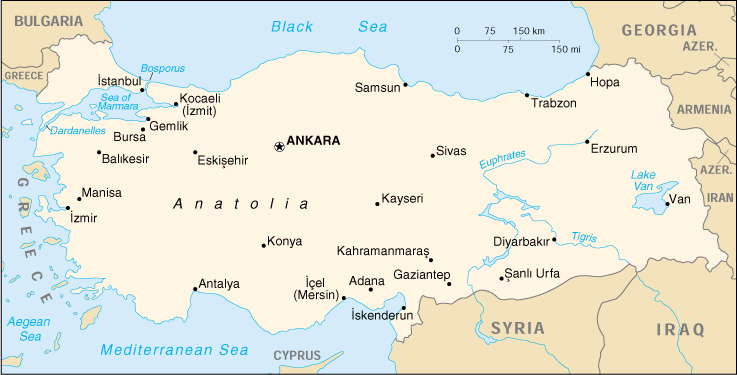
Facts About Turkey
Background: Turkey was created in 1923 from the Turkish remnants of the Ottoman Empire. Soon thereafter the country instituted secular laws to replace traditional religious fiats. In 1945 Turkey joined the UN and in 1952 it became a member of NATO. Turkey occupied the northern portion of Cyprus in 1974 to prevent a Greek takeover of the island; relations between the two countries remain strained. Periodic military offensives against Kurdish separatists have dislocated part of the population in southeast Turkey and have drawn international condemnation.
Government type: republican parliamentary democracy
Capital: Ankara
Currency: Turkish lira (TRL) = 100 kurus (theoretical)
Geography of Turkey
Location: southeastern Europe and southwestern Asia (that portion of Turkey west of the Bosporus is geographically part of Europe), bordering the Black Sea, between Bulgaria and Georgia, and bordering the Aegean Sea and the Mediterranean Sea, between Greece and Syria.
Geographic coordinates: 39 00 N, 35 00 E
Area:
total: 780,580 sq km
land: 770,760 sq km
water: 9,820 sq km
Land boundaries:
total: 2,627 km
border countries: Armenia 268 km, Azerbaijan 9 km, Bulgaria 240 km, Georgia 252 km, Greece 206 km, Iran 499 km, Iraq 331 km, Syria 822 km
Coastline: 7,200 km
Maritime claims:
exclusive economic zone: in Black Sea only: to the maritime boundary agreed upon with the former USSR
territorial sea: 6 nm in the Aegean Sea; 12 nm in Black Sea and in Mediterranean Sea
Climate: temperate; hot, dry summers with mild, wet winters; harsher in interior
Terrain: mostly mountains; narrow coastal plain; high central plateau (Anatolia)
Elevation extremes:
lowest point: Mediterranean Sea 0 m
highest point: Mount Ararat 5,166 m
Natural resources: antimony, coal, chromium, mercury, copper, borate, sulfur, iron ore, arable land, hydropower
Land use:
arable land: 32%
permanent crops: 4%
permanent pastures: 16%
forests and woodland: 26%
other: 22% (1993 est.)
Irrigated land: 36,740 sq km (1993 est.)
Natural hazards: very severe earthquakes, especially in northern Turkey, along an arc extending from the Sea of Marmara to Lake Van
Environment – current issues: water pollution from dumping of chemicals and detergents; air pollution, particularly in urban areas; deforestation; concern for oil spills from increasing Bosporus ship traffic.
Environment – international agreements:
party to: Air Pollution, Antarctic Treaty, Biodiversity, Desertification, Endangered Species, Hazardous Wastes, Nuclear Test Ban, Ozone Layer Protection, Ship Pollution, Wetlands
signed, but not ratified: Antarctic-Environmental Protocol, Environmental Modification
Geography – note: strategic location controlling the Turkish Straits (Bosporus, Sea of Marmara, Dardanelles) that link Black and Aegean Seas; Mount Ararat, the legendary landing place of Noah’s Ark, is in the far eastern portion of the country.
People of Turkey
Bridging Europe and Asia Minor, Turkey is a land of geographic, economic, and social contrasts. Slightly larger than Texas, modern Turkey spans bustling cosmopolitan centers, pastoral farming villages, barren wastelands, peaceful Aegean coastlines, and steep mountain regions. More than half of Turkey’s population lives in urban areas that juxtapose Western lifestyles with traditional-style mosques and markets. Most Turks, however, work in agriculture. Although Turkey is still a developing country, recent improvements in services have resulted in the proliferation of electricity nationwide and telephone connections for all its 34,500 villages.
Turkey has been officially secular since 1924, although 98% of the population is Muslim. Most Turkish Muslims belong to the Sunni branch of Islam, but a significant number are Alevi Muslims. The appeal of political Islam and the Kurdish insurgency continue to fuel public debate on several aspects of Turkish society, including the role of religion, the necessity for human rights protections, and the expectation of security.
Turks of Kurdish origin constitute an ethnic and linguistic group. Estimates of their population range up to 12 million. Although an increasing number have migrated to the cities, the traditional home of the Kurds is in poor, remote areas of the east and southeast, where incomes are less than half the national average and all other economic and social indicators lag.
Turkish culture, rich in Ottoman and folkloric elements, is traditional and modern. Turkish carpet weaving is one of the oldest crafts in the world. Ceramics and other Ottoman-era crafts retain their varied regional character.
Modern Turkish cultural life dates from the 1923 founding of the republic and early efforts to Westernize Turkish society. As a result, the arts, literature, drama, and classical and contemporary music have flourished. State support of cultural activities is extensive and encompasses a national network of theaters, orchestras, opera and ballet companies, university fine arts academies, and various conservatories. Public funds also are used to provide partial support for private theater groups and for major art exhibits and festivals.
Population: 69,660,559 (July 2005 est.)
Age structure:
0-14 years: 29%
15-64 years: 65%
65 years and over: 6%
Population growth rate: 1.27%
Birth rate: 18.65 births/1,000 population
Death rate: 5.96 deaths/1,000 population
Net migration rate: 0 migrant(s)/1,000 population
Infant mortality rate: 48.9 deaths/1,000 live births
Life expectancy at birth:
total population: 70.97 years
male: 68.63 years
female: 73.41 years
Total fertility rate: 2.16 children born/woman
Nationality:
noun: Turk(s)
adjective: Turkish
Ethnic groups: Turkish 80%, Kurdish 20%
Religions: Muslim 99.8% (mostly Sunni), other 0.2% (Christian and Jews)
Languages: Turkish (official), Kurdish, Arabic, Armenian, Greek
Literacy:
definition: age 15 and over can read and write
total population: 82.3%
male: 91.7%
female: 72.4% (1995 est.)
History of Turkey
THE REPUBLIC OF TURKEY (Türkiye Cumhuriyeti) was established on October 29, 1923, under the firm control and leadership of Mustafa Kemal, better known as Kemal Atatürk. The new state was at once the successor to and victor over the Ottoman Empire, long a major power in the European states system. The creation of the modern Turkish polity reflected not only a successful struggle against external enemies but also a triumph over deeply rooted domestic traditions. The republic deliberately rejected important elements of Turkey’s Ottoman past, especially the Ottoman dynasty’s claim to spiritual leadership of Muslims worldwide. However, the official disestablishment of Islam as the state religion in 1924 did not result in the creation of a fully secular society as Atatürk and his colleagues had hoped.
Although a commitment to secularism has continued to be almost a prerequisite for membership in the country’s political elite, Turkey has experienced several popular movements of Islamic political activism. The most recent movement, which began in the mid-1980s and is continuing, has threatened secularism in ways the republic’s founders could not have imagined in the 1920s and 1930s.
Although the republic emerged through the work and effort of many people, it bore the indelible imprint of Atatürk. During World War I, the Ottoman Empire had been an ally of Germany, and in the chaos that accompanied the empire’s defeat by the Allied powers, Atatürk, as the victor over Australian and British forces at Gallipoli, emerged as one of the few national heroes. His military reputation was enhanced further during the four-year War of Independence, when he led the forces that expelled the Greek invading army from the country. Of even greater long-term importance, Atatürk was a pragmatic political leader with a penchant for social reform. In keeping with long-standing Ottoman concepts of government, however, he was also an elitist; his reforms did not change significantly the relationship of the privileged governing stratum with the masses, although they did alter to some extent the nature of the elite. By the mid-1990s, the continuing impact of Atatürk and his precepts in shaping the form and nature of Turkish society were being challenged by Turkey’s diverse ethnic, religious, and social groups.
Atatürk’s avowed goal was to create from the Anatolian remnant of the Ottoman Empire a new society patterned directly on the societies of Western Europe. In pursuit of this goal, he tolerated only token opposition. Turkey’s president from 1923 until his death in 1938, he apparently was persuaded that the masses needed a period of tutelage. Although the presidency technically possessed relatively few constitutional powers, Atatürk ruled for fifteen years as charismatic governor and teacher–training, cajoling, and forcing the government, his political party, the bureaucracy, the military, and the masses to behave in the manner he thought appropriate. Atatürk’s “Six Arrows”–secularism, republicanism, etatism, populism, nationalism, and reformism–were incorporated into the constitutions of 1924, 1961, and 1982. In a general sense, Atatürkism (also known as Kemalism) has been accepted by the Turkish political elite but has been contested by various organized groups.
There is general agreement among scholars that secularism was and remains the most significant, and by far the most controversial, aspect of Atatürkism. The Turks, whose origins go back to Central Asia, had converted to Islam by the time they began establishing their political sovereignty in parts of Anatolia during the tenth century. Throughout the next nine centuries, Islam was the primary guiding as well as delimiting force in societal development. From administrative institutions to social customs, from ideals of governance to the concepts of being a subject or a citizen, from birth to death, most aspects of life were influenced and regulated by Islamic tenets, precepts, and laws. Various forms of popular or folk Islam gained an important hold on the Turkish imagination, and Sufi brotherhoods became vital socioreligious institutions.
Atatürk and his associates rejected the historical legacy of Islam and were determined to create a secular republic. Following the disestablishment of Islam and continuing into the mid-1940s, the government suppressed public manifestations and observances of religion that the secularist minority deemed inimical to the development of a modern, European-style state. The regime closed the religious schools, shut down the Sufi brotherhoods, and banned their rituals and meetings. The reformers replaced Islamic law, the seriat , with codes borrowed from European countries; dropped the Islamic calendar in favor of the Gregorian; and abolished the pervasive legal and religious functions of the religious scholars and lawyers. Atatürk imposed outward signs of secularization by discouraging or outlawing articles of clothing closely identified with Islamic traditions such as the veil for women and the fez for men. Finally, the use of Arabic script for writing in Turkish was declared illegal, despite its sacerdotal association as the language of the Kuran (Quran) and hence the language of God.
Although Atatürk believed that the secularist campaign made a period of authoritarian government necessary, his successors wanted to establish a democratic government. Thus, Ismet Inönü, who had become president after Atatürk’s death in 1938, permitted the creation of a multiparty political system following World War II. In the first contested election in 1946, the ruling Republican People’s Party (Cumhuriyet Halk Partisi–CHP) retained its majority in the Turkish Grand National Assembly, although opposition candidates accused the CHP of electoral irregularities. When the Democrat Party (Demokrat Parti–DP) subsequently won a majority in the 1950 election, Inönü voluntarily relinquished power, despite offers from elements of the armed forces to stage a coup. Thus began Turkey’s experiment in democracy: the military-bureaucratic elite that had established the republican order gradually turned over its power to an elected parliament, which reflected the interests and desires of broader sectors of society.
Although the Kemalists have made compromises with traditional forces in Turkish society, they never have abandoned the main tenets of the secularist program. By the end of the 1950s, the armed forces had assumed a role as guardians, not only of national security, but also of Atatürk’s legacy. On three occasions, in 1960, 1971, and 1980, the senior military intervened to safeguard Turkey’s political development from forces that the military believed threatened the integrity of the state. In each case, civilian leaders had proved unable or unwilling to deliver policies acceptable to the military. In both 1960 and 1980, a military junta took over the government, and rule by martial law included widespread suppression of civil rights and purges of the political class. On both occasions, after a period of direct military rule the military restored civilian government, but only after implementing constitutional changes, social reforms, and economic policies designed to put Turkey back on the path of achieving Atatürk’s goal: a modern, secular republic.
Before the 1980 military coup, Turkish society had experienced what was perhaps its most serious crisis since the War of Independence. The framework instituted by the relatively liberal constitution of 1961, along with the fragmented party system, had contributed to political disorder: unstable coalitions rapidly succeeded one another while failing to address the country’s pressing social, economic, and political problems. Underlying the political crisis were rapid and profound social changes. Massive population shifts from villages to towns and cities, expanded access to primary and secondary education, the availability of mass media, and the experiences of many Turkish workers in Western Europe exposed a nation of primarily peasants to new and generally disruptive influences. The extension of the Westernization process from the educated elite to the Anatolian masses both challenged and reinforced the latter’s adherence to Islamic and Turkish traditions. During the second half of the 1970s, the economy, which had undergone rapid growth in the postwar decades, entered a severe depression. Turkey’s economic difficulties resulted from the inherent limitations of import-substitution industrialization and were exacerbated by the deterioration of world economic conditions that followed the 1973 oil crisis. By the late 1970s, at least one-quarter of the work force was unemployed, the annual inflation rate exceeded 100 percent, and shortages of foreign exchange reduced imports of essential commodities, causing widespread reductions in industrial production.
One result of these interrelated crises was the mobilization of opposing social and cultural forces, which found political expression in radical parties and organizations. These included leftists active in the Turkish Communist Party (TCP) and the Confederation of Revolutionary Trade Unions of Turkey (Türkiye Devrimçi Isçi Sendikalari Konfederasyonu–DISK), Islamicly motivated political elements behind Necmettin Erbakan’s National Salvation Party (Milli Selamet Partisi–MSP), and extreme nationalist groups linked to Alparslan Türkes’s Nationalist Action Party (Milliyetçi Hareket Partisi–MHP). As political life became increasingly tense, offshoots of these political groups fought each other and carried out terrorist attacks against representatives of the established order; an estimated 5,000 persons were killed in politically related civil strife between 1971 and 1980. The coalition governments of the 1970s lacked sufficient political support to effect the kinds of social reforms that would alleviate the main causes of popular discontent, and the country consequently descended into conditions resembling civil war.
Following the September 1980 coup, the military made the restoration of political stability its main priority. The commanders of the armed forces formed the National Security Council, which ruled the country until November 1983. The NSC ordered the arrest and imprisonment of thousands of militants, political leaders, and trade unionists; it also imposed widespread censorship and purged the armed forces, the bureaucracy, and the universities. These and other measures effectively suppressed both violence and normal political life. The NSC’s objective was to eliminate leftist, nationalist, Islamic, and ethnic organizations that contested Atatürk’s political legacy. The NSC retained Turgut Özal, an economist who had served in Süleyman Demirel’s civilian cabinet ousted by the coup and who enjoyed the confidence of the international financial community, and gave him responsibility for economic policy. Although Özal’s austerity package brought immediate hardship for many Turks, it ended the balance of payments crisis and contributed to an economic recovery.
After restoring public order and overcoming the most pressing economic problems, the NSC supervised the drafting of a new constitution and electoral laws designed to rectify the perceived defects of the 1961 constitution by limiting the role of smaller parties and strengthening the powers of the president, the prime minister, and the party that won a majority in parliamentary elections. However, the new constitution also curtailed political rights, thus arousing sharp criticism both in Turkey and abroad. Particularly controversial was a ten-year ban on the political activities of about 200 leading politicians, including former prime ministers Bülent Ecevit and Demirel. The NSC sought to maintain its role by means of a clause under which the NSC chairman, General Kenan Evren, was named president for a six-year term.
Having established a new political framework, the NSC gradually relaxed restrictions on political life and arranged a return to civilian government after a parliamentary election held in November 1983. The NSC strictly supervised this election; it allowed only three parties to present candidates, and President Evren blatantly intervened on behalf of the NSC’s favorite, the Nationalist Democracy Party (Milliyetçi Demokrasi Partisi–MDP). Nevertheless, Özal’s Motherland Party (Anavatan Partisi–ANAP), the only independently established party that had been tolerated by the NSC, achieved a strong majority, an outcome that was widely interpreted as a sign of the electorate’s disapproval of military rule.
Özal, whose primary goal was economic liberalization, claimed that his triumph represented a mandate for sweeping changes in the economy. In power from November 1983 to November 1989, he sought to limit state intervention in the economy. Rejecting protectionism and import substitution, he opened the economy to international markets, arguing that economic growth and technical modernization would do more than traditional social policies to ease the country’s problems. His package of economic reforms aimed to make Turkey economically similar to the countries of the European Union, a body that Özal hoped Turkey could join. The package of reforms included reduction of government price-setting, positive real interest rates, devaluation and floating of the Turkish lira, liberalization of import regulations, and export subsidies.
Turkey’s economic performance after 1983 was impressive. Real gross domestic product averaged an annual 5.5 percent growth rate. GDP actually reached 8 percent in 1986, higher than that of any other member of the Organisation for Economic Co-operation and Development. Inflation, estimated at more than 30 percent during the 1983-85 period, fell in the 1986-89 period. Unemployment, however, remained a serious problem, rising every year during the 1980s except for 1986, a year when growth was sufficient to allow employment to increase faster than the increase in the working population.
The restoration of civilian rule and the general improvement in the overall economy failed to resolve outstanding social issues, which have continued to bedevil Turkey’s leadership. Although the government tends to play down the diversity of the population, the country’s inhabitants in fact form a mosaic of diverse religious and ethnic groups. Most of the country’s citizens continue to accept as true Turks only Sunni Muslims whose native language is Turkish–effectively excluding other religious and ethnic groups such as the Alevi Muslims and Kurds, who together comprise at least 20 percent of the population. Conflicts between the country’s Turkish-speaking, Sunni majority and its various ethnic and religious minorities have intensified since the mid-1980s, threatening to disrupt public order and projecting an illiberal spirit at odds with the dominant political culture of the EU that Turkey aspires to join. In effect, the question of Turkey’s national identity remains a focal point for political controversy and social conflict.
The government’s troubled relations with its Kurdish minority reveal the limits of social integration. Beginning in 1984, the Kurdistan Workers’ Party (Partiya Karkere Kurdistan–PKK) launched guerrilla attacks on government personnel and installations in the predominantly Kurdish-populated provinces of southeastern Turkey. The PKK’s announced objective was the establishment of a separate state of Kurdistan. PKK guerrillas have evoked some sympathy among Kurds in the southeast, a region characterized by endemic poverty, lack of jobs, inadequate schools and health care facilities, and severe underdevelopment of basic infrastructure such as electricity, piped water, and sewerage systems. The Özal government sought to counter the appeal of the PKK by making government aid to the long-neglected southeast a priority, and it invested large sums to extend electricity, telephones, and roads to the region. Özal envisioned the major southeastern Anatolia irrigation and power project as a program to provide the basis for real economic development that eventually would assuage local resentments of the central government. In the short run, however, the government has continued to depend on police actions to suppress the activities of Kurdish insurgents. Nevertheless, the armed forces have been unable to maintain order in the region, despite the deployment of large military and paramilitary forces, and the southeastern provinces remain under de facto martial law.
Turkey also has experienced a revival of religiously motivated political activity since the early 1980s. Veteran Islamist activist Necmettin Erbakan organized the new Welfare Party (Refah Partisi–RP; also seen as Prosperity Party) in 1983, but the military prohibited it from participating in the parliamentary elections held in the fall of that year. Subsequently, the new civilian government under Özal relaxed restrictions on avowedly religious parties, thus enabling the Welfare Party to organize freely and compete in local and national elections. With the notable exception of Erbakan, the Welfare Party’s leaders represent a new generation that has grown up and been educated in a secular Turkey but professes a commitment to Islamic values. The Welfare Party rejects the use of political violence and seeks to propagate its political message through example. Working at the grassroots level in Turkey’s cities and towns, the party’s strongest appeal has been in lower-middle-class neighborhoods. However, the Welfare Party also has attracted support among some upper-middle-class professionals and ethnic Kurds. Although the Welfare Party calls for the application of Islamic principles in relations between government agencies and the people, its primary appeal seems to derive from its advocacy of economic reform policies designed to control inflation and limit the amount of interest banks may charge on loans.
The Welfare Party’s popularity has grown gradually but steadily. In the 1991 parliamentary elections, it obtained more than 10 percent of the vote, thus surpassing the minimum threshold for winning seats in the National Assembly. Its electoral performance in the 1994 municipal elections was even better: the party won 19 percent of the total vote and control of the government of several large cities, including both Ankara and Istanbul. In the December 1995 National Assembly elections, the Welfare Party won 21 percent of the vote and the largest number of seats of any party–158.
The return to civilian rule in 1983 also affected Turkey’s foreign policy. The three years of military government had harmed the country’s reputation among its allies in the North Atlantic Treaty Organization (NATO) and the OECD, all of which had democratic governments. Turkey’s leaders had been committed to becoming an equal partner of the countries of Western Europe since the late 1940s. For example, Turkey became a member of the Council of Europe in 1949, dispatched its troops to participate in the United States – led United Nations military force in Korea in 1950, and became a full member of the NATO military alliance in 1952. Thus, West European criticisms of Turkey’s undemocratic government and human rights abuses were very painful. In addition, Turkey’s image suffered from the continuing tension with neighboring Greece–also a member of NATO–over Cyprus and the control of the Aegean Sea. Özal therefore wanted to repair Turkey’s international reputation as quickly as possible. He envisioned EU membership as an important means to demonstrate that Turkey is an essential part of Western Europe. In addition, he believed that EU membership would provide Turkey with vital economic benefits.
Although a substantial portion of the political and economic elite supported Özal’s objective of EU membership, it was not a goal shared by all Turks. For example, the Welfare Party opposed any further integration with Europe, arguing instead that Turkey should search for new export markets in its natural and historical hinterland, the Middle East. The Özal government did not dismiss the idea of expanding political and economic ties with other Islamic countries, and actually did cultivate relations with Iran and Iraq. These two neighbors were at war with each other from 1980 to 1988, and Turkey was able to reap economic dividends by remaining strictly neutral with respect to that conflict. Nevertheless, the government continued to believe that Turkey’s national interests would be served best by strengthening ties to Western Europe. Thus, Özal undertook a series of economic and political reform measures that he believed would provide credibility for Turkey’s formal application to join the EU. The application finally was submitted in April 1987. To demonstrate that Turkey was committed to democracy, and thus worthy of membership in the EU, all martial law decrees were repealed in March, although a state of emergency remained in force in the southeastern provinces. New parliamentary elections also were announced for the fall, a full year before they were required.
The November 1987 parliamentary elections were a turning point in the democratization process in Turkey inasmuch as these were the first genuinely free elections since the 1980 coup. All political parties were permitted to take part. In addition, the ban on political activities of 200 senior political leaders had been lifted as a result of a popular referendum held earlier in September 1987. Consequently, former prime ministers Süleyman Demirel and Bülent Ecevit campaigned actively, the former as head of the True Path Party (Dogru Yol Partisi–DYP) and the latter as head of the Democratic Left Party (Demokratik Sol Partisi–DSP). Although Özal’s Motherland Party retained its parliamentary majority (292 of 450 seats), the True Path Party obtained fifty-nine seats, thus gaining for Demirel an important national political platform. During the next four years, Demirel used his organizing and persuasive skills to rebuild the True Path Party with the objective of attracting enough Motherland voters to propel his party to the leading position. Within eighteen months, Demirel’s persistent criticisms of Özal administration policies brought initial political dividends for the True Path Party. As a result of the March 1989 municipal council elections, the Motherland Party suffered a major setback; it received only 26 percent of the total vote nationwide and ranked third behind the Social Democratic Populist Party (Sosyal Demokrat Halkçi Parti–SHP) and the True Path Party.
Neither Demirel nor other True Path leaders considered the opportunity to share responsibility for local government to be equivalent to the control of the national government, which remained in the hands of Özal’s Motherland Party. However, they appreciated the significance of their increased share of the popular vote and the fact that they had party cadres in positions to dispense some city and town patronage. Capitalizing on the momentum of the victories, the True Path Party intensified its organizing efforts in anticipation of the next parliamentary elections. These elections, which were held in October 1991, proved to be both sweet and sour for Demirel. The True Path Party defeated its rival, the Motherland Party, by edging it out in the popular vote, 27 to 24 percent. Although Demirel could draw satisfaction from the True Path’s emergence from the elections as the largest party in parliament with 178 seats, he simultaneously was disappointed that it had not won the absolute majority–226 seats–required to form a government. After weeks of negotiations, Demirel and SHP leader Erdal Inönü–the son of Ismet Inönü–reached agreement on the formation of a True Path-SHP coalition government. Thus, Demirel, whom the military had overthrown in 1980, once again became prime minister of Turkey.
Demirel’s victory was not at the expense of Özal. Two years earlier, Özal had been elected president to replace General Evren, whose constitutionally mandated seven-year term had concluded at the end of 1989. The 1982 constitution provides for the president to be elected by the parliament. Because the Motherland Party still held a majority of parliamentary seats in 1989, Özal’s election seemed assured once he announced his candidacy. Nevertheless, Demirel and other politicians refused to support Özal’s bid for the presidency, and their tactics prevented his confirmation until the third ballot. Demirel’s own opposition to Özal seemed to be more personal than ideological. Prior to the 1980 coup, Özal had been a member of Demirel’s Justice Party (Adalet Partisi–AP) and had held a junior ministerial post in the Demirel cabinet. Demirel apparently never forgave Özal for joining the military government following the coup. Thus, when Demirel became prime minister, Turkish politicians had reservations as to whether he and President Özal would be able to cooperate. Indeed, as leader of an opposition party in parliament during 1990 and 1991, Demirel had expressed frequent criticism of Özal’s role in foreign policy, especially the latter’s decisions to align Turkey on the side of the United States-led coalition against Iraq during the Kuwait crisis and Persian Gulf War of 1990-91. Nevertheless, once Demirel became prime minister, he and Özal did cooperate.
Demirel had served as prime minister for less than eighteen months when the unexpected death of Özal in April 1993 provided the opportunity for him to succeed to the presidency. During his tenure as head of government, Demirel had been preoccupied with both domestic and international challenges. Within Turkey, the PKK had intensified its attacks on Turkish security and civilian personnel in southeastern Anatolia. The PKK’s insurgency had received an unexpected boost from the 1991 collapse of central government authority in northern Iraq’s Kurdish region, which borders southeastern Turkey. Since the mid-1980s, the PKK had established in this territory clandestine bases from which it carried out some of its operations. By the end of 1991, the absence of any security on the Iraqi side of the border had enabled the PKK both to expand its network of bases and to use them as sanctuaries. One of Demirel’s most important policy decisions was to approve in October 1992 a plan by the Turkish military to attack PKK bases in northern Iraq. This plan was particularly controversial because three of Turkey’s NATO allies–Britain, France, and the United States–were enforcing a ban on any Iraqi military presence in northern Iraq in order to protect Iraqi Kurds from being attacked by their own government.
Demirel’s government also had to deal with the unanticipated collapse of the Soviet Union and Yugoslavia. The Soviet Union had been a powerful and generally feared neighbor ever since the establishment of the Turkish Republic. Its sudden disappearance necessitated the formulation of new diplomatic, economic, and political strategies to deal with the multifaceted consequences. Demirel and his colleagues had a special interest in Central Asia, and they hoped that Turkey could serve as a role model for the new Turkic-speaking states of Azerbaijan, Kazakhstan, Kyrgyzstan, Turkmenistan, and Uzbekistan. However, from a geographic perspective, these new countries were closer to Iran than to Turkey, and officials frequently expressed concern about suspected Iranian intentions in Central Asia. Throughout 1992 the Demirel administration perceived Turkey to be engaged in a competitive race with Iran for regional influence. However, by the time Demirel became president in May 1993, most officials had come to realize that neither their country nor Iran had sufficient resources for such a competition.
Demirel had to give up his leadership of the True Path Party when the National Assembly elected him president. The DYP deputies in the assembly subsequently chose Tansu Çiller as their leader–the first woman to head a political party–and in June 1993 she became Turkey’s first woman prime minister. Under Çiller’s administration, the status of Turkey’s Kurdish minority continued to be the country’s most serious domestic problem, one that had multiple international repercussions. Although the PKK had renounced its goal of a separate Kurdish state in 1993, reaching a political compromise proved difficult because the Turkish military insisted on a military solution. Because both Çiller and Demirel were sensitive about past military interventions in domestic politics, neither was prepared to risk a civilian-military confrontation by challenging the military’s assumption of almost a free hand in dealing with the security situation in southeastern Turkey. By 1995 more than 220,000 soldiers, in addition to 50,000 gendarmerie and other security forces, were stationed in the southeast. Nevertheless, the progressive intensification of the military offensive against the PKK failed to repress the PKK’s ability to mount deadly assaults.
The military campaign provoked criticism from Kurdish and Turkish politicians, and in response the military resurrected the Prevention of Terrorism Law, which criminalized any activity–including speech–that threatened the integrity of the state. This law was used in 1994 and 1995 to arrest journalists and elected members of the National Assembly, who were tried in special state security courts that are under the jurisdiction of the military.
The Kurdish problem has had significant reverberations on Turkey’s foreign policy. The arrest of seven members of the National Assembly, all of whom were Kurdish deputies charged with endangering state security through their discussions of the Kurdish issue with fellow parliamentarians in Europe and North America, was especially troublesome for EU countries. Member governments of the EU condemned the arrests, the stripping of the Kurdish deputies’ parliamentary immunity, and the subsequent December 1994 sentencing of the deputies to long prison terms. Much to the embarrassment of the Turkish government, imprisoned Deputy Leyla Zane, who was one of the first women elected to the National Assembly, was among the several human rights activists whom the Norwegian parliament nominated for the 1995 Nobel Peace Prize. Several EU countries cited the trial of the elected Kurdish deputies and similar prosecutions of journalists as well as of Turkey’s most famous novelist, Yashar Kamal, as evidence that authoritarianism was stronger than democratic practices in Turkey and that, therefore, the country’s outstanding application for EU membership should not be considered.
Because joining the EU was as important an economic goal for the Çiller administration as it had been for her predecessors, Çiller sought to dampen European criticisms in January 1995 by proposing to repeal those clauses of the Prevention of Terrorism Law that criminalized speech and publications. Her objective was to obtain enough support to win EU approval of an agreement that accepted Turkey into a customs union with the EU. The EU voted in March 1995 to accept Turkey into a customs union on condition that the Council of Europe (the European parliament) certify that the country had made progress in the institutionalization of democratic practices.
Immediately following the EU vote, a new crisis in Turkish-EU relations erupted when more than 35,000 Turkish troops invaded northern Iraq in yet another attempt to destroy suspected PKK bases. The military offensive in northern Iraq lasted for more than three months and reignited European criticisms of Turkish policies. Attention inevitably focused on the government of Turkey’s relations with its Kurdish minority. Criticism of Turkey’s human rights practices at an April 1995 meeting of the Council of Europe was so intense that the Turkish delegates walked out, partly in protest and partly to avoid the humiliation of being present for a vote against Turkey. To dilute European criticisms, Çiller proposed that the National Assembly adopt amendments to the 1982 constitution that would strengthen democratic procedures. For example, the amendments would end the ban on political activities by associations such as labor unions and professional groups, permit civil servants and university students to organize, and make it difficult for courts to strip parliamentary deputies of their immunity from prosecution. The National Assembly’s adoption of the amendments in July 1995, coupled with the withdrawal of the last Turkish military units from Iraq, helped to ease some of the tension between Turkey and its erstwhile European friends.
The democratization process is not without controversy within Turkey. An influential minority of the political elite believe that the country’s laws and institutions provide adequate protection of civil liberties and that EU pressures constitute unacceptable interference in Turkey’s internal affairs. This view is particularly strong among some military officers, and their opposition to Çiller’s proposal to repeal Article 8 of the Prevention of Terrorism Law was sufficient to persuade a majority of deputies in the National Assembly to vote against the bill.
The failure to win approval for repealing the controversial Article 8 of the Prevention of Terrorism Law had serious implications for the Çiller government. During the summer of 1995, the DYP coalition partner, the SHP, effectively dissolved itself by incorporating with the more liberal Republican People’s Party (CHP), which, since its revival in 1992, had adopted a strong position in favor of abolishing Article 8. The merger necessitated party elections for a new leader, elections that resulted in Deniz Baykal’s selection as head of the expanded CHP in September 1995. Baykal not only was opposed to Article 8, but also advocated civil rights legislation that would include punishment for security officials who abuse the rights of political detainees. Given his views, Baykal was not expected to keep the CHP in the coalition government, and, only ten days after his victory, he withdrew, causing the government’s collapse. Çiller tried to form a minority government in October, but within ten days was forced to resign for the second time in less than one month when her DYP government failed to win a vote of confidence from the National Assembly. Baykal then agreed to join a new coalition government on two conditions: that the Article 8 amendments be resubmitted to the National Assembly and that new parliamentary elections be scheduled. Çiller imposed strict party discipline for the second vote, thus ensuring a majority favoring passage of the amendments to Article 8 of the Prevention of Terrorism Law, and she reluctantly called for new elections, to be held in December 1995.
The December 1995 elections represented a major setback for Çiller and her party, which came in third with 19 percent of the vote. The Welfare Party emerged in first place with 21 percent of the vote, followed by the Motherland Party with 19.6 percent. The failure of any party to win a majority of seats in the National Assembly mandated the formation of a coalition government. However, this task proved to be politically difficult because none of the secular parties was willing to participate in a Welfare-dominated government, and neither the DYP nor the Motherland Party was keen on cooperation. Finally, after more than ten weeks of sometimes tense political wrangling, Çiller and Motherland Party leader Mesut Yilmaz agreed to put aside their bitter rivalry and form a minority government with Yilmaz as prime minister for the first year and Çiller replacing him in 1997. This Motherland-DYP coalition won a vote of confidence in March 1996 because Ecevit’s DSP, which had seventy-five National Assembly seats, agreed to abstain on confidence votes.
The performance of Turkey’s economy was mixed during 1995. The monetary policies of the Çiller government included strict controls over public-sector expenditures, which contributed to an easing of the financial crisis that had developed in early 1994. Although exports rose steadily during the first two quarters of the year, imports increased at a faster rate, and this surge in imports added to the country’s severe balance of payments deficit. In addition, inflation continued to be a major economic problem, totalling 78.9 percent for all of 1995. Several years of high inflation rates and low wage increases had aggravated employer-employee relations. The strain was reflected in the large number of strikes during 1995, including a crippling two-month-long strike by more than 350,000 public-sector workers in the autumn. Moreover, the privatization of state-owned enterprises–the principal feature of the Çiller administration’s structural adjustment program–made little progress in 1995. Within the National Assembly, a majority of deputies opposed the sale of major public factories for ideological (the relevant industries were strategic) or political (fear that sales would lead to increased unemployment) reasons.
Turkey Economy
Economy – overview: Turkey’s dynamic economy is a complex mix of modern industry and commerce along with traditional agriculture that still accounts for nearly 40% of employment. It has a strong and rapidly growing private sector, yet the state still plays a major role in basic industry, banking, transport, and communication. The most important industry – and largest exporter – is textiles and clothing, which is almost entirely in private hands. In recent years the economic situation has been marked by erratic economic growth and serious imbalances. Real GNP growth has exceeded 6% in most years, but this strong expansion was interrupted by sharp declines in output in 1994 and 1999. Meanwhile the public sector fiscal deficit has regularly exceeded 10% of GDP – due in large part to the huge burden of interest payments, which now account for more than 40% of central government spending – while inflation has remained in the high double digit range. Perhaps because of these problems, foreign direct investment in Turkey remains low – less than $1 billion annually. Prospects for the future are improving, however, because the ECEVIT government since June 1999 has been implementing an IMF-backed reform program, including a tighter budget, social security reform, banking reorganization, and accelerated privatization. As a result, the fiscal situation is greatly improved and inflation has dropped below 40% – the lowest rate since 1987. The country experienced a financial crisis in late 2000, including sharp drops in the stock market and foreign exchange reserves, but is recovering rapidly, thanks to additional IMF support and the government’s commitment to a specific timetable of economic reforms.
GDP: purchasing power parity – $444 billion (2000 est.)
GDP – real growth rate: -5% (1999 est.), 6% (2000 est.)
GDP – per capita: purchasing power parity – $6,800 (2000 est.)
GDP – composition by sector:
agriculture: 18%
industry: 29%
services: 53% (1998)
Inflation rate (consumer prices): 65% (1999 est.)
Labor force: 23.8 million (April 1999)
note: about 1.5 million Turks work abroad (1994)
Labor force – by occupation: agriculture 45.8%, services 33.7%, industry 20.5% (April 1999)
Unemployment rate: 7.3% plus underemployment of 6.9% (April 1999 est.)
Budget:
revenues: $45.2 billion
expenditures: $66.7 billion, including capital expenditures of $3.4 billion (1999)
Industries: textiles, food processing, autos, mining (coal, chromite, copper, boron), steel, petroleum, construction, lumber, paper
Industrial production growth rate: -5.2% (1999 est.)
Electricity – production: 116.5 billion kWh (1999)
Electricity – production by source:
fossil fuel: 69.4%
hydro: 30.5%
nuclear: 0%
other: 0.1% (1999 est.)
Electricity – consumption: 118.5 billion kWh (1999)
Electricity – exports: 209 million kWh (1999 est.)
Electricity – imports: 2.3 billion kWh (1999 est.)
Agriculture – products: tobacco, cotton, grain, olives, sugar beets, pulse, citrus; livestock
Exports: $26 billion (f.o.b., 1999 est.)
Exports – commodities: apparel 28%, foodstuffs 17%, textiles 12%, metal manufactures 9% (1998)
Exports – partners: Germany 21%, United States 9%, United Kingdom 7%, Italy 6%, France 6% (1999)
Imports: $40 billion (c.i.f., 1999 est.)
Imports – commodities: machinery 29%, semi-finished goods 16%, chemicals 14%, transport equipment 11%, fuels 8% (1998)
Imports – partners: Germany 14%, Italy 8%, United States 8%, France 8%, Russia 6%, United Kingdom 5% (1999)
Debt – external: $104 billion (1999)
Economic aid – recipient: ODA, $195 million (1993)
Currency: Turkish lira (TRL) = 100 kurus (theoretical)
Map of Turkey