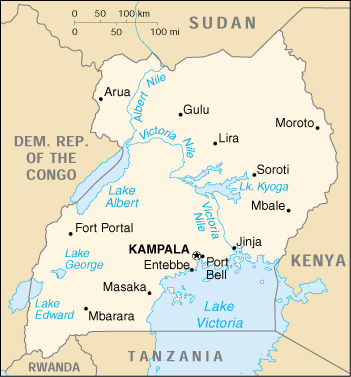
Facts About Uganda
Background: Uganda achieved independence from the UK in 1962. The dictatorial regime of Idi AMIN (1971-79) was responsible for the deaths of some 300,000 opponents; guerrilla war and human rights abuses under Milton OBOTE (1980-85) claimed another 100,000 lives. During the 1990s the government promulgated non-party presidential and legislative elections.
Government type: republic
Capital: Kampala
Currency: 1 Ugandan shilling (UGX) = 100 cents
Geography of Uganda
Location: Eastern Africa, west of Kenya
Geographic coordinates: 1 00 N, 32 00 E
Area:
total: 236,040 sq km
land: 199,710 sq km
water: 36,330 sq km
Land boundaries:
total: 2,698 km
border countries: Democratic Republic of the Congo 765 km, Kenya 933 km, Rwanda 169 km, Sudan 435 km, Tanzania 396 km
Coastline: 0 km (landlocked)
Maritime claims: none (landlocked)
Climate: tropical; generally rainy with two dry seasons (December to February, June to August); semiarid in northeast
Terrain: mostly plateau with rim of mountains
Elevation extremes:
lowest point: Lake Albert 621 m
highest point: Margherita Peak on Mount Stanley 5,110 m
Natural resources: copper, cobalt, hydropower, limestone, salt, arable land
Land use:
arable land: 25%
permanent crops: 9%
permanent pastures: 9%
forests and woodland: 28%
other: 29% (1993 est.)
Irrigated land: 90 sq km (1993 est.)
Environment – current issues: draining of wetlands for agricultural use; deforestation; overgrazing; soil erosion; poaching is widespread
Environment – international agreements:
party to: Biodiversity, Climate Change, Desertification, Endangered Species, Hazardous Wastes, Law of the Sea, Marine Life Conservation, Nuclear Test Ban, Ozone Layer Protection, Wetlands
signed, but not ratified: Environmental Modification
Geography – note: landlocked; fertile, well-watered country with many lakes and rivers
People of Uganda
Africans of three main ethnic groups–Bantu, Nilotic, and Nilo-Hamitic–constitute most of the population. The Bantu are the most numerous and include the Baganda, which, with about 3 million members (18% of the population), constitute the largest-single ethnic group.
The people of the southwest comprise 30% of the population, divided into five major ethnic groups: the Banyankole and Bahima,10%; the Bakiga, 8%; the Banyarwanda, 6%; the Bunyoro, 3%; and the Batoro, 3%). Residents of the north, largely Nilotic, are the next largest group, including the Langi, 6% and the Acholi, 4%. In the northwest are the Lugbara, 4%, and the Karamojong, 2% occupy the considerably drier, largely pastoral territory in the northeast. Europeans, Asians, and Arabs make up about 1% of the population with other groups accounting for the remainder.
Uganda’s population is predominately rural, and its density is highest in the southern regions.
Until 1972, Asians constituted the largest nonindigenous ethnic group in Uganda. In that year, the Idi Amin regime expelled 50,000 Asians, who had been engaged in trade, industry, and various professions. In the years since Amin’s overthrow in 1979, Asians have slowly returned. About 3,000 Arabs of various national origins and small numbers of Asians live in Uganda. Other nonindigenous people in Uganda include several hundred Western missionaries and a few diplomats and businesspeople.
Population: 27,269,482 (July 2005 est.)
Age structure:
0-14 years: 51%
15-64 years: 47%
65 years and over: 2%
Population growth rate: 2.72%
Birth rate: 48.04 births/1,000 population
Death rate: 18.44 deaths/1,000 population
Net migration rate: -2.29 migrant(s)/1,000 population
note: according to the UNHCR, by the end of 1999, Uganda was host to 218,000 refugees from a number of neighboring countries, including: Sudan 200,600, Rwanda 8,000, and Democratic Republic of the Congo 8,000
Infant mortality rate: 93.25 deaths/1,000 live births
Life expectancy at birth:
total population: 42.93 years
male: 42.22 years
female: 43.67 years
Total fertility rate: 6.96 children born/woman
Nationality:
noun: Ugandan(s)
adjective: Ugandan
Ethnic groups: Baganda 17%, Karamojong 12%, Basogo 8%, Iteso 8%, Langi 6%, Rwanda 6%, Bagisu 5%, Acholi 4%, Lugbara 4%, Bunyoro 3%, Batobo 3%, non-African (European, Asian, Arab) 1%, other 23%
Religions: Roman Catholic 33%, Protestant 33%, Muslim 16%, indigenous beliefs 18%
Languages: English (official national language, taught in grade schools, used in courts of law and by most newspapers and some radio broadcasts), Ganda or Luganda (most widely used of the Niger-Congo languages, preferred for native language publications in the capital and may be taught in school), other Niger-Congo languages, Nilo-Saharan languages, Swahili, Arabic
Literacy:
definition: age 15 and over can read and write
total population: 61.8%
male: 73.7%
female: 50.2% (1995 est.)
History of Uganda
UGANDA WAS ONE of the lesser-known African countries until the 1970s when Idi Amin Dada rose to the presidency. His bizarre public pronouncements–ranging from gratuitous advice for Richard Nixon to his proclaimed intent to raise a monument to Adolf Hitler–fascinated the popular news media. Beneath the facade of buffoonery, however, the darker reality of massacres and disappearances was considered equally newsworthy. Uganda became known as an African horror story, fully identified with its field marshal president. Even a decade after Amin’s flight from Uganda in 1979, popular imagination still insisted on linking the country and its exiled former ruler.
But Amin’s well-publicized excesses at the expense of Uganda and its citizens were not unique, nor were they the earliest assaults on the rule of law. They were foreshadowed by Amin’s predecessor, Apolo Milton Obote, who suspended the 1962 constitution and ruled part of Uganda by martial law for five years before a military coup in 1971 brought Amin into power. Amin’s bloody regime was followed by an even bloodier one– Obote’s second term as president during the civil war from 1981 to 1985, when government troops carried out genocidal sweeps of the rural populace in a region that became known as the Luwero Triangle. The dramatic collapse of coherent government under Amin and his plunder of his nation’s economy, followed by the even greater failure of the second Obote government in the 1980s, raised the essential question–“what went wrong?”
At Uganda’s independence in October 1962 there was little indication that the country was headed for disaster. On the contrary, it appeared a model of stability and potential progress. Unlike neighboring Kenya, Uganda had no alien white settler class attempting to monopolize the rewards of the cashcrop economy. Nor was there any recent legacy of bitter and violent conflict in Uganda to compare with the 1950s Mau Mau rebellion in Kenya. In Uganda it was African producers who grew the cotton and coffee that brought a higher standard of living, financed the education of their children, and led to increased expectations for the future.
Unlike neighboring Tanzania, Uganda enjoyed rich natural resources, a flourishing economy, and an impressive number of educated and prosperous middle-class African professionals, including business people, doctors, lawyers, and scientists. And unlike neighboring Zaire (the former Belgian Congo), which experienced only a brief period of independence before descending into chaos and misrule, Uganda’s first few years of self-rule saw a series of successful development projects. The new government built many new schools, modernized the transportation network, and increased manufacturing output as well as national income. With its prestigious national Makerere University, its gleaming new teaching hospital at Mulago, its Owen Falls hydroelectric project at Jinja–all gifts of the departing British–Uganda at independence looked optimistically to the future.
Independence, too, was in a sense a gift of the British because it came without a struggle. The British determined a timetable for withdrawal before local groups had organized an effective nationalist movement. Uganda’s political parties emerged in response to impending independence rather than as a means of winning it.
In part the result of its fairly smooth transition to independence, the near absence of nationalism among Uganda’s diverse ethnic groups led to a series of political compromises. The first was a government made up of coalitions of local and regional interest groups loosely organized into political parties. The national government was presided over by a prime minister whose principal role appeared to be that of a broker, trading patronage and development projects–such as roads, schools, and dispensaries–to local or regional interest groups in return for political support. It was not the strong, directive, ideologically clothed central government desired by most African political leaders, but it worked. And it might reasonably have been expected to continue to work, because there were exchanges and payoffs at all levels and to all regions.
IN MID-1992 UGANDA WAS still trying to recover from two decades of instability and civil war. For the majority of the population born after Idi Amin Dada seized power in 1971, a peaceful and prosperous Uganda was difficult to imagine. But many Ugandans saw promising signs of economic and political reform in the nation’s fledgling grass-roots democracy, new economic development projects and export initiatives, and the renewed commitment to education and social services. Serious problems remained unresolved, however, and it was clear that efforts to rehabilitate Uganda’s devastated economy and return the country to civilian rule would take most of the decade.
Uganda in earlier times had known periods of relative peace, but not quiet isolation. Its early history, told through the archaeological record and accounts of travelers, included centuries of political change, population migration, and the development of cultural diversity. The earliest occupants of the low-lying plateau that stretches north from the shores of Lake Victoria had been joined by new migrants from the north and west by about the fourth century A.D. These new arrivals, ancestors of today’s Bantu-speaking societies, came under pressure from the expansion of non-Bantu speaking warriors and herders from the northeast by about the tenth century A.D. The gradual population movement to the southwest was slowed by the formation of new societies comprising farmers and herders. Several of them competed for regional control, assimilating and dominating their neighbors to varying degrees, and several evolved into complex centralized societies marked by economic and social stratification. During the nineteenth century, the strongest among them, Bunyoro, began to lose power to its breakaway neighbor, Buganda. By the end of the nineteenth century, Buganda dominated the region, but the rivalry between Buganda and Bunyoro remained strong enough to be exploited by colonial agents who established the Uganda Protectorate in 1894.
Representatives of Islam and Christianity, who had also competed for social, spiritual, and economic advantage over one another, also left a lasting imprint on Ugandan society. Political developments throughout the twentieth century have reflected the divisions between Uganda’s centralized and noncentralized societies, and among the diverse ethnic groups in each of these categories, their different responses to the colonial experience, and the impact of world religions.
Uganda had been brought into the world economic system gradually over the centuries, first through trade in ivory, and later through trade in slaves and agricultural products. In the early twentieth century, colonial officials, with the help of Baganda (people of Buganda; sing., Muganda) agents, established cash crops, especially cotton, and later coffee, to help finance economic development according to world market demands. Buganda prospered and drew farm workers from other areas of the protectorate. Buganda’s schools also developed ahead of those in other regions, helping fuel existing rivalries between the Baganda and their neighbors.
Agricultural production increased dramatically during World War I, and during the 1920s and 1930s, farmers were able to weather the fluctuations in world market prices by cutting cash- crop production and reverting to subsistence agriculture. Protectorate laws carefully regulated the use of land and other resources, often allocating economic rights according to racial categories. Protests against such restrictions increased after World War II, but unlike much of Africa, Uganda was preparing peacefully for independence well before it arrived.
At independence in October 1962, ethnic and regional rivalries were crystallized in several newly formed political parties and in the federal system that gave substantial autonomy to the four large kingdoms in the south, plus the highly centralized society of Busoga. The central government maintained control over the northern region. The army flourished under the first independent government led by Milton Obote and pressed its demands for higher pay and improved conditions of service. A military coup in 1971, however, plunged Uganda into eight years of terror and disintegration under the government of Idi Amin. Uganda’s once-developing economy disintegrated, and its once- thriving education system suffered lasting damage. Government- sanctioned brutality became commonplace. Many of Uganda’s intellectuals and entrepreneurs were forced to flee. A brief but tumultuous political transition followed the nightmare of the Amin years, and the early 1980s became a time of revenge-seeking and despair under the second government led by Milton Obote. Growing rebellions finally forced Obote from office in 1985, but Ugandans had little cause for confidence in their political future.
The government led by Yoweri Kaguta Museveni that seized power in January 1986 had not inspired overwhelming public confidence in its ability to rule. Museveni’s National Resistance Army (NRA), however, had shown greater military discipline than other armed forces in recent years, and Museveni declared that establishing a peaceful and secure environment was his highest priority as president. For this goal, Museveni had strong popular backing.
The NRA’s hastily formed political arm, the National Resistance Movement (NRM), set out its political program in the Ten-Point Program, which advocated a broad-based democracy and a hierarchy of popular assemblies, or resistance councils (RCs), from the village through district levels to mediate between the national government and the village. After initial doubts about embracing Western economic reforms, the NRM also embarked on ambitious structural adjustment and export diversification programs. Museveni took seriously the notion of accountability in government service and set about improving standards of behavior among public sector employees.
But the NRM had few politically educated people in its ranks, and Museveni’s policy of appointing members of previous governments to high office cost him political support. In addition, the NRM’s political ideas were new and lacked support in the northern and eastern regions, where popular insurgencies continued to plague his rule even after six years in power. And the army, with its intense recruitment drives and policy of incorporating former rebel opponents into its ranks, was unable to eliminate the human rights abuses for which it had become infamous. Campaigns to pacify and stabilize rebel-occupied areas turned into army assaults on peaceful residents of the north and east, and the judicial system was slow to deal with those accused of serious atrocities. At the same time, the cost of maintaining the military escalated rapidly, and pressures to reduce the size of the army posed the dilemma of escalating unemployment among former members of the military.
Since research on this volume was completed in 1990, the government has continued its program of political reform in an effort to meet its own deadline for returning to civilian rule by 1995. Progress, however, has been slow. The central institutions of grass-roots democracy, the RCs, improved their ability to function as part of the government, but in some areas the RCs’ exact responsibilities were not well understood. In a few cases, their efforts to maintain order degenerated into vigilantism.
A twenty-one member constitutional commission appointed in 1988 completed its nationwide consultations in late 1991, but it postponed submitting a draft constitution to the government until November 1992. The government also planned a nationwide referendum on the draft constitution in mid-1993.
Nationwide RC elections, held from February 29 to March 9, 1992, were generally considered a success. Voters in more than 30,000 villages elected RCs for their villages, and indirect elections were held for RC members at the parish, subcounty, county, and district levels. Partisan campaigning and explicitly soliciting votes were legally prohibited; candidates who violated this prohibition were disqualified, although candidates were able to use other avenues to make their views known. In several areas, staunch critics of the government were elected to the RCs, confirming the widespread belief that the elections were generally free and fair. About half of the incumbent RC members were removed from office, and several members of the national legislature lost in elections for village RCs.
In a few areas, such as Bushenyi, elections were delayed because of conditions caused by religious feuding, political violence, or the spreading drought. In a few localities, election irregularities led to the annulment and rescheduling of the balloting. But when the votes were counted, more than 400,000 Ugandans had been elected to various levels of political office, and the new office-holders represented nearly every ethnic, religious, and political identity in the country. The next elections were planned for late 1994, when the government pledged it would provide secret ballots and the direct election of legislators at all levels.
Despite well-publicized human rights abuses by the military that continued through early 1991, President Museveni’s New Year’s message for 1992 emphasized his commitment to improving this record. By mid-1992, the courts had begun to hear the cases of eighteen prominent northern politicians who had been accused of treason in April 1991, and charges against several of the accused had been dropped. The government had disciplined soldiers for human rights abuses in unsettled areas of the north and east, and the army response to the unrest was more restrained in 1992. An inspector general of government (IGG) was appointed to serve as a “watchdog” on government but the incumbent’s effectiveness was undermined by the IGG’s large caseload and the fact that the inspector general served at the president’s pleasure.
The government declared northern Uganda “pacified” in late 1991, following a three-month-long army sweep that included house-to-house searches in Gulu, Lira, Kitgum, and Apac districts. Residents were asked to produce poll tax receipts and other documents to prove their identity. In some cases, civilians were assaulted, and a few were executed for failing to comply.
Museveni also attempted to bring order to Uganda’s foreign relations. He met in Nairobi with Kenyan president Daniel T. arap Moi and Tanzanian president Ali Hassan Mwinyi in late 1991, and they agreed to develop closer ties among the three countries. Relations with Kenya had been strained, primarily because of continuing clashes along their common border. Most of the attacks were provoked by banditry and cross-border skirmishes among isolated groups of soldiers or herders, but the two leaders harbored mutual suspicions of one another. Moi feared Museveni’s close ties with Libyan leader Muammar Qadhafi could contribute to destabilization in Kenya, where ethnic and political tensions were already high. (This fear probably diminished, however, following Libya’s June 1992 termination of its military relationship with Uganda.) The three leaders agreed to coordinate policies in security, trade, transportation, agriculture, and industry, and to pursue other avenues for regional cooperation.
Relations with Rwanda remained strained as of mid-1992. Fighting continued along the Uganda-Rwanda border following the October 1990 invasion of Rwanda by Rwandan exiles in Uganda. Many members of the invading rebel army, the Rwandan Patriotic Front (RPF), had been members of the Ugandan Army. Rwandan president Juvénal Habyarimana continued to accuse Museveni of allowing, and even supporting, RPF operations from Ugandan territory, and Rwandan forces struck back across the border several times in 1991 and early 1992. Ugandan officials estimated that several thousand Ugandans had been killed, and more than 30,000 displaced, by the conflict. Representatives of the Organization of African Unity (OAU), along with officials from Rwanda, Burundi, Tanzania, and Zaire, met several times in 1991 and 1992 and urged the warring parties to observe the ceasefire agreed to in March 1991, but fighting continued as of mid-1992.
Unrest in Zaire arising out of economic deterioration and a stalemate over political reform also contributed to the security crisis in southwestern Uganda in 1992. Ugandan officials claimed more than 20,000 Zairian refugees had entered Uganda, seeking refuge from marauding Zairian troops and antigovernment rebel banditry.
In northern Uganda, similar problems arose out of civil war and drought conditions in Sudan. In 1991 and 1992, Sudanese army assaults on antigovernment rebel units near the Ugandan border were forcing southern Sudanese to seek refuge in the increasingly drought-stricken area of northern Uganda, and in a few cases Sudanese attacks extended into Ugandan territory.
The influx of refugees strained an already struggling Ugandan economy. Uganda’s overall economic growth continued in 1992, but fell from the impressive rate of nearly 6 percent in 1990 and almost 5 percent in 1991 to a projected 4.5 percent in 1992. The government attributed the positive performance to the nation’s returning political stability and an increasingly favorable investment environment. Foreign assistance also continued to play a significant role in economic growth. Inflation fell from triple-digit levels to about 25 percent in 1990 but rose to 38 percent in 1991. Targeted inflation for 1992 was 15 percent.
The fiscal year 1992 budget included total government spending of 674.35 billion Uganda shillings, or about US$911.3 million, of which the government claimed defense spending would constitute about 20 percent. Educational expenditures would constitute 12 percent; health care, 6.5 percent; 3 percent was earmarked for providing safe drinking water. Roughly one-third of expenditures were to be financed by government revenues; one- third by foreign grants; and one-third by borrowing, debt rescheduling, and the sale of treasury bills.
Agricultural growth reached 2.8 percent in 1991 and was expected to exceed that in 1992. Cotton production doubled in 1991 over 1990 levels; production of tea and tobacco also increased. Coffee earnings fell to about US$140 million in 1991– largely the result of the collapse of the International Coffee Agreement, which had regulated world market prices–but coffee still accounted for about 70 percent of merchandise export earnings. Nontraditional export earnings, although small in comparison with traditional exports, doubled between 1990 and 1992 to more than US$50 million, largely because of government support programs that included low-interest loans and expanded credit opportunities to encourage the production of a wider variety of agricultural products.
Nevertheless, Uganda’s trade deficit remained high in 1991, with imports roughly three times the value of exports. Combined with high interest payments, the unfavorable trade deficit produced a current account deficit of almost US$500 million. Debt service requirements reached roughly 75 percent of export earnings, with arrears mounting steadily. Most of Uganda’s external debt was owed to multilateral creditors and therefore could not be rescheduled.
The government continued to implement features of the 1987-91 economic rehabilitation program, such as liberalizing the marketing of agricultural produce. In 1992 a few coffee producers’ groups were handling coffee marketing, although the government’s Coffee Marketing Board remained active. In early 1992, the government introduced an auction system for allocating foreign exchange on the basis of market dictates rather than government selection among importers. To help improve Uganda’s investment climate, the government also began restoring to its original owners the property that had been expropriated during the 1970s, and negotiating compensation in a few other cases.
The government announced that it would privatize, at least in part, 100 of the country’s 116 public enterprises and eliminate 16 parastatals. It would retain majority shares in commercial banking; copper mining; housing; airlines; breweries; grain milling; pharmaceutical distribution; steel and cement production; textile and sugar manufacturing; and the marketing of coffee, cotton, and most agricultural produce. Private investors, including foreigners, would be able to purchase shares in companies in which the government was a major shareholder. The government planned to retain full ownership of electric utilities, railroads, air cargo services, development finance banking, posts and telecommunications, insurance agencies, tourist agencies, and newspaper publishing. To improve accountability among these enterprises, it intended to reduce the number of political appointments and increase its oversight of recordkeeping practices.
Civil service reform was also an important goal for the early 1990s. With the elimination of “ghost” employees from government rolls in mid-1991, the number of public employees outside the education sector was reduced from 90,000 to roughly 64,000, and teachers’ rolls were reduced to roughly 80,000. The salaries of remaining government employees were increased, some by as much as 40 percent, after these payroll cuts were announced.
Despite significant progress and ambitious planning, Uganda faced serious economic and political problems in 1992. Lingering insurgency campaigns in the north and east, increased defense spending, and serious military abuses reinforced one another to erode public confidence. The government’s commitment to economic development provided hope of improved living standards, but the combined economic and security problems, along with the effects of two decades of neglect of education and social services, led many people to question whether Museveni could deliver on his pledge to restore broad-based democracy to Uganda.
Uganda Economy
Economy – overview: Uganda has substantial natural resources, including fertile soils, regular rainfall, and sizable mineral deposits of copper and cobalt. Agriculture is the most important sector of the economy, employing over 80% of the work force. Coffee is the major export crop and accounts for the bulk of export revenues. Since 1986, the government – with the support of foreign countries and international agencies – has acted to rehabilitate and stabilize the economy by undertaking currency reform, raising producer prices on export crops, increasing prices of petroleum products, and improving civil service wages. The policy changes are especially aimed at dampening inflation and boosting production and export earnings. In 1990-2000, the economy turned in a solid performance based on continued investment in the rehabilitation of infrastructure, improved incentives for production and exports, reduced inflation, gradually improved domestic security, and the return of exiled Indian-Ugandan entrepreneurs. Ongoing Ugandan involvement in the war in the Democratic Republic of the Congo, corruption within the government, and slippage in the government’s determination to press reforms raise doubts about the continuation of strong growth. In 2000, Uganda qualified for enhanced HIPC debt relief worth $1.3 billion and Paris Club debt relief worth $145 million. These amounts combined with the original Highly Indebted Poor Countries HIPC debt relief add up to about $2 billion. Growth for 2001 should be somewhat lower than in 2000, because of a decline in the price of coffee, Uganda’s principal export.
GDP: purchasing power parity – $26.2 billion (2000 est.)
GDP – real growth rate: 5.5% (1999 est.), 6% (2000 est.)
GDP – per capita: purchasing power parity – $1,100 (2000 est.)
GDP – composition by sector:
agriculture: 44%
industry: 17%
services: 39% (1997 est.)
Population below poverty line: 55% (1993 est.)
Household income or consumption by percentage share:
lowest 10%: 3%
highest 10%: 33.4% (1992)
Inflation rate (consumer prices): 7% (1999)
Labor force: 8.361 million (1993 est.)
Labor force – by occupation: agriculture 82%, industry 5%, services 13% (1999 est.)
Budget:
revenues: $959 million
expenditures: $1.04 billion (FY98/99 est.)
Industries: sugar, brewing, tobacco, cotton textiles, cement
Industrial production growth rate: 9.3% (FY98/99)
Electricity – production: 792 million kWh (1998)
Electricity – production by source:
fossil fuel: 0.88%
hydro: 99.12%
nuclear: 0%
other: 0% (1998)
Electricity – consumption: 622 million kWh (1998)
Electricity – exports: 115 million kWh (1998)
Electricity – imports: 0 kWh (1998)
Agriculture – products: coffee, tea, cotton, tobacco, cassava (tapioca), potatoes, corn, millet, pulses; beef, goat meat, milk, poultry
Exports: $471 million (f.o.b., 1999)
Exports – commodities: coffee, fish and fish products, tea; electrical products, iron and steel
Exports – partners: EU 51% (Netherlands 6%, Switzerland 6%, Germany 5%, Belgium 4%), Kenya 5% (1998)
Imports: $1.1 billion (f.o.b., 1999)
Imports – commodities: vehicles, petroleum, medical supplies; cereals
Imports – partners: Kenya 12%, United Kingdom 6%, Japan 4%, India 4%, South Africa (1998)
Debt – external: $3.1 billion (1998 est.)
Economic aid – recipient: $839.9 million (1997)
Currency: 1 Ugandan shilling (UGX) = 100 cents
Map of Uganda