Facts About Ukraine
Background: Richly endowed in natural resources, Ukraine has been fought over and subjugated for centuries; its 20th-century struggle for liberty is not yet complete. A short-lived independence from Russia (1917-1920) was followed by brutal Soviet rule that engineered two artificial famines (1921-22 and 1932-33) in which over 8 million died, and World War II, in which German and Soviet armies were responsible for some 7 million more deaths. Although independence was attained in 1991 with the dissolution of the USSR, true freedom remains elusive as many of the former Soviet elite remain entrenched, stalling efforts at economic reform, privatization, and civic liberties.
Government type: republic
Capital: Kiev (Kyyiv)
Currency: 1 hryvnia (UAH) = 100 kopiykas
Geography of Ukraine
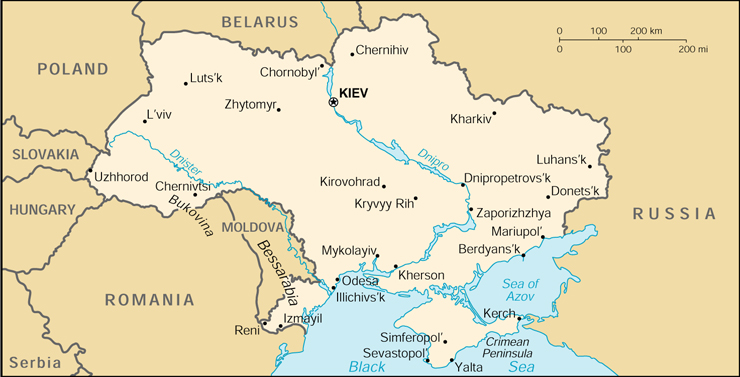
Location: Eastern Europe, bordering the Black Sea, between Poland and Russia
Geographic coordinates: 49 00 N, 32 00 E
Area:
total: 603,700 sq km
land: 603,700 sq km
water: 0 sq km
Land boundaries:
total: 4,558 km
border countries: Belarus 891 km, Hungary 103 km, Moldova 939 km, Poland 428 km, Romania (south) 169 km, Romania (west) 362 km, Russia 1,576 km, Slovakia 90 km
Coastline: 2,782 km
Maritime claims:
continental shelf: 200-m or to the depth of exploitation
exclusive economic zone: 200 nm
territorial sea: 12 nm
Climate: temperate continental; Mediterranean only on the southern Crimean coast; precipitation disproportionately distributed, highest in west and north, lesser in east and southeast; winters vary from cool along the Black Sea to cold farther inland; summers are warm across the greater part of the country, hot in the south
Terrain: most of Ukraine consists of fertile plains (steppes) and plateaus, mountains being found only in the west (the Carpathians), and in the Crimean Peninsula in the extreme south
Elevation extremes:
lowest point: Black Sea 0 m
highest point: Hora Hoverla 2,061 m
Natural resources: iron ore, coal, manganese, natural gas, oil, salt, sulfur, graphite, titanium, magnesium, kaolin, nickel, mercury, timber, arable land
Land use:
arable land: 58%
permanent crops: 2%
permanent pastures: 13%
forests and woodland: 18%
other: 9% (1993 est.)
Irrigated land: 26,050 sq km (1993 est.)
Environment – current issues: inadequate supplies of potable water; air and water pollution; deforestation; radiation contamination in the northeast from 1986 accident at Chornobyl’ Nuclear Power Plant
Environment – international agreements:
party to: Air Pollution, Air Pollution-Nitrogen Oxides, Air Pollution-Sulphur 85, Antarctic-Marine Living Resources, Antarctic Treaty, Biodiversity, Climate Change, Endangered Species, Environmental Modification, Hazardous Wastes, Law of the Sea, Marine Dumping, Ozone Layer Protection, Ship Pollution, Wetlands
signed, but not ratified: Air Pollution-Persistent Organic Pollutants, Air Pollution-Sulphur 94, Air Pollution-Volatile Organic Compounds, Antarctic-Environmental Protocol, Climate Change-Kyoto Protocol
Geography – note: strategic position at the crossroads between Europe and Asia; second-largest country in Europe
People of Ukraine
The population of Ukraine is about 50 million, which represents about 18% of the population of the former Soviet Union. Ukrainians make up about 73% of the total; ethnic Russians number about 22%. The industrial regions in the east and southeast are the most heavily populated, and the urban population makes up about 70% of the population. Ukrainian and Russian are the principal languages, but about 88% of the population consider Ukrainian their native language. The dominant religions are the Ukrainian Orthodox Church, much of which retains its links to the Russian Orthodox Church, and the Ukrainian Greek Catholic Church. The Ukrainian Orthodox Church (Kiev Patriarchate) is independent of Moscow.
The birth rate of Ukraine is diminishing. About 70% of adult Ukrainians have a secondary or higher education. Ukraine has about 150 colleges and universities, of which the most important are at Kiev, Lviv, and Kharkiv. About 70,000 scholars in 80 research institutes make Ukraine a leader in science and technology.
Population: 47,425,336 (July 2005 est.)
Age structure:
0-14 years: 18%
15-64 years: 68%
65 years and over: 14%
Population growth rate: -0.83%
Birth rate: 9.03 births/1,000 population
Death rate: 16.48 deaths/1,000 population
Net migration rate: -0.84 migrant(s)/1,000 population
Infant mortality rate: 21.67 deaths/1,000 live births
Life expectancy at birth:
total population: 65.98 years
male: 60.39 years
female: 71.85 years
Total fertility rate: 1.26 children born/woman
Nationality:
noun: Ukrainian(s)
adjective: Ukrainian
Ethnic groups: Ukrainian 73%, Russian 22%, Jewish 1%, other 4%
Religions: Ukrainian Orthodox – Moscow Patriarchate, Ukrainian Orthodox – Kiev Patriarchate, Ukrainian Autocephalous Orthodox, Ukrainian Catholic (Uniate), Protestant, Jewish
Languages: Ukrainian, Russian, Romanian, Polish, Hungarian
Literacy:
definition: age 15 and over can read and write
total population: 98%
male: 100%
female: 97% (1989 est.)
History of Ukraine
The first identifiable groups to populate what is now Ukraine were Cimmerians, Scythians, Sarmatians, and Goths, among other nomadic peoples who arrived throughout the first millennium B.C. These people were well known to colonists and traders in the ancient world, including Greeks and Romans, who established trading outposts which eventually became city states. Slavic tribes occupied central and eastern Ukraine in the sixth century A.D. and played an important role in the establishment of Kiev. Situated on lucrative trade routes, Kiev quickly prospered as the center of a powerful state of Kievan Rus. In the 11th century, Kievan Rus was, geographically, the largest state in Europe. A Christian missionary, Cyril, converted the Kievan nobility and most of the population in 988. Conflict among the feudal lords led to decline in the 12th century. Kiev was razed by Mongol raiders in the 12th century.
Most of the territory was annexed by Poland and Lithuania in the 14th century, but during that time, the Ukrainian people began to conceive of themselves as a distinct people, a feeling which survived subsequent partitioning by greater powers over the next centuries. In addition, Ukrainian peasants who fled the Polish effort to force them into servitude came to be known as Cossacks and earned a reputation for their fierce martial spirit. In 1667, Ukraine was partitioned between Poland and Russia. In 1793, it was reunited as part of the Russian Empire.
The 19th century found the region largely agricultural, with a few cities and centers of trade and learning. The region was under the control of the Austrians in the extreme west and of the Russians elsewhere. Ukrainian writers and intellectuals were inspired by the nationalistic spirit stirring other European peoples existing under other imperial governments and were determined to revive Ukrainian linguistic and cultural traditions and re-establish a Ukrainian nation-state. The Russians in particular imposed strict limits on attempts to elevate Ukrainian language and culture, even banning its use and study.
When World War I and the Bolshevik revolution in Russia shattered the Hapsburg and Russian empires, Ukrainians declared independent statehood. In 1917 and 1918, three separate Ukrainian republics declared independence. However, by 1921, the western part of the traditional territory had been incorporated into Poland, and the larger, central and eastern part became part of the Soviet Union.
The Ukrainian national idea persevered during the interwar years, and Soviet reaction was severe, particularly under Stalin, who imposed terror campaigns, which ravaged the intellectual class. He also created artificial famines as part of his forced collectivization policies, which killed millions of previously independent peasants and others throughout the country. Estimates of deaths from the 1932-33 famine alone range from 3 million to 7 million.
After the German and Soviet invasions of Poland in 1939, the western Ukrainian regions were incorporated into the Soviet Union. When the Germans invaded the Soviet Union in 1941, many Ukrainians, particularly in the west, welcomed them, but this did not last. German brutality was directed principally against Ukraine’s Jews (of whom 1 million were killed) but also against many other Ukrainians. Kiev and other parts of the country were heavily damaged. Some Ukrainians began to resist the Germans as well as the Soviets. Resistance against Soviet Government forces continued as late as the 1950s.
Little changed for Ukraine over the next decades. During periods of relative liberalization–as under Nikita Khrushchev from 1955 to 1964–Ukrainian communists pursued national objectives. In the years of perestroika, under U.S.S.R. President Mikhail Gorbachev, national goals were again advanced by Ukrainian officials. Ukraine became an independent state on August 24, 1991, following the dissolution of the Soviet Union, and was a founding member of the Commonwealth of Independent States (CIS).
Ukraine Economy
Economy – overview: After Russia, the Ukrainian republic was far and away the most important economic component of the former Soviet Union, producing about four times the output of the next-ranking republic. Its fertile black soil generated more than one-fourth of Soviet agricultural output, and its farms provided substantial quantities of meat, milk, grain, and vegetables to other republics. Likewise, its diversified heavy industry supplied the unique equipment (for example, large diameter pipes) and raw materials to industrial and mining sites (vertical drilling apparatus) in other regions of the former USSR. Ukraine depends on imports of energy, especially natural gas, to meet some 85% of its annual energy requirements. Shortly after independence in late 1991, the Ukrainian Government liberalized most prices and erected a legal framework for privatization, but widespread resistance to reform within the government and the legislature soon stalled reform efforts and led to some backtracking. Output in 1992-99 fell to less than 40% the 1991 level. Loose monetary policies pushed inflation to hyperinflationary levels in late 1993. Ukraine’s dependence on Russia for energy supplies and the lack of significant structural reform have made the Ukrainian economy vulnerable to external shocks. Now in his second term, President KUCHMA has pledged to reduce the number of government agencies and streamline the regulation process, create a legal environment to encourage entrepreneurs and protect ownership rights, and enact a comprehensive tax overhaul. Reforms in the more politically sensitive areas of structural reform and land privatization are still lagging. Outside institutions – particularly the IMF – have encouraged Ukraine to quicken the pace and scope of reforms and have threatened to withdraw financial support. GDP in 2000 showed strong export-based growth of 6% – the first growth since independence – and industrial production grew 12.9%. As the capacity for further export-based economic expansion diminishes, GDP growth in 2001 is likely to decline to around 3%.
GDP: purchasing power parity – $189.4 billion (2000 est.)
GDP – real growth rate: 6% (2000 est.)
GDP – per capita: purchasing power parity – $3,850 (2000 est.)
GDP – composition by sector:
agriculture: 12%
industry: 26%
services: 62% (1998 est.)
Population below poverty line: 50% (1999 est.)
Household income or consumption by percentage share:
lowest 10%: 4.1%
highest 10%: 20.8% (1992)
Inflation rate (consumer prices): 20% (1999 est.)
Labor force: 22.8 million (yearend 1997)
Labor force – by occupation: industry and construction 32%, agriculture and forestry 24%, health, education, and culture 17%, trade and distribution 8%, transport and communication 7%, other 12% (1996)
Unemployment rate: 4.3% officially registered; large number of unregistered or underemployed workers (December 1999)
Budget:
revenues: $8.3 billion
expenditures: $8.8 billion (1999 est.)
Industries: coal, electric power, ferrous and nonferrous metals, machinery and transport equipment, chemicals, food-processing (especially sugar)
Industrial production growth rate: 4.3% (1999 est.)
Electricity – production: 171 billion kWh (1999)
Electricity – production by source:
fossil fuel: 52%
hydro: 5.9%
nuclear: 42.1%
other: 0% (1999)
Electricity – consumption: 144.011 billion kWh (1998)
Electricity – exports: 7 billion kWh (1998)
Electricity – imports: 4.15 billion kWh (1998)
Agriculture – products: grain, sugar beets, sunflower seeds, vegetables; beef, milk
Exports: $11.6 billion (1999 est.)
Exports – commodities: ferrous and nonferrous metals, fuel and petroleum products, machinery and transport equipment, food products
Exports – partners: Russia 20%, EU 17%, China 7%, Turkey 6%, United States 4% (1999)
Imports: $11.8 billion (1999 est.)
Imports – commodities: energy, machinery and parts, transportation equipment, chemicals
Imports – partners: Russia 48%, EU 23%, United States 3% (1999)
Debt – external: $12.6 billion (January 2000 est.)
Economic aid – recipient: $637.7 million (1995); IMF Extended Funds Facility $2.2 billion (1998)
Currency: 1 hryvnia (UAH) = 100 kopiykas
Map of Ukraine