Facts About Uzbekistan
Background: Russia conquered Uzbekistan in the late 19th century. Stiff resistance to the Red Army after World War I was eventually suppressed and a socialist republic set up in 1925. During the Soviet era, intensive production of “white gold” (cotton) and grain led to overuse of agrochemicals and the depletion of water supplies, which have left the land poisoned and the Aral Sea and certain rivers half dry. Independent since 1991, the country seeks to gradually lessen its dependence on agriculture while developing its mineral and petroleum reserves. Current concerns include insurgency by Islamic militants based in Tajikistan and Afghanistan, a non-convertible currency, and the curtailment of human rights and democratization.
Government type: republic; effectively authoritarian presidential rule, with little power outside the executive branch; executive power concentrated in the presidency
Capital: Tashkent (Toshkent)
Currency: Uzbekistani som (UKS)
Geography of Uzbekistan
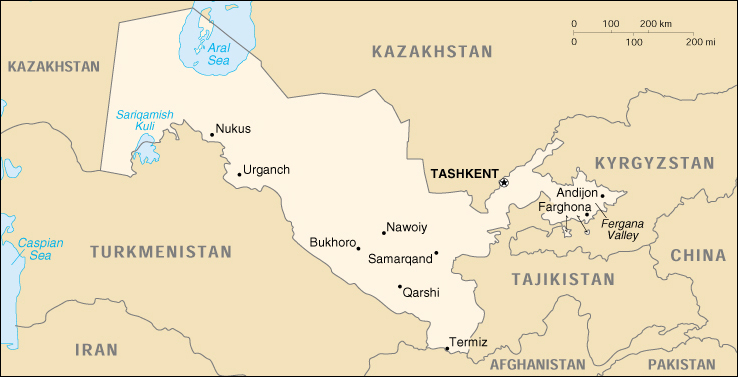
Location: Central Asia, north of Afghanistan
Geographic coordinates: 41 00 N, 64 00 E
Area:
total: 447,400 sq km
land: 425,400 sq km
water: 22,000 sq km
Land boundaries:
total: 6,221 km
border countries: Afghanistan 137 km, Kazakhstan 2,203 km, Kyrgyzstan 1,099 km, Tajikistan 1,161 km, Turkmenistan 1,621 km
Coastline: 0 km
note: Uzbekistan includes the southern portion of the Aral Sea with a 420 km shoreline
Maritime claims: none (doubly landlocked)
Climate: mostly midlatitude desert, long, hot summers, mild winters; semiarid grassland in east
Terrain: mostly flat-to-rolling sandy desert with dunes; broad, flat intensely irrigated river valleys along course of Amu Darya, Sirdaryo (Syr Darya), and Zarafshon; Fergana Valley in east surrounded by mountainous Tajikistan and Kyrgyzstan; shrinking Aral Sea in west
Elevation extremes:
lowest point: Sariqarnish Kuli -12 m
highest point: Adelunga Toghi 4,301 m
Natural resources: natural gas, petroleum, coal, gold, uranium, silver, copper, lead and zinc, tungsten, molybdenum
Land use:
arable land: 9%
permanent crops: 1%
permanent pastures: 46%
forests and woodland: 3%
other: 41% (1993 est.)
Irrigated land: 40,000 sq km (1993 est.)
Environment – current issues: drying up of the Aral Sea is resulting in growing concentrations of chemical pesticides and natural salts; these substances are then blown from the increasingly exposed lake bed and contribute to desertification; water pollution from industrial wastes and the heavy use of fertilizers and pesticides is the cause of many human health disorders; increasing soil salination; soil contamination from agricultural chemicals, including DDT
Environment – international agreements:
party to: Biodiversity, Climate Change, Climate Change-Kyoto Protocol, Desertification, Endangered Species, Environmental Modification, Hazardous Wastes, Ozone Layer Protection
signed, but not ratified: none of the selected agreements
Geography – note: along with Liechtenstein, one of the only two doubly landlocked countries in the world
People of Uzbekistan
Uzbekistan is Central Asia’s most populous country. Its 24 million people, concentrated in the south and east of the country, are close to half the region’s total population. Uzbekistan had been one of the poorest republics of the Soviet Union; much of its population was engaged in cotton farming in small rural communities. The population continues to be heavily rural and dependent on farming for its livelihood. The predominant ethnicity is Uzbek. Other ethnic groups include Russian 5.5%, Tajik 5%, Kazakh 3%, Karakalpak 2.5%, Tatar 1.5%, other 2.5%. The nation is 88% Sunni Moslem, 9% Eastern Orthodox, and 3% other. Uzbek is the official state language; however, Russian is the de facto language for interethnic communication, including much day-to-day government and business use.
The educational system has achieved 99% literacy, and the mean amount of schooling for both men and women is 11 years. However, due to budget constraints and other transitional problems following the collapse of the Soviet Union, texts and other school supplies, teaching methods, curricula, and educational institutions are outdated, inappropriate, and poorly kept. Additionally, the proportion of school-aged persons enrolled has been dropping. Although the government is concerned about this, budgets remain tight. Similarly, in health care, life expectancy is long, but after the breakup of the Soviet Union, health care resources have declined, reducing health care quality, accessibility, and efficiency.
Population: 26,851,195 (July 2005 est.)
Age structure:
0-14 years: 37%
15-64 years: 58%
65 years and over: 5%
Population growth rate: 1.6%
Birth rate: 26.18 births/1,000 population
Death rate: 8.02 deaths/1,000 population
Net migration rate: -2.18 migrant(s)/1,000 population
Infant mortality rate: 72.13 deaths/1,000 live births
Life expectancy at birth:
total population: 63.71 years
male: 60.09 years
female: 67.52 years
Total fertility rate: 3.09 children born/woman
Nationality:
noun: Uzbekistani(s)
adjective: Uzbekistani
Ethnic groups: Uzbek 80%, Russian 5.5%, Tajik 5%, Kazakh 3%, Karakalpak 2.5%, Tatar 1.5%, other 2.5% (1996 est.)
Religions: Muslim 88% (mostly Sunnis), Eastern Orthodox 9%, other 3%
Languages: Uzbek 74.3%, Russian 14.2%, Tajik 4.4%, other 7.1%
Literacy:
definition: age 15 and over can read and write
total population: 99%
male: 99%
female: 99% (yearend 1996)
History of Uzbekistan
IN 1991 THE FIVE SOVIET REPUBLICS of Central Asia–Kazakstan, Kyrgyzstan, Tajikistan, Turkmenistan, and Uzbekistan–were faced for the first time with the prospect of existence as independent states. In critical respects, they were unprepared for this event: their economies all had performed specific tasks in the Soviet system, mainly the supply of raw materials; only outdated Soviet-era political structures remained behind in the five republics, with no tradition of national political institutions; and the end of the union fragmented the armed forces units of the former Soviet Union that remained on the republics’ territory. In the 1990s, the progress of the five republics toward resolving these problems has been quite uneven. The republics with the richest natural resources–Kazakstan, Turkmenistan, and Uzbekistan–have developed the strongest economies–albeit with serious defects in each case–and have attracted substantial Western investment. In all cases, movement away from the Soviet model of strong, one-party central government has been extremely slow. Some degree of military autonomy has appeared in all republics save Tajikistan, which still is bedeviled by rebel forces and a porous southern border. At the same time, the strategic doctrine of all Central Asian countries remains based on protection from Russia’s military.
The total area of the five republics is approximately 3.9 million square kilometers, slightly more than 40 percent of the area of the United States and less than one-quarter of the area of Russia (see fig. 1). The region stretches from the Caspian Sea in the west to China in the east, and from central Siberia in the north to Afghanistan, Iran, and Pakistan in the south. The area of the republics varies greatly: Kazakstan, by far the largest, occupies about 2.7 million square kilometers, more than two-thirds of the region. The smallest republic, Kyrgyzstan, occupies only 198,500 square kilometers. The Central Asian republics also feature quite different topographies, varying from the wide expanses of desert in primarily flat Kazakstan and Turkmenistan to the steep slopes and river valleys of mountainous Tajikistan and Kyrgyzstan.
The region contains enormous natural and agricultural resources. All five republics have favorable agricultural regions and some combination of attractive minerals and fuels. Their industrial bases include trained workers, and their populations have relatively high educational levels and literacy rates. Unfortunately, the moribund, highly inefficient system through which the Soviet Union exploited those resources has proved very difficult to disassemble. The Central Asians have suffered all the typical transitional ills of former communist states moving toward a market economy: erratic supply of critical industrial inputs, increased unemployment, sharply increased inflation, declining capacity utilization and output by industry, and acute shortages of goods. In response, all five governments have pledged meaningful reform, but obstacles such as unworkable government structure, ethnic rivalries, and a variety of social tensions have made all five move cautiously.
Central Asia has a rich history to which numerous tribes and nationalities have contributed over at least 2,500 years. A vital factor in the history of the southern part of the region was its location astride the most direct trade route between China and Europe, the so-called Silk Route, which began to develop in the heyday of the Roman Empire (see fig. 3). Cities such as Samarqand (Samarkand) and Bukhoro (Bukhara), founded by Iranians, became powerful cultural and commercial centers as East-West trade increased. That prosperity made part or all of the region the object of many conquests (including those by the Arabs in the eighth century A.D., several Turkic groups beginning in the ninth century, and the Mongols in the early thirteenth century). The Arabs and the Turks brought Islam to much of Central Asia. Meanwhile, the northern part of the region was inhabited by nomadic herding peoples, including the Turkic predecessors of the Kazaks and Kyrgyz, who also fell under the control of the Mongols.
In the sixteenth century, the Uzbeks established powerful khanates along the Silk Route. Those entities flourished until the nineteenth century, when they were overtaken gradually by the traders and settlers of the expanding Russian Empire. The Russians moved southward from the steppes of Kazakstan in search of trade and later of the cotton that could be grown in present-day Tajikistan, Turkmenistan, and Uzbekistan. In the ensuing decades, cotton became the vital economic magnet for increased Russian occupation, and large tracts of the region were devoted to that crop to supply Russia’s domestic needs.
In 1917 the region passed from the Russian Empire to the Soviet Union, with little participation by its inhabitants. Full Soviet control did not occur until the mid-1920s, as guerrilla bands continued to resist Soviet authority. In the 1920s, four of the five republics came into existence for the first time as Soviet authorities drew borders in anticipation of reordering all of Central Asian society. (Kyrgyzstan gained full republic status in 1936.) In the 1930s, the primarily agricultural region was traumatized by the forced collectivization campaign of Joseph V. Stalin’s regime; episodes of widespread famine were common. (By 1900 the Kazak, Kyrgyz, and Turkmen nomads already had suffered massive disruption of their traditional lifestyles as a result of Russian settlers taking their grazing land for farms.)
Throughout the Soviet period, the Central Asian republics participated in the life of the union in a rather peripheral sense, and many phases of cultural life were unaffected by Soviet rule. Local communist parties suffered the same purges as those in other republics, but they exercised little political influence in Moscow. Regional economies were stunted by increased demands for production of cotton and other specifically assigned items. As was discovered in the 1980s, decades of Soviet intensive cultivation caused massive pollution, from which the region still suffers. Interrepublican animosities over access to scarce resources went largely ignored by Soviet authorities. The more liberal Soviet regime of Mikhail S. Gorbachev (in office 1985-91) saw increased airing of grievances that long had been withheld by the peoples of the Central Asian republics, but before 1991 no organized movement for independence had evolved from that discontent.
The five post-Soviet states of Central Asia still are defined by the arbitrary borders created in the early years of the Soviet era, and the demarcation among them still fails to correspond to the ethnic and linguistic situation of the region. Thus, Kyrgyzstan and Turkmenistan have substantial Uzbek minorities, and Tajikistan and Uzbekistan have large numbers of their respective neighbor’s people. Kazakstan has few Central Asian people of other nationalities; its largest minorities are Russian, Ukrainian, and German.
Until the 1990s, the Soviet Central Asian states were viewed from the outside world largely as parts of a single, homogeneous region. Since 1991, however, the Western world has begun to discover substantial differences in almost all aspects of those new nations. The West also has discovered the possibility of commercial gain from oil, natural gas, gold, and other natural resources abundant in the region. The presence of these materials was known in the Soviet era, but they were accessible only by way of Moscow.
In responding to their neighbors in the new independence period, the policy makers of the five states have moved in two contrary directions: toward establishing common goals and greater unity in a regional grouping, and toward individual economic and political development and identification with countries outside the region. The philosophical ideal of Pan-Turkism, an ethnically based unity concept that originated among Central Asian intellectuals in the nineteenth century, still receives support, but relatively few concrete steps have been taken to realize the ideal. Furthermore, the people of Tajikistan are of predominantly Persian rather than Turkic origin. Meanwhile, Central Asians have placed special emphasis on ethnic self-differentiation as a belated reaction against the stereotyping of non-Slavs that was common practice in the Soviet Union. That ethnic generalization continues in the Russian Federation, which still exerts enormous influence in the Central Asian republics.
The most important single cultural commonality among the republics is the practice of Sunni Islam, which is the professed religion of a very large majority of the peoples of the five republics and which has experienced a significant revival throughout the region in the 1990s. Propaganda from Russia and from the ruling regimes in the republics identifies Islamic political activity as a vague, monolithic threat to political stability everywhere in the region. However, the role of Islam in the five cultures is far from uniform, and its role in politics has been minimal everywhere except in Tajikistan. For Kazaks, Kyrgyz, and Turkmen, whose society was based on a nomadic lifestyle that carried on many traditional tribal beliefs after their nominal conversion, Islam has had a less profound influence on culture than for the sedentary Tajik and Uzbek Muslims, who have a conventional religious hierarchy.
Regional economic cooperation, another type of unity that has received substantial lip service in the 1990s, has failed to materialize on a large scale. All five republics joined the Economic Cooperation Organization shortly after independence, and Kazakstan, Kyrgyzstan, and Uzbekistan established a limited common market in 1994. But Uzbekistan vetoed the membership of unstable Tajikistan, and Turkmenistan refused to join. Existing arrangements within the free-trade zone have not significantly promoted large-scale commerce within the group of three. For all five republics, Russia remains the top trading partner because much of the emphasis in their agricultural and industrial infrastructures remains the same as when the republics had assigned roles in supplying Moscow. Those roles and dependence on Russian trade are changing slowly in the mid-1990s, however, as diversification occurs.
Several factors encourage economic rivalry rather than cooperation. Water, a crucial resource for agriculture and power generation, has been the object of bitter bilateral and multilateral disputes both before and after independence. In the 1990s, the republics at the headwaters of major rivers, Kyrgyzstan and Tajikistan, have chafed at apportionment of water consumption favoring downstream consumers Turkmenistan and Uzbekistan, and Turkmenistan has complained about excessive water consumption by the Uzbekistanis upstream. Kyrgyzstan and Uzbekistan have come close to conflict over water in the Fergana Valley, where vital agricultural reform and land privatization programs are endangered by unresolved water disputes.
The republics still offer a similar range of commodities for trade. Their common emphasis on cotton, natural gas, and oil limits the potential for advantageous commerce within the group and fosters rivalry in trade with outside customers. Some of the commercial relationships that have developed–such as the sale of fuels to Kyrgyzstan and Tajikistan by the other three fuel-rich republics–have been one-sided and subject to shutdown in response to nonpayment or in attempts to gain economic and political leverage.
The five republics have several major problems in common. All remain in the economic, military, and political shadow of their giant neighbor to the north. In the mid-1990s, Russian policy makers, encouraged by a very vocal nationalist faction in the federation, speak openly of recapturing influence in the “near abroad”; Central Asia usually is the first region cited as an example. In the first two years of independence, the five republics remained in the ruble zone, their monetary activities restricted by the nonconvertibility of the old Soviet ruble that remained the currency of that grouping. In 1993 all but Tajikistan introduced new currencies with limited convertibility. Russia had attempted to keep Kazakstan and Uzbekistan in a new Russian ruble zone, but ruble distribution problems and harsh conversion conditions forced those republics to follow the independent course of Kyrgyzstan and Turkmenistan. The Tajikistani ruble introduced in 1995 remained closely connected with its Russian counterpart. In 1996 Kazakstan and Kyrgyzstan established a new customs union and other economic ties with Russia and Belarus, hoping to gain selected advantages while avoiding large-scale concessions that would increase Russian influence.
The Soviet legacy includes an economic infrastructure in which all republics depend heavily on other republics for vital inputs. A complex Soviet-designed system of pipelines and electric cables connects the five republics. Pending completion of Turkmenistan’s new line to Iran, only one railroad line leading out of Central Asia connects the region with a destination other than Russia (the one line goes only to the Xinjiang Uygur Autonomous Region in China). Heavy industry in all five republics also has depended heavily on local Russian skilled labor.
The Central Asian republics also suffer common geographic disadvantages. All are landlocked and located far from potential markets outside the Commonwealth of Independent States and the Middle East. Nations such as Azerbaijan and Afghanistan, through which goods must travel overland to reach Western markets, still are quite unstable, and others such as China and Russia are powerful neighbors with a history of taking advantage of weaker nations that need commercial favors. Kazakstan and Turkmenistan, both in need of a route to move oil and gas to Western customers, have been especially frustrated by Russia’s failure to support new pipelines. The landlocked position also presents a national security obstacle.
Although the region is blessed with ample arable land, most of that land becomes useful only when irrigated. Large-scale irrigation, in turn, has taken a huge toll on the hydrological systems of the region–in the most obvious case, the system that feeds the fast-disappearing Aral Sea. Regional cooperation on the Aral Sea problem, recognized as one of the most serious environmental crises in the world, received much lip service and little action in the first half of the 1990s. By 1995 an estimated 36,000 square kilometers of the sea’s bed had been exposed, and an estimated 3 million inhabitants of nearby Turkmenistan, Uzbekistan, and Kazakstan had developed chronic health problems associated with that process. In October 1995, a United Nations (UN)-sponsored regional conference produced the Nukus Declaration, which resulted in the promise of intensified joint efforts to stabilize the sea and a pledge of US$200 million from the UN and the World Bank for regional development and aid.
When independence was declared in 1991, none of the five republics had experienced an independence movement or had a corps of leaders who had considered how such a change might be managed. Five years after independence, in four of the states political leadership remains in the hands of the same individual as in the last years of the Soviet Union: Nursultan Nazarbayev in Kazakstan, Askar Akayev in Kyrgyzstan, Saparmyrat Niyazov in Turkmenistan, and Islam Karimov in Uzbekistan. President Imomali Rahmonov of Tajikistan was not president in 1991, but, like his cohorts, his roots are in his republic’s pre-1992 political world. Political power in all five republics is based on clan and regional groupings that make national coalitions risky and fragile. Clan rivalries have played a particular role in the civil war of Tajikistan and in Akayev’s difficulties in unifying Kyrgyzstan behind a reform program.
Although all the republics had adopted new constitutions by 1995, the three government branches prescribed by those documents are severely imbalanced in favor of the executive. In all five cases, the political opposition of the early 1990s has been virtually extinguished in the name of preserving stability and preventing the putative onset of Islamic politicization. Although the new constitutions of the republics specify independent judicial branches, the concept of due process has not been established consistently anywhere.
All five republics have suffered increasing rates of crime in the liberalized atmosphere of the postindependence years. Drug trafficking, official corruption, and white-collar crime have increased most noticeably. All republics lack the resources to equip and train qualified police and specialized forces, and their judicial systems are not sufficiently removed from their Soviet antecedents to deal equitably with new generations of criminals. Evaluation and quantification of crime in post-Soviet Central Asia have been hampered by changes in responsible agencies, by irregularities in reporting procedures, and by lack of control and responsiveness in law enforcement agencies, particularly in Tajikistan. Statistics for the years 1990 and 1994 from Kazakstan and Kyrgyzstan show dramatic increases in every type of crime, although those from the other three republics, where record keeping is known to be substantially less comprehensive, show considerable drops in many categories. In 1995 and 1996, Kazakstan and Uzbekistan set up new, specialized police units to deal with economic and organized crime.
Uzbekistan
Uzbekistan is the third-largest of the Central Asian republics in area and the first in population (estimated at 23 million in 1994 and growing at the fastest rate in Central Asia). Uzbekistan is completely landlocked between Kazakstan to the north, Turkmenistan to the south, and Kyrgyzstan and Tajikistan to the east. It shares the Aral Sea, and hence the environmental problems of that area, with Kazakstan. The territory of modern Uzbekistan was at the center of the rich cultural and commercial developments that occurred in Central Asia over a period of two millennia, especially along the axis defined by the Silk Route between Europe and China. Included in Uzbekistan are the three chief Silk Route outposts of Bukhoro (Bukhara), Khiva, and Samarqand (Samarkand).
Besides the agricultural base that yields cotton, vegetables, and grain, Uzbekistan’s economy is blessed with gold, several other valuable minerals, and substantial reserves of energy resources, especially natural gas. In the mid-1990s, the economy still is based primarily on agriculture, following substantial increases in irrigation-dependent output in the 1970s and 1980s. Cotton remains the most valuable crop, and Uzbekistan is the fourth-largest cotton producer in the world.
Uzbekistan has suffered from high inflation, mainly because the state has continued Soviet-era social protection programs, bank credits for unprofitable enterprises, budget deficits, and price supports that require expanding the supply of money. As inflation has redistributed wealth, many Uzbekistanis have suffered substantial losses of real income. By 1994 annual inflation reached 1,300 percent, but government restrictions in 1995 lowered the year-end figure to 77 percent.
Throughout the post-Soviet period, a primary goal of Uzbekistan’s economic reform policy has been to avoid the disruptions associated with rapid transition. While proclaiming the eventual goal of a market economy, economic planners have moved very slowly in privatization and in the creation of a Western-style financial sector that would offer economic incentives and encourage private entrepreneurial initiative. This strategy has succeeded in reducing the transition shocks experienced by other post-Soviet societies. Since independence, Uzbekistan’s GDP has fallen about 20 percent, compared with the Central Asian average of 50 percent. Part of that moderation results from Uzbekistan’s initially more favorable situation in 1992. Because the cotton monoculture gave Uzbekistan a commodity with sales value worldwide (in 1995 some 75 percent of cotton exports went outside the CIS) and because Uzbekistan was less dependent on foreign trade and imported energy supplies than the other Central Asian countries, the end of the Soviet Union imposed fewer economic hardships. The 1995 cotton crop, expected to set a record, was significantly below forecast levels, however. Meanwhile, in 1996 the republics of the region continued nominal efforts to improve the Aral Sea environmental disaster, amid significant doubts that Uzbekistan would sacrifice cotton irrigation water from Aral tributaries to achieve that goal.
In late 1995, the IMF lent the regime US$260 million for economic reform, the first money accepted by Karimov from the IMF. In its evaluation at that time, the IMF noted that Uzbekistan’s structural reform had been slow, notably in the banking sector, but that its tight monetary policy had slowed the economy’s previous runaway inflation and liberalization of foreign exchange had been effective. Inflation for 1995 was 77 percent; the IMF year-end inflation target for 1996 was 21 to 25 percent; the exchange rate of the Uzbekistani som (for value of the som–see Glossary) fell from thirty to the United States dollar in 1995 to thirty-five to the dollar in 1996. The Economist Intelligence Unit forecast a 1996 drop in GDP of 1 percent, followed by growth of 1 percent in 1997. The projected budget deficit for 1996 was 3.5 percent of GDP, which conforms with IMF loan guidelines. An IMF credit of US$124 million was granted in December 1995.
Uzbekistan’s economy is one of the most stable in the Central Asian region, and foreign investment activity there has been the highest in the region. In December 1995, the United States Overseas Private Investment Corporation agreed to provide US$500 million to convert the Soviet-era military industry, and United States oil companies committed US$1.3 billion of long-term investments in the oil and gas industry. Uzbekistan is the regional distribution center for electronic and domestic appliances from Dubai, based on a favorable tariff system that places no tax on most imports (a 15 percent tariff was levied on electronics in 1996). A large Daewoo (South Korean) television and videocassette plant in Tashkent is the most visible foreign electronics enterprise. The British Massey-Ferguson firm plans an agricultural machinery plant at some future date, and the British Quickstop supermarket chain opened outlets in Tashkent in 1996. Although some improvement has been made in Uzbekistan’s tax and legal system, the dominance of the state bureaucracy continues to complicate foreign investment.
In 1996 the Karimov regime became noticeably less cautious in its approach to economic reform. Karimov criticized some bureaucrats for hindering execution of reform decrees, and the president began advocating private enterprise as the surest path to individual and national prosperity.
Overall foreign trade goals still include expanded commercial agreements with East Asia and the West, but by 1996 Uzbekistan had expressed willingness to join a customs union with Belarus, Kazakstan, and Russia, which already had reached a series of commercial accommodations early in 1996. Self-sufficiency in oil, gained for the first time in 1996, has freed Uzbekistan from dependence on Russia in a key area.
Uzbekistan’s position as the only Central Asian state bordering all the other four has combined with other advantages (the largest population in the region and significant natural resources) to advance its claim as the leader and potential unifying force of the Central Asians. That putative role also has gained Uzbekistan considerable distrust among the other four republics, each of which has a significant Uzbek minority population and each of which has felt the impact of Uzbekistan’s drive for supremacy in different ways. In 1992 Uzbekistani troops–the best-equipped in Central Asia–were instrumental in the triumph of Imomali Rahmonov’s communist forces in Tajikistan, and since that time Uzbekistan has participated in the CIS force attempting to keep the peace in that country. In tandem with its drive for Western economic ties and privatization, in 1996 Uzbekistan intensified its promotion of regional economic and security agreements. Partly as a counterweight to Russia’s influence in the region, Uzbekistan has encouraged broader activities by the Central Asian Economic Union, which it shares with Kazakstan and Kyrgyzstan. In 1996 the most notable departure from dependency on Russia was establishment of the Central Asian peacekeeping battalion, which held an initial exercise in the United States under the auspices of the NATO Partnership for Peace program. In January 1997, the economic union’s members signed a treaty of “eternal friendship” that included mutual security guarantees.
The armed forces, which had inherited a substantial infrastructure from the Soviet period, were the best-equipped force in the region by 1996, after developing steadily in the interim years. In 1996, Uzbekistan’s armed forces numbered 30,000 persons, including 25,000 ground and 4,000 air force troops. At that time, the government announced that ethnic Uzbeks constituted 80 percent of the country’s armed forces, compared with 6 percent in the former Soviet force of 1992.
After independence, much of Uzbekistan’s political structure remained essentially unchanged. Although some impetus had existed toward more democratic governance prior to independence, Karimov set the tone for political activity by winning a rigged presidential election in 1991. The new constitution approved in December 1992 prescribed a secular, multiparty democracy with full observance of human rights. However, the trial and harassment of opposition political figures and the restriction of the media began immediately; international protests in the next few years achieved scant results. Only two parties, Karimov’s and a token opposition group, were permitted to participate in the parliamentary election of 1994. In March 1995, a rigged referendum extended the presidency of Karimov until 2000. Shortly thereafter, Karimov sentenced seven leaders of the political opposition to prison terms. Although the stable atmosphere fostered by Karimov’s regime had tended to soften international criticism, Uzbekistan’s human rights record still left much to be desired. In 1995 and 1996, however, a general improvement in government observation of human rights was noted; the government apparently has attempted to attract Western investors by responding to criticism of its handling of human rights cases. Two new political parties were formed and registered officially in mid-1995.
Uzbekistan’s relations with Russia have been characterized by a combination of resentment and dependence, representing one of the few areas where the Karimov regime does not exercise full control. Although Karimov has strongly encouraged business activities by Western countries, especially Germany, he has been careful not to alienate Russia’s commercial interests. In 1994 and 1995, Uzbekistan signed commercial treaties with a variety of CIS countries, but Russia always was the primary partner in such deals.
The issue of dual citizenship for the Russian minority in Uzbekistan, strongly pressed by Russia in the early 1990s, has caused serious irritation, as did Russia’s unsuccessful pressure for Uzbekistan to remain in the ruble zone in 1993. Like the other Central Asian republics, Uzbekistan has suffered a rapid loss of its Russian technocrat population. Since independence, an estimated 500,000 Russians (out of the 1.65 million in 1989) have left, and the emigration of Germans, Jews, and Koreans further depleted the republic’s base of technical know-how.
Just beyond the borders of Central Asia, Uzbekistan has established new relationships with Iran, Pakistan, and Turkey, based chiefly on economic exchanges. Stimulated by the economic stability of Uzbekistan, international lenders such as the EBRD and the IMF have offered fairly generous loans. The United States, conscious of human rights violations, has offered less generous assistance to Uzbekistan than to other Central Asian countries.
The republics of Central Asia emerged from the Soviet Union with a combination of assets and handicaps. Their geographic isolation has complicated establishment of commercial relationships, and even name recognition, in the West. The complete lack of democratic tradition has kept the republics from complying with Western legal and commercial standards, and the expression of political dissent has been erratic and sometimes costly to dissenters. Serious deterioration of the Soviet-era education systems in all five countries threatens to diminish the capabilities of the next generation to contribute to the national economies at a time when those economies may be ready to flourish. At the same time, ample natural resources hold out the prospect that at least the republics most blessed in this way–Kazakstan, Turkmenistan, and Uzbekistan–may ultimately enrich their economies and hence the standard of living of their people. The prospect of full regional cooperation remains only theoretical, in spite of numerous bilateral and trilateral agreements. And relations with Russia, traditionally the dominant outside force in Central Asia’s geopolitical situation, remain close and vital, although fraught with misgivings. In early 1997, the future of the region remained nearly as unclear as it was in 1991, the year of independence.
Uzbekistan Economy
For several years now, the Government of Uzbekistan has stated that it is committed to a gradual transition to a free market economy. Very recently, the government signed an agreement with the IMF to move toward current account convertibility. If implemented, these steps will move Uzbekistan toward a market economy, although much structural reform is needed, particularly in the area of improving the investment climate for foreign investors and in freeing the agricultural sector from smothering state control. Until now, continuing restrictions on currency convertibility and other government measures to control economic activity have constrained economic growth and led international lending organizations to suspend or scale back credits.
The government has made some progress in reducing inflation and the budget deficit, but government statistics understate both, while overstating economic growth. There are no reliable statistics on unemployment, which is believed to be high and growing. The economy is based primarily on agriculture and agricultural processing; Uzbekistan is a major producer and exporter of cotton. It also is a major producer of gold with the largest open-pit gold mine in the world and has substantial deposits of copper, strategic minerals, gas, and oil. The government is taking some modest steps to reduce the barriers that constrain the nascent private sector.
GDP and Employment
The government claims that the GDP rose 4.5% in 2001. Unemployment and underemployment are very high, but reliable figures are difficult to obtain, as no recent credible surveying has been done. Underemployment in the agricultural sector is particularly high–which is important given the fact that 60% of the population is rural-based. Many observers believe that employment growth and real wage growth has been stagnant, given virtually no growth in output.
Labor
Literacy in Uzbekistan is almost universal, and workers are generally well-educated and trained. Most local technical and managerial training does not meet international business standards, but foreign companies engaged in production report that locally hired workers learn quickly and work effectively. Foreign firms generally find that younger workers, untainted by the Soviet system, work well at all levels. The government emphasizes foreign education and each year sends about 400 students to the United States, Europe, and Japan for university degrees, after which they have a commitment to work for the government for 5 years. Some American companies offer special training programs in the United States to their local employees.
With the closure or downsizing of many foreign firms, it is relatively easy to find qualified, well-trained employees, and salaries are very low by Western standards. Salary caps, which the government implements in an apparent attempt to prevent firms from circumventing restrictions on withdrawal of cash from banks, prevent many foreign firms from paying their workers as much as they would like. The threshold for the maximum income tax rate of 33% is 245,000 soum ($363) per year. Labor market regulations in Uzbekistan are similar to that of the Soviet Union, with all rights guaranteed but some rights unobserved. The only known case of workers striking since independence was of Turkish construction workers striking against their Turkish employer over working conditions.
Prices; Monetary/Fiscal Policy
Since the fall of 1996, Uzbekistan’s national currency, the soum, has not been freely convertible. The government sets three level exchange rates, all highly overvalued, but most businesses and individuals are unable to buy dollars legally at these rates, so a widespread black market meets the unmet demand. President Karimov repeatedly pledged to restore convertibility in 2000, but failed to do so. As a result the IMF closed its office in Tashkent in the spring of 2001. On November 1, 2001, the government devalued the official exchange rate to a level nearly equal to the so-called “commercial” rate of approximately 693 soum/$ and eliminated the use of this “official rate” for all but accounting purposes.
In March 2002, the government devalued the exchange booth rate from approximately 920 to about 1,300, much closer to the curb market rate. The Staff Monitored Program, signed by the Uzbek Government and the IMF, envisions lowering the gap between the so-called official and commercial rates and the curb rate to no more than 20% by the end of June 2002. Outstanding external debt reached $4.5 billion as of end of 2001, and tax collection rates remain high, due to the use of the banking system by the government as a collection agency. Implementation of the SMP would likely cause tax revenues to fall, however, and the government has few traditional tools to conduct open market operations in the area of monetary policy. In April, a new decree was promulgated which allows for the Central Bank to sell bonds, essential to the conduct of monetary policy. Technical assistance from the World Bank, Office of Technical Assistance at the Treasury Department, and from the UNDP is being provided in reforming the Central Bank and Ministry of Finance into institutions which conduct market-oriented fiscal and monetary policy.
Agriculture and Natural Resources
Agriculture and the agroindustrial sector contribute more than 40% to Uzbekistan’s GDP. Cotton is Uzbekistan’s dominant crop, accounting for roughly 45% of the country’s exports (gold is second at 22%). It also produces significant amounts of silk, fruits, and vegetables. Virtually all agriculture involves heavy irrigation. Agricultural workers receive very low wages, because the government uses the difference between the world prices of cotton and wheat and what they pay the farmers to subsidize highly inefficient capital intensive industrial concerns, such as factories producing automobiles, airplanes, and tractors.
Consequently, agricultural productivity is low, with many farmers focusing on producing fruits and vegetables–for which supply and demand determine the price–on small plots of land, as well as smuggling cotton and wheat across the border with Kazakhstan and Kyrgyzstan in order to obtain higher prices.
Minerals and mining also are important to Uzbekistan’s economy. Gold is most prominent; Uzbekistan is the world’s seventh-largest producer, about 80 tons p.a., and holds the fourth-largest reserves. Uzbekistan has an abundance of natural gas, used both for domestic consumption and export; oil almost sufficient for domestic needs; and Uzbekistan has significant reserves of copper, lead, zinc, tungsten, and uranium. Inefficiency in energy use is extremely high, given the failure to use realistic price signals (tariffs) to cause users to conserve energy and failure of domestic producers and the government to reap potential revenues from the energy sector.
Trade and Investment
Uzbekistan has adopted a policy of import substitution reflected, for example, in its strong focus on increased wheat and oil and gas production. Given the multiple exchange rate system and the highly over-regulated trade regime has led to both import and export declines since 1996, although imports have declined more than exports, as the government squeezed imports to maintain hard currency reserves. Most “legal” import growth has been in capital equipment related to investment projects. Currency convertibility restrictions have severely constrained trade and new investment. Uzbekistan’s traditional “trade” partners are NIS states, notably Russia, Ukraine, Kazakhstan, and the other Central Asian countries. Non-NIS partners have been increasing in importance in recent years, with the U.S., Korea, Germany, Japan, and Turkey being the most active.
Uzbekistan is a member of the IMF, World Bank, the Asian Development Bank, and the European Bank for Reconstruction and Development. It has observer status at the World Trade Organization and is a member of the World Intellectual Property Organization. It is a signatory to the Convention on Settlement of Investment Disputes Between States and Nationals of Other States, the Paris Convention on Industrial Property, the Madrid Agreement on Trademarks Protection, and the Patent Cooperation Treaty. In 2002, Uzbekistan was again placed on the special “301” Watch List for lack of intellectual copyright protection. Although Uzbekistan has patent, copyright, and trademark laws dating from 1996 and compiled with technical assistance from experts, nonenforcement has caused the country to again be placed on the Watch List.
Uzbekistan’s lack of currency convertibility has caused foreign investment inflows to dwindle to a trickle, in fact Uzbekistan has the lowest level of FDI in the CIS. Since Uzbekistan’s independence, U.S. firms have invested roughly $500 million in Uzbekistan. Large U.S. investors include Newmont, reprocessing tailings from the Muruntau gold mine, Case Corporation, manufacturing and servicing cotton harvesters and tractors; Coca Cola, with bottling plants in Tashkent, Namangan and Samarkand; Texaco, producing lubricants for sale in the Uzbek market; and Baker Hughes, in oil and gas development. No large new investments have taken place from the U.S. in the last 5 years.
GDP: purchasing power parity – $60 billion (2000 est.)
GDP – real growth rate: -1% (1999 est.), 2.1% (2000 est.)
GDP – per capita: purchasing power parity – $2,400 (2000 est.)
GDP – composition by sector:
agriculture: 27%
industry: 27%
services: 46% (1997 est.)
Inflation rate (consumer prices): 29% (1999 est.)
Labor force: 11.9 million (1998 est.)
Labor force – by occupation: agriculture and forestry 44%, industry 20%, services 36% (1995)
Unemployment rate: 5% plus another 10% underemployed (December 1996 est.)
Budget:
revenues: $4.4 billion
expenditures: $4.7 billion, including capital expenditures of $1.1 billion (1997 est.)
Industries: textiles, food processing, machine building, metallurgy, natural gas
Industrial production growth rate: 6% (1999 est.)
Electricity – production: 43.47 billion kWh (1998)
Electricity – production by source:
fossil fuel: 85.2%
hydro: 14.8%
nuclear: 0%
other: 0% (1998)
Electricity – consumption: 41.327 billion kWh (1998)
Electricity – exports: 5.1 billion kWh (1998)
Electricity – imports: 6 billion kWh (1998)
Agriculture – products: cotton, vegetables, fruits, grain; livestock
Exports: $2.9 billion (1999 est.)
Exports – commodities: cotton, gold, natural gas, mineral fertilizers, ferrous metals, textiles, food products, automobiles
Exports – partners: Russia 15%, Switzerland 10%, United Kingdom 10%, Belgium 4%, Kazakhstan 4%, Tajikistan 4% (1998)
Imports: $3.1 billion (1999 est.)
Imports – commodities: machinery and equipment, chemicals, metals; foodstuffs
Imports – partners: Russia 16%, South Korea 11%, Germany 8%, United States 7%, Turkey 6%, Kazakhstan 5% (1998)
Debt – external: $3.2 billion (1998 est.)
Economic aid – recipient: $276.6 million (1995)
Currency: Uzbekistani som (UKS)
Map of Uzbekistan