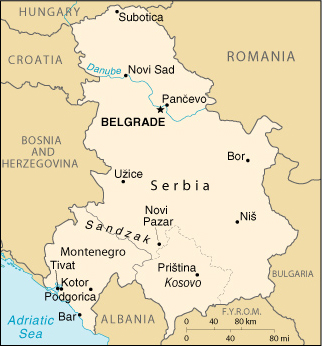
Facts About Yugoslavia
Background: The Kingdom of Serbs, Croats, and Slovenes was formed in 1918; its name was changed to Yugoslavia in 1929. Occupation by Nazi Germany in 1941 was resisted by various partisan bands that fought themselves as well as the invaders. The group headed by Marshal TITO took full control upon German expulsion in 1945. Although communist in name, his new government successfully steered its own path between the Warsaw Pact nations and the West for the next four and a half decades. In the early 1990s, post-TITO Yugoslavia began to unravel along ethnic lines: Slovenia, Croatia, and The Former Yugoslav Republic of Macedonia all declared their independence in 1991; Bosnia and Herzegovina in 1992. The remaining republics of Serbia and Montenegro declared a new “Federal Republic of Yugoslavia” in 1992 and, under President Slobodan MILOSEVIC, Serbia led various military intervention efforts to unite Serbs in neighboring republics into a “Greater Serbia.” All of these efforts were ultimately unsuccessful. In 1999, massive expulsions by Serbs of ethnic Albanians living in the autonomous republic of Kosovo provoked an international response, including the NATO bombing of Serbia and the stationing of NATO and Russian peacekeepers in Kosovo. Blatant attempts to manipulate presidential balloting in October of 2000 were followed by massive nationwide demonstrations and strikes that saw the election winner, Vojislav KOSTUNICA, replace MILOSEVIC.
Government type: republic
Capital: Belgrade
Currency: new Yugoslav dinar (YUM); note – in Montenegro the German deutsche mark is legal tender (1999)
Geography of Yugoslavia
Location: Southeastern Europe, bordering the Adriatic Sea, between Albania and Bosnia and Herzegovina
Geographic coordinates: 44 00 N, 21 00 E
Area:
total: 102,350 sq km
land: 102,136 sq km
water: 214 sq km
Land boundaries:
total: 2,246 km
border countries: Albania 287 km, Bosnia and Herzegovina 527 km, Bulgaria 318 km, Croatia (north) 241 km, Croatia (south) 25 km, Hungary 151 km, The Former Yugoslav Republic of Macedonia 221 km, Romania 476 km
Coastline: 199 km
Climate: in the north, continental climate (cold winters and hot, humid summers with well distributed rainfall); central portion, continental and Mediterranean climate; to the south, Adriatic climate along the coast, hot, dry summers and autumns and relatively cold winters with heavy snowfall inland
Terrain: extremely varied; to the north, rich fertile plains; to the east, limestone ranges and basins; to the southeast, ancient mountains and hills; to the southwest, extremely high shoreline with no islands off the coast
Elevation extremes:
lowest point: Adriatic Sea 0 m
highest point: Daravica 2,656 m
Natural resources: oil, gas, coal, antimony, copper, lead, zinc, nickel, gold, pyrite, chrome, hydropower, arable land
Land use:
arable land: 40%
permanent crops: 0%
permanent pastures: 20.7%
forests and woodland: 17.3%
other: 22% (1998 est.)
Natural hazards: destructive earthquakes
Environment – current issues: pollution of coastal waters from sewage outlets, especially in tourist-related areas such as Kotor; air pollution around Belgrade and other industrial cities; water pollution from industrial wastes dumped into the Sava which flows into the Danube.
Environment – international agreements:
party to: Air Pollution, Climate Change, Hazardous Wastes, Law of the Sea, Marine Dumping, Marine Life Conservation, Nuclear Test Ban, Ozone Layer Protection, Ship Pollution, Wetlands
signed, but not ratified: Biodiversity
Geography – note: controls one of the major land routes from Western Europe to Turkey and the Near East; strategic location along the Adriatic coast
People of Yugoslavia
Population: 10,829,175 (July 2005 est.)
Age structure:
0-14 years: 19.8%
15-64 years: 65.3%
65 years and over: 14.9%
Population growth rate: -0.27%
Birth rate: 12.61 births/1,000 population
Death rate: 10.54 deaths/1,000 population
Net migration rate: -4.71 migrant(s)/1,000 population
Infant mortality rate: 17.42 deaths/1,000 live births
Life expectancy at birth:
total population: 73.5 years
male: 70.57 years
female: 76.67 years
Total fertility rate: 1.75 children born/woman
Nationality:
noun: Serb(s); Montenegrin(s)
adjective: Serbian; Montenegrin
Ethnic groups: Serb 62.6%, Albanian 16.5%, Montenegrin 5%, Hungarian 3.3%, other 12.6% (1991)
Religions: Orthodox 65%, Muslim 19%, Roman Catholic 4%, Protestant 1%, other 11%
Languages: Serbian 95%, Albanian 5%
Literacy:
definition: age 15 and over can read and write
total population: 93%
male: 97.2%
female: 88.9% (1991)
History of Yugoslavia
BY 1990 YUGOSLAVIA, “the land of the South Slavs,” had become an international metaphor for ethnic strife and political fragmentation. Mikhail S. Gorbachev was described as attempting to keep the Soviet Union from becoming a “giant Yugoslavia” when Soviet republics began clamoring for independence in 1989. The metaphor was based on diversity in almost every aspect of Yugoslav national life–historical experiences, standard of living, the relationship of the people to the land, and religious, cultural, and political traditions–among the six republics and the two provinces that constituted the federal state.
In spite of ongoing conflict and fragmentation, many aspects of life in the country as a whole underwent significant improvement in the post-World War II period. A fundamentally agrarian society was industrialized and urbanized, and standards of living rose dramatically in most regions between 1945 and 1970. The literacy rate increased steadily, school instruction in the country’s several minority languages became widespread, and the university system expanded. A national health care system was developed to protect most Yugoslav citizens, although serious defects remained in rural medical care. The traditional patriarchal family, once the most important social institution in most regions, lost its influence as Yugoslavs became more mobile and as large numbers of women entered the work force. In these same years, Yugoslavia adopted a unique economic planning system (socialist self-management) and an independent foreign policy (nonalignment) to meet its own domestic and security needs. In these ways, by 1980 Yugoslavia had assumed many of the qualities of a modern European state. In the following decade, as Western Europe moved toward unification in the 1980s, acceptance into the new European community became an important national goal for Yugoslavia.
The 1980s brought persistent challenges to the concept of federating the South Slavs. Although the unlikelihood of a union between “Catholic, westward-looking Croatia and Slovenia” and “Orthodox, eastward-looking Serbia” had been viewed as highly unlikely long before secession occurred and civil crisis escalated in 1991, arguments for preserving at least a loose Yugoslav confederation retained much of the logic of earlier decades. All regions of Yugoslavia were substantially interdependent economically throughout the postwar period. Although regions differed greatly in economic level, in 1991 many of the most profitable markets for all republics remained inside Yugoslavia. More important, in modern history only Montenegro and Serbia had existed as independent states, and no republic had been self-sufficient since 1918.
Nevertheless, in 1991 the six republics–Bosnia and Hercegovina, Croatia, Macedonia, Montenegro, Serbia, and Slovenia–and the two provinces, Kosovo and Vojvodina, moved decisively away from whatever unity had been achieved in the postwar period. Given the lack of common values between Orthodox Serbs in Belgrade and Muslim Slavs in Sarajevo, or between private entrepreneurs in Slovenia and Leninists in Montenegro, many experts argued that the survival and modernization of the postwar Yugoslav state had been the result of a unique, dominating personality, Josip Broz Tito, whose regime had orchestrated all the social, economic, and foreign policy changes. According to that theory, post-Tito separation of Yugoslavia’s constituent parts was the natural course of events.
The fall of East European communism at the end of the 1980s intensified the forces of fragmentation in Yugoslavia by finally replacing the decrepit League of Communists of Yugoslavia, which had checked political expression of ethnic differences, with an open system that fostered such expression. But separation proved to be no less complex than continued federation. The first obstacle to dividing the federation was disagreement on the identity of its constituent parts–a result of centuries of ethnic intermixture and jurisdictional shifts. The second obstacle was the fact that the parts were not only diverse but also of unequal political and economic stature. Beginning in 1990, the Republic of Serbia, still run by a conventional communist regime, attempted to restrain fragmentation by reviving its historical tradition of geopolitical dominance in the Balkans. At the same time, the republics of Slovenia and Croatia used their economic superiority to seek independence on their own terms. The less endowed regions, caught between these contradictory aims, took sides or became pawns. The military and political events of 1991 then intensified the struggle of the diverse parts to achieve diverse aims. In the struggle, each of the political units had a different stake in, and a different perspective on, the theory that a post-Tito Yugoslav federation could work. Ominously, the intractable fighting of 1991 between Croats and Serbs was in many ways a continuation of their last bitter confrontation in World War II–supporting doubts that the Croats and Serbs could remain together in a single political structure.
The Yugoslav nation-state had begun as the dream of nineteenth-century idealists who envisioned a political union of the major South Slavic groups: the Croats, Serbs, Slovenes, and Bulgars. But by the twentieth century, each of those groups, as well as a number of smaller ethnic communities within their territories, had experienced centuries of very diverse cultural and political influences. Under these limitations, the Kingdom of the Serbs, Croats, and Slovenes (later renamed the Kingdom of Yugoslavia) was formed as a constitutional monarchy after World War I.
The interwar period was dominated by the competing claims of Serbian and Croatian politicians–the former dominating the government and supporting a strong centralized state, the latter agitating for regional autonomy. King Aleksandar, a genuine believer in the Yugoslav ideal, sought to unify his country by a variety of political measures, including dictatorship, but he was assassinated in 1934. Lacking a tradition of political compromise that might forge a national consensus, Yugoslavia remained divided as World War II began. More than three years of Nazi occupation yielded bloody fighting among three Yugoslav factions as well as with the invaders.
Two results of that war had particular impact on the postwar condition of Yugoslavia. The first was a vivid new set of memories to kindle hostility between Serbs and Croats, the majority of whom had fought on opposite sides in the occupation years; the second was the emergence of the unifying war hero Tito, who became dictator of a nonaligned communist federation. After declaring independence from the Soviet alliance in 1948, Tito also modified Yugoslavia’s Stalinist command economy by giving local worker groups limited control in a self-management system. Although ultimately dominated by the party, this system brought substantial economic growth between the early 1950s and the 1970s and made Yugoslavia a model for the nonaligned world.
Two economic policies unknown in orthodox communist countries contributed greatly to this growth. Allowing laborers to emigrate to Western Europe as guest workers brought substantial hard currency into Yugoslavia and relieved labor surpluses at home. And opening the country’s many scenic beaches and mountains to Western tourists provided a second reliable source of hard currency, which proved especially useful when other parts of the economy declined during the 1980s.
In his later years, Tito began restructuring his government to prepare it for the post-Tito era. The last decade of the Tito regime paved the way for a power-sharing government-by-consensus that he saw as the best hope of binding the federation after his regime ended. The 1974 Constitution gave substantial new power to the republics, which obtained veto power over federal legislation. This tactic also kept Tito’s potential rivals within small local fiefdoms, denying them national status. Both the government and the ruling LCY became increasingly stratified between federal and regional organizations; by Tito’s later years, the locus of political power was already diffused.
In the meantime, in 1966 the repressive national secret police organization of Aleksandar Rankovic had been dismantled, yielding political liberalization that led to major outbursts of nationalism in Kosovo (1968) and Croatia (1971). Although Tito quelled such movements, they restated existing threats to a strong, Serb-dominated central government, a concept still cherished by the Serbs. The 1974 Constitution further alarmed the Serbs by giving virtual autonomy to Serbia’s provinces, Kosovo and Vojvodina.
At Tito’s death in 1980, the promising Yugoslav economy was in decline because of international oil crises, heavy foreign borrowing, and inefficient investment policies. Economic reform, recognized throughout the 1980s as an imperative step, was consistently blocked during that decade by ever more diametrically opposed regional interests that found little incentive to compromise in the decentralized post-Tito federal structure. Thus, Slovenia and Croatia, already long separate culturally from the rest of the federation, came to resist the central government policy of redistributing their relatively great wealth to impoverished regions to the south. By 1990 this resistance was both economic (withholding revenue from the federal treasury) and political (threatening secession unless granted substantial economic and political autonomy within the federation).
The decade that followed the death of Tito was a time of gradual deterioration and a period that saw ethnic hostility boiling just below the surface of the Yugoslav political culture. The 1980s in Yugoslavia was also a decade singularly lacking strong political leadership in the Tito tradition, even at the regional level. When the wave of anticommunist political and economic reform swept Eastern Europe in the late 1980s, a variety of noncommunist parties challenged the monolithic Yugoslav communist system in place since 1945. In 1990 the LCY gave up its stranglehold on national political power. Long-overdue economic reforms began promisingly in 1990 but then slowed abruptly as regions defended their vested interests in the status quo. Meanwhile, in 1989 the Serbian communist Slobodan Milosevic had stepped into the Yugoslav power vacuum, striking a note of Serbian national hegemony that confronted a wide range of newly released nationalist forces in the other republics.
The Yugoslav republics were further separated by their varied reactions to the collapse of communism in Eastern Europe. Already pro-Western and economically dissatisfied, Slovenia and Croatia were the first republics to hold multiparty elections in early 1990; both elected noncommunist republic governments. Later in 1990, the republics of Macedonia and Bosnia and Hercegovina followed suit, but Serbia and Montenegro (Serbia’s most loyal ally in the federation) gave decisive victories to the communists in their republic elections. By that time, the LCY had split along republic lines and renounced its role as the leading institution in Yugoslav society–a position that since 1945 had been the foundation of the party’s legitimacy.
Already in the late 1980s, a large variety of small parties and factions had sprouted throughout the country. These groups advocated radical, nationalist, environmentalist, regional, and religious agendas. By the first republic elections in 1990, some of the new parties had formed coalitions. The largest of these in Croatia, the right-of-center Croatian Democratic Union, gained a solid parliamentary majority in that republic under Franjo Tudjman, who became president. In Slovenia, former communist Milan Kucan reached the presidency as leader of the diverse anticommunist Demos coalition. In general, although parties with very similar philosophies existed in two or more republics, issues of nationality largely prevented the union of such parties across republic borders.
Among Yugoslavia’s postwar trouble spots, the Serbian province of Kosovo was the most enduringly problematic both economically and politically. Always the poorest region in Yugoslavia (in spite of significant mineral and fuel reserves), Kosovo also led by a wide margin in birth rates and unemployment rates. Its territory was claimed on valid historical grounds by two fiercely nationalistic ethnic groups–the Kosovo Albanians and the Serbs. Although they constituted a shrinking minority in Kosovo, the Serbs and Montenegrins controlled the province government and suppressed separatist movements in the province– adding to the resentment of the Albanian majority. Sporadic anti- Yugoslav propaganda from neighboring Albania reminded the Kosovo Albanians of their subservient position. Extensive federal economic aid programs throughout the 1970s and 1980s failed to eliminate the economic basis of discontent. In February 1989, units of the Yugoslav People’s Army (YPA) and the federal militia were called in to quell the violence, and the province remained under occupation for the next three years.
The autonomy granted to Kosovo in the 1974 Constitution was virtually revoked by 1990. But resistance in Kosovo continued. Albanians boycotted the multiparty Serbian elections in December 1990, and in 1991 students and workers staged mass demonstrations against Serbianization of education and workplaces. Although Serbia had suspended the province legislature in mid-1990, Albanian delegates and intellectuals adopted a constitution for an independent republic of Kosovo, which was ratified in a referendum in September 1991. In response, Serbia amended its constitution to abolish the remnants of self-rule in Kosovo and in Serbia’s second province, Vojvodina. In 1990 drastic political reform in isolationist Albania gave Kosovo Albanians a new political option previously judged undesirable: joining Albania in a union of Greater Albania. By 1991 Kosovan separatist groups deemphasized the goal of republic status within Yugoslavia in favor of ethnic unity with their fellow Albanians. Such an eventuality threatened to spark war between Serbia and Albania as well as conflict with Macedonia, where over 25 percent of the population was Albanian in 1991.
The chaotic condition of Kosovo was a sensitive issue throughout postwar Yugoslav national politics. In the late 1980s, the issue assumed even greater dimensions, however. Milosevi used the threat of Albanian irredentism in Kosovo to rally Serbian ethnic pride behind his nationalist faction of the League of Communists of Serbia. In doing so, he won the presidency of Serbia. By 1990 this single-issue strategy had made Milosevic the most powerful political figure in post-Tito Yugoslavia. His open ambition for power and his assertion of Serbian hegemony soon added Macedonia and Bosnia and Hercegovina to the list of republics opposing Serbia in federal disputes. Despite widely held contempt for communism, however, opposition within Serbia remained fragmented and ineffectual until 1991. In the first multiparty elections in postwar Serbia, Milosevic easily won reelection in December 1990. Because he controlled almost all the Serbian media, his campaign was able to ignore the chaotic Serbian economy.
In October 1990, internal and external conditions caused Slovenia and Croatia to seek independence in some form. Accordingly, the two republics proposed that Yugoslavia be restructured as a loose confederation of states, each with national sovereignty and its own army and each conducting its own foreign policy. Following the model of the European Economic Community, the formula included monetary uniformity and a common market. Serbia immediately blocked the plan, arguing that the large number of Serbs living in republics other than Serbia would become citizens of foreign countries. Beginning in 1990, groups from several Serbian enclaves in Croatia, which declared themselves the Krajina Serbian Autonomous Region in March 1991, skirmished with local police and Croatian security forces. Milosevic was suspected of giving this movement substantial encouragement. By early 1991, large caches of illegally imported arms were held by both Serbs and Croats in multiethnic parts of Croatia, sharpening the threat of full-scale civil war.
Complex population patterns had been established in most of Yugoslavia by centuries of cultural, political, and military influences from outside–most notably the settlement policies of the long-dominant Habsburg and Ottoman empires. In fact, remaining ethnic patterns blocked a clean break from the federation by any republic except homogeneous Slovenia because large populations would be left behind unless borders were substantially redrawn. Even if Krajina had seceded from Croatia to join Serbia, for example, a substantial number of Serbs would have remained scattered in the Republic of Croatia.
Early in 1991, local conflicts in Krajina brought threats from Milosevic to defend his countrymen from oppression, and tension mounted between Serbia and Croatia. In April 1991, Krajina declared itself part of Serbia; the Croats responded by tightening economic pressure on the enclave and by threatening to redraw their own boundaries to include adjacent parts of Bosnia inhabited by a Croatian majority. In early 1991, however, moderates on both sides managed to defuse numerous local crises and prevent a broader conflict.
Meanwhile, a major indication of Serbian political diversity appeared in March 1991 when anticommunist Serbs held a mass demonstration in Belgrade against the economic bungling and dictatorial practices of the Milosevic government. When Milosevi demanded that the YPA quell the uprising in his capital, half of the eight-member State Presidency of Yugoslavia (nominally commander in chief of the armed forces) voted against the measure. Repeating his frequent claim that an anti-Serb coalition was endangering Yugoslavia, Milosevic secured the resignation of the other four members of the State Presidency (delegates from Serbia, Montenegro, Kosovo, and Vojvodina, all of whom he controlled). The crisis peaked when YPA troops mobilized but remained inactive, and Milosevic soon instructed the four delegates to resume their positions.
This confrontation seemingly dealt Milosevic a double blow: recanting his position toward the State Presidency was a major retreat for this most visible Yugoslav politician, and he lost substantial popularity among Serbs for his willingness to send the military against his own people. More important, the largely peaceful demonstrations set a precedent for public discussion of issues in Serbia, temporarily improving the prospects of a viable multiparty system in that republic.
In the months following the Belgrade demonstrations, the Serbs adopted a more conciliatory position in State Presidency- sponsored talks with representatives of the other republics on loosening the political structure of the federal system. Milosevic continued railing against Croatian nationalist ambitions, hoping to provoke an incident that would justify YPA occupation of Croatia. In May 1991, violence in Krajina subsided when the State Presidency and the republic presidents reached an accord on jurisdictions and borders in areas disputed between Serbs and Croats.
At the same time, the Slovenes and Croats had continued the slow, steady brinkmanship of their relations with the federal government. In February 1991, both republic assemblies had passed resolutions to dissolve the Yugoslav federation into separate states as the next step after their 1990 declarations of the right to secede. The respective assemblies also passed constitutional amendments declaring republic law supreme over federal law and essentially overriding the authority of the federal Constitution.
Then in June 1991, Croatia and Slovenia declared their independence, which set off a new chain of events. Under orders from the Serb-dominated federal Secretariat for National Defense but without approval of the State Presidency, YPA units occupied strategic points in Slovenia on the pretext of defending Yugoslav territorial integrity against an illegal secession. After encountering unexpectedly stiff resistance from Slovenian territorial defense forces, the YPA withdrew from Slovenian territory. YPA embarrassment at this military failure was only partially averted by a three-month cease-fire arranged by the European Community. When Slovenia reasserted its independence at the end of that time, the YPA made no response.
The cease-fire in Slovenia moved the conflict decisively from Slovenia to Croatia. Croatia’s declaration of independence enabled Milosevic to strengthen his position as defender of the Serbian minority in Croatia, which now seemed poised to absorb its Serbs into a separate state. Under the banner of anti- Croatian Serbian nationalism, economic failures and internal political differences became secondary; Milosevic abandoned his conciliatory approach and regained his political foothold.
The first phase of the 1991 Serb-Croat conflict pitted Serbian guerrillas against Croatian militia in the regions of Croatia with large Serbian populations. The YPA intervened, ostensibly as a peacekeeping force preventing a wider conflict. The YPA role soon evolved into one of support for the Serbs and then into active occupation of Croatian territory, with no pretense of neutrality. Croatian forces besieged and captured YPA warehouses and garrisons, somewhat improving their decidedly inferior military position. Through the summer and fall of 1991, prolonged, sometimes siege-like battles raged in Croatia between Serbian guerrillas and the YPA on one side and the Croatian militia on the other. The areas of heaviest fighting were the population centers of Slavonia in eastern Croatia and the ports along the Adriatic coastline. Between August and December, fourteen cease-fires were arranged but were shortly violated by both sides. The EC, which feared the spread of ethnic conflict into other parts of Europe, arranged most of those agreements; Gorbachev was the broker of one. An estimated 10,000 people, the majority of them Croats, were killed in the conflict in the last four months of 1991, and about 600,000 people became refugees. During most of that time, Serbian and YPA forces occupied about one-third of Croatia.
Throughout the political and economic turmoil of the late 1980s and 1990, two national institutions survived: the YPA and the federal government. After World War II, the YPA had played the theoretical role of defender of the country’s vaunted independent international position against attack from east or west. The YPA remained a bastion of conservative political influence after Cold War threats subsided and after electoral and legislative setbacks had sapped the unifying power of the LCY in 1990.
Led by an officer corps heavily Serbian and Montenegrin, the YPA took a dim view of rampant political diversification that threatened the power of the central government. Especially troubling were Slovenian and Croatian assertions of republic sovereignty over local military units, which threatened the very existence of the YPA organization. The failure of the old system also threatened the life-style of the YPA officer corps, which had enjoyed privileges such as summer houses on the Adriatic and generous pensions as part of their elite status in Yugoslav society.
Several times in 1990 and early 1991, Serbian and federal officials threatened to use YPA troops to restore order or protect federal property. In January 1991, Defense Secretary Veljko Kadijevic, a Serb, threatened to send YPA forces into Croatia when that republic formed its own military establishment, and in March YPA units confronted mass demonstrations in Belgrade. After preliminary mobilization in the Belgrade crisis, a divided high command announced that it would not intervene in political disputes unless armed conflict erupted in one of the republics. Although this statement deferred the often-mentioned scenario of a military coup to hold the nation together, in the spring of 1991 the YPA intervened in dozens of battles between separatist Serbs and Croatian authorities in Croatia.
Forces of change began to affect the YPA by 1990. Disintegration of the LCY removed the ideological unity of the YPA (whose political power had been exercised through representation in party organizations) and negated its role as defender of the ruling party. LCY activity in the army was officially outlawed in late 1990, and all political organization in the military was to be banned in 1991 legislation. One response to depolitization was the formation in November 1990 of the League of Communists of Yugoslavia-Movement for Yugoslavia by a group of retired YPA officers to replace the old LCY as an advocate of preserving the existing federal structure. This party advocated continued socialism and condemned Slovenia and Croatia as capitalist puppets.
In February 1991, Slovenia and Croatia proposed that new, depoliticized professional military organizations be formed in each republic, and the two republics announced that they would slash support for the national military budget. At the same time, federal military spending decreased because of budget deficits, and the reliability of conscripts from Kosovo and other areas came increasingly into question. All republics save Serbia and Montenegro refused to provide recruits for the 1991 YPA action in Croatia; when draft evasion became a problem even in Serbia, the long-term future of the YPA became doubtful. Although the YPA was the fifth-largest armed force in Europe in 1991, its command structure and resource base were shown to be unreliable in combat. Nevertheless, as the authority of the Yugoslav federal government dwindled and arbitration of disputes faltered, the on- site power of the military often negated the civilian authority meant to restrain it. The unpredictability of YPA forces became a major obstacle for United Nations (UN) diplomats seeking an effective cease-fire between Serbian and Croatian forces at the end of 1991.
Economic reform remained a critical national and regional need in 1991. When economist Ante Markovic became prime minister at the end of 1989, he inherited an inflation rate that had reached 2,600 percent that year and a national average personal income that had sunk to 1960s levels. Markovic’s two-step program began with harsh measures, such as closing unproductive plants, freezing wages, and instituting a tight monetary policy to clear away the remainder of the moribund state-subsidized system as soon as possible. Markovic also avidly sought new economic ties with Western Europe to reinvigorate Yugoslavia’s traditional policy of multilateral trade.
Once inflation had been curbed, phase two (July 1990) continued tight monetary control but sought to spur lagging productivity by encouraging private and foreign investment and unfreezing wages. Markovic applied his plan doggedly, convincing the Federal Assembly (Skupstina) to pass most of its provisions. He was aided by the lack of workable alternatives among his critics, by the international credibility of his consultation with economists of the International Monetary Fund, and by his personal popularity. Inflation ended when the dinar was pegged to the deutsche mark in December 1989, and new foreign loans and joint ventures in 1990 improved capital investment.
Although the end of inflation was very popular, however, plant closure and wage freezes were decidedly not so in regions where as many as 80 percent of plants were kept running only because of state subsidies. The Serbs opposed the plan from the beginning because their communist-dominated industrial management system was still in place, meaning that a new market economy would threaten many privileged positions. The Slovenes resented federalization of their funds to help run the program. In all republics, the immediate threat of mass unemployment blunted the drive to privatize and to peg wages to productivity. As in previous years, the republics saw a threat to their autonomy if they acceded to the requirements of such a sweeping federal program. By the fall of 1990, the optimism of Markovic’s first stage was replaced by the realization that many enterprises throughout the country either could not or would not discontinue their inefficient operations and would remain socially owned. Several major industries in Slovenia and Croatia were also still state controlled in 1991, although both republics drafted privatization laws that year.
The Serbian economy continued to decline at an especially rapid rate after the Markovic reforms. In December 1990, the Serbian government illegally transferred US$1.3 billion from the National Bank of Yugoslavia to bolster the sagging republic economy–defying federal economic authority, further alienating the other republics, and exposing the failure of reform in the Yugoslav banking system.
The proportion of unprofitable enterprises in the national economy (about one-third) did not change between 1989 and 1990. By 1991 bankruptcy declarations by such firms had virtually ceased. Strikes decreased only slightly from a 1989 high of 1,900. A wave of strikes, mostly by blue-collar workers, slowed the economy in all regions of Yugoslavia at the end of 1990. At that point, inflation had risen to 118 percent per year and was expected to continue to rise into 1991 spurred by the Serbian bank transaction and unauthorized printing of money by republics in the last half of 1990. In mid-1991 inflation rose further when the federal government began printing more money to cover escalating military costs. By that time, the government had lost control of federal tax revenues, which were collected by the republics. Unemployment was close to 25 percent in January 1991, and no improvement in the standard of living was foreseen in the near future. Industrial production that month was down 18.2 percent from January 1990, the greatest such drop in forty years. The failure to devise a new banking system after the previous system collapsed increased black market financial activity and discouraged guest workers abroad from making deposits.
Markovic warned consistently that continued chaos jeopardized economic reform and ultimately the federation itself. The IMF, for example, had joined the EEC in offering a combined loan of US$2 billion in early 1991, but continued unrest threatened that vital arrangement. Already in January 1991, the EEC postponed consideration of membership for Yugoslavia because of the internal situation. In early 1991, the United States cited human rights violations in Kosovo in threatening to end all bilateral economic aid. In the fall of 1991, the United States, the Soviet Union, and the EEC all threatened economic sanctions if diplomacy did not replace armed conflict in the Croatian crisis. The United States adopted sanctions against all the republics, but the EEC excluded Slovenia and Croatia.
Already seriously undermined by the constitutional power of the republics, the Yugoslav federal government apparatus was completely overshadowed in 1991. In December 1990, the Markovic cabinet had drafted an eleven-point emergency program of basic legislation to keep the federation running until the State Presidency could agree on political reform. Four months later, however, the Federal Assembly was still debating some of those laws. Markovic faced a delicate balance between using federal authority to hold the country together and heeding the demands of the economically vital Slovenes and Croats to loosen the federation. In early 1991, Markovic criticized those republics for arming separate paramilitary forces and passing resolutions of separation from Yugoslavia. By April 1991, a substantial movement in the Federal Assembly sought to unseat Markovic as prime minister. But the economic ties he had formed with the West were correctly seen by many politicians as the best way to save the Yugoslav economy, and Markovic remained because his ouster would likely end the prospect for such aid.
Unlike most countries of Eastern Europe, Yugoslavia had begun major economic reform before making any changes in government structure. A round of constitutional amendments in 1990 dealt only with economic matters, leaving political power relationships untouched. Although Markovic had planned to call elections for a Federal Assembly to begin work on a new constitution in 1990, he achieved no consensus on the timing or form of those elections. Among other changes, the new constitution presumably would have revamped Tito’s unworkable system of rotating chief executives. In March 1991, special “professional working groups,” including members from each republic, began drafting for the State Presidency proposals on political and economic issues for possible use as constitutional amendments. The first proposal outlined a new federal structure; the second proposed a new procedure for a republic to secede from the federation–two of the most volatile issues of the “transformation period.”
The weakness of the national executive structure was revealed by the Belgrade demonstrations, when the eight-member State Presidency was essentially obliterated by walkouts and resignations orchestrated by Milosevic. After the full membership was reestablished, fruitless constitutional discussions and “summit meetings” further damaged confidence in the State Presidency. By July 1991, unauthorized YPA actions in Slovenia and Croatia had removed de facto command of the military from the State Presidency, and national executive authority had virtually disappeared.
The events of 1991 forced all the republics to adjust their positions and defend their own interests first, lessening the probability of reversing regionalization and reestablishing a credible federal government backed by a reframed constitution. The diametrically opposed political blueprints of the centralist republics (Serbia and Montenegro) and the autonomist republics (Slovenia and Croatia, later joined by Macedonia and Bosnia and Hercegovina) meant that any attempt to redistribute power was very likely to be deadlocked.
While Serbia, Croatia, and Slovenia occupied center stage in 1991, the other three republics–Montenegro, Macedonia, and Bosnia and Hercegovina–divided their attention between local economic and social problems and the transformation crisis of the federation. After moving gradually toward supporting republic sovereignty, Macedonia and Bosnia and Hercegovina were forced by circumstances in the fall of 1991 to declare their own independence. Montenegro remained allied with Serbia in support of a strong central government. Unlike Slovenia and Croatia, those republics had little hope of surviving independently, and all contained precariously balanced ethnic mixtures (the Montenegrin population included a total of 20 percent Albanians and Muslim Slavs).
In December 1990, Bosnia and Hercegovina elected a multiparty assembly in which the noncommunist Muslim Party for Democratic Action (PDA) won a plurality of the 240 seats, and PDA president Alija Izetbegovic became the first noncommunist president of the republic. The new assembly contained an ethnic mix representative of the overall population: 99 Muslim Slavs, 83 Serbs, and 50 Croats. Peaceful transition to a multiparty system in 1990 was considered a triumph of the three major ethnic parties and a promising indication that coalition building among them might work. In discussing the republic’s position on a new federal structure in early 1991, the Serbian party advocated more centralism; the other two parties followed the Croatian and Slovenian recipe for a loose confederation. In the first year of his presidency, Izetbegovic was a strong voice of conciliation on national constitutional issues, attempting to preserve political relations with all factions.
Because of its ethnic makeup, Bosnia and Hercegovina was a central point of contention between Serbs and Croats. Both sides had substantial territorial claims that threatened to destabilize the republic’s internal politics. Serbs feared that Croatia would take Croatian-dominated parts of Bosnia and Hercegovina with it if it seceded; Croats feared leaving those parts to the mercy of the Serbs. The Muslim Slavs, in turn, remembered that Croatia and Serbia had split Bosna and Hercegovina between them before World War II, so the Muslim Slavs feared reabsorption into those states. Within the six-member republic presidency, accusations and threats mimicked those exchanged by the factions in the federal executive branch.
In mid-1991 the central location of Bosnia and Hercegovina between Serbia and Croatia threatened to make it a second major military front in the Serb-Croat confrontation. When Croatian and Muslim Slav legislators sought to avoid a Serbian takeover by declaring the sovereignty of the republic in October, they antagonized their Serbian counterparts and exacerbated the threat of civil war. By that time, a large part of the population was armed and in the same explosive state as were the Serbian enclaves in Croatia a few months earlier.
Macedonia, least developed of the six republics, began 1991 in worsening economic condition (official unemployment was 26 percent, but likely much higher in reality, and per capita earnings were 70 percent of the national average) and with new manifestations of old problems: nationalism and ethnic tension. Politically, Macedonia had supported the Markovic economic reforms wholeheartedly; in the republic elections of November 1990, all six major party platforms advocated a multiparty parliamentary system and a market economy. In voting for their reconfigured unicameral assembly of 120, Macedonians gave a plurality to the noncommunist nationalist coalition Internal Macedonian Revolutionary Organization-Democratic Party for National Unity, with the League of Communists of Macedonia a close second among the sixteen parties that posted candidates.
Anticommunism was much weaker in Macedonia than in Croatia and Slovenia. In 1945 Tito’s recognition of Macedonia as a republic had freed the Macedonians from Serbian control and inspired strong loyalty to the Yugoslav federation. Nevertheless, in December 1990 a number of Macedonian leaders, including Macedonia’s delegate to the State Presidency, Vasil Tupurkovski, and Ljupco Georgievski, head of the nationalist coalition, expressed solidarity with Slovenian and Croatian declarations of autonomy. At the same time, however, they cautioned that Macedonia was not ready for such a move. Because Macedonians had been treated as Serbs (and Macedonia had been part of Serbia) before World War II, the aggressive nationalism of Milosevi brought alarm and hostility that was intensified by a new wave of Macedonian nationalism. Beginning in November 1988, a series of mass demonstrations demanded that Macedonia’s Balkan neighbors, Greece and Bulgaria, recognize Macedonia’s status as a Yugoslav republic (they had not done so because those countries had long- standing claims to parts of Macedonia) and treat their own Macedonian citizens as a separate minority. A significant faction in the republic advocated reuniting the Macedonians of all three countries in a new political entity.
Another ethnic issue also festered in 1991. The illegal influx of as many as 150,000 Albanian refugees from Kosovo to Macedonia brought resentment and calls for closing the borders. Especially in Skopje, Albanians were refused status as a separate nationality and barred from some types of employment; demonstrations were forbidden. But the Albanian Party for Democratic Prosperity elected seventeen delegates to the Macedonian assembly in the 1990 republic election. This significant departure from the total repression of the former communist regime in Macedonia brought hope that Albanian-Slav hostility would not spill over from Kosovo into Macedonia.
Montenegro had been the first Yugoslav republic where communist leaders held talks with the political opposition; in January 1990, Montenegro proposed a nationwide multiparty system for Yugoslavia. The talks grew out of the “Montenegrin Uprising” of 1989, in which mass demonstrations unseated the entire communist leadership and replaced it with a generation of younger communists seen as antibureaucratic reformers. But reformist zeal decreased in the next two years; republic multiparty elections were finally held in December 1990, but the League of Communists of Montenegro won 86 of the 125 assembly seats in a process marked by controversy and irregularities. Its candidate, Momir Bulatovic, was elected president. Of the seven parties posting candidates in the election, four won seats.
In the first multiparty election, the major Montenegrin parties agreed on several key positions: a sovereign Montenegro within a united Yugoslav federation; conversion to a market economy, with partial or complete rejection of socialism; and integration of Yugoslavia into the EEC. Issues of dispute were the nature and pace of economic reform, the structure of the new federal Yugoslavia, and the advisable strategy for Montenegro should the federation dissolve. In spite of the reformist tendency of Montenegrin communists, the republic backed Milosevi in most of his disputes with the northern republics. In March 1991, Prime Minister Milo Djukanovic of Montenegro joined Milosevic in a statement that expressed identical goals for Yugoslavia as a federation and for their respective republics. In the second half of 1991, Montenegro supported the Serbian diplomatic and military positions against Croatia, and YPA troops staged maneuvers against Croatia’s Adriatic coastal cities from bases in Montenegro.
October 31, 1991
* * *
In the months following completion of this manuscript, Serbian guerrillas and YPA forces continued to advance into Croatia and pound Croatian strongholds in Vukovar, Dubrovnik, Osijek, and other locations. Vukovar, in the northeast region of Croatia, was designated for all-out defense by the Croats; after intense bombardment and almost complete destruction, the city surrendered in November. The medieval structures of Dubrovnik were threatened by heavy Serbian bombardment, arousing international protest. Croatian blockades of YPA garrisons and ostensible Croatian atrocities were the pretext for continued YPA action at the same time as Croatia requested that the EC or the UN negotiate a settlement. De facto control of the YPA came into question in November, when Milosevic and Tudjman both requested that a UN peacekeeping force separate the two sides, but continued fighting prevented such a force from being inserted. The failure of EC-arranged cease-fires between October and December brought speculation that the YPA was fighting independently for its own survival, beyond the control of either the federal government or Milosevic’s Serbian government. YPA spokesmen admitted that some units were moving outside the central command. Meanwhile, maintenance of the YPA effort put new stress on the already staggering national economy.
No agency of the federal government asserted influence over the struggle in Croatia at the end of 1991. The State Presidency, nominally in command of the YPA, lost its last vestige of ethnic balance when Croat Stipe Mesic resigned his position as president of the State Presidency in December, leaving the national executive in the hands of pro-Serbian delegates. In November one chamber of the Federal Assembly voted no confidence in Prime Minister Markovic, and the second chamber threatened to force his resignation by following suit. Markovic resigned in December to protest the proposed 1992 “war budget,” over 80 percent of which was designated for the military.
Thus, control of events moved even further from the center to the republics, which showed no inclination to cede autonomy for the sake of reestablishing a credible central government. Instead, distrust and mutual hostility grew as each jurisdiction protected its own interests in the new power vacuum. Slovenia and Croatia entered 1992 anticipating recognition of their independence by the EC, while Montenegro, until the fall of 1991 the strongest backer of Serbian military action in Croatia, established an independent position in favor of a peaceful resolution of the national crisis. In October Montenegro split from Serbia by supporting an EC call for transformation of Yugoslavia into an association of sovereign republics.
Meanwhile, radical nationalist factions in Croatia and Serbia urged annihilation of the other side and threatened Milosevic and Tudjman with overthrow if they reached a compromise peace agreement. Vuk Drackovic, a radical Serbian nationalist opponent of Milosevic, openly compared Croatian acts in the new civil war with atrocities by the Nazi-allied Croatian Ustase terrorists in World War II. For the governments of both Serbia and Croatia, policy making became the hostage of extremist sentiments aroused by the leaders themselves.
Croatia, meanwhile, had pressed hard for EC recognition as a key step toward gaining UN membership and full national status in possible UN-sponsored negotiations with the Serbs. In December 1991, the EC, under strong pressure from Germany, announced that it would recognize the independence of Slovenia, Croatia, and any other Yugoslav republic satisfying human rights and political requirements; the EC also officially named Serbia the aggressor in the Croatian conflict. Some EC members and the United States, however, feared that de jure Croatian independence would further inflame the conflict with Serbia or extend it into multiethnic Bosnia and Hercegovina.
Milosevic reacted to the EC announcement by issuing charges that German expansionist ambitions were behind the EC position and that international recognition of Yugoslav republics would expand the civil war. At the end of 1991, Serbia sought to consolidate the advantages gained in recent months by settling Serbs in areas deserted by their Croatian populations, and plans were announced to make Krajina a separate Yugoslav republic.
At the beginning of 1992, most of Yugoslavia’s major political and economic questions remained unanswered. One republic, Slovenia, seemingly had enough resources and a geopolitical position suitable to survival as an independent state. In 1991 it had already strengthened cultural and economic relations with West European nations, especially Austria and Germany, and had shed much of the remnants of the old Yugoslav centralized economic system–steps that promised rapid integration into Western market systems. In 1991 Slovenian officials, especially Foreign Secretary Dimitrij Rupel, traveled widely in the West to overcome international reluctance to recognize Slovenia. When initial Serbian resistance to its independence ended, Slovenia was completely free of political and economic obligations to the Yugoslav federation.
Croatia, with its long history of nationalist independence movements and a relatively prosperous economy, remained entangled in the militant demands of its Serbian minority and ultranationalist Croats, its economy disrupted by the Serbian occupation, destruction of urban centers, and a massive refugee movement. Croatia’s hopes for true independence rested on international mediation in 1992 of its thorny territorial disputes with Serbia. Following the fifteenth cease-fire, imposed in December 1991, Serbia and the YPA agreed to allow a UN peacekeeping force to assume the role of protecting the Serbs in Croatia prior to final settlement and to remove all occupation forces from Croatian territory. The UN force headquarters was to be in Banja Luka, Bosnia, midway between the battle areas of Slavonia and the Adriatic coast. In January 1992, the main obstacle to introducing the UN force was continued military activity by irregular Serbian forces not controlled by the YPA or by any government.
Serbia’s resources were increasingly taxed by the war with Croatia, by the decrepit state of its economy, and by growing isolation in Europe. Increased separatist activity in Kosovo threatened to open a second front for the YPA, and opposition groups also grew stronger in Vojvodina. For these reasons, Serbia revised its goals late in 1991 to include domination of a reduced Yugoslav federation. Serbian planners envisioned that the state would include most of the Serbian nationals in Croatia and Bosnia and Hercegovina, loyal ally Montenegro, and Macedonia. As 1991 ended, the Milosevic government faced increased pressure from democratic opposition factions to end the war, reform the economy, and follow the other republics seeking the benefits of integration into the European community. At that time, 50 percent of Serbs polled described war against Croatia as a mistake. Although the Milosevic government continued its anti-Croatian rhetoric, its conditions for a UN peacekeeping force had eased considerably by January 1992.
Meanwhile, to avoid being absorbed in the new Serbian federation, Macedonia and Bosnia and Hercegovina reaffirmed their 1991 declarations of sovereignty by requesting recognition by the EC, which promised to use human rights and commitment to democracy as the standards for recognition. European support was especially important for Bosnia and Hercegovina, where an uneasy peace among the Serbs, Croats, and Muslim Slavs was threatened by proposals to unite all Serbs in a single nation. Although Montenegro also showed discomfort at the prospect of Serbian domination, it did not leave the Serbian sphere by immediately seeking EC recognition. For all the actors, including Serbia, an important goal for 1992 was to cultivate a positive image and communication with the outside world. For the less powerful, this course could confer the recognition that might protect them from being swallowed into a new Greater Serbia. Some signs indicated improvement in the political culture, however. All five non- Serbian republics entered 1992 under competent popularly elected leaders: Tudjman in Croatia, Izetbegovic in Bosnia and Hercegovina, Kiro Gligorov in Macedonia, Bulatovic in Montenegro, and Kucan in Slovenia.
The Croatian conflict was the bloodiest war in Europe since World War II. Because the United States was far removed and the Soviet Union had ceased to exist, the military and political resolution of the conflict became an entirely European problem. The conflict accelerated a natural movement of the republics toward the economic stability of the EC and officially ended the era of Titoist nonalignment. Yugoslavia, a paragon of economic self-sufficiency twenty years before, had finally dissolved into units with sharply varying potential prosperity. Although these units had as little in common in 1992 as they had had in 1972, all of them, including Serbia, looked to Western Europe to help them salvage some of their postwar gains in the new and uncertain era that lay ahead in 1992.
Yugoslavia Economy
Economy – overview: The swift collapse of the Yugoslav federation in 1991 was followed by highly destructive warfare, the destabilization of republic boundaries, and the breakup of important interrepublic trade flows. Output in Yugoslavia dropped by half in 1992-93. Like the other former Yugoslav republics, it had depended on its sister republics for large amounts of energy and manufactures. Wide differences in climate, mineral resources, and levels of technology among the republics accentuated this interdependence, as did the communist practice of concentrating much industrial output in a small number of giant plants. The breakup of many of the trade links, the sharp drop in output as industrial plants lost suppliers and markets, and the destruction of physical assets in the fighting all have contributed to the economic difficulties of the republics. Hyperinflation ended with the establishment of a new currency unit in June 1993; prices were relatively stable from 1995 through 1997, but inflationary pressures resurged in 1998. Reliable statistics continue to be hard to come by, and the GDP estimate is extremely rough. The economic boom anticipated by the government after the suspension of UN sanctions in December 1995 has failed to materialize. Government mismanagement of the economy is largely to blame, but the damage to Yugoslavia’s infrastructure and industry by the NATO bombing during the war in Kosovo have added to problems. All sanctions now have been lifted. Yugoslavia is in the first stage of economic reform. Severe electricity shortages are chronic, the result of lack of investment by former regimes, depleted hydropower reservoirs due to extended drought, and lack of funds. GDP growth in 2000 was perhaps 15%, which made up for a large part of the 20% decline of 1999.
GDP: purchasing power parity – $24.2 billion (2000 est.)
GDP – real growth rate: 15% (2000 est.)
GDP – per capita: purchasing power parity – $2,300 (2000 est.)
GDP – composition by sector:
agriculture: 20%
industry: 50%
services: 30% (1998 est.)
Inflation rate (consumer prices): 42% (1999 est.)
Labor force: 1.6 million (1999 est.)
Unemployment rate: 30% (2000 est.)
Industries: machine building (aircraft, trucks, and automobiles; tanks and weapons; electrical equipment; agricultural machinery); metallurgy (steel, aluminum, copper, lead, zinc, chromium, antimony, bismuth, cadmium); mining (coal, bauxite, nonferrous ore, iron ore, limestone); consumer goods (textiles, footwear, foodstuffs, appliances); electronics, petroleum products, chemicals, and pharmaceuticals.
Industrial production growth rate: -22% (1999 est.)
Electricity – production: 34.455 billion kWh (1999)
Electricity – production by source:
fossil fuel: 70%
hydro: 30%
nuclear: 0%
other: 0% (1999))
Electricity – consumption: 33.006 billion kWh (1999)
Agriculture – products: cereals, fruits, vegetables, tobacco, olives; cattle, sheep, goats
Exports: $1.5 billion (1999)
Exports – commodities: manufactured goods, food and live animals, raw materials
Exports – partners: Bosnia and Herzegovina, Italy, The Former Yugoslav Republic of Macedonia, Germany (1998)
Imports: $3.3 billion (1999)
Imports – commodities: machinery and transport equipment, fuels and lubricants, manufactured goods, chemicals, food and live animals, raw materials
Imports – partners: Germany, Italy, Russia, The Former Yugoslav Republic of Macedonia (1998)
Debt – external: $14.1 billion (1999 est.)
Currency: new Yugoslav dinar (YUM); note – in Montenegro the German deutsche mark is legal tender (1999)
Map of Yugoslavia