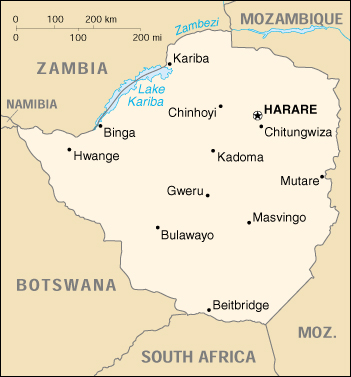
Facts About Zimbabwe
Background: The UK annexed Southern Rhodesia from the South Africa Company in 1923. A 1961 constitution was formulated to keep whites in power. In 1965 the government unilaterally declared its independence, but the UK did not recognize the act and demanded voting rights for the black African majority in the country (then called Rhodesia). UN sanctions and a guerrilla uprising finally led to free elections in 1979 and independence (as Zimbabwe) in 1980. Robert MUGABE, the nation’s first prime minister, has been the country’s only ruler (as president since 1987) and has dominated the country’s political system since independence.
Government type: parliamentary democracy
Capital: Harare
Currency: 1 Zimbabwean dollar (Z$) = 100 cents
Geography of Zimbabwe
Location: Southern Africa, between South Africa and Zambia
Geographic coordinates: 20 00 S, 30 00 E
Area:
total: 390,580 sq km
land: 386,670 sq km
water: 3,910 sq km
Land boundaries:
total: 3,066 km
border countries: Botswana 813 km, Mozambique 1,231 km, South Africa 225 km, Zambia 797 km
Coastline: 0 km (landlocked)
Maritime claims: none (landlocked)
Climate: tropical; moderated by altitude; rainy season (November to March)
Terrain: mostly high plateau with higher central plateau (high veld); mountains in east
Elevation extremes:
lowest point: junction of the Runde and Save rivers 162 m
highest point: Inyangani 2,592 m
Natural resources: coal, chromium ore, asbestos, gold, nickel, copper, iron ore, vanadium, lithium, tin, platinum group metals
Land use:
arable land: 7%
permanent crops: 0%
permanent pastures: 13%
forests and woodland: 23%
other: 57% (1993 est.)
Irrigated land: 1,930 sq km (1993 est.)
Natural hazards: recurring droughts; floods and severe storms are rare
Environment – current issues: deforestation; soil erosion; land degradation; air and water pollution; the black rhinoceros herd – once the largest concentration of the species in the world – has been significantly reduced by poaching
Environment – international agreements:
party to: Biodiversity, Climate Change, Desertification, Endangered Species, Law of the Sea, Ozone Layer Protection
signed, but not ratified: none of the selected agreements
Geography – note: landlocked; the Zambezi forms a natural riverine boundary with Zambia; in full flood (February-April) the massive Victoria Falls on the river forms the world’s largest curtain of falling water
People of Zimbabwe
Primarily of the Bantu group of south and central Africa, the black Zimbabweans are divided into two major language groups, which are subdivided into several ethnic groups. The Mashona (Shona speakers), who constitute about 75% of the population, have lived in the area the longest and are the majority language group. The Matabele (Sindebele speakers), representing about 20% of the population and centered in the southwest around Bulawayo, arrived in within the last 150 years. An offshoot of the South African Zulu group, they maintained control over the Mashona until the white occupation of Rhodesia in 1890.
More than half of the white Zimbabweans, primarily of English origin, arrived in Zimbabwe after World War II. Afrikaners from South Africa and other European minorities, including Portuguese from Mozambique, are also present. Until the mid-1970s, there were about 1,000 white immigrants per year, but from 1976 to 1985 a steady emigration resulted in a loss of more than 150,000, leaving about 100,000 in 1992. English, the official language, is spoken by the white population and understood, if not always used, by more than half of the black population.
Population: 12,746,990 (July 2005 est.)
Age structure:
0-14 years: 39.64%
15-64 years: 56.82%
65 years and over: 3.54%
Population growth rate: 0.26%
Birth rate: 25 births/1,000 population
Death rate: 22.43 deaths/1,000 population
Net migration rate: 0 migrant(s)/1,000 population
note: there is a small but steady flow of Zimbabweans into South Africa in search of better paid employment
Infant mortality rate: 62.25 deaths/1,000 live births
Life expectancy at birth:
total population: 37.78 years
male: 39.18 years
female: 36.34 years
Total fertility rate: 3.34 children born/woman
Nationality:
noun: Zimbabwean(s)
adjective: Zimbabwean
Ethnic groups: African 98% (Shona 71%, Ndebele 16%, other 11%), white 1%, mixed and Asian 1%
Religions: syncretic (part Christian, part indigenous beliefs) 50%, Christian 25%, indigenous beliefs 24%, Muslim and other 1%
Languages: English (official), Shona, Sindebele (the language of the Ndebele, sometimes called Ndebele), numerous but minor tribal dialects
Literacy:
definition: age 15 and over can read and write English
total population: 85%
male: 90%
female: 80% (1995 est.)
History of Zimbabwe
Early History
Archaeologists have found stone-age implements and pebble tools in several areas of Zimbabwe, a suggestion of human habitation for many centuries, and the ruins of stone buildings provide evidence of early civilization. The most impressive of these sites is the “Great Zimbabwe” ruins, after which the country is named, located near Masvingo. Evidence suggests that these stone structures were built between the 9th and 13th centuries A.D. by indigenous Africans who had established trading contacts with commercial centers on Africa’s southeastern coast.
In the 16th century, the Portuguese were the first Europeans to attempt colonization of south-central Africa, but the hinterland lay virtually untouched by Europeans until the arrival of explorers, missionaries, ivory hunters, and traders some 300 years later. Meanwhile, mass migrations of indigenous peoples took place. Successive waves of more highly developed Bantu peoples from equatorial regions supplanted the original inhabitants and are the ancestors of the region’s Africans today.
British Settlement And Administration
In 1888, Cecil Rhodes obtained a concession for mineral rights from local chiefs. Later that year, the area that became Southern and Northern Rhodesia was proclaimed a British sphere of influence. The British South Africa Company was chartered in 1889, and the settlement of Salisbury (now Harare, the capital) was established in 1890. In 1895, the territory was formally named Rhodesia after Cecil Rhodes under the British South Africa Company’s administration.
Following the abrogation of the company’s charter in 1923, Southern Rhodesia’s white settlements were given the choice of being incorporated into the Union of South Africa or becoming a separate entity within the British Empire. The settlers rejected incorporation, and Southern Rhodesia was formally annexed by the United Kingdom that year. Until 1980, Rhodesia was an internally self-governing colony with its own legislature, civil service, armed forces, and police. Although Rhodesia was never administered directly from London, the United Kingdom always retained the right to intervene in the affairs of the colony, particularly in matters affecting Africans.
After 1923, European immigrants concentrated in developing Rhodesia’s rich mineral resources and agricultural potential. The settlers’ demand for more land led in 1934 to the passage of the first of a series of land apportionment acts that reserved certain areas for Europeans.
In September 1953, Southern Rhodesia was joined in a multiracial Central African Federation with the British protectorate of Northern Rhodesia and Nyasaland in an effort to pool resources and markets. Although the federation flourished economically, it was opposed by the African population who feared they would not be able to achieve self-government with the federal structure dominated by White Southern Rhodesians. The federation was dissolved at the end of 1963 after much crisis and turmoil, and Northern Rhodesia and Nyasaland became the independent states of Zambia and Malawi in 1964.
Unilateral Declaration Of Independence (UDI)
The European electorate in Rhodesia, however, showed little willingness to accede to African demands for increased political participation and progressively replaced more moderate party leaders. In April 1964, Prime Minister Winston Field, accused of not moving rapidly enough to obtain independence from the United Kingdom, was replaced by his deputy, Ian Smith. Prime Minster Smith led his Rhodesian Front Party to an overwhelming victory in the 1965 elections, winning all 50 of the first roll seats and demoralizing the more moderate European opposition.
Although prepared to grant independence to Rhodesia, the United Kingdom insisted that the authorities at Salisbury first demonstrate their intention to move toward eventual majority rule. Desiring to keep their dominant position, the white Rhodesians refused to give such assurances. On November 11, 1965, after lengthy and unsuccessful negotiations with the British Government, Prime Minister Smith issued a Unilateral Declaration of Independence (UDI) from the United Kingdom.
Post-UDI Events
The British government considered the UDI unconstitutional and illegal but made clear that it would not use force to the rebellion. On November 12, 1965, the United Nations also determined the Rhodesian government and UDI to be illegal and called on member states to refrain from assisting or recognizing the Smith regime. The British government imposed sanctions on Rhodesia and requested other nations to do the same.
On December 16, 1966, the UN Security Council, for the first time in this history, imposed mandatory economic sanctions on a state. Rhodesia’s primary exports including ferrochrome and tobacco, were replaced on the selective sanctions list, as were shipments of arms, aircraft, motor vehicles, petroleum, and petroleum products to Rhodesia. On May 29, 1968, the Security Council unanimously voted to broaden the sanctions by imposing an almost total embargo on all trade with, investments in, or transfers of funds to Rhodesia and imposed restrictions on air transport to the territory.
In the early 1970s, informal attempts at settlement were renewed between the United Kingdom and the Rhodesian administration. Following the April 1974 coup in Portugal and the resulting shifts of power in Mozambique and Angola, pressure on the Smith regime to negotiate a peaceful settlement began to increase. In addition, sporadic antigovernment guerilla activity which began in the late 1960s, increased dramatically after 1972, causing destruction, economic dislocation, casualties, and a slump in white morale. In 1974, the major African nationalists groups–the Zimbabwe African Peoples Union (ZAPU), and the Zimbabwe African National Union (ZANU), which split away from ZAPU in 1963–were united into the “Patriotic Front” and combined their military forces, at least nominally.
In 1976, because of a combination of embargo-related economic hardships, the pressure of guerilla activity, independence and majority rule in the neighboring former Portuguese territories, and a U.K.-U.S. diplomatic initiative, the Smith government agreed in principle to majority rule and to a meeting in Geneva with black nationalist leaders to negotiate a final settlement of the conflict. Blacks represented at the Geneva meeting included ZAPU leader Joshua Nkomo, ZANU leader Robert Mugabe, UANC chairman bishop Abel Muzorewa, and former ZANU leader Rev. Nadabaningi Sithole. The meeting failed to find a basis for agreement because of Smith’s inflexibility and the inability of the black leaders to form a common political front.
On September 1, 1977 a detailed Anglo-American plan was put forward with proposals for majority rule, neutrally administered with pre-independence elections, a democratic constitution and the formation of an integrated army. Reactions were mixed, but no party rejected them. In the interim, on March 3, 1978, the Smith administration signed the “internal settlement” agreement in Salisbury with Bishop Muzorewa, Rev. Sithole, and Chief Jeremiah Chirau. The agreement provided for qualified majority rule and elections with universal suffrage. Following elections in April 1979, in which his UANC party won a majority, Bishop Muzorewa assumed office on June 1, becoming “Zimbabwe-Rhodesia’s” first black prime minister. However, the installation of the new black majority government did not end the guerilla conflict that had claimed more than 20,000 lives since 1972.
Shortly after British Prime Minister Margaret Thatcher’s conservative government took power in May 1979, the British began a new round of consultations that culminated in an agreement among the Commonwealth countries as the basis for fresh negotiations among the parties and the British involving a new constitution, free elections and independence.
The British and the African parties began deliberations on a Rhodesian settlement at Lancaster house in London on September 10, 1979. On December 10, 1979, in preparation for the transition under British authority to officially recognized independence, the “Zimbabwe-Rhodesia” reverted de facto to colonial status. On December 12, British Governor Lord Christopher Soames arrived in Salisbury to reassert British authority over the colony. His arrival signaled the end of the Rhodesian rebellion and the “internal settlement,” as well as the beginning of Zimbabwe’s transition to independence. The United Kingdom lifted all remaining sanctions against Zimbabwe that day. The United States lifted sanctions effective December 16.
On December 21, after three months of hard bargaining, the parties signed an agreement at Lancaster House calling for a cease-fire, new elections, a transition period under British rule, and a new constitution implementing majority rule while protecting minority rights. The agreement specified that upon the granting of independence, the country’s name would be Zimbabwe. The same day, the UN Security Council endorsed the settlement agreement and formally voted unanimously to call on member nations to remove sanctions.
During the transition period, nine political parties campaigned for the February 27-29 pre-independence elections. The elections were supervised by the British government and monitored by hundreds of observers, most of whom concluded that, under the prevailing circumstances, the elections were free and fair and reflected the will of the people. Robert Mugabe’s ZANU(PF) party won an absolute majority and was asked to form Zimbabwe’s first government.
In a series of public statements during the transition period, Prime Minister Mugabe indicated that he was committed to a process of national reconciliation and reconstruction as well as moderate socioeconomic change. His priorities were to integrate the various armed forces, reestablish social services and education in rural areas, and resettle the estimated one million refugees and displaced persons. Mugabe also announced that his government would begin investigating ways of reversing past discriminatory policies in land distribution, education, employment, and wages.
Mugabe stated that Zimbabwe would follow a non-aligned foreign policy while seeking assistance from all actions and would pursue a pragmatic relationship with South Africa. He noted that while Zimbabwe opposed apartheid and would support democratic change in South Africa, it would not provide bases for anti-South African guerillas.
The British Government formally granted independence to Zimbabwe on April 18, 1980. Most nations recognized Zimbabwe following independence. The United States was to first nation to open an embassy in Salisbury on that day. Parliament convened for the first time on May 13, 1980. Zimbabwe became a member of the United Nations on August 25, 1980.
In seeking national reconciliation, Prime Minister Mugabe’s first cabinet comprised members of ZANU-PF, PF-ZAPU, and independent white members of parliament (MPs) and senators. The government embarked on an ambitious reconstruction and development program and instituted increases in minimum wages. Land redistribution proceeded under four experimental models on land that the government had purchased at market rates from willing sellers.
Zimbabwe Since Independence
Prime Minister Mugabe’s policy of reconciliation was generally successful during the country’s first two years of independence, as the former political and military opponents began to work together. Although additional blacks were hired to fill new places in the civil service, there was no retribution for those whites who had worked for the Smith regime. Smith and many of his associates held seats in the parliament where they participated freely in debates. Likewise, Joshua Nkomo, Mugabe’s rival as leader of the nationalist forces, was included in the first cabinet along with several other members of PF-ZAPU.
Splits soon developed, however. In 1981, several MPs from Smith’s party left to sit as “independents,” signifying that they did not automatically accept his antigovernment posture. More importantly, government security officials discovered large caches of arms and ammunition on properties owned by ZAPU, and Nkomo and his followers were accused of plotting to overthrow Mugabe’s government. Nkomo and his closest aides were expelled from the cabinet.
As a result of what they perceived as persecution of Nkomo (known as “Father Zimbabwe”) and of his party, PF-ZAPU supporters, some of them deserters from the army, began a loosely organized and ill-defined campaign of dissidence against the government. Centering primarily in Matabeleland, home of the Ndebeles who were PF-ZAPU’s main followers, this dissidence continued through 1987 and involved attacks on government personnel and installations, armed banditry aimed at disrupting security and economic life in the rural areas, and harassment of ZANU-PF members. Occasionally, some demanded the Nkomo and his colleagues be reinstated in the cabinet. More frequently, however, dissidents called for the return of farms and other properties seized from PF-ZAPU.
Because of the unsettled security situation immediately after independence and the continuing anti-government dissidence, the government kept in force a “state of emergency,” which was first declared before UDI. This gave government authorities widespread powers under the “Law and Order Maintenance Act,” including the right to detain persons without charge.
In 1983-84, the government declared a curfew in areas of Matabeleland and sent in the army in an attempt to suppress dissidents. Credible reports surfaced of widespread violence and disregard for human rights by the security forces during these operations, and the level of political tension rose in the country as a result. Nkomo and his lieutenants repeatedly denied any connection with the dissidents and called for an all-party conference to discuss the political problems facing the country. In the 1985 elections, ZANU-PF increased its majority, holding 67 of the 100 seats. ZANU-PF and PF-ZAPU agreed to unite in December 1987, and the parties formally merged in December 1989.
In October 1987, in accordance with the Lancaster House Accords, the constitution was amended to end the separate roll for white voters and to establish an executive presidency to replace the whites whose reserved seats had been abolished; among the new members were 15 whites in the Senate and House of Assembly. Elections in March of 1990 resulted in another overwhelming victory for Mugabe and his party, which won 117 of the 120 election seats. However, voter turnout was only 54% and the campaign was not free and fair although the actual balloting was. Not satisfied with a de facto one-party state, Mugabe called the ZANU-PF Central Committee to support the creation of a de jure one-party state in September 1990 and lost. The state of emergency was lifted in July 1990. However, though control of the media, the huge parastatal sector of the economy, and the security forces, the government has managed to keep political opposition to minimum.
Beginning in 1999, Zimbabwe has experienced a period of considerable political and economic upheaval. Opposition to President Mugabe and the ZANU-PF government has grown quickly in recent years, in part due to worsening economic and human rights conditions. The opposition is currently led by the Movement for Democratic Change (MDC), established in September 1999.
The first opportunity to test opposition to the Mugabe government came in February 2000, when a referendum was held on a draft constitution proposed by the government. Among its elements, the new constitution would have permitted President Mugabe to seek two additional terms in office, granted government officials immunity from prosecution, and sanctioned government seizure of white-owned land. The referendum was handily defeated. Shortly thereafter, the government, through a loosely organized group of war veterans, launched an aggressive land redistribution program often characterized by forced expulsion of white farmers and violence against both farmers and farm employees.
Parliamentary elections held in June 2000 were marred by localized violence, and claims of electoral irregularities and government intimidation of opposition supporters. Nonetheless, the MDC succeeded in capturing 57 of 120 seats in the National Assembly.
Local and international human rights monitors have noted a marked increase in human rights abuses since the February 2000 constitutional referendum. With presidential elections anticipated in early 2002, the political environment in Zimbabwe is tense, with recurrent intimidation of opposition supporters, the independent press, and the judiciary.
Zimbabwe Economy
Economy – overview: The government of Zimbabwe faces a wide variety of difficult economic problems as it struggles to consolidate earlier moves to develop a market-oriented economy. Its involvement in the war in the Democratic Republic of the Congo, for example, has already drained hundreds of millions of dollars from the economy. Badly needed support from the IMF suffers delays in part because of the country’s failure to meet budgetary goals. Inflation rose from an annual rate of 32% in 1998 to 59% in 1999 and 60% in 2000. The economy is being steadily weakened by excessive government deficits and AIDS; Zimbabwe has the highest rate of infection in the world. Per capita GDP, which is twice the average of the poorer sub-Saharan nations, will increase little if any in the near-term, and Zimbabwe will suffer continued frustrations in developing its agricultural and mineral resources.
GDP: purchasing power parity – $28.2 billion (2000 est.)
GDP – real growth rate: 0% (1999 est.), -6.1% (2000 est.)
GDP – per capita: purchasing power parity – $2,500 (2000 est.)
GDP – composition by sector:
agriculture: 28%
industry: 32%
services: 40% (1997 est.)
Population below poverty line: 60% (1999 est.)
Household income or consumption by percentage share:
lowest 10%: 1.8%
highest 10%: 46.9% (1990)
Inflation rate (consumer prices): 59% (1999 est.)
Labor force: 5 million (1997 est.)
Labor force – by occupation: agriculture 66%, services 24%, industry 10% (1996 est.)
Unemployment rate: 50% (1999 est.)
Budget:
revenues: $2.5 billion
expenditures: $2.9 billion, including capital expenditures of $279 million (FY96/97 est.)
Industries: mining (coal, gold, copper, nickel, tin, clay, numerous metallic and nonmetallic ores), steel, wood products, cement, chemicals, fertilizer, clothing and footwear, foodstuffs, beverages
Electricity – production: 6.97 billion kWh (1998)
Electricity – production by source:
fossil fuel: 78.19%
hydro: 21.81%
nuclear: 0%
other: 0% (1998)
Electricity – consumption: 8.403 billion kWh (1998)
Electricity – exports: 0 kWh (1998)
Electricity – imports: 1.921 billion kWh (1998)
Agriculture – products: corn, cotton, tobacco, wheat, coffee, sugarcane, peanuts; cattle, sheep, goats, pigs
Exports: $2 billion (f.o.b., 1999 est.)
Exports – commodities: tobacco 23%, gold 14%, ferroalloys 7%, cotton 6% (1997 est.)
Exports – partners: South Africa 12%, United Kingdom 11%, Germany 8%, Japan 6%, United States 6% (1997 est.)
Imports: $2 billion (f.o.b., 1998 est.)
Imports – commodities: machinery and transport equipment 39%, other manufactures 18%, chemicals 15%, fuels 10% (1997 est.)
Imports – partners: South Africa 37%, United Kingdom 7%, United States 6%, Japan 6%, Germany 5% (1997 est.)
Debt – external: $5 billion (1998)
Economic aid – recipient: $437.6 million (1995)
Currency: 1 Zimbabwean dollar (Z$) = 100 cents
Map of Zimbabwe