Ahmad Shah DURRANI unified the Pashtun tribes and founded Afghanistan in 1747. The country served as a buffer between the British and Russian Empires until it won independence from notional British control in 1919. A brief experiment in democracy ended in a 1973 coup and a 1978 Communist counter-coup. The Soviet Union invaded in 1979 to support the tottering Afghan Communist regime, touching off a long and destructive war. The USSR withdrew in 1989 under relentless pressure by internationally supported anti-Communist mujahedin rebels. A series of subsequent civil wars saw Kabul finally fall in 1996 to the Taliban, a hardline Pakistani-sponsored movement that emerged in 1994 to end the country’s civil war and anarchy. Following the 11 September 2001 terrorist attacks in New York City and Washington, D.C., a US, Allied, and anti-Taliban Northern Alliance military action toppled the Taliban for sheltering Osama BIN LADIN. The UN-sponsored Bonn Conference in 2001 established a process for political reconstruction that included the adoption of a new constitution, a presidential election in 2004, and National Assembly elections in 2005. In December 2004, Hamid KARZAI became the first democratically elected president of Afghanistan and the National Assembly was inaugurated the following December. Karzai was re-elected in August 2009 for a second term. Despite gains toward building a stable central government, a resurgent Taliban and continuing provincial instability – particularly in the south and the east – remain serious challenges for the Afghan Government.
Geography of Afghanistan
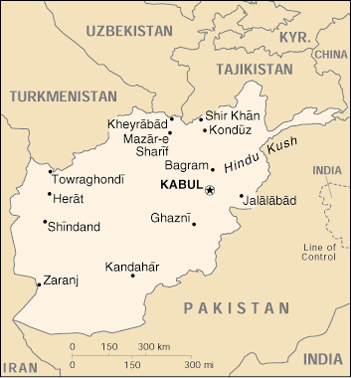
Location: Southern Asia, north and west of Pakistan, east of Iran
Capital: Kabul
Geographic coordinates: 33 00 N, 65 00 E
Area:
total: 652,000 sq km
land: 652,000 sq km
water: 0 sq km
Area – comparative: slightly smaller than Texas
Land boundaries:
total: 5,529 km
border countries: China 76 km, Iran 936 km, Pakistan 2,430 km, Tajikistan 1,206 km, Turkmenistan 744 km, Uzbekistan 137 km
Coastline: 0 km (landlocked)
Climate: arid to semiarid; cold winters and hot summers
Terrain: mostly rugged mountains; plains in north and southwest
Elevation extremes:
lowest point: Amu Darya 258 m
highest point: Nowshak 7,485 m
Natural resources: natural gas, petroleum, coal, copper, chromite, talc, barites, sulfur, lead, zinc, iron ore, salt, precious and semiprecious stones
Natural hazards: damaging earthquakes occur in Hindu Kush mountains; flooding
People of Afghanistan
Afghanistan’s ethnically and linguistically mixed population reflects its location astride historic trade and invasion routes leading from Central Asia into South and Southwest Asia. While population data is somewhat unreliable for Afghanistan, Pashtuns make up the largest ethnic group at 42% of the population, followed by Tajiks (27%), Hazaras (9%), Uzbek (9%), Aimaq, Turkmen, Baluch, and other small groups. Dari (Afghan Farsi) and Pashto are official languages. Dari is spoken by more than one-third of the population as a first language and serves as a lingua franca for most Afghans, though Pashto is spoken throughout the Pashtun areas of eastern and southern Afghanistan. Tajik and Turkic languages are spoken widely in the north. Smaller groups throughout the country also speak more than 70 other languages and numerous dialects.
Afghanistan is an Islamic country. An estimated 80% of the population is Sunni, following the Hanafi school of jurisprudence; the remainder of the population–and primarily the Hazara ethnic group–is predominantly Shi’a. Despite attempts during the years of communist rule to secularize Afghan society, Islamic practices pervade all aspects of life. In fact, Islam served as a principal basis for expressing opposition to communism and the Soviet invasion. Islamic religious tradition and codes, together with traditional tribal and ethnic practices, have an important role in personal conduct and dispute settlement. Afghan society is largely based on kinship groups, which follow traditional customs and religious practices, though somewhat less so in urban areas.
History of Afghanistan
Afghanistan, often called the crossroads of Central Asia, has had a turbulent history. In 328 BC, Alexander the Great entered the territory of present-day Afghanistan, then part of the Persian Empire, to capture Bactria (present-day Balkh). Invasions by the Scythians, White Huns, and Turks followed in succeeding centuries. In AD 642, Arabs invaded the entire region and introduced Islam.
Arab rule quickly gave way to the Persians, who controlled the area until conquered by the Turkic Ghaznavids in 998. Mahmud of Ghazni (998-1030) consolidated the conquests of his predecessors and turned Ghazni into a great cultural center as well as a base for frequent forays into India. Following Mahmud’s short-lived dynasty, various princes attempted to rule sections of the country until the Mongol invasion of 1219. The Mongol invasion, led by Genghis Khan, resulted in massive slaughter of the population, destruction of many cities, including Herat, Ghazni, and Balkh, and the despoliation of fertile agricultural areas.
Following Genghis Khan’s death in 1227, a succession of petty chiefs and princes struggled for supremacy until late in the 14th century, when one of his descendants, Tamerlane, incorporated Afghanistan into his own vast Asian empire. Babur, a descendant of Tamerlane and the founder of India’s Moghul dynasty at the beginning of the 16th century, made Kabul the capital of an Afghan principality.
In 1747, Ahmad Shah Durrani, the founder of what is known today as Afghanistan, established his rule. A Pashtun, Durrani was elected king by a tribal council after the assassination of the Persian ruler Nadir Shah at Khabushan in the same year. Throughout his reign, Durrani consolidated chieftainships, petty principalities, and fragmented provinces into one country. His rule extended from Mashad in the west to Kashmir and Delhi in the east, and from the Amu Darya (Oxus) River in the north to the Arabian Sea in the south. With the exception of a 9-month period in 1929, all of Afghanistan’s rulers until the 1978 Marxist coup were from Durrani’s Pashtun tribal confederation, and all were members of that tribe’s Mohammadzai clan after 1818.
European Influence
Collision between the expanding British and Russian Empires significantly influenced Afghanistan during the 19th century in what was termed “The Great Game.” British concern over Russian advances in Central Asia and growing influence in Persia culminated in two Anglo-Afghan wars. The first (1839-42) resulted not only in the destruction of a British army, but is remembered today as an example of the ferocity of Afghan resistance to foreign rule. The second Anglo-Afghan war (1878-80) was sparked by Amir Sher Ali’s refusal to accept a British mission in Kabul. This conflict brought Amir Abdur Rahman to the Afghan throne. During his reign (1880-1901), the British and Russians officially established the boundaries of what would become modern Afghanistan. The British retained effective control over Kabul’s foreign affairs.
Afghanistan remained neutral during World War I, despite German encouragement of anti-British feelings and Afghan rebellion along the borders of British India. The Afghan king’s policy of neutrality was not universally popular within the country, however.
Habibullah, Abdur Rahman’s son and successor, was assassinated in 1919, possibly by family members opposed to British influence. His third son, Amanullah, regained control of Afghanistan’s foreign policy after launching the Third Anglo-Afghan war with an attack on India in the same year. During the ensuing conflict, the war-weary British relinquished their control over Afghan foreign affairs by signing the Treaty of Rawalpindi in August 1919. In commemoration of this event, Afghans celebrate August 19 as their Independence Day.
Reform and Reaction
King Amanullah (1919-29) moved to end his country’s traditional isolation in the years following the Third Anglo-Afghan war. He established diplomatic relations with most major countries and, following a 1927 tour of Europe and Turkey–during which he noted the modernization and secularization advanced by Ataturk–introduced several reforms intended to modernize Afghanistan. Some of these, such as the abolition of the traditional Muslim veil for women and the opening of a number of co-educational schools, quickly alienated many tribal and religious leaders. Faced with overwhelming armed opposition, Amanullah was forced to abdicate in January 1929 after Kabul fell to forces led by Bacha-i-Saqao, a Tajik brigand. Prince Nadir Khan, a cousin of Amanullah’s, in turn defeated Bacha-i-Saqao in October of the same year and, with considerable Pashtun tribal support, was declared King Nadir Shah. Four years later, however, he was assassinated in a revenge killing by a Kabul student.
Mohammad Zahir Shah, Nadir Khan’s 19-year-old son, succeeded to the throne and reigned from 1933 to 1973. In 1964, King Zahir Shah promulgated a liberal constitution providing for a two-chamber legislature to which the king appointed one-third of the deputies. The people elected another third, and the remainder were selected indirectly by provincial assemblies. Although Zahir’s “experiment in democracy” produced few lasting reforms, it permitted the growth of unofficial extremist parties on both the left and the right. These included the communist People’s Democratic Party of Afghanistan (PDPA), which had close ideological ties to the Soviet Union. In 1967, the PDPA split into two major rival factions: the Khalq (Masses) faction headed by Nur Muhammad Taraki and Hafizullah Amin and supported by elements within the military, and the Parcham (Banner) faction led by Babrak Karmal. The split reflected ethnic, class, and ideological divisions within Afghan society.
Zahir’s cousin, Sardar Mohammad Daoud, served as his Prime Minister from 1953 to 1963. During his tenure as Prime Minister, Daoud solicited military and economic assistance from both Washington and Moscow and introduced controversial social policies of a reformist nature. Daoud’s alleged support for the creation of a Pashtun state in the Pakistan-Afghan border area heightened tensions with Pakistan and eventually resulted in Daoud’s dismissal in March 1963.
Daoud’s Republic (1973-78) and the April 1978 Coup
Amid charges of corruption and malfeasance against the royal family and poor economic conditions created by the severe 1971-72 drought, former Prime Minister Daoud seized power in a military coup on July 17, 1973. Zahir Shah fled the country eventually finding refuge in Italy. Daoud abolished the monarchy, abrogated the 1964 constitution, and declared Afghanistan a republic with himself as its first President and Prime Minister. His attempts to carry out badly needed economic and social reforms met with little success, and the new constitution promulgated in February 1977 failed to quell chronic political instability.
Seeking to exploit more effectively mounting popular disaffection, the PDPA reunified with Moscow’s support. On April 27, 1978, the PDPA initiated a bloody coup, which resulted in the overthrow and murder of Daoud and most of his family. Nur Muhammad Taraki, Secretary General of the PDPA, became President of the Revolutionary Council and Prime Minister of the newly established Democratic Republic of Afghanistan.
Opposition to the Marxist government emerged almost immediately. During its first 18 months of rule, the PDPA brutally imposed a Marxist-style “reform” program, which ran counter to deeply rooted Afghan traditions.
Decrees abolishing usury, forcing changes in marriage customs, and pushing through an ill-conceived land reform were particularly misunderstood virtually all Afghans. In addition, thousands of members of the traditional elite, the religious establishment, and the intelligentsia were imprisoned, tortured, or murdered. Conflicts within the PDPA also surfaced early and resulted in exiles, purges, imprisonments, and executions.
By the summer of 1978, a revolt began in the Nuristan region of eastern Afghanistan and quickly spread into a countrywide insurgency. In September 1979, Hafizullah Amin, who had earlier been Prime Minister and Minister of Defense, seized power from Taraki after a palace shootout. Over the next 2 months, instability plagued Amin’s regime as he moved against perceived enemies in the PDPA. By December, party morale was crumbling, and the insurgency was growing.
The Soviet Invasion
The Soviet Union moved quickly to take advantage of the April 1978 coup. In December 1978, Moscow signed a new bilateral treaty of friendship and cooperation with Afghanistan, and the Soviet military assistance program increased significantly. The regime’s survival increasingly was dependent upon Soviet military equipment and advisers as the insurgency spread and the Afghan army began to collapse.
By October 1979, however, relations between Afghanistan and the Soviet Union were tense as Hafizullah Amin refused to take Soviet advice on how to stabilize and consolidate his government. Faced with a deteriorating security situation on December 24, 1979, large numbers of Soviet airborne forces, joining thousands of Soviet troops already on the ground, began to land in Kabul under the pretext of a field exercise. On December 26, these invasion forces killed Hafizullah Amin and installed Babrak Karmal, exiled leader of the Parcham faction, bringing him back from Czechoslovakia and making him Prime Minister. Massive Soviet ground forces invaded from the north on December 27.
Following the invasion, the Karmal regime, although backed by an expeditionary force that grew as large as 120,000 Soviet troops, was unable to establish authority outside Kabul. As much as 80% of the countryside, including parts of Herat and Kandahar, eluded effective government control. An overwhelming majority of Afghans opposed the communist regime, either actively or passively. Afghan freedom fighters (mujahidin) made it almost impossible for the regime to maintain a system of local government outside major urban centers. Poorly armed at first, in 1984 the mujahidin began receiving substantial assistance in the form of weapons and training from the U.S. and other outside powers.
In May 1985, the seven principal Peshawar-based guerrilla organizations formed an alliance to coordinate their political and military operations against the Soviet occupation. Late in 1985, the mujahidin were active in and around Kabul, launching rocket attacks and conducting operations against the communist government. The failure of the Soviet Union to win over a significant number of Afghan collaborators or to rebuild a viable Afghan army forced it to bear an increasing responsibility for fighting the resistance and for civilian administration.
Soviet and popular displeasure with the Karmal regime led to its demise in May 1986. Karmal was replaced by Muhammad Najibullah, former chief of the Afghan secret police (KHAD). Najibullah had established a reputation for brutal efficiency during his tenure as KHAD chief. As Prime Minister, Najibullah was ineffective and highly dependent on Soviet support. Undercut by deep-seated divisions within the PDPA, regime efforts to broaden its base of support proved futile.
The Geneva Accords and Their Aftermath
By the mid-1980s, the tenacious Afghan resistance movement–aided by the United States, Saudi Arabia, Pakistan, and others–was exacting a high price from the Soviets, both militarily within Afghanistan and by souring the U.S.S.R.’s relations with much of the Western and Islamic world. Although informal negotiations for a Soviet withdrawal from Afghanistan had been underway since 1982, it was not until 1988 that the Governments of Pakistan and Afghanistan, with the United States and Soviet Union serving as guarantors, signed an agreement settling the major differences between them. The agreement, known as the Geneva accords, included five major documents, which, among other things, called for U.S. and Soviet noninterference in the internal affairs of Pakistan and Afghanistan, the right of refugees to return to Afghanistan without fear of persecution or harassment, and, most importantly, a timetable that ensured full Soviet withdrawal from Afghanistan by February 15, 1989. About 14,500 Soviet and an estimated one million Afghan lives were lost between 1979 and the Soviet withdrawal in 1989.
Significantly, the mujahidin were neither party to the negotiations nor to the 1988 agreement and, consequently, refused to accept the terms of the accords. As a result, the civil war continued after the Soviet withdrawal, which was completed in February 1989. Najibullah’s regime, though failing to win popular support, territory, or international recognition, was able to remain in power until 1992 but collapsed after the defection of Gen. Abdul Rashid Dostam and his Uzbek militia in March. However, when the victorious mujahidin entered Kabul to assume control over the city and the central government, a new round of internecine fighting began between the various militias, which had coexisted only uneasily during the Soviet occupation. With the demise of their common enemy, the militias’ ethnic, clan, religious, and personality differences surfaced, and the civil war continued.
Seeking to resolve these differences, the leaders of the Peshawar-based mujahidin groups established an interim Islamic Jihad Council in mid-April to assume power in Kabul. Moderate leader Prof. Sibghatullah Mojaddedi was to chair the council for 2 months, after which a 10-member leadership council composed of mujahidin leaders and presided over by the head of the Jamiat-i-Islami, Prof. Burhanuddin Rabbani, was to be set up for 4 months. During this 6-month period, a Loya Jirga, or grand council of Afghan elders and notables, would convene and designate an interim administration which would hold power up to a year, pending elections.
But in May 1992, Rabbani prematurely formed the leadership council, undermining Mojaddedi’s fragile authority. In June, Mojaddedi surrendered power to the Leadership Council, which then elected Rabbani as President. Nonetheless, heavy fighting broke out in August 1992 in Kabul between forces loyal to President Rabbani and rival factions, particularly those who supported Gulbuddin Hekmatyar’s Hezb-i-Islami. After Rabbani extended his tenure in December 1992, fighting in the capital flared up in January and February 1993. The Islamabad Accord, signed in March 1993, which appointed Hekmatyar as Prime Minister, failed to have a lasting effect. A follow-up agreement, the Jalalabad Accord, called for the militias to be disarmed but was never fully implemented. Through 1993, Hekmatyar’s Hezb-i-Islami forces, allied with the Shi’a Hezb-i-Wahdat militia, clashed intermittently with Rabbani and Masood’s Jamiat forces. Cooperating with Jamiat were militants of Sayyaf’s Ittehad-i-Islami and, periodically, troops loyal to ethnic Uzbek strongman Abdul Rashid Dostam. On January 1, 1994, Dostam switched sides, precipitating largescale fighting in Kabul and in northern provinces, which caused thousands of civilian casualties in Kabul and elsewhere and created a new wave of displaced persons and refugees. The country sank even further into anarchy, forces loyal to Rabbani and Masood, both ethnic Tajiks, controlled Kabul and much of the northeast, while local warlords exerted power over the rest of the country.
Rise of the Taliban
In reaction to the anarchy and warlordism prevalent in the country, and the lack of Pashtun representation in the Kabul government, a movement of former mujahidin arose. Many Taliban had been educated in madrassas in Pakistan and were largely from rural Pashtun backgrounds. The name “Talib” itself means pupil. This group dedicated itself to removing the warlords, providing order, and imposing Islam on the country. It received considerable support from Pakistan. In 1994 it developed enough strength to capture the city of Kandahar from a local warlord and proceeded to expand its control throughout Afghanistan, occupying Kabul in September 1996. By the end of 1998, the Taliban occupied about 90% of the country, limiting the opposition largely to a small largely Tajik corner in the northeast and the Panjshir valley. Efforts by the UN, prominent Afghans living outside the country, and other interested countries to bring about a peaceful solution to the continuing conflict came to naught, largely because of intransigence on the part of the Taliban.
The Taliban has sought to impose an extreme interpretation of Islam–based in part upon rural Pashtun tradition–upon the entire country and committed massive human rights violations, particularly directed against women and girls, in the process. Women are restricted from working outside the home, pursuing an education, are not to leave their homes without an accompanying male relative, and forced to wear a traditional body-covering garment called the burka. The Taliban committed serious atrocities against minority populations, particularly the Shi’a Hazara ethnic group, and killed noncombatants in several well-documented instances. In 2001, as part of a drive against relics of Afghanistan’s pre-Islamic past, the Taliban destroyed two large statues of the Buddha outside of the city of Bamiyan and announced destruction of all pre-Islamic statues in Afghanistan, including the remaining holdings of the Kabul Museum.
Since the mid-1990s the Taliban has provided sanctuary to Usama bin Laden, a Saudi national who had fought with them against the Soviets, and provided a base for his and other terrorist organizations. The UN Security Council repeatedly sanctioned the Taliban for these activities. Bin Laden is believed to provide both financial and political support to the Taliban. Bin Laden and his al Qaeda group were charged with the bombing of the U.S. embassies in Nairobi and Dar Es Salaam in 1998, and in August 1998 the United States launched a cruise missile attack against bin Laden’s terrorist camp in Afghanistan. Bin Laden and al Qaeda are believed to be responsible for the September 11, 2001 terrorist acts in the United States, among other crimes.
In September, agents working on behalf of the Taliban and believed to be associated with bin Laden’s al Qaeda group assassinated Northern Alliance Defense Minister and chief military commander Ahmed Shah Masood, a hero of the Afghan resistance against the Soviets and the Taliban’s principal military opponent. Following the Taliban’s repeated refusal to expel bin Laden and his group and end its support for international terrorism, the U.S. and its partners in the anti-terrorist coalition began a campaign on October 7, 2001, targeting terrorist facilities and various Taliban military and political assets within Afghanistan.
Afghanistan Economy
In the 1930s, Afghanistan embarked on a modest economic development program. The government founded banks; introduced paper money; established a university; expanded primary, secondary, and technical schools; and sent students abroad for education. Historically, there has been a dearth of information and reliable statistics about Afghanistan’s economy. The 1979 Soviet invasion and ensuing civil war destroyed much of the country’s limited infrastructure and disrupted normal patterns of economic activity. Gross domestic product fell substantially because of loss of labor and capital and disruption of trade and transport. Continuing internal strife hampered both domestic efforts at reconstruction as well as international aid efforts. However, Afghanistan’s economy has grown at a fast pace since the 2001 fall of the Taliban, albeit from a low base. GDP growth exceeded 12% in 2007 and 3.4% in 2008; growth for 2009-2010 was 22.5%. Despite these increases, unemployment remains around 40% and factors such as corruption, security, and shortage of skilled workers constrains development and the conduct of business. In June 2006, Afghanistan and the International Monetary Fund agreed on a Poverty Reduction and Growth Facility program for 2006-2009 that focused on maintaining macroeconomic stability, boosting growth, and reducing poverty. Afghanistan is also rebuilding its banking infrastructure through the Da Afghanistan National Central Bank.
Map of Afghanistan