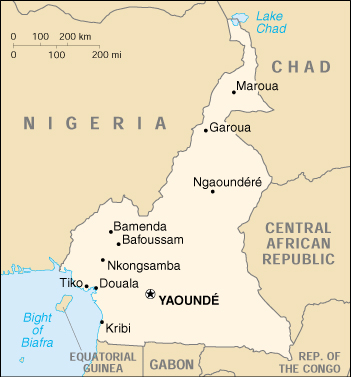
Background: The former French Cameroon and part of British Cameroon merged in 1961 to form the present country. Cameroon has generally enjoyed stability, which has permitted the development of agriculture, roads, and railways, as well as a petroleum industry. Despite movement toward democratic reform, political power remains firmly in the hands of an ethnic oligarchy.
Government type: unitary republic; multiparty presidential regime (opposition parties legalized in 1990)
note: preponderance of power remains with the president
Capital: Yaounde
Currency: 1 Communaute Financiere Africaine franc (CFAF) = 100 centimes
Geography of Cameroon
Location: Western Africa, bordering the Bight of Biafra, between Equatorial Guinea and Nigeria
Geographic coordinates: 6 00 N, 12 00 E
Area:
total: 475,440 sq. km
land: 469,440 sq. km
water: 6,000 sq. km
Land boundaries:
total: 4,591 km
border countries: Central African Republic 797 km, Chad 1,094 km, Republic of the Congo 523 km, Equatorial Guinea 189 km, Gabon 298 km, Nigeria 1,690 km
Coastline: 402 km
Maritime claims:
territorial sea: 50 nm
Climate: varies with terrain, from tropical along coast to semiarid and hot in north
Terrain: diverse, with coastal plain in southwest, dissected plateau in center, mountains in west, plains in north
Elevation extremes:
lowest point: Atlantic Ocean 0 m
highest point: Fako 4,095 m
Natural resources: petroleum, bauxite, iron ore, timber, hydropower
Land use:
arable land: 13%
permanent crops: 2%
permanent pastures: 4%
forests and woodland: 78%
other: 3% (1993 est.)
Irrigated land: 210 sq. km (1993 est.)
Natural hazards: recent volcanic activity with release of poisonous gases
Environment – current issues: water-borne diseases are prevalent; deforestation; overgrazing; desertification; poaching; overfishing
Environment – international agreements:
party to: Biodiversity, Climate Change, Desertification, Endangered Species, Law of the Sea, Ozone Layer Protection, Tropical Timber 83, Tropical Timber 94
signed, but not ratified: Nuclear Test Ban
Geography – note: sometimes referred to as the hinge of Africa; throughout the country there are areas of thermal springs and indications of current or prior volcanic activity; Mount Cameroon, the highest mountain in Sub-Saharan west Africa, is an active volcano.
People of Cameroon
Cameroon’s estimated 250 ethnic groups form five large regional-cultural groups: western highlanders (or grassfielders), including the Bamileke, Bamoun, and many smaller entities in the Northwest (est. 38% of population); coastal tropical forest peoples, including the Bassa, Douala, and many smaller entities in the Southwest (12%); southern tropical forest peoples, including the Beti, Bulu (subgroup of Beti), Fang (subgroup of Beti), and Pygmies (officially called Bakas) (18%); predominantly Islamic peoples of the northern semi-arid regions (the Sahel) and central highlands, including the Fulani, also known as Peuhl in French (14%); and the “Kirdi”, non-Islamic or recently Islamic peoples of the northern desert and central highlands (18%).
The people concentrated in the southwest and northwest provinces–around Buea and Bamenda–use standard English and “pidgin,” as well as their local languages. In the three northern provinces–Adamaoua, Garoua, and Maroua–either French or Fulfulde, the language of the Fulani, is widely spoken. Elsewhere, French is the principal second language, although pidgin and some local languages such as Ewondo, the dialect of a Beti clan from the Yaounde area, also are widely spoken.
Although Yaounde is Cameroon’s capital, Douala is the largest city, main seaport, and main industrial and commercial center.
The western highlands are the most fertile in Cameroon and have a relatively healthy environment in higher altitudes. This region is densely populated and has intensive agriculture, commerce, cohesive communities, and historical emigration pressures. From here, Bantu migrations into eastern, southern, and central Africa are believed to have originated about 2,000 years ago. Bamileke people from this area have in recent years migrated to towns elsewhere in Cameroon, such as the coastal provinces, where they form much of the business community. About 14,000 non-Africans, including more than 6,000 French and 1,000 U. S. citizens, reside in Cameroon.
Population: 16,380,005 (July 2005 est.)
Age structure:
0-14 years: 42.37%
15-64 years: 54.28%
65 years and over: 3.35%
Population growth rate: 2.41%
Birth rate: 36.12 births/1,000 population
Death rate: 11.99 deaths/1,000 population
Infant mortality rate: 69.83 deaths/1,000 live births
Life expectancy at birth:
total population: 54.59 years
male: 53.76 years
female: 55.44 years
Total fertility rate: 4.8 children born/woman
Nationality:
noun: Cameroonian(s)
adjective: Cameroonian
Ethnic groups: Cameroon Highlanders 31%, Equatorial Bantu 19%, Kirdi 11%, Fulani 10%, Northwestern Bantu 8%, Eastern Nigritic 7%, other African 13%, non-African less than 1%
Religions: indigenous beliefs 40%, Christian 40%, Muslim 20%
Languages: 24 major African language groups, English (official), French (official)
Literacy:
definition: age 15 and over can read and write
total population: 63.4%
male: 75%
female: 52.1% (1995 est.)
History of Cameroon
The earliest inhabitants of Cameroon were probably the Bakas (Pygmies). They still inhabit the forests of the south and east provinces. Bantu speakers originating in the Cameroonian highlands were among the first groups to move out before other invaders.
During the late 1770s and early 1800s, the Fulani, a pastoral Islamic people of the western Sahel, conquered most of what is now northern Cameroon, subjugating or displacing its largely non-Muslim inhabitants.
Although the Portuguese arrived on Cameroon’s coast in the 1500s, malaria prevented significant European settlement and conquest of the interior until the late 1870s, when large supplies of the malaria suppressant, quinine, became available. The early European presence in Cameroon was primarily devoted to coastal trade and the acquisition of slaves. The northern part of Cameroon was an important part of the Muslim slave trade network. The slave trade was largely suppressed by the mid-l9th century. Christian missions established a presence in the late 19th century and continue to play a role in Cameroonian life.
Beginning in 1884, all of present-day Cameroon and parts of several of its neighbors became the German colony of Kamerun, with a capital first at Buea and later at Yaounde. After World War I, this colony was partitioned between Britain and France under a June 28, 1919 League of Nations mandate. France gained the larger geographical share, transferred outlying regions to neighboring French colonies, and ruled the rest from Yaounde. Britain’s territory, a strip bordering Nigeria from the sea to Lake Chad, with an equal population was ruled from Lagos.
In 1955, the outlawed Union of Cameroonian Peoples (UPC), based largely among the Bamileke and Bassa ethnic groups, began an armed struggle for independence in French Cameroon. This rebellion continued, with diminishing intensity, even after independence. Estimates of death from this conflict vary from tens of thousands to hundreds of thousands.
French Cameroon achieved independence in 1960 as the Republic of Cameroon. The following year the largely Muslim northern two-thirds of British Cameroon voted to join Nigeria; the largely Christian southern third voted to join with the Republic of Cameroon to form the Federal Republic of Cameroon. The formerly French and British regions each maintained substantial autonomy. Ahmadou Ahidjo, a French-educated Fulani, was chosen president of the federation in 1961. Ahidjo, relying on a pervasive internal security apparatus, outlawed all political parties but his own in 1966. He successfully suppressed the UPC rebellion, capturing the last important rebel leader in 1970. In 1972, a new constitution replaced the federation with a unitary state.
Ahidjo resigned as president in 1982 and was constitutionally succeeded by his Prime Minister, Paul Biya, a career official from the Bulu-Beti ethnic group. Ahidjo later regretted his choice of successors, but his supporters failed to overthrow Biya in a 1984 coup. Biya won single-candidate elections in 1984 and 1983 and flawed multiparty elections in 1992 and 1997. His CPDM party holds a sizeable majority in the legislature.
Cameroon Economy
Economy – overview: Because of its oil resources and favorable agricultural conditions, Cameroon has one of the best-endowed primary commodity economies in sub-Saharan Africa. Still, it faces many of the serious problems facing other underdeveloped countries, such as a top-heavy civil service and a generally unfavorable climate for business enterprise. Since 1990, the government has embarked on various IMF and World Bank programs designed to spur business investment, increase efficiency in agriculture, improve trade, and recapitalize the nation’s banks. In June 2000, the government completed an IMF-sponsored, three-year structural adjustment program; however, the IMF is pressing for more reforms, including increased budget transparency and privatization. Higher oil prices in 2000 helped to offset the country’s lower cocoa export revenues. A rebound in the cocoa market should increase growth to over 5% in 2001.
GDP: purchasing power parity – $26 billion (2000 est.)
GDP – real growth rate: 5.2% (1999 est.), 4.4% (2000 est.)
GDP – per capita: purchasing power parity – $1,700 (2000 est.)
GDP – composition by sector:
agriculture: 43.4%
industry: 20.1%
services: 36.5% (1999 est.)
Population below poverty line: 48% (2000 est.)
Inflation rate (consumer prices): 2% (2000 est.)
Labor force – by occupation: agriculture 70%, industry and commerce 13%, other 17%
Unemployment rate: 30% (1998 est.)
Budget:
revenues: $2.1 billion
expenditures: $2.1 billion (FY00/01 est.)
Industries: petroleum production and refining, food processing, light consumer goods, textiles, lumber
Industrial production growth rate: 4.2% (1999 est.)
Electricity – production: 3.47 billion kWh (1999)
Electricity – production by source:
fossil fuel: 2.59%
hydro: 97.41%
nuclear: 0%
other: 0% (1999)
Electricity – consumption: 3.227 billion kWh (1999)
Electricity – exports: 0 kWh (1999)
Electricity – imports: 0 kWh (1999)
Agriculture – products: coffee, cocoa, cotton, rubber, bananas, oilseed, grains, root starches; livestock; timber
Exports: $2.1 billion (f.o.b., 2000 est.)
Exports – commodities: crude oil and petroleum products, lumber, cocoa beans, aluminum, coffee, cotton
Exports – partners: Italy 24%, France 18%, Netherlands 10% (2000 est.)
Imports: $1.6 billion (f.o.b., 2000 est.)
Imports – commodities: machines and electrical equipment, transport equipment, fuel, food
Imports – partners: France 29%, Germany 7%, US 6%, Japan 6% (2000 est.)
Debt – external: $10.9 billion (2000 est.)
Economic aid – recipient: on 23 January 2001, the Paris Club agreed to reduce Cameroon’s debt of $1.3 billion by $900 million; total debt relief now amounts to $1.26 billion.
Currency: Communaute Financiere Africaine franc (XAF); note – responsible authority is the Bank of the Central African States.
Map of Cameroon