Background: For centuries China has stood as a leading civilization, outpacing the rest of the world in the arts and sciences. But in the first half of the 20th century, China was beset by major famines, civil unrest, military defeats, and foreign occupation. After World War II, the Communists under MAO Zedong established a dictatorship that, while ensuring China’s sovereignty, imposed strict controls over everyday life and cost the lives of tens of millions of people. After 1978, his successor DENG Xiaoping gradually introduced market-oriented reforms and decentralized economic decision making. Output quadrupled in the next 20 years and China now has the world’s second largest GDP. Political controls remain tight even while economic controls continue to weaken.
Government type: Communist state
Capital: Beijing
Currency: 1 yuan = 10 jiao
Geography of China
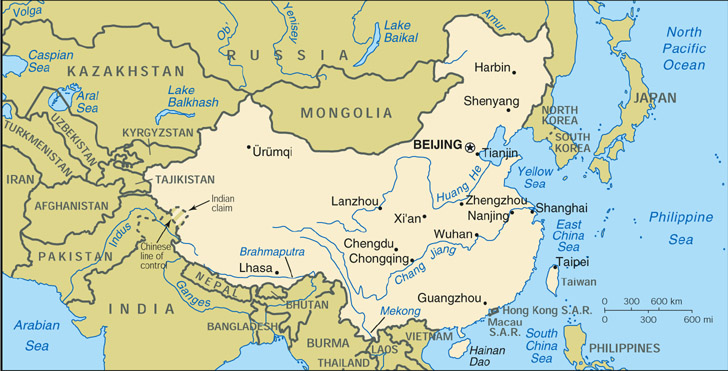
Location: Eastern Asia, bordering the East China Sea, Korea Bay, Yellow Sea, and South China Sea, between North Korea and Vietnam
Geographic coordinates: 35 00 N, 105 00 E
Area:
total: 9,596,960 sq. km
land: 9,326,410 sq. km
water: 270,550 sq. km
Land boundaries:
total: 22,143.34 km
border countries: Afghanistan 76 km, Bhutan 470 km, Burma 2,185 km, Hong Kong 30 km, India 3,380 km, Kazakhstan 1,533 km, North Korea 1,416 km, Kyrgyzstan 858 km, Laos 423 km, Macau 0.34 km, Mongolia 4,673 km, Nepal 1,236 km, Pakistan 523 km, Russia (northeast) 3,605 km, Russia (northwest) 40 km, Tajikistan 414 km, Vietnam 1,281 km
Coastline: 14,500 km
Maritime claims:
contiguous zone: 24 nm
continental shelf: 200 nm or to the edge of the continental margin
territorial sea: 12 nm
Climate: extremely diverse; tropical in south to subarctic in north
Terrain: mostly mountains, high plateaus, deserts in west; plains, deltas, and hills in east
Elevation extremes:
lowest point: Turpan Pendi -154 m
highest point: Mount Everest 8,850 m (1999 est.)
Natural resources: coal, iron ore, petroleum, natural gas, mercury, tin, tungsten, antimony, manganese, molybdenum, vanadium, magnetite, aluminum, lead, zinc, uranium, hydropower potential (world’s largest)
Land use:
arable land: 10%
permanent crops: 0%
permanent pastures: 43%
forests and woodland: 14%
other: 33% (1993 est.)
Irrigated land: 498,720 sq km (1993 est.)
Natural hazards: frequent typhoons (about five per year along southern and eastern coasts); damaging floods; tsunamis; earthquakes; droughts
Environment – current issues: air pollution (greenhouse gases, sulfur dioxide particulates) from reliance on coal, produces acid rain; water shortages, particularly in the north; water pollution from untreated wastes; deforestation; estimated loss of one-fifth of agricultural land since 1949 to soil erosion and economic development; desertification; trade in endangered species.
Environment – international agreements:
party to: Antarctic-Environmental Protocol, Antarctic Treaty, Biodiversity, Climate Change, Desertification, Endangered Species, Hazardous Wastes, Law of the Sea, Marine Dumping, Nuclear Test Ban, Ozone Layer Protection, Ship Pollution, Tropical Timber 83, Tropical Timber 94, Wetlands, Whaling
signed, but not ratified: Climate Change-Kyoto Protocol, Marine Life Conservation
Geography – note: world’s fourth-largest country (after Russia, Canada, and US); Mount Everest on the border with Nepal, is the world’s tallest peak.
REMARKABLY VARIED LANDSCAPES suggest the disparate climate and broad reach of China, the third largest country in the world in terms of area. China’s climate ranges from subarctic to tropical. Its topography includes the world’s highest peaks, tortuous but picturesque river valleys, and vast plains subject to lifethreatening but soil-enriching flooding. These characteristics have dictated where the Chinese people live and how they make their livelihood.
The majority of China’s people live in the eastern segment of the country, the traditional China Proper. Most are peasants living, as did their forebears, in the low-lying hills and central plains that stretch from the highlands eastward and southward to the sea. Agriculture predominates in this vast area, generally favored by a temperate or subtropical climate. The meticulously tilled fields are evidence in part of the government’s continuing concern over farm output and the food supply.
Although migration to urban areas has been restricted since the late 1950s, as of the end of 1985 about 37 percent of the population was urban. An urban and industrial corridor formed a broad arc stretching from Harbin in the northeast through the Beijing area and south to China’s largest city, the huge industrial metropolitan complex of Shanghai.
The uneven pattern of internal development, so strongly weighted toward the eastern part of the country, doubtless will change little even with developing interest in exploiting the mineral-rich and agriculturally productive portions of the vast northwest and southwest regions. The adverse terrain and climate of most of those regions have discouraged dense population. For the most part, only ethnic minority groups have settled there.
The “minority nationalities” are an important element of Chinese society. In 1987 there were 55 recognized minority groups, comprising nearly 7 percent of the total population. Because some of the groups were located in militarily sensitive border areas and in regions with strategic minerals, the government tried to maintain benevolent relations with the minorities. But the minorities played only a superficial role in the major affairs of the nation.
China’s ethnically diverse population is the largest in the world, and the Chinese Communist Party and the government work strenuously to count, control, and care for their people. In 1982 China conducted its first population census since 1964. It was by far the most thorough and accurate census taken under Communist rule and confirmed that China was a nation of more than 1 billion people, or about one-fifth of the world’s population. The census provided demographers with a wealth of accurate data on China’s age-sex structure, fertility and mortality rates, and population density and distribution. Useful information also was gathered on minority ethnic groups, urban population, and marital status. For the first time since the People’s Republic of China was founded, demographers had reliable information on the size and composition of the Chinese work force.
Beginning in the mid-1950s, the Chinese government introduced, with varying degrees of enthusiasm and success, a number of family planning, or population control, campaigns and programs. The most radical and controversial was the one-child policy publicly announced in 1979. Under this policy, which had different guidelines for national minorities, married couples were officially permitted only one child. Enforcement of the program, however, varied considerably from place to place, depending on the vigilance of local population control workers.
Health care has improved dramatically in China since 1949. Major diseases such as cholera, typhoid, and scarlet fever have been brought under control. Life expectancy has more than doubled, and infant mortality has dropped significantly. On the negative side, the incidence of cancer, cerebrovascular disease, and heart disease has increased to the extent that these have become the leading causes of death. Economic reforms initiated in the late 1970s fundamentally altered methods of providing health care; the collective medical care system was gradually replaced by a more individual-oriented approach.
More liberalized emigration policies enacted in the 1980s facilitated the legal departure of increasing numbers of Chinese who joined their overseas Chinese relatives and friends. The Four Modernizations program, which required access of Chinese students and scholars, particularly scientists, to foreign education and research institutions, brought about increased contact with the outside world, particularly the industrialized nations. Thus, as China moved toward the twenty-first century, the diverse resources and immense population that it had committed to a comprehensive process of modernization became ever more important in the interdependent world.
Physical Environment
China stretches some 5,000 kilometers across the East Asian landmass in an erratically changing configuration of broad plains, expansive deserts, and lofty mountain ranges, including vast areas of inhospitable terrain. The eastern half of the country, its seacoast fringed with offshore islands, is a region of fertile lowlands, foothills and mountains, desert, steppes, and subtropical areas. The western half of China is a region of sunken basins, rolling plateaus, and towering massifs, including a portion of the highest tableland on earth. The vastness of the country and the barrenness of the western hinterland have important implications for defense strategy. In spite of many good harbors along the approximately 18,000- kilometer coastline, the nation has traditionally oriented itself not toward the sea but inland, developing as an imperial power whose center lay in the middle and lower reaches of the Huang He (Yellow River) on the northern plains.
Figures for the size of China differ slightly depending on where one draws a number of ill-defined boundaries. The official Chinese figure is 9.6 million square kilometers, making the country substantially smaller than the Soviet Union, slightly smaller than Canada, and somewhat larger than the United States. China’s contour is reasonably comparable to that of the United States and lies largely at the same latitudes.
Boundaries
In 1987 China’s borders, more than 20,000 kilometers of land frontier shared with nearly all the nations of mainland East Asia, were disputed at a number of points. In the western sector, China claimed portions of the 41,000-square-kilometer Pamir Mountains area, a region of soaring mountain peaks and glacial valleys where the borders of Afghanistan, Pakistan, the Soviet Union, and China meet in Central Asia. North and east of this region, some sections of the border remained undemarcated in 1987. The 6,542-kilometer frontier with the Soviet Union has been a source of continual friction. In 1954 China published maps showing substantial portions of Soviet Siberian territory as its own. In the northeast, border friction with the Soviet Union produced a tense situation in remote regions of Nei Monggol Autonomous Region (Inner Mongolia) and Heilongjiang Province along segments of the Ergun He (Argun River), Heilong Jiang (Amur River), and Wusuli Jiang (Ussuri River). Each side had massed troops and had exchanged charges of border provocation in this area. In a September 1986 speech in Vladivostok, Soviet leader Mikhail S. Gorbachev offered the Chinese a more conciliatory position on Sino-Soviet border rivers. In 1987 the two sides resumed border talks that had been broken off after the 1979 Soviet invasion of Afghanistan. Although the border issue remained unresolved as of late 1987, China and the Soviet Union agreed to consider the northeastern sector first.
A major dispute between China and India focuses on the northern edge of their shared border, where the Aksai Chin area of northeastern Jammu and Kashmir is under Chinese control but claimed by India. Eastward from Bhutan and north of the Brahmaputra River (Yarlung Zangbo Jiang) lies a large area controlled and administered by India but claimed by the Chinese in the aftermath of the 1959 Tibetan revolt. The area was demarcated by the British McMahon Line, drawn along the Himalayas in 1914 as the Sino-Indian border; India accepts and China rejects this boundary. In June 1980 China made its first move in twenty years to settle the border disputes with India, proposing that India cede the Aksai Chin area in Jammu and Kashmir to China in return for China’s recognition of the McMahon Line; India did not accept the offer, however, preferring a sector-by-sector approach to the problem. In July 1986 China and India held their seventh round of border talks, but they made little headway toward resolving the dispute. Each side, but primarily India, continued to make allegations of incursions into its territory by the other.
China, Taiwan, and Vietnam all claim sovereignty over both the Xisha (Paracel) and the Nansha (Spratly) islands, but the major islands of the Xisha are occupied by China. The Philippines claims an area known as Kalayaan (Freedom Land), which excludes the Nansha in the west and some reefs in the south. Malaysia claims the islands and reefs in the southernmost area, and there also is a potential for dispute over the islands with Brunei.
The China-Burma border issue was settled October 1, 1960, by the signing of the Sino-Burmese Boundary Treaty. The first joint inspection of the border was completed successfully in June 1986. In 1987 the island province of Taiwan continued to be under the control of the Guomindang authorities.
Terrain and Drainage
Terrain and vegetation vary greatly in China. Mountains, hills, and highlands cover about 66 percent of the nation’s territory, impeding communication and leaving limited level land for agriculture. Most ranges, including all the major ones, trend eastwest . In the southwest, the Himalayas and the Kunlun Mountains enclose the Qing Zang Plateau, which encompasses most of Xizang Autonomous Region (also known as Tibet) and part of Qinghai Province. It is the most extensive plateau in the world, where elevations average more than 4,000 meters above sea level and the loftiest summits rise to more than 7,200 meters.
From the Qing Zang Plateau, other less-elevated highlands, rugged east-west trending mountains, and plateaus interrupted by deep depressions fan out to the north and east. A continental scarp marks the eastern margin of this territory extending from the Greater Hinggan Range in northeastern China, through the Taihang Shan (a range of mountains overlooking the North China Plain) to the eastern edge of the Yunnan-Guizhou Plateau in the south. Virtually all of the low-lying areas of China–the regions of dense population and intensive cultivation–are found east of this scarp line.
East-west ranges include some of Asia’s greatest mountains. In addition to the Himalayas and the Kunlun Mountains, there are the Gangdise Shan (Kailas) and the Tian Shan ranges. The latter stands between two great basins, the massive Tarim Basin to the south and the Junggar Basin to the north. Rich deposits of coal, oil, and metallic ores lie in the Tian Shan area. The largest inland basin in China, the Tarim Basin measures 1,500 kilometers from east to west and 600 kilometers from north to south at its widest parts.
The Himalayas form a natural boundary on the southwest as the Altai Mountains do on the northwest. Lesser ranges branch out, some at sharp angles from the major ranges. The mountains give rise to all the principal rivers.
The spine of the Kunlun Mountains separates into several branches as it runs eastward from the Pamir Mountains. The northernmost branches, the Altun Shan and the Qilian Shan, rim the Qing Zang Plateau in west-central China and overlook the Qaidam Basin, a sandy and swampy region containing many salt lakes. A southern branch of the Kunlun Mountains divides the watersheds of the Huang He and the Chang Jiang (Yangtze River). The Gansu Corridor, west of the great bend in the Huang He, was traditionally an important communications link with Central Asia.
North of the 3,300-kilometer-long Great Wall, between Gansu Province on the west and the Greater Hinggan Range on the east, lies the Nei Monggol Plateau, at an average elevation of 1,000 meters above sea level. The Yin Shan, a system of mountains with average elevations of 1,400 meters, extends east-west through the center of this vast desert steppe peneplain. To the south is the largest loess plateau in the world, covering 600,000 square kilometers in Shaanxi Province, parts of Gansu and Shanxi provinces, and some of Ningxia-Hui Autonomous Region. Loess is a yellowish soil blown in from the Nei Monggol deserts. The loose, loamy material travels easily in the wind, and through the centuries it has veneered the plateau and choked the Huang He with silt.
Because the river level drops precipitously toward the North China Plain, where it continues a sluggish course across the delta, it transports a heavy load of sand and mud from the upper reaches, much of which is deposited on the flat plain. The flow is channeled mainly by constantly repaired manmade embankments; as a result the river flows on a raised ridge fifty meters or more above the plain, and waterlogging, floods, and course changes have recurred over the centuries. Traditionally, rulers were judged by their concern for or indifference to preservation of the embankments. In the modern era, the new leadership has been deeply committed to dealing with the problem and has undertaken extensive flood control and conservation measures.
Flowing from its source in the Qing Zang highlands, the Huang He courses toward the sea through the North China Plain, the historic center of Chinese expansion and influence. Han (see Glossary) people have farmed the rich alluvial soils of the plain since ancient times, constructing the Grand Canal for north-south transport (see The Imperial Era , ch. 1). The plain itself is actually a continuation of the Dongbei (Manchurian) Plain to the northeast but is separated from it by the Bo Hai Gulf, an extension of the Huang Hai (Yellow Sea).
Like other densely populated areas of China, the plain is subject not only to floods but to earthquakes. For example, the mining and industrial center of Tangshan, about 165 kilometers east of Beijing, was leveled by an earthquake in July 1976 that reportedly also killed 242,000 people and injured 164,000.
The Qin Ling mountain range, a continuation of the Kunlun Mountains, divides the North China Plain from the Chang Jiang Delta and is the major physiographic boundary between the two great parts of China Proper (see Glossary). It is in a sense a cultural boundary as well, influencing the distribution of custom and language. South of the Qin Ling divide are the densely populated and highly developed areas of the lower and middle plains of the Chang Jiang and, on its upper reaches, the Sichuan Basin, an area encircled by a high barrier of mountain ranges.
The country’s longest and most important waterway, the Chang Jiang is navigable over much of its length and has a vast hydroelectric potential. Rising on the Qing Zang Plateau, the Chang Jiang traverses 6,300 kilometers through the heart of the country, draining an area of 1.8 million square kilometers before emptying into the East China Sea. The roughly 300 million people who live along its middle and lower reaches cultivate a great rice- and wheat-producing area. The Sichuan Basin, favored by a mild, humid climate and a long growing season, produces a rich variety of crops; it is also a leading silk-producing area and an important industrial region with substantial mineral resources.
Second only to the Qin Ling as an internal boundary is the Nan Ling, the southernmost of the east-west mountain ranges. The Nan Ling overlooks the part of China where a tropical climate permits two crops of rice to be grown each year. Southeast of the mountains lies a coastal, hilly region of small deltas and narrow valley plains; the drainage area of the Zhu Jiang (Pearl River) and its associated network of rivers occupies much of the region to the south. West of the Nan Ling, the Yunnan-Guizhou Plateau rises in two steps, averaging 1,200 and 1,800 meters in elevation, respectively, toward the precipitous mountain regions of the eastern Qing Zang Plateau.
The Hai He, like the Zhu Jiang and other major waterways, flows from west to east. Its upper course consists of five rivers that converge near Tianjin, then flow seventy kilometers before emptying into the Bo Hai Gulf. Another major river, the Huai He, rises in Henan Province and flows through several lakes before joining the Chang Jiang near Yangzhou.
Inland drainage involving a number of upland basins in the north and northeast accounts for about 40 percent of the country’s total drainage area. Many rivers and streams flow into lakes or diminish in the desert. Some are useful for irrigation.
China’s extensive territorial waters are principally marginal seas of the western Pacific Ocean; these waters wash the shores of a long and much-indented coastline and approximately 5,000 islands. The Yellow, East China, and South China seas, too, are marginal seas of the Pacific Ocean. More than half the coastline (predominantly in the south) is rocky; most of the remainder is sandy. The Bay of Hangzhou roughly divides the two kinds of shoreline.
Climate
Monsoon winds, caused by differences in the heat-absorbing capacity of the continent and the ocean, dominate the climate. Alternating seasonal air-mass movements and accompanying winds are moist in summer and dry in winter. The advance and retreat of the monsoons account in large degree for the timing of the rainy season and the amount of rainfall throughout the country. Tremendous differences in latitude, longitude, and altitude give rise to sharp variations in precipitation and temperature within China. Although most of the country lies in the temperate belt, its climatic patterns are complex.
China’s northernmost point lies along the Heilong Jiang in Heilongjiang Province in the cold-temperate zone; its southernmost point, Hainan Island, has a tropical climate. Temperature differences in winter are great, but in summer the diversity is considerably less. For example, the northern portions of Heilongjiang Province experience an average January mean temperature of below 0°C, and the reading may drop to minus 30°C; the average July mean in the same area may exceed 20°C. By contrast, the central and southern parts of Guangdong Province experience an average January temperature of above 10°C, while the July mean is about 28°C.
Precipitation varies regionally even more than temperature. China south of the Qin Ling experiences abundant rainfall, most of it coming with the summer monsoons. To the north and west of the range, however, rainfall is uncertain. The farther north and west one moves, the scantier and more uncertain it becomes. The northwest has the lowest annual rainfall in the country and no precipitation at all in its desert areas.
Wildlife
China lies in two of the world’s major zoogeographic regions, the Palearctic and the Oriental. The Qing Zang Plateau, Xinjiang and Nei Monggol autonomous regions, northeastern China, and all areas north of the Huang He are in the Palearctic region. Central, southern, and southwest China lie in the Oriental region. In the Palearctic zone are found such important mammals as the river fox, horse, camel, tapir, mouse hare, hamster, and jerboa. Among the species found in the Oriental region are the civet cat, Chinese pangolin, bamboo rat, tree shrew, and also gibbon and various other species of monkeys and apes. Some overlap exists between the two regions because of natural dispersal and migration, and deer or antelope, bears, wolves, pigs, and rodents are found in all of the diverse climatic and geological environments. The famous giant panda is found only in a limited area along the Chang Jiang.
People of China
Ethnic Groups
The largest ethnic group is the Han Chinese, who constitute about 91.9% of the total population. The remaining 8.1% are Zhuang (16 million), Manchu (10 million), Hui (9 million), Miao (8 million), Uygur (7 million), Yi (7 million), Mongolian (5 million), Tibetan (5 million), Buyi (3 million), Korean (2 million), and other ethnic minorities.
Language
There are seven major Chinese dialects and many sub dialects. Mandarin (or Putonghua), the predominant dialect, is spoken by over 70% of the population. It is taught in all schools and is the medium of government. About two-thirds of the Han ethnic group are native speakers of Mandarin; the rest, concentrated in southwest and southeast China, speak one of the six other major Chinese dialects. Non-Chinese languages spoken widely by ethnic minorities include Mongolian, Tibetan, Uygur and other Turkic languages (in Xinjiang), and Korean (in the northeast).
Religion
Religion plays a significant part in the life of many Chinese. Buddhism is most widely practiced, with an estimated 100 million adherents. Traditional Taoism also is practiced. Official figures indicate there are 18 million Muslims, 4 million Catholics, and 10 million Protestants; unofficial estimates are much higher.
While the Chinese constitution affirms religious toleration, the Chinese Government places restrictions on religious practice outside officially recognized organizations. Only two Christian organizations–a Catholic church without official ties to Rome and the “Three-Self-Patriotic” Protestant church–are sanctioned by the Chinese Government. Unauthorized churches have sprung up in many parts of the country and unofficial religious practice is flourishing. In some regions authorities have tried to control activities of these unregistered churches. In other regions, registered and unregistered groups are treated similarly by authorities and congregations worship in both types of churches. Most Chinese Catholic bishops are recognized by the Pope, and official priests have Vatican approval to administer all the sacraments.
Population Policy
With a population officially just under 1.3 billion and an estimated growth rate of about 1%, China is very concerned about its population growth and has attempted with mixed results to implement a strict family planning policy. The government’s goal is one child per urban family, and two children per rural family, with guidelines looser for ethnic minorities with small populations. Enforcement varies widely, and relies upon “social compensation fees” for extra children as a means of keeping families small. Official government policy opposes forced abortion or sterilization, but occasional allegations of coercion persist in localities that take their population growth targets most seriously. Recent international efforts, including those funded by the UN Population Fund (UNFPA), are demonstrating to government officials that a voluntary, non-coercive approach to family planning can be effective in promoting sustainable population growth. The government’s goal is to stabilize the population in the first half of the 21st century, and current projections are that the population will peak at around 1.6 billion by 2050.
Population: 1,306,313,812 (July 2005 est.)
Age structure:
0-14 years: 25.01%
15-64 years: 67.88%
65 years and over: 7.11%
Population growth rate: 0.88%
Birth rate: 15.95 births/1,000 population
Death rate: 6.74 deaths/1,000 population
Net migration rate: -0.39 migrant(s)/1,000 population
Infant mortality rate: 28.08 deaths/1,000 live births
Life expectancy at birth:
total population: 71.62 years
male: 69.81 years
female: 73.59 years
Total fertility rate: 1.82 children born/woman
Nationality:
noun: Chinese (singular and plural)
adjective: Chinese
Ethnic groups: Han Chinese 91.9%, Zhuang, Uygur, Hui, Yi, Tibetan, Miao, Manchu, Mongol, Buyi, Korean, and other nationalities 8.1%.
Religions: Daoist (Taoist), Buddhist, Muslim 2%-3%, Christian 1% (est.)
note: officially atheist
Languages: Standard Chinese or Mandarin (Putonghua, based on the Beijing dialect), Yue (Cantonese), Wu (Shanghaiese), Minbei (Fuzhou), Minnan (Hokkien-Taiwanese), Xiang, Gan, Hakka dialects, minority languages (see Ethnic groups entry)
Literacy:
definition: age 15 and over can read and write
total population: 81.5%
male: 89.9%
female: 72.7% (1995 est.)
History of China
REFORM–DUBBED CHINA’S “SECOND REVOLUTION”–was one of the most common terms in China’s political vocabulary in the 1980s. Reform of the Chinese Communist Party and its political activities, reform of government organization, reform of the economy, military reforms, cultural and artistic reforms, indeed, China’s post-Mao Zedong leaders called for reform of every part of Chinese society. The leaders of the People’s Republic of China saw reform as the way to realize the broad goal of the Four Modernizations (announced by Premier Zhou Enlai in 1975: the modernization of industry, agriculture, science and technology, and national defense) and to bring China into the community of advanced industrial nations by the start of the new millennium. The reform movement had antecedents in Chinese history in the Han (206 B.C.-A.D. 220), Song (960-1279), and Qing (1644-1911) dynasties, when concerted efforts were made to bring about fundamental changes in administrative methods while keeping the overall institutional framework intact. Thus, the reform movement of the 1980s–which has been attributed largely to the insights and determination of Deng Xiaoping, the most important figure in the post-Mao Zedong leadership–took its place in the broad spectrum of Chinese history. As with previous reform movements, history will measure this one’s success.
Late twentieth-century Chinese society has developed out of some 3,300 years of recorded history and, as archaeological finds indicate, several millennia of prehistoric civilization. For thousands of years, the Middle Kingdom (Zhongguo–the Chinese name for China) was marked by organizational and cultural continuity, which were reaffirmed in a cyclic rise, flourishing, and decline of imperial dynasties. Short-lived, vibrant, but often tyrannical dynasties frequently were followed by long periods of stability and benevolent rule that were built on the best features of the preceding era and that discarded or modified more authoritarian ideas. An ethical system of relations–governed by rules of propriety attributed to the School of Literati (also known as the Confucian school)–carefully defined each person’s place in society. In this system, harmony of social relations rather than the rights of the individual was the ideal. The highest social status was held by scholar-officials, the literati who provided the interpretations needed for maintaining harmony in a slowly evolving world. Hard-working farmers, the providers of sustenance to society, also occupied an important place in the societal structure.
China’s development was influenced by the alien peoples on the frontiers of Chinese civilization, who were sinicized into the Chinese polity (see fig. 1, frontispiece). Occasionally, groups arose among alien border peoples that were strong enough to conquer China itself. These groups established their own dynasties, only to be absorbed into an age-old system of governance. The importation of Buddhism, too, in the first century A.D. and its gradual assimilation had a fundamental impact on China. Early contacts with the premodern Western world brought a variety of exchanges. The Chinese contributed silk, printing, gunpowder, and porcelain. Staple foodstuffs from Africa and the Americas were assimilated by China, as was the Western-style chair. In later centuries, Chinese scholars studied Western astronomy, mathematics, and other branches of science. Westerners arrived in China in the nineteenth century, during the decline of the Qing dynasty, in search of trade and colonial empires. Through force of arms the Westerners imposed unequal treaties compelling China to accept humiliating compromises to its traditional system of society and government.
China reacted to intrusions from the West–and from a newly modernized Japan (to which China lost a war in 1895)–in a variety of ways, sometimes maintaining the traditional status quo, adapting Western functions to Chinese substance, or rejecting Chinese tradition in favor of Western substance and form. As the Qing dynasty declined, reforms came too late and did too little. The unsuccessful reform efforts were followed by revolution. Still burdened with the legacy of thousands of years of imperial rule and nearly a century of humiliations at foreign hands, China saw the establishment of a republic in 1911. But warlord rule and civil war continued for nearly forty more years, accompanied in 1937-45 by war with Japan.
The Chinese civil war of 1945-49 was won by the Chinese Communist Party, the current ruling party of China, led by its chairman and chief ideologist, Mao Zedong. The Communists moved quickly to consolidate their victory and integrate all Chinese society into a People’s Republic. Except for the island of Taiwan (which became the home of the exiled Guomindang under Chiang Kai- shek and his successors), the new government unified the nation and achieved a stability China had not experienced for generations. Eagerness on the part of some Communist leaders to achieve even faster results engendered the Great Leap Forward (1958-60), a program that attempted rapid economic modernization but proved disastrous. Political reaction to the Great Leap Forward brought only a temporary respite before a counterreaction occurred in the form of the Cultural Revolution (1966-76), a period of radical experimentation and political chaos that brought the educational system to a halt and severely disrupted attempts at rational economic planning. When Mao Zedong died in 1976, the Cultural Revolution era effectively came to an end.
Eager to make up for lost time and wasted resources, China’s leaders initiated China’s “second revolution”–a comprehensive economic modernization and organizational reform program. Deng Xiaoping and his associates mobilized the Chinese people in new ways to make China a world power. Starting with the Third Plenum of the Chinese Communist Party’s Eleventh National Party Congress in December 1978, Deng reaffirmed the aims of the Four Modernizations, placing economic progress above the Maoist goals of class struggle and permanent revolution. Profit incentives and bonuses took the place of ideological slogans and red banners as China’s leaders experimented with ways to modernize the economy. Mao’s legendary people’s communes were dismantled and replaced by a responsibility system, in which peasant households were given greater decision- making power over agricultural production and distribution. Farm families were allowed to lease land and grow crops of their own choosing. In the urban sector, factory managers were granted the flexibility to negotiate with both domestic and foreign counterparts over matters that previously had been handled by central planners in Beijing. Exploitation of China’s rich natural resources advanced significantly in the late 1970s and throughout the 1980s. As China’s industrial sector advanced, there was increasing movement of the population to urban areas. China’s population itself had surpassed 1 billion people by 1982 and was experiencing an annual rate of increase of 1.4 percent. As in times past, foreign specialists were invited to assist in the modernization process, and joint ventures with foreign capitalists and multinational conglomerates proliferated. Increasing numbers of Chinese students went abroad to pursue advanced degrees in a wide range of scientific and technical fields.
All this change was not without cost–both political and monetary. Efforts at fundamental transformation of economic, governmental, and political organizations caused discontent among some people and in some institutions and were resisted by those who clung to the “iron rice bowl” of guaranteed lifetime job tenure. Beijing’s reform leaders made repeated calls for party members and government bureaucrats to reform their “ossified thinking” and to adopt modern methods. Older and inappropriately trained bureaucrats retired in great numbers as a younger and more technically oriented generation took over. In the ongoing debate between those who emphasized ideological correctness and those who stressed the need for technical competence–“reds” versus “experts”–the technocrats again emerged predominant. But developing and successfully applying technological expertise–the very essence of the Four Modernizations–cost vast sums of money and required special effort on the part of the Chinese people. In a rejection of the time- honored concept of “self-reliance,” China entered into the milieu of international bank loans, joint ventures, and a whole panoply of once-abhorred capitalist economic practices.
As politics and the economy continued to respond to and change each other, China’s reformers had to balance contending forces within and against their reform efforts while maintaining the momentum of the Four Modernizations program. In doing so, Deng Xiaoping and his associates were faced with several unenviable tasks. One was to create unity and support for the scope and pace of the reform program among party members. There was also a necessity to deliver material results to the broad masses of people amid economic experiments and mounting inflation. Failure to achieve these balances and to make mid-course corrections could prove disastrous for the reform leadership.
A sound ideological basis was needed to ensure the support of the party for the reform program. Deng’s political idioms, such as “seeking truth from facts” and “socialism with Chinese characteristics,” were reminiscent of reformist formulations of centuries past and had underlying practical ramifications. The supporters of Deng held that theory and practice must be fully integrated if success is to be hoped for, and they articulated the position that the Marxist-Leninist creed is not only valid but is adaptable to China’s special–if not unique–situation. The ideological conviction that China was still in the “initial stage of socialism”–a viewpoint reaffirmed at the Thirteenth National Party Congress in October and November 1987–provided a still broader ideological basis for continuing the development of the Deng’s reform program in the late 1980s and early 1990s. This ideological pronouncement also emphasized reformers’ fundamental tenet that since the end of the “period of socialist transformation” (turning over private ownership of the means of production to the state) in 1956, there had been numerous “leftist” errors made in the party’s ideological line. Mistakes such as the Great Leap Forward and the Cultural Revolution had produced setbacks in achieving “socialist modernization” and had kept China from emerging from the initial stage of socialism. It was, perhaps, the very failure of these leftist campaigns that had paved the way for the reforms of the 1980s.
Political confrontation over the reforms was pervasive and, to many foreign observers, confusing. In simplistic terms, the “conservatives” in the reform debate were members of the post-Mao “left,” while the “liberals” were the pro-Deng “right.” Being conservative in China in the 1980s variously meant adhering to the less radical aspects of Maoist orthodoxy (not all of which had been discredited) or accepting the goals of reform but rejecting the pace, scope, or certain methods of the Deng program. Thus, there were both conservative opponents to reform and conservative reformers. While many reform opponents had been swept away into “retirement,” conservative reformers until the late 1980s served as members of China’s highest ruling body and locus of power, the Standing Committee of the party’s Political Bureau. Such leaders as Standing Committee member Chen Yun, one of the principal architects of economic reform, objected to the “bourgeois liberalization” of the modernization process that came with infusions of foreign, especially Western, culture. In the conservative reform view, the application of Chinese values to Western technology (reminiscent of the traditional tiyong [substance versus form] formulation evoked in the late-nineteenth-century reform period) would serve the People’s Republic in good stead.
In the 1980s China’s intellectuals and students frequently tested the limits of official tolerance in calls for freer artistic and literary expression, demands for more democratic processes, and even criticisms of the party. These confrontations reached their apex in late 1986, when thousands of students throughout the nation took to the streets to make their views known. In the resulting crackdown, some prominent intellectuals were demoted or expelled from the party. Even its highest official was not invulnerable: General Secretary Hu Yaobang was demoted in January 1987 for having dealt unsuccessfully with public activism and criticism of the party. Hu’s ouster paved the way for the chief implementer of the Deng reforms, Zhao Ziyang, premier of the State Council, to assume command of the party and more firmly establish Deng’s ideology as the status quo of reform. At the time of the writing of this book, it remained to be seen what degree of success the conservative reform elements would have in effecting a compromise, having placed their own representatives in the Political Bureau Standing Committee and the State Council’s highest offices in late 1987.
Self-proclaimed successes of the reforms of the 1980s included improvements in both rural and urban life, adjustment of the structures of ownership, diversification of methods of operation, and introduction of more people into the decision-making process. As market mechanisms became an important part of the newly reformed planning system, products circulated more freely and the commodity market was rapidly improved. The government sought to rationalize prices, revamp the wage structure, and reform the financial and taxation systems. The policy of opening up to the outside world (the Chinese eschew the term open door, with its legacy of imperialist impositions) brought a significant expansion of economic, technological, and trade relations with other countries. Reforms of the scientific, technological, and educational institutions rounded out the successes of the Deng-inspired reforms. For the first time in modern Chinese history, the reforms also were being placed on the firm basis of a rational body of law and a carefully codified judicial system. Although reform and liberalization left the once more-strictly regimented society open to abuses, the new system of laws and judicial organizations continued to foster the stable domestic environment and favorable investment climate that China needed to realize its modernization goals.
Amid these successes, the authorities admitted that there were difficulties in attempting simultaneously to change the basic economic structure and to avoid the disruptions and declines in production that had marked the ill-conceived “leftist experiments” of the previous thirty years. China’s size and increasing economic development rendered central economic planning ineffective, and the absence of markets and a modern banking system left the central authorities few tools with which to manage the economy. A realistic pricing system that reflected accurately levels of supply and demand and the value of scarce resources had yet to be implemented. The tremendous pent-up demand for consumer goods and the lack of effective controls on investment and capital grants to local factories unleashed inflationary pressures that the government found difficult to contain. Efforts to transform lethargic state factories into efficient enterprises responsible for their own profits and losses were hampered by shortages of qualified managers and by the lack of both a legal framework for contracts and a consistent and predictable taxation system. The goals of economic reform were clear, but their implementation was slowed by practical and political obstacles. National leaders responded by reaffirming support for reform in general terms and by publicizing the successes of those cities that had been permitted to experiment with managerial responsibility, markets for raw materials, and fundraising through the sale of corporate bonds.
National security has been a key determinant of Chinese planning since 1949. Although national defense has been the lowest priority of the Four Modernizations, it has not been neglected. China has had a perennial concern with being surrounded by enemies- -the Soviets to the north and west, the Vietnamese to the south, and the Indians to the southwest–and has sought increasingly to project itself as a regional power. In response to this concern and power projection, in the 1970s China moved to augment “people’s war” tactics with combined-arms tactics; to develop intercontinental ballistic missiles, nuclear submarines, and other strategic forces; and to acquire sophisticated foreign technologies with military applications. In the international arena, China in the 1980s increasingly used improved bilateral relations and a variety of international forums to project its “independent foreign policy of peace” while opening up to the outside world.
Historical Setting
THE HISTORY OF CHINA, as documented in ancient writings, dates back some 3,300 years. Modern archaeological studies provide evidence of still more ancient origins in a culture that flourished between 2500 and 2000 B.C. in what is now central China and the lower Huang He (Yellow River) Valley of north China. Centuries of migration, amalgamation, and development brought about a distinctive system of writing, philosophy, art, and political organization that came to be recognizable as Chinese civilization. What makes the civilization unique in world history is its continuity through over 4,000 years to the present century.
The Chinese have developed a strong sense of their real and mythological origins and have kept voluminous records since very early times. It is largely as a result of these records that knowledge concerning the ancient past, not only of China but also of its neighbors, has survived.
Chinese history, until the twentieth century, was written mostly by members of the ruling scholar-official class and was meant to provide the ruler with precedents to guide or justify his policies. These accounts focused on dynastic politics and colorful court histories and included developments among the commoners only as backdrops. The historians described a Chinese political pattern of dynasties, one following another in a cycle of ascent, achievement, decay, and rebirth under a new family.
Of the consistent traits identified by independent historians, a salient one has been the capacity of the Chinese to absorb the people of surrounding areas into their own civilization. Their success can be attributed to the superiority of their ideographic written language, their technology, and their political institutions; the refinement of their artistic and intellectual creativity; and the sheer weight of their numbers. The process of assimilation continued over the centuries through conquest and colonization until what is now known as China Proper was brought under unified rule. The Chinese also left an enduring mark on people beyond their borders, especially the Koreans, Japanese, and Vietnamese.
Another recurrent historical theme has been the unceasing struggle of the sedentary Chinese against the threat posed to their safety and way of life by non-Chinese peoples on the margins of their territory in the north, northeast, and northwest. In the thirteenth century, the Mongols from the northern steppes became the first alien people to conquer all China. Although not as culturally developed as the Chinese, they left some imprint on Chinese civilization while heightening Chinese perceptions of threat from the north. China came under alien rule for the second time in the mid-seventeenth century; the conquerors–the Manchus– came again from the north and northeast.
For centuries virtually all the foreigners that Chinese rulers saw came from the less developed societies along their land borders. This circumstance conditioned the Chinese view of the outside world. The Chinese saw their domain as the self-sufficient center of the universe and derived from this image the traditional (and still used) Chinese name for their country–Zhongguo, literally, Middle Kingdom or Central Nation. China saw itself surrounded on all sides by so-called barbarian peoples whose cultures were demonstrably inferior by Chinese standards. This China-centered (“sinocentric”) view of the world was still undisturbed in the nineteenth century, at the time of the first serious confrontation with the West. China had taken it for granted that its relations with Europeans would be conducted according to the tributary system that had evolved over the centuries between the emperor and representatives of the lesser states on China’s borders as well as between the emperor and some earlier European visitors. But by the mid-nineteenth century, humiliated militarily by superior Western weaponry and technology and faced with imminent territorial dismemberment, China began to reassess its position with respect to Western civilization. By 1911 the two-millennia-old dynastic system of imperial government was brought down by its inability to make this adjustment successfully.
Because of its length and complexity, the history of the Middle Kingdom lends itself to varied interpretation. After the communist takeover in 1949, historians in mainland China wrote their own version of the past–a history of China built on a Marxist model of progression from primitive communism to slavery, feudalism, capitalism, and finally socialism. The events of history came to be presented as a function of the class struggle. Historiography became subordinated to proletarian politics fashioned and directed by the Chinese Communist Party. A series of thought-reform and antirightist campaigns were directed against intellectuals in the arts, sciences, and academic community. The Cultural Revolution (1966-76) further altered the objectivity of historians. In the years after the death of Mao Zedong in 1976, however, interest grew within the party, and outside it as well, in restoring the integrity of historical inquiry. This trend was consistent with the party’s commitment to “seeking truth from facts.” As a result, historians and social scientists raised probing questions concerning the state of historiography in China. Their investigations included not only historical study of traditional China but penetrating inquiries into modern Chinese history and the history of the Chinese Communist Party.
In post-Mao China, the discipline of historiography has not been separated from politics, although a much greater range of historical topics has been discussed. Figures from Confucius–who was bitterly excoriated for his “feudal” outlook by Cultural Revolution-era historians–to Mao himself have been evaluated with increasing flexibility. Among the criticisms made by Chinese social scientists is that Maoist-era historiography distorted Marxist and Leninist interpretations. This meant that considerable revision of historical texts was in order in the 1980s, although no substantive change away from the conventional Marxist approach was likely. Historical institutes were restored within the Chinese Academy of Social Sciences, and a growing corps of trained historians, in institutes and academia alike, returned to their work with the blessing of the Chinese Communist Party. This in itself was a potentially significant development.
The Ancient Dynasties
Chinese civilization, as described in mythology, begins with Pangu, the creator of the universe, and a succession of legendary sage-emperors and culture heroes who taught the ancient Chinese to communicate and to find sustenance, clothing, and shelter. The first prehistoric dynasty is said to be Xia, from about the twentyfirst to the sixteenth century B.C. Until scientific excavations were made at early bronze-age sites at Anyang, Henan Province, in 1928, it was difficult to separate myth from reality in regard to the Xia. But since then, and especially in the 1960s and 1970s, archaeologists have uncovered urban sites, bronze implements, and tombs that point to the existence of Xia civilization in the same locations cited in ancient Chinese historical texts. At minimum, the Xia period marked an evolutionary stage between the late neolithic cultures and the typical Chinese urban civilization of the Shang dynasty.
The Dawn of History
Thousands of archaeological finds in the Huang He Valley–the apparent cradle of Chinese civilization–provide evidence about the Shang dynasty, which endured roughly from 1700 to 1027 B.C. The Shang dynasty (also called the Yin dynasty in its later stages) is believed to have been founded by a rebel leader who overthrew the last Xia ruler. Its civilization was based on agriculture, augmented by hunting and animal husbandry. Two important events of the period were the development of a writing system, as revealed in archaic Chinese inscriptions found on tortoise shells and flat cattle bones (commonly called oracle bones), and the use of bronze metallurgy. A number of ceremonial bronze vessels with inscriptions date from the Shang period; the workmanship on the bronzes attests to a high level of civilization.
A line of hereditary Shang kings ruled over much of northern China, and Shang troops fought frequent wars with neighboring settlements and nomadic herdsmen from the inner Asian steppes. The capitals, one of which was at the site of the modern city of Anyang, were centers of glittering court life. Court rituals to propitiate spirits and to honor sacred ancestors were highly developed. In addition to his secular position, the king was the head of the ancestor- and spirit-worship cult. Evidence from the royal tombs indicates that royal personages were buried with articles of value, presumably for use in the afterlife. Perhaps for the same reason, hundreds of commoners, who may have been slaves, were buried alive with the royal corpse.
The Zhou Period
The last Shang ruler, a despot according to standard Chinese accounts, was overthrown by a chieftain of a frontier tribe called Zhou, which had settled in the Wei Valley in modern Shaanxi Province. The Zhou dynasty had its capital at Hao, near the city of Xi’an, or Chang’an, as it was known in its heyday in the imperial period. Sharing the language and culture of the Shang, the early Zhou rulers, through conquest and colonization, gradually sinicized, that is, extended Shang culture through much of China Proper north of the Chang Jiang (Yangtze River). The Zhou dynasty lasted longer than any other, from 1027 to 221 B.C. It was philosophers of this period who first enunciated the doctrine of the “mandate of heaven” (tianming), the notion that the ruler (the “son of heaven”) governed by divine right but that his dethronement would prove that he had lost the mandate. The doctrine explained and justified the demise of the two earlier dynasties and at the same time supported the legitimacy of present and future rulers.
The term feudal has often been applied to the Zhou period because the Zhou’s early decentralized rule invites comparison with medieval rule in Europe. At most, however, the early Zhou system was proto-feudal, being a more sophisticated version of earlier tribal organization, in which effective control depended more on familial ties than on feudal legal bonds. Whatever feudal elements there may have been decreased as time went on. The Zhou amalgam of city-states became progressively centralized and established increasingly impersonal political and economic institutions. These developments, which probably occurred in the latter Zhou period, were manifested in greater central control over local governments and a more routinized agricultural taxation.
In 771 B.C. the Zhou court was sacked, and its king was killed by invading barbarians who were allied with rebel lords. The capital was moved eastward to Luoyang in present-day Henan Province. Because of this shift, historians divide the Zhou era into Western Zhou (1027-771 B.C.) and Eastern Zhou (770-221 B.C.). With the royal line broken, the power of the Zhou court gradually diminished; the fragmentation of the kingdom accelerated. Eastern Zhou divides into two subperiods. The first, from 770 to 476 B.C., is called the Spring and Autumn Period, after a famous historical chronicle of the time; the second is known as the Warring States Period (475-221 B.C.).
The Hundred Schools of Thought
The Spring and Autumn and Warring States periods, though marked by disunity and civil strife, witnessed an unprecedented era of cultural prosperity–the “golden age” of China. The atmosphere of reform and new ideas was attributed to the struggle for survival among warring regional lords who competed in building strong and loyal armies and in increasing economic production to ensure a broader base for tax collection. To effect these economic, military, and cultural developments, the regional lords needed ever-increasing numbers of skilled, literate officials and teachers, the recruitment of whom was based on merit. Also during this time, commerce was stimulated through the introduction of coinage and technological improvements. Iron came into general use, making possible not only the forging of weapons of war but also the manufacture of farm implements. Public works on a grand scale–such as flood control, irrigation projects, and canal digging–were executed. Enormous walls were built around cities and along the broad stretches of the northern frontier.
So many different philosophies developed during the late Spring and Autumn and early Warring States periods that the era is often known as that of the Hundred Schools of Thought. From the Hundred Schools of Thought came many of the great classical writings on which Chinese practices were to be based for the next two and onehalf millennia. Many of the thinkers were itinerant intellectuals who, besides teaching their disciples, were employed as advisers to one or another of the various state rulers on the methods of government, war, and diplomacy.
The body of thought that had the most enduring effect on subsequent Chinese life was that of the School of Literati (ru), often called the Confucian school in the West. The written legacy of the School of Literati is embodied in the Confucian Classics, which were to become the basis for the order of traditional society. Confucius (551-479 B.C.), also called Kong Zi, or Master Kong, looked to the early days of Zhou rule for an ideal social and political order. He believed that the only way such a system could be made to work properly was for each person to act according to prescribed relationships. “Let the ruler be a ruler and the subject a subject,” he said, but he added that to rule properly a king must be virtuous. To Confucius, the functions of government and social stratification were facts of life to be sustained by ethical values. His ideal was the junzi (ruler’s son), which came to mean gentleman in the sense of a cultivated or superior man.
Mencius (372-289 B.C.), or Meng Zi, was a Confucian disciple who made major contributions to the humanism of Confucian thought. Mencius declared that man was by nature good. He expostulated the idea that a ruler could not govern without the people’s tacit consent and that the penalty for unpopular, despotic rule was the loss of the “mandate of heaven.”
The effect of the combined work of Confucius, the codifier and interpreter of a system of relationships based on ethical behavior, and Mencius, the synthesizer and developer of applied Confucian thought, was to provide traditional Chinese society with a comprehensive framework on which to order virtually every aspect of life.
There were to be accretions to the corpus of Confucian thought, both immediately and over the millennia, and from within and outside the Confucian school. Interpretations made to suit or influence contemporary society made Confucianism dynamic while preserving a fundamental system of model behavior based on ancient texts.
Diametrically opposed to Mencius, for example, was the interpretation of Xun Zi (ca. 300-237 B.C.), another Confucian follower. Xun Zi preached that man is innately selfish and evil and that goodness is attainable only through education and conduct befitting one’s status. He also argued that the best government is one based on authoritarian control, not ethical or moral persuasion.
Xun Zi’s unsentimental and authoritarian inclinations were developed into the doctrine embodied in the School of Law (fa), or Legalism. The doctrine was formulated by Han Fei Zi (d. 233 B.C.) and Li Si (d. 208 B.C.), who maintained that human nature was incorrigibly selfish and therefore the only way to preserve the social order was to impose discipline from above and to enforce laws strictly. The Legalists exalted the state and sought its prosperity and martial prowess above the welfare of the common people. Legalism became the philosophic basis for the imperial form of government. When the most practical and useful aspects of Confucianism and Legalism were synthesized in the Han period (206 B.C.-A.D. 220), a system of governance came into existence that was to survive largely intact until the late nineteenth century. Taoism (or Daoism in pinyin), the second most important stream of Chinese thought, also developed during the Zhou period. Its formulation is attributed to the legendary sage Lao Zi (Old Master), said to predate Confucius, and Zhuang Zi (369-286 B.C.). The focus of Taoism is the individual in nature rather than the individual in society. It holds that the goal of life for each individual is to find one’s own personal adjustment to the rhythm of the natural (and supernatural) world, to follow the Way (dao) of the universe. In many ways the opposite of rigid Confucian moralism, Taoism served many of its adherents as a complement to their ordered daily lives. A scholar on duty as an official would usually follow Confucian teachings but at leisure or in retirement might seek harmony with nature as a Taoist recluse.
Another strain of thought dating to the Warring States Period is the school of yin-yang and the five elements. The theories of this school attempted to explain the universe in terms of basic forces in nature, the complementary agents of yin (dark, cold, female, negative) and yang (light, hot, male, positive) and the five elements (water, fire, wood, metal, and earth). In later periods these theories came to have importance both in philosophy and in popular belief.
Still another school of thought was based on the doctrine of Mo Zi (470-391 B.C.?), or Mo Di. Mo Zi believed that “all men are equal before God” and that mankind should follow heaven by practicing universal love. Advocating that all action must be utilitarian, Mo Zi condemned the Confucian emphasis on ritual and music. He regarded warfare as wasteful and advocated pacificism. Mo Zi also believed that unity of thought and action were necessary to achieve social goals. He maintained that the people should obey their leaders and that the leaders should follow the will of heaven. Although Moism failed to establish itself as a major school of thought, its views are said to be “strongly echoed” in Legalist thought. In general, the teachings of Mo Zi left an indelible impression on the Chinese mind.
The Imperial Era
The First Imperial Period
Much of what came to constitute China Proper was unified for the first time in 221 B.C.. In that year the western frontier state of Qin, the most aggressive of the Warring States, subjugated the last of its rival states. (Qin in Wade-Giles romanization is Ch’in, from which the English China probably derived.) Once the king of Qin consolidated his power, he took the title Shi Huangdi (First Emperor), a formulation previously reserved for deities and the mythological sage-emperors, and imposed Qin’s centralized, nonhereditary bureaucratic system on his new empire. In subjugating the six other major states of Eastern Zhou, the Qin kings had relied heavily on Legalist scholaradvisers . Centralization, achieved by ruthless methods, was focused on standardizing legal codes and bureaucratic procedures, the forms of writing and coinage, and the pattern of thought and scholarship. To silence criticism of imperial rule, the kings banished or put to death many dissenting Confucian scholars and confiscated and burned their books. Qin aggrandizement was aided by frequent military expeditions pushing forward the frontiers in the north and south. To fend off barbarian intrusion, the fortification walls built by the various warring states were connected to make a 5,000- kilometer-long great wall. (What is commonly referred to as the Great Wall is actually four great walls rebuilt or extended during the Western Han, Sui, Jin, and Ming periods, rather than a single, continuous wall. At its extremities, the Great Wall reaches from northeastern Heilongjiang Province to northwestern Gansu. A number of public works projects were also undertaken to consolidate and strengthen imperial rule. These activities required enormous levies of manpower and resources, not to mention repressive measures. Revolts broke out as soon as the first Qin emperor died in 210 B.C. His dynasty was extinguished less than twenty years after its triumph. The imperial system initiated during the Qin dynasty, however, set a pattern that was developed over the next two millennia.
After a short civil war, a new dynasty, called Han (206 B.C.- A.D. 220), emerged with its capital at Chang’an. The new empire retained much of the Qin administrative structure but retreated a bit from centralized rule by establishing vassal principalities in some areas for the sake of political convenience. The Han rulers modified some of the harsher aspects of the previous dynasty; Confucian ideals of government, out of favor during the Qin period, were adopted as the creed of the Han empire, and Confucian scholars gained prominent status as the core of the civil service. A civil service examination system also was initiated. Intellectual, literary, and artistic endeavors revived and flourished. The Han period produced China’s most famous historian, Sima Qian (145-87 B.C.?), whose Shiji (Historical Records) provides a detailed chronicle from the time of a legendary Xia emperor to that of the Han emperor Wu Di(141-87 B.C.). Technological advances also marked this period. Two of the great Chinese inventions, paper and porcelain, date from Han times.
The Han dynasty, after which the members of the ethnic majority in China, the “people of Han,” are named, was notable also for its military prowess. The empire expanded westward as far as the rim of the Tarim Basin (in modern Xinjiang-Uyghur Autonomous Region), making possible relatively secure caravan traffic across Central Asia to Antioch, Baghdad, and Alexandria. The paths of caravan traffic are often called the “silk route” because the route was used to export Chinese silk to the Roman Empire. Chinese armies also invaded and annexed parts of northern Vietnam and northern Korea toward the end of the second century B.C. Han control of peripheral regions was generally insecure, however. To ensure peace with non-Chinese local powers, the Han court developed a mutually beneficial “tributary system.” Non-Chinese states were allowed to remain autonomous in exchange for symbolic acceptance of Han overlordship. Tributary ties were confirmed and strengthened through intermarriages at the ruling level and periodic exchanges of gifts and goods.
After 200 years, Han rule was interrupted briefly (in A.D. 9-24 by Wang Mang, a reformer), and then restored for another 200 years. The Han rulers, however, were unable to adjust to what centralization had wrought: a growing population, increasing wealth and resultant financial difficulties and rivalries, and ever-more complex political institutions. Riddled with the corruption characteristic of the dynastic cycle, by A.D. 220 the Han empire collapsed.
Era of Disunity
The collapse of the Han dynasty was followed by nearly four centuries of rule by warlords. The age of civil wars and disunity began with the era of the Three Kingdoms (Wei, Shu, and Wu, which had overlapping reigns during the period A.D. 220-80). In later times, fiction and drama greatly romanticized the reputed chivalry of this period. Unity was restored briefly in the early years of the Jin dynasty (A.D. 265-420), but the Jin could not long contain the invasions of the nomadic peoples. In A.D. 317 the Jin court was forced to flee from Luoyang and reestablished itself at Nanjing to the south. The transfer of the capital coincided with China’s political fragmentation into a succession of dynasties that was to last from A.D. 304 to 589. During this period the process of sinicization accelerated among the non-Chinese arrivals in the north and among the aboriginal tribesmen in the south. This process was also accompanied by the increasing popularity of Buddhism (introduced into China in the first century A.D.) in both north and south China. Despite the political disunity of the times, there were notable technological advances. The invention of gunpowder (at that time for use only in fireworks) and the wheelbarrow is believed to date from the sixth or seventh century. Advances in medicine, astronomy, and cartography are also noted by historians.
Restoration of Empire
China was reunified in A.D. 589 by the short-lived Sui dynasty (A.D. 581-617), which has often been compared to the earlier Qin dynasty in tenure and the ruthlessness of its accomplishments. The Sui dynasty’s early demise was attributed to the government’s tyrannical demands on the people, who bore the crushing burden of taxes and compulsory labor. These resources were overstrained in the completion of the Grand Canal–a monumental engineering feat– and in the undertaking of other construction projects, including the reconstruction of the Great Wall. Weakened by costly and disastrous military campaigns against Korea in the early seventh century, the dynasty disintegrated through a combination of popular revolts, disloyalty, and assassination.
The Tang dynasty (A.D. 618-907), with its capital at Chang’an, is regarded by historians as a high point in Chinese civilization– equal, or even superior, to the Han period. Its territory, acquired through the military exploits of its early rulers, was greater than that of the Han. Stimulated by contact with India and the Middle East, the empire saw a flowering of creativity in many fields. Buddhism, originating in India around the time of Confucius, flourished during the Tang period, becoming thoroughly sinicized and a permanent part of Chinese traditional culture. Block printing was invented, making the written word available to vastly greater audiences. The Tang period was the golden age of literature and art. A government system supported by a large class of Confucian literati selected through civil service examinations was perfected under Tang rule. This competitive procedure was designed to draw the best talents into government. But perhaps an even greater consideration for the Tang rulers, aware that imperial dependence on powerful aristocratic families and warlords would have destabilizing consequences, was to create a body of career officials having no autonomous territorial or functional power base. As it turned out, these scholar-officials acquired status in their local communities, family ties, and shared values that connected them to the imperial court. From Tang times until the closing days of the Qing empire in 1911, scholarofficials functioned often as intermediaries between the grassroots level and the government.
By the middle of the eighth century A.D., Tang power had ebbed. Domestic economic instability and military defeat in 751 by Arabs at Talas, in Central Asia, marked the beginning of five centuries of steady military decline for the Chinese empire. Misrule, court intrigues, economic exploitation, and popular rebellions weakened the empire, making it possible for northern invaders to terminate the dynasty in 907. The next half-century saw the fragmentation of China into five northern dynasties and ten southern kingdoms. But in 960 a new power, Song (960-1279), reunified most of China Proper. The Song period divides into two phases: Northern Song (960-1127) and Southern Song (1127-1279). The division was caused by the forced abandonment of north China in 1127 by the Song court, which could not push back the nomadic invaders.
The founders of the Song dynasty built an effective centralized bureaucracy staffed with civilian scholar-officials. Regional military governors and their supporters were replaced by centrally appointed officials. This system of civilian rule led to a greater concentration of power in the emperor and his palace bureaucracy than had been achieved in the previous dynasties.
The Song dynasty is notable for the development of cities not only for administrative purposes but also as centers of trade, industry, and maritime commerce. The landed scholar-officials, sometimes collectively referred to as the gentry, lived in the provincial centers alongside the shopkeepers, artisans, and merchants. A new group of wealthy commoners–the mercantile class– arose as printing and education spread, private trade grew, and a market economy began to link the coastal provinces and the interior. Landholding and government employment were no longer the only means of gaining wealth and prestige.
Culturally, the Song refined many of the developments of the previous centuries. Included in these refinements were not only the Tang ideal of the universal man, who combined the qualities of scholar, poet, painter, and statesman, but also historical writings, painting, calligraphy, and hard-glazed porcelain. Song intellectuals sought answers to all philosophical and political questions in the Confucian Classics. This renewed interest in the Confucian ideals and society of ancient times coincided with the decline of Buddhism, which the Chinese regarded as foreign and offering few practical guidelines for the solution of political and other mundane problems.
The Song Neo-Confucian philosophers, finding a certain purity in the originality of the ancient classical texts, wrote commentaries on them. The most influential of these philosophers was Zhu Xi (1130-1200), whose synthesis of Confucian thought and Buddhist, Taoist, and other ideas became the official imperial ideology from late Song times to the late nineteenth century. As incorporated into the examination system, Zhu Xi’s philosophy evolved into a rigid official creed, which stressed the one-sided obligations of obedience and compliance of subject to ruler, child to father, wife to husband, and younger brother to elder brother. The effect was to inhibit the societal development of premodern China, resulting both in many generations of political, social, and spiritual stability and in a slowness of cultural and institutional change up to the nineteenth century. Neo-Confucian doctrines also came to play the dominant role in the intellectual life of Korea, Vietnam, and Japan.
Mongolian Interlude
By the mid-thirteenth century, the Mongols had subjugated north China, Korea, and the Muslim kingdoms of Central Asia and had twice penetrated Europe. With the resources of his vast empire, Kublai Khan (1215-94), a grandson of Genghis Khan (1167?-1227) and the supreme leader of all Mongol tribes, began his drive against the Southern Song. Even before the extinction of the Song dynasty, Kublai Khan had established the first alien dynasty to rule all China–the Yuan (1279-1368).
Although the Mongols sought to govern China through traditional institutions, using Chinese (Han) bureaucrats, they were not up to the task. The Han were discriminated against socially and politically. All important central and regional posts were monopolized by Mongols, who also preferred employing non-Chinese from other parts of the Mongol domain–Central Asia, the Middle East, and even Europe–in those positions for which no Mongol could be found. Chinese were more often employed in non-Chinese regions of the empire.
As in other periods of alien dynastic rule of China, a rich cultural diversity developed during the Yuan dynasty. The major cultural achievements were the development of drama and the novel and the increased use of the written vernacular. The Mongols’ extensive West Asian and European contacts produced a fair amount of cultural exchange. Western musical instruments were introduced to enrich the Chinese performing arts. From this period dates the conversion to Islam, by Muslims of Central Asia, of growing numbers of Chinese in the northwest and southwest. Nestorianism and Roman Catholicism also enjoyed a period of toleration. Lamaism (Tibetan Buddhism) flourished, although native Taoism endured Mongol persecutions. Confucian governmental practices and examinations based on the Classics, which had fallen into disuse in north China during the period of disunity, were reinstated by the Mongols in the hope of maintaining order over Han society. Advances were realized in the fields of travel literature, cartography and geography, and scientific education. Certain key Chinese innovations, such as printing techniques, porcelain production, playing cards, and medical literature, were introduced in Europe, while the production of thin glass and cloisonne became popular in China. The first records of travel by Westerners date from this time. The most famous traveler of the period was the Venetian Marco Polo, whose account of his trip to “Cambaluc,” the Great Khan’s capital (now Beijing), and of life there astounded the people of Europe. The Mongols undertook extensive public works. Road and water communications were reorganized and improved. To provide against possible famines, granaries were ordered built throughout the empire. The city of Beijing was rebuilt with new palace grounds that included artificial lakes, hills and mountains, and parks. During the Yuan period, Beijing became the terminus of the Grand Canal, which was completely renovated. These commercially oriented improvements encouraged overland as well as maritime commerce throughout Asia and facilitated the first direct Chinese contacts with Europe. Chinese and Mongol travelers to the West were able to provide assistance in such areas as hydraulic engineering, while bringing back to the Middle Kingdom new scientific discoveries and architectural innovations. Contacts with the West also brought the introduction to China of a major new food crop–sorghum–along with other foreign food products and methods of preparation.
The Chinese Regain Power
Rivalry among the Mongol imperial heirs, natural disasters, and numerous peasant uprisings led to the collapse of the Yuan dynasty. The Ming dynasty (1368-1644) was founded by a Han Chinese peasant and former Buddhist monk turned rebel army leader. Having its capital first at Nanjing (which means Southern Capital) and later at Beijing (Northern Capital), the Ming reached the zenith of power during the first quarter of the fifteenth century. The Chinese armies reconquered Annam, as northern Vietnam was then known, in Southeast Asia and kept back the Mongols, while the Chinese fleet sailed the China seas and the Indian Ocean, cruising as far as the east coast of Africa. The maritime Asian nations sent envoys with tribute for the Chinese emperor. Internally, the Grand Canal was expanded to its farthest limits and proved to be a stimulus to domestic trade.
The Ming maritime expeditions stopped rather suddenly after 1433, the date of the last voyage. Historians have given as one of the reasons the great expense of large-scale expeditions at a time of preoccupation with northern defenses against the Mongols. Opposition at court also may have been a contributing factor, as conservative officials found the concept of expansion and commercial ventures alien to Chinese ideas of government. Pressure from the powerful Neo-Confucian bureaucracy led to a revival of strict agrarian-centered society. The stability of the Ming dynasty, which was without major disruptions of the population (then around 100 million), economy, arts, society, or politics, promoted a belief among the Chinese that they had achieved the most satisfactory civilization on earth and that nothing foreign was needed or welcome.
Long wars with the Mongols, incursions by the Japanese into Korea, and harassment of Chinese coastal cities by the Japanese in the sixteenth century weakened Ming rule, which became, as earlier Chinese dynasties had, ripe for an alien takeover. In 1644 the Manchus took Beijing from the north and became masters of north China, establishing the last imperial dynasty, the Qing (1644- 1911).
The Rise of the Manchus
Although the Manchus were not Han Chinese and were strongly resisted, especially in the south, they had assimilated a great deal of Chinese culture before conquering China Proper. Realizing that to dominate the empire they would have to do things the Chinese way, the Manchus retained many institutions of Ming and earlier Chinese derivation. They continued the Confucian court practices and temple rituals, over which the emperors had traditionally presided.
The Manchus continued the Confucian civil service system. Although Chinese were barred from the highest offices, Chinese officials predominated over Manchu officeholders outside the capital, except in military positions. The Neo-Confucian philosophy, emphasizing the obedience of subject to ruler, was enforced as the state creed. The Manchu emperors also supported Chinese literary and historical projects of enormous scope; the survival of much of China’s ancient literature is attributed to these projects.
Ever suspicious of Han Chinese, the Qing rulers put into effect measures aimed at preventing the absorption of the Manchus into the dominant Han Chinese population. Han Chinese were prohibited from migrating into the Manchu homeland, and Manchus were forbidden to engage in trade or manual labor. Intermarriage between the two groups was forbidden. In many government positions a system of dual appointments was used–the Chinese appointee was required to do the substantive work and the Manchu to ensure Han loyalty to Qing rule.
The Qing regime was determined to protect itself not only from internal rebellion but also from foreign invasion. After China Proper had been subdued, the Manchus conquered Outer Mongolia (now the Mongolian People’s Republic) in the late seventeenth century. In the eighteenth century they gained control of Central Asia as far as the Pamir Mountains and established a protectorate over the area the Chinese call Xizang but commonly known in the West as Tibet. The Qing thus became the first dynasty to eliminate successfully all danger to China Proper from across its land borders. Under Manchu rule the empire grew to include a larger area than before or since; Taiwan, the last outpost of anti-Manchu resistance, was also incorporated into China for the first time. In addition, Qing emperors received tribute from the various border states.
The chief threat to China’s integrity did not come overland, as it had so often in the past, but by sea, reaching the southern coastal area first. Western traders, missionaries, and soldiers of fortune began to arrive in large numbers even before the Qing, in the sixteenth century. The empire’s inability to evaluate correctly the nature of the new challenge or to respond flexibly to it resulted in the demise of the Qing and the collapse of the entire millennia-old framework of dynastic rule.
Emergence of Modern China
The success of the Qing dynasty in maintaining the old order proved a liability when the empire was confronted with growing challenges from seafaring Western powers. The centuries of peace and self-satisfaction dating back to Ming times had encouraged little change in the attitudes of the ruling elite. The imperial Neo-Confucian scholars accepted as axiomatic the cultural superiority of Chinese civilization and the position of the empire at the hub of their perceived world. To question this assumption, to suggest innovation, or to promote the adoption of foreign ideas was viewed as tantamount to heresy. Imperial purges dealt severely with those who deviated from orthodoxy.
By the nineteenth century, China was experiencing growing internal pressures of economic origin. By the start of the century, there were over 300 million Chinese, but there was no industry or trade of sufficient scope to absorb the surplus labor. Moreover, the scarcity of land led to widespread rural discontent and a breakdown in law and order. The weakening through corruption of the bureaucratic and military systems and mounting urban pauperism also contributed to these disturbances. Localized revolts erupted in various parts of the empire in the early nineteenth century. Secret societies, such as the White Lotus sect in the north and the Triad Society in the south, gained ground, combining anti-Manchu subversion with banditry.
The Western Powers Arrive
As elsewhere in Asia, in China the Portuguese were the pioneers, establishing a foothold at Macao (Aomen in pinyin), from which they monopolized foreign trade at the Chinese port of Guangzhou (Canton). Soon the Spanish arrived, followed by the British and the French.
Trade between China and the West was carried on in the guise of tribute: foreigners were obliged to follow the elaborate, centuries-old ritual imposed on envoys from China’s tributary states. There was no conception at the imperial court that the Europeans would expect or deserve to be treated as cultural or political equals. The sole exception was Russia, the most powerful inland neighbor.
The Manchus were sensitive to the need for security along the northern land frontier and therefore were prepared to be realistic in dealing with Russia. The Treaty of Nerchinsk (1689) with the Russians, drafted to bring to an end a series of border incidents and to establish a border between Siberia and Manchuria (northeast China) along the Heilong Jiang (Amur River), was China’s first bilateral agreement with a European power. In 1727 the Treaty of Kiakhta delimited the remainder of the eastern portion of the SinoRussian border. Western diplomatic efforts to expand trade on equal terms were rebuffed, the official Chinese assumption being that the empire was not in need of foreign–and thus inferior–products. Despite this attitude, trade flourished, even though after 1760 all foreign trade was confined to Guangzhou, where the foreign traders had to limit their dealings to a dozen officially licensed Chinese merchant firms.
Trade was not the sole basis of contact with the West. Since the thirteenth century, Roman Catholic missionaries had been attempting to establish their church in China. Although by 1800 only a few hundred thousand Chinese had been converted, the missionaries–mostly Jesuits–contributed greatly to Chinese knowledge in such fields as cannon casting, calendar making, geography, mathematics, cartography, music, art, and architecture. The Jesuits were especially adept at fitting Christianity into a Chinese framework and were condemned by a papal decision in 1704 for having tolerated the continuance of Confucian ancestor rites among Christian converts. The papal decision quickly weakened the Christian movement, which it proscribed as heterodox and disloyal.
The Opium War, 1839-42
During the eighteenth century, the market in Europe and America for tea, a new drink in the West, expanded greatly. Additionally, there was a continuing demand for Chinese silk and porcelain. But China, still in its preindustrial stage, wanted little that the West had to offer, causing the Westerners, mostly British, to incur an unfavorable balance of trade. To remedy the situation, the foreigners developed a third-party trade, exchanging their merchandise in India and Southeast Asia for raw materials and semiprocessed goods, which found a ready market in Guangzhou. By the early nineteenth century, raw cotton and opium from India had become the staple British imports into China, in spite of the fact that opium was prohibited entry by imperial decree. The opium traffic was made possible through the connivance of profit-seeking merchants and a corrupt bureaucracy.
In 1839 the Qing government, after a decade of unsuccessful anti-opium campaigns, adopted drastic prohibitory laws against the opium trade. The emperor dispatched a commissioner, Lin Zexu (1785- 1850), to Guangzhou to suppress illicit opium traffic. Lin seized illegal stocks of opium owned by Chinese dealers and then detained the entire foreign community and confiscated and destroyed some 20,000 chests of illicit British opium. The British retaliated with a punitive expedition, thus initiating the first Anglo-Chinese war, better known as the Opium War (1839-42). Unprepared for war and grossly underestimating the capabilities of the enemy, the Chinese were disastrously defeated, and their image of their own imperial power was tarnished beyond repair. The Treaty of Nanjing (1842), signed on board a British warship by two Manchu imperial commissioners and the British plenipotentiary, was the first of a series of agreements with the Western trading nations later called by the Chinese the “unequal treaties.” Under the Treaty of Nanjing, China ceded the island of Hong Kong (Xianggang in pinyin) to the British; abolished the licensed monopoly system of trade; opened 5 ports to British residence and foreign trade; limited the tariff on trade to 5 percent ad valorem; granted British nationals extraterritoriality (exemption from Chinese laws); and paid a large indemnity. In addition, Britain was to have most-favored-nation treatment, that is, it would receive whatever trading concessions the Chinese granted other powers then or later. The Treaty of Nanjing set the scope and character of an unequal relationship for the ensuing century of what the Chinese would call “national humiliations.” The treaty was followed by other incursions, wars, and treaties that granted new concessions and added new privileges for the foreigners.
The Taiping Rebellion, 1851-64
During the mid-nineteenth century, China’s problems were compounded by natural calamities of unprecedented proportions, including droughts, famines, and floods. Government neglect of public works was in part responsible for this and other disasters, and the Qing administration did little to relieve the widespread misery caused by them. Economic tensions, military defeats at Western hands, and anti-Manchu sentiments all combined to produce widespread unrest, especially in the south. South China had been the last area to yield to the Qing conquerors and the first to be exposed to Western influence. It provided a likely setting for the largest uprising in modern Chinese history–the Taiping Rebellion.
The Taiping rebels were led by Hong Xiuquan (1814-64), a village teacher and unsuccessful imperial examination candidate. Hong formulated an eclectic ideology combining the ideals of preConfucian utopianism with Protestant beliefs. He soon had a following in the thousands who were heavily anti-Manchu and antiestablishment . Hong’s followers formed a military organization to protect against bandits and recruited troops not only among believers but also from among other armed peasant groups and secret societies. In 1851 Hong Xiuquan and others launched an uprising in Guizhou Province. Hong proclaimed the Heavenly Kingdom of Great Peace (Taiping Tianguo, or Taiping for short) with himself as king. The new order was to reconstitute a legendary ancient state in which the peasantry owned and tilled the land in common; slavery, concubinage, arranged marriage, opium smoking, footbinding, judicial torture, and the worship of idols were all to be eliminated. The Taiping tolerance of the esoteric rituals and quasi-religious societies of south China–themselves a threat to Qing stability–and their relentless attacks on Confucianism–still widely accepted as the moral foundation of Chinese behavior– contributed to the ultimate defeat of the rebellion. Its advocacy of radical social reforms alienated the Han Chinese scholar-gentry class. The Taiping army, although it had captured Nanjing and driven as far north as Tianjin, failed to establish stable base areas. The movement’s leaders found themselves in a net of internal feuds, defections, and corruption. Additionally, British and French forces, being more willing to deal with the weak Qing administration than contend with the uncertainties of a Taiping regime, came to the assistance of the imperial army. Before the Chinese army succeeded in crushing the revolt, however, 14 years had passed, and well over 30 million people were reported killed.
To defeat the rebellion, the Qing court needed, besides Western help, an army stronger and more popular than the demoralized imperial forces. In 1860, scholar-official Zeng Guofan (1811-72), from Hunan Province, was appointed imperial commissioner and governor-general of the Taiping-controlled territories and placed in command of the war against the rebels. Zeng’s Hunan army, created and paid for by local taxes, became a powerful new fighting force under the command of eminent scholar-generals. Zeng’s success gave new power to an emerging Han Chinese elite and eroded Qing authority. Simultaneous uprisings in north China (the Nian Rebellion) and southwest China (the Muslim Rebellion) further demonstrated Qing weakness.
The Self-Strengthening Movement
The rude realities of the Opium War, the unequal treaties, and the mid-century mass uprisings caused Qing courtiers and officials to recognize the need to strengthen China. Chinese scholars and officials had been examining and translating “Western learning” since the 1840s. Under the direction of modern-thinking Han officials, Western science and languages were studied, special schools were opened in the larger cities, and arsenals, factories, and shipyards were established according to Western models. Western diplomatic practices were adopted by the Qing, and students were sent abroad by the government and on individual or community initiative in the hope that national regeneration could be achieved through the application of Western practical methods.
Amid these activities came an attempt to arrest the dynastic decline by restoring the traditional order. The effort was known as the Tongzhi Restoration, named for the Tongzhi Emperor (1862-74), and was engineered by the young emperor’s mother, the Empress Dowager Ci Xi (1835-1908). The restoration, however, which applied “practical knowledge” while reaffirming the old mentality, was not a genuine program of modernization.
The effort to graft Western technology onto Chinese institutions became known as the Self-Strengthening Movement. The movement was championed by scholar-generals like Li Hongzhang (1823-1901) and Zuo Zongtang (1812-85), who had fought with the government forces in the Taiping Rebellion. From 1861 to 1894, leaders such as these, now turned scholar-administrators, were responsible for establishing modern institutions, developing basic industries, communications, and transportation, and modernizing the military. But despite its leaders’ accomplishments, the SelfStrengthening Movement did not recognize the significance of the political institutions and social theories that had fostered Western advances and innovations. This weakness led to the movement’s failure. Modernization during this period would have been difficult under the best of circumstances. The bureaucracy was still deeply influenced by Neo-Confucian orthodoxy. Chinese society was still reeling from the ravages of the Taiping and other rebellions, and foreign encroachments continued to threaten the integrity of China.
The first step in the foreign powers’ effort to carve up the empire was taken by Russia, which had been expanding into Central Asia. By the 1850s, tsarist troops also had invaded the Heilong Jiang watershed of Manchuria, from which their countrymen had been ejected under the Treaty of Nerchinsk. The Russians used the superior knowledge of China they had acquired through their century-long residence in Beijing to further their aggrandizement. In 1860 Russian diplomats secured the secession of all of Manchuria north of the Heilong Jiang and east of the Wusuli Jiang (Ussuri River). Foreign encroachments increased after 1860 by means of a series of treaties imposed on China on one pretext or another. The foreign stranglehold on the vital sectors of the Chinese economy was reinforced through a lengthening list of concessions. Foreign settlements in the treaty ports became extraterritorial–sovereign pockets of territories over which China had no jurisdiction. The safety of these foreign settlements was ensured by the menacing presence of warships and gunboats.
At this time the foreign powers also took over the peripheral states that had acknowledged Chinese suzerainty and given tribute to the emperor. France colonized Cochin China, as southern Vietnam was then called, and by 1864 established a protectorate over Cambodia. Following a victorious war against China in 1884-85, France also took Annam. Britain gained control over Burma. Russia penetrated into Chinese Turkestan (the modern-day Xinjiang-Uyghur Autonomous Region). Japan, having emerged from its century-and-a- half-long seclusion and having gone through its own modernization movement, defeated China in the war of 1894-95. The Treaty of Shimonoseki forced China to cede Taiwan and the Penghu Islands to Japan, pay a huge indemnity, permit the establishment of Japanese industries in four treaty ports, and recognize Japanese hegemony over Korea. In 1898 the British acquired a ninety-nine-year lease over the so-called New Territories of Kowloon (Jiulong in pinyin), which increased the size of their Hong Kong colony. Britain, Japan, Russia, Germany, France, and Belgium each gained spheres of influence in China. The United States, which had not acquired any territorial cessions, proposed in 1899 that there be an “open door” policy in China, whereby all foreign countries would have equal duties and privileges in all treaty ports within and outside the various spheres of influence. All but Russia agreed to the United States overture.
The Hundred Days’ Reform and the Aftermath
In the 103 days from June 11 to September 21, 1898, the Qing emperor, Guangxu (1875-1908), ordered a series of reforms aimed at making sweeping social and institutional changes. This effort reflected the thinking of a group of progressive scholar-reformers who had impressed the court with the urgency of making innovations for the nation’s survival. Influenced by the Japanese success with modernization, the reformers declared that China needed more than “self-strengthening” and that innovation must be accompanied by institutional and ideological change.
The imperial edicts for reform covered a broad range of subjects, including stamping out corruption and remaking, among other things, the academic and civil-service examination systems, legal system, governmental structure, defense establishment, and postal services. The edicts attempted to modernize agriculture, medicine, and mining and to promote practical studies instead of Neo-Confucian orthodoxy. The court also planned to send students abroad for firsthand observation and technical studies. All these changes were to be brought about under a de facto constitutional monarchy.
Opposition to the reform was intense among the conservative ruling elite, especially the Manchus, who, in condemning the announced reform as too radical, proposed instead a more moderate and gradualist course of change. Supported by ultraconservatives and with the tacit support of the political opportunist Yuan Shikai (1859-1916), Empress Dowager Ci Xi engineered a coup d’etat on September 21, 1898, forcing the young reform-minded Guangxu into seclusion. Ci Xi took over the government as regent. The Hundred Days’ Reform ended with the rescindment of the new edicts and the execution of six of the reform’s chief advocates. The two principal leaders, Kang Youwei (1858-1927) and Liang Qichao (1873-1929), fled abroad to found the Baohuang Hui (Protect the Emperor Society) and to work, unsuccessfully, for a constitutional monarchy in China.
The conservatives then gave clandestine backing to the antiforeign and anti-Christian movement of secret societies known as Yihetuan (Society of Righteousness and Harmony). The movement has been better known in the West as the Boxers (from an earlier name–Yihequan, Righteousness and Harmony Boxers). In 1900 Boxer bands spread over the north China countryside, burning missionary facilities and killing Chinese Christians. Finally, in June 1900, the Boxers besieged the foreign concessions in Beijing and Tianjin, an action that provoked an allied relief expedition by the offended nations. The Qing declared war against the invaders, who easily crushed their opposition and occupied north China. Under the Protocol of 1901, the court was made to consent to the execution of ten high officials and the punishment of hundreds of others, expansion of the Legation Quarter, payment of war reparations, stationing of foreign troops in China, and razing of some Chinese fortifications.
In the decade that followed, the court belatedly put into effect some reform measures. These included the abolition of the moribund Confucian-based examination, educational and military modernization patterned after the model of Japan, and an experiment, if half-hearted, in constitutional and parliamentary government. The suddenness and ambitiousness of the reform effort actually hindered its success. One effect, to be felt for decades to come, was the establishment of new armies, which, in turn, gave rise to warlordism.
The Republican Revolution of 1911
Failure of reform from the top and the fiasco of the Boxer Uprising convinced many Chinese that the only real solution lay in outright revolution, in sweeping away the old order and erecting a new one patterned preferably after the example of Japan. The revolutionary leader was Sun Yat-sen (Sun Yixian in pinyin, 1866- 1925), a republican and anti-Qing activist who became increasingly popular among the overseas Chinese and Chinese students abroad, especially in Japan. In 1905 Sun founded the Tongmeng Hui (United League) in Tokyo with Huang Xing (1874-1916), a popular leader of the Chinese revolutionary movement in Japan, as his deputy. This movement, generously supported by overseas Chinese funds, also gained political support with regional military officers and some of the reformers who had fled China after the Hundred Days’ Reform. Sun’s political philosophy was conceptualized in 1897, first enunciated in Tokyo in 1905, and modified through the early 1920s. It centered on the Three Principles of the People (san min zhuyi): “nationalism, democracy, and people’s livelihood.” The principle of nationalism called for overthrowing the Manchus and ending foreign hegemony over China. The second principle, democracy, was used to describe Sun’s goal of a popularly elected republican form of government. People’s livelihood, often referred to as socialism, was aimed at helping the common people through regulation of the ownership of the means of production and land.
The republican revolution broke out on October 10, 1911, in Wuchang, the capital of Hubei Province, among discontented modernized army units whose anti-Qing plot had been uncovered. It had been preceded by numerous abortive uprisings and organized protests inside China. The revolt quickly spread to neighboring cities, and Tongmeng Hui members throughout the country rose in immediate support of the Wuchang revolutionary forces. By late November, fifteen of the twenty-four provinces had declared their independence of the Qing empire. A month later, Sun Yat-sen returned to China from the United States, where he had been raising funds among overseas Chinese and American sympathizers. On January 1, 1912, Sun was inaugurated in Nanjing as the provisional president of the new Chinese republic. But power in Beijing already had passed to the commander-in-chief of the imperial army, Yuan Shikai, the strongest regional military leader at the time. To prevent civil war and possible foreign intervention from undermining the infant republic, Sun agreed to Yuan’s demand that China be united under a Beijing government headed by Yuan. On February 12, 1912, the last Manchu emperor, the child Puyi, abdicated. On March 10, in Beijing, Yuan Shikai was sworn in as provisional president of the Republic of China.
Republican China
The republic that Sun Yat-sen and his associates envisioned evolved slowly. The revolutionists lacked an army, and the power of Yuan Shikai began to outstrip that of parliament. Yuan revised the constitution at will and became dictatorial. In August 1912 a new political party was founded by Song Jiaoren (1882-1913), one of Sun’s associates. The party, the Guomindang (Kuomintang or KMT–the National People’s Party, frequently referred to as the Nationalist Party), was an amalgamation of small political groups, including Sun’s Tongmeng Hui. In the national elections held in February 1913 for the new bicameral parliament, Song campaigned against the Yuan administration, and his party won a majority of seats. Yuan had Song assassinated in March; he had already arranged the assassination of several pro-revolutionist generals. Animosity toward Yuan grew. In the summer of 1913 seven southern provinces rebelled against Yuan. When the rebellion was suppressed, Sun and other instigators fled to Japan. In October 1913 an intimidated parliament formally elected Yuan president of the Republic of China, and the major powers extended recognition to his government. To achieve international recognition, Yuan Shikai had to agree to autonomy for Outer Mongolia and Xizang. China was still to be suzerain, but it would have to allow Russia a free hand in Outer Mongolia and Britain continuance of its influence in Xizang.
In November Yuan Shikai, legally president, ordered the Guomindang dissolved and its members removed from parliament. Within a few months, he suspended parliament and the provincial assemblies and forced the promulgation of a new constitution, which, in effect, made him president for life. Yuan’s ambitions still were not satisfied, and, by the end of 1915, it was announced that he would reestablish the monarchy. Widespread rebellions ensued, and numerous provinces declared independence. With opposition at every quarter and the nation breaking up into warlord factions, Yuan Shikai died of natural causes in June 1916, deserted by his lieutenants.
Nationalism and Communism
After Yuan Shikai’s death, shifting alliances of regional warlords fought for control of the Beijing government. The nation also was threatened from without by the Japanese. When World War I broke out in 1914, Japan fought on the Allied side and seized German holdings in Shandong Province. In 1915 the Japanese set before the warlord government in Beijing the so-called Twenty-One Demands, which would have made China a Japanese protectorate. The Beijing government rejected some of these demands but yielded to the Japanese insistence on keeping the Shandong territory already in its possession. Beijing also recognized Tokyo’s authority over southern Manchuria and eastern Inner Mongolia. In 1917, in secret communiques, Britain, France, and Italy assented to the Japanese claim in exchange for the Japan’s naval action against Germany.
In 1917 China declared war on Germany in the hope of recovering its lost province, then under Japanese control. But in 1918 the Beijing government signed a secret deal with Japan accepting the latter’s claim to Shandong. When the Paris peace conference of 1919 confirmed the Japanese claim to Shandong and Beijing’s sellout became public, internal reaction was shattering. On May 4, 1919, there were massive student demonstrations against the Beijing government and Japan. The political fervor, student activism, and iconoclastic and reformist intellectual currents set in motion by the patriotic student protest developed into a national awakening known as the May Fourth Movement. The intellectual milieu in which the May Fourth Movement developed was known as the New Culture Movement and occupied the period from 1917 to 1923. The student demonstrations of May 4, 1919 were the high point of the New Culture Movement, and the terms are often used synonymously. Students returned from abroad advocating social and political theories ranging from complete Westernization of China to the socialism that one day would be adopted by China’s communist rulers.
Opposing the Warlords
The May Fourth Movement helped to rekindle the then-fading cause of republican revolution. In 1917 Sun Yat-sen had become commander-in-chief of a rival military government in Guangzhou in collaboration with southern warlords. In October 1919 Sun reestablished the Guomindang to counter the government in Beijing. The latter, under a succession of warlords, still maintained its facade of legitimacy and its relations with the West. By 1921 Sun had become president of the southern government. He spent his remaining years trying to consolidate his regime and achieve unity with the north. His efforts to obtain aid from the Western democracies were ignored, however, and in 1921 he turned to the Soviet Union, which had recently achieved its own revolution. The Soviets sought to befriend the Chinese revolutionists by offering scathing attacks on “Western imperialism.” But for political expediency, the Soviet leadership initiated a dual policy of support for both Sun and the newly established Chinese Communist Party (CCP). The Soviets hoped for consolidation but were prepared for either side to emerge victorious. In this way the struggle for power in China began between the Nationalists and the Communists. In 1922 the Guomindang-warlord alliance in Guangzhou was ruptured, and Sun fled to Shanghai. By then Sun saw the need to seek Soviet support for his cause. In 1923 a joint statement by Sun and a Soviet representative in Shanghai pledged Soviet assistance for China’s national unification. Soviet advisers–the most prominent of whom was an agent of the Comintern, Mikhail Borodin–began to arrive in China in 1923 to aid in the reorganization and consolidation of the Guomindang along the lines of the Communist Party of the Soviet Union. The CCP was under Comintern instructions to cooperate with the Guomindang, and its members were encouraged to join while maintaining their party identities. The CCP was still small at the time, having a membership of 300 in 1922 and only 1,500 by 1925. The Guomindang in 1922 already had 150,000 members. Soviet advisers also helped the Nationalists set up a political institute to train propagandists in mass mobilization techniques and in 1923 sent Chiang Kai-shek (Jiang Jieshi in pinyin), one of Sun’s lieutenants from Tongmeng Hui days, for several months’ military and political study in Moscow. After Chiang’s return in late 1923, he participated in the establishment of the Whampoa (Huangpu in pinyin) Military Academy outside Guangzhou, which was the seat of government under the Guomindang-CCP alliance. In 1924 Chiang became head of the academy and began the rise to prominence that would make him Sun’s successor as head of the Guomindang and the unifier of all China under the right-wing nationalist government.
Sun Yat-sen died of cancer in Beijing in March 1925, but the Nationalist movement he had helped to initiate was gaining momentum. During the summer of 1925, Chiang, as commander-in-chief of the National Revolutionary Army, set out on the long-delayed Northern Expedition against the northern warlords. Within nine months, half of China had been conquered. By 1926, however, the Guomindang had divided into left- and right-wing factions, and the Communist bloc within it was also growing. In March 1926, after thwarting a kidnapping attempt against him, Chiang abruptly dismissed his Soviet advisers, imposed restrictions on CCP members’ participation in the top leadership, and emerged as the preeminent Guomindang leader. The Soviet Union, still hoping to prevent a split between Chiang and the CCP, ordered Communist underground activities to facilitate the Northern Expedition, which was finally launched by Chiang from Guangzhou in July 1926.
In early 1927 the Guomindang-CCP rivalry led to a split in the revolutionary ranks. The CCP and the left wing of the Guomindang had decided to move the seat of the Nationalist government from Guangzhou to Wuhan. But Chiang, whose Northern Expedition was proving successful, set his forces to destroying the Shanghai CCP apparatus and established an anti-Communist government at Nanjing in April 1927. There now were three capitals in China: the internationally recognized warlord regime in Beijing; the Communist and left-wing Guomindang regime at Wuhan; and the right-wing civilian-military regime at Nanjing, which would remain the Nationalist capital for the next decade.
The Comintern cause appeared bankrupt. A new policy was instituted calling on the CCP to foment armed insurrections in both urban and rural areas in preparation for an expected rising tide of revolution. Unsuccessful attempts were made by Communists to take cities such as Nanchang, Changsha, Shantou, and Guangzhou, and an armed rural insurrection, known as the Autumn Harvest Uprising, was staged by peasants in Hunan Province. The insurrection was led by Mao Zedong (1893-1976), who would later become chairman of the CCP and head of state of the People’s Republic of China. Mao was of peasant origins and was one of the founders of the CCP.
But in mid-1927 the CCP was at a low ebb. The Communists had been expelled from Wuhan by their left-wing Guomindang allies, who in turn were toppled by a military regime. By 1928 all of China was at least nominally under Chiang’s control, and the Nanjing government received prompt international recognition as the sole legitimate government of China. The Nationalist government announced that in conformity with Sun Yat-sen’s formula for the three stages of revolution–military unification, political tutelage, and constitutional democracy–China had reached the end of the first phase and would embark on the second, which would be under Guomindang direction.
Consolidation under the Guomindang
The decade of 1928-37 was one of consolidation and accomplishment by the Guomindang. Some of the harsh aspects of foreign concessions and privileges in China were moderated through diplomacy. The government acted energetically to modernize the legal and penal systems, stabilize prices, amortize debts, reform the banking and currency systems, build railroads and highways, improve public health facilities, legislate against traffic in narcotics, and augment industrial and agricultural production. Great strides also were made in education and, in an effort to help unify Chinese society, in a program to popularize the national language and overcome dialectal variations. The widespread establishment of communications facilities further encouraged a sense of unity and pride among the people.
Rise of the Communists
There were forces at work during this period of progress that would eventually undermine the Chiang Kai-shek government. The first was the gradual rise of the Communists.
Mao Zedong, who had become a Marxist at the time of the emergence of the May Fourth Movement (he was working as a librarian at Beijing University), had boundless faith in the revolutionary potential of the peasantry. He advocated that revolution in China focus on them rather than on the urban proletariat, as prescribed by orthodox Marxist-Leninist theoreticians. Despite the failure of the Autumn Harvest Uprising of 1927, Mao continued to work among the peasants of Hunan Province. Without waiting for the sanction of the CCP center, then in Shanghai, he began establishing peasantbased soviets (Communist-run local governments) along the border between Hunan and Jiangxi provinces. In collaboration with military commander Zhu De (1886-1976), Mao turned the local peasants into a politicized guerrilla force. By the winter of 1927-28, the combined “peasants’ and workers'” army had some 10,000 troops.
Mao’s prestige rose steadily after the failure of the Comintern-directed urban insurrections. In late 1931 he was able to proclaim the establishment of the Chinese Soviet Republic under his chairmanship in Ruijin, Jiangxi Province. The Soviet-oriented CCP Political Bureau came to Ruijin at Mao’s invitation with the intent of dismantling his apparatus. But, although he had yet to gain membership in the Political Bureau, Mao dominated the proceedings.
In the early 1930s, amid continued Political Bureau opposition to his military and agrarian policies and the deadly annihilation campaigns being waged against the Red Army by Chiang Kai-shek’s forces, Mao’s control of the Chinese Communist movement increased. The epic Long March of his Red Army and its supporters, which began in October 1934, would ensure his place in history. Forced to evacuate their camps and homes, Communist soldiers and government and party leaders and functionaries numbering about 100,000 (including only 35 women, the spouses of high leaders) set out on a circuitous retreat of some 12,500 kilometers through 11 provinces, 18 mountain ranges, and 24 rivers in southwest and northwest China. During the Long March, Mao finally gained unchallenged command of the CCP, ousting his rivals and reasserting guerrilla strategy. As a final destination, he selected southern Shaanxi Province, where some 8,000 survivors of the original group from Jiangxi Province (joined by some 22,000 from other areas) arrived in October 1935. The Communists set up their headquarters at Yan’an, where the movement would grow rapidly for the next ten years. Contributing to this growth would be a combination of internal and external circumstances, of which aggression by the Japanese was perhaps the most significant. Conflict with Japan, which would continue from the 1930s to the end of World War II, was the other force (besides the Communists themselves) that would undermine the Nationalist government.
Anti-Japanese War
Few Chinese had any illusions about Japanese designs on China. Hungry for raw materials and pressed by a growing population, Japan initiated the seizure of Manchuria in September 1931 and established ex-Qing emperor Puyi as head of the puppet regime of Manchukuo in 1932. The loss of Manchuria, and its vast potential for industrial development and war industries, was a blow to the Nationalist economy. The League of Nations, established at the end of World War I, was unable to act in the face of the Japanese defiance. The Japanese began to push from south of the Great Wall into northern China and into the coastal provinces. Chinese fury against Japan was predictable, but anger was also directed against the Guomindang government, which at the time was more preoccupied with anti-Communist extermination campaigns than with resisting the Japanese invaders. The importance of “internal unity before external danger” was forcefully brought home in December 1936, when Nationalist troops (who had been ousted from Manchuria by the Japanese) mutinied at Xi’an. The mutineers forcibly detained Chiang Kai-shek for several days until he agreed to cease hostilities against the Communist forces in northwest China and to assign Communist units combat duties in designated anti-Japanese front areas.
The Chinese resistance stiffened after July 7, 1937, when a clash occurred between Chinese and Japanese troops outside Beijing (then renamed Beiping) near the Marco Polo Bridge. This skirmish not only marked the beginning of open, though undeclared, war between China and Japan but also hastened the formal announcement of the second Guomindang-CCP united front against Japan. The collaboration took place with salutary effects for the beleaguered CCP. The distrust between the two parties, however, was scarcely veiled. The uneasy alliance began to break down after late 1938, despite Japan’s steady territorial gains in northern China, the coastal regions, and the rich Chang Jiang Valley in central China. After 1940, conflicts between the Nationalists and Communists became more frequent in the areas not under Japanese control. The Communists expanded their influence wherever opportunities presented themselves through mass organizations, administrative reforms, and the land- and tax-reform measures favoring the peasants–while the Nationalists attempted to neutralize the spread of Communist influence.
At Yan’an and elsewhere in the “liberated areas,” Mao was able to adapt Marxism-Leninism to Chinese conditions. He taught party cadres to lead the masses by living and working with them, eating their food, and thinking their thoughts. The Red Army fostered an image of conducting guerrilla warfare in defense of the people. Communist troops adapted to changing wartime conditions and became a seasoned fighting force. Mao also began preparing for the establishment of a new China. In 1940 he outlined the program of the Chinese Communists for an eventual seizure of power. His teachings became the central tenets of the CCP doctrine that came to be formalized as Mao Zedong Thought. With skillful organizational and propaganda work, the Communists increased party membership from 100,000 in 1937 to 1.2 million by 1945.
In 1945 China emerged from the war nominally a great military power but actually a nation economically prostrate and on the verge of all-out civil war. The economy deteriorated, sapped by the military demands of foreign war and internal strife, by spiraling inflation, and by Nationalist profiteering, speculation, and hoarding. Starvation came in the wake of the war, and millions were rendered homeless by floods and the unsettled conditions in many parts of the country. The situation was further complicated by an Allied agreement at the Yalta Conference in February 1945 that brought Soviet troops into Manchuria to hasten the termination of war against Japan. Although the Chinese had not been present at Yalta, they had been consulted; they had agreed to have the Soviets enter the war in the belief that the Soviet Union would deal only with the Nationalist government. After the war, the Soviet Union, as part of the Yalta agreement’s allowing a Soviet sphere of influence in Manchuria, dismantled and removed more than half the industrial equipment left there by the Japanese. The Soviet presence in northeast China enabled the Communists to move in long enough to arm themselves with the equipment surrendered by the withdrawing Japanese army. The problems of rehabilitating the formerly Japanese-occupied areas and of reconstructing the nation from the ravages of a protracted war were staggering, to say the least.
Return to Civil War
During World War II, the United States emerged as a major actor in Chinese affairs. As an ally it embarked in late 1941 on a program of massive military and financial aid to the hard-pressed Nationalist government. In January 1943 the United States and Britain led the way in revising their treaties with China, bringing to an end a century of unequal treaty relations. Within a few months, a new agreement was signed between the United States and China for the stationing of American troops in China for the common war effort against Japan. In December 1943 the Chinese exclusion acts of the 1880s and subsequent laws enacted by the United States Congress to restrict Chinese immigration into the United States were repealed.
The wartime policy of the United States was initially to help China become a strong ally and a stabilizing force in postwar East Asia. As the conflict between the Nationalists and the Communists intensified, however, the United States sought unsuccessfully to reconcile the rival forces for a more effective anti-Japanese war effort. Toward the end of the war, United States Marines were used to hold Beiping and Tianjin against a possible Soviet incursion, and logistic support was given to Nationalist forces in north and northeast China.
Through the mediatory influence of the United States a military truce was arranged in January 1946, but battles between Nationalists and Communists soon resumed. Realizing that American efforts short of large-scale armed intervention could not stop the war, the United States withdrew the American mission, headed by General George C. Marshall, in early 1947. The civil war, in which the United States aided the Nationalists with massive economic loans but no military support, became more widespread. Battles raged not only for territories but also for the allegiance of cross sections of the population.
Belatedly, the Nationalist government sought to enlist popular support through internal reforms. The effort was in vain, however, because of the rampant corruption in government and the accompanying political and economic chaos. By late 1948 the Nationalist position was bleak. The demoralized and undisciplined Nationalist troops proved no match for the People’s Liberation Army (PLA). The Communists were well established in the north and northeast. Although the Nationalists had an advantage in numbers of men and weapons, controlled a much larger territory and population than their adversaries, and enjoyed considerable international support, they were exhausted by the long war with Japan and the attendant internal responsibilities. In January 1949 Beiping was taken by the Communists without a fight, and its name changed back to Beijing. Between April and November, major cities passed from Guomindang to Communist control with minimal resistance. In most cases the surrounding countryside and small towns had come under Communist influence long before the cities. After Chiang Kai-shek and a few hundred thousand Nationalist troops fled from the mainland to the island of Taiwan, there remained only isolated pockets of resistance. In December 1949 Chiang proclaimed Taipei, Taiwan, the temporary capital of China.
The People’s Republic of China
On October 1, 1949, the People’s Republic of China was formally established, with its national capital at Beijing. “The Chinese people have stood up!” declared Mao as he announced the creation of a “people’s democratic dictatorship.” The people were defined as a coalition of four social classes: the workers, the peasants, the petite bourgeoisie, and the national-capitalists. The four classes were to be led by the CCP, as the vanguard of the working class. At that time the CCP claimed a membership of 4.5 million, of which members of peasant origin accounted for nearly 90 percent. The party was under Mao’s chairmanship, and the government was headed by Zhou Enlai (1898-1976) as premier of the State Administrative Council (the predecessor of the State Council).
The Soviet Union recognized the People’s Republic on October 2, 1949. Earlier in the year, Mao had proclaimed his policy of “leaning to one side” as a commitment to the socialist bloc. In February 1950, after months of hard bargaining, China and the Soviet Union signed the Treaty of Friendship, Alliance, and Mutual Assistance, valid until 1980. The pact also was intended to counter Japan or any power’s joining Japan for the purpose of aggression.
For the first time in decades a Chinese government was met with peace, instead of massive military opposition, within its territory. The new leadership was highly disciplined and, having a decade of wartime administrative experience to draw on, was able to embark on a program of national integration and reform. In the first year of Communist administration, moderate social and economic policies were implemented with skill and effectiveness. The leadership realized that the overwhelming and multitudinous task of economic reconstruction and achievement of political and social stability required the goodwill and cooperation of all classes of people. Results were impressive by any standard, and popular support was widespread.
By 1950 international recognition of the Communist government had increased considerably, but it was slowed by China’s involvement in the Korean War. In October 1950, sensing a threat to the industrial heartland in northeast China from the advancing United Nations (UN) forces in the Democratic People’s Republic of Korea (North Korea), units of the PLA–calling themselves the Chinese People’s Volunteers–crossed the Yalu Jiang River into North Korea in response to a North Korean request for aid. Almost simultaneously the PLA forces also marched into Xizang to reassert Chinese sovereignty over a region that had been in effect independent of Chinese rule since the fall of the Qing dynasty in 1911. In 1951 the UN declared China to be an aggressor in Korea and sanctioned a global embargo on the shipment of arms and war materiel to China. This step foreclosed for the time being any possibility that the People’s Republic might replace Nationalist China (on Taiwan) as a member of the UN and as a veto-holding member of the UN Security Council.
After China entered the Korean War, the initial moderation in Chinese domestic policies gave way to a massive campaign against the “enemies of the state,” actual and potential. These enemies consisted of “war criminals, traitors, bureaucratic capitalists, and counterrevolutionaries.” The campaign was combined with partysponsored trials attended by huge numbers of people. The major targets in this drive were foreigners and Christian missionaries who were branded as United States agents at these mass trials. The 1951-52 drive against political enemies was accompanied by land reform, which had actually begun under the Agrarian Reform Law of June 28, 1950. The redistribution of land was accelerated, and a class struggle against landlords and wealthy peasants was launched. An ideological reform campaign requiring self-criticisms and public confessions by university faculty members, scientists, and other professional workers was given wide publicity. Artists and writers were soon the objects of similar treatment for failing to heed Mao’s dictum that culture and literature must reflect the class interest of the working people, led by the CCP. These campaigns were accompanied in 1951 and 1952 by the san fan (“three anti”) and wu fan (“five anti”) movements. The former was directed ostensibly against the evils of “corruption, waste, and bureaucratism”; its real aim was to eliminate incompetent and politically unreliable public officials and to bring about an efficient, disciplined, and responsive bureaucratic system. The wu fan movement aimed at eliminating recalcitrant and corrupt businessmen and industrialists, who were in effect the targets of the CCP’s condemnation of “tax evasion, bribery, cheating in government contracts, thefts of economic intelligence, and stealing of state assets.” In the course of this campaign the party claimed to have uncovered a well-organized attempt by businessmen and industrialists to corrupt party and government officials. This charge was enlarged into an assault on the bourgeoisie as a whole. The number of people affected by the various punitive or reform campaigns was estimated in the millions.
The Transition to Socialism, 1953-57
The period of officially designated “transition to socialism” corresponded to China’s First Five-Year Plan (1953-57). The period was characterized by efforts to achieve industrialization, collectivization of agriculture, and political centralization.
The First Five-Year Plan stressed the development of heavy industry on the Soviet model. Soviet economic and technical assistance was expected to play a significant part in the implementation of the plan, and technical agreements were signed with the Soviets in 1953 and 1954. For the purpose of economic planning, the first modern census was taken in 1953; the population of mainland China was shown to be 583 million, a figure far greater than had been anticipated.
Among China’s most pressing needs in the early 1950s were food for its burgeoning population, domestic capital for investment, and purchase of Soviet-supplied technology, capital equipment, and military hardware. To satisfy these needs, the government began to collectivize agriculture. Despite internal disagreement as to the speed of collectivization, which at least for the time being was resolved in Mao’s favor, preliminary collectivization was 90 percent completed by the end of 1956. In addition, the government nationalized banking, industry, and trade. Private enterprise in mainland China was virtually abolished.
Major political developments included the centralization of party and government administration. Elections were held in 1953 for delegates to the First National People’s Congress, China’s national legislature, which met in 1954. The congress promulgated the state constitution of 1954 and formally elected Mao chairman (or president) of the People’s Republic; it elected Liu Shaoqi (1898-1969) chairman of the Standing Committee of the National People’s Congress; and named Zhou Enlai premier of the new State Council.
In the midst of these major governmental changes, and helping to precipitate them, was a power struggle within the CCP leading to the 1954 purge of Political Bureau member Gao Gang and Party Organization Department head Rao Shushi, who were accused of illicitly trying to seize control of the party.
The process of national integration also was characterized by improvements in party organization under the administrative direction of the secretary general of the party Deng Xiaoping (who served concurrently as vice premier of the State Council). There was a marked emphasis on recruiting intellectuals, who by 1956 constituted nearly 12 percent of the party’s 10.8 million members. Peasant membership had decreased to 69 percent, while there was an increasing number of “experts”, who were needed for the party and governmental infrastructures, in the party ranks.
As part of the effort to encourage the participation of intellectuals in the new regime, in mid-1956 there began an official effort to liberalize the political climate. Cultural and intellectual figures were encouraged to speak their minds on the state of CCP rule and programs. Mao personally took the lead in the movement, which was launched under the classical slogan “Let a hundred flowers bloom, let the hundred schools of thought contend.” At first the party’s repeated invitation to air constructive views freely and openly was met with caution. By mid-1957, however, the movement unexpectedly mounted, bringing denunciation and criticism against the party in general and the excesses of its cadres in particular. Startled and embarrassed, leaders turned on the critics as “bourgeois rightists” and launched the Anti-Rightist Campaign. The Hundred Flowers Campaign, sometimes called the Double Hundred Campaign, apparently had a sobering effect on the CCP leadership.
The Great Leap Forward, 1958-60
The antirightist drive was followed by a militant approach toward economic development. In 1958 the CCP launched the Great Leap Forward campaign under the new “General Line for Socialist Construction.” The Great Leap Forward was aimed at accomplishing the economic and technical development of the country at a vastly faster pace and with greater results. The shift to the left that the new “General Line” represented was brought on by a combination of domestic and external factors. Although the party leaders appeared generally satisfied with the accomplishments of the First Five-Year Plan, they–Mao and his fellow radicals in particular– believed that more could be achieved in the Second Five-Year Plan (1958-62) if the people could be ideologically aroused and if domestic resources could be utilized more efficiently for the simultaneous development of industry and agriculture. These assumptions led the party to an intensified mobilization of the peasantry and mass organizations, stepped-up ideological guidance and indoctrination of technical experts, and efforts to build a more responsive political system. The last of these undertakings was to be accomplished through a new xiafang (down to the countryside) movement, under which cadres inside and outside the party would be sent to factories, communes, mines, and public works projects for manual labor and firsthand familiarization with grassroots conditions. Although evidence is sketchy, Mao’s decision to embark on the Great Leap Forward was based in part on his uncertainty about the Soviet policy of economic, financial, and technical assistance to China. That policy, in Mao’s view, not only fell far short of his expectations and needs but also made him wary of the political and economic dependence in which China might find itself.
The Great Leap Forward centered on a new socioeconomic and political system created in the countryside and in a few urban areas–the people’s communes. By the fall of 1958, some 750,000 agricultural producers’ cooperatives, now designated as production brigades, had been amalgamated into about 23,500 communes, each averaging 5,000 households, or 22,000 people. The individual commune was placed in control of all the means of production and was to operate as the sole accounting unit; it was subdivided into production brigades (generally coterminous with traditional villages) and production teams. Each commune was planned as a self-supporting community for agriculture, small-scale local industry (for example, the famous backyard pig-iron furnaces), schooling, marketing, administration, and local security (maintained by militia organizations). Organized along paramilitary and laborsaving lines, the commune had communal kitchens, mess halls, and nurseries. In a way, the people’s communes constituted a fundamental attack on the institution of the family, especially in a few model areas where radical experiments in communal living– large dormitories in place of the traditional nuclear family housing– occurred. (These were quickly dropped.) The system also was based on the assumption that it would release additional manpower for such major projects as irrigation works and hydroelectric dams, which were seen as integral parts of the plan for the simultaneous development of industry and agriculture.
The Great Leap Forward was an economic failure. In early 1959, amid signs of rising popular restiveness, the CCP admitted that the favorable production report for 1958 had been exaggerated. Among the Great Leap Forward’s economic consequences were a shortage of food (in which natural disasters also played a part); shortages of raw materials for industry; overproduction of poor-quality goods; deterioration of industrial plants through mismanagement; and exhaustion and demoralization of the peasantry and of the intellectuals, not to mention the party and government cadres at all levels. Throughout 1959 efforts to modify the administration of the communes got under way; these were intended partly to restore some material incentives to the production brigades and teams, partly to decentralize control, and partly to house families that had been reunited as household units.
Political consequences were not inconsiderable. In April 1959 Mao, who bore the chief responsibility for the Great Leap Forward fiasco, stepped down from his position as chairman of the People’s Republic. The National People’s Congress elected Liu Shaoqi as Mao’s successor, though Mao remained chairman of the CCP. Moreover, Mao’s Great Leap Forward policy came under open criticism at a party conference at Lushan, Jiangxi Province. The attack was led by Minister of National Defense Peng Dehuai, who had become troubled by the potentially adverse effect Mao’s policies would have on the modernization of the armed forces. Peng argued that “putting politics in command” was no substitute for economic laws and realistic economic policy; unnamed party leaders were also admonished for trying to “jump into communism in one step.” After the Lushan showdown, Peng Dehuai, who allegedly had been encouraged by Soviet leader Nikita Khrushchev to oppose Mao, was deposed. Peng was replaced by Lin Biao, a radical and opportunist Maoist. The new defense minister initiated a systematic purge of Peng’s supporters from the military.
Militancy on the domestic front was echoed in external policies. The “soft” foreign policy based on the Five Principles of Peaceful Coexistence to which China had subscribed in the mid-1950s gave way to a “hard” line in 1958. From August through October of that year, the Chinese resumed a massive artillery bombardment of the Nationalist-held offshore islands of Jinmen (Chin-men in Wade Giles but often referred to as Kinmen or Quemoy) and Mazu (Ma-tsu in Wade-Giles). This was accompanied by an aggressive propaganda assault on the United States and a declaration of intent to “liberate” Taiwan.
Chinese control over Xizang had been reasserted in 1950. The socialist revolution that took place thereafter increasingly became a process of sinicization for the Tibetans. Tension culminated in a revolt in 1958-59 and the flight to India by the Dalai Lama, the Tibetans’ spiritual and de facto temporal leader. Relations with India–where sympathy for the rebels was aroused–deteriorated as thousands of Tibetan refugees crossed the Indian border. There were several border incidents in 1959, and a brief Sino-Indian border war erupted in October 1962 as China laid claim to Aksai Chin, nearly 103,600 square kilometers of territory that India regarded as its own. The Soviet Union gave India its moral support in the dispute, thus contributing to the growing tension between Beijing and Moscow.
The Sino-Soviet dispute of the late 1950s was the most important development in Chinese foreign relations. The Soviet Union had been China’s principal benefactor and ally, but relations between the two were cooling. The Soviet agreement in late 1957 to help China produce its own nuclear weapons and missiles was terminated by mid-1959. From that point until the mid-1960s, the Soviets recalled all of their technicians and advisers from China and reduced or canceled economic and technical aid to China. The discord was occasioned by several factors. The two countries differed in their interpretation of the nature of “peaceful coexistence.” The Chinese took a more militant and unyielding position on the issue of anti-imperialist struggle, but the Soviets were unwilling, for example, to give their support on the Taiwan question. In addition, the two communist powers disagreed on doctrinal matters. The Chinese accused the Soviets of “revisionism”; the latter countered with charges of “dogmatism.” Rivalry within the international communist movement also exacerbated Sino-Soviet relations. An additional complication was the history of suspicion each side had toward the other, especially the Chinese, who had lost a substantial part of territory to tsarist Russia in the mid-nineteenth century. Whatever the causes of the dispute, the Soviet suspension of aid was a blow to the Chinese scheme for developing industrial and high-level (including nuclear) technology.
Readjustment and Recovery, 1961-65
In 1961 the political tide at home began to swing to the right, as evidenced by the ascendancy of a more moderate leadership. In an effort to stabilize the economic front, for example, the party– still under Mao’s titular leadership but under the dominant influence of Liu Shaoqi, Deng Xiaoping, Chen Yun, Peng Zhen, Bo Yibo, and others–initiated a series of corrective measures. Among these measures was the reorganization of the commune system, with the result that production brigades and teams had more say in their own administrative and economic planning. To gain more effective control from the center, the CCP reestablished its six regional bureaus and initiated steps aimed at tightening party discipline and encouraging the leading party cadres to develop populist-style leadership at all levels. The efforts were prompted by the party’s realization that the arrogance of party and government functionaries had engendered only public apathy. On the industrial front, much emphasis was now placed on realistic and efficient planning; ideological fervor and mass movements were no longer the controlling themes of industrial management. Production authority was restored to factory managers. Another notable emphasis after 1961 was the party’s greater interest in strengthening the defense and internal security establishment. By early 1965 the country was well on its way to recovery under the direction of the party apparatus, or, to be more specific, the Central Committee’s Secretariat headed by Secretary General Deng Xiaoping.
The Cultural Revolution Decade, 1966-76
In the early 1960s, Mao was on the political sidelines and in semiseclusion. By 1962, however, he began an offensive to purify the party, having grown increasingly uneasy about what he believed were the creeping “capitalist” and antisocialist tendencies in the country. As a hardened veteran revolutionary who had overcome the severest adversities, Mao continued to believe that the material incentives that had been restored to the peasants and others were corrupting the masses and were counterrevolutionary.
To arrest the so-called capitalist trend, Mao launched the Socialist Education Movement, in which the primary emphasis was on restoring ideological purity, reinfusing revolutionary fervor into the party and government bureaucracies, and intensifying class struggle. There were internal disagreements, however, not on the aim of the movement but on the methods of carrying it out. Opposition came mainly from the moderates represented by Liu Shaoqi and Deng Xiaoping, who were unsympathetic to Mao’s policies. The Socialist Education Movement was soon paired with another Mao campaign, the theme of which was “to learn from the People’s Liberation Army.” Minister of National Defense Lin Biao’s rise to the center of power was increasingly conspicuous. It was accompanied by his call on the PLA and the CCP to accentuate Maoist thought as the guiding principle for the Socialist Education Movement and for all revolutionary undertakings in China.
In connection with the Socialist Education Movement, a thorough reform of the school system, which had been planned earlier to coincide with the Great Leap Forward, went into effect. The reform was intended as a work-study program–a new xiafang movement–in which schooling was slated to accommodate the work schedule of communes and factories. It had the dual purpose of providing mass education less expensively than previously and of re-educating intellectuals and scholars to accept the need for their own participation in manual labor. The drafting of intellectuals for manual labor was part of the party’s rectification campaign, publicized through the mass media as an effort to remove “bourgeois” influences from professional workers– particularly, their tendency to have greater regard for their own specialized fields than for the goals of the party. Official propaganda accused them of being more concerned with having “expertise” than being “red”.
The Militant Phase, 1966-68
By mid-1965 Mao had gradually but systematically regained control of the party with the support of Lin Biao, Jiang Qing (Mao’s fourth wife), and Chen Boda, a leading theoretician. In late 1965 a leading member of Mao’s “Shanghai Mafia,” Yao Wenyuan, wrote a thinly veiled attack on the deputy mayor of Beijing, Wu Han. In the next six months, under the guise of upholding ideological purity, Mao and his supporters purged or attacked a wide variety of public figures, including State Chairman Liu Shaoqi and other party and state leaders. By mid-1966 Mao’s campaign had erupted into what came to be known as the Great Proletarian Cultural Revolution, the first mass action to have emerged against the CCP apparatus itself.
Considerable intraparty opposition to the Cultural Revolution was evident. On the one side was the Mao-Lin Biao group, supported by the PLA; on the other side was a faction led by Liu Shaoqi and Deng Xiaoping, which had its strength in the regular party machine. Premier Zhou Enlai, while remaining personally loyal to Mao, tried to mediate or to reconcile the two factions.
Mao felt that he could no longer depend on the formal party organization, convinced that it had been permeated with the “capitalist” and bourgeois obstructionists. He turned to Lin Biao and the PLA to counteract the influence of those who were allegedly “`left’ in form but `right’ in essence.” The PLA was widely extolled as a “great school” for the training of a new generation of revolutionary fighters and leaders. Maoists also turned to middle-school students for political demonstrations on their behalf. These students, joined also by some university students, came to be known as the Red Guards. Millions of Red Guards were encouraged by the Cultural Revolution group to become a “shock force” and to “bombard” with criticism both the regular party headquarters in Beijing and those at the regional and provincial levels.
Red Guard activities were promoted as a reflection of Mao’s policy of rekindling revolutionary enthusiasm and destroying “outdated,” “counterrevolutionary” symbols and values. Mao’s ideas, popularized in the Quotations from Chairman Mao, became the standard by which all revolutionary efforts were to be judged. The “four big rights” – speaking out freely, airing views fully, holding great debates, and writing big-character posters – became an important factor in encouraging Mao’s youthful followers to criticize his intraparty rivals. The “four big rights” became such a major feature during the period that they were later institutionalized in the state constitution of 1975. The result of the unfettered criticism of established organs of control by China’s exuberant youth was massive civil disorder, punctuated also by clashes among rival Red Guard gangs and between the gangs and local security authorities. The party organization was shattered from top to bottom. (The Central Committee’s Secretariat ceased functioning in late 1966.) The resources of the public security organs were severely strained. Faced with imminent anarchy, the PLA–the only organization whose ranks for the most part had not been radicalized by Red Guard-style activities–emerged as the principal guarantor of law and order and the de facto political authority. And although the PLA was under Mao’s rallying call to “support the left,” PLA regional military commanders ordered their forces to restrain the leftist radicals, thus restoring order throughout much of China. The PLA also was responsible for the appearance in early 1967 of the revolutionary committees, a new form of local control that replaced local party committees and administrative bodies. The revolutionary committees were staffed with Cultural Revolution activists, trusted cadres, and military commanders, the latter frequently holding the greatest power.
The radical tide receded somewhat beginning in late 1967, but it was not until after mid-1968 that Mao came to realize the uselessness of further revolutionary violence. Liu Shaoqi, Deng Xiaoping, and their fellow “revisionists” and “capitalist roaders” had been purged from public life by early 1967, and the Maoist group had since been in full command of the political scene.
Viewed in larger perspective, the need for domestic calm and stability was occasioned perhaps even more by pressures emanating from outside China. The Chinese were alarmed in 1966-68 by steady Soviet military buildups along their common border. The Soviet invasion of Czechoslovakia in 1968 heightened Chinese apprehensions. In March 1969 Chinese and Soviet troops clashed on Zhenbao Island (known to the Soviets as Damanskiy Island) in the disputed Wusuli Jiang (Ussuri River) border area. The tension on the border had a sobering effect on the fractious Chinese political scene and provided the regime with a new and unifying rallying call.
The Ninth National Party Congress to the Demise of Lin Biao, 1969-71
The activist phase of the Cultural Revolution–considered to be the first in a series of cultural revolutions–was brought to an end in April 1969. This end was formally signaled at the CCP’s Ninth National Party Congress, which convened under the dominance of the Maoist group. Mao was confirmed as the supreme leader. Lin Biao was promoted to the post of CCP vice chairman and was named as Mao’s successor. Others who had risen to power by means of Cultural Revolution machinations were rewarded with positions on the Political Bureau; a significant number of military commanders were appointed to the Central Committee. The party congress also marked the rising influence of two opposing forces, Mao’s wife, Jiang Qing, and Premier Zhou Enlai.
The general emphasis after 1969 was on reconstruction through rebuilding of the party, economic stabilization, and greater sensitivity to foreign affairs. Pragmatism gained momentum as a central theme of the years following the Ninth National Party Congress, but this tendency was paralleled by efforts of the radical group to reassert itself. The radical group–Kang Sheng, Xie Fuzhi, Jiang Qing, Zhang Chunqiao, Yao Wenyuan, and Wang Hongwen–no longer had Mao’s unqualified support. By 1970 Mao viewed his role more as that of the supreme elder statesman than of an activist in the policy-making process. This was probably the result as much of his declining health as of his view that a stabilizing influence should be brought to bear on a divided nation. As Mao saw it, China needed both pragmatism and revolutionary enthusiasm, each acting as a check on the other. Factional infighting would continue unabated through the mid-1970s, although an uneasy coexistence was maintained while Mao was alive.
The rebuilding of the CCP got under way in 1969. The process was difficult, however, given the pervasiveness of factional tensions and the discord carried over from the Cultural Revolution years. Differences persisted among the military, the party, and left-dominated mass organizations over a wide range of policy issues, to say nothing of the radical-moderate rivalry. It was not until December 1970 that a party committee could be reestablished at the provincial level. In political reconstruction two developments were noteworthy. As the only institution of power for the most part left unscathed by the Cultural Revolution, the PLA was particularly important in the politics of transition and reconstruction. The PLA was, however, not a homogeneous body. In 1970-71 Zhou Enlai was able to forge a centrist-rightist alliance with a group of PLA regional military commanders who had taken exception to certain of Lin Biao’s policies. This coalition paved the way for a more moderate party and government leadership in the late 1970s and 1980s.
The PLA was divided largely on policy issues. On one side of the infighting was the Lin Biao faction, which continued to exhort the need for “politics in command” and for an unremitting struggle against both the Soviet Union and the United States. On the other side was a majority of the regional military commanders, who had become concerned about the effect Lin Biao’s political ambitions would have on military modernization and economic development. These commanders’ views generally were in tune with the positions taken by Zhou Enlai and his moderate associates. Specifically, the moderate groups within the civilian bureaucracy and the armed forces spoke for more material incentives for the peasantry, efficient economic planning, and a thorough reassessment of the Cultural Revolution. They also advocated improved relations with the West in general and the United States in particular–if for no other reason than to counter the perceived expansionist aims of the Soviet Union. Generally, the radicals’ objection notwithstanding, the Chinese political tide shifted steadily toward the right of center. Among the notable achievements of the early 1970s was China’s decision to seek rapprochement with the United States, as dramatized by President Richard M. Nixon’s visit in February 1972. In September 1972 diplomatic relations were established with Japan.
Without question, the turning point in the decade of the Cultural Revolution was Lin Biao’s abortive coup attempt and his subsequent death in a plane crash as he fled China in September 1971. The immediate consequence was a steady erosion of the fundamentalist influence of the left-wing radicals. Lin Biao’s closest supporters were purged systematically. Efforts to depoliticize and promote professionalism were intensified within the PLA. These were also accompanied by the rehabilitation of those persons who had been persecuted or fallen into disgrace in 1966-68.
End of the Era of Mao Zedong, 1972-76
Among the most prominent of those rehabilitated was Deng Xiaoping, who was reinstated as a vice premier in April 1973, ostensibly under the aegis of Premier Zhou Enlai but certainly with the concurrence of Mao Zedong. Together, Zhou Enlai and Deng Xiaoping came to exert strong influence. Their moderate line favoring modernization of all sectors of the economy was formally confirmed at the Tenth National Party Congress in August 1973, at which time Deng Xiaoping was made a member of the party’s Central Committee (but not yet of the Political Bureau).
The radical camp fought back by building an armed urban militia, but its mass base of support was limited to Shanghai and parts of northeastern China–hardly sufficient to arrest what it denounced as “revisionist” and “capitalist” tendencies. In January 1975 Zhou Enlai, speaking before the Fourth National People’s Congress, outlined a program of what has come to be known as the Four Modernizations for the four sectors of agriculture, industry, national defense, and science and technology. This program would be reaffirmed at the Eleventh National Party Congress, which convened in August 1977. Also in January 1975, Deng Xiaoping’s position was solidified by his election as a vice chairman of the CCP and as a member of the Political Bureau and its Standing Committee. Deng also was installed as China’s first civilian chief of PLA General Staff Department.
The year 1976 saw the deaths of the three most senior officials in the CCP and the state apparatus: Zhou Enlai in January, Zhu De (then chairman of the Standing Committee of the National People’s Congress and de jure head of state) in July, and Mao Zedong in September. In April of the same year, masses of demonstrators in Tiananmen Square in Beijing memorialized Zhou Enlai and criticized Mao’s closest associates, Zhou’s opponents. In June the government announced that Mao would no longer receive foreign visitors. In July an earthquake devastated the city of Tangshan in Hebei Province. These events, added to the deaths of the three Communist leaders, contributed to a popular sense that the “mandate of heaven” had been withdrawn from the ruling party. At best the nation was in a state of serious political uncertainty.
Deng Xiaoping, the logical successor as premier, received a temporary setback after Zhou’s death, when radicals launched a major counterassault against him. In April 1976 Deng was once more removed from all his public posts, and a relative political unknown, Hua Guofeng, a Political Bureau member, vice premier, and minister of public security, was named acting premier and party first vice chairman.
Even though Mao Zedong’s role in political life had been sporadic and shallow in his later years, it was crucial. Despite Mao’s alleged lack of mental acuity, his influence in the months before his death remained such that his orders to dismiss Deng and appoint Hua Guofeng were accepted immediately by the Political Bureau. The political system had polarized in the years before Mao’s death into increasingly bitter and irreconcilable factions. While Mao was alive–and playing these factions off against each other–the contending forces were held in check. His death resolved only some of the problems inherent in the succession struggle.
The radical clique most closely associated with Mao and the Cultural Revolution became vulnerable after Mao died, as Deng had been after Zhou Enlai’s demise. In October, less than a month after Mao’s death, Jiang Qing and her three principal associates– denounced as the Gang of Four –were arrested with the assistance of two senior Political Bureau members, Minister of National Defense Ye Jianying (1897-1986) and Wang Dongxing, commander of the CCP’s elite bodyguard. Within days it was formally announced that Hua Guofeng had assumed the positions of party chairman, chairman of the party’s Central Military Commission, and premier.
The Post-Mao Period, 1976-78
The jubilation following the incarceration of the Gang of Four and the popularity of the new ruling triumvirate (Hua Guofeng, Ye Jianying, and Li Xiannian, a temporary alliance of necessity) were succeeded by calls for the restoration to power of Deng Xiaoping and the elimination of leftist influence throughout the political system. By July 1977, at no small risk to undercutting Hua Guofeng’s legitimacy as Mao’s successor and seeming to contradict Mao’s apparent will, the Central Committee exonerated Deng Xiaoping from responsibility for the Tiananmen Square incident. Deng admitted some shortcomings in the events of 1975, and finally, at a party Central Committee session, he resumed all the posts from which he had been removed in 1976.
The post-Mao political order was given its first vote of confidence at the Eleventh National Party Congress, held August 12- 18, 1977. Hua was confirmed as party chairman, and Ye Jianying, Deng Xiaoping, Li Xiannian, and Wang Dongxing were elected vice chairmen. The congress proclaimed the formal end of the Cultural Revolution, blamed it entirely on the Gang of Four, and reiterated that “the fundamental task of the party in the new historical period is to build China into a modern, powerful socialist country by the end of the twentieth century.” Many contradictions still were apparent, however, in regard to the Maoist legacy and the possibility of future cultural revolutions.
The new balance of power clearly was unsatisfactory to Deng, who sought genuine party reform and, soon after the National Party Congress, took the initiative to reorganize the bureaucracy and redirect policy. His longtime protege Hu Yaobang replaced Hua supporter Wang Dongxing as head of the CCP Organization Department. Educational reforms were instituted, and Cultural Revolution-era verdicts on literature, art, and intellectuals were overturned. The year 1978 proved a crucial one for the reformers. Differences among the two competing factions–that headed by Hua Guofeng (soon to be branded as a leftist) and that led by Deng and the more moderate figures–became readily apparent by the time the Fifth National People’s Congress was held in February and March 1978. Serious disputes arose over the apparently disproportionate development of the national economy, the Hua forces calling for still more largescale projects that China could ill afford. In the face of substantive losses in leadership positions and policy decisions, the leftists sought to counterattack with calls for strict adherence to Mao Zedong Thought and the party line of class struggle. Rehabilitations of Deng’s associates and others sympathetic to his reform plans were stepped up. Not only were many of those purged during the Cultural Revolution returned to power, but individuals who had fallen from favor as early as the mid-1950s were rehabilitated. It was a time of increased political activism by students, whose big-character posters attacking Deng’s opponents–and even Mao himself–appeared with regularity.
China and the Four Modernizations, 1979-82
The culmination of Deng Xiaoping’s re-ascent to power and the start in earnest of political, economic, social, and cultural reforms were achieved at the Third Plenum of the Eleventh National Party Congress Central Committee in December 1978. The Third Plenum is considered a major turning point in modern Chinese political history. “Left” mistakes committed before and during the Cultural Revolution were “corrected,” and the “two whatevers” policy (“support whatever policy decisions Chairman Mao made and follow whatever instructions Chairman Mao gave”) was repudiated. The classic party line calling for protracted class struggle was officially exchanged for one promoting the Four Modernizations. In the future, the attainment of economic goals would be the measure of the success or failure of policies and individual leadership; in other words, economics, not politics, was in command. To effect such a broad policy redirection, Deng placed key allies on the Political Bureau (including Chen Yun as an additional vice chairman and Hu Yaobang as a member) while positioning Hu Yaobang as secretary general of the CCP and head of the party’s Propaganda Department. Although assessments of the Cultural Revolution and Mao were deferred, a decision was announced on “historical questions left over from an earlier period.” The 1976 Tiananmen Square incident, the 1959 removal of Peng Dehuai, and other now infamous political machinations were reversed in favor of the new leadership. New agricultural policies intended to loosen political restrictions on peasants and allow them to produce more on their own initiative were approved.
Rapid change occurred in the subsequent months and years. The year 1979 witnessed the formal exchange of diplomatic recognition between the People’s Republic and the United States, a border war between China and Vietnam, the fledgling “democracy movement” (which had begun in earnest in November 1978), and the determination not to extend the thirty-year-old Treaty of Friendship, Alliance, and Mutual Assistance with the Soviet Union. All these events led to some criticism of Deng Xiaoping, who had to alter his strategy temporarily while directing his own political warfare against Hua Guofeng and the leftist elements in the party and government. As part of this campaign, a major document was presented at the September 1979 Fourth Plenum of the Eleventh National Party Congress Central Committee, giving a “preliminary assessment” of the entire thirty-year period of Communist rule. At the plenum, party Vice Chairman Ye Jianying pointed out the achievements of the CCP while admitting that the leadership had made serious political errors affecting the people. Furthermore, Ye declared the Cultural Revolution “an appalling catastrophe” and “the most severe setback to [the] socialist cause since [1949].” Although Mao was not specifically blamed, there was no doubt about his share of responsibility. The plenum also marked official acceptance of a new ideological line that called for “seeking truth from facts” and of other elements of Deng Xiaoping’s thinking. A further setback for Hua was the approval of the resignations of other leftists from leading party and state posts. In the months following the plenum, a party rectification campaign ensued, replete with a purge of party members whose political credentials were largely achieved as a result of the Cultural Revolution. The campaign went beyond the civilian ranks of the CCP, extending to party members in the PLA as well.
Economic advances and political achievements had strengthened the position of the Deng reformists enough that by February 1980 they were able to call the Fifth Plenum of the Eleventh National Party Congress Central Committee. One major effect of the plenum was the resignation of the members of the “Little Gang of Four” (an allusion to the original Gang of Four, Mao’s allies)–Hua’s closest collaborators and the backbone of opposition to Deng. Wang Dongxing, Wu De, Ji Dengkui, and Chen Xilian were charged with “grave [but unspecified] errors” in the struggle against the Gang of Four and demoted from the Political Bureau to mere Central Committee membership. In turn, the Central Committee elevated Deng’s proteges Hu Yaobang and Zhao Ziyang to the Standing Committee of the Political Bureau and the newly restored party Secretariat. Under the title of secretary general, Hu Yaobang took over day-to-day running of the party. Especially poignant was the posthumous rehabilitation of the late president and one-time successor to Mao, Liu Shaoqi, at the Fifth Plenum. Finally, at the Fifth National People’s Congress session in August and September that year, Deng’s preeminence in government was consolidated when he gave up his vice premiership and Hua Guofeng resigned as premier in favor of Zhao Ziyang.
One of the more spectacular political events of modern Chinese history was the month-long trial of the Gang of Four and six of Lin Biao’s closest associates. A 35-judge special court was convened in November 1980 and issued a 20,000-word indictment against the defendants. The indictment came more than four years after the arrest of Jiang Qing and her associates and more than nine years after the arrests of the Lin Biao group. Beyond the trial of ten political pariahs, it appeared that the intimate involvement of Mao Zedong, current party chairman Hua Guofeng, and the CCP itself were on trial. The prosecution wisely separated political errors from actual crimes. Among the latter were the usurpation of state power and party leadership; the persecution of some 750,000 people, 34,375 of whom died during the period 1966-76; and, in the case of the Lin Biao defendants, the plotting of the assassination of Mao. In January 1981 the court rendered guilty verdicts against the ten. Jiang Qing, despite her spirited self-vindication and defense of her late husband, received a death sentence with a two-year suspension; later, Jiang Qing’s death sentence was commuted to life imprisonment. So enduring was Mao’s legacy that Jiang Qing appeared to be protected by it from execution. The same sentence was given to Zhang Chunqiao, while Wang Hongwen was given life and Yao Wenyuan twenty years. Chen Boda and the other Lin Biao faction members were given sentences of between sixteen and eighteen years. The net effect of the trial was a further erosion of Mao’s prestige and the system he created. In pre-trial meetings, the party Central Committee posthumously expelled CCP vice chairman Kang Sheng and Political Bureau member Xie Fuzhi from the party because of their participation in the “counterrevolutionary plots” of Lin Biao and Jiang Qing. The memorial speeches delivered at their funerals were also rescinded. There was enough adverse pre-trial testimony that Hua Guofeng reportedly offered to resign the chairmanship before the trial started. In June 1981 the Sixth Plenum of the Eleventh National Party Congress Central Committee marked a major milestone in the passing of the Maoist era. The Central Committee accepted Hua’s resignation from the chairmanship and granted him the face- saving position of vice chairman. In his place, CCP secretary general Hu Yaobang became chairman. Hua also gave up his position as chairman of the party’s Central Military Commission in favor of Deng Xiaoping. The plenum adopted the 35,000-word “Resolution on Certain Questions in the History of Our Party Since the Founding of the People’s Republic of China.” The resolution reviewed the sixty years since the founding of the CCP, emphasizing party activities since 1949. A major part of the document condemned the ten-year Cultural Revolution and assessed Mao Zedong’s role in it. “Chief responsibility for the grave `Left’ error of the `cultural revolution,’ an error comprehensive in magnitude and protracted in duration, does indeed lie with Comrade Mao Zedong . . . . [and] far from making a correct analysis of many problems, he confused right and wrong and the people with the enemy. . . . Herein lies his tragedy.” At the same time, Mao was praised for seeking to correct personal and party shortcomings throughout his life, for leading the effort that brought the demise of Lin Biao, and for having criticized Jiang Qing and her cohort. Hua too was recognized for his contributions in defeating the Gang of Four but was branded a “whateverist.” Hua also was criticized for his anti-Deng Xiaoping posture in the period 1976-77.
Several days after the closing of the plenum, on the occasion of the sixtieth anniversary of the founding of the CCP, new party chairman Hu Yaobang declared that “although Comrade Mao Zedong made grave mistakes in his later years, it is clear that if we consider his life work, his contributions to the Chinese revolution far outweigh his errors. . . . His immense contributions are immortal.” These remarks may have been offered in an effort to repair the extensive damage done to the Maoist legacy and by extension to the party itself. Hu went on, however, to praise the contributions of Zhou Enlai, Liu Shaoqi, Zhu De, Peng Dehuai, and a score of other erstwhile enemies of the late chairman. Thus the new party hierarchy sought to assess, and thus close the books on, the Maoist era and move on to the era of the Four Modernizations. The culmination of Deng’s drive to consolidate his power and ensure the continuity of his reformist policies among his successors was the calling of the Twelfth National Party Congress in September 1982 and the Fifth Session of the Fifth National People’s Congress in December 1982.
Thirteenth National Party Congress, 1987
From October 25 to November 1, 1987, the Chinese Communist Party held its Thirteenth National Party Congress. Dozens of veteran party leaders retired from active front-line positions. Not least among the changes was the alteration of the Standing Committee of the party Political Bureau–the very apex of power in China–both in personnel and in stated purpose. Deng Xiaoping, Chen Yun, and Li Xiannian stepped down, and Hu Yaobang’s demotion to mere Political Bureau membership was confirmed. Only one incumbent–Zhao Ziyang– was left on the Standing Committee. In place of the party elders and Hu Yaobang, a group of mostly younger, more technologically oriented individuals were seated. The Political Bureau’s Standing Committee comprised Deng’s protege, sixty-eight-year-old Zhao Ziyang (who relinquished his position as head of government to become general secretary of the party); Li Peng, a sixty-year-old, Soviet-educated engineer, who became acting premier of the State Council in Zhao’s place (he was confirmed as premier in spring 1988); Qiao Shi, a sixty-four-year-old expert in party affairs, government administration, and legal matters; Hu Qili, a fifty- eight-year-old party Secretariat member in charge of ideological education, theoretical research, and propaganda; and veteran economic planner and conservative reform architect Yao Yilin, the new party elder at age seventy-one. In regard to function, the Political Bureau no longer was conceived of as a group of influential individuals but as a consensual decision-making organization. The party constitution was amended to make the party Secretariat a staff arm of the Political Bureau and its Standing Committee, rather than the somewhat autonomous body it had been since 1982. By mid-1988, the Chinese Communist Party announced that its increasingly well educated membership had risen to 47 million, an all-time high.
The retirees were not left without a voice. Deng, eighty-three and still China’s de facto leader, retained his positions as chairman of the party and state Central Military Commissions, the latter of which designated him as commander-in-chief of the Chinese armed forces. (Zhao Ziyang was appointed first vice chairman of the party and state Central Military Commissions, giving him military credentials and paving the way for him to succeed Deng.) Eighty- two-year-old Chen Yun gave up his position as first secretary of the party Central Commission for Discipline Inspection but replaced Deng as chairman of the party’s Central Advisory Commission, a significant forum for party elders. Li Xiannian who relinquished his position as head of state, or president, to another party elder–eighty-one-year-old Yang Shangkun–to become chairman of the Seventh Chinese People’s Political Consultative Conference in spring 1988, was left without a leading party position. Hu Yaobang, far from being totally disgraced after his January 1987 debacle, retained membership on the Political Bureau and enjoyed a fair amount of popular support at the Thirteenth National Party Congress and afterward.
Below the national level, numerous leadership changes also took place following the Thirteenth National Party Congress. More than 600 younger and better educated leaders of provincial-level congresses and governments had been elected in China’s twenty-nine provinces, autonomous regions, and special municipalities.
The Seventh National People’s Congress was held from March 25 to April 13, 1988. This congress, along with the Seventh Chinese People’s Political Consultative Conference, held from March 24 to April 10, 1988, was marked by a new openness and tolerance of debate and dissent. The opening ceremony of the National People’s Congress was televised live, and meetings and panel discussions were recorded and broadcast the same day. Chinese and foreign journalists were permitted to attend the panel discussions and question the deputies in press conferences. Dissenting statements and dissenting votes were widely publicized in the domestic press. A spirit of reform prevailed as laws and constitutional amendments were ratified to legitimize private business and land sales and to encourage foreign investment. The State Council was restructured and streamlined. Fourteen ministries and commissions were dissolved and ten new ones–the State Planning Commission and ministries of personnel, labor, materials, transportation, energy, construction, aeronautics and astronautics industry, water resources, and machine building and electronics industry–were established. Many of the ministries that were dissolved were converted into business enterprises responsible for their own profits and losses.
Li Peng was elected premier of the State Council, as expected, and Yao Yilin and fifty-nine-year-old financial expert Tian Jiyun were re-elected as vice premiers. Sixty-six-year-old former Minister of Foreign Affairs Wu Xueqian also was elected vice premier. State councillors, all technocrats chosen for their professional expertise, were reduced in number from eleven to nine. All state councillors except Beijing mayor Chen Xitong and Secretary General of the State Council Chen Junsheng served concurrently as heads of national-level commissions or ministries. Although seven of the nine were new state councillors, only Li Guixian, the newly appointed governor of the People’s Bank of China, was new to national politics. On a move that seemed to bode well for reform efforts, long-time Deng ally and political moderate Wan Li was selected to replace Peng Zhen as chairman of the Standing Committee of the Seventh National People’s Congress. The conservative Peng had been considered instrumental in blocking or delaying many important pieces of reformist legislation. It also was decided at the Seventh National People’s Congress to elevate Hainan Island, formerly part of Guangdong Province, to provincial status and to designate it as a special economic zone.
In September and October 1987 and again in March 1988, riots erupted in the streets of Lhasa, the capital of Xizang Autonomous Region (Tibet). Calls for “independence for Tibet” and expressions of support for the exiled spiritual leader, the Dalai Lama, were made amid violence that claimed the lives of at least six people in 1987 and at least nine more (including policemen) in 1988. Many more were reported to have been badly injured. Although Chinese authorities condemned the riots, their initial response was restrained in comparison with actions they had taken against earlier anti-Chinese demonstrations in Xizang. In addition, the authorities accompanied their censure of the Lhasa riots with a plethora of publicity on advances made by the inhabitants of Xizang in recent years and a lifting of travel restrictions on foreign correspondents. The March 1988 rioting spread to neighboring Qinghai Province, where there is a sizable Tibetan (Zang) minority. This time the authorities resorted to sterner measures, such as military force and numerous arrests, but only after offering lenient treatment to rioters who turned themselves in voluntarily. By mid-1988, it appeared that both the Dalai Lama, concerned that violence and bloodshed in his homeland was out of control, and the Chinese government, worried about instability in a strategic border area, were displaying greater flexibility in their respective positions.
The January 1988 death of Taiwan’s leader, Chiang Ching-kuo, brought expressions of sympathy from Zhao Ziyang and other Chinese Communist Party leaders and renewed calls for the reunification of China under the slogan “one country, two systems.” Implicit in the mainland’s discussion of the transfer of power to a new generation of leaders–Taiwan-born Li Teng-hui succeeded Chiang–was regret that the opportunity had been lost for reaching a rapprochement with the last ruling member of the Chiang family. Beijing appealed to the patriotism of the people in Taiwan and called for unity with the mainland but, at the same time, kept a close watch for any sentiments that might lead to independence for Taiwan.
In foreign affairs, Beijing continued to balance its concern for security with its desire for an independent foreign policy. China reacted cautiously to the signing of a nuclear arms treaty by the Soviet Union and the United States and refused to hold its own summit with Soviet leader Mikhail Gorbachev. Despite a lessening of tensions between Beijing and Moscow and greatly improved Chinese relations with the governments and ruling parties throughout Eastern Europe, China continued to insist that the Soviet Union would have to end its support for Vietnamese occupation of Cambodia, withdraw all of its troops from Afghanistan, and significantly reduce Soviet forces deployed on the Sino-Soviet border and in the Mongolian People’s Republic before relations between the Chinese and Soviet governments and parties could improve. By mid-1988 there were indications that the Soviet Union was taking steps to remove these “three obstacles” to improved Sino-Soviet relations. As early as the fall of 1986, the Soviet Union announced the pullback of a significant number of troops from Mongolia and the Sino-Soviet border. In May 1988 Moscow began withdrawing troops from Afghanistan with the goal of evacuating its forces from that country by early 1989. But China remained skeptical of Vietnamese government announcements that it would withdraw 50,000 troops from Cambodia by the end of 1988, and China’s leaders continued to pressure the Soviet Union to exert more influence on Vietnam to secure an early withdrawal of all Vietnamese troops from Cambodia. Already strained Sino-Vietnamese relations were exacerbated when Chinese and Vietnamese naval forces clashed in March 1988 over several small islands in the strategically located Nansha (Spratly) archipelago.
In Sino-American relations, disputes over trade and technology transfer in 1987 were further clouded by United States concern over reported Chinese Silkworm missile sales to Iran, sales of Dongfeng- 3 intermediate range missiles to Saudi Arabia, and disclosures that Israel allegedly assisted China in the development of the missile system later sold to the Saudis. Another concern was China’s protest over an October 1987 United States Senate resolution on the “Tibetan question” that focused on alleged human rights violations in Xizang. A visit to Washington, by then Minister of Foreign Affairs Wu Xueqian in March 1988, however, had salutary effects on bilateral relations: China made assurances that it would cease Silkworm missile sales to Iran and the United States pledged to continue to make desired technologies available to China. The perennial Taiwan issue and problems in Xizang apparently were subsumed by larger national interests.
In February 1988 Beijing China achieved its long-sought goal of establishing diplomatic relations with Uruguay, one of the few nations that still had state-to-state ties with Taipei. With this accomplishment China increased its diplomatic exchanges to 134 countries, while Taiwan’s official representations were reduced to 22.
The dynamism of China’s domestic activities and international relations will continue the new millennium approaches. Developments in the all-encompassing reform program and their resulting impact on Chinese society, particularly the efforts of China’s leaders to bring increasing prosperity to the more than 1 billion Chinese people, and China’s growing participation and influence in the international community will remain of interest to observers throughout the world.
China Economy
Economic Reforms
Since 1979, China has been engaged in an effort to reform its economy. The Chinese leadership has adopted a pragmatic perspective on many political and socioeconomic problems, and has sharply reduced the role of ideology in economic policy. Political and social stability, economic productivity, and public welfare are considered paramount. In these years, the government has emphasized raising personal income and consumption and introducing new management systems to help increase productivity. The government also has focused on foreign trade as a major vehicle for economic growth.
In the 1980s, China tried to combine central planning with market-oriented reforms to increase productivity, living standards, and technological quality without exacerbating inflation, unemployment, and budget deficits. China pursued agricultural reforms, dismantling the commune system and introducing a household-based system that provided peasants greater decisionmaking in agricultural activities. The government also encouraged nonagricultural activities such as village enterprises in rural areas, and promoted more self-management for state-owned enterprises, increased competition in the marketplace, and facilitated direct contact between Chinese and foreign trading enterprises. China also relied more upon foreign financing and imports.
During the 1980s, these reforms led to average annual rates of growth of 10% in agricultural and industrial output. Rural per capita real income doubled. China became self-sufficient in grain production; rural industries accounted for 23% of agricultural output, helping absorb surplus labor in the countryside. The variety of light industrial and consumer goods increased. Reforms began in the fiscal, financial, banking, price setting, and labor systems.
By the late 1980s, however, the economy had become overheated with increasing rates of inflation. At the end of 1988, in reaction to a surge of inflation caused by accelerated price reforms, the leadership introduced an austerity program.
China’s economy regained momentum in the early 1990s. During a visit to southern China in early 1992, China’s paramount leader at the time Deng Xiaoping made a series of political pronouncements designed to reinvigorate the process of economic reform. The 14th Party Congress later in the year backed Deng’s renewed push for market reforms, stating that China’s key task in the 1990s was to create a “socialist market economy.” The 10-year development plan for the 1990s stressed continuity in the political system with bolder reform of the economic system.
During 1993, output and prices were accelerating, investment outside the state budget was soaring, and economic expansion was fueled by the introduction of more than 2,000 special economic zones (SEZs) and the influx of foreign capital that the SEZs facilitated. Fearing hyperinflation, Chinese authorities called in speculative loans, raised interest rates, and re-evaluated investment projects. The growth rate was thus tempered, and the inflation rate dropped from over 17% in 1995 to 8% in early 1996. In 1996, the Chinese economy continued to grow at a rapid pace, at about 9.5%, accompanied by low inflation. The economy slowed for the next 3 years, with official growth of 8.9% in 1997, 7.8% in 1998 and 7.1% for 1999. The year 2000 showed a modest reversal of this trend. Gross domestic product in 2000 grew officially at 8.0% that year.
Despite China’s impressive economic development during the past two decades, reforming the state enterprise sector and modernizing the banking system remain major hurdles. During the 15th National Congress of the Chinese Communist Party that met in September 1997, President Jiang Zemin announced plans to sell, merge, or close the vast majority of SOEs in his call for increased “non-public ownership.” The 9th National People’s Congress endorsed the plans at its March 1998 session.
Agriculture
Most of China’s labor force is engaged in agriculture, even though only under 10% of the land is suitable for cultivation. There are 329 million Chinese farmers–roughly half the work force–mostly laboring on tiny plots of land relative to U.S. farmers. Virtually all arable land is used for food crops, and China is among the world’s largest producers of rice, potatoes, sorghum, millet, barley, peanuts, tea, and pork. Major non-food crops, including cotton, other fibers, and oil seeds, furnish China with a large proportion of its foreign trade revenue. Agricultural exports, such as vegetables and fruits, fish and shellfish, grain and grain products, and meat and meat products, are exported to Hong Kong. Yields are high because of intensive cultivation, but China hopes to further increase agricultural production through improved plant stocks, fertilizers, and technology. Incomes for Chinese farmers are stagnating, leading to an increasing wealth gap between the cities and countryside. Government policies that continue to emphasize grain self-sufficiency and the fact that farmers do not own–and cannot buy or sell–the land they work have contributed to this situation.
Industry
Major state industries are iron, steel, coal, machine building, light industrial products, armaments, and textiles. These industries completed a decade of reform (1979-89) with little substantial management change. The 1999 industrial census revealed that there were 7,930,000 industrial enterprises at the end of 1999 (including small-scale town and village enterprises); total employment in state-owned industrial enterprises was approximately 24 million. High-tech industries are well positioned to take advantage of opportunities created by WTO; the response of moribund industries–such as autos–is less clear. Machinery and electronic products have become China’s main exports.
Energy and Mineral Resources
According to Chinese statistics, China has managed to keep its energy growth rate at just half the rate of GDP growth over the past decade. Though these numbers are not reliable, there is agreement that China has improved its energy efficiency significantly over this period. China’s total energy consumption may double by 2020 according to some projections. China is expected to add approximately 15,000 megawatts of generating capacity a year, with 20% of that coming from foreign suppliers.
Beijing, due in large part to environmental concerns, would like to shift China’s current energy mix from a heavy reliance on coal, which accounts for 75% of China’s energy, toward greater reliance on oil, natural gas, renewable energy, and nuclear power.
China has closed thousands of coal mines over the past 5 years to cut overproduction. According to Chinese statistics, this has reduced coal production by over 25%. Since 1993, China has been a net importer of oil. Net imports are expected to rise to 3.5 million barrels per day by 2010. China is interested in developing oil imports from Central Asia and has invested in Kazhakstan oil fields. Beijing is particularly interested in increasing China’s natural gas production–currently just 10% of oil production–and is incorporating a natural gas strategy in its tenth 5-year plan (2001-05) with the goal of expanding gas use from its current 2% share of China’s energy production to 4% by 2005 (gas accounts for 25% of U.S. energy production).
Beijing also intends to continue to improve energy efficiency and promote the use of clean coal technology. Only one-fifth of the new coal power plant capacity installed from 1995 to 2000 included desulphurization equipment. Interest in renewable sources of energy is growing, but except for hydropower, their contribution to the overall energy mix is unlikely to rise above 1%-2% in the near future.
China’s energy sector continues to be hampered by difficulties in obtaining funding, including long-term financing, and by market balkanization due to local protectionism that prevents more efficient large plants from achieving economies of scale.
Environment
One of the serious negative consequences of China’s rapid industrial development has been increased pollution and degradation of natural resources. A 1998 World Health Organization report on air quality in 272 cities worldwide concluded that seven of the world’s 10 most polluted cities were in China. According to China’s own evaluation, two-thirds of the 338 cities for which air-quality data are available are considered polluted–two-thirds of them moderately or severely so. Respiratory and heart diseases related to air pollution are the leading cause of death in China. Almost all of the nation’s rivers are considered polluted to some degree, and half of the population lacks access to clean water. Ninety percent of urban water bodies are severely polluted. Water scarcity also is an issue; for example, severe water scarcity in Northern China is a serious threat to sustained economic growth and has forced the government to plan a largescale diversion of water from the Yangtze River to northern cities, including Beijing and Tianjin. Acid rain falls on 30% of the country. Various studies estimate pollution costs the Chinese economy about 7% of GDP each year.
China’s leaders are increasingly paying attention to the country’s severe environmental problems. In March 1998, the State Environmental Protection Administration (SEPA) was officially upgraded to a ministry-level agency, reflecting the growing importance the Chinese Government places on environmental protection. In recent years, China has strengthened its environmental legislation and made some progress in stemming environmental deterioration. In 1999, China invested more than one percent of GDP in environmental protection, a proportion that will likely increase in coming years. During the 10th 5-Year Plan, China plans to reduce total emissions by 10%. Beijing in particular will invest heavily in pollution control as part of its campaign to host a successful Olympiad in 2008. Some cities have seen improvement in air quality in recent years.
China is an active participant in the climate change talks and other multilateral environmental negotiations, taking environmental challenges seriously but pushing for the developed world to help developing countries to a greater extent. It is a signatory to the Basel Convention governing the transport and disposal of hazardous waste and the Montreal Protocol for the Protection of the Ozone Layer, as well as the Convention on International Trade in Endangered Species and other major environmental agreements.
The question of environmental impacts associated with the Three Gorges Dam project has generated controversy among environmentalists inside and outside China. Critics claim that erosion and silting of the Yangtze River threaten several endangered species, while Chinese officials say the dam will help prevent devastating floods and generate clean hydroelectric power that will enable the region to lower its dependence on coal, thus lessening air pollution.
The United States and China have been engaged in an active program of bilateral environmental cooperation since the mid-1990s, with an emphasis on clean energy technology and the design of effective environmental policy. While both governments view this cooperation positively, China has often compared the U.S. program, which lacks a foreign assistance component, with those of Japan and several European Union (EU) countries that include generous levels of aid.
Science and Technology
Science and technology have always preoccupied Chinas leaders; indeed, China’s leading technocrats–both Jiang and Zhu were trained as electric power engineers–have a great reverence for science. Deng called it “the first productive force.” Distortions in the economy and society created by party rule have severely hurt Chinese science, according to some Chinese science policy experts. The Chinese Academy of Sciences, modeled on the Soviet system, puts much of China’s greatest scientific talent in a large, under-funded apparatus that remains largely isolated from industry, although the reforms of the past decade have begun to address this problem.
Chinese science strategists see China’s greatest opportunities in newly emerging fields such as biotechnology and computers where there is still a chance for China to become a significant player. Most Chinese students who went abroad have not returned, but they have built a dense network of transpacific contacts that will greatly facilitate U.S.-China scientific cooperation in coming years. The United States is often held up as the standard of modernity in China. Indeed, photos of the Space Shuttle often appear in Chinese advertisements as a symbol of advanced technology. China’s small but growing space program, which may put a man in space within a few years, is a focus of national pride.
The U.S.-China Science and Technology Agreement remains the framework for bilateral cooperation in this field. A 5-year agreement to extend the S&T Agreement was signed in April 2001. There are currently over 30 active protocols under the Agreement, covering cooperation in areas such as marine conservation, renewable energy, and health. Japan and the European Union also have high profile science and technology cooperative relationships with China.
Trade and Investment
According to IMF statistics, China’s global trade totaled $454 billion in 2000; the trade surplus stood at $20 billion. China’s primary trading partners include Japan, the EU, the United States, South Korea, Hong Kong, and Taiwan. According to U.S. statistics, China had a trade surplus with the U.S. of $83 billion in 2000.
China is taking steps to decentralize its foreign trading system and integrate itself into the world trading system. In November 1991, China joined the Asia Pacific Economic Cooperation (APEC) group, which promotes free trade and cooperation in the economic, trade, investment, and technology spheres. China served as APEC chair in 2001, and Shanghai hosted the annual APEC leaders meeting in October.
China formally joined the WTO in December 2001. Accession marks the end of a 16 year long cycle of negotiations. As part of this far-reaching trade liberalization agreement, China agreed to lower tariffs and abolish market impediments after it joins the WTO. Chinese and foreign businessmen, for example, will gain the right to import and export on their own, and to sell their products without going through a government middleman. Average tariff rates on key U.S. agricultural exports will drop from 31% to 14% in 2004 and on industrial products from 25% to 9% by 2005. The agreement also opens up new opportunities for U.S. providers of services like banking, insurance, and telecommunications.
Export growth continues to be a major component supporting China’s rapid economic growth. To increase exports, China has pursued policies such as fostering the rapid development of foreign-invested factories, which assemble imported components into consumer goods for export and liberalizing trading rights.
The United States is one of China’s primary suppliers of power generating equipment, aircraft and parts, computers and industrial machinery, raw materials, and chemical and agricultural products. However, U.S. exporters continue to have concerns about fair market access due to strict testing and standards requirements for some imported products. In addition, nontransparency in the regulatory process makes it difficult for businesses to plan for changes in the domestic market structure.
Foreign Investment
Foreign investment stalled in late 1989 in the aftermath of Tiananmen. In response, the government introduced legislation and regulations designed to encourage foreigners to invest in high-priority sectors and regions.
In 1990, the government eliminated time restrictions on the establishment of joint ventures, provided some assurances against nationalization, and allowed foreign partners to become chairs of joint venture boards. In 1991, China granted more preferential tax treatment for wholly foreign-owned businesses and contractual ventures and for foreign companies which invest in selected economic zones or in projects encouraged by the state, such as energy, communications, and transportation. China also authorized some foreign banks to open branches in Shanghai and allowed foreign investors to purchase special “B” shares of stock in selected companies listed on the Shanghai and Shenzhen Securities Exchanges. These “B” shares are sold to foreigners but carry no ownership rights in a company. China revised significantly its laws on Wholly Foreign-Owned Enterprises and China Foreign Equity Joint Ventures in 2000 and 2001, easing export performance and domestic content requirements. In 2000, China received nearly $41 billion in foreign direct investment.
Opening to the outside remains central to China’s development. Foreign-invested enterprises produce about 45% of China’s exports, and China continues to attract large investment inflows. For the past 8 years, China has been the world’s second-largest recipient of foreign direct investment after the United States. Foreign exchange reserves totaled about $165 billion in 2000.
GDP: purchasing power parity – $4.5 trillion (2000 est.)
GDP – real growth rate: 7% (1999 est.), 8% (2000 est.)
GDP – per capita: purchasing power parity – $3,600 (2000 est.)
GDP – composition by sector:
agriculture: 15%
industry: 50%
services: 35% (2000 est.)
Population below poverty line: 10% (1999 est.)
Household income or consumption by percentage share:
lowest 10%: 2.4%
highest 10%: 30.4% (1998)
Inflation rate (consumer prices): -1.3% (1999 est.), 0.4% (2000 est.)
Labor force: 700 million (1998 est.)
Labor force – by occupation: agriculture 50%, industry 24%, services 26% (1998)
Unemployment rate: urban unemployment roughly 10%; substantial unemployment and underemployment in rural areas (2000 est.)
Industries: iron and steel, coal, machine building, armaments, textiles and apparel, petroleum, cement, chemical fertilizers, footwear, toys, food processing, automobiles, consumer electronics, telecommunications
Industrial production growth rate: 8.8% (1999 est.), 10% (2000 est.)
Electricity – production: 1.173 trillion kWh (1999)
Electricity – production by source:
fossil fuel: 79.82%
hydro: 18.98%
nuclear: 1.2%
other: 0.01% (1999)
Electricity – consumption: 1.084 trillion kWh (1999)
Electricity – exports: 7.2 billion kWh (1999)
Electricity – imports: 90 million kWh (1999)
Agriculture – products: rice, wheat, potatoes, sorghum, peanuts, tea, millet, barley, cotton, oilseed; pork; fish
Exports: $194.9 billion (f.o.b., 1999), $232 billion (f.o.b., 2000)
Exports – commodities: machinery and equipment; textiles and clothing, footwear, toys and sporting goods; mineral fuels, chemicals
Exports – partners: US 21%, Hong Kong 18%, Japan 17%, South Korea, Germany, Netherlands, UK, Singapore, Taiwan (2000)
Imports: $197 billion (f.o.b., 2000)
Imports – commodities: machinery and equipment, mineral fuels, plastics, iron and steel, chemicals
Imports – partners: Japan 18%, Taiwan 11%, US 10%, South Korea 10%, Germany, Hong Kong, Russia, Malaysia (2000)
Debt – external: $159 billion (1998 est.), $162 billion (2000 est.)
Currency: yuan (CNY)
Map of China