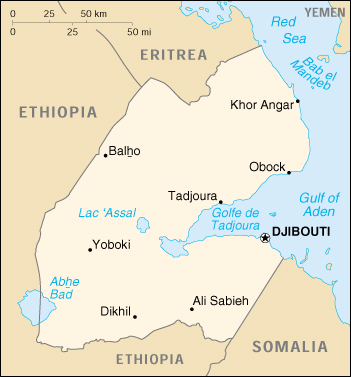
Background: The French Territory of the Afars and the Issas became Djibouti in 1977. A peace accord in 1994 ended a three-year uprising by Afars rebels.
Government type: republic
Capital: Djibouti
Currency: 1 Djiboutian franc (DF) = 100 centimes
Geography of Djibouti
Location: Eastern Africa, bordering the Gulf of Aden and the Red Sea, between Eritrea and Somalia
Geographic coordinates: 11 30 N, 43 00 E
Area:
total: 22,000 sq. km
land: 21,980 sq. km
water: 20 sq. km
Land boundaries:
total: 508 km
border countries: Eritrea 113 km, Ethiopia 337 km, Somalia 58 km
Coastline: 314 km
Maritime claims:
contiguous zone: 24 nm
exclusive economic zone: 200 nm
territorial sea: 12 nm
Climate: desert; torrid, dry
Terrain: coastal plain and plateau separated by central mountains
Elevation extremes:
lowest point: Lac Assal -155 m
highest point: Moussa Ali 2,028 m
Natural resources: geothermal areas
Land use:
arable land: 0%
permanent crops: 0%
permanent pastures: 9%
forests and woodland: 0%
other: 91% (1993 est.)
Natural hazards: earthquakes; droughts; occasional cyclonic disturbances from the Indian Ocean bring heavy rains and flash floods
Environment – current issues: inadequate supplies of potable water; desertification
Environment – international agreements:
party to: Biodiversity, Climate Change, Desertification, Endangered Species, Law of the Sea, Ozone Layer Protection, Ship Pollution
signed, but not ratified: none of the selected agreements
Geography – note: strategic location near world’s busiest shipping lanes and close to Arabian oilfields; terminus of rail traffic into Ethiopia; mostly wasteland; Lac Assal (Lake Assal) is the lowest point in Africa.
People of Djibouti
About two-thirds of the Republic of Djibouti’s 652,000 inhabitants live in the capital city. The indigenous population is divided between the majority Somalis (predominantly of the Issa tribe, with minority Issak and Gadaboursi representation) and the Afars (Danakils). All are Cushitic-speaking peoples, and nearly all are Muslim. Among the 15,000 foreigners residing in Djibouti, the French are the most numerous. Among the French are 3,000 troops.
Population: 476,703 (July 2005 est.)
Age structure:
0-14 years: 42.58%
15-64 years: 54.58%
65 years and over: 2.84%
Population growth rate: 2.6%
Birth rate: 40.66births/1,000 population
Death rate: 14.66deaths/1,000 population
Net migration rate: 0 migrant(s)/1,000 population
Infant mortality rate: 101.51 deaths/1,000 live births
Life expectancy at birth:
total population: 51.21 years
male: 49.37 years
female: 53.1 years
Total fertility rate: 5.72 children born/woman
Nationality:
noun: Djiboutian(s)
adjective: Djiboutian
Ethnic groups: Somali 60%, Afar 35%, French, Arab, Ethiopian, and Italian 5%
Religions: Muslim 94%, Christian 6%
Languages: French (official), Arabic (official), Somali, Afar
Literacy:
definition: age 15 and over can read and write
total population: 46.2%
male: 60.3%
female: 32.7% (1995 est.)
History of Djibouti
The Republic of Djibouti gained its independence on June 27, 1977. It is the successor to French Somaliland (later called the French Territory of the Afars and Issas), which was created in the first half of the 19th century as a result of French interest in the Horn of Africa. However, the history of Djibouti, recorded in poetry and songs of its nomadic peoples, goes back thousands of years to a time when Djiboutians traded hides and skins for the perfumes and spices of ancient Egypt, India, and China. Through close contacts with the Arabian peninsula for more than 1,000 years, the Somali and Afar tribes in this region became the first on the African continent to adopt Islam.
It was Rochet d’Hericourt’s exploration into Shoa (1839-42) that marked the beginning of French interest in the African shores of the Red Sea. Further exploration by Henri Lambert, French Consular Agent at Aden, and Captain Fleuriot de Langle led to a treaty of friendship and assistance between France and the sultans of Raheita, Tadjoura, and Gobaad, from whom the French purchased the anchorage of Obock (1862).
Growing French interest in the area took place against a backdrop of British activity in Egypt and the opening of the Suez Canal in 1869. In 1884-85, France expanded its protectorate to include the shores of the Gulf of Tadjoura and the Somaliland. Boundaries of the protectorate, marked out in 1897 by France and Emperor Menelik II of Ethiopia, were affirmed further by agreements with Ethiopian Emperor Haile Selassie I in 1945 and 1954.
The administrative capital was moved from Obock to Djibouti in 1896. Djibouti, which has a good natural harbor and ready access to the Ethiopian highlands, attracted trade caravans crossing East Africa as well as Somali settlers from the south. The Franco-Ethiopian railway, linking Djibouti to the heart of Ethiopia, was begun in 1897 and reached Addis Ababa in June 1917, further facilitating the increase of trade.
During the Italian invasion and occupation of Ethiopia in the 1930s and during World War II, constant border skirmishes occurred between French and Italian forces. The area was ruled by the Vichy (French) government from the fall of France until December 1942, and fell under British blockade during that period. Free French and the Allied forces recaptured Djibouti at the end of 1942. A local battalion from Djibouti participated in the liberation of France in 1944.
On July 22, 1957, the colony was reorganized to give the people considerable self-government. On the same day, a decree applying the Overseas Reform Act (Loi Cadre) of June 23, 1956, established a territorial assembly that elected eight of its members to an executive council. Members of the executive council were responsible for one or more of the territorial services and carried the title of minister. The council advised the French-appointed governor general.
In a September 1958 constitutional referendum, French Somaliland opted to join the French community as an overseas territory. This act entitled the region to representation by one deputy and one senator in the French Parliament, and one counselor in the French Union Assembly.
The first elections to the territorial assembly were held on November 23, 1958, under a system of proportional representation. In the next assembly elections (1963), a new electoral law was enacted. Representation was abolished in exchange for a system of straight plurality vote based on lists submitted by political parties in seven designated districts. Ali Aref Bourhan, allegedly of Turkish origin, was selected to be the president of the executive council. French President Charles de Gaulle’s August 1966 visit to Djibouti was marked by 2 days of public demonstrations by Somalis demanding independence. On September 21, 1966, Louis Saget, appointed governor general of the territory after the demonstrations, announced the French Government’s decision to hold a referendum to determine whether the people would remain within the French Republic or become independent. In March 1967, 60% chose to continue the territory’s association with France.
In July of that year, a directive from Paris formally changed the name of the region to the French Territory of Afars and Issas. The directive also reorganized the governmental structure of the territory, making the senior French representative, formerly the governor general, a high commissioner. In addition, the executive council was redesignated as the council of government, with nine members.
In 1975, the French Government began to accommodate increasingly insistent demands for independence. In June 1976, the territory’s citizenship law, which favored the Afar minority, was revised to reflect more closely the weight of the Issa Somali. The electorate voted for independence in a May 1977 referendum, and the Republic of Djibouti was established on June 27, 1977. Hassan Gouled Aptidon became the country’s first president.
Djibouti Economy
Djibouti’s fledgling economy depends on a large foreign expatriate community, the maritime and commercial activities of the Port of Djibouti, its airport, and the operation of the Addis Ababa-Djibouti railroad. During the civil war (1991-94), there was a significant diversion of government budgetary resources from developmental and social services to military needs. France is insisting that future aid be conditional on an overhaul of Djibouti’s dilapidated state finances in conjunction with the International Monetary Fund. Agriculture and industry are little developed, in part due to the harsh climate, high production costs, unskilled labor, and limited natural resources. Only a few mineral deposits exist in the country, and the arid soil is unproductive–89% is desert wasteland, 10% is pasture, and 1% is forested. Services and commerce provide most of the gross domestic product.
Djibouti’s most important economic asset is its strategic location on the shipping routes between the Mediterranean Sea and the Indian Ocean–the Republic lies on the west side of the Bab-el-Mandeb, which connects the Red Sea and the Gulf of Aden. Its port is an important transshipment point for containers. It also functions as a bunkering port and a small French naval facility. Business increased at Djibouti port when hostilities between Eritrea and Ethiopia denied Ethiopia access to the Eritrean port of Assab. Djibouti became the only significant port for landlocked Ethiopia, handling all its imports and exports, including huge shipments of U.S. food aid in 2000 during the drought and famine. In 2000, Jebel Ali Port Mangers, who manage the port of Dubai, took over management of Djibouti’s port. This was part of a regional management scheme that also included the port of Beirut. As a result, the Port of Djibouti has increased its efficiency and is positioned to be a major port and transshipment port for the Red Sea.
The Addis Ababa-Djibouti railroad is the only line serving central and southeastern Ethiopia. The single-track railway–a prime source of employment–occupies a prominent place in Ethiopia’s internal distribution system for domestic commodities such as cement, cotton textiles, sugar, cereals and charcoal.
Principal exports from the region transiting Djibouti are coffee, salt, hides, dried beans, cereals, other agricultural products, wax and salt. Djibouti itself has few exports, and the majority of its imports come from France. Most imports are consumed in Djibouti, and the remainder goes to Ethiopia and northwestern Somalia. Djibouti’s unfavorable balance of trade is offset partially by invisible earnings such as transit taxes and harbor dues. In 1999, U.S. exports to Djibouti totaled $26.7 million while U.S. imports from Djibouti were less than $100,000.
The city of Djibouti has the only paved airport in the republic. Djibouti has one of the most liberal economic regimes in Africa, with almost unrestricted banking and commerce sectors.
GDP: purchasing power parity – $574 million (2000 est.)
GDP – real growth rate: 2% (1999 est.), 2% (2000 est.)
GDP – per capita: purchasing power parity – $1,300 (2000 est.)
GDP – composition by sector:
agriculture: 3%
industry: 22%
services: 75% (1998 est.)
Inflation rate (consumer prices): 0% (1999 est.), 2% (2000 est.)
Labor force: 282,000
Labor force – by occupation: agriculture 75%, industry 11%, services 14% (1991 est.)
Unemployment rate: 50% (2000 est.)
Budget:
revenues: $133 million
expenditures: $187 million (1999 est.)
Industries: limited to a few small-scale enterprises, such as dairy products and mineral-water bottling
Industrial production growth rate: 3% (1996 est.)
Electricity – production: 180 million kWh (1999)
Electricity – production by source:
fossil fuel: 100%
hydro: 0%
nuclear: 0%
other: 0% (1999)
Agriculture – products: fruits, vegetables; goats, sheep, camels
Exports: $260 million (f.o.b., 1999 est.)
Exports – commodities: reexports, hides and skins, coffee (in transit)
Exports – partners: Somalia 53%, Yemen 23%, Ethiopia 5%, (1998)
Imports: $440 million (f.o.b., 1999 est.)
Imports – commodities: foods, beverages, transport equipment, chemicals, petroleum products
Imports – partners: France 13%, Ethiopia 12%, Italy 9%, Saudi Arabia 6%, United Kingdom 6% (1998)
Debt – external: $350 million (1999 est.)
Economic aid – recipient: $106.3 million (1995)
Currency: Djiboutian franc (DJF)
Map of Djibouti