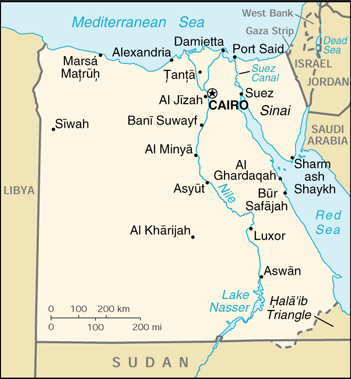
Background: Nominally independent from the UK in 1922, Egypt acquired full sovereignty following World War II. The completion of the Aswan High Dam in 1971 and the resultant Lake Nasser have altered the time-honored place of the Nile river in the agriculture and ecology of Egypt. A rapidly growing population (the largest in the Arab world), limited arable land, and dependence on the Nile all continue to overtax resources and stress society. The government has struggled to ready the economy for the new millennium through economic reform and massive investment in communications and physical infrastructure.
Government type: republic
Capital: Cairo
Currency: 1 Egyptian pound = 100 piasters
Geography of Egypt
Location: Northern Africa, bordering the Mediterranean Sea, between Libya and the Gaza Strip
Geographic coordinates: 27 00 N, 30 00 E
Area:
total: 1,001,450 sq. km
land: 995,450 sq. km
water: 6,000 sq. km
Land boundaries:
total: 2,689 km
border countries: Gaza Strip 11 km, Israel 255 km, Libya 1,150 km, Sudan 1,273 km
Coastline: 2,450 km
Maritime claims:
contiguous zone: 24 nm
continental shelf: 200-m depth or to the depth of exploitation
exclusive economic zone: 200 nm
territorial sea: 12 nm
Climate: desert; hot, dry summers with moderate winters
Terrain: vast desert plateau interrupted by Nile valley and delta
Elevation extremes:
lowest point: Qattara Depression -133 m
highest point: Mount Catherine 2,629 m
Natural resources: petroleum, natural gas, iron ore, phosphates, manganese, limestone, gypsum, talc, asbestos, lead, zinc
Land use:
arable land: 2%
permanent crops: 0%
permanent pastures: 0%
forests and woodland: 0%
other: 98% (1993 est.)
Irrigated land: 32,460 sq. km (1993 est.)
Natural hazards: periodic droughts; frequent earthquakes, flash floods, landslides, volcanic activity; hot, driving windstorm called khamsin occurs in spring; dust storms, sandstorms
Environment – current issues: agricultural land being lost to urbanization and windblown sands; increasing soil salination below Aswan High Dam; desertification; oil pollution threatening coral reefs, beaches, and marine habitats; other water pollution from agricultural pesticides, raw sewage, and industrial effluents; very limited natural fresh water resources away from the Nile which is the only perennial water source; rapid growth in population overstraining natural resources.
Environment – international agreements:
party to: Biodiversity, Climate Change, Desertification, Endangered Species, Environmental Modification, Hazardous Wastes, Law of the Sea, Marine Dumping, Nuclear Test Ban, Ozone Layer Protection, Ship Pollution, Tropical Timber 83, Tropical Timber 94, Wetlands
signed, but not ratified: Climate Change-Kyoto Protocol
Geography – note: controls Sinai Peninsula, only land bridge between Africa and remainder of Eastern Hemisphere; controls Suez Canal, shortest sea link between Indian Ocean and Mediterranean Sea; size, and juxtaposition to Israel, establish its major role in Middle Eastern geopolitics; dependence on upstream neighbors; dominance of Nile basin issues; prone to influxes of refugees.
Physical Size and Borders
Egypt, covering 1,001,449 square kilometers of land, is about the same size as Texas and New Mexico combined. The country’s greatest distance from north to south is 1,024 kilometers, and from east to west, 1,240 kilometers. The country is located in northeastern Africa and includes the Sinai Peninsula (also seen as Sinai), which is often considered part of Asia. Egypt’s natural boundaries consist of more than 2,900 kilometers of coastline along the Mediterranean Sea, the Gulf of Suez, the Gulf of Aqaba, and the Red Sea.
Egypt has land boundaries with Israel, Libya, Sudan, and the Gaza Strip, a Palestinian area formerly administered by Egypt and occupied by Israel since 1967. The land boundaries are generally straight lines that do not conform to geographic features such as rivers. Egypt shares its longest boundary, which extends 1,273 kilometers, with Sudan. In accordance with the Anglo-Egyptian Condominium Agreement of 1899, this boundary runs westward from the Red Sea along the twenty-second parallel, includes the Sudanese Nile salient (Wadi Halfa salient), and continues along the twenty-second parallel until it meets the twenty-fifth meridian. The Sudanese Nile salient, a finger-shaped area along the Nile River (Nahr an Nil) north of the twenty-second parallel, is nearly covered by Lake Nasser, which was created when the Aswan High Dam was constructed in the 1960s. An “administrative” boundary, which supplements the main Egyptian-Sudanese boundary permits nomadic tribes to gain access to water holes at the eastern end of Egypt’s southern frontier. The administrative boundary departs from the international boundary in two places; Egypt administers the area south of the twenty-second parallel, and Sudan administers the area north of it.
Egypt shares all 1,150 kilometers of the western border with Libya. This border was defined in 1925 under an agreement with Italy, which had colonized Libya. Before and after World War II, the northern border was adjusted, resulting in the return of the village of As Sallum to Egyptian sovereignty. Egypt shares 255 kilometers of its eastern border in Sinai with Israel and 11 kilometers with the Gaza Strip.
Egypt is divided into twenty-six governorates (sometimes called provinces), which include four city governorates: Alexandria (Al Iskandariyah), Cairo (Al Qahirah), Port Said (Bur Said) and Suez; the nine governorates of Lower Egypt in the Nile Delta region; the eight governorates of Upper Egypt along the Nile River south from Cairo to Aswan; and the five frontier governorates covering Sinai and the deserts that lie west and east of the Nile. All governorates, except the frontier ones, are in the Nile Delta or along the Nile Valley and Suez Canal.
Natural Regions
Egypt is predominantly desert. Only 35,000 square kilometers- -3.5 percent of the total land area–are cultivated and permanently settled. Most of the country lies within the wide band of desert that stretches from Africa’s Atlantic Coast across the continent and into southwest Asia. Egypt’s geological history has produced four major physical regions: the Nile Valley and Delta, the Western Desert (also known as the Libyan Desert), the Eastern Desert (also known as the Arabian Desert), and the Sinai Peninsula. The Nile Valley and Delta is the most important region because it supports 99 percent of the population on the country’s only cultivable land.
Nile Valley and Delta
The Nile Valley and Delta, the most extensive oasis on earth, was created by the world’s second-longest river and its seemingly inexhaustible sources. Without the topographic channel that permits the Nile to flow across the Sahara, Egypt would be entirely desert; the Nile River traverses about 1,600 kilometers through Egypt and flows northward from the Egyptian-Sudanese border to the Mediterranean Sea. The Nile is a combination of three long rivers whose sources are in central Africa: the White Nile, the Blue Nile, and the Atbarah.
The White Nile, which begins at Lake Victoria in Uganda, supplies about 28 percent of the Nile’s waters in Egypt. In its course from Lake Victoria to Juba in southern Sudan, the elevation of the White Nile’s channel drops more than 600 meters. In its 1,600-kilometer course from Juba to Khartoum, Sudan’s capital, the river descends only 75 meters. In southern and central Sudan, the White Nile passes through a wide, flat plain covered with swamp vegetation and slows almost to stagnation.
The Blue Nile, which originates at Lake Tana in Ethiopia, provides an average of 58 percent of the Nile’s waters in Egypt. It has a steeper gradient and flows more swiftly than the White Nile, which it joins at Khartoum. Unlike the White Nile, the Blue Nile carries a considerable amount of sediment; for several kilometers north of Khartoum, water closer to the eastern bank of the river is visibly muddy and comes from the Blue Nile, while the water closer to the western bank is clearer and comes from the White Nile.
The much shorter Atbarah River, which also originates in Ethiopia, joins the main Nile north of Khartoum between the fifth and sixth cataracts (areas of steep rapids) and provides about 14 percent of the Nile’s waters in Egypt. During the low-water season, which runs from January to June, the Atbarah shrinks to a number of pools. But in late summer, when torrential rains fall on the Ethiopian plateau, the Atbarah provides 22 percent of the Nile’s flow.
The Blue Nile has a similar pattern. It contributes 17 percent of the Nile’s waters in the low-water season and 68 percent during the high-water season. In contrast, the White Nile provides only 10 percent of the Nile’s waters during the highwater season but contributes more than 80 percent during the lowwater period. Thus, before the Aswan High Dam was completed in 1971, the White Nile watered the Egyptian stretch of the river throughout the year, whereas the Blue Nile, carrying seasonal rain from Ethiopia, caused the Nile to overflow its banks and deposit a layer of fertile mud over adjacent fields. The great flood of the main Nile usually occurred in Egypt during August, September, and October, but it sometimes began as early as June at Aswan and often did not completely wane until January.
The Nile enters Egypt a few kilometers north of Wadi Halfa, a Sudanese town that was completely rebuilt on high ground when its original site was submerged in the reservoir created by the Aswan High Dam. As a result of the dam’s construction, the Nile actually begins its flow into Egypt as Lake Nasser, which extends south from the dam 320 kilometers to the border and an additional 158 kilometers into Sudan. Lake Nasser’s waters fill the area through Lower Nubia (Upper Egypt and northern Sudan) within the narrow gorge between the cliffs of sandstone and granite created by the flow of the river over many centuries. Below Aswan the cultivated floodplain strip widens to as much as twenty kilometers. North of Isna (160 kilometers north of Aswan), the plateau on both sides of the valley rises as high as 550 meters above sea level; at Qina (about 90 kilometers north of Isna) the 300-meter limestone cliffs force the Nile to change course to the southwest for about 60 kilometers before turning northwest for about 160 kilometers to Asyut. Northward from Asyut, the escarpments on both sides diminish, and the valley widens to a maximum of twenty-two kilometers. The Nile reaches the Delta at Cairo.
At Cairo the Nile spreads out over what was once a broad estuary that has been filled by silt deposits to form a fertile, fan-shaped delta about 250 kilometers wide at the seaward base and about 160 kilometers from north to south. The Nile Delta extends over approximately 22,000 square kilometers (roughly equivalent in area to Massachusetts). According to historical accounts from the first century A.D., seven branches of the Nile once ran through the Delta. According to later accounts, the Nile had only six branches by around the twelfth century. Since then, nature and man have closed all but two main outlets: the east branch, Damietta (also seen as Dumyat; 240 kilometers long), and the west branch, Rosetta (235 kilometers long). Both outlets are named after the ports located at their mouths. A network of drainage and irrigation canals supplements these remaining outlets. In the north near the coast, the Delta embraces a series of salt marshes and lakes; most notable among them are Idku, Al Burullus, and Manzilah.
The fertility and productivity of the land adjacent to the Nile depends largely on the silt deposited by floodwaters. Archaeological research indicates that people once lived at a much higher elevation along the river than they do today, probably because the river was higher or the floods more severe. The timing and the amount of annual flow were always unpredictable. Measurements of annual flows as low as 1.2 billion cubic meters and as high as 4.25 billion cubic meters have been recorded. For centuries Egyptians attempted to predict and take advantage of the flows and moderate the severity of floods.
The construction of dams on the Nile, particularly the Aswan High Dam, transformed the mighty river into a large and predictable irrigation ditch. Lake Nasser, the world’s largest artificial lake, has enabled planned use of the Nile regardless of the amount of rainfall in Central Africa and East Africa. The dams have also affected the Nile Valley’s fertility, which was dependent for centuries not only on the water brought to the arable land but also on the materials left by the water. Researchers have estimated that beneficial silt deposits in the valley began about 10,000 years ago. The average annual deposit of arable soil through the course of the river valley was about nine meters. Analysis of the flow revealed that 10.7 million tons of solid matter passed Cairo each year. Today the Aswan High Dam obstructs most of this sediment, which is now retained in Lake Nasser. The reduction in annual silt deposits has contributed to rising water tables and increasing soil salinity in the Delta, the erosion of the river’s banks in Upper Egypt, and the erosion of the alluvial fan along the shore of the Mediterranean Sea.
Western Desert
The Western Desert covers about 700,000 square kilometers (equivalent in size to Texas) and accounts for about two-thirds of Egypt’s land area. This immense desert to the west of the Nile spans the area from the Mediterranean Sea south to the Sudanese border. The desert’s Jilf al Kabir Plateau has an altitude of about 1,000 meters, an exception to the uninterrupted territory of basement rocks covered by layers of horizontally bedded sediments forming a massive plain or low plateau. The Great Sand Sea lies within the desert’s plain and extends from the Siwah Oasis to Jilf al Kabir. Scarps (ridges) and deep depressions (basins) exist in several parts of the Western Desert, and no rivers or streams drain into or out of the area.
The government has considered the Western Desert a frontier region and has divided it into two governorates at about the twenty-eighth parallel: Matruh to the north and New Valley (Al Wadi al Jadid) to the south. There are seven important depressions in the Western Desert, and all are considered oases except the largest, Qattara, the water of which is salty. The Qattara Depression is approximately 15,000 square kilometers (about the size of Connecticut and Rhode Island) and is largely below sea level (its lowest point is 133 meters below sea level). Badlands, salt marshes, and salt lakes cover the sparsely inhabited Qattara Depression.
Limited agricultural production, the presence of some natural resources, and permanent settlements are found in the other six depressions, all of which have fresh water provided by the Nile or by local groundwater. The Siwah Oasis, close to the Libyan border and west of Qattara, is isolated from the rest of Egypt but has sustained life since ancient times. The Siwa’s cliff-hung Temple of Amun was renowned for its oracles for more than 1,000 years. Herodotus and Alexander the Great were among the many illustrious people who visited the temple in the pre-Christian era.
The other major oases form a topographic chain of basins extending from the Al Fayyum Oasis (sometimes called the Fayyum Depression) which lies sixty kilometers southwest of Cairo, south to the Bahriyah, Farafirah, and Dakhilah oases before reaching the country’s largest oasis, Kharijah. A brackish lake, Birkat Qarun, at the northern reaches of Al Fayyum Oasis, drained into the Nile in ancient times. For centuries sweetwater artesian wells in the Fayyum Oasis have permitted extensive cultivation in an irrigated area that extends over 1,800 square kilometers.
Eastern Desert
The topographic features of the region east of the Nile are very different from those of the Western Desert. The relatively mountainous Eastern Desert rises abruptly from the Nile and extends over an area of approximately 220,000 square kilometers (roughly equivalent in size to Utah). The upward-sloping plateau of sand gives way within 100 kilometers to arid, defoliated, rocky hills running north and south between the Sudan border and the Delta. The hills reach elevations of more than 1,900 meters. The region’s most prominent feature is the easterly chain of rugged mountains, the Red Sea Hills, which extend from the Nile Valley eastward to the Gulf of Suez and the Red Sea. This elevated region has a natural drainage pattern that rarely functions because of insufficient rainfall. It also has a complex of irregular, sharply cut wadis that extend westward toward the Nile.
The Eastern Desert is generally isolated from the rest of the country. There is no oasis cultivation in the region because of the difficulty in sustaining any form of agriculture. Except for a few villages on the Red Sea coast, there are no permanent settlements. The importance of the Eastern Desert lies in its natural resources, especially oil. A single governorate, the capital of which is at Al Ghardaqah, administers the entire region.
Sinai Peninsula
This triangular area covers about 61,100 square kilometers (slightly smaller than West Virginia). Similar to the desert, the peninsula contains mountains in its southern sector that are a geological extension of the Red Sea Hills, the low range along the Red Sea coast that includes Mount Catherine (Jabal Katrinah), the country’s highest point–2,642 meters. The Red Sea is named after these mountains, which are red.
The southern side of the peninsula has a sharp escarpment that subsides after a narrow coastal shelf that slopes into the Red Sea and the Gulf of Aqaba. The elevation of Sinai’s southern rim is about 1,000 meters. Moving northward, the elevation of this limestone plateau decreases. The northern third of Sinai is a flat, sandy coastal plain, which extends from the Suez Canal into the Gaza Strip and Israel.
Before the Israeli military occupied Sinai during the June 1967 War (Arab-Israeli war, also known as the Six-Day War), a single Egyptian governorate administered the whole peninsula. By 1982 after all of Sinai was returned to Egypt, the central government divided the peninsula into two governorates. North Sinai has its capital at Al Arish and the South Sinai has its capital in At Tur.
Climate
Throughout Egypt, days are commonly warm or hot, and nights are cool. Egypt has only two seasons: a mild winter from November to April and a hot summer from May to October. The only differences between the seasons are variations in daytime temperatures and changes in prevailing winds. In the coastal regions, temperatures range between an average minimum of 14° C in winter and an average maximum of 30° C in summer.
Temperatures vary widely in the inland desert areas, especially in summer, when they may range from 7° C at night to 43° C during the day. During winter, temperatures in the desert fluctuate less dramatically, but they can be as low as 0° C at night and as high as 18° C during the day.
The average annual temperature increases moving southward from the Delta to the Sudanese border, where temperatures are similar to those of the open deserts to the east and west. In the north, the cooler temperatures of Alexandria during the summer have made the city a popular resort. Throughout the Delta and the northern Nile Valley, there are occasional winter cold spells accompanied by light frost and even snow. At Aswan, in the south, June temperatures can be as low as 10° C at night and as high as 41° C during the day when the sky is clear.
Egypt receives fewer than eighty millimeters of precipitation annually in most areas. Most rain falls along the coast, but even the wettest area, around Alexandria, receives only about 200 millimeters of precipitation per year. Alexandria has relatively high humidity, but sea breezes help keep the moisture down to a comfortable level. Moving southward, the amount of precipitation decreases suddenly. Cairo receives a little more than one centimeter of precipitation each year. The city, however, reports humidity as high as 77 percent during the summer. But during the rest of the year, humidity is low. The areas south of Cairo receive only traces of rainfall. Some areas will go years without rain and then experience sudden downpours that result in flash floods. Sinai receives somewhat more rainfall (about twelve centimeters annually in the north) than the other desert areas, and the region is dotted by numerous wells and oases, which support small population centers that formerly were focal points on trade routes. Water drainage toward the Mediterranean Sea from the main plateau supplies sufficient moisture to permit some agriculture in the coastal area, particularly near Al Arish.
A phenomenon of Egypt’s climate is the hot spring wind that blows across the country. The winds, known to Europeans as the sirocco and to Egyptians as the khamsin, usually arrive in April but occasionally occur in March and May. The winds form in small but vigorous low-pressure areas in the Isthmus of Suez and sweep across the northern coast of Africa. Unobstructed by geographical features, the winds reach high velocities and carry great quantities of sand and dust from the deserts. These sandstorms, often accompanied by winds of up to 140 kilometers per hour, can cause temperatures to rise as much as 20° C in two hours. The winds blow intermittently and may continue for days, cause illness in people and animals, harm crops, and occasionally damage houses and infrastructure.
People of Egypt
Egypt is the most populous country in the Arab world and the second-most populous on the African Continent. Nearly 100% of the country’s 69 million people live in Cairo and Alexandria; elsewhere on the banks of the Nile; in the Nile delta, which fans out north of Cairo; and along the Suez Canal. These regions are among the world’s most densely populated, containing an average of over 3,820 persons per square mile (1,540 per sq. km.), as compared to 181 persons per sq. mi. for the country as a whole.
Small communities spread throughout the desert regions of Egypt are clustered around oases and historic trade and transportation routes. The government has tried with mixed success to encourage migration to newly irrigated land reclaimed from the desert. However, the proportion of the population living in rural areas has continued to decrease as people move to the cities in search of employment and a higher standard of living.
The Egyptians are a fairly homogeneous people of Hamitic origin. Mediterranean and Arab influences appear in the north, and there is some mixing in the south with the Nubians of northern Sudan. Ethnic minorities include a small number of Bedouin Arab nomads in the eastern and western deserts and in the Sinai, as well as some 50,000-100,000 Nubians clustered along the Nile in Upper (southern) Egypt.
The literacy rate is about 51% of the adult population. Education is free through university and compulsory from ages six through 15. Rates for primary and secondary education have strengthened in recent years. Ninety-three percent of children enter primary school and about one-quarter drop out after the sixth year; in 1994-95, 87% entered primary school and about half dropped out after the sixth year.
Population: 77,505,756 (July 2005 est.)
Age structure:
0-14 years: 34.59%
15-64 years: 61.6%
65 years and over: 3.81%
Population growth rate: 1.69%
Birth rate: 24.89 births/1,000 population
Death rate: 7.7 deaths/1,000 population
Net migration rate: -0.24 migrant(s)/1,000 population
Infant mortality rate: 60.46 deaths/1,000 live births
Life expectancy at birth:
total population: 63.69 years
male: 61.62 years
female: 65.85 years
Total fertility rate: 3.07 children born/woman
Nationality:
noun: Egyptian(s)
adjective: Egyptian
Ethnic groups: Eastern Hamitic stock (Egyptians, Bedouins, and Berbers) 99%, Greek, Nubian, Armenian, other European (primarily Italian and French) 1%
Religions: Muslim (mostly Sunni) 94%, Coptic Christian and other 6%
Languages: Arabic (official), English and French widely understood by educated classes.
Literacy:
definition: age 15 and over can read and write
total population: 51.4%
male: 63.6%
female: 38.8% (1995 est.)
History of Egypt
THE ROOTS OF EGYPTIAN civilization go back more than 6,000 years to the beginning of settled life along the banks of the Nile River. The country has an unusual geographical and cultural unity that has given the Egyptian people a strong sense of identity and a pride in their heritage as descendants of humankind’s earliest civilized community.
Within the long sweep of Egyptian history, certain events or epochs have been crucial to the development of Egyptian society and culture. One of these was the unification of Upper Egypt and Lower Egypt sometime in the third millennium B.C. The ancient Egyptians regarded this event as the most important in their history, comparable to the “First Time,” or the creation of the universe. With the unification of the “Two Lands” by the legendary, if not mythical, King Menes, the glorious Pharaonic Age began. Power was centralized in the hands of a god-king, and, thus, Egypt became the first organized society.
The ancient Egyptians were the first people of antiquity to believe in life after death. They were the first to build in stone and to fashion the arch in stone and brick. Even before the unification of the Two Lands, the Egyptians had developed a plow and a system of writing. They were accomplished sailors and shipbuilders. They learned to chart the heavens in order to predict the Nile flood. Their physicians prescribed healing remedies and performed surgical operations. They sculpted in stone and decorated the walls of their tombs with naturalistic murals in vibrant colors. The legacy of ancient Egypt is written in stone across the face of the country from the pyramids of Upper Egypt to the rock tombs in the Valley of the Kings to the Old Kingdom temples of Luxor and Karnak to the Ptolemaic temples of Edfu and Dendera and to the Roman temple to Isis on Philae Island.
The Arab conquest of 641 by the military commander Amr ibn al As was perhaps the next most important event in Egyptian history because it resulted in the Islamization and Arabization of the country, which endure to this day. Even those who clung to the Coptic religion, a substantial minority of the population in 1990, were Arabized; that is, they adopted the Arabic language and were assimilated into Arab culture.
Although Egypt was formally under Arab rule, beginning in the ninth century hereditary autonomous dynasties arose that allowed local rulers to maintain a great deal of control over the country’s destiny. During this period Cairo was established as the capital of the country and became a center of religion, learning, art, and architecture. In 1260, the Egyptian ruler, Qutuz, and his forces stopped the Mongol advance across the Arab world at the battle of Ayn Jalut in Palestine. Because of this victory, Islamic civilization could continue to flourish when Baghdad, the capital of the Abbasid caliphate, fell to the Mongols. Qutuz’s successor, Baybars I, inaugurated the reign of the Mamluks, a dynasty of slave-soldiers of Turkish and Circassian origin that lasted for almost three centuries.
In 1517 Egypt was conquered by Sultan Selim I and absorbed into the Ottoman Empire. Since the Turks were Muslims, however, and the sultans regarded themselves as the preservers of Sunni Islam, this period saw institutional continuity, particularly in religion, education, and the religious law courts. In addition, after only a century of Ottoman rule, the Mamluk system reasserted itself, and Ottoman governors became at times virtual prisoners in the citadel, the ancient seat of Egypt’s rulers.
The modern history of Egypt is marked by Egyptian attempts to achieve political independence, first from the Ottoman Empire and then from the British. In the first half of the nineteenth century, Muhammad Ali, an Albanian and the Ottoman viceroy in Egypt, attempted to create an Egyptian empire that extended to Syria and to remove Egypt from Turkish control. Ultimately, he was unsuccessful, and true independence from foreign powers would not be achieved until midway through the next century.
Foreign, including British, investment in Egypt and Britain’s need to maintain control over the Suez Canal resulted in the British occupation of Egypt in 1882. Although Egypt was granted nominal independence in 1922, Britain remained the real power in the country. Genuine political independence was finally achieved between the 1952 Revolution and the 1956 War. In 1952 the Free Officers, led by Lieutenant Colonel Gamal Abdul Nasser, took control of the government and removed King Faruk from power. In 1956 Nasser, as Egyptian president, announced the nationalization of the Suez Canal, an action that resulted in the tripartite invasion by Britain, France, and Israel. Ultimately, however, Egypt prevailed, and the last British troops were withdrawn from the country by the end of the year.
No history of Egypt would be complete without mentioning the Arab-Israeli conflict, which has cost Egypt so much in lives, territory, and property. Armed conflict between Egypt and Israel ended in 1979 when the two countries signed the Camp David Accords. The accords, however, constituted a separate peace between Egypt and Israel and did not lead to a comprehensive settlement that would have satisfied Palestinian demands for a homeland or brought about peace between Israel and its Arab neighbors. Thus, Egypt remained embroiled in the conflict on the diplomatic level and continued to press for an international conference to achieve a comprehensive agreement.
Egypt Economy
Economy – overview: A series of IMF arrangements – along with massive external debt relief resulting from Egypt’s participation in the Gulf war coalition – helped Egypt improve its macroeconomic performance during the 1990s. Sound fiscal and monetary policies through the mid-1990s helped to tame inflation, slash budget deficits, and build up foreign reserves, while structural reforms such as privatization and new business legislation prompted increased foreign investment. By mid-1998, however, the pace of structural reform slackened, and lower combined hard currency earnings resulted in pressure on the Egyptian pound and sporadic US dollar shortages. External payments were not in crisis, but Cairo’s attempts to curb demand for foreign exchange convinced some investors and currency traders that government financial operations lacked transparency and coordination. Monetary pressures have since eased, however, with the 1999-2000 higher oil prices, a rebound in tourism, and a series of mini-devaluations of the pound. The development of a gas export market is a major plus factor in future growth.
GDP: purchasing power parity – $247 billion (2000 est.)
GDP – real growth rate: 5% (2000 est.)
GDP – per capita: purchasing power parity – $3,600 (2000 est.)
GDP – composition by sector:
agriculture: 17%
industry: 32%
services: 51% (1999)
Population below poverty line: 22.9% (FY95/96 est.)
Household income or consumption by percentage share:
lowest 10%: 4.4%
highest 10%: 25% (1995)
Inflation rate (consumer prices): 3.7% (1999), 3% (2000)
Labor force: 19.9 million (2000 est.)
Labor force – by occupation: agriculture 29%, services 49%, industry 22% (FY99)
Unemployment rate: 11.8% (1999 est.), 11.5% (2000 est.)
Budget:
revenues: $22.6 billion
expenditures: $26.2 billion (FY99)
Industries: textiles, food processing, tourism, chemicals, hydrocarbons, construction, cement, metals
Industrial production growth rate: 2.1% (2000 est.)
Electricity – production: 64.685 billion kWh (1999)
Electricity – production by source:
fossil fuel: 76.59%
hydro: 23.41%
nuclear: 0%
other: 0% (1999)
Electricity – consumption: 60.157 billion kWh (1999)
Electricity – exports: 0 kWh (1999)
Electricity – imports: 0 kWh (1999)
Agriculture – products: cotton, rice, corn, wheat, beans, fruits, vegetables; cattle, water buffalo, sheep, goats
Exports: $4.6 billion (f.o.b., 1999 est.), $7.3 billion (f.o.b., 2000 est.)
Exports – commodities: crude oil and petroleum products, cotton, textiles, metal products, chemicals
Exports – partners: EU 35%, Middle East 17%, Afro-Asian countries 14%, US 12% (1999)
Imports: $15.8 billion (f.o.b., 1999 est.), $17 billion (f.o.b., 2000 est.)
Imports – commodities: machinery and equipment, foodstuffs, chemicals, wood products, fuels
Imports – partners: EU 36%, US 14%, Afro-Asian countries 14%, Middle East 6% (1999)
Debt – external: $31 billion (2000 est.)
Economic aid – recipient: ODA, $2.25 billion (1999)
Currency: Egyptian pound (EGP)
Map of Egypt