Background: Eritrea was awarded to Ethiopia in 1952 as part of a federation. Ethiopia’s annexation of Eritrea as a province 10 years later sparked a 30-year struggle for independence that ended in 1991 with Eritrean rebels defeating governmental forces; independence was overwhelmingly approved in a 1993 referendum. A two and a half year border war with Ethiopia that erupted in 1998 ended under UN auspices on 12 December 2000.
Government type: transitional government
note: following a successful referendum on independence for the Autonomous Region of Eritrea on 23-25 April 1993, a National Assembly, composed entirely of the People’s Front for Democracy and Justice or PFDJ, was established as a transitional legislature; a Constitutional Commission was also established to draft a constitution; ISAIAS Afworki was elected president by the transitional legislature; the constitution, ratified in May 1997, did not enter into effect, pending parliamentary and presidential elections; parliamentary elections have now been scheduled to take place in December 2001.
Capital: Asmara (formerly Asmera)
Currency: 1 nafka = 100 cents
Geography of Eritrea
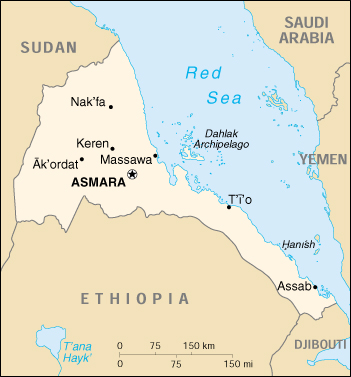
Location: Eastern Africa, bordering the Red Sea, between Djibouti and Sudan
Geographic coordinates: 15 00 N, 39 00 E
Area:
total: 121,320 sq. km
land: 121,320 sq. km
water: 0 sq. km
Land boundaries:
total: 1,630 km
border countries: Djibouti 113 km, Ethiopia 912 km, Sudan 605 km
Coastline: 2,234 km total; mainland on Red Sea 1,151 km, islands in Red Sea 1,083 km
Maritime claims: NA
Climate: hot, dry desert strip along Red Sea coast; cooler and wetter in the central highlands (up to 61 cm of rainfall annually); semiarid in western hills and lowlands; rainfall heaviest during June-September except in coastal desert
Terrain: dominated by extension of Ethiopian north-south trending highlands, descending on the east to a coastal desert plain, on the northwest to hilly terrain and on the southwest to flat-to-rolling plains
Elevation extremes:
lowest point: near Kulul within the Denakil depression -75 m
highest point: Soira 3,018 m
Natural resources: gold, potash, zinc, copper, salt, possibly oil and natural gas, fish
Land use:
arable land: 12%
permanent crops: 1%
permanent pastures: 49%
forests and woodland: 6%
other: 32% (1998 est.)
Irrigated land: 280 sq. km (1993 est.)
Natural hazards: frequent droughts and locust storms
Environment – current issues: deforestation; desertification; soil erosion; overgrazing; loss of infrastructure from civil warfare
Environment – international agreements:
party to: Biodiversity, Climate Change, Desertification, Endangered Species
signed, but not ratified: none of the selected agreements
Geography – note: strategic geopolitical position along world’s busiest shipping lanes; Eritrea retained the entire coastline of Ethiopia along the Red Sea upon de jure independence from Ethiopia on 24 May 1993.
People of Eritrea
Eritrea’s population comprises nine ethnic groups, most of which speak Semitic or Cushitic languages. The Tigrinya and Tigre make up four-fifths of the population and speak different, but related and somewhat mutually intelligible, Semitic languages. In general, most of the Christians live in the highlands, while Muslims and adherents of traditional beliefs live in the lowland regions. Tigrinya and Arabic are the most frequently used languages for commercial and official transactions, but English is widely spoken and is the language used for secondary and university education.
Population: 4,561,599 (July 2005 est.)
Age structure:
0-14 years: 42.85% (male 922,691; female 918,916)
15-64 years: 53.87% (male 1,147,927; female 1,167,705)
65 years and over: 3.28%
Population growth rate: 3.84%
Birth rate: 42.52 births/1,000 population
Death rate: 12.07 deaths/1,000 population
Net migration rate: 7.91 migrant(s)/1,000 population
note: according to the UNHCR, about 150,000 Eritrean refugees in Sudan have registered for voluntary repatriation, following the restoration of diplomatic relations between Eritrea and Sudan in January 2000.
Infant mortality rate: 75.14 deaths/1,000 live births
Life expectancy at birth:
total population: 56.18 years
male: 53.73 years
female: 58.71 years
Total fertility rate: 5.87 children born/woman
Nationality:
noun: Eritrean(s)
adjective: Eritrean
Ethnic groups: ethnic Tigrinya 50%, Tigre and Kunama 40%, Afar 4%, Saho (Red Sea coast dwellers) 3%
Religions: Muslim, Coptic Christian, Roman Catholic, Protestant
Languages: Afar, Amharic, Arabic, Tigre and Kunama, Tigrinya, other Cushitic languages
Literacy: 25% of total population
History of Eritrea
Eritrea officially celebrated its independence on May 24, 1993, becoming the world’s newest nation. Prior to Italian colonization in 1885, what is now Eritrea had been ruled by the various local or international powers that successively dominated the Red Sea region. In 1896, the Italians used Eritrea as a springboard for their disastrous attempt to conquer Ethiopia. Eritrea was placed under British military administration after the Italian surrender in World War II. In 1952, a UN resolution federating Eritrea with Ethiopia went into effect. The resolution ignored Eritrean pleas for independence but guaranteed Eritreans some democratic rights and a measure of autonomy. Almost immediately after the federation went into effect, however, these rights began to be abridged or violated.
In 1962, Emperor Haile Sellassie unilaterally dissolved the Eritrean parliament and annexed the country, sparking the Eritrean fight for independence that continued after Haile Sellassie was ousted in a coup in 1974. The new Ethiopian Government, called the Derg, was a Marxist military junta led by strongman Mengistu Haile Miriam.
During the 1960s, the Eritrean independence struggle was led by the Eritrean Liberation Front (ELF). In 1970, members of the group had a falling out, and a group broke away from the ELF and formed the Eritrean People’s Liberation Front (EPLF). By the late 1970s, the EPLF had become the dominant armed Eritrean group fighting against the Ethiopian Government, and Isaias Afwerki had emerged as its leader. Much of the materiel used to combat Ethiopia was captured from the Ethiopian Army.
By 1977 the EPLF was poised to drive the Ethiopians out of Eritrea. That same year, however, a massive airlift of Soviet arms to Ethiopia enabled the Ethiopian Army to regain the initiative and forced the EPLF to retreat to the bush. Between 1978 and 1986, the Derg launched eight major offensives against the independence movement — all failed. In 1988, the EPLF captured Afabet, headquarters of the Ethiopian Army in northeastern Eritrea, prompting the Ethiopian Army to withdraw from its garrisons in Eritrea’s western lowlands. EPLF fighters then moved into position around Keren, Eritrea’s second-largest city. Meanwhile, other dissident movements were making headway throughout Ethiopia. At the end of the 1980s, the Soviet Union informed Mengistu that it would not be renewing its defense and cooperation agreement. With the withdrawal of Soviet support and supplies, the Ethiopian Army’s morale plummeted, and the EPLF — along with other Ethiopian rebel forces — began to advance on Ethiopian positions.
The United States played a facilitative role in the peace talks in Washington during the months leading up to the May 1991 fall of the Mengistu regime. In mid-May, Mengistu resigned as head of the Ethiopian Government and went into exile in Zimbabwe, leaving a caretaker government in Addis Ababa. Having defeated the Ethiopian forces in Eritrea, EPLF troops took control of their homeland. Later that month, the United States chaired talks in London to formalize the end of the war. These talks were attended by the four major combatant groups, including the EPLF.
A high-level U.S. delegation also was present in Addis Ababa for the July 1-5, 1991 conference that established a transitional government in Ethiopia. The EPLF attended the July conference as an observer and held talks with the new transitional government regarding Eritrea’s relationship to Ethiopia. The outcome of those talks was an agreement in which the Ethiopians recognized the right of the Eritreans to hold a referendum on independence.
Although some EPLF cadres at one time espoused a Marxist ideology, Soviet support for Mengistu had cooled their ardor. The fall of communist regimes in the former Soviet Union and the Eastern Bloc convinced them it was a failed system. The EPLF now says it is committed to establishing a democratic form of government and a free-market economy in Eritrea. The United States agreed to provide assistance to both Ethiopia and Eritrea, conditional on continued progress toward democracy and human rights.
In May 1991, the EPLF established the Provisional Government of Eritrea (PGE) to administer Eritrean affairs until a referendum was held on independence and a permanent government established. EPLF leader Isaias became the head of the PGE, and the EPLF Central Committee served as its legislative body.
On April 23-25, 1993, Eritreans voted overwhelmingly for independence from Ethiopia in a UN-monitored free and fair referendum. The Eritrean authorities declared Eritrea an independent state on April 27. The government was reorganized and after a national, freely contested election, the National Assembly, which chose Isaias as President of the PGE, was expanded to include both EPLF and non-EPLF members. The EPLF established itself as a political party, the People’s Front for Democracy and Justice (PFDJ), and is now in the process of drafting a new constitution and setting up a permanent government.
Eritrea Economy
The Eritrean economy is largely based on agriculture, which employs 80% of the population but currently may contribute as little as 22% to GDP. Export crops include coffee, cotton, fruit, hides, and meat, but farmers are largely dependent on rain-fed agriculture, and growth in this and other sectors is hampered by lack of a dependable water supply. Worker remittances from abroad currently contribute 40% of GDP.
The Government of Eritrea states that it is committed to a market economy and privatization, and it has made development and economic recovery its priorities. Nevertheless, the government or the ruling PFDJ party plays a pervasive role in the economy and the government has imposed an arbitrary and complex set of regulatory requirements that discourage investment. The economy was devastated by war and the misguided policies of the Derg, which disrupted agriculture and industry. The more recent war with Ethiopia has also had a major, negative impact on the economy and further discouraged investment. Eritrea lost many valuable economic assets in particular during the last round of fighting in May-June 2000, when a significant portion of its territory in the agriculturally important west and south was occupied by Ethiopia. As a result of this last round of fighting, more than one million Eritreans were displaced. According to World Bank estimates, Eritreans also lost livestock worth some $225 million and 55,000 homes worth $41 million were destroyed. Damages to public buildings, including hospitals, are estimated at $24 million. Much of the transportation and communications infrastructure remains outmoded and deteriorating. As a result, the government has sought international assistance for a variety of development projects and has mobilized young Eritreans serving in the National Youth Service to repair crumbling roads and dams.
Small businesses, such as restaurants, bars, stores, auto repair, and crafts continue to thrive in the Asmara area. A brewery, cigarette factory, small glass and plastics producers, several companies involved in making leather goods, and textile and sweater factories operate in the Asmara area. The textile and leather industries have made a partial recovery since independence.
In Massawa, the port has been rehabilitated. In addition, the government has begun to export fish from the Red Sea to markets in Europe and elsewhere. Also in Massawa, in 2001, Seawater Farms Eritrea began to export shrimp to Europe and the Middle East. The farm is a joint venture between a group of international investors based in the U.S. and the Eritrean Ministry of Fisheries. It is an integrated project designed to grow shrimp, tilapia, and salicornia (a succulent that can be irrigated with seawater), and to foster the growth of mangrove wetlands. The project is expected to generate a significant volume of exports as well as employment opportunities for Eritreans. The investors also hope that it will serve as the model for a new kind of sustainable, ecologically friendly, yet profitable operation.
GDP: purchasing power parity – $2.9 billion (2000 est.)
GDP – real growth rate: 3% (1999 est.), -1% (2000 est.)
GDP – per capita: purchasing power parity – $710 (2000 est.)
GDP – composition by sector:
agriculture: 16%
industry: 27%
services: 57% (2000 est.)
Inflation rate (consumer prices): 9% (1998 est.), 14% (2000 est.)
Labor force – by occupation: agriculture 80%, industry and commerce 20%
Budget:
revenues: $283.9 million
expenditures: $351.6 million (1997 est.)
Industries: food processing, beverages, clothing and textiles
Electricity – production: 165 million kWh (1999)
Electricity – production by source:
fossil fuel: 100%
hydro: 0%
nuclear: 0%
other: 0% (1999)
Agriculture – products: sorghum, lentils, vegetables, corn, cotton, tobacco, coffee, sisal; livestock, goats; fish
Exports: $52.9 million (f.o.b., 1997), $26 million (f.o.b., 1999)
Exports – commodities: livestock, sorghum, textiles, food, small manufactures
Exports – partners: Sudan 27.2%, Ethiopia 26.5%, Japan 13.2%, UAE 7.3%, Italy 5.3% (1998)
Imports: $489.4 million (c.i.f., 1997), $560 million (c.i.f., 1999)
Imports – commodities: machinery, petroleum products, food, manufactured goods
Imports – partners: Italy 17.4%, UAE 16.2%, Germany 5.7%, UK 4.5%, Korea 4.4% (1998)
Debt – external: $281 million (2000 est.)
Economic aid – recipient: $77 million (1999)
Currency: nakfa (ERN)
Map of Eritrea