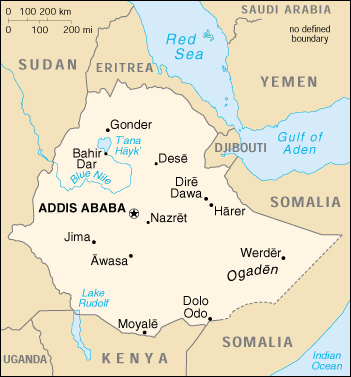
Background: Unique among African countries, the ancient Ethiopian monarchy maintained its freedom from colonial rule, one exception being the Italian occupation of 1936-41. In 1974 a military junta, the Derg, deposed Emperor Haile SELASSIE (who had ruled since 1930) and established a socialist state. Torn by bloody coups, uprisings, wide-scale drought, and massive refugee problems, the regime was finally toppled by a coalition of rebel forces, the Ethiopian People’s Revolutionary Democratic Front (EPRDF), in 1991. A constitution was adopted in 1994 and Ethiopia’s first multiparty elections were held in 1995. A two and a half year border war with Eritrea that ended with a peace treaty on 12 December 2000 has strengthened the ruling coalition, but has hurt the nation’s economy.
Government type: federal republic
Capital: Addis Ababa
Currency: 1 birr (Br) = 100 cents
Geography of Ethiopia
Location: Eastern Africa, west of Somalia
Geographic coordinates: 8 00 N, 38 00 E
Area:
total: 1,127,127 sq. km
land: 1,119,683 sq. km
water: 7,444 sq. km
Land boundaries:
total: 5,311 km
border countries: Djibouti 337 km, Eritrea 912 km, Kenya 830 km, Somalia 1,626 km, Sudan 1,606 km
Coastline: 0 km (landlocked)
Climate: tropical monsoon with wide topographic-induced variation
Terrain: high plateau with central mountain range divided by Great Rift Valley
Elevation extremes:
lowest point: Denakil -125 m
highest point: Ras Dashen Terara 4,620 m
Natural resources: small reserves of gold, platinum, copper, potash, natural gas, hydropower
Land use:
arable land: 12%
permanent crops: 1%
permanent pastures: 40%
forests and woodland: 25%
other: 22% (1993 est.)
Irrigated land: 1,900 sq. km (1993 est.)
Natural hazards: geologically active Great Rift Valley susceptible to earthquakes, volcanic eruptions; frequent droughts
Environment – current issues: deforestation; overgrazing; soil erosion; desertification
Environment – international agreements:
party to: Biodiversity, Climate Change, Desertification, Endangered Species, Hazardous Wastes, Ozone Layer Protection
signed, but not ratified: Environmental Modification, Law of the Sea, Nuclear Test Ban
Geography – note: landlocked – entire coastline along the Red Sea was lost with the de jure independence of Eritrea on 24 May 1993; the Blue Nile, the chief headstream of the Nile, rises in T’ana Hayk (Lake Tana) in northwest Ethiopia.
People of Ethiopia
Ethiopia’s population is highly diverse. Most of its people speak a Semitic or Cushitic language. The Oromo, Amhara, and Tigreans make up more than three-fourths of the population, but there are more than 80 different ethnic groups within Ethiopia. Some of these have as few as 10,000 members. In general, most of the Christians live in the highlands, while Muslims and adherents of traditional African religions tend to inhabit lowland regions. English is the most widely spoken foreign language and is taught in all secondary schools. Amharic was the language of primary school instruction but has been replaced in many areas by local languages such as Oromifa and Tigrinya.
Population: 73,053,286 (July 2005 est.)
Age structure:
0-14 years: 47.18%
15-64 years: 50.03%
65 years and over: 2.79%
Population growth rate: 2.7%
Birth rate: 44.68 births/1,000 population
Death rate: 17.84 deaths/1,000 population
Net migration rate: 0.13 migrant(s)/1,000 population
note: repatriation of Ethiopians who fled to Sudan for refuge from war and famine in earlier years is expected to continue for several years; small numbers of Sudanese and Somali refugees, who fled to Ethiopia from the fighting or famine in their own countries, continue to return to their homes.
Infant mortality rate: 99.96 deaths/1,000 live births
Life expectancy at birth:
total population: 44.68 years
male: 43.88 years
female: 45.51 years
Total fertility rate: 7 children born/woman
Nationality:
noun: Ethiopian(s)
adjective: Ethiopian
Ethnic groups: Oromo 40%, Amhara and Tigre 32%, Sidamo 9%, Shankella 6%, Somali 6%, Afar 4%, Gurage 2%, other 1%
Religions: Muslim 45%-50%, Ethiopian Orthodox 35%-40%, animist 12%, other 3%-8%
Languages: Amharic, Tigrinya, Orominga, Guaraginga, Somali, Arabic, other local languages, English (major foreign language taught in schools)
Literacy:
definition: age 15 and over can read and write
total population: 35.5%
male: 45.5%
female: 25.3% (1995 est.)
History of Ethiopia
MODERN ETHIOPIA IS THE PRODUCT of many millennia of interaction among peoples in and around the Ethiopian highlands region. From the earliest times, these groups combined to produce a culture that at any given time differed markedly from that of surrounding peoples. The evolution of this early “Ethiopian” culture was driven by a variety of ethnic, linguistic, and religious groups.
One of the most significant influences on the formation and evolution of culture in northern Ethiopia consisted of migrants from Southwest Arabia. They arrived during the first millennium B.C. and brought Semitic speech, writing, and a distinctive stone-building tradition to northern Ethiopia. They seem to have contributed directly to the rise of the Aksumite kingdom, a trading state that prospered in the first centuries of the Christian era and that united the shores of the southern Red Sea commercially and at times politically. It was an Aksumite king who accepted Christianity in the mid-fourth century, a religion that the Aksumites bequeathed to their successors along with their concept of an empire-state under centralized rulership.
The establishment of what became the Ethiopian Orthodox Church was critical in molding Ethiopian culture and identity. The spread of Islam to the coastal areas of the Horn of Africa in the eighth century, however, led to the isolation of the highlands from European and Middle Eastern centers of Christendom. The appearance of Islam was partly responsible for what became a long-term rivalry between Christians and Muslims–a rivalry that exacerbated older tensions between highlanders and lowlanders and agriculturalists and pastoralists that have persisted to the present day.
Kingship and Orthodoxy, both with their roots in Aksum, became the dominant institutions among the northern Ethiopians in the post-Aksumite period. In the twelfth and thirteenth centuries, a dynasty known as the Zagwe ruled from their capital in the northern highlands. The Zagwe era is one of the most artistically creative periods in Ethiopian history, involving among other things the carving of a large number of rock-hewn churches.
The Zagwe heartland was well south of the old Aksumite domain, and the Zagwe interlude was but one phase in the long-term southward shift of the locus of political power. The successors of the Zagwe after the mid-thirteenth century–the members of the so-called “Solomonic” dynasty– located themselves in the central highlands and involved themselves directly in the affairs of neighboring peoples still farther south and east.
In these regions, the two dominant peoples of what may be termed the “Christian kingdom of Ethiopia,” the Amhara of the central highlands and the Tigray of the northern highlands, confronted the growing power and confidence of Muslim peoples who lived between the eastern edge of the highlands and the Red Sea and Gulf of Aden. In religious and ethnic conflicts that reached their climax in the midsixteenth century, the Amhara and Tigray turned back a determined Muslim advance with Portuguese assistance, but only after the northern highlands had been overrun and devastated. The advent of the Portuguese in the area marked the end of the long period of isolation from the rest of Christendom that had been near total, except for contact with the Coptic Church of Egypt. The Portuguese, however, represented a mixed blessing, for with them they brought their religion–Roman Catholicism. During the early seventeenth century, Jesuit and kindred orders sought to impose Catholicism on Ethiopia, an effort that led to civil war and the expulsion of the Catholics from the kingdom.
By the mid-sixteenth century, the Oromo people of southwestern Ethiopia had begun a prolonged series of migrations during which they overwhelmed the Muslim states to the east and began settling in the central highlands. A profound consequence of the far-flung settlement of the Oromo was the fusion of their culture in some areas with that of the heretofore dominant Amhara and Tigray.
The period of trials that resulted from the Muslim invasions, the Oromo migrations, and the challenge of Roman Catholicism had drawn to a close by the middle of the seventeenth century. During the next two-and-one-half centuries, a reinvigorated Ethiopian state slowly reconsolidated its control over the northern highlands and eventually resumed expansion to the south, this time into lands occupied by the Oromo.
By the mid-nineteenth century, the Ethiopian state under Emperor Tewodros II (reigned 1855-68) found itself beset by a number of problems, many of them stemming from the expansion of European influence in northeastern Africa. Tewodros’s successors, Yohannis IV (reigned 1872-89) and Menelik II (reigned 1889-1913), further expanded and consolidated the state, fended off local enemies, and dealt with the encroachments of European powers, in particular Italy, France, and the United Kingdom. Italy posed the greatest threat, having begun to colonize part of what would become its future colony of Eritrea in the mid-1880s.
To one of Menelik’s successors, Haile Selassie I (reigned 1930-74), was left the task of dealing with resurgent Italian expansionism. The disinclination of the world powers, especially those in the League of Nations, to counter Italy’s attack on Ethiopia in 1935 was in many ways a harbinger of the indecisiveness that would lead to World War II. In the early years of the war, Ethiopia was retaken from the Italians by the British, who continued to dominate the country’s external affairs after the war ended in 1945. A restored Haile Selassie attempted to implement reforms and modernize the state and certain sectors of the economy. For the most part, however, mid-twentieth century Ethiopia resembled what could loosely be termed a “feudal” society.
The later years of Haile Selassie’s rule saw a growing insurgency in Eritrea, which had been federated with and eventually annexed by the Ethiopian government following World War II. This insurgency, along with other internal pressures, including severe famine, placed strains on Ethiopian society that contributed in large part to the 1974 military rebellion that ended the Haile Selassie regime and, along with it, more than 2,000 years of imperial rule. The most salient results of the coup d’état were the eventual emergence of Lieutenant Colonel Mengistu Haile Mariam as head of state and the reorientation of the government and national economy from capitalism to Marxism.
A series of crises immediately consumed the revolutionary regime. First, domestic political violence erupted as groups maneuvered to take control of the revolution. Then, the Eritrean insurgency flared at the same time that an uprising in the neighboring region of Tigray began. In mid-1977 Somalia, intent upon wresting control of the Ogaden region from Ethiopia and sensing Addis Ababa’s distractions, initiated a war on Ethiopia’s eastern frontier. Mengistu, in need of military assistance, turned to the Soviet Union and its allies, who supplied vast amounts of equipment and thousands of Cuban combat troops, which enabled Ethiopia to repulse the Somali invasion.
Misery mounted throughout Ethiopia in the 1980s. Recurrent drought and famine, made worse in the north by virtual civil war, took an enormous human toll, necessitating the infusion of massive amounts of international humanitarian aid. The insurgencies in Eritrea, Tigray, and other regions intensified until by the late 1980s they threatened the stability of the regime. Drought, economic mismanagement, and the financial burdens of war ravaged the economy. At the same time, democratic reform in Eastern Europe and the Soviet Union threatened to isolate the revolutionary government politically, militarily, and economically from its allies.
Ethiopia Economy
The current government has embarked on a program of economic reform, including privatization of state enterprises and rationalization of government regulation. While the process is still ongoing, the reforms have begun to attract much-needed foreign investment.
The Ethiopian economy is based on agriculture, which contributes 45% to GNP and more than 80% of exports and employs 85% of the population. The major agricultural export crop is coffee, providing 65%-75% of Ethiopia’s foreign exchange earnings. Other traditional major agricultural exports are hides and skins, pulses, oilseeds, and the traditional “khat,” a leafy shrub which has psychotropic qualities when chewed.
Ethiopia’s agriculture is plagued by periodic drought, soil degradation caused by overgrazing, deforestation, high population density, and poor infrastructure, making it difficult and expensive to get goods to market. Yet it is the country’s most promising resource. A potential exists for self-sufficiency in grains and for export development in livestock, grains, vegetables, and fruits.
Gold, marble, limestone, and small amounts of tantalum are mined in Ethiopia. Other resources with potential for commercial development include large potash deposits, natural gas, iron ore, and possibly oil and geothermal energy. Although Ethiopia has good hydroelectric resources ,which power most of its manufacturing sector, it is totally dependent on imports for its oil. A landlocked country, Ethiopia uses the seaports of Assab and Massawa in Eritrea. Ethiopia also uses the port of Djibouti, connected to Addis Ababa by rail, for international trade. Of the 23,812 kilometers of Ethiopia’s all-weather roads, 15% are asphalt. Mountainous terrain and the lack of good roads and sufficient vehicles make land transportation difficult. However, the government-owned airline is excellent. Ethiopian Airlines serves 38 domestic airfields and has 42 international destinations.
Dependent on a few vulnerable crops for its foreign exchange earnings and reliant on imported oil, Ethiopia lacks sufficient foreign exchange. The financially conservative government has taken measures to solve this problem, including stringent import controls and sharply reduced subsidies on retail gasoline prices. Nevertheless, the largely subsistence economy is incapable of supporting high military expenditures, drought relief, an ambitious development plan, and indispensable imports such as oil and, therefore, must depend on foreign assistance.
GDP: purchasing power parity – $39.2 billion (2000 est.)
GDP – real growth rate: 0% (1999 est.), 2% (2000 est.)
GDP – per capita: purchasing power parity – $600 (2000 est.)
GDP – composition by sector:
agriculture: 45%
industry: 12%
services: 43% (1999 est.)
Household income or consumption by percentage share:
lowest 10%: 3%
highest 10%: 33.7% (1995)
Inflation rate (consumer prices): 4% (1999 est.), 5% (2000 est.)
Labor force – by occupation: agriculture and animal husbandry 80%, government and services 12%, industry and construction 8% (1985)
Budget:
revenues: $1 billion
expenditures: $1.48 billion, including capital expenditures of $415 million (FY96/97)
Industries: food processing, beverages, textiles, chemicals, metals processing, cement
Electricity – production: 1.625 billion kWh (1999)
Electricity – production by source:
fossil fuel: 3.08%
hydro: 96.92%
nuclear: 0%
other: 0% (1999)
Agriculture – products: cereals, pulses, coffee, oilseed, sugarcane, potatoes; hides, cattle, sheep, goats
Exports: $460 million (f.o.b., 1999)
Exports – commodities: coffee, gold, leather products, oilseeds
Exports – partners: Germany 16%, Japan 13%, Djibouti 10%, Saudi Arabia 7% (1999 est.)
Imports: $1.25 billion (f.o.b., 1999)
Imports – commodities: food and live animals, petroleum and petroleum products, chemicals, machinery, motor vehicles
Imports – partners: Saudi Arabia 28%, Italy 10%, Russia 7%, US 6% (1999 est.)
Debt – external: $10 billion (1999 est.)
Economic aid – recipient: $367 million (FY95/96)
Currency: birr (ETB)
Map of Ethiopia