Background: Ruled by Sweden from the 12th to the 19th centuries and by Russia from 1809, Finland finally won its independence in 1917. During World War II, it was able to successfully defend its freedom and fend off invasions by the Soviet Union and Germany. In the subsequent half century, the Finns have made a remarkable transformation from a farm/forest economy to a diversified modern industrial economy; per capita income is now on par with Western Europe. As a member of the European Union, Finland was the only Nordic state to join the euro system at its initiation in January 1999.
Government type: republic
Capital: Helsinki
Currency: 1 markka (FMk) or Finmark = 100 pennia
Geography of Finland
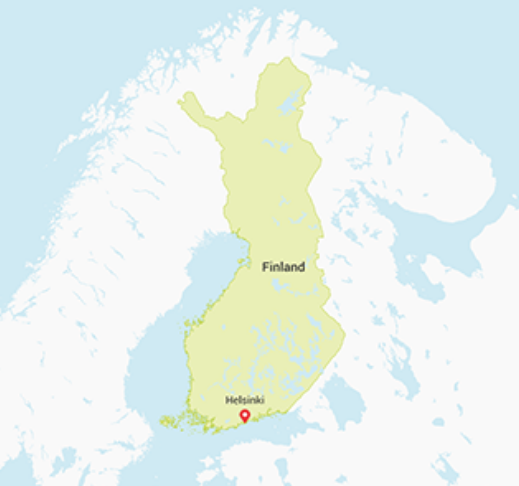
Location: Northern Europe, bordering the Baltic Sea, Gulf of Bothnia, and Gulf of Finland, between Sweden and Russia
Geographic coordinates: 64 00 N, 26 00 E
Area:
total: 337,030 sq. km
land: 305,470 sq. km
water: 31,560 sq. km
Land boundaries:
total: 2,628 km
border countries: Norway 729 km, Sweden 586 km, Russia 1,313 km
Coastline: 1,126 km (excludes islands and coastal indentations)
Maritime claims:
contiguous zone: 6 nm
continental shelf: 200-m depth or to the depth of exploitation
exclusive fishing zone: 12 nm
territorial sea: 12 nm (in the Gulf of Finland – 3 nm)
Climate: cold temperate; potentially subarctic, but comparatively mild because of moderating influence of the North Atlantic Current, Baltic Sea, and more than 60,000 lakes.
Terrain: mostly low, flat to rolling plains interspersed with lakes and low hills
Elevation extremes:
lowest point: Baltic Sea 0 m
highest point: Haltiatunturi 1,328 m
Natural resources: timber, copper, zinc, iron ore, silver
Land use:
arable land: 8%
permanent crops: 0%
permanent pastures: 0%
forests and woodland: 76%
other: 16% (1993 est.)
Irrigated land: 640 sq. km (1993 est.)
Environment – current issues: air pollution from manufacturing and power plants contributing to acid rain; water pollution from industrial wastes, agricultural chemicals; habitat loss threatens wildlife populations.
Environment – international agreements:
party to: Air Pollution, Air Pollution-Nitrogen Oxides, Air Pollution-Sulphur 85, Air Pollution-Sulphur 94, Air Pollution-Volatile Organic Compounds, Antarctic-Environmental Protocol, Antarctic-Marine Living Resources, Antarctic Treaty, Biodiversity, Climate Change, Desertification, Endangered Species, Environmental Modification, Hazardous Wastes, Law of the Sea, Marine Dumping, Marine Life Conservation, Nuclear Test Ban, Ozone Layer Protection, Ship Pollution, Tropical Timber 83, Tropical Timber 94, Wetlands, Whaling
signed, but not ratified: Air Pollution-Persistent Organic Pollutants, Climate Change-Kyoto Protocol
Geography – note: long boundary with Russia; Helsinki is northernmost national capital on European continent; population concentrated on small southwestern coastal plain.
Finland is the northernmost country on the European continent. Although other countries have points extending farther north, virtually all of Finland is north of 60 degrees north latitude; nearly a quarter of the land area and fully one-third of the latitudinal extent of the country lie north of the Arctic Circle.
In area, Finland has 304,623 square kilometers of land and 33,522 square kilometers of inland water, a total of 338,145 square kilometers. It shares borders on the west with Sweden for 540 kilometers, on the north with Norway for 720 kilometers, and on the east with the Soviet Union for 1,268 kilometers. There are approximately 1,107 kilometers of coastline on the Gulf of Finland (south), the Baltic Sea (southwest), and the Gulf of Bothnia (west). The rugged coastline is deeply indented with bays and inlets. The offshore region is studded with islands.
The most predominant influences on Finland’s geography were the continental glaciers that scoured and gouged the country’s surface. When the glaciers receded about 10,000 years ago, they left behind them moraines, drumlins, and eskers. Other indications of their presence are the thousands of lakes they helped to form in the southern part of the country. The force of the moving ice sheets gouged the lake beds, and meltwaters helped to fill them. The recession of the glaciers is so recent (in geologic terms) that modern-day drainage patterns are immature and poorly established. The direction of glacial advance and recession set the alignment of the lakes and streams in a general northeast to southwest lineation. The two Salpausselka Ridges, which run parallel to each other about twenty-five kilometers apart, are the terminal moraines. At their greatest height they reach an elevation of about 200 meters, the highest point in southern Finland.
Landform Regions
Many countries of the world can be divided into distinct geographic regions, in each of which some physical characteristic is dominant, almost to the exclusion of others. In Finland, the same physical characteristics are common to each of the four geographic regions into which the country is divided. Regional differences in Finland lie, therefore, in subtle combinations of physical qualities. In archipelago Finland, rock and water are dominant. Coastal Finland consists of broad clay plains where agriculture plays a leading role. The interior lake district supports extensive forests. Upland Finland is covered by Arctic scrub. Nonetheless, each of these regions contains elements of the others. For instance, patches of agriculture extend far northward along some rivers in Lapland, and in southern Finland a substantial bogland, the Suomenselka, is sometimes referred to as Satakunta Lapland because it has the character of Arctic tundra.
Archipelago Finland, consisting of thousands of islands and skerries, extends from the southwestern coast out into the Baltic Sea. It includes the strategically significant Aland Islands, positioned at the entrance to the Gulf of Bothnia. After World War I, both Finland and Sweden laid claim to the islands, which are culturally more Swedish than Finnish. For strategic reasons, however, the League of Nations awarded the Aland Islands to Finland in 1921. A principal reason for this decision was that, during the winter, the islands are physically linked to Finland by the frozen waters of the sea and are hence essential for the country’s defense. This myriad of forest-covered and bare bedrock islands was formed and continues to be formed by the process of uplift following the last glaciation.
The rest of the country is also still emerging from the sea. The weight of the continental glaciers depressed the land over which they moved, and even now, a hundred centuries after their recession, Finland is rising up from this great load through the process of isostatic rebound. In the south and the southwest, this process is occurring slowly, at a rate of twenty-five to thirty centimeters a century. Farther north in the Ostrobothnia area, uplift is more rapid, it amounts to eighty or ninety centimeters a century. The process also means that Finland is growing about seven square kilometers yearly as land emerges from the sea.
Coastal Finland consists of broad clay plains extending from the coast inland, for no more than 100 kilometers. These plains slope southward from the morainic Salpausselka Ridges in southern Finland. Along the Gulf of Bothnia coast, the plains slope southwest from upland areas. The land of coastal Finland is used for agriculture and dairy farming.
The interior lake district is the largest geographic region, and it is perhaps what most foreigners think of when they imagine Finland. The district is bounded to the south by the Salpausselka Ridges. Behind the ridges extend networks of thousands of lakes separated by hilly forested countryside. This landscape continues to the east and extends into the Soviet Union. As a consequence, there is no natural border between the two countries. Because no set definition of what constitutes a lake and no procedures for counting the number of lakes exist, it has been impossible to ascertain exactly how many lakes the region has. There are, however, at least 55,000 lakes that are 200 or more meters wide. The largest is Lake Saimaa, which, with a surface area of more than 4,400 square kilometers, is the fifth largest lake in Europe. The deepest lake has a depth of only 100 meters; the depth of the average lake is 7 meters. Because they are shallow, these many lakes contain only slightly more water than Finland’s annual rainfall. The hilly, forest-covered landscape of the lake plateau is dominated by drumlins and by long sinuous eskers, both glacial remnants.
Upland Finland extends beyond the Arctic Circle. The extreme north of this region is known as Lapland. The highest points in upland Finland reach an elevation of about 1,000 meters, and they are found in the Kilpisjarvi area of the Scandinavian Keel Ridge. In the southern upland region the hills are undulating, while in the north they are rugged. Much of upland Finland is not mountainous, but consists of bogs.
Finland’s longest and most impressive rivers are in the north. The Kemijoki has the largest network of tributaries. Farther south the Oulujoki drains the beginning of the north country. Most of the streams flow to the Gulf of Bothnia, but there is a broad stretch of land in the north and northeast that is drained by rivers flowing north across Norway and northeast across the Soviet Union to the Arctic Ocean.
Climate
Latitude is the principal influence on Finland’s climate. Because of Finland’s northern location, winter is the longest season. On the average, winter lasts 105 to 120 days in the archipelago and 180 to 220 days in Lapland. This means that southern portions of the country are snow-covered about three months of the year and the northern, about seven months. The long winter causes about half of the annual 500 to 600 millimeters of precipitation in the north to fall as snow. Precipitation in the south amounts to about 600 to 700 millimeters annually. Like that of the north, it occurs all through the year, though not so much of it is snow.
The Atlantic Ocean to the west and the Eurasian continent to the east interact to modify the climate of the country. The warm waters of the Gulf Stream and the North Atlantic Drift Current, which warm Norway and Sweden, also warm Finland. Westerly winds bring the warm air currents into the Baltic areas and to the country’s shores, moderating winter temperatures, especially in the south. These winds, because of clouds associated with weather systems accompanying the westerlies, also decrease the amount of sunshine received during the summer. By contrast, the continental high pressure system situated over the Eurasian continent counteracts the maritime influences, causing severe winters and occasionally high temperatures in the summer.
People of Finland
Population: 5,223,442 (July 2005 est.)
Age structure:
0-14 years: 18%
15-64 years: 66.97%
65 years and over: 15.03%
Population growth rate: 0.16%
Birth rate: 10.69 births/1,000 population
Death rate: 9.75 deaths/1,000 population
Net migration rate: 0.61 migrant(s)/1,000 population
Infant mortality rate: 3.79 deaths/1,000 live births
Life expectancy at birth:
total population: 77.58 years
male: 73.92 years
female: 81.36 years
Total fertility rate: 1.7 children born/woman
Nationality:
noun: Finn(s)
adjective: Finnish
Ethnic groups: Finn 93%, Swede 6%, Sami 0.11%, Roma 0.12%, Tatar 0.02%
Religions: Evangelical Lutheran 89%, Greek Orthodox 1%, none 9%, other 1%
Languages: Finnish 93.4% (official), Swedish 5.9% (official), small Lapp- and Russian-speaking minorities
Literacy:
definition: age 15 and over can read and write
total population: 100% (1980 est.)
History of Finland
THE SIGNAL ACHIEVEMENT OF FINLAND has been its survival against great odds–against a harsh climate, physical and cultural isolation, and international dangers. Finland lies at higher latitudes than any other country in the world, and the punishing northern climate has complicated life there considerably. Geographically, Finland is on the remote northern periphery, far from the mass of Europe, yet near two larger states, Sweden and Russia–later the Soviet Union, which have drawn it into innumerable wars and have dominated its development.
At the beginning of its recorded history, in the eleventh century A.D., Finland was conquered by its powerful neighbor, Sweden. Christianization and more than 600 years of Swedish rule (c. 1150-1809) made the Finns an essentially West European people, integrated into the religion, culture, economics, and politics of European civilization. The Finns have, however, maintained their own language, which is complex and is not related to most other European languages.
The centuries of Swedish rule witnessed Finland’s increasing involvement in European politics, particularly when the country served as a battleground between Sweden on the west and Russia on the east. Over the centuries, Russia has exerted an especially persistent and powerful pressure on Finland. Many wars were fought between Swedes and Finns on the one side and Russians on the other. Eventually, Russia conquered Finland and incorporated it into the Russian Empire, where it remained for more than a century, from 1809 to 1917.
Until the nineteenth century, the Finns were, like many other peoples of Europe, a subject nation seemingly without a culture or a history of their own. The national awakening of the nineteenth century brought recognition of the uniqueness of the Finnish people and their culture, and led to Finland’s independence in 1917. Complicating the emergence of the Finnish people into national consciousness, however, was the split between the majority of Finnish speakers and a powerful and influential minority of Swedish speakers. Only during the twentieth century was this conflict gradually resolved.
In 1987 Finland celebrated the seventieth anniversary of its national independence, which was a hard-won achievement. Independence was threatened at the start in a bloody civil war in 1918 between Finnish leftists (Reds) and rightists (Whites); a victory by the Reds might have resulted in Finland’s eventual absorption by the Soviet Union. One legacy of the war was a longlasting political division between working class Reds and middleclass Whites during the first two decades of independence. As a result, political extremism, as represented by communism and by fascism was stronger in Finland than it was in many other Western democracies; it was eventually neutralized, however, and with time Finnish democracy became strongly rooted.
The most serious challenges to Finland’s independence came during World War II, when the Finns twice faced attack by overwhelming Soviet forces. They fought heroically, but were defeated both times, and the Soviets were narrowly prevented from occupying and absorbing Finland. Since World War II, the Soviet Union’s status as a superpower has meant that it could at any time end Finland’s existence as a separate state. Recognizing this, the Finns have sought and achieved reconciliation with the Soviets, and they have tenaciously pursued a policy of neutrality, avoiding entanglement in superpower conflicts.
The long era of peace after World War II made possible the blossoming of Finland as a modern, industrialized, social-welfare democracy. By the 1980s, the intense social conflicts of previous decades were largely reconciled, and the country’s relationships with other nations were apparently stable
Introduction
FINLAND HAS BEEN THE SITE of human habitation since the last ice age ended 10,000 years ago. When the first Swedish-speaking settlers arrived in the ninth century, the country was home to people speaking languages belonging to the distinctive Finno- Ugric linguistic group, unrelated to the more prevalent Indo- European language family. The first dates in Finnish history are connected with the Swedish crusade of the 1150s that, according to legend, aimed at conquering the “heathen” Finns and converting them to Christianity. There was, however, no Swedish conquest of Finland. The bodies of water that lay between Finland and Sweden, rather than making them enemies or separating them, brought them together. Trade and settlement between the two areas intensified, and a political entity, the dual kingdom of Sweden-Finland, gradually evolved.
During the seven centuries of Swedish rule, Finland was brought more and more into the kingdom’s administrative system. Finland’s ruling elite, invariably drawn from the country’s Swedish-speaking inhabitants, traveled to Stockholm to participate in the Diet of the Four Estates and to help manage the kingdom’s affairs. Swedish became the language of law and commerce in Finland; Finnish was spoken by the peasantry living away from the coasts. The clergy (Lutheran after the Protestant Reformation), who needed to communicate with their parishioners, were the only members of the educated classes likely to know Finnish well.
Swedish rule was benevolent. Sweden and Finland were not separate countries, but rather were regions in a single state. The elite spoke a common language, and it was not until late in the eighteenth century that any separatist sentiments were heard within Finland. However, Finns occasionally suffered much from Sweden’s wars with neighboring states. In the sixteenth and the seventeenth centuries, Sweden was one of Europe’s great powers and had a considerable empire around the shores of the Baltic Sea. Wars were frequently the means of settling Finland’s eastern border. In the long run, however, Sweden could not sustain its imperial pretensions, and military defeats obliged it to cede Finland to tsarist Russia in 1809.
Finland’s new ruler, Tsar Alexander I, convinced of the strategic need to control Finland for the protection of his capital at St. Petersburg, decided it was more expedient to woo his Finnish subjects to allegiance than to subjugate them by force. He made the country the Grand Duchy of Finland and granted it an autonomous status within the empire. The Grand Duchy kept its Swedish code of laws, its governmental structure and bureaucracy, its Lutheran religion, and its native languages. In addition, Finns remained free of obligations connected to the empire, such as the duty to serve in tsarist armies, and they enjoyed certain rights that citizens from other parts of the empire did not have.
Nevertheless, the Grand Duchy was not a democratic state. The tsar retained supreme power and ruled through the highest official in the land, the governor general, almost always a Russian officer. Alexander dissolved the Diet of the Four Estates shortly after convening it in 1809, and it did not meet again for half a century. The tsar’s actions were in accordance with the royalist constitution Finland had inherited from Sweden. The Finns had no guarantees of liberty, but depended on the tsar’s goodwill for any freedoms they enjoyed. When Alexander II, the Tsar Liberator, convened the Diet again in 1863, he did so not to fulfill any obligation but to meet growing pressures for reform within the empire as a whole. In the remaining decades of the century, the Diet enacted numerous legislative measures that modernized Finland’s system of law, made its public administration more efficient, removed obstacles to commerce, and prepared the ground for the country’s independence in the next century.
The wave of romantic nationalism that appeared in Europe in the first half of the nineteenth century had profound effects in Finland. For hundreds of years, Finland’s Swedish-speaking minority had directed the country’s affairs. The Finnish-speaking majority, settled mostly in the interior regions, was involved only marginally in the social and the commercial developments along the coast. Finnish-speakers wishing to rise in society learned Swedish. Few schools used Finnish as a means of instruction: higher education was conducted entirely in Swedish, and books in Finnish were usually on religious subjects. The nationalist movement in Finland created an interest in the language and the folklore of the Finnish-speaking majority. Scholars set out into the countryside to learn what they could of the traditional arts. Elias Lönnrot, the most important of these men, first published his collection of Finnish folk poems in 1835. This collection, the Kalevala, was quickly recognized as Finland’s national epic. It became the cornerstone of the movement that aimed at transforming rural Finnish dialects into a language suitable for modern life and capable of displacing Swedish as the language of law, commerce, and culture.
Several generations of struggle were needed before the Finnish nationalist movement realized its objectives. Numerous members of the Swedish-speaking community entered the campaign, adopting Finnish as their language and exchanging their Swedish family names for Finnish ones. Finnish journals were founded, and Finnish became an official language in 1863. By the end of the century, there was a slight majority of Finnish-speaking students at the University of Helsinki, and Finnish-speakers made up sizable portions of the professions.
Finland’s first political parties grew out of the language struggle. Those advocating full rights for Finnish-speakers formed the so-called Fennoman group that by the 1890s had split into the Old Finns and the Young Finns, the former mainly concerned with the language question, the latter urging the introduction of political liberalism. The Swedish-speaking community formed a short-lived Liberal Party. As the century drew to a close and the Fennoman movement had achieved its principal goals, economic issues and relations with the tsarist empire came to dominate politics.
Finland’s economy had always been predominantly agricultural, and with the exception of a small merchant class along the coast, nearly all Finns were engaged in farming, mostly on small family farms. Despite the location of the country in the high north, long summer days usually allowed harvests sufficient to support the country’s population, although many lived at a subsistence level. In years of poor harvests, however, famine was possible. In 1867–68, for example, about 8 percent of the population starved to death.
Sweden’s political development had favored the formation of an independent peasantry rather than a class of large landowners. Even while part of the tsarist empire, Finland maintained this tradition. As a result, instead of serfs, there were many independent small farmers, who, in addition to owning their land, had stands of timber they could sell. When Western Europe began to buy Finnish timber on a large scale in the latter part of the nineteenth century, many farmers profited from the sale of Finland’s only significant natural resource, and ready money transformed many of them into entrepreneurs. There was also demand for timber products, and, at sites close to both timber and means of transport, pulp and paper mills were constructed.
Liberalization of trade laws and the institution of a national currency not tied to the Russian ruble encouraged a quickening of the economy and the growth of other sectors. Finland’s position within the Russian Empire was also beneficial. As Finnish products were not subject to import duties, they could be sold at lower prices than comparable goods coming from Western Europe.
The appearance of an industrial sector offered employment to a rural work force, many of whom owned no land and earned their living as tenant farmers or laborers. Much of the employment offered was of a seasonal nature, a circumstance that meant considerable hardship. In contrast to the larger European countries, most of this emerging proletariat did not live in concentrated urban areas, but near numerous small industrial centers around the country. This had two results: the one was that the Finnish working class retained much of its rural character; the other was that labor problems affected the entire country, not just urban centers.
Finland’s modernizing economy encouraged the formation of social groups with specific, and sometimes opposing, interests. In addition to the Finnish movement’s Old and Young Finns, other political organizations came into being. Because the existing political groups did not adequately represent labor’s interests, a workers’ party was formed at the end of the century. In 1903 it became the Finnish Social Democratic Party (Suomen Sosialidemokraatthinen Puolue–SDP). At the same time labor was organizing itself, the farmers began a cooperative movement; in 1907 they formed the Agrarian Party (Maalaisliitto–ML). The Swedish People’s Party (Svenska Folkpartiet–SFP), also dating from this period, was formed to serve the entire Swedish-speaking population, not just those involved in commerce, an area where Swedish-speakers were still dominant.
The Grand Duchy’s relationship with St. Petersburg began to deteriorate in the 1890s. The nervousness of tsarist officials about Finnish loyalty in wartime prompted measures to bind Finland more closely to the empire. The campaign of “Russification” ended only with Finland’s independence in 1917. In retrospect the campaign can be seen as a failure, but for several decades it caused much turmoil within Finland, reaching its most extreme point with the assassination of the governor general in 1904. The first Russian revolution, that of 1905, allowed Finns to discard their antiquated Diet and to replace it with a unicameral legislature, the Eduskunta, elected through universal suffrage. Finland became the first European nation in which women had the franchise. The first national election, that of 1907, yielded Europe’s largest social democratic parliamentary faction. In a single step, Finland went from being one of Europe’s most politically backward countries to being one of its most advanced. Nonetheless, frequent dissolutions at the hands of the tsar permitted the Eduskunta to achieve little before independence.
The second Russian revolution allowed Finland to break away from the Russian empire, and independence was declared on December 6, 1917. Within weeks, domestic political differences led to an armed struggle among Finns themselves that lasted until May 1918, when right-wing forces, with some German assistance, were able to claim victory. Whether seen as a civil war or as a war of independence, the conflict created bitter political divisions that endured for decades. As a consequence, Finland began its existence as an independent state with a considerable segment of its people estranged from the holders of power, a circumstance that caused much strife in Finnish politics.
In mid-1919, Finns agreed on a new Constitution, one that constructed a modern parliamentary system of government from existing political institutions and traditions. The 200-seat unicameral parliament, the Eduskunta, was retained. A cabinet, the Council of State, was fashioned from the Senate of the tsarist period. A powerful presidency, derived, in part at least, from the office of governor general, was created and provided with a mixture of powers and duties that, in other countries, might be shared by such figures as king, president, and prime minister. Also included in the new governmental system was an independent judiciary. The powers of the three branches of government were controlled through an overlapping of powers, rather than a strict separation of powers.
Finland faced numerous political and economic difficulties in the interwar years, but it surmounted them better than many other European countries. Despite the instability of many short-lived governments, the political system held together during the first decades of independence. While other countries succumbed to right-wing forces, Finland had only a brush with fascism. Communist organizations were banned, and their representatives in the Eduskunta arrested, but the SDP was able to recover from wounds sustained during the Civil War and was returned to power. In 1937 the party formed the first of the so-called Red-Earth coalitions with the ML, the most common party combination of the next fifty years, one that brought together the parties representing the two largest social groups. The language problem was largely resolved by provisions in the Constitution that protected the rights of the Swedish-speaking minority. Bitterness about the past dominance of Swedish-speaking Finns remained alive in some segments of the population, but Finnish at last had a just place in the country’s economic and social life.
Finland’s economy diversified further during the the 1920s and the 1930s. Timber, the country’s “green gold,” remained essential, but timber products such as pulp and paper came to displace timber as the most important export. Government measures, such as nationalization of some industries and public investment in others, encouraged the growth and strengthening of the mining, chemical, and metallurgical industries. Nevertheless, agriculture continued to be more important in Finland than it was in many other countries of Western Europe. Government-enforced redistribution of plots of land reduced the number of landless workers and fostered the development of the family farm. Survival during the Great Depression dictated that Finnish farmers switch from animal products for export to grains for domestic consumption.
Finland’s official foreign policy of neutrality in the interwar period could not offset the strategic importance of the country’s territory to Nazi Germany and to the Soviet Union. The latter was convinced that it had a defensive need to ensure that Finland would not be used as an avenue for attack on its northwestern areas, especially on Leningrad. When Finland refused to accede to its demands for some territory, the Soviet Union launched an attack in November 1939. A valiant Finnish defense, led by Carl Gustaf Emil Mannerheim, slowed the invaders, but in March 1940 the Winter War ended when Finland agreed to cede to the Soviets about 10 percent of Finnish territory and to permit a Soviet military base on Finnish soil. In June 1941, Finland joined Germany as cobelligerent in its attack on the Soviet Union. In what Finns call the Continuation War, Finland confined its military actions to areas near its prewar borders. In the fall of 1944, Finland made a separate peace with the Soviet Union, one that was conditional on its ceding territory, granting basing rights, agreeing to onerous reparation payments, and expelling German forces from its territory. However, although Finland suffered greatly during World War II and lost some territory, it was never occupied, and it survived the war with its independence intact.
Finland faced daunting challenges in the immediate postwar years. The most pressing perhaps was the settlement of 400,000 Finns formerly residing in territory ceded to the Soviet Union. Most were natives of Karelia. Legislation that sequestered land throughout the country and levied sacrifices on the whole population provided homes for these displaced Finns. Another hurdle was getting the economy in shape to make reparation payments equivalent to US$300 million, most of it in kind, to the Soviet Union. This payment entailed a huge effort, successfully completed in 1952.
A less concrete problem, but ultimately a more important one, was the regulation of Finland’s international relations. The Treaty of Paris, signed in 1947, limited the size and the nature of Finland’s armed forces. Weapons were to be solely defensive. A deepening of postwar tensions led a year later to the Treaty of Friendship, Cooperation, and Mutual Assistance with the Soviet Union, the treaty that has been the foundation of Finnish foreign relations in the postwar era. Under the terms of the treaty, Finland is bound to confer with the Soviets and perhaps to accept their aid if an attack from Germany, or countries allied with Germany, seems likely. The treaty prescribes consultations between the two countries, but it is not a mechanism for automatic Soviet intervention in a time of crisis. The treaty has worked well, and it has been renewed several times, the last time in 1983. What the Soviet Union saw as its strategic defensive need–a secure northwestern border– was met. The Finns also achieved their objective in that Finland remained an independent nation.
The Finnish architect of the treaty, Juho Kusti Paasikivi, a leading conservative politician, saw that an essential element of Finnish foreign policy must be a credible guarantee to the Soviet Union that it need not fear attack from, or through, Finnish territory. Because a policy of neutrality was a political component of this guarantee, Finland would ally itself with no one. Another aspect of the guarantee was that Finnish defenses had to be sufficiently strong to defend the nation’s territory. This policy, continued after Paasikivi’s term as president (1946-56) by Urho Kekkonen (1956-81) and Mauno Koivisto (1982- ), remained the core of Finland’s foreign relations.
In the following decades, Finland maintained its neutrality and independence. It had moved from temporary isolation in the immediate postwar years to full membership in the community of nations by the end of the 1980s. Finland joined the United Nations (UN) and the Nordic Council in 1955. It became an associate member of the European Free Trade Association in 1961 and a full member in 1986. Relations with the European Community and the Council of Mutual Economic Assistance date from the first half of the 1970s. In mid-1989, Finland joined the Council of Europe. The policy of neutrality became more active in the 1960s, when Finland began to play a larger role in the UN, most notably in its peacekeeping forces. Measures aiming at increasing world peace have also been a hallmark of this policy. Since the 1960s, Finland has urged the formation of a Nordic Nuclear-Weapons-Free Zone (Nordic NWFZ), and in the 1970s was the host of the Conference on Security and Cooperation in Europe (CSCE), which culminated in the signing of the Helsinki Accords in 1975. By the end of the 1980s, the most serious question for Finland in international relations was how the country’s economy, heavily dependent on exports, would fare once the EC had achieved its goal of a single market in 1992. Finland’s neutrality seemed to preclude membership in an organization where foreign policy concerns were no longer left to individual member nations.
Finland also dealt effectively with domestic political problems in the postwar era. By the early 1950s, the patterns of postwar Finnish politics were established. No one group was dominant, but the ML under the leadership of Kekkonen, who became president in 1956, became an almost permanent governing party until the late 1980s. In 1966 it changed its name to the Center Party (Keskustapuolue–Kesk) in an attempt to appeal to a broader segment of the electorate, but it still was not successful in penetrating southern coastal Finland. The SDP remained strong, but it was often riven by dissension. In addition, it had to share the socialist vote with the Communist Party of Finland (Suomen Kommunistinen Puolue–SKP). As a consequence, nonsocialist parties never had to face a united left. In the 1980s, the communists had severe problems adjusting to new social conditions, and they split into several warring groups. As a result, their movement had a marginal position in Finnish politics. The SFP, a moderate centrist party with liberal and conservative wings, had a slightly declining number of seats in the Eduskunta, but its position in the middle of the political spectrum often made it indispensable for coalition governments. The National Coalition Party (Kansallinen Kokoomuspuoue–KOK), rigidly conservative in the interwar period, gradually became more moderate and grew stronger, surpassing Kesk in the number of parliamentary seats in 1979. Excluded from a role in government for decades, possibly because it had been so right-wing earlier, th KOK Party participated in the government formed after the national elections of 1987, supplying the prime minister, Harri Holkeri. The Liberal Party of the postwar period was never strong, and it had a negligible role by the 1980s.
A number of smaller parties, protest parties, and parties representing quite distinct groups filled out the list of about a dozen organizations that regularly vied for public office. Pensioners and activist Christians each had their own party, and environmentalists won several seats in the 1983 and the 1987 national elections. The most active of the protest parties was the Finnish Rural Party (Suomen Maaseudun Puolue–SMP), which managed to take votes from both Kesk and the socialist groups. It scored its first big successes in the 1970 national elections. Since then its electoral results have varied considerably. By late 1980s, it seemed a spent force.
After the 1966 national elections, President Kekkonen succeeded in forming a popular front coalition government that contained communists, socialists, and members of Kesk. Although this government lasted only two years and was succeeded for another decade by short-lived coalition and caretaker civil service governments, it was the beginning of what Finns call the politics of consensus. By the 1980s, consensus politics had become so dominant that some observers claimed that Finnish politics, long so bitter and contentious, had become the most boring in Western Europe. Although the larger parties differed on specific issues, and personal rivalries could be poisonous, there was broad agreement about domestic and foreign policy. The cabinet put in place after the 1983 elections, consisting mainly of social democrats and members of Kesk, completed its whole term of office, the first government to do so in the postwar period. Observers believed that the next government, formed in 1987 and composed mainly of conservatives and social democrats, would also serve out its term.
A foundation of the politics of consensus was the success of the system of broad incomes agreements that has characterized Finland’s employee-employer relations in recent decades. The first of these, the Liinamaa Agreement, dated from 1968. By the 1980s, the process was so regular as to seem institutionalized. With about 80 percent of the work force as members, unions negotiated incomes agreements with employers’ organizations. The government often helped in the talks and subsequently proposed legislation embodying social welfare measures or financial measures that underpinned the agreements. The process was successful at increasing labor peace in a country that had been racked by strikes for the first decades after World War II. Although there were complaints that the agreements bypassed political channels or excluded minority opinion, the obvious prosperity they had helped bring about made the incomes policy system and the politics of consensus highly popular.
For much of its history, Finland had been a poor country, but in the postwar era it gradually become one of the world’s most prosperous. At the end of the war, the country’s economy faced serious hurdles. Although it was never occupied, Finland had suffered extensive material damage, especially in the north. The burden of reparations, to be paid in kind, meant that much rebuilding had to occur quickly and the economy had to be diversified. The Finns were successful, and by the early 1950s the country had an economy well poised to compete in the world market. Timber and timber products remained important, but a skillful selection of export objectives and the general high quality of its manufactures allowed Finnish products to penetrate the international economy at many points. Careful government fiscal policies and selected state supports combined with liberal trade policies and financial deregulation to create an economy among the most capitalistic of Western Europe. In the 1980s, Finnish businessmen began to invest some of their profits abroad. Faced with the prospect of being closed out of the EC’s single market, they bought into many firms located within the EC’s member states. Finland’s membership in EFTA, an important trading partner of the EC, also served to allay worries about the future of Finland’s export trade.
Finland’s access to the Soviet Union’s economy, through an arrangement whereby Finnish products were exchanged for raw materials, had for decades provided a fairly secure market for many of Finland’s exports. By the late 1980s, trade with the Soviet Union was declining because of the long-term drop in the price of oil, but sophisticated joint venture agreements were being adopted to meet changed circumstances.
The economic transformation of Finland caused a social transformation as well. In 1950, approximately 40 percent of the work force was engaged in agricultural and forest work. By the 1980s, fewer than 10 percent were employed in this sector. Rather, the service sector became the largest single source of work. As the country became wealthier, between 1950 and the 1980s, the number of persons retired or being educated increased dramatically and accounted for a significant portion of the population. An advanced economy required a skilled work force, and enrollment at the university level alone had quadrupled.
A changing economy changed ways of life. Finns moved to areas where jobs were available, mainly to the south coastal region. This area saw a tremendous expansion, while other regions, most notably the central-eastern area, lost population. Finns call this movement of people from the countryside to the urbanized south the “Great Migration.” It gave Finns improved living conditions, but it caused much uprooting with predictable social effects: loss of traditional social ties, psychological disorders, and asocial behavior. Not all of the new settlements constructed in the south were as famed for their design as the garden town Tapiola in greater Helsinki.
The new prosperity was widely distributed, and people of all classes benefited from it. Labor was highly organized, and the broad incomes agreements involved nearly all of the working population. Those not in the active work force got a decent share of the country’s wealth via an extensive system of social welfare programs . Worries about health or old age were no longer pressing because government assistance was available for those who needed it. Some social measures dealt with family welfare. Paid maternity leave lasted for nearly a year, and in the 1980s increasing resources were earmarked for childcare, as most mothers were employed outside the home. Finland’s welfare system was based on the model developed in the other Nordic countries in which coverage was universal and was seen as a right, not as a privilege. Faced with special problems, and beginning with smaller means, Finland put its welfare system in place somewhat later than did the Scandinavian countries. By the late 1980s, however, it had become a member of that small community of nations that combined an extensive state welfare system with a highly competitive, privately owned market economy.
ORIGINS OF THE FINNS
Present-day Finland became habitable in about 8,000 B.C., following the northward retreat of the glaciers, and at about that time Neolithic peoples migrated into the country. According to the legends found in the Finnish folk epic, the Kalevala, those early inhabitants included the people of the mythical land Pohjola, against whom the Kalevala people– identified with the Finns–struggled; however, archaeological and linguistic evidence of the prehistory of the region is fragmentary.
According to the traditional view of Finnish prehistory, ancestors of the Finns migrated westward and northward from their ancestral home in the Volga River basin during the second millennium B.C., arriving on the southern shore of the Baltic Sea some time during the next millennium. According to this folk history, the early Finns began a migration from present-day Estonia into Finland in the first century A.D. and settled along the northern coast of the Gulf of Finland. Recent research, suggesting that the Finns arrived in the region at a much earlier date, perhaps by 3,000 B.C., has questioned this traditional view, however.
Both the traditional and modern theories agree that in referring to this prehistoric age one should not speak of a Finnish people, but rather of Finnic tribes that established themselves in present-day southern Finland, gradually expanded along the coast and inland, and eventually merged with one another, absorbing the indigenous population. Among those tribes were the Suomalaiset, who inhabited southwestern Finland and from whom was derived Suomi, the Finnish word for Finland. The Tavastians, another Finnic tribe, lived inland in southern Finland; the Karelians lived farther east in the area of the present-day Karelian Isthmus and Lake Ladoga. On the southern coast of the Gulf of Finland were the Estonians, who spoke a Finno-Ugric language closely related to Finnish. North of the Finns were the Lapps (or Sami), who also spoke a Finno-Ugric language, but who resisted assimilation with the Finns.
Prehistoric Finnic peoples reached the Iron Age level of development, with social organization at the tribal stage. These Finnic tribes were threatened increasingly by the politically more advanced Scandinavian peoples to the west and the Slavic peoples to the east.
THE ERA OF SWEDISH RULE, 1150-1809
During the Viking Age (c. A.D. 800-1050), Swedish Vikings came into contact with the Finns in the course of their expeditions eastward, which were aimed at establishing, via Russia, trade ties with the Arab world, although they built no permanent settlements in Finland. The Finns’ name for the Swedes, Rus, was derived from the Finnish word for Sweden, Ruotsi, and is believed to be the origin of the name Russia.
Swedish influence in Finland grew at approximately the close of the Viking Age, when the Swedes were converted to Christianity by the Roman Catholic Church and soon afterward began missionary activities in Finland. Most Finns were converted to the Roman Catholic Church about the mid-twelfth century, during the wave of crusades that began in 1095. A quasi-historical legend maintains that in 1157 a crusade was led against the polytheistic Finns by the Swedish King Erik IX and the English monk Henry, who had been appointed archbishop of Uppsala. According to tradition, Henry was martyred in Finland and was subsequently recognized as the country’s patron saint. The success of the crusade was supposed to have given Sweden and Latin Christianity a solid foothold in Finland. There is no evidence of the crusade and Henry’s role in it, however, and there are indications that Christian communities existed in Finland at an earlier date.
Meanwhile, the Russians, partly on religious grounds, also sought control of Finland. They had been converted to Eastern Orthodox Christianity and subsequently tried to convert the Finns to this religion. Finnic peoples in eastern Karelia were converted to Orthodoxy and were thereby drawn into a different religious and cultural orbit from Swedish-ruled, Roman Catholic Finns in the west.
About 1240, Rome sanctioned two crusades in an effort to push the frontier of Latin Christianity eastward. Swedish crusaders first invaded Russia along the northern shore of the Gulf of Finland, but they were halted in 1240 on the banks of the Neva River by Prince Alexander of Novgorod, who thereby earned the name Alexander Nevsky (“of the Neva”). The second crusade, spearheaded by the Teutonic Knights, followed the southern shore of the Gulf of Finland and was defeated by Alexander Nevsky in 1242 on the ice of Lake Peipus. The Swedes initiated a final attempt to wrest eastern Karelia from the Russians in 1293, but the thirty years of war that followed failed to dislodge the Russians from the region. The Peace of Pahkinasaari (Swedish, Nöteborg) in 1323, which ended this war, established the border between Finland and Russia that was maintained for nearly three hundred years.
Sweden consolidated its control over Finland gradually, in a process that was facilitated by the introduction of Swedish settlers along the southern and the western coasts of Finland. The settlers, most of whom remained in the coastal region, became a ruling class within Finland, and Finland was politically integrated into the Swedish realm.
Medieval Society and Economy
The late medieval period was marked by the expansion of settlements along the coast and into the interior. The Finns gradually conquered the wilderness to the north, moved into it, cleared the forest, and established agricultural communities. This settling of the wilderness caused conflict between the Finnish farmers and the Lapp reindeer herdsmen, forcing the Lapps slowly northward. By the end of the fifteenth century, the line of settlement was about 200 kilometers north of the Gulf of Finland, and it ran along most of the coast of the Gulf of Bothnia, though less than 100 kilometers inland. The population of Finland likewise had grown slowly in this difficult environment; it numbered about 400,000 by the end of the Middle Ages.
The economy of medieval Finland was based on agriculture, but the brevity of the growing season, coupled with the paucity of good soil, required that farming be supplemented by hunting, fishing, trapping, and gathering. All but a small portion of the Finnish population earned their livelihood in this way.
Although the European institution of serfdom never existed in Finland, and although most of the farmers were freemen, they had little political power. Society and politics were dominated by a largely Swedish-speaking nobility. Finland was represented, however, in the Swedish Diet of the Four Estates (Riksdag)– clergy, nobility, burghers, and farmers–that had advisory powers in relation to the king. The Finns also had some responsibility for matters of local justice and administration.
Catholicism was deeply rooted in medieval Finnish society. The church parishes doubled as units of local administration, and the church played the leading role in fostering an educated Finnish leadership and the development of the Finnish language. For example, the general requirement that parish priests use the indigenous language helped to maintain the speaking of Finnish. Turku (Swedish, Abo), encompassing the whole country, was the was diocese, and the bishop of Turku was the head of the Finnish church. In 1291 the first Finn was named bishop, and thereafter all incumbents were native-born.
The southwestern seaport city of Turku, the seat of the bishopric, became the administrative capital of Finland. Turku was also the center of Finland’s mercantile life, which was dominated by German merchants of the Hanseatic League. Finland’s main exports at this time were various furs; the trade in naval stores was just beginning. The only other city of importance at this time was Viipuri (Swedish, Vyborg), which was significant both as a Hanseatic trade center and as a military bastion that anchored Finland’s eastern defenses against the Russians.
The Kalmar Union
Only once has Scandinavia been united politically, from 1397 to 1523 under the Danish crown. The Kalmar Union came into existence essentially to allow the three Scandinavian states of Denmark, Sweden, and Norway to present a united front against foreign–primarily German–encroachments. The driving force behind the union was Queen Margaret I of Denmark, who had gained the Norwegian crown by marriage and the Swedish crown by joining with the Swedish nobility against an unpopular German king.
Under the Kalmar Union, monarchs sought to expand royal power, an attempt that brought them into conflict with the nobles. The union eventually came apart as a result of antagonisms between the Danish monarchy and the Swedish nobility, which controlled both Sweden and Finland. Frequent warfare marked Danish-Swedish relations during these years, and there was also fighting between factions competing for the Swedish crown. As a result of the turmoil, Finland suffered from heavy taxation, the disruption of commerce, and the effects of warfare carried out on its soil.
The struggle between Denmark and Sweden diverted essential resources from Finland’s eastern defenses and left them open to attack by the Muscovites. The late fifteenth century had witnessed the steady expansion of the power of the Grand Duchy of Muscovy, which was eventually to become the basis for the Russian Empire. In 1478 Grand Duke Ivan III subdued Novgorod and thus brought Muscovite power directly to the border of Finland. In 1493 Denmark and Muscovy concluded a treaty of alliance aimed at embroiling Sweden in a two-front war, and in 1495 Muscovite forces invaded Finland. Although the fortress city of Viipuri held out, the Muscovites avoided the city, and, almost unchecked, devastated large areas of Finland’s borderlands and interior. The Swedes made peace with Muscovy in 1497, and the borders of 1323 were reaffirmed, but the Swedish-Finnish nobility had to defend Finland without much direct assistance from Sweden.
A revolt, against the Kalmar Union, under the leadership of a Swedish noble named Gustav Vasa resulted in 1523 in the creation of a Swedish state separate from Denmark. Vasa became king of Sweden, as Gustav I Vasa, and he founded a dynasty that ruled Sweden-Finland for more than a century. He was generally credited with establishing the modern Swedish state. Under his rule, Finland remained integrated with the Swedish state, and the Swedish-Finnish nobility retained its primacy over local affairs.
The Reformation
The Protestant Reformation that Martin Luther initiated in Germany in 1517 spread quickly to other countries. German merchants, students, and missionaries soon brought Lutheran doctrines to Scandinavia, where for centuries German influence had been strong, and where, moreover, there was some receptivity to the new doctrines. By the time Luther died in 1546, Lutheranism was firmly implanted in the Scandinavian countries. Sweden-Finland converted to Lutheranism largely through the efforts of Gustav I Vasa, who acted mainly for political reasons, especially in order to strengthen the monarchy. The decisive break with Rome took place in 1527 at the Riksdag held at VasterAs. This acceptance of Lutheranism enabled Gustav I Vasa, with the help of the aristocracy, to break the political power of the Roman Catholic Church, which had stood in the way of his desire for a stronger centralized state. The confiscation of Church properties that accompanied the Reformation also provided an enormous economic windfall for both the aristocracy and the monarchy. Before the Reformation, the Church had owned about onefifth of the land in Sweden.
In Finland there was little popular demand for the Reformation because more than 90 percent of the homesteads were owned by the farmers, and the Church, which owned less than 10 percent, used most of its income to support schools and charities. Lutheranism was instituted without serious opposition, nevertheless. In part, this was attributable to the gradual and cautious manner in which Lutherans replaced Roman Catholic doctrines while retaining many Catholic customs and practices. The Lutheran Church was not firmly established finally until 1598, when the last Catholic king of Sweden-Finland, Sigismund, was driven from the throne.
The outstanding ecclesiastical figure of the Reformation in Finland was Mikael Agricola (1506-1557), who exerted a great influence on the subsequent development of the country. Agricola had studied under Luther at Wittenberg, and, recognizing the centrality of the Bible in the Reformation, he undertook to translate the Bible into Finnish. Agricola’s translation of the New Testament was published in 1548. He wrote other religious works and translated parts of the Old Testament as well. Because Finnish had not appeared previously in print, Agricola is regarded as the father of the Finnish literary language. After 1554 he served as the bishop of Turku, the highest office of the Finnish church.
The Reformation brought two educational benefits to Finland. Its emphasis on religious instruction in the vernacular languages supported an increase in literacy, especially after the Ecclesiastical Law of 1686 had confirmed royal control over the Lutheran Church of Sweden-Finland and had charged it with teaching the catechism to each church member. Another benefit of the Reformation was the founding of Abo Academy in 1640 to provide theological training for Finnish clergymen. Abo Academy was the precursor of the University of Helsinki, which later became the center of higher education in Finland and the focus of Finland’s cultural life.
Finland and the Swedish Empire
During his reign, Gustav I Vasa concentrated on consolidating royal power in the dynasty that he had founded and on furthering the aims of the Reformation. In the process, he molded Sweden into a great power, but he wisely avoided involvement in foreign wars. His successors, however, sought, through an aggressive foreign policy, to expand Sweden’s power in the Baltic area. This policy produced some ephemeral successes, and it led to the creation of a Swedish empire on the eastern and the southern shores of the Baltic Sea.
Beginning in the mid-sixteenth century, Sweden’s ambitious foreign policy brought it into conflict with the three other main powers that had an interest in the Baltic: Denmark, Poland, and Russia. These three powers fought numerous wars with Sweden, which was at war for more than 80 of the last 300 years it ruled Finland. Finland itself was often the scene of military campaigns that were generally conducted as total war and thus included the devastation of the countryside and the killing of civilians. One example of such campaigns was the war between Sweden and Russia that lasted from 1570 to 1595 and was known in Finland as the Long Wrath, because of the devastations inflicted on the country. Sweden was also heavily involved in the Thirty Years’ War (1618- 48), in which the Swedes under King Gustavus II Adolphus thwarted the advance of the Habsburg Empire to the shores of the Baltic and thereby secured the Swedish possessions there. Finnish troops were conscripted in great numbers into the Swedish army to fight in this or in other wars, and the Finns often distinguished themselves on the battlefield.
The Great Northern War began in 1700 when Denmark, Poland, and Russia formed an alliance to take advantage of Sweden’s apparent weakness at that time and to partition the Swedish empire. Sweden’s youthful king Charles XII surprised them, however, with a series of military victories that knocked Denmark out of the war in 1700 and Poland, in 1706. The impetuous Swedish king then marched on Moscow, but he met disaster at the battle of Poltava in 1709. As a result, Denmark and Poland rejoined the war against Sweden. Charles attempted to compensate for Sweden’s territorial losses in the Baltic by conquering Norway, but he was killed in action there in 1718. His death removed the main obstacle to a negotiated peace between Sweden and the alliance.
The Great Northern War ended on August 30, 1721, with the signing of the Peace of Uusikaupunki (Swedish, Nystad), by which Sweden ceded most of its territories on the southern and the eastern shores of the Baltic Sea. Sweden was also forced to pay a large indemnity to Russia, and, in return, the Russians evacuated Finland, retaining only some territory along Finland’s southeastern border. This area included the fortress city of Viipuri. As a result of the war, Sweden’s power was much reduced, and Russia replaced Sweden as the main power in the Baltic.
Finland’s ability to defend itself had been impaired by the famine of 1696 in which about one-third of the Finnish people died of starvation, a toll greater than that caused by the Black Death in the fourteenth century. The war’s greatest impact on Finland, beyond the heavy taxes and conscription, was caused by Russian occupation from 1714 to 1722, a period of great difficulty, remembered by the Finns as the Great Wrath. The hardships of being conquered by a foreign invader were compounded by Charles XII’s insistence that the Finns carry on partisan warfare against the Russians. Much of the countryside was devastated by the Russians in order to deny Finland’s resources to Sweden. Of the nearly 60,000 Finns who served in the Swedish army, only about 10,000 survived the Great Northern War. Finland’s prewar population of 400,000 was reduced by the end of the war to about 330,000.
Charles XII’s policies led to the repudiation of absolute monarchy in Sweden and to the ushering in of a half-century of parliamentary supremacy, referred to as the Age of Freedom. One major characteristic of this era was the strife between the two major political parties, the Hats, representing the upper classes, and the Caps, representing the lower classes. These political parties, however, proved no more competent in the realm of foreign affairs than the kings. In 1741 the Hats led Sweden into a war with Russia in order to try to undo the result of the Peace of Uusikaupunki. Russian forces thereupon invaded Finland and began, virtually without a fight, a short-lived occupation known as the Lesser Wrath. In accordance with the Peace of Turku signed in 1743, Russia once again evacuated Finland, but took another slice of Finnish territory along the southeastern frontier.
King Gustav III, who in 1772 had reimposed absolutism in Sweden, also tried to alter the verdict of the Great Northern War. In 1788 Sweden declared war against Russia with the intention of regaining territory along Finland’s eastern frontier. A significant incident during that war was the mutiny of a group of Finnish military officers, the Anjala League, the members of which, hoped to avert Russian revenge against Finland. A leading figure in the mutiny was a former colonel in the Swedish army, Göran Sprengtporten. Most Finnish officers did not support the mutiny, which was promptly put down, but an increasing number of Finns, especially Finnish nobles, were weary of Finland’s serving as a battleground between Sweden and Russia. Because of Russia’s simultaneous involvement in a war with the Ottoman Empire, Sweden was able to secure a settlement in 1790 in the Treaty of Varala, which ended the war without altering Finland’s boundaries.
Sweden’s frequent wars were expensive, and they led to increased taxation, among other measures for augmenting state revenues. A system of government controls on the economy, or mercantilism, was imposed on both Sweden and Finland, whereby the Finnish economy was exploited for the benefit of Sweden. In addition to hindering Finland’s economic development, Sweden’s wars enabled Swedish aristocrats and military officers to gain large estates in Finland as a reward for their services. The Swedish-speaking minority dominated landholding, government, and the military. Although free of serfdom, peasants paid high taxes, and they had to perform labor for the government. Through the provincial assemblies, the peasants retained a small measure of political power, but the Swedish-speaking nobility held most political and economic power in Finland.
Throughout this period, the peasantry continued to be the backbone of Finland’s predominantly agrarian society. The frontier was pushed northward as new stretches of inland wilderness were settled. The potato was introduced into Finnish agriculture in the 1730s, and it helped to ensure a stable food supply. Although Finland’s trade in naval stores–timber, tar, pitch, resin–was expanded considerably, the growth of an indigenous Finnish middle class was retarded by the continuing dominance of foreign merchants, especially the Germans and the Dutch.
The centuries-old union between Sweden and Finland came to an end during the Napoleonic wars. France and Russia became allies in 1807 at Tilsit, and Napoleon subsequently urged Russia to force Sweden into joining them against Britain. Tsar Alexander I obliged by invading Finland in 1808, and, after overwhelming Sweden’s poorly-organized defenses, he conquered Finland in 1809. Sweden formally ceded Finland to Russia by the Treaty of Hamina (Swedish, Fredrikshamn) on September 17, 1809.
THE RUSSIAN GRAND DUCHY OF FINLAND, 1809-1917
Russia planned at first to annex Finland directly as a province of the Russian Empire, but in order to overcome the Finns’ misgivings about Russian rule, Tsar Alexander I offered them the following solution. Finland was not annexed to the Russian Empire but was joined to Russia instead through the person of the tsar. In addition, Finland was made an autonomous state–the Grand Duchy of Finland–with its inherited traditions intact. Thus the laws and constitution of Finland remained unchanged, and the tsar took the place of the Swedish king as sovereign. The official forms of government inherited from the era of Swedish absolutism were sufficiently autocratic to allow the tsar to accept them largely intact; however, included in these forms of government was the comprehensive law code of 1734 that protected individual rights. Imperial assurances that Finland would be autonomous and that its traditions would be respected were encoded in two 1809 decrees that constituted for the Finns the basis of their relationship with Russia. The Finnish Diet that met at Porvoo (Swedish, BorgA) in 1809 seconded the tsar’s decrees. As a further gesture of magnanimity, in 1812 the tsar restored to Finland the lands Russia had annexed in the eighteenth century. These conciliatory measures were effective, and, as long as Russia respected this arrangement, the Finns proved to be loyal subjects of the Russian Empire.
According to the terms of the agreement reached between the Diet and the tsar, the government of Finland was directly controlled by the tsar, who appointed a governor general as his advisor. With one brief exception, all of the governors general were Russian. The first governor general was the Swedish-Finn Göran Sprengtporten, who was ably assisted by the prominent Swedish-Finn politician, Gustaf Mauritz Armfelt. The chief instrument of government in the grand duchy was the Government Council, renamed in 1816 the Senate, which was composed of fourteen Finns appointed by the tsar. The counterpart of the Senate in St. Petersburg was the Committee for Finnish Affairs, composed of Finns, which presented Finnish requests to the tsar; however, Finnish civil servants usually carried on the business of government with little interference from the tsarist government in St. Petersburg. The Diet was formally the lawmaking body of the government; it could not initiate legislation, however, but could only petition the tsar to introduce legislation. The tsar, moreover, could summon and could dismiss the Senate without reference to the Diet. There was an independent judicial system. Finland even maintained its own customs system, and taxes collected in Finland remained in the country. Finns were exempted from conscription into the Russian army.
Despite these safeguards, Finland still felt the autocracy of the tsar. The Finnish Diet was dismissed in 1809, and it was not reconvened for more than fifty years. Although the government of the grand duchy represented an uneasy balance between the traditions of Finnish self-government and those of Russian autocracy, as long as the Russians respected the balance, the Finnish people were satisfied. The period of Russian rule was characterized by peaceful internal development, largely because, for the first time in centuries, Finland was free of war.
The Rise of Finnish Nationalism
The eighteenth century had witnessed the appearance of embryonic Finnish nationalism. Originating as an academic movement, it incorporated the study of linguistics, folklore, and history, which helped to establish a sense of national identity for the Finnish people. The leading figure of this movement was professor Henrik Gabriel Porthan of the University of Turku. The work of Porthan and others was an expression of the Finns’ growing doubts about Swedish rule, and it prefigured the rise of Finnish nationalism in the nineteenth century.
In the nineteenth century, Finland witnessed the rise of not one but two national movements: Finnish-language nationalism and Swedish-language nationalism. The creation of the independent Finnish state in the twentieth century was made possible in large part by these nationalist movements.
Finnish-language nationalism arose in the nineteenth century, in part as a reaction against the dominance of the Swedish language in Finland’s cultural and political life. The ethnic self-consciousness of Finnish speakers was given a considerable boost by the Russian conquest of Finland in 1809, because ending the connection with Sweden forced Finns to define themselves with respect to the Russians. At first the Russian government generally supported Finnish linguistic nationalism, seeing it as a way to alienate the Finns from Sweden and thereby to preclude any movement toward reintegration. For the same reason, the Russians in 1812 moved the capital of Finland from Turku to Helsinki, bringing it closer to St. Petersburg. Similarly, after a catastrophic fire in Turku, the University of Turku was moved to Helsinki in 1827. The University of Helsinki soon became the center of the Finnish nationalist movement. Finnish-language nationalism, or the Fennoman movement, became the most powerful political force in nineteenth-century Finland. A famous phrase of uncertain origin that was coined in the early nineteenth century summed up Finnish feelings as follows: “We are no longer Swedes; we cannot become Russians; we must be Finns.”
The leading Finnish nationalist spokesman was Johan Vilhelm Snellman (1806-81), who saw increasing the use of the Finnish language as a way for Finland to avoid assimilation by Russia. Snellman stressed the importance of literature in fostering national consciousness; until the nineteenth century, however, there had been almost nothing published in Finnish except for religious works. The publication in 1835 of the Kalevala, the Finnish folk epic, filled the void, and in the late twentieth century the Kalevala continued to be the single most important work of Finnish literature. Its author was a country doctor named Elias Lönnrot, who, while practicing medicine along Finland’s eastern border, compiled hundreds of folk ballads that he wove together into an epic poem of nearly 23,000 lines. In the years following the publication of the Kalevala, numerous other works of Finnish literature were published. Of special importance was the work of the Swedish-language poet Johan Ludvig Runeberg (1804-77), who authored a collection of poems called The Tales of Ensign StAl. The first poem of the cycle, called “Our Land,” was soon set to music, and it became the national anthem of Finland.
The growth of the militant and increasingly powerful Fennoman movement threatened the traditional dominance of the Swedish speakers in Finland, who reacted by forming a Swedish-speaking nationalist countermovement, the Svecoman movement. The main idea of the Svecomans was that the Swedish-speakers of Finland were a separate nation from the Finnish-speakers and needed to preserve their Swedish language and culture. The Svecomans became a small but powerful political movement that won the backing of much of the Swedish-speaking community in Finland.
A third political faction at this time was the short-lived Liberal Party. This party sought to obtain reforms for Finland, especially freedom of the press, greater self-government, and increased economic freedom. It was split, however, by the growing language controversy, and most of its members were absorbed into either the Fennomans or the Svecomans.
Emerging as a debate among educated Finns, the nationalist movement reached ever wider circles of the Finnish people in succeeding decades in the nineteenth century. Major breakthroughs for the Finnish-language movement were made possible by Russia’s humiliating defeat in the Crimean War (1853-56), which opened up an era of reform in Russia. For example, in 1858 Finnish was established as the language of local self-government in those administrative districts where it was spoken by the majority of the inhabitants.
When Poland revolted in 1863, the Finns remained at peace, and the Russian government showed its gratitude by granting the Finns two major imperial edicts. The first summoned the Finnish Diet for the first time since 1809, an event that had long-term repercussions. The Diet enacted legislation establishing a separate Finnish monetary system and creating a separate Finnish army. The subsequent regular meetings of the Diet gave the Finns valuable experience in parliamentary politics. The second edict of 1863 was the Language Ordinance, which over a period of twenty years gave the Finnish language a status equal to that of Swedish in official business. Although Swedish speakers found ways of blocking the full implementation of the Language Ordinance, it still made possible a vast expansion of the Finnish language school system. Ultimately, the Language Ordinance led to the creation of an educated class of Finnish speakers, who provided articulate mass support for the nationalist cause.
Social and Economic Developments
Over the centuries, Finland underwent various political changes, but its society and economy remained fairly static. At the beginning of the nineteenth century, Finland was a predominantly agrarian country; about 90 percent of its population was engaged in farming. The scourges of war and famine had kept down the population, which in 1811 numbered just 1 million, only about 4 percent of which lived in cities.
Except for some copper, Finland was without important mineral deposits. During the nineteenth century, its sole natural resource was timber, and this became to be the basis on which industrialization was launched. By the mid-nineteenth century, wood was beginning to be in short supply in Central Europe and in Western Europe, but at the same time it was needed in unprecedented quantities for railroad ties, mineshaft supports, construction, and paper production. Finland thus found a ready and expanding market for its wood.
The development of the lumber industry was retarded for a time, however, by the lack of a modern economic infrastructure. Into the breach stepped the Finnish government, which promulgated a number of measures aimed at creating the needed infrastructure. Railroads and inland waterways were developed, beginning in the 1850s and the 1860s, to connect the interior of the country with the coast; and harbor facilities were built that, through merchant shipping, connected Finland with the rest of the world. In addition, the Bank of Finland and the monetary system were reorganized, antiquated laws restricting economic activity were repealed, and tariff duties on many items were reduced or were abolished; thus, the Finnish government promoted industrialization and general progress in Finland.
The 1860s and the 1870s witnessed a tremendous boom in the Finnish lumber industry, which put Finland on the road to industrialization. Between then and 1914, the lumber industry spawned a number of associated industries for the production of wood pulp, paper, matches, cellulose, and plywood. The profits earned in these industries led in turn to the creation of numerous other enterprises that produced, among other things, textiles, cement, and metal products. Finland’s leading trading partner by 1910 was Germany, followed by Russia and Britain. The trade in lumber products also stimulated the rise of a relatively large and modern Finnish merchant marine, which, after 1900, carried about half of Finland’s foreign trade. Meanwhile, however, the steady conversion of merchant shipping from woodenhulled sailing ships to iron-hulled and steel-hulled steamships curtailed Finland’s traditional export of naval stores.
The growth of industry was accompanied by the emergence of an urban working class. As in early industrialization elsewhere, the living and working conditions of the new industrial laborers were poor, and these laborers sought to improve their situation through trade unions. Trade unions were legalized in 1883, and soon a number of them were established, including, in 1907, a national trade union organization, the Finnish Trade Union Federation (Suomen Ammattijarjestö–SAJ). Workers founded a political party in 1899 to represent them in the Diet, and in 1903 it was renamed the Finnish Social Democratic Party (Suomen Sosialidemokraattinen Puolue–SDP). By the elections of 1907, the SDP was already the largest single party in politics. Both the SAJ and the SDP were heavily influenced by their counterparts in Germany, and, as a consequence, their doctrines had a pronounced Marxist character. The SDP grew even more radical, in part because of the resistance of the middle class parties to virtually all aspects of social reform, but also because of its strict adherence to the Marxist dogma of class conflict. One example of its radicalism was its persistent unwillingness to cooperate with any of the other political parties. Another was its program, which began in 1911 to change from upholding the right of farmers to own their own land to demanding that land be nationalized–a change that cost the SDP most of its support among agricultural laborers.
In spite of industrialization, Finland in the early twentieth century was still predominantly an agrarian state. Agriculture also had undergone modernization, however, a process that had had a significant impact on Finland. The introduction of the potato in the eighteenth century had significantly reduced the threat of famine; the gradual introduction of scientific agricultural techniques during the nineteenth century had brought about further increases in productivity.
The ultimate consequence of this increased agricultural productivity was a significant increase of the population from 865,000 in 1810 to 2,950,000 in 1910. Some of this surplus rural population was absorbed by the growing urban factory centers, but the rest of these people were forced to stay on the land. Because the amount of arable land in Finland was limited, about twothirds or more of the agricultural population was relegated to the status of tenant farmers and landless agricultural laborers. These people’s lives were precarious because of their large numbers and their dependence on the vagaries of the harvests. The tsarist government did little on their behalf, and the Diet, which was dominated by middle-class interests, showed no great concern for them. As a result, from about 1870 to 1920, approximately 380,000 people left Finland, more than 90 percent of them for the United States. Of those remaining in Finland, many were initially attracted by the SDP, until its pronounced atheistic outlook and its aim of nationalizing land alienated them. A program of land reform, begun after independence, eventually integrated these agricultural laborers into the Finnish economy.
One expression of popular discontent with the status quo during the nineteenth century was the rise of religious movements that challenged the formalistic and rationalistic Lutheran state church. Of special significance was the Pietist movement, in which the farmer-evangelist Paavo Ruotsalainen (1777-1852) was the most important figure. The Pietists popularized the notion of personal religion, an idea that appealed to the agrarian population. Pietism eventually had much influence within the Lutheran Church of Finland; it was also influential among Finnish emigrants to the United States, where, among other things, it provided an effective counterweight to Finnish political radicalism.
The Era of Russification
The Russian Empire in the late nineteenth century faced a number of seemingly intractable problems associated with its general backwardness. At the same time, ethnocentric, authoritarian Russian nationalism was on the rise, as manifested both in an aggressive foreign policy and in a growing intolerance of non-Russian minorities within the empire. The Russian government began implementing a program of Russification that included the imposition of the Russian language in schools and in governmental administration. The goal of these measures was to bring non-Russian peoples into the Russian cultural sphere and under more direct political control. Poles bore the brunt of the Russification policies, but eventually other non-Russian peoples also began to feel its pressure.
Russian nationalists considered the autonomous state of Finland an anomaly in an empire that strove to be a unified autocratic state; furthermore, by the 1890s Russian nationalists had several reasons to favor the Russification of Finland. First, continued suspicions about Finnish separatism gained plausibility with the rise of Finnish nationalism. Second, Finnish commercial competition began in the 1880s. Third, Russia feared that Germany might capitalize on its considerable influence in Sweden to use Finland as a staging base for an invasion of Russia. The Russian government was concerned especially for the security of St. Petersburg. Fourth, there was a growing desire that the Finns, who enjoyed the protection of the Russian Empire, should contribute to that protection by allowing the conscription of Finnish youths into the Russian army. These military considerations were decisive in leading the tsarist government to implement Russification, and it was a Russian military officer, Nikolai Ivanovich Bobrikov, who, in October 1898, became the new governor-general and the eventual instrument of the policy.
The first major measure of Russification was the February Manifesto of 1899, an imperial decree that asserted the right of the tsarist government to rule Finland without consulting either the Finnish Senate or the Diet. This decree relegated Finland to the status of the other provinces of the Russian Empire, and it cleared the way for further Russification. The response of the Finns was swift and overwhelming. Protest petitions circulated rapidly throughout Finland, and they gathered more than 500,000 signatures. In March 1899, these petitions were collected, and they were submitted to the tsar, who chose to ignore this so- called Great Address. The February Manifesto was followed by the Language Manifesto of 1900, which was aimed at making Russian the main administrative language in government offices.
In spite of the impressive show of unity displayed in the Great Address, the Finns were divided over how to respond to Russification. Those most opposed to Russification were the Constitutionalists, who stressed their adherence to Finland’s traditional system of government and their desire to have it respected by the Russian government. The Constitutionalists formed a political front that included a group of Finnish speakers, called the Young Finns, and most Swedish speakers. Another party of Finnish speakers, called the Old Finns, represented those who were tempted to comply with Russification, partly out of a recognition of their own powerlessness and partly out of a desire to use the Russians to undermine the influence of Swedish speakers in Finland. These Finns were also called Compliants, but by 1910 the increasingly unreasonable demands of the tsarist government showed their position to be untenable. The SDP favored the Constitutionalists, insolar as it favored any middle-class party.
The measure that transformed Finnish resistance into a mass movement was the new conscription law promulgated by the tsar in July 1901. On the basis of the February Manifesto, the tsar enacted a law for Finland that dramatically altered the nature of the Finnish army. Established originally as an independent army with the sole mission of defending Finland, the Finnish army was now incorporated into the Russian army and was made available for action anywhere. Again the Finns responded with a massive petition containing about half a million signatures, and again it was ignored by the tsar; however, this time the Finns did not let matters rest with a petition, but rather followed it up with a campaign of passive resistance. Finnish men eligible for conscription were first called up under the new law in 1902, but they responded with the so-called Army Strike–only about half of them reported for duty. The proportion of eligible Finns complying with the draft rose in 1903, however, from about half to two-thirds and, in 1904, to about four-fifths. The high incidence of non-compliance nevertheless convinced the Russian military command that the Finns were unreliable for military purposes, and, as a consequence, the Finns were released from military service in return for the levy of an extra tax, which they were to pay to the imperial government.
The Finns’ victory in the matter of conscription was not achieved until the revolution of 1905 in Russia. In the meantime, the Russian government had resorted to repressive measures against the Finns. They had purged the Finnish civil service of opponents of Russification; they had expanded censorship; and, in April 1903, they had granted dictatorial powers to Governor- General Bobrikov. These years also witnessed the growth of an active and conspiratorial resistance to Russification, called the Kagal after a similar Jewish resistance organization in Russia. In June 1904, the active resistance succeeded in assassinating Bobrikov, and his death brought a lessening of the pressure on Finland.
The first era of Russification came to an end with the outbreak of revolution in Russia. The general strike that began in Russia in October 1905 spread quickly to Finland and led there, as in Russia, to the assumption of most real power by the local strike committees. As in Russia, the revolutionary situation was defused quickly by the sweeping reforms promised in the tsar’s October Manifesto, which for the Finns suspended, but did not rescind, the February Manifesto, the conscription law, and Bobrikov’s dictatorial measures.
In 1906, the tsar proposed that the antiquated Finnish Diet be replaced by a modern, unicameral parliament. The Finns accepted the proposal, and the Eduskunta was created. Also included in the tsar’s proposal was the provision that the parliament be elected by universal suffrage, a plan that the Finns accepted, thanks to the spirit of national solidarity they had gained through the struggle against Russification. The number of eligible voters was increased thereby from 125,000 to 1,125,000, and Finland became the second country, after New Zealand, to allow women to vote. When the new parliament met in 1907, the SDP was the largest single party, with 80 of 200 seats.
Partly out of frustration that the revolution of 1905 had not accomplished more, the Finnish SDP became increasingly radical. Foreshadowing the civil War, the short-lived revolutionary period also brought about, in 1906, the first armed clash between the private armies of the workers (Red Guard) and the middle classes (Civil Guard or White Guard). Thus the Finns were increasingly united in their opposition to Russification, but they were split on other major issues.
By 1908 the Russian government had recovered its confidence sufficiently to resume the program of Russification, and in 1910 Russian prime minister Pyotr Stolypin easily persuaded the Russian parliament, the Duma, to pass a law that ended most aspects of Finnish autonomy. By 1914 the Finnish constitution had been greatly weakened, and Finland was ruled from St. Petersburg as a subject province of the empire.
The outbreak of the World War I had no immediate effects on Finland because Finns–except for a number of Finnish officers in the Russian army–did not fight in it, and Finland itself was not the scene of fighting. Finland suffered from the war in a variety of ways, nevertheless. Cut off from overseas markets, Finland’s primary industry–lumber–experienced a severe decline, with layoffs of many workers. Some of the unemployed were absorbed by increased production in the metal-working industry, and others found work constructing fortifications in Finland. By 1917 shortages of food had become a major problem, contributing further to the distress of Finnish workers. In addition, sizable contingents of the Russian army and navy were stationed in Finland. These forces were intended to prevent a German incursion through Finland, and by 1917 they numbered more than 100,000 men. The Finns disliked having so many Russians in their country, and all of this discontent played into the hands of the SDP, the main opposition party, which in the 1916 parliamentary elections won 103 of 200 seats in the Eduskunta–an absolute majority.
There were no longer any doubts about Russia’s long-term objectives for Finland after November 1914, when the Finnish press published the Russian government’s secret program for the complete Russification of Finland. Germany appeared as the only power capable of helping Finland, and many Finns thus hoped that Germany would win the war, seeing in Russia’s defeat the best means of obtaining independence. The German leadership, for its part, hoped to further its war effort against Russia by aiding the Finns. In 1915, about 2,000 young Finns began receiving military training in Germany. Organized in a jaeger (light infantry) battalion, these Finns saw action on the eastern front.
By 1917, despite the divisions among the Finns, there was an emerging unanimity that Finland must achieve its independence from Russia. Then in March 1917, revolution broke out in Russia, the tsar abdicated, and within a few days the revolution spread to Finland. The tsarist regime had been discredited by its failures and had been toppled by revolutionary means, but it was not yet clear what would take its place.
INDEPENDENCE AND THE INTERWAR ERA, 1917-39
More than a century of Russian rule in Finland ended in 1917. The Finns, however, experienced no easy transition to independence, but rather endured a bloody civil war between their own leftist Reds and rightist Whites. Finally, a leftist takeover was averted; Finland’s independence was secured; and a parliamentary democracy emerged.
The Finnish Civil War
The Revolution that was underway in Russia by March 8, 1917, spread to Helsinki on March 16, when the Russian fleet in Helsinki mutinied. The Provisional Government promulgated the so- called March Manifesto, which cancelled all previous unconstitutional legislation of the tsarist government regarding Finland. The Finns overwhelmingly favored independence, but the Provisional Government granted them neither independence nor any real political power, except in the realm of administration. As during the Revolution of 1905, most actual power in Finland was wielded by the local strike committees, of which there were usually two: one, middle-class; the other, working-class. Also as before, each of the two factions in Finnish society had its own private army: the middle-class, the Civil Guard; and the workers, the Red Guard. The disintegration of the normal organs of administration and order, especially the police, and their replacement by local strike committees and militias unsettled society and led to a growing sense of unease.
Contention among political factions grew. The SDP first sought to use its parliamentary majority to increase its power at the expense of the Provisional Government. In July 1917, it passed the so-called Power Act, which made the legislature supreme in Finland, and which reserved only matters of foreign affairs and defense for the Provisional Government. The latter thereupon dissolved the Finnish parliament and called for new elections. The campaign for these new elections was bitterly fought between the socialists and the nonsocialists. Violence between elements of the middle class and the working class escalated at this time, and murders were committed by both sides. The nonsocialists won in the election, reducing the socialist contingent in the parliament to 92 of 200 seats, below the threshold of an absolute majority.
Meanwhile, the socialists were becoming disillusioned with parliamentary politics. Their general failure to accomplish anything, using parliamentary action, from 1907 to 1917 contrasted strongly with their successes in the 1905 to 1906 period, using direct action. By autumn 1917, the trend in the SDP was for the rejection of parliamentary means in favor of revolutionary action. The high unemployment and the serious food shortages suffered, in particular, by the Finnish urban workers accelerated the growth of revolutionary fervor. The SDP proposed a comprehensive program of social reform, known as the We Demand (Me vaadimme) in late October 1917, but it was rejected by parliament, now controlled by the middle class. Acts of political violence then became more frequent. Finnish society was gradually dividing into two camps, both armed, and both intent on total victory.
The Bolshevik takeover in Russia in November 1917 heightened emotions in Finland. For the middle classes, the Bolsheviks aroused the specter of living under revolutionary socialism. Workers, however, were inspired by the apparent efficacy of revolutionary action. The success of the Bolsheviks emboldened the Finnish workers to begin a general strike on November 14, 1917, and within forty-eight hours they controlled most of the country. The most radical workers wanted to convert the general strike into a full seizure of power, but they were dissuaded by the SDP leaders, who were still committed to democratic procedures and who helped to bring an end to the strike by November 20. Already there were armed clashes between the Red Guards and the White Guards; during and after the general strike, a number of people were killed.
Following the general strike, the middle and the upper classes were in no mood for compromise, particularly because arms shipments and the return of some jaegers from Germany were transforming the White Guard into a credible fighting force. In November a middle-class government was established under the tough and uncompromising Pehr Evind Svinhufvud, and on December 6, 1917, it declared Finland independent. Since then, December 6 has been celebrated in Finland as Independence Day. True to his April Theses that called for the self-determination of nations, Lenin’s Bolshevik government recognized Finland’s independence on December 31.
Throughout December 1917 and January 1918, the Svinhufvud government demonstrated that it would make no concessions to the socialists and that it would rule without them. The point of no return probably was passed on January 9, 1918, when the government authorized the White Guard to act as a state security force and to establish law and order in Finland. That decision in turn encouraged the workers to make a preemptive strike, and in the succeeding days, revolutionary elements took over the socialist movement and called for a general uprising to begin on the night of January 27-28, 1918. Meanwhile, the government had appointed a Swedish-speaking Finn and former tsarist general, Carl Gustaf Emil Mannerheim (1867-1951), as the commander of its military forces, soon to be called the Whites. Independently of the Reds, Mannerheim also called for military action to begin on the night of January 27-28. Whether or not the civil war was avoidable has been debated ever since, but both sides must share in the responsibility for its outbreak because of their unwillingness to compromise.
Within a few days of the outbreak of the civil war, the front lines had stabilized. The Whites, whose troops were mostly farmers, controlled the northern and more rural part of the country. The Reds, who drew most of their support from the urban working class, controlled the southern part of the country, as well as the major cities and industrial centers and about one- half of the population. The Red forces numbered 100,000 to 140,000 during the course of the war, whereas the Whites mustered at most about 70,000.
The soldiers of both armies displayed great heroism on the battlefield; nevertheless, the Whites had a number of telling advantages–probably the most important of which was professional leadership–that made them the superior force. Mannerheim, the Whites’ military leader, was a professional soldier who was experienced in conducting large-scale operations, and his strategic judgment guided the White cause almost flawlessly. He was aided by the influx of jaegers from Germany, most of whom were allowed to return to Finland in February 1918. The White side also had a number of professional Swedish military officers, who brought military professionalism even to the small-unit level. In addition, beginning in February, the Whites had better equipment, most of which was supplied by Germany. Finally, the Whites had the benefit of more effective foreign intervention on their side. The approximately 40,000 Russian troops remaining in Finland in January 1918 helped the Finnish Reds to a small extent, especially in such technical areas as artillery, but these troops were withdrawn after the signing of the Treaty of Brest-Litovsk on March 3, 1918, and thus were gone before fighting reached the crucial stage. On the White side, however, the Germans sent not only the jaegers and military equipment but also a reinforced division of first-rate troops, the Baltic Division, which proved superior to the Reds.
The Red Guards suffered from several major disadvantages: poor leadership, training, and equipment; food shortages; the practice of electing officers democratically, which made discipline lax; and the general unwillingness of the Red troops to go on offensive operations or even to operate outside their local areas. Ultimately, the Reds suffered most from a lack of dynamic leadership. There was no Finnish Lenin to direct the revolution, and there was no Finnish Trotsky to vitalize the Red armed forces. These Red disadvantages became apparent in late March and early April 1918, when the Whites won a decisive victory by reducing the Red stronghold of Tampere, the major inland industrial center. At about the same time, German forces landed along the southern coast, quickly driving all before them, securing Helsinki on April 13 and, in the process, destroying about half of the remaining effective strength of the Red Guards. The last Red strongholds in southeastern Finland were cleared out in late April and early May 1918, and thousands of Finnish Reds, including the Red leadership, escaped into the Soviet Union. On May 16, 1918, General Mannerheim entered Helsinki, formally marking the end of the conflict. Each year thereafter, until World War II, May 16 was celebrated by the Whites as a kind of second independence day.
The tragedy of the civil war was compounded by a reign of terror that was unleashed by each side. In Red-dominated areas, 1,649 people, mostly businessmen, independent farmers, and other members of the middle class were murdered for political reasons. This Red Terror appears not to have been a systematic effort to liquidate class enemies, but rather to have been generally random. The Red Terror was disavowed by the Red leadership and illustrated the extent to which the Red Guard evaded the control of the leadership. More than anything else, the Red Terror helped to alienate the populace from the Red cause; it also harmed the morale of the Reds.
The Red Terror confirmed the belief of the Whites that the Reds were criminals and traitors and were therefore not entitled to the protection of the rules of war. As a consequence, the Whites embarked on their own reign of terror, the White Terror, which proved much more ferocious than the Red Terror. First, there were reprisals against defeated Reds, in the form of mass executions of Red prisoners. These killings were carried on by local White commanders over the opposition of White leadership. At least 8,380 Reds were killed, more than half after the Whites’ final victory. Another component of the White Terror was the suffering of the Reds imprisoned after the war. The Whites considered these Reds to be criminals and feared that they might start another insurrection. By May 1918, they had captured about 80,000 Red troops, whom they could neither house nor feed. Placed in a number of detention camps, the prisoners suffered from malnutrition and general neglect, and within a few months an estimated 12,000 of them had died. The third aspect of the White Terror was legal repression. As a result of mass trials, approximately 67,000 Reds were convicted of participating in the war, and of these 265 were executed; the remainder lost their rights of citizenship, although many sentences were later suspended or commuted.
The civil war was a catastrophe for Finland. In only a few months, about 30,000 Finns perished, less than a quarter of them on the battlefield, the rest in summary executions and in detention camps. These deaths amounted to about 1 percent of the total population of Finland. By comparison, the bloodiest war in the history of the United States, the Civil War, cost the lives of about 2 percent of the population, but that loss was spread out over four years.
The memory of the injuries perpetrated during the war divided the society into two camps; victors and vanquished. The working class had suffered the deaths of about 25,000 from battle, execution, or prison, and thousands of others had been imprisoned or had lost their political rights. Almost every working-class family had a direct experience of suffering or death at the hands of the Whites, and perhaps as much as 40 percent of the population was thereby alienated from the system. As a result, for several generations thereafter, a large number of Finns expressed their displeasure with the system by voting communist; and until the 1960s, the communists often won a fifth or more of the vote in Finland’s national elections, a higher percentage than they did in most Western democracies.
The divisions in society that resulted from the conflict were so intense that the two sides could not even agree on what it ought to be called. The right gave it the name “War of Independence,” thereby stressing the struggle against Russian rule, for they had feared that a Red victory could well lead to the country’s becoming a Soviet satellite. Leftists emphasized the domestic dimensions of the conflict, referring to it by the term “Civil War.” Their feelings about the course of the hostilities were so intense that, until the late 1930s, Social Democrats refused to march in the Independence Day parade. Today, with the passing of decades, historians have generally come to define the clash as a civil war.
The Establishment of Finnish Democracy
The end of the civil war in May 1918 found the government of Prime Minister Svinhufvud seated again in Helsinki. Many Finns, however, now questioned establishing the republic mentioned in the declaration of independence of December 6, 1917. Monarchist sentiment was widespread among middle-class Finns after the civil war for two reasons: monarchist Germany had helped the Whites to defeat the Reds, and a monarchy seemed capable of providing strong government and, thus, of better protecting the country. Owing to the absence from parliament of most of the socialists, rightists held the majority, through which they sought to establish a monarchal form of government. On May 18, 1918, that is, two days after General Mannerheim’s triumphal entry into Helsinki, Svinhufvud was elected the “possessor of supreme authority,” and the search for a suitable monarch began. The new prime minister was a prominent White politician, Juho Kusti Paasikivi. Its strongly pro-German mood led the government to offer the crown to a German nobleman, Friedrich Karl, Prince of Hesse, in October 1918. The sudden defeat of Germany in November 1918, however, discredited Svinhufvud’s overtly pro-German and monarchal policy and led to his replacement by Mannerheim.
Meanwhile, the SDP was reorganized under Vainö Tanner, a Social Democrat who had not joined in the Red uprising, and this newly formed SDP repudiated the extremism and violence that had led to civil war. In the general parliamentary election of March 1919, the SDP again became the largest single party, winning 80 of 200 parliamentary seats. In conjunction with Finnish liberals, the SDP ensured that Finland would be a republic. On July 17, 1919, the parliament adopted a constitution that established a republican form of government, safeguarded the basic rights of citizens, and created a strong presidency with extensive powers and a six-year term of office. This Constitution was still in effect in 1988. Also in July 1919, the first president of Finland was elected. He was a moderate liberal named Kaarlo Juho StAhlberg, who had been the primary author of the Constitution. White Finland’s main leaders, Svinhufvud, Mannerheim, and Paasikivi, retired from public life in 1918 and 1919, but each of the three would later be recalled to serve as president at a crucial moment in Finland’s development–in 1931, 1944, and 1946, respectively. It is a tribute to the strength of the democratic tradition in Finland that the country was able to undergo a bloody and bitter civil war and almost immediately afterward recommence the practices of parliamentary democracy.
The achievement of independence and the experience of the civil war helped to bring about a major realignment of the political parties. The Old Finn Party and the Young Finn Party were disbanded, and Finnish speakers were divided into two new parties: conservatives and monarchists formed the National Coalition Party (Kansallinen Kokoomuspuolue–KOK); and liberals and republicans formed the National Progressive Party (Kansallinen Edistyspuolue–ED), the ranks of which included President StAhlberg. The Agrarian Party (Maalaisliitto–ML) took on the interests of farmers, and the Swedish People’s Party (Svenska Folkpartiet–SFP), which had been founded in 1906, continued to represent the interests of Swedish speakers. The process of rehabilitating the SDP proceeded so far that in 1926 it was entrusted briefly with forming a government, with Vainö Tanner as prime minister. Of the twenty governments formed from 1919 to 1939, one was headed by the SDP; five by the KOK; six by the ML; and eight by the ED. On the average, there was thus one government a year, but this apparent parliamentary instability was balanced somewhat by the continuity provided by the office of president–in twenty years there were only four presidents.
Another major political party was the Communist Party of Finland (Suomen Kommunistinen Puolue–SKP), which was founded in August 1918 in Moscow by Finnish Reds who had fled to the Soviet Union at the close of the civil war. During the interwar period, the party was headed by Otto Kuusinen, a former minister in the Finnish Red government. Like much of the SKP leadership, he remained in exile in the Soviet Union, from where he directed the party’s clandestine activities in Finland. The SKP attracted mainly left-wing militants and embittered survivors of the civil war. In the 1922 election, the SKP, acting under the front organization of the Finnish Socialist Workers’ Party (Suomen Sosialistinen Työvaenpuolue–SSTP), received 14.8 percent of the total vote and twenty-seven seats in parliament. The following year the SSTP was declared treasonous and was outlawed. As a result, the communists formed another front organization, and in 1929 they won 13.5 percent of the vote before being outlawed in 1930. Deprived of political access, the communists tried to use strikes to disrupt the country’s economic life. They had so far infiltrated the SAJ by 1930 that politically moderate trade unionists formed an entirely new organization, the Confederation of Finnish Trade Unions (Suomen Ammattiyhdistysten Keskusliitto– SAK), which established itself solidly in the coming years.
The competition between Finnish speakers and Swedish speakers was defused by the Language Act of 1922, which declared both Finnish and Swedish to be official national languages. This law enabled the Swedish speaking minority to survive in Finland, although in the course of the twentieth century the Swedish- speakers have been gradually Finnicized, declining from 11 percent of the population in the 1920s to about 6 percent in the 1980s. The unanimity with which both language groups fought together in World War II attested to the success of the national integration.
The enduring domestic political turmoil generated by the civil war led to the rise not only of a large communist party, but also to that of a large radical right-wing movement. The right wing consisted mainly of Finnish nationalists who were unhappy with the 1920 Treaty of Dorpat (Tartu) that had formally ended the conflict between the Soviet Union and Finland and recognized Soviet sovereignty over Eastern Karelia. The more extreme Finnish nationalists hoped for the establishment of a Greater Finland (Suur-Suomi) that would unite the Finnic peoples of Northern Europe within boundaries, running from the Gulf of Bothnia to the White Sea and from Estonia to the Arctic Ocean, that included Eastern Karelia. Eastern Karelia was the area, located roughly between Finland and the White Sea, that was inhabited by Finnic-speaking people who, centuries before, had been brought under Russian rule and had been converted to Eastern Orthodoxy. Since the nineteenth century, romantic Finnish nationalists had sought to reunite the Karelians with Finland.
The most prominent organization advancing the Greater Finland idea was the Academic Karelia Society (Akateeminen Karjala-Seura- -AKS), which was founded in 1922 by Finnish students who had fought in Eastern Karelia against Soviet rule during the winter of 1921 to 1922. In the 1920s, the AKS became the dominant group among Finnish university students. Its members often retained their membership after their student days, and the AKS was strongly represented among civil servants, teachers, lawyers, physicians, and clergymen. Most Lutheran clergymen had been strongly pro-White during the civil war, and many of them were also active in the AKS and in the even more radical anti- communist Lapua movement. Thus the AKS created a worldview among an entire generation of educated Finns that was relentlessly anti-Soviet and expansionistic. (The Eastern Karelians were eventually assimilated into Russian culture through a deliberate Soviet policy of denationalization, aimed at removing any possibility of their being attracted to Finland.)
The military muscle for the right wing was provided by the Civil Guard. In the 1920s, the Civil Guard had a strength of about 100,000, and it received arms by parliamentary appropriation; however, Social Democrats, branded as leftists, were not welcome as members. Finally during World War II, the Civil Guard was integrated into the regular army, and peace was made with the Social Democrats. The Civil Guard included a women’s auxiliary called Lotta Svard after a female hero of the war of 1808 to 1809. This organization performed important support work, behind the lines during the civil war and later during World War II, thereby releasing many men for service on the front.
The apogee of right-wing nationalism was reached in the Lapua movement, from 1929 to 1932. The emergence of the SKP in the 1920s had contributed to a rightward trend in politics that became evident as early as 1925 when Lauri Kristian Relander, a right-wing Agrarian, was elected president. In November 1929, a rightist mob broke up a communist rally at Lapua, a conservative town in northern Finland. That event inspired a movement dedicated to extirpating communism from Finland by any means, legal or illegal, an imperative that was termed the “Law of Lapua.”
Under pressure from the Lapua movement, parliament outlawed communism through a series of laws passed in 1930. Not content, however, the Lapuans embarked on a campaign of terror against communists and others that included beatings, kidnappings, and murders. The Lapuans overreached themselves in 1930, however, when they kidnapped former president StAhlberg, whom they disliked for his alleged softness toward communism. Public revulsion against that act ensured the eventual decline of the Lapua movement.
The final major political success of the Lapuans came in the election to the presidency in 1931 of the former White leader, Svinhufvud, who was sympathetic to them. In February 1932, the Lapuans began calling for a “Finnish Hitler,” and in March 1932, they used armed force to take over the town of Mantsala, not far from Helsinki, in what appeared to be the first step toward a rightist coup. Members of the Civil Guard were prominent in this coup attempt. The Lapuans had, however, underestimated President Svinhufvud, who used the Finnish army to isolate the rebellion and to suppress it without bloodshed. The leaders of the Mantsala revolt were tried and were convicted, and, although they were given only nominal sentences, the Lapua movement was outlawed.
The last flowering of right-wing nationalism began the month after the Mantsala revolt, when a number of ex-Lapuans formed the Patriotic People’s Movement (Isanmaallinen Kansanliike–IKL). Ideologically, the IKL, calling for a new system to replace parliamentary democracy, picked up where the Lapua movement had left off. Much more than had the Lapua movement, the IKL styled itself a fascist organization, and it borrowed the ideas and trappings of Italian fascism and of German Nazism. Unlike the Lapua movement, the IKL achieved scant respectability among middle-class Finns. A future president of Finland, Urho Kekkonen, who in 1938 was minister of interior, banned the IKL. Like the communists, however, the IKL demanded the protection of the Constitution that it sought to destroy, and the IKL persuaded the Finnish courts to lift the ban.
By the late 1930s, Finland appeared to have surmounted the threat from the extreme right and to have upheld parliamentary democracy. The White hero of the civil war, General Mannerheim, speaking in 1933 at the May 16 parade, called for national reconciliation with the words; “We need no longer ask where the other fellow was fifteen years ago [that is, during the civil war].” In 1937 President Svinhufvud was replaced by a more politically moderate Agrarian Party leader, Kyösti Kallio, who promoted national integration by helping to form a so-called Red- Earth government coalition that included Social Democrats, National Progressives, and Agrarians.
A final factor promoting political integration during the interwar years was the steady growth of material prosperity. The agricultural sector continued to be the backbone of the economy throughout this period; in 1938 well over half of the population was engaged in farming. The main problem with agriculture before 1918 had been tenancy: about three-quarters of the rural families cultivated land under lease arrangements. In order to integrate these tenant farmers more firmly into society, several laws were passed between 1918 and 1922. The most notable was the so-called Lex Kallio (Kallio Law, named after its main proponent, Kyösti Kallio) in 1922; by it, loans and other forms of assistance were provided to help landless farmers obtain farmland. As a result, about 150,000 new independent holdings were created between the wars, so that by 1937 almost 90 percent of the farms were held by independent owners and the problem of tenancy was largely solved. Agriculture was also modernized by the great expansion of a cooperative movement, in which farmers pooled their resources in order to provide such basic services as credit and marketing at reasonable cost. The growth of dairy farming provided Finland with valuable export products. In summary, the agricultural sector of the Finnish economy showed notable progress between the wars.
In addition, Finnish industry recovered quickly from the devastation caused by the civil war, and by 1922 the lumber, paper, pulp, and cellulose industries had returned to their prewar level of production. As before the war, the lumber industry still led the economy, and its success fueled progress in other sectors. By the Treaty of Dorpat in 1920, Finland had gained nickel deposits near the Arctic port of Petsamo. These deposits were the largest in Europe, and production began there in 1939. The success of Finnish products on the world market was indicated by the general rise in exports and by the surplus in the balance of payments. Finnish governments protected economic prosperity by following generally conservative fiscal policies and by avoiding the creation of large domestic deficits or foreign indebtedness.
In the 1920s and the 1930s, Finnish society moved toward greater social integration and progress, mirroring developments in the Nordic region as a whole. Social legislation included protection of child workers; protection of laborers against the dangers of the workplace; compulsory social insurance for accidents, disability, and old age; aid for mothers and young children; aid for the poor, the crippled, the alcoholic, and the mentally deficient; and housing aid. Finland reflected European trends also in the emancipation of women, who gained voting rights in 1906 and full legal equality under the Constitution in 1919. The 1920s and the 1930s witnessed a great increase in the number of women in the work force, including the professions and politics.
Although in many ways Finland was predominantly nationalist and introspective in spirit, it participated increasingly in the outside world, both economically and culturally, a trend that contributed to its gradual integration into the international community.
Finnish Security Policy Between the Wars
The first security policy issue Finland faced upon becoming independent concerned the Aland Islands. Settled by Swedes in about the sixth century A.D., the islands were administered as part of Finland as long as Finland was part of Sweden. In 1809 they were transferred to Russian sovereignty, where they remained until the Russian Revolution. Throughout this period, almost all of the inhabitants of the Aland Islands, the Alanders, continued to be Swedish speakers. During the chaos of the Russian Revolution, the Alanders began negotiations to be united with Sweden, a move that was later supported in a plebiscite by 96 percent of the islands’ inhabitants. The Swedish government welcomed this move, and in February 1918 sent troops who disarmed the Russian forces and the Red Guards on the islands. The Finns felt that the Swedish intervention in the Aland Islands represented an unwarranted interference in the internal affairs of Finland. Tension rose as both countries claimed the islands, Sweden emphasizing the principle of national self-determination and Finland pointing to its historical rights and to the need to have the islands in order to defend Finland’s southwestern coast. Germany then moved into the islands as part of its intervention in the civil war and forced out the Swedes; later that year, however, Germany handed the islands over to Finland. The Finns arrested the Aland separatist leaders on charges of treason. In 1920 both countries referred the matter to the League of Nations, which ruled the following year in favor of Finland. The Swedes were placated by the demilitarization of the islands as well as by the grant of extensive autonomy to the Alanders, a settlement that still obtained in 1988.
Finland’s interwar security policy was dominated by fear of an attack by the Soviet Union. Two of its priorities were to end the conflict between Finland and the Soviet Union–that had continued unofficially since the civil war–and to settle the Soviet-Finnish boundary. Negotiations were held intermittently between 1918 and 1920, leading in October 1920 to the signing of the Treaty of Dorpat. In it, Finland received all of the land it had held under Russian rule plus the Petsamo area, which gave Finland a port on the Arctic Ocean. At this point, Finland controlled more territory than it had at any other time in its history. The Soviet-Finnish border on the Karelian Isthmus was drawn only thirty kilometers from Leningrad (formerly St. Petersburg). The new border caused some Soviet apprehension because it placed the city and the vital naval base at Kronstadt within the range of the Finns’ heavy artillery.
Finland’s relations with the Soviet Union had been problematic from the beginning, because of the Finns’ strong historical distrust for Russia and the inherent incompatibility of the two political systems. The Finns saw themselves as occupying an exposed outpost of Western civilization, an attitude that was well expressed in a poem by Uuno Kailas that included the verse:
Like a chasm runs the border.
In front, Asia, the East;
In back, Europe, the West:
Like a sentry, I stand guard.
The mistrust between the countries had been strengthened by the tsarist policies of Russification, by the Bolsheviks’ participation in the Finnish revolution, and by continued Soviet efforts to foster subversion in Finland. From the Soviet viewpoint, the Greater Finland agitation and the blossoming of ideological anti-communism in Finland posed a threat. In 1932 the Soviet Union and Finland signed a ten-year non-aggression pact, which, however, did not mitigate the mutual distrust–illustrated in part by the Soviets’ cessation of all trade between the two countries in 1934–that was to culminate in war.
In dealing with the Soviet threat, Finland was unable to find effective outside help. The Finns sought assistance first from the other Baltic states, and in March 1922 an agreement was signed by Finland, Estonia, Latvia, and Poland. The Finns soon realized, however, that in a crisis no substantial help would be forthcoming from these countries, and they thereupon sought support through active membership in the League of Nations. The breakdown of collective security in the 1930s led the Finns to seek security through a collective neutrality with the other Nordic states, but that arrangement offered no effective counterweight to the Soviets. The more powerful Britain and France did not take a major interest in the Baltic area.
Throughout this period, the Finnish ruling circles had been strongly pro-German in outlook, in large part as a result of the civil war. For this reason, the Soviets developed the suspicion that Finland would allow Germany to use its territory as a base from which to invade the Soviet Union. Although Soviet fears were unfounded, the Finns did little to allay them. In 1937 a German submarine flotilla visited Helsinki, and it was greeted warmly by the people and by the government. In April and in May 1938, the Finnish government presided over two great celebrations, marking the twentieth anniversary of the entry of German troops into Helsinki and of the entry of Mannerheim’s forces into Helsinki, respectively, events that numerous prominent Germans attended. The Finns were also indiscreet in allowing a German naval squadron to visit Helsinki. Soviet suspicions were fuelled again by the visit to Finland in June 1939 of the German army chief of staff, General Franz Halder, who was received by the government in Helsinki and who viewed Finnish army maneuvers on the Karelian Isthmus. In summation, Finnish foreign policy between the wars was genuinely unaggressive in relation to the Soviet Union, but it lacked the appearance of unaggressiveness, a deficiency that Finland since World War II has been at pains to remedy.
With German help, Finland established regular armed forces in 1918 to 1919, using the army of the Whites as a foundation. Beginning in the 1920s, conscription was introduced, and most Finnish males were trained for military service. Finnish military doctrine presumed an essentially defensive war in which Finland’s forests, lakes, and other geographical obstacles could be exploited to advantage. The Defense Review Committee, in its report of 1926, called for the establishment of a Finnish army of thirteen divisions, equipped with the most modern arms, as the surest means of deterring a possible Soviet invasion. Because of budget restraints, however, these recommendations were instituted only in part, so that when the Soviet Union did attack in November 1939, Finland had only nine available divisions, and their equipment was generally inadequate. Beginning in 1931, however, General Mannerheim had contributed ably to Finnish military preparations from his position as chairman of the Defense Council, and thousands of citizens spent the summer of 1939, without pay, strengthening the Mannerheim Line of fortifications on the Karelian Isthmus. The line later proved to be the anchor of Finland’s defenses in this important area.
WORLD WAR II, 1939-45
For most of Finland’s history, the country had lived on the periphery of world events, but for a few weeks during the winter of 1939-40, Finland stood at the center of the world stage. Finland’s stand against Soviet aggression aroused the world’s admiration. The Winter War, however, proved to be only a curtain- raiser for Finland’s growing entanglement in World War II.
The Winter War
The underlying cause of the Winter War was Soviet concern about Nazi Germany’s expansionism. With a population of only 3.5 million, Finland itself was not a threat to the Soviet Union, but its territory, located strategically near Leningrad, could be used as a base by the Germans. The Soviets initiated negotiations with Finland that ran intermittently from the spring of 1938 to the summer of 1939, but nothing was achieved. Finnish assurances that the country would never allow German violations of its neutrality were not accepted by the Soviets, who asked for more concrete guarantees. In particular, the Soviets sought a base on the northern shore of the Gulf of Finland, from which they could block the Gulf of Finland from hostile naval forces. The Finnish government, however, felt that accepting these terms would only lead to further, increasingly unreasonable, demands.
The Nazi-Soviet Non-Aggression Pact of August 1939, by bringing together these former archenemies, revolutionized European politics. The secret protocol of the pact gave the Soviet Union a sphere of influence that included Finland, the Baltic states, and parts of Eastern Europe. When the Germans won a stunningly quick victory over Poland in September 1939, the Soviets hastened to take control in their sphere of influence. In addition to the land taken from Poland in September, the Soviets quickly turned the three Baltic states into quasi-protectorates. Finland followed these events closely; thus, when, on October 5, the Soviets invited Finland to discuss “concrete political questions,” the Finns felt that they were next on the Soviets’ agenda. Finland’s first reaction was to mobilize its field army on October 6, and on October 10 Finland’s reservists were called up in what amounted to a general mobilization. The following day the two countries began negotiations that were to last until November 8.
In the negotiations, the main Soviet demand was that the Finns cede small parcels of territory, including a naval base on the Gulf of Finland that the Soviets wanted to help them protect Leningrad. In exchange, the Soviets offered to cede to Finland about 8,800 square kilometers of Karelia along the Finnish border, or about twice the amount of land to be ceded by Finland. Unlike the previous negotiations, these talks were conducted in the public eye, and the Finnish people, like the government, were almost unanimous in rejecting the Soviet proposals. The ostensible reasons for Finland’s refusal were to protect its neutral status and to preserve its territorial integrity. In addition, moving the Finnish border on the Karelian Isthmus away from Leningrad would have given the Soviets possession of much of the line of Finnish fortifications, the loss of which would have weakened Finland’s defenses. Underlying the hardline Finnish negotiating position were a basic mistrust of the Soviets and a feeling that the Soviet offer was merely a first step in subjugating Finland. In this suspicion of an ulterior motive, the Finns were matched by the Soviets, who believed that Finland would willingly assist Germany in a future war.
The Finnish government appears to have underestimated the Soviet determination to achieve these national security goals. The two main Finnish negotiators, Vainö Tanner and Juho Paasikivi, vainly urged the Finnish government to make more concessions, because they realized that Finland was completely isolated diplomatically and could expect no support from any quarter if events led to war. General Mannerheim also urged conciliating the Soviets, because Finland by itself could not fight the Soviet Union. When he was ignored, he resigned from the Defense Council and as commander-in-chief, saying that he could no longer be responsible for events. Mannerheim withdrew his resignation when war broke out, however, and served ably as the Finnish military leader. Some historians suggest that the war could have been prevented by timely Finnish concessions. It appears that both sides proceeded from a basic mistrust of the other that was compounded by mutual miscalculations and by the willingness to risk war.
The Soviets attacked on November 30, 1939, without a declaration of war. The Soviet preparations for the offensive were not especially thorough, in part because they underestimated the Finnish capabilities for resistance, and in part because they believed that the Finnish workers would welcome the Soviets as liberators. However, almost no Finns supported the Soviet puppet government under the veteran communist Otto Kuusinen. In addition, in one of its last significant acts, the League of Nations expelled the Soviet Union because of its unprovoked aggression against Finland.
The task facing the Finnish armed forces, to obstruct a vastly larger enemy along a boundary of about 1,300 kilometers, appeared impossible. Geography aided the Finns, however, because much of the northern area was a virtually impassable wilderness containing a few, easily-blocked roads, and Finland generally presented difficult terrain on which to conduct offensive operations. Thus the Finns were able to use only light covering forces in the north and to concentrate most troops in the crucial southeastern sector, comprising the Karelian Isthmus and the area north of Lake Ladoga, that protected the isthmus from rear assault. The position on the isthmus was strengthened considerably by the Mannerheim Line. An additional Finnish advantage lay in the Finns’ unorthodox military doctrine. They were trained in the use of small, mobile forces to strike at the flanks and the rear of road-bound enemies. By means of the so- call motti tactic (the name is taken from the Finnish word for a cord of firewood), they sought to break invading columns into small segments, which were then destroyed piecemeal. The final advantage of the Finns was their phenomenally high morale; they knew they were fighting for their national survival. Finland’s main disadvantage lay in the glaring, fifty-to-one disparity between its population and that of the Soviet Union. The Finnish hope was to hold out until help could arrive from the West, a forlorn hope as events turned out.
Most observers expected an easy Soviet victory. The Soviets simply advanced all along the front with overwhelming forces, apparently intending to occupy all of Finland. Thanks to the foresight the Soviets had shown in previous years by constructing bases and railroads near the Finnish border, they were able to commit much larger forces than the Finns had anticipated. The main Soviet assault on the Mannerheim Line was stopped, though, in December 1939. Farther north along the line, the Finns were able to employ their motti tactics with surprising effectiveness. At the most famous of these engagements, the Battle of Suomussalmi, two Soviet divisions were virtually annihilated. By the end of December 1939, the Finns had dealt the Soviets a series of humiliating defeats. For a few weeks, the popular imagination of the outside world was captured by the exploits of the white-clad Finnish ski troops gliding ghostlike through the dark winter forests, and in general by the brave resistance of the “land of heroes.”
The Soviet invasion brought the Finns together as never before. In an act that only a few years before would have been unthinkable, on Christmas Eve in December 1939, middle-class Finns placed lighted candles on the graves of Finnish Red Guards who had died in the civil war. The magnificent courage displayed by Finnish soldiers of all political persuasions during the Winter War of 1939-40 led Mannerheim to declare afterwards that May 16 would no longer be celebrated, but that another day would be chosen to commemorate “those on both sides who gave their lives on behalf of their political convictions during the period of crisis in 1918.”
The defeats and the humiliations suffered by the Soviet Union made it even more determined to win the struggle. The military command was reorganized, and it was placed under General S. K. Timoshenko. The Soviets made intensive preparations for a new offensive, assembling masses of tanks, artillery, and first-class troops. On February 1, 1940, the Soviet offensive began, and this time it was confined to the Karelian Isthmus. Soviet tactics were simple: powerful artillery bombardments were followed by repeated frontal assaults, using masses of tanks and infantry. The Finnish defenders were worn down by the continual attacks, the artillery and the aerial bombardments, the cold, and the lack of relief and of replacements. On February 11, 1940, the Soviets achieved a breakthrough in the Mannerheim Line that led to a series of Finnish retreats. By early March, the Finnish army was on the verge of total collapse. Finland was saved only by agreeing quickly to Soviet terms, which were encompassed in the Peace of Moscow, signed on March 13, 1940.
By the terms of the Peace of Moscow, Finland ceded substantial territories: land along the southeastern border approximately to the line drawn by the Peace of Uusikaupunki in 1721, including Finland’s second-largest city, Viipuri; the islands in the Gulf of Finland that were the object of the negotiations in 1938-39; land in the Salla sector in northeastern Finland (near the Murmansk Railroad); Finland’s share of the Rybachiy Peninsula in the Petsamo area; and the naval base at Hanko on the Gulf of Finland, which was leased for thirty years. The ceded territories contained about one-eighth of Finland’s population; virtually all of the inhabitants moved over to Finnish territory, thereby losing their homes and livelihoods.
Finland’s losses in the war were about 25,000 dead, 10,000 permanently disabled, and another 35,000 wounded, out of a population of only 3.5 million. Estimates of Soviet losses vary greatly. A subsequent Soviet leader, Nikita Khrushchev, estimated in his memoirs that the Soviet losses were about one million men. In addition, the Soviets lost much of their military credibility. Foreigners had observed keenly the performance of the Red Army in Finland, with the result that the military capabilities of the Soviet Union were widely discounted. Four months after the conclusion of the Winter War, Adolf Hitler decided to invade the Soviet Union, an event that historians generally consider a turning point of World War II.
It is true that the Red Army had performed badly in Finland, but there had been some extenuating circumstances. The winter of 1939 to 1940 was one of the coldest winters of the century, and the Soviet troops were not trained for action under Arctic conditions. The Soviet officer corps had been decimated by the purges of the 1930s, and the officers were intimidated by the presence of political commissars within their units. There was, especially in the first phase of the fighting, poor coordination of the various arms (infantry, artillery, armor, aircraft), and there were deficiencies in preparation and in intelligence. In the year following the Winter War, the Soviets worked hard at correcting their weaknesses, with the result that in 1941 the Red Army was a much more effective military machine.
The Continuation War
The sudden admission of defeat by the Finnish government shocked the Finnish people, who had been misled by overly optimistic government reports on the military situation; however, the resilience of democratic society helped the people to absorb defeat without undergoing radical change. Instead, the Finns threw themselves into two major tasks: absorbing the 400,000 refugees from the ceded territories, and rearming.
In the succeeding months, Soviet meddling in Finnish affairs and other overbearing actions indicated to the Finns a continuing Soviet desire to subjugate Finland. Among other actions, the Soviets demanded the demilitarization of the Aland Islands (not called for by the Peace of Moscow), control of the Petsamo nickel mines, and the expulsion of Vainö Tanner from the Finnish government. More ominously, the Soviets demanded to send an unlimited number of troop trains through Finnish territory to the Soviet base at Hanko. Occurring at about the same time that the Soviets annexed the Baltic states in June and July 1940, the Finns began to fear that they would be next. When Soviet foreign minister Viacheslav Molotov visited Berlin later that year, he admitted privately to his German hosts that the Soviets intended to crush Finland. The Finnish-Soviet Peace and Friendship Society (Suomen-Neuvostoliiton rauhan ja ystavyyden seura–SNS), a communist-front organization that quickly gained 35,000 Finnish members, conducted subversive activities in open defiance of the Finnish government. The SNS was banned in August, thus preserving public order, but on other matters of concern to the Soviets the Finnish government was forced to make concessions. Unknown to the Soviets, however, the Finns had made an agreement with Germany in August 1940 that had stiffened their resolve.
Hitler soon saw the value of Finland as a staging base for his forthcoming invasion of the Soviet Union. The informal German-Finnish agreement of August 1940 was formalized in September, and it allowed Germany the right to send its troops by railroad through Finland, ostensibly to facilitate Germany’s reinforcement of its forces in northern Norway. A further GermanFinnish agreement in December 1940 led to the stationing of German troops in Finland, and in the coming months they arrived in increasing numbers. Although the Finnish people knew only the barest details of the agreements with Germany, they approved generally of the pro-German policy, and they were virtually unanimous in wanting to recover the ceded territories.
By the spring of 1941, the Finnish military had joined the German military in planning for the invasion of Russia. In midJune the Finnish armed forces were mobilized. It was not politically expedient for the Finnish government to appear as the aggressor, however, so Finland at first took no part in the Nazi invasion of the Soviet Union on June 22. Three days later, Soviet aerial attacks against Finland gave the Finnish government the pretext needed to open hostilities, and war was declared on June 26. Finland thus appeared to be defending itself against an act of Soviet aggression, a posture that helped unite the Finnish people for the war effort.
The Finns called this conflict the Continuation War, because it was seen as a continuation of events that began with the Winter War. What began as a defensive strategy, designed to provide a German counterweight to Soviet pressure, ended as an offensive strategy, aimed at invading the Soviet Union. The Finns had been lured by the prospects of regaining their lost territories and ridding themselves of the Soviet threat. In July 1941, the Finnish army began a major offensive on the Karelian Isthmus and north of Lake Ladoga, and by the end of August 1941, Finnish troops had reached the prewar boundaries. By December 1941, the Finnish advance had reached the outskirts of Leningrad and the Svir River (which connects the southern ends of Lake Ladoga and Lake Onega). By the end of 1941, the front became stabilized, and the Finns did not conduct major offensive operations for the following two and one-half years.
Finland’s participation in the war brought major benefits to Germany. First, the Soviet fleet was blockaded in the Gulf of Finland, so that the Baltic was freed for training German submarine crews as well as for German shipping activities, especially the shipping of vital iron ore from northern Sweden and nickel from the Petsamo area. Second, the sixteen Finnish divisions tied down Soviet troops, put pressure on Leningrad, and cut one branch of the Murmansk Railroad. Third, Sweden was further isolated and was forced to comply with German wishes.
Despite Finland’s contributions to the German cause, the Western Allies had ambivalent feelings, torn between their residual goodwill for Finland and the need to support their vital ally, the Soviet Union. As a result, Britain declared war against Finland, but the United States did not; there were no hostilities between these countries and Finland. In the United States, Finland was highly regarded, because it had continued to make payments on its World War I debt faithfully throughout the interwar period. Finland also earned respect in the West for its refusal to allow the extension of Nazi anti-Semitic practices in Finland. Jews were not only tolerated in Finland, but Jewish refugees also were allowed asylum there. In a strange paradox, Finnish Jews fought in the Finnish army on the side of Hitler.
Finland began to seek a way out of the war after the disastrous German defeat at Stalingrad in January-February 1943. Negotiations were conducted intermittently between Finland on the one side and the Western Allies and the Soviet Union on the other, from 1943 to 1944, but no agreement was reached. As a result, in June 1944 the Soviets opened a powerful offensive against Finnish positions on the Karelian Isthmus and in the Lake Ladoga area. On the second day of the offensive, the Soviet forces broke through Finnish lines, and in the succeeding days they made advances that appeared to threaten the survival of Finland. The Finns were equal to the crisis, however, and with some German assistance, halted the Russians in early July, after a retreat of about one hundred kilometers that brought them to approximately the 1940 boundary. Finland had been a sideshow for the Soviets, however, and they then turned their attention to Poland and to the Balkans. Although the Finnish front was once again stabilized, the Finns were exhausted, and they needed desperately to get out of the war. Finland’s military leader and national hero, Gustaf Mannerheim, became president, and he accepted responsibility for ending the war.
In September 1944, a preliminary peace agreement was signed in Moscow between the Soviet Union and Finland. Its major terms severely limited Finish sovereignty. The borders of 1940 were reestablished, except for the Petsamo area, which was ceded to the Soviet Union. Finland was forced to expel all German troops from its territory. The Porkkala Peninsula (southwest of Helsinki) was leased to the Soviets for fifty years, and the Soviets were given transit rights to it. Various rightist organizations were abolished, including the Civil Guard, Lotta Svard, the Patriotic People’s Movement, and the Academic Karelia Society. The Communist Party of Finland (Suomen Kommunistinen Puolue–SKP) was allowed legal status. The size of the Finnish armed forces was restricted. Finland agreed to pay reparations to the Soviet Union. Finland agreed to hold war crimes trials. Finally, an Allied Control Commission, which was dominated by the Soviets, was established to check Finland’s adherence to the terms of the preliminary peace. This preliminary peace treaty remained in effect until 1947, when the final Soviet-Finnish peace treaty was signed. Although Finland had been defeated for a second time, it had managed to avoid occupation by the Soviets.
The Lapland War
As early as the summer of 1943, the German high command began making plans for the eventuality that Finland might conclude a separate peace with the Soviet Union. The Germans planned to withdraw forces northward in order to shield the nickel mines near Petsamo. During the winter of 1943 to 1944, the Germans improved the roads from northern Norway to northern Finland, and they accumulated stores in that region. Thus the Germans were ready in September 1944, when Finland made peace with the Soviet Union. While German ground troops withdrew northward, the German navy mined the seaward approaches to Finland and attempted to seize Suursaari Island in the Gulf of Finland. Fighting broke out between German and Finnish forces even before the Soviet-Finnish preliminary peace treaty was signed, and the fighting intensified thereafter, as the Finns sought to comply with the Soviet demand that all German troops be expelled from Finland. The Finns were thus placed in a situation similar to that of the Italians and of the Romanians, who, after surrendering to the Allies, had to fight to free their lands of German forces. The Finns’ task was complicated by the Soviet stipulation that the Finnish armed forces be reduced drastically, even during the campaign against the Germans.
The capable Finnish general, Hjalmar Siilasvuo, the victor of Suomussalmi, led operations against the Germans; in October and November 1944, he drove them out of most of northern Finland. The German forces under General Lothar Rendulic took their revenge, however, by devastating large stretches of northern Finland. More than one-third of the dwellings in that area were destroyed, and the provincial capital of Rovaniemi was burned down. In addition to the property losses, estimated as equivalent to about US$300 million (in 1945 dollars), suffered in northern Finland, about 100,000 inhabitants became refugees, a situation that added to the problems of postwar reconstruction. (After the war the Allies convicted Rendulic of war crimes, and they sentenced him to twenty years in prison.) The last German troops were expelled in April 1945. As a final, lingering effect of the Lapland War, the Germans planted numerous mines during their retreat; some of the mines were so cleverly placed that they continued to kill and maim civilians who triggered them as late as 1948.
The Effects of the War
World War II had a profound impact on Finland. Approximately 86,000 Finns died in the war–about three times the losses suffered during the civil war. In addition, about 57,000 Finns were permanently disabled, and the vast majority of the dead and the disabled were young men in their most productive years. The war had also left 24,000 war widows; 50,000 orphans; and 15,000 elderly, who had lost, in the deaths of their sons, their means of support. In addition, about one-eighth of the prewar area of Finland was lost, including the Petsamo area with its valuable nickel mines. One-half million Finns were refugees–more than 400,000 from the ceded or leased territories and about 100,000 from Lapland, where their homes had been destroyed. Another effect of the war was the financial burden imposed by the cost of maintaining one-half million troops in the field for several years and by the requirement to pay the Soviets reparations in kind worth US$300 million (in 1938 dollars). The Soviet lease of the Porkkala Peninsula less than twenty kilometers west of Helsinki, as a military base, was a blot on the nation’s sovereignty. Finally, an intangible, but real, restriction was placed on Finland’s freedom of action in international affairs. Finland’s relationship with the Soviet Union was permanently altered by the war.
Despite the great losses inflicted by the war, Finland fought for and preserved its independence; nevertheless, had the Soviets been vitally concerned about Finland, there is no doubt that Finnish independence would have been extinguished. Finland emerged from the war conscious of these realities and determined to establish a new and constructive relationship with the Soviet Union.
THE POST-WAR ERA
The signing of the preliminary peace treaty between Finland and the Soviet Union on September 19, 1944, marked the beginning of a new era for Finland. Its hallmark was to be a diametrical change in Finnish policy toward the Soviet Union; the traditional hostility was to be replaced by a policy of friendship. Finnish leaders felt that only a genuine rapprochement between the two countries could guarantee Finland’s long-term survival as an independent state. In the late 1980s, the new policy, operative for more than forty years,appeared to have been successful in preserving Finland’s freedom. Domestically, Finland’s society and economy have undergone rapid changes that have made the country a prosperous social-welfare state. Finland’s achievements in the postwar years have been surviving external threats and thriving as a modern industrialized country.
The Cold War and the Treaty of 1948
The Finnish statesman Juho Kusti Paasikivi was a leading proponent of the relationship between Finland and the Soviet Union that permitted Finland’s postwar development. For decades, Paasikivi had been the leading noncommunist Finn advocating reconciliation with the Soviet Union. Before World War I, he had been on Old Finn and a Compliant, who advocated accommodation with Russification. In the negotiations over the Treaty of Dorpat in 1920, he had argued for drawing Finland’s border farther away from Leningrad. In the fall of 1939, he had recommended giving in to some of the Soviet demands, because he considered the ensuing war avoidable. He had also opposed Finland’s entry into the Continuation War. As a former prime minister under the Finnish White government of 1918 and as a member of the Conservative National Coalition Party (Kansallinen Kokoomuspuolve–KOK), Paasikivi was politically an anticommunist. His lifelong study of history, however, convinced him that Finland’s policies toward the Soviet Union needed to be governed by pragmatism. By late 1944, Finland’s previous policy of antagonism to the Soviet Union had been shown to be counterproductive, because it had nearly led to Finland’s extinction as an independent state. Summoned out of private life to serve–first as prime minister from October 1944 to March 1946 and then as president from March 1946 to March 1956–Paasikivi established the policy of accommodation with the Soviet Union that, with time, became almost universally accepted among the Finns. The change in Finland’s policy was so marked that some observers considered the post-1944 years to be the era of the “Second Republic.”
The immediate postwar years of 1944 to 1948 were filled with uncertainty for Finland because it was in a weakened condition and the because new policy of reconciliation was still being formed. The Allied Control Commission, established by the 1944 armistice to oversee Finland’s internal affairs until the final peace treaty was concluded in 1947, was dominated by the Soviets. Under the leadership of a Soviet, Marshal Andrei Zhdanov, the commission checked Finland’s adherence to the terms of the preliminary peace of September 1944. The first test of Finland’s new policy of reconciliation was thus to observe faithfully the treaty with the Soviets, including the punctual payment of reparations and the establishment of war crimes trials. Eight leading Finnish politicians were tried for war crimes in proceedings lasting from November 1945 to February 1946. Among the accused were ex-president Risto Ryti (served 1940-44), who, along with six other prominent Finnish politicians, was convicted of plotting aggressive war against the Soviet Union and was sentenced to prison.
The war crimes trials and other stipulations of the armistice were distasteful to the Finns, but their careful compliance led to the reestablishment of national sovereignty. Compliance may have been facilitated by Finland’s having its national hero, Mannerheim, as president to carry out these policies, until he resigned for health reasons in March 1946 and was succeeded by Paasikivi. The signing of the Treaty of Paris on February 10, 1947, led in September 1947 to the removal of the Allied Control Commission.
In their strict fulfillment of the Soviet terms of peace, the Finns faced other difficulties. The armistice agreement of September 1944 had legalized the SKP, which had been outlawed in 1930. In October 1944, the SKP led in the formation of the Finnish People’s Democratic League (Suomen Kansan Demokraattinen Liitto–SKDL). Commonly referred to as the People’s Democrats, the SKDL claimed to represent a broad spectrum of progressive forces. From its inception, however, the SKDL has been dominated by the SKP and has provided the electoral vehicle by which members of the SKP have been sent to the Eduskunta.
In March 1945, in the first parliamentary elections held after the war, the SKDL scored a major success by winning fifty- one seats and becoming the largest single party in the Eduskunta (the ML had forty-nine and the SDP had forty-eight). Several factors account for the success of the communists. A strong sympathy for communism among a large number of voters had persisted since the Finnish civil war. In addition, many Social Democratic voters were alienated from the SDP because of its ardent support of the recent war that had cost Finland so dearly. Many Finns who suffered under the depressed economic conditions of postwar Finland voted for the SKDL as a protest gesture. Finally, the SKDL proved adept at electoral politics, de- emphasizing its communist ties and emphasizing its devotion to democracy, to full employment, and to a peaceful foreign policy.
The SKDL played a large role in Finnish politics during the immediate postwar years. By November 1944, President Mannerheim recognized the growing power of the communists when he appointed to the cabinet the first communist, Yrjö Leino, ever to hold such a position. Following the election of March 1945, Leino was appointed to the important post of minister of interior, a position from which he controlled, among other things, the state security police and a large mobile police detachment. The power of the communists was at its greatest from 1946 to 1948, when the SKDL held, or shared, as many as eight of twelve cabinet posts. These included that of prime minister, which was held by Mauno Pekkala, who also served as co-minister of defense.
Pressures on Finland reached a peak in early 1948. In February the communists took Czechoslovakia by coup, an act that heightened international tensions considerably. The Soviets then requested that Finland sign a treaty nearly identical to those forced on some of their satellite states in Eastern Europe. By March there were rumors of a possible communist coup in Finland. Although it is not clear that a coup was imminent, President Paasikivi took precautionary measures. The Finnish armed forces were under his control, and he summoned them in strength to Helsinki, where they would have proved more than a match for the police units of the ministry of interior that were suspected of involvement in the coup.
In negotiating the requested treaty, meanwhile, the Soviets showed a willingness to accept a neutralized Finland. Paasikivi secured significant changes in the treaty that gave Finland substantially more independence with respect to the Soviet Union than was enjoyed by the East European states under Soviet domination. Paasikivi had served notice on the Soviets that they would not get their way through pressure, but rather would have to use military force. This they were reluctant to do in the tense international atmosphere of early 1948.
The Treaty of Friendship, Cooperation, and Mutual Assistance, which was signed on April 6, 1948, has since then provided the foundation for Soviet-Finnish relations. The key provision of the treaty, in Article 1, calls for military cooperation between Finland and the Soviet Union if Germany, or a country allied with it, attempts to invade Finland or the Soviet Union by way of Finnish territory. Article 2 of the treaty calls for military consultations to precede actual cooperation. Finland’s sovereignty is safeguarded, however, because mutual assistance is not automatic but must be negotiated. The treaty helped to stabilize Soviet-Finnish relations by giving the Soviet Union guarantees that it would not face a military threat from the direction of Finland. The Soviets have been pleased with the treaty, and before expiration its original ten-year term has been extended to twenty years on three occasions–1955, 1970, and 1983.
When new elections were held in July 1948, the SKDL suffered a sharp drop in support, falling from fifty-one to thirty-eight seats in the Eduskunta. Communists were not included in the new government formed under the Social Democrat Karl-August Fagerholm, and there was no communist participation in Finland’s government again until 1966.
The end of World War II had found Finland in a thoroughly weakened state economically. In addition to its human and physical losses, Finland had to deal with more than 400,000 refugees from the territories seized by the Soviets. In an attempt to resolve the refugee problem through a program of resettlement, the parliament adopted the Land Act of 1945. Through the program thus established, the state bought up farmland through compulsory purchases and redistributed it to refugees and to ex-servicemen, creating in the process 142,000 new holdings. Finland’s large class of independent farmers was thereby expanded considerably. Although many of the resulting holdings were too small to be economically viable, they speeded the integration of the refugees into the social and economic fabric of the country.
Reparations were another burden for Finland. From the failure of the reparations demands imposed by the Treaty of Versailles, the Soviets had drawn the lesson that, to be effective, reparations should take the form of deliveries of goods in kind, rather than of financial payments. As a result, the Finns were obligated to make deliveries of products, mainly machine goods, cable products, merchant ships, paper, wood pulp, and other wood products. About one-third of the goods included as reparations came from Finland’s traditionally strong forest industries, and the remainder came from the shipbuilding and the metallurgical industries, which were as yet only partially developed in Finland. The reparations paid from 1944 to 1952 amounted to an annual average of more than 2 percent of Finland’s gross national product. The reparations were delivered according to a strict schedule, with penalties for late shipments. As the earnestness of the Finns in complying with the Soviet demands became apparent, the Soviets relented somewhat by extending the payment deadline from 1950 to 1952, but they still prevented Finland from participating in the Marshall Plan (European Recovery Program). The United States played an important role, nonetheless, by mediating the extension of financial credits of more than US$100 million from its Export- Import Bank to help Finland rebuild its economy and meet its reparations obligations punctually.
The Finns turned adversity into advantage by using the industrial capacities created to meet the reparations obligations as the basis for thriving export trades in those products. As a result, Finland’s industrial base acquired greater balance than before, between, on the one hand, Finland’s traditional industries of lumber, wood pulp, and paper products, and on the other hand, the relatively new industries of shipbuilding and machine production. Finland’s growing integration into the world economy was demonstrated by its joining the General Agreement on Tariffs and Trade in 1949.
Domestic Developments and Foreign Politics, 1948-66
The underlying assumption of Paasikivi’s foreign policy was that the Soviets could tolerate the existence of an independent Finland only because Finland was peripheral to the Soviet Union’s main strategic interests in Central Europe. Paasikivi sought to reinforce that Soviet attitude by actively demonstrating that Finland would never again be a source of danger to the Soviet Union. The combination of traditional neutrality plus friendly measures toward the Soviets was known as the Paasikivi Line. Continued by Paasikivi’s successor as president, Urho Kekkonen (in office 1956-81), the policy came to be known as the so-called Paasikivi-Kekkonen Line. It remained the foundation of Finland’s foreign policy in the late 1980s.
Paasikivi’s statesmanship was rewarded in 1955, when the Soviet Union returned the Porkkala Peninsula to Finland, well before the end of the fifty-year lease granted in 1944. The return of Porkkala ended the stationing of Soviet troops on Finnish soil, and it strengthened Finland’s claim to neutrality. The Soviets also allowed Finland to take a more active part on the international scene. In December 1955, Finland was admitted to the United Nations (UN); in that same year Finland joined the Nordic Council.
In the three parliamentary elections held during Paasikivi’s presidency–those of 1948, 1951, and 1954–the SDP and the ML received the largest number of votes and provided the basis for several of the government coalitions. These so-called Red-Earth coalitions revived the prewar cooperation between these parties and laid the basis for their subsequent cooperation, which was a major feature of Finnish politics after World War II. The communist-dominated SKDL retained some power because of domestic discontent; in the elections of 1951 and 1954, it won more than 20 percent of the vote.
Domestic politics during Paasikivi’s presidency were characterized by conflict and instability. During those ten years, 1946 to 1956, there were nine government coalitions, nearly one per year. The issues that divided the parties and brought such frequent changes of government were primarily economic, centering on the rising cost of living. One early attempt to solve conflicts among the various sectors of the economy was the so-called General Agreement made in 1946 between the Confederation of Finnish Trade Unions (Suomen Ammattiyhdistysten Keskusliitto–SAK) and the Confederation of Finnish Employers (Suomen Työnantajain Keskusliitto–STK). The General Agreement, which called for compulsory negotiations between labor and management, was used as a basis for reconciling industrial disputes. Another milestone was the Castle Peace Agreement of 1951 that brought together the main economic interest groups for a wage and price freeze that helped to establish a precedent for wage and price control. Nevertheless, throughout these years there were frequent strikes.
The intensity of the conflict over economic issues was demonstrated by the general strike of 1956, the first general strike in Finland since November 1917. The cause of the nineteen- day general strike was an increase in food prices for which the trade unions demanded a wage increase as compensation. When the employers refused the wage increase, the trade unions called the general strike. More than 400,000 workers–about one-fifth of the total work force–participated, the flow of various vital supplies was disrupted, and some violence occurred. The strike ended when the employers agreed to the wage increases demanded by the unions. These wage increases, however, were largely cancelled out by subsequent rises in consumer prices.
Paasikivi’s successor, Kekkonen, assumed office in March 1956, and he remained as president until 1981. A member of the ML, he had been one of only three members of the parliament who voted against the Peace of Moscow in 1940. The following year, he had been one of the most outspoken advocates of the Continuation War. By 1943, however, he had reversed himself totally in calling for reconciliation between Finland and the Soviet Union, and he remained a leading advocate of that policy for the remainder of his life. From 1944 to 1946, he served as minister of justice, a position from which he prosecuted Finnish war criminals. Between 1950 and 1956, he served as prime minister in five cabinets, before being elected president in 1956.
Kekkonen demonstrated his mastery of politics by bringing Finland successfully through two major crises with the Soviet Union, the first in 1958 to 1959 (the Night Frost Crisis) and the second in 1961 (the Note Crisis). The Night Frost Crisis received its name from the Soviet leader, Nikita Khrushchev, who declared that Soviet-Finnish relations had undergone a “night frost.” The immediate origins of the crisis lay in Finnish elections of 1958, in which the SKDL won the largest popular vote and the largest parliamentary representation of all Finnish parties but was not given a place in the Finnish government headed by the Social Democrat, Fagerholm. As a result, the Soviets recalled their ambassador from Helsinki and generally made known their unhappiness with the Fagerholm government.
Two reasons are generally brought forward for this instance of Soviet interference in Finland’s domestic politics. One was the Soviet dislike of certain Social Democrats, whom they referred to as “Tannerites,” after the long-time leader of the SDP, Vainö Tanner. The second reason may have been the international crisis of the late 1950s that centered on West Berlin. Underlying the Soviet actions was the traditional fear of a German resurgence; the Soviets imagined a renewed German military threat’s developing through Germany’s North Atlantic Treaty Organization (NATO) partners, Denmark and Norway.
Kekkonen defused the crisis by pulling the ML out of the government coalition, thereby toppling the SDP government that was objectionable to the Soviets. The alacrity with which Kekkonen placated the Soviets resolved the crisis.
The Note Crisis of 1961, far more serious than the 1958 crisis, constituted the most severe strain in Soviet-Finnish relations since 1948. On October 30, 1961, the Soviet government sent a note to Finland that called for mutual military consultations according to Article 2 of the 1948 FCMA treaty. For Finland, the note represented a real threat of Soviet military intervention. As during the 1958 crisis, a tense international situation coupled with Soviet fears of a German military resurgence led to Soviet pressure on Finland. There was also a domestic side to the crisis; as in 1958, the Soviets considered certain elements on the Finnish political scene to be objectionable. The Soviets were concerned about the SDP, especially about the SDP nominee for president, Olavi Honka. Delivered only two and one-half months before the Finnish presidential elections, the Soviet note demonstrated clearly which candidate the Soviets preferred. In response to the note, Kekkonen sought to placate Soviet fears by dissolving the Finnish parliament in November 1961. He then flew to Novosibirsk, where he met with Khrushchev and, after three days of personal consultations, succeeded in winning Khrushchev’s confidence to such a degree that the call for military consultations was rescinded. The Note Crisis not only constituted a personal diplomatic triumph for Kekkonen but also led to an era of increased confidence-building measures between the two governments.
For Kekkonen, the lesson of the Note Crisis was that the Soviets needed continual reassurance of Finnish neutrality. He pointed out that Soviet mistrust of Finnish declarations of neutrality in the 1930s had led to war. After 1961, the Finns took great pains to demonstrate their neutrality and to prevent a repetition of the Note Crisis. The effort to win the trust of the Soviets led Kekkonen in two directions–expanded trade and cultural contacts between the two countries and a more active international political role in which Finland worked to promote peace in Northern Europe and around the world.
Kekkonen sought to create ever-wider zones of peace around Finland; thus, he became a determined advocate of an entirely neutral Northern Europe, a position he had enunciated as early as 1952. The Danes and the Norwegians, however, generally did not accept neutrality because they would thereby lose the military protection of NATO. In 1963 Kekkonen also proposed a Nordic Nuclear-Weapons-Free Zone. Kekkonen’s advocacy of these peace issues helped him to win the virtually unquestioned confidence of the Soviets and precluded a repetition of the Note Crisis.
Conflict among Finnish political parties was so great that, during the twenty-five years of Kekkonen’s tenure as president, there were twenty-six governments. Among these twenty-six governments were six nonpartisan caretaker governments, formed when conflicts among the parties became too intense to permit their joining in coalition governments. As during the years of the Paasikivi presidency, there was greater agreement on foreign policy issues than on economic concerns. An especially divisive issue was whether or not to link agricultural income, consumer prices, and workers’ wages, and thus to reconcile the competing aims of the main sectors of the economy–farming, capital, and labor.
The conflict over domestic policies was also evident in the consistent strength of the protest vote in elections. The electoral vehicle of the communists, the SKDL, polled more than 20 percent of the vote in the 1958, the 1962, and the 1966 parliamentary elections. That same discontent brought about the emergence of another protest party, the Social Democratic Union of Workers and Small Farmers (Työvaen ja Pienviljelijain Sosialidemokraattinen Liitto–TPSL), which broke off from the SDP in 1959. The TPSL advocated both a friendlier stance toward the Soviet Union and more active measures to protect workers’ and farmers’ economic interests. In 1959 a breakaway group from the ML formed a party called the Finnish Small Farmers’ Party; in 1966 its name was changed to the Finnish Rural Party (Suomen Maaseudun Puolue–SMP). Led by Veikko Vennamo, the SMP spoke for the so-called Forgotten Finland, the small farmers, mainly of northern and eastern Finland, who lived a precarious economic existence. The SMP made a breakthrough into the ranks of the major parties in the parliamentary elections of 1970 by winning 18 seats in the Eduskunta, but in following years its power fluctuated greatly.
Kekkonen’s personal triumph in the Note Crisis led not only to his reelection as president in 1962, but also to the dominance, for a short time, of his own party, the ML. (From 1958 to 1966, the SDP was considered too anti-Soviet to be part of a government.) The ML provided the basis for the various coalition governments formed during those years. In its desire to be at the center of Finnish politics, the ML changed its name to the Center Party (Keskustapuolue–Kesk) in 1965. The presence of this large and important agrarian-based party at the center of the political spectrum has characterized the Finnish political system since independence. Fifty-four of sixty-four Finnish governments (through 1988) included the Agrarian/Center Party, compared with thirty-three for the SDP, and twenty-six for the KOK; furthermore, three of Finland’s nine presidents, Relander, Kallio, and Kekkonen have belonged to this party.
Finland’s economy underwent a major transformation in the 1950s and the 1960s, shifting from a predominantly agrarian economy to an increasingly industrial one. The number of workers engaged in agriculture and forestry dropped from about 50 percent to about 25 percent, and the decline of this traditionally dominant sector of the economy continued into the late 1980s. After the Soviet reparations were paid off in 1952, Soviet-Finnish trade did not decline, but rather it increased. In 1947 the Treaty of Paris had been followed by a Finnish-Soviet commercial treaty that provided the framework for expanded trade between the two countries. The Five-Year Framework Agreement of 1951, which has been renewed repeatedly, established this trade on a highly regulated basis. To a large extent, the trade consisted of Finland’s selling machine goods to the Soviets in exchange for crude oil. Finland benefited from the arrangement because Finnish products sold well in the Soviet market, which could be counted on regardless of fluctuations in the Western economic system. Increased trade between the two countries also strengthened the political relationship between them.
Throughout the postwar period, the Soviet Union has been Finland’s single most important trading partner, generally accounting for 20 percent to 25 percent of Finland’s total imports and exports. Nevertheless, Finland’s goal has been to create a balanced trade system embracing both East and West, and more than 70 percent of Finland’s trade has been with noncommunist states. Finland’s main trading partners, after the Soviet Union, have been Sweden, Britain, the Federal Republic of Germany (West Germany), and the United States, in order of importance. This trade has consisted mainly of the export of timber, pulp, and paper products in exchange for other countries’ manufactures, technology, and raw materials for Finland’s various industries. In maintaining good economic ties with these countries, Finland has had to overcome persistent Soviet suspicions; however, Finland was allowed to join the European Free Trade Association as an associate member in 1961 in the so-called FINEFTA agreement. The members of EFTA, including Finland, signed free-trade agreements with the European Economic Community in 1973. Finland placated the Soviets for these initiatives by signing a trade agreement in 1973 with the Council for Mutual Economic Assistance, the Soviets’ organization for trade and cooperation with its East European allies. Nevertheless, through the trading arrangements with EFTA and the EEC, Finland gained greater economic independence from the Soviet Union.
The economic growth that Finland has experienced in this century has laid the foundation for its social welfare state. The benefits of economic prosperity have been spread around to the population as a whole, with the result that the Finns have enjoyed a level of material security unsurpassed in their history. Conceived not as a whole, but as a series of responses to specific needs, the social welfare system has become strongly rooted. Among its main components are several forms of social insurance: allowances for mothers and children, aimed at encouraging people to have children; pensions; and national health insurance. By 1977 social welfare expenditures accounted for over 20 percent of GDP. The general effect of these measures has been to raise the standard of living of the average Finn and to remove the sources of discontent caused by material want.
Finland in the Era of Consensus, 1966-81
The parliamentary elections of 1966 marked a major turning point in Finnish politics. As in most of the recent Finnish parliamentary elections, the main debate centered on domestic issues. One issue in 1966 was the need to promote economic development in the northern part of Finland, which was lagging behind the more prosperous southern part of the country. The parliamentary elections were a great victory for the socialist parties, which gained 103 seats, their first absolute majority in parliament since 1916. Changes in the leadership of the SDP–which under a new party chairman, Rafael Paasio, had become more temperate in its attitude toward the Soviet Union–had made the SDP a viable partner in the government. Kekkonen thereupon took the major step of allying his Kesk with the SDP and with other leftist parties in order to help achieve a greater measure of cooperation in Finnish politics. The Red-Earth coalition was thus revived, and the communists enjoyed their first participation in government since 1948. Center-left coalition governments dominated Finnish politics for several elections after 1966, and this cooperation among center and left parties contributed to a growing consensus in Finnish political life.
The core of the developing consensus politics was the participation of all market sectors in major economic decisions. This had begun earlier, but was now intensified. A milestone, for example, was the conclusion in March 1968 of the Liinamaa Agreement, the first comprehensive settlement among the economic interest groups that regulated agricultural prices, workers’ wages, and industrial productivity. This agreement brought together the trade union organization, SAK, the employers’ organization, STK, and the Confederation of Agricultural Producers (Maataloustuottajain Keskusliitto–MTK). The agreement was made possible in large part by Kekkonen’s active intervention. In succeeding years, the creation of package deals to regulate conflicts among the various sectors of the economy became a regular feature of political life. One important government-sponsored meeting among these various economic interests, at the Korpilampi Motel near Helsinki in 1977, led to the coining of the phrase “the spirit of Korpilampi” to describe this growing spirit of cooperation.
Another milestone in Finland’s development was reached in 1969 with the amalgamation of two competing trade union organizations–the smaller, communist-dominated SAJ and the larger, Social Democrat-dominated Confederation of Finnish Trade Unions (Suomen Ammattiyhdistysten Keskusliitto–SAK)–into the Central Organization of Finnish Trade Unions (Suomen Ammattiliittojen Keskusjarjestö–SAK). By the 1980s, it had succeeded in organizing about 85 percent of Finland’s total work force, one of the highest percentages in the world.
Between the watershed election of 1966 and the late 1980s, there were several more parliamentary elections. Throughout these elections, the SDP remained the largest party, and Kesk, the KOK, and the SKDL competed for the next three positions. A series of center-left governments came into power from 1966 to the 1980s, and these generally broad-based coalitions–together with the package deals for regulating conflicts in the economy–helped to make this period the most politically stable in the history of the Finnish Republic. Although there was some instability at the cabinet level, where until recent years there was a new cabinet nearly every year, the presidency added stability; between 1946 and the late 1980s, Finland had only three presidents.
The pathbreaking center-left cabinet of 1966, which was headed by the Social Democrat Rafael Paasio as prime minister, lasted until 1968. Conflicts over economic issues, especially incomes and prices policy, brought the downfall of the Paasio cabinet and the formation of a new one under the Social Democrat, and head of the Bank of Finland, Mauno Koivisto. This cabinet, which lasted until the parliamentary election of 1970, included the three socialist parties, Kesk, and the SFP.
In spite of the growing consensus in Finnish politics, the 1970s witnessed increased votes for non-government parties and sustained conflicts in parliament. In the 1970 parliamentary elections, for example, Kesk lost about one-third of its strength, and the KOK, which was not part of the government, rose from fourth place among parties to second. Even more striking, the SMP, which relied on small, economically vulnerable farmers, increased its vote almost tenfold. In addition, the conflicts among the parties were so intense that no coalition could be established, and, instead, a nonpartisan caretaker government was installed. It lasted sixty-three days. Finally, a broad-based coalition was established under the Kesk politician Ahti Karjalainen. This coalition included Kesk, the SDP, the SKDL, the SFP, and the Liberal People’s Party (Liberaalinen Kansanpuolue– LKP). The SKDL withdrew from this government in 1971 because of conflicts within the party. Karjalainen’s coalition fell in late 1971 because of disagreement over economic issues, especially inflation, the balance of payments, and growing unemployment. New parliamentary elections were called for early 1972, two years ahead of schedule. Another nonpartisan caretaker government held power until the election.
The results of the 1972 elections were similar to those of the 1970 elections, except that the KOK fell from second place to fourth. Political conflicts among the parties, however, still kept a workable coalition from being formed, and, as a result, a minority SDP government was created with Paasio as prime minister. It lasted five months. President Kekkonen’s direct intervention helped to bring about the formation of a coalition under the Social Democrat Kalevi Sorsa in the fall of 1972; this four-party coalition included the SDP, Kesk, the SFP, and the LKP. The Sorsa government held together until the 1975 parliamentary election, an uncommonly long time in recent Finnish history.
Finland’s growing economic difficulties, which stemmed from the world economic crisis that began in 1973, provided the background for the parliamentary elections of 1975. The SKDL increased its vote to almost 19 percent, making it the second largest party. Following the election, the parties were reluctant to agree on terms for a coalition government. Kekkonen thereupon appointed Keijo Liinamaa, a retired Kesk leader, as prime minister of a caretaker government that lasted about five months. Kekkonen’s direct, public intervention made possible the formation of a large, five-party (the SDP, Kesk, the SKDL, the SFP, and LKP) coalition with the Kesk politician Martti Miettunen as prime minister. The following year, the SDP and the SKDL left the coalition as a result of conflicts with the other parties. The Miettunen government fell in 1977 because of Finland’s continuing economic difficulties, and a center-left government was formed under Kalevi Sorsa, Finland’s sixtieth government in sixty years. Included in the five-party coalition were the SDP, Kesk, the SKDL, the SFP, and LKP. The following year, the SFP withdrew from the coalition because of conflicts with the other parties, but the Sorsa government lasted until the 1979 parliamentary election.
The main issues in the 1979 parliamentary election were unemployment and taxation. The election witnessed a resurgence of the KOK, which became the second largest party, behind the SDP, but was still excluded from governmental coalitions. A major political crisis, called the “Midsummer Bomb,” was unleashed by a Kesk leader’s incautious statement that the KOK was kept out of power because it was unacceptable to the Soviets, although in reality domestic political considerations may have played a role in its exclusion from the government. Another protest against the established consensus was registered in the 1979 election by the Finnish Christian League (Suomen Kristillinen Liitto–SKL), which represented a religious backlash against secularization and which polled 4.8 percent of the total vote. Nevertheless, a center-left coalition was established under Koivisto; the coalition included the SDP, Kesk, the SKDL, and the SFP, and it lasted until early 1982, when Koivisto was elected president.
Corresponding to the growth of political consensus in Finland was the increase in social consensus: the divisions of previous decades, especially the conflicts between language groups and between the working class and the middle class, diminished.
The Swedish-speaking minority declined steadily in the twentieth century from 350,000, or 13 percent of the population, in 1906 (the year the SFP was founded to protect the interests of Swedish speakers), to about 300,000, or 6 percent of the population, in the 1980s. The decline has been attributed both to emigration to Sweden (largely for economic reasons) and to the gradual Finnicization of society. Swedish remains one of the two official languages of Finland, nevertheless, and a separate Swedish-language educational establishment is maintained.
The slow decline of the communist vote in Finland since the 1960s has been interpreted as a sign that the wounds caused by the civil war have gradually healed and that Finland has achieved a larger measure of national integration. In the seven parliamentary elections from 1945 to 1966, the SKDL won 20 to 25 percent of the popular vote and a correspondingly large representation in parliament. Active participation in the government, beginning in 1966, was followed by a decline in its electoral success. In 1969, Finnish communists dropped the aim of revolution from their program.
One major problem that developed in these years, however, was the urban-rural cleavage, which was compounded by regional differences. The relatively urbanized, industrialized, and prosperous south and west contrasted strongly with the basically rural, agrarian, and less prosperous north and east. The protest vote was typically stronger in the north and the east than it was elsewhere. The government has tried to relieve discontent with subsidies for the smaller, less-prosperous farmers and through other social welfare measures.
During the postwar era, Finland changed from a primarily agrarian society to an urban society, from a land of peasant proprietors to a modern society with a predominance of urban- dwelling, white-collar and blue-collar workers. Along with the changes in social and in economic circumstances went changes in popular attitudes; in particular, cosmopolitanism increased. Just as modern productive technology has made possible an unprecedented material prosperity, so also has modern communications technology speeded the diffusion of new ideas, breaking down Finland’s cultural isolation. In the process, however, traditional values have come under assault by cultural imports from Western Europe.
President Kekkonen exerted a formidable influence on Finland’s development during his long tenure as president from 1956 to 1981. He was re-elected in 1962 and in 1968 by larger percentages of votes than any other Finnish president had ever received. In 1973 his term of office was extended for four years by special act of parliament. This extension, it now appears, was designed to reassure the Soviets that Finnish foreign policy would remain the same, despite the free-trade agreement with the EEC that was concluded in 1973. It was evidence of Kekkonen’s international stature that he hosted the Conference on Security and Cooperation in Europe from 1973 to 1975, a conference that culminated in the signing of the Helsinki Accords in 1975. By then Kekkonen was generally recognized as indispensable to Finnish politics, and he was re-elected again in 1978 with the support of all major parties. Bad health forced him to resign in October 1981 at the age of 81; he lived in retirement until his death in 1986. His successor as president, the Social Democrat Mauno Koivisto, began his term of service in January 1982.
The great majority of the Finnish people and their political parties have continued to agree on the Paasikivi-Kekkonen Line as the basis of Finland’s foreign policy. Only a few political extremists have opposed it, and they have been excluded from any role in formulating foreign policy. A tiny splinter group from the conservatives appeared during the 1970s as a protest against Kekkonen’s allegedly too pro-Soviet foreign policy. Since 1980 this group has been called the Constitutional Party of the Right (Perustuslaillinen Oikeistopuolue–POP), but it has achieved virtually no influence.
Finland Economy
Economy – overview: Finland has a highly industrialized, largely free-market economy, with per capita output roughly that of the UK, France, Germany, and Italy. Its key economic sector is manufacturing – principally the wood, metals, engineering, telecommunications, and electronics industries. Trade is important, with exports equaling more than one-third of GDP. Except for timber and several minerals, Finland depends on imports of raw materials, energy, and some components for manufactured goods. Because of the climate, agricultural development is limited to maintaining self-sufficiency in basic products. Forestry, an important export earner, provides a secondary occupation for the rural population. Rapidly increasing integration with Western Europe – Finland was one of the 11 countries joining the euro monetary system (EMU) on 1 January 1999 – will dominate the economic picture over the next several years. Growth in 2001 will be bolstered by strong private consumption, yet may be 1 or 2 points lower than in 2000, largely because of a weakening in export demand.
GDP: purchasing power parity – $118.3 billion (2000 est.)
GDP – real growth rate: 3.5% (1999 est.), 5.6% (2000 est.)
GDP – per capita: purchasing power parity – $22,900 (2000 est.)
GDP – composition by sector:
agriculture: 3.5%
industry: 29%
services: 67.5% (1999)
Household income or consumption by percentage share:
lowest 10%: 4.2%
highest 10%: 21.6% (1991)
Inflation rate (consumer prices): 1% (1999 est.), 3.4% (2000 est.)
Labor force: 2.6 million (2000 est.)
Labor force – by occupation: public services 32%, industry 22%, commerce 14%, finance, insurance, and business services 10%, agriculture and forestry 8%, transport and communications 8%, construction 6%.
Unemployment rate: 10% (1999 est.), 9.8% (2000 est.)
Budget:
revenues: $36.1 billion
expenditures: $31 billion (2000 est.)
Industries: metal products, shipbuilding, pulp and paper, copper refining, foodstuffs, chemicals, textiles, clothing
Industrial production growth rate: 4.8% (1999), 7.5% (2000)
Electricity – production: 75.792 billion kWh (1999)
Electricity – production by source:
fossil fuel: 41.88%
hydro: 16.77%
nuclear: 28.82%
other: 12.53% (1999)
Electricity – consumption: 81.611 billion kWh (1999)
Electricity – exports: 232 million kWh (1999)
Electricity – imports: 11.356 billion kWh (1999)
Agriculture – products: cereals, sugar beets, potatoes; dairy cattle; fish
Exports: $43 billion (f.o.b., 1998), $44.4 billion (f.o.b., 2000)
Exports – commodities: machinery and equipment, chemicals, metals; timber, paper, and pulp
Exports – partners: EU 58% (Germany 13%, Sweden 10%, UK 9%, France 5%, Netherlands 4%), US 8%, Russia, Japan (1999
Imports: $30.7 billion (f.o.b., 1998), $32.7 billion (f.o.b., 2000)
Imports – commodities: foodstuffs, petroleum and petroleum products, chemicals, transport equipment, iron and steel, machinery, textile yarn and fabrics, grains
Imports – partners: EU 60% (Germany 15%, Sweden 11%, UK 7%), US 8%, Russia 7%, Japan 6% (1999)
Debt – external: $30 billion (December 1993)
Economic aid – donor: ODA, $379 million (1997)
Currency: 1markka (FIM); euro (EUR)
note: on 1 January 1999, the EU introduced a common currency that is now being used by financial institutions in some member countries at a fixed rate of 5.94573 markkaa per euro; the euro will replace the local currency in consenting countries for all transactions in 2002.
Map of Finland