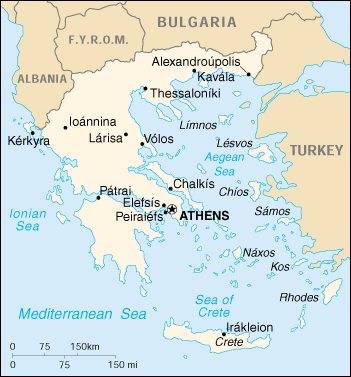
Background: Greece achieved its independence from the Ottoman Empire in 1829. During the second half of the 19th century and the first half of the 20th century, it gradually added neighboring islands and territories with Greek-speaking populations. Following the defeat of communist rebels in 1949, Greece joined NATO in 1952. A military dictatorship, which in 1967 suspended many political liberties and forced the king to flee the country, lasted seven years. Democratic elections in 1974 and a referendum created a parliamentary republic and abolished the monarchy; Greece joined the European Community or EC in 1981 (which became the EU in 1992).
Government type: parliamentary republic; monarchy rejected by referendum 8 December 1974
Capital: Athens
Currency: drachma (GRD); euro (EUR)
Geography of Greece
Location: Southern Europe, bordering the Aegean Sea, Ionian Sea, and the Mediterranean Sea, between Albania and Turkey
Geographic coordinates: 39 00 N, 22 00 E
Area:
total: 131,940 sq. km
land: 130,800 sq. km
water: 1,140 sq. km
Land boundaries:
total: 1,210 km
border countries: Albania 282 km, Bulgaria 494 km, Turkey 206 km, The Former Yugoslav Republic of Macedonia 228 km
Coastline: 13,676 km
Maritime claims:
continental shelf: 200-m depth or to the depth of exploitation
territorial sea: 6 nm
Climate: temperate; mild, wet winters; hot, dry summers
Terrain: mostly mountains with ranges extending into the sea as peninsulas or chains of islands
Elevation extremes:
lowest point: Mediterranean Sea 0 m
highest point: Mount Olympus 2,917 m
Natural resources: bauxite, lignite, magnesite, petroleum, marble, hydropower
Land use:
arable land: 19%
permanent crops: 8%
permanent pastures: 41%
forests and woodland: 20%
other: 12% (1993 est.)
Irrigated land: 13,140 sq. km (1993 est.)
Natural hazards: severe earthquakes
Environment – current issues: air pollution; water pollution
Environment – international agreements:
party to: Air Pollution, Air Pollution-Nitrogen Oxides, Air Pollution-Sulphur 94, Antarctic-Environmental Protocol, Antarctic-Marine Living Resources, Biodiversity, Climate Change, Desertification, Endangered Species, Environmental Modification, Hazardous Wastes, Law of the Sea, Marine Dumping, Nuclear Test Ban, Ozone Layer Protection, Ship Pollution, Tropical Timber 83, Tropical Timber 94, Wetlands
signed, but not ratified: Air Pollution-Persistent Organic Pollutants, Air Pollution-Volatile Organic Compounds, Antarctic Treaty, Climate Change-Kyoto Protocol
Geography – note: strategic location dominating the Aegean Sea and southern approach to Turkish Straits; a peninsular country, possessing an archipelago of about 2,000 islands.
People of Greece
Greece was inhabited as early as the Paleolithic period and by 3000 BC had become home, in the Cycladic Islands, to a culture whose art remains among the most evocative in world history. In the second millennium BC, the island of Crete nurtured the maritime empire of the Minoans, whose trade reached from Egypt to Sicily. The Minoans were supplanted by the Mycenaeans of the Greek mainland, who spoke a dialect of ancient Greek. During the Roman, Byzantine, and Ottoman Empires (1st-19th centuries), Greece’s ethnic composition became more diverse. Since independence in 1830 and an exchange of populations with Turkey in 1923, Greece has forged a national state which claims roots reaching back 3,000 years. The Greek language dates back at least 3,500 years, and modern Greek preserves many elements of its classical predecessor.
Education
Greek education is free and compulsory for children between the ages of 6 and 15. English language study is compulsory from 4th grade through high school. University education, including books, also is free, contingent upon the student’s ability to meet stiff entrance requirements. Overall responsibility for education rests with the Ministry of National Education and Religious Affairs. Private primary and secondary schools are under the authority of the Ministry of National Education. Control is mainly exercised in matters of curriculum and competence of teaching staff, as well as financial control in connection with fee collection and increases in fees. The Greek constitution does not permit the operation of private universities in Greece. Private colleges and universities (mostly foreign), however, do have campuses in Greece in spite of the fact that their degrees are not recognized by the Greek state.
Religion
Eastern Orthodox Christianity is the dominant religion in Greece and receives state funding. During the centuries of Ottoman domination, the Greek Orthodox Church preserved the Greek language and cultural identity and was an important rallying point in the struggle for independence. There is a Muslim religious minority concentrated in Thrace. Smaller religious communities in Greece include Old Calendar Orthodox, Catholics, Protestants, Jews, Jehovah’s Witnesses, and Mormons.
Media
The Greek media constitute a very influential institution–usually aggressive, sensationalist, and frequently irresponsible with regard to content. Objectivity as known to the U.S. media on the whole does not exist in the Greek media. Most of the media are owned by businessmen with extensive commercial interests in other sectors of the economy. They use their newspapers, magazines, and radio and TV channels to promote their commercial enterprises as well as to seek political influence.
Population: 10,668,354 (July 2005 est.)
Age structure:
0-14 years: 14.98%
15-64 years: 67.3%
65 years and over: 17.72%
Population growth rate: 0.21%
Birth rate: 9.83 births/1,000 population
Death rate: 9.73 deaths/1,000 population
Net migration rate: 1.96 migrant(s)/1,000 population
Infant mortality rate: 6.38 deaths/1,000 live births
Life expectancy at birth:
total population: 78.59 years
male: 76.03 years
female: 81.32 years
Total fertility rate: 1.33 children born/woman
Nationality:
noun: Greek(s)
adjective: Greek
Ethnic groups: Greek 98%, other 2%
note: the Greek Government states there are no ethnic divisions in Greece
Religions: Greek Orthodox 98%, Muslim 1.3%, other 0.7%
Languages: Greek 99% (official), English, French
Literacy:
definition: age 15 and over can read and write
total population: 95%
male: 98%
female: 93% (1991 est.)
History of Greece
The Greek War of Independence began in 1821 and concluded in 1830 when England, France, and Russia forced the Ottoman Empire to grant Greece its independence under a European monarch, Bavarian prince Otto. He was deposed 30 years later, and the Great Powers chose a prince of the Danish House of Glucksberg as his successor. He became George I, King of the Hellenes.
At independence, Greece had an area of 47,515 square kilometers (18,346 square mi.), and its northern boundary extended from the Gulf of Volos to the Gulf of Arta. Under the influence of the “Meagali Idea,” of expanding the Greek state to include all areas of Greek population, Greece aquired the Ionian Islands in 1864; Thessaly and part of Epirus in 1881; Macedonia, Crete, Epirus, and the Aegean Islands in 1913; Western Thrace in 1918; and the Dodecanese Islands in 1947.
Greece entered World War I in 1917 on the side of the Allies. After the war, Greece took part in the Allied occupation of Turkey, where many Greeks still lived. In 1921, the Greek army marched toward Ankara but was defeated by Turkish forces led by Mustafa Kemal (later Ataturk) and forced to withdraw. In a forced exchange of populations, more than 1.3 million Christian refugees from Turkey poured into Greece, creating enormous challenges for the Greek economy and society.
Greek politics, particularly between the two World Wars, involved a struggle for power between monarchists and republicans. Greece was proclaimed a republic in 1924, but George II returned to the throne in 1935. A plebiscite in 1946 upheld the monarchy, which was finally abolished by referendum on December 8, 1974.
Greece’s entry into World War II was precipitated by the Italian invasion on October 28, 1940. Despite Italian superiority in numbers and equipment, determined Greek defenders drove the invaders back into Albania. Hitler was forced to divert German troops to protect his southern flank and overran Greece in 1941. German forces withdrew in October 1944, and the government in exile returned to Athens.
After the German withdrawal, the principal Greek resistance movement, which was controlled by the communists, refused to disarm. A banned demonstration by resistance forces in Athens in December 1944 ended in battles with Greek Government and British forces. Continuing tensions led to the outbreak of full-fledged civil war in 1946. First the United Kingdom and later the United States gave extensive military and economic aid to the Greek Government. In 1947, Secretary of State George C. Marshall implemented the Marshall Plan under President Truman, which focused on the economic recovery and the rebuilding of Europe. The U.S. contributed millions of dollars to rebuilding Greece in terms of buildings, agriculture, and industry.
In August 1949, the national army forced the remaining insurgents to surrender or flee to Greece’s communist neighbors. The insurgency resulted in 100,000 killed, 700,000 displaced persons inside the country, and catastrophic economic disruption. This civil war left deep political division in Greek society between leftist and rightest.
Greece became a member of NATO in 1952. From 1952 to late 1963, Greece was governed by conservative parties–the Greek Rally of Marshal Alexandros Papagos and its successor, the National Radical Union (ERE) of Constantine Karamanlis. In 1963, the Center Union Party of George Papandreou was elected and governed until July 1965. It was followed by a succession of unstable coalition governments.
On April 21, 1967, just before scheduled elections, a group of colonels led by Col. George Papadopoulos seized power in a coup d’etat. Civil liberties were suppressed, special military courts were established, and political parties were dissolved. Several thousand political opponents were imprisoned or exiled to remote Greek islands. In November 1973, following an uprising of students at the Athens Polytechnic University, Gen. Dimitrios Ioannides replaced Papadopoulos and tried to continue the dictatorship.
Gen. Ioannides’ attempt in July 1974 to overthrow Archbishop Makarios, the President of Cyprus, brought Greece to the brink of war with Turkey, which invaded Cyprus and occupied part of the island. Senior Greek military officers then withdrew their support from the junta, which toppled. Leading citizens persuaded Karamanlis to return from exile in France to establish a government of national unity until elections could be held. Karamanlis’ newly organized party, New Democracy (ND), won elections held in November 1974, and he became Prime Minister.
Following the 1974 referendum, which resulted in the rejection of the monarchy, a new constitution was approved by parliament on June 19, 1975, and parliament elected Constantine Tsatsos as president of the republic. In the parliamentary elections of 1977, New Democracy again won a majority of seats. In May 1980, Prime Minister Karamanlis was elected to succeed Tsatsos as president. George Rallis was then chosen party leader and succeeded Karamanlis as Prime Minister.
On January 1, 1981, Greece became the 10th member of the European Community (now the European Union). In parliamentary elections held on October 18, 1981, Greece elected its first socialist government when the Panhellenic Socialist Movement (PASOK), led by Andreas Papandreou, won 172 of 300 seats. In 1985, Supreme Court Justice Christos Sartzetakis was elected president by the Greek parliament.
Greece had two rounds of parliamentary elections in 1989; both produced weak coalition governments with limited mandates. In the April 1990 election, ND won 150 seats and subsequently gained 2 others. After Mitsotakis fired his Foreign Minister, Andonis Samaras in 1992, the rift led to the collapse of the ND government and new elections in September 1993 won again by Andreas Papandreou’s PASOK.
On January 17, 1996, following a protracted illness, Prime Minister Papandreou resigned and was replaced as Prime Minister by former Minister of Industry Constantine Simitis. In elections held in September 1996, Constantine Simitis was elected Prime Minister. In April 2000, Simitis and PASOK won again by a narrow margin, gaining 158 seats to ND’s 125. New elections must be held no later than spring 2004.
Greece Economy
The government has succeeded in reducing budget deficits and inflation, two key factors that allowed Greece to join the Economic and Monetary Union (EMU) on January 1, 2001. On January 1, 2002, Greece, along with 11 out of its 14 EU partners, adopted the euro as its new common currency. The euro is expected to boost trade, help dismantle the last remaining market barriers within the EU, and stimulate production.
The Greek economy is expected to grow 3.5% in 2002 and continue at robust rates above projected EU averages. Years of austerity and reform programs, however, have increased unemployment in some sectors. Foreign investment has also dropped and efforts to revive it have been only partially successful. Greece’s large general government debt is projected to drop to 99% of GDP ($135 billion euros) in 2002. Many structural problems persist and privatization of the telecommunications, banking, aerospace, and energy sectors has not moved at the pace originally proposed.
Services make up the largest and fastest-growing sector of the Greek economy. Tourism is a major source of foreign exchange earnings, although the industry has been slow to expand and suffers from poor infrastructure. About 12 million tourists visited Greece in 2001 with net revenues exceeding five billion euros. Industrial activity posted increases for the seventh year in a row, rising by 6.1% in 2000. Greece’s food industry is expanding rapidly to support new markets in neighboring countries. High-technology equipment production, especially for telecommunications, is also a fast-growing sector. Agriculture employs about 15% of the work force and is still characterized by small farms and low capital investment, despite significant support from the EU in structural funds and subsidies. Traditionally, a seafaring nation, the Greek merchant fleet totaled 5,101 ships in 2000, with 1850 registered under the Greek flag.
EU Membership
Greece has realigned its economy as part of an extended transition to full EU membership that began in 1981. Greece will assume the rotating EU presidency in the first half of 2003. Greek businesses continue to adjust to competition from EU firms and the government has had to liberalize its economic and commercial regulations and practices. Greece has been granted waivers from certain aspects of the EU’s 1992 single market program.
Greece has been a net beneficiary of the EU budget; in 2001 EU transfers accounted for 3.4% of GDP. From 1994-99, about $20 billion in EU structural funds were spent on projects to modernize and develop Greece’s transportation network in time for the Olympics in 2004. The centerpiece was the construction of the new international airport near Athens, which opened in March 2001 soon after the launch of the new Athens subway system.
EU transfers to Greece are to phase out over the next decade, when the last of some $24 billion in structural funds are disbursed by 2006. These funds contribute significantly to Greece’s current accounts balance and further reduce the state budget deficit. In addition, EU funds will continue to finance major public works and economic development projects, upgrade competitiveness and human resources, improve living conditions, and address disparities between poorer and more developed regions of the country.
GDP: purchasing power parity – $181.9 billion (2000 est.)
GDP – real growth rate: 3.8% (2000 est.)
GDP – per capita: purchasing power parity – $17,200 (2000 est.)
GDP – composition by sector:
agriculture: 8.3%
industry: 27.3%
services: 64.4% (1998)
Household income or consumption by percentage share:
lowest 10%: 3%
highest 10%: 25.3% (1993 est.)
Inflation rate (consumer prices): 3.1% (2000 est.)
Labor force: 4.32 million (1999 est.)
Labor force – by occupation: industry 21%, agriculture 20%, services 59% (2000 est.)
Unemployment rate: 11.3% (2000 est.)
Budget:
revenues: $45 billion
expenditures: $47.6 billion (1998 est.)
Industries: tourism; food and tobacco processing, textiles; chemicals, metal products; mining, petroleum
Industrial production growth rate: 7% (2000 est.)
Electricity – production: 46.432 billion kWh (1999)
Electricity – production by source:
fossil fuel: 89.6%
hydro: 9.72%
nuclear: 0%
other: 0.68% (1999)
Agriculture – products: wheat, corn, barley, sugar beets, olives, tomatoes, wine, tobacco, potatoes; beef, dairy products
Exports: $15.8 billion (f.o.b., 2000)
Exports – commodities: manufactured goods, food and beverages, petroleum products
Exports – partners: EU 49% (Germany 15%, Italy 13%, UK 6%), US 6% (1999)
Imports: $33.9 billion (c.i.f., 2000)
Imports – commodities: manufactured goods, foodstuffs, fuels, chemicals
Imports – partners: EU 66% (Italy 15%, Germany 15%, France 9%, UK 6%) (1999)
Debt – external: $57 billion (2000 est.)
Economic aid – recipient: $5.4 billion from EU (1997 est.)
Currency: euro (EUR)
Map of Greece