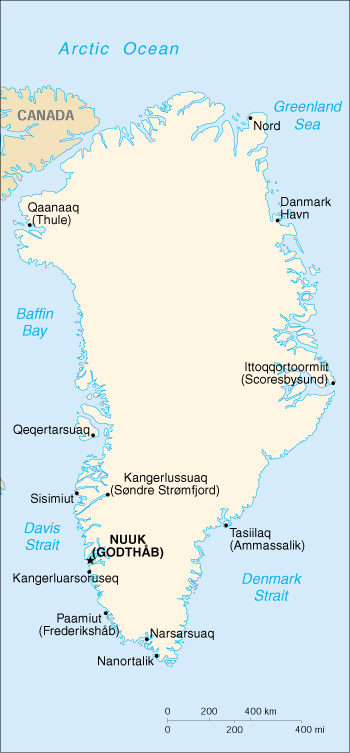
Background: The world’s largest island, about 84% ice-capped, Greenland was granted self-government in 1978 by the Danish parliament. The law went into effect the following year. Denmark continues to exercise control of Greenland’s foreign affairs.
Government type: parliamentary democracy within a constitutional monarchy
Capital: Nuuk (Godthab)
Currency: 1 Danish krone (DKr) = 100 oere
Geography of Greenland
Location: Northern North America, island between the Arctic Ocean and the North Atlantic Ocean, northeast of Canada
Geographic coordinates: 72 00 N, 40 00 W
Area:
total: 2,175,600 sq. km
land: 2,175,600 sq. km (341,700 sq. km ice-free, 1,833,900 sq. km ice-covered) (est.)
Land boundaries: 0 km
Coastline: 44,087 km
Maritime claims:
exclusive fishing zone: 200 nm
territorial sea: 3 nm
Climate: arctic to subarctic; cool summers, cold winters
Terrain: flat to gradually sloping icecap covers all but a narrow, mountainous, barren, rocky coast
Elevation extremes:
lowest point: Atlantic Ocean 0 m
highest point: Gunnbjorn 3,700 m
Natural resources: zinc, lead, iron ore, coal, molybdenum, gold, platinum, uranium, fish, seals, whales
Land use:
arable land: 0%
permanent crops: 0%
permanent pastures: 1%
forests and woodland: 0%
other: 99% (1993 est.)
Natural hazards: continuous permafrost over northern two-thirds of the island
Environment – current issues: protection of the arctic environment; preservation of the Inuit traditional way of life, including whaling and seal hunting
Geography – note: dominates North Atlantic Ocean between North America and Europe; sparse population confined to small settlements along coast; world’s second largest ice cap
People of Greenland
Population: 56,375 (July 2005 est.)
Age structure:
0-14 years: 26.69%
15-64 years: 67.87%
65 years and over: 5.44%
Population growth rate: 0.06%
Birth rate: 16.52 births/1,000 population
Death rate: 7.58 deaths/1,000 population
Net migration rate: -8.38 migrant(s)/1,000 population
Infant mortality rate: 17.77 deaths/1,000 live births
Life expectancy at birth:
total population: 68.37 years
male: 64.82 years
female: 72.01 years
Total fertility rate: 2.44 children born/woman
Nationality:
noun: Greenlander(s)
adjective: Greenlandic
Ethnic groups: Greenlander 88% (Inuit and Greenland-born whites), Danish and others 12%
Religions: Evangelical Lutheran
Languages: Greenlandic (East Inuit), Danish, English
Literacy: similar to Denmark
Greenland Economy
Economy – overview: The economy remains critically dependent on exports of fish and substantial support from the Danish Government, which supplies about half of government revenues. The public sector, including publicly owned enterprises and the municipalities, plays the dominant role in the economy. Despite several interesting hydrocarbon and minerals exploration activities, it will take several years before production can materialize. Tourism is the only sector offering any near-term potential, and even this is limited due to a short season and high costs.
GDP: purchasing power parity – $1.1 billion (2000 est.)
GDP – real growth rate: 0.6% (1997 est.)
GDP – per capita: purchasing power parity – $20,000 (2000 est.)
Inflation rate (consumer prices): 1.6% (1999 est.)
Labor force: 24,500 (1999 est.)
Unemployment rate: 7% (1999 est.)
Budget:
revenues: $646 million
expenditures: $629 million, including capital expenditures of $85 million (1999)
Industries: fish processing (mainly shrimp), handicrafts, furs, small shipyards
Electricity – production: 250 million kWh (1999)
Electricity – production by source:
fossil fuel: 41%
hydro: 59%
nuclear: 0%
other: 0%
note: Greenland is shifting its electricity production from fossil fuel to hydroelectric power production (1999)
Agriculture – products: forage crops, garden vegetables; sheep, reindeer; fish
Exports: $276 million (f.o.b., 1999)
Exports – commodities: fish and fish products 94%
Exports – partners: EU (mainly Denmark) 85%, Japan 8%, US 2% (1999)
Imports: $400 million (c.i.f., 1999)
Imports – commodities: machinery and transport equipment, manufactured goods, food and live animals, petroleum products
Imports – partners: EU (mostly Denmark), Norway, US, Canada
Debt – external: $25 million (1999)
Economic aid – recipient: $380 million subsidy from Denmark (1999)
Currency: Danish krone (DKK)
Map of Greenland